Louisiana Anthology
Francis Hobart Herrick.
Audubon the Naturalist. Volume I.
AUDUBON
THE
NATURALIST
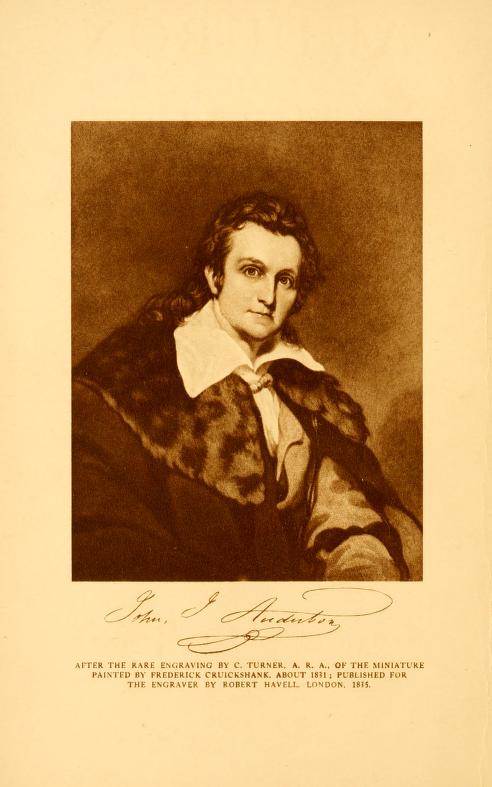
John J. Audubon
AFTER THE RARE ENGRAVING BY C. TURNER, A.R.A., OF THE MINIATURE
PAINTED BY FREDERICK CRUIKSHANK, ABOUT 1831; PUBLISHED FOR
THE ENGRAVER BY ROBERT HAVELL, LONDON, 1835.
AUDUBON
THE
NATURALIST
A History of His Life and Time
By
FRANCIS HOBART HERRICK, Ph.D., Sc.D.
Professor Emeritus of Biology in Western Reserve University,
Author of “The American Eagle,” “Wild Birds at Home,” etc.
illustrated

two volumes
volume one
D. APPLETON-CENTURY COMPANY
incorporated
NEW YORK
LONDON
1917
vii
The origin of the gifted ornithologist, animal painter, and
writer, known to the world as John James Audubon, has remained
a mystery up to the present time. In now lifting the
veil which was cast over his early existence, I feel that I serve
the cause of historical truth; at the same time it is possible
to do fuller justice to all most intimately concerned with the
story of his life and accomplishments.
The present work is in reality the outcome of what was first
undertaken as a holiday recreation in the summer of 1903.
While engaged upon a research of quite a different character,
I reread, with greater care, Audubon’s Ornithological Biography,
and after turning the leaves of his extraordinary illustrations,
it seemed to me most strange that but little should be
known of the making of so original and masterful a character.
As I was in England at the time some investigations were
undertaken in London, but, as might have been expected, with
rather barren results. After my return to America in the
following year the search was continued, but as it proved
equally fruitless here, the subject was set aside. Not until
1913, when this investigation was resumed in France, did I
meet with success.
Every man, however poor or inconsequential he may appear
or be, is supposed to possess an estate, and every man
of affairs is almost certain to leave behind him domestic, professional,
or commercial papers, which are, in some degree, a
mark of his attainments and an indication of his character
and tastes. In the summer of 1913 I went to France in
search of the personal records of the naturalist’s father, Lieutenant
Jean Audubon, whose home had been at Nantes and in
the little commune of Couëron, nine miles below that city, on
viii
the right bank of the Loire. The part which Lieutenant
Audubon played in the French Revolution was fully revealed
in his letters, his reports to the Central Committee, and numerous
other documents which are preserved in the archives
of the Préfecture at Nantes; while complete records of his
naval career both in the merchant marine and governmental service
(service pour l’État) were subsequently obtained at Paris;
but at Nantes his name had all but vanished, and little could
be learned of his immediate family, which had been nearly
extinct in France for over thirty years.
Again the quest seemed likely to prove futile until a letter,
which I received through the kindness of Mr. Louis Goldschmidt,
then American Consul at Nantes, to M. Giraud
Gangie, conservateur of the public library in that city,
brought a response, under date of December 29, 1913, informing
me that two years before that time, he had met by
chance in the streets of Couëron a retired notary who assured
him that he held in possession numerous exact records of Jean
Audubon and his family. The sage Henry Thoreau once remarked
that you might search long and diligently for a rare
bird, and then of a sudden surprise the whole family at dinner.
So it happened in this case, and since these manuscript records,
sought by many in vain on this side of the Atlantic, are so
important for this history, the reader is entitled to an account
of them.
Upon corresponding with the gentleman in question, M. L.
Lavigne, I was informed that the documents in his possession
were of the most varied description, comprising letters, wills,
deeds, certificates of births, baptisms, adoptions, marriages
and deaths, to the number, it is believed, of several hundred
pieces. This unique and extraordinary collection of Audubonian
records had been slumbering in a house in the commune of
Couëron called “Les Tourterelles” (“The Turtle Doves”) for
nearly a hundred years, or since the death of the naturalist’s
stepmother in 1821.
Since I was unable to judge of the authenticity of the
documents or to visit France at that time, my friend, Professor
ix
Gustav G. Laubscher, who happened to be in Paris,
engaged in investigating Romance literary subjects, kindly
consented to go to Couëron for the purpose of inspecting them.
Monsieur Lavigne had already prepared for me, and still held,
a number of photographs of the most important manuscripts,
which are now for the first time reproduced, and, with the
aid of a stenographer, in the course of two or three days they
were able to transcribe the most essential and interesting parts
of this voluminous material. But at that very moment sinister
clouds were blackening the skies of Europe, and my friend
was obliged to leave his task unfinished and hasten to Paris;
when he arrived in that city, on the memorable Saturday of
August 1, 1914, orders for the mobilization of troops had
been posted; it was some time before copies of the manuscripts
were received from Couëron, and he left the French capital
to return to America.
These documents came into the hands of Monsieur Lavigne
through his wife, who was a daughter and legatee of Gabriel
Loyen du Puigaudeau, the second, son of Gabriel Loyen du
Puigaudeau, the son-in-law of Lieutenant and Mme. Jean Audubon.
Gabriel Loyen du Puigaudeau, the second, who died at
Couëron in 1892, is thought to have destroyed all letters of the
naturalist which had been in possession of the family and
which were written previous to 1820, when his relations with
the elder Du Puigaudeau were broken off; not a line in the
handwriting of John James Audubon has been preserved at
Couëron.
In June and July, 1914, Dr. Laubscher had repeatedly
applied to the French Foreign Office, through the American
Embassy at Paris, for permission to examine the dossier of
Jean Audubon in the archives of the Department of the
Marine, in order to verify certain dates in his naval career
and to obtain the personal reports which he submitted upon
his numerous battles at sea, but at that period of strain it
was impossible to gain further access to the papers sought.
Having told the story of the way in which these unique
and important records came into my possession, I wish to express
x
my gratitude to Professor Laubscher for his able cooperation
in securing transcriptions and photographs, and to
Monsieur Lavigne for his kind permission to use them, as well
as for his careful response to numerous questions which arose
in the course of the investigation.
In dealing with letters and documents, of whatever kind,
in manuscript, I have made it my invariable rule to reproduce
the form and substance of the record as it exists as exactly
as possible; in translations, however, no attempt has been
made to preserve any minor idiosyncrasies of the writer. The
source of all scientific, literary or historical material previously
published is indicated in footnotes, and the reader will find
copious references to hitherto unpublished documents, which
in their complete and original form, with or without translations,
together with an annotated Bibliography, have been
gathered in Appendices at the end of Volume II. For convenience
of reference each chapter has been treated as a unit
so far as the footnotes are concerned, and the quoted author’s
name, with the title of his work in addition to the bibliographic
number, has been given in nearly every instance.
Besides the many coadjutors whose friendly aid has been
gladly acknowledged in the body of this work, I now wish to
offer my sincere thanks, in particular, to the Misses Maria
R. and Florence Audubon, granddaughters of the naturalist,
who have shown me many courtesies, and to the Hon. Myron
T. Herrick, late American Ambassador to France, for his
kindly assistance in obtaining documentary transcripts from
the Department of the Marine at Paris. I am under special
obligations also to the librarians of the British Museum and Oxford
University, the Linnæan and Zoölogical Societies of London,
the Jardin des Plantes at Paris, the Public Libraries of
Boston and New York, and the libraries of the Historical Societies
of New York, Philadelphia, Boston and Louisiana, as
well as to the Director of the Museum of Comparative Zoölogy
of Harvard University, and to the American Museum of
Natural History in New York City, for photographs of paintings
and other objects, for permission to read or copy manuscripts,
xi
and for favors of various sorts. Furthermore, I am
indebted to the good offices of Mr. Ferdinand Lathrop Mayer,
Secretary of Legation, Port-au-Prince, and of M. Fontaine,
American Consular Agent at Les Cayes, Haiti, for a series
of photographs made expressly to represent Les Cayes as it
appears today. I would also acknowledge the courtesy of the
Corporation of Trinity Parish, New York, through Mr.
Pendleton Dudley, for an excellent photograph of the Audubon
Monument.
I cannot express too fully my appreciation of the hearty
response which the publishers of these volumes have given to
every question concerned with their presentation in an adequate
and attractive form, and particularly to Mr. Francis
G. Wickware, of D. Appleton and Company, to whose knowledge,
skill, and unabated interest the reader, like myself, is indebted
in manifold ways.
My friend, Mr. Ruthven Deane, well known for his investigations
in Auduboniana and American ornithological literature,
has not only read the proofs of the text, but has generously
placed at my disposal many valuable notes, references,
pictures, letters and other documents, drawn from his own
researches and valuable personal collections. I wish to
express in the most particular manner also my appreciation
of the generous spirit in which Mr. Joseph
Y. Jeanes has opened the treasures in his possession,
embracing not only large numbers of hitherto unpublished
letters, but an unrivaled collection of early unpublished Audubonian
drawings, for the enrichment and embellishment of
these pages. For the loan or transcription of other original
manuscript material, or for supplying much needed data of
every description, I am further most indebted to Mr. Welton
H. Rozier, of St. Louis; Mr. Tom J. Rozier, of Ste. Geneviève;
Mr. C. A. Rozier, of St. Louis; the Secretary of the Linnæan
Society of London, through my friend, Mr. George E. Bullen,
of St. Albans; Mr. Henry R. Rowland of the Buffalo Society
of Natural Sciences, of Buffalo; Mr. William Beer, of
the Howard Memorial Library, of New Orleans; and Mr. W.
xii
H. Wetherill, of Philadelphia. For the use of new photographic
and other illustrative material, I am further indebted
to Mr. Stanley Clisby Arthur, of the Conservation Commission
of Louisiana, and to Cassinia, the medium of publication
of the Delaware Valley Ornithological Club.
Through the kindness of Messrs. Charles Scribner’s Sons
I have been permitted to draw rather freely from Audubon
and His Journals, by Miss Maria R. Audubon and Elliott
Coues, and to reproduce three portraits therefrom; original
photographs of two of these have been kindly supplied by Dr.
R. W. Shufeldt. I also owe to the courtesy of the Girard
Trust Company, of Philadelphia, the privilege of quoting certain
letters contained in William Healey Dall’s Spencer Fullerton
Baird.
To my esteemed colleague, Professor Benjamin P. Bourland,
I am under particular obligations for his invaluable aid
in revising translations from the French and in the transliteration
of manuscripts, as well as for his kindly assistance in
correspondence on related subjects. I have derived much
benefit also from my sister, Miss Elizabeth A. Herrick, who
has made many valuable suggestions. To all others who have
aided me by will or deed in the course of this work I wish to
express my cordial thanks.
Francis H. Herrick.
Western Reserve University,
Cleveland.
July 2, 1917.
xiii
TABLE OF CONTENTS
|
PAGE |
| Preface |
vii |
| Chronology |
xxv |
| CHAPTER I |
|
Introduction
|
|
Audubon’s growing fame — Experience in Paris in 1828 — Cuvier’s patronage — Audubon’s
publications — His critics — His talents and accomplishments — His
Americanism and honesty of purpose — His foibles
and faults — Appreciations and monuments — The Audubon Societies — Biographies
and autobiography — Robert Buchanan and the true
history of his Life of Audubon
|
1 |
CHAPTER II |
| Jean Audubon and His Family |
| Extraordinary career of the naturalist’s father — Wounded at fourteen
and prisoner of war for five years in England — Service in the
French merchant marine and navy — Voyages to Newfoundland and
Santo Domingo — His marriage in France — His sea fights, capture
and imprisonment in New York — His command at the Battle of
Yorktown — Service in America and encounters with British privateers |
24 |
CHAPTER III |
| Jean Audubon as Santo Domingo Planter and Merchant |
| Captain Audubon at Les Cayes — As planter, sugar refiner, general
merchant and slave dealer, amasses a fortune — His return to
France with his children — History of the Santo Domingo revolt — Baron
de Wimpffen’s experience — Revolution of the whites — Opposition
of the abolitionists — Effect of the Declaration of Rights
on the mulattoes — The General Assembly drafts a new constitution — First
blood drawn between revolutionists and loyalists at Port-au-Prince — Ogé’s
xiv
futile attempt to liberate the mulattoes — Les
Cayes first touched by revolution in 1790, four years after the death
of Audubon’s mother — Emancipation of the mulattoes — Resistance
of the whites — General revolt of blacks against whites and the
ruin of the colony |
36 |
CHAPTER IV |
| Audubon’s Birth, Nationality, and Parentage |
| Les Cayes — Audubon’s French Creole mother — His early names — Discovery
of the Sanson bill with the only record of his birth — Medical
practice of an early day — Birth of Muguet, Audubon’s sister — Fougère
and Muguet taken to France — Audubon’s adoption and
baptism — His assumed name — Dual personality in legal documents — Source
of published errors — Autobiographic records — Rise of
enigma and tradition — The Marigny myth |
52 |
CHAPTER V |
| Lieutenant Audubon as Revolutionist |
| Background of Audubon’s youth — Nantes in Revolution — Revolt in La
Vendée — Siege of Nantes — Reign of terror under Carrier — Plague
robbing the guillotine — Flight of the population — Execution of
Charette — The Chouan raid — Citizen Audubon’s service — He reenters
the navy and takes a prize from the English — His subsequent
naval career — His losses in Santo Domingo — His service and
rank — Retires on a pension — His death — His character and appearance |
73 |
CHAPTER VI |
| School Days in France |
| Molding of Audubon’s character — Factor of environment — Turning failure
into success — An indulgent step-mother — The truant — His love
of nature — Early drawings and discipline — Experience at Rochefort — Baptized
in the Roman Catholic Church |
90 |
CHAPTER VII |
| First Visit to the United States, and Life at
“Mill Grove” |
| Audubon is sent to the United States to learn English and enter trade — Taken
ill — Befriended by the Quakers — Settles at “Mill Grove”
xv
farm — Its history and attractions — Studies of American birds begun — Engagement
to Lucy Bakewell — Sports and festivities |
98 |
CHAPTER VIII |
| Dacosta and the “Mill Grove” Mine |
| Advent of a new agent at “Mill Grove” — Dacosta becomes guardian
to young Audubon and exploits a neglected lead mine on the farm — Correspondence
of Lieutenant Audubon and Dacosta — Quarrel
with Dacosta — Audubon’s return to France |
113 |
CHAPTER IX |
| Audubon’s Last Visit to his Home in France |
| Life at Couëron — Friendship of D’Orbigny — Drawings of French birds — D’Orbigny’s
troubles — Marriage of Rosa Audubon — The Du Puigaudeaus — Partnership
with Ferdinand Rozier — Their Articles of
Association — They sail from Nantes, are overhauled by British
privateers, but land safely at New York — Settle at “Mill Grove” |
127 |
CHAPTER X |
| “La Gerbetière” of Yesterday and Today |
| Home of Audubon’s youth at Couëron — Its situation on the Loire — History
of the villa and commune — Changes of a century |
136 |
CHAPTER XI |
| First Ventures in Business at New York, and Sequel to
the “Mill Grove” Mine |
| Audubon and Rosier at “Mill Grove” — Their partnership rules — Attempts
to form a mining company lead to disappointment — Decision
to sell their remaining interests in “Mill Grove” to Dacosta — Division
of the property and legal entanglements — Audubon as a
clerk in New York — Business correspondence and letters to his
father — Later history of the lead mine and Dacosta —
xvi Audubon
continues his drawings in New York and works for Dr. Mitchell’s
Museum — Forsakes the counting-room for the fields — Personal
sketch |
146
|
CHAPTER XII |
| Early Drawings in France and America |
| Child and man — His ideals, perseverance and progress — Study under
David at Paris — David’s pupils and studios — David at Nantes
arouses the enthusiasm of its citizens — His part in the Revolution — His
art and influence over Audubon — Audubon’s drawings of
French birds — Story of the Edward Harris collection — The Birds
of America in the bud — Audubon’s originality, style, methods, and
mastery of materials and technique — His problem and how he
solved it — His artistic defects |
173 |
CHAPTER XIII |
| Audubon’s Marriage and Settlement in the West |
| Audubon and Rozier decide to start a pioneer store at Louisville,
Kentucky — Their purchase of goods in New York — “Westward
Ho” with Rozier — Rozier’s diary of the journey — An unfortunate
investment in indigo — Effect of the Embargo Act — Marriage to
Lucy Bakewell — Return to Louisville — Life on the Ohio — Depression
of trade — William Bakewell’s assistance — Audubon’s eldest son
born at the “Indian Queen” — The Bakewells — Life at Louisville |
186 |
CHAPTER XIV |
| A Meeting of Rivals, and Sketch of Another Pioneer |
| Alexander Wilson and his American Ornithology — His canvassing tour
of 1810 — His retort to a Solomon of the bench — Descriptions of
Pittsburgh, Cincinnati and Louisville — Meeting with Audubon — Journey
to New Orleans — Youth in Scotland — Weaver, itinerant
peddler, poet and socialist — Sent to jail for libel — Emigrates to the
United States — Finally settles as a school teacher near Philadelphia — His
friendships with Bartram and Lawson — Disappointments
in love — Early studies of American birds — His drawings,
thrift, talents and genius — Publication of his Ornithology —
xvii
His
travels, discouragements and success — His premature death — Conflicting
accounts of the visit to Audubon given by the two naturalists — Rivalry
between the friends of Wilson, dead, and those of
Audubon, living — The controversy which followed — An evasive
“Flycatcher” — Singular history of the Mississippi Kite plate |
202
|
CHAPTER XV |
| Experiments in Trade on the Frontier |
| The Ohio a hundred years ago — Hardships of the pioneer trader — Audubon’s
long journeys by overland trail or river to buy goods — The “ark”
and keelboat — Chief pleasures of the naturalist at Louisville — The
partners move their goods by flatboat to Henderson,
Kentucky, and then to Ste. Geneviève (Missouri) — Held up by the
ice — Adventures with the Indians — Mississippi in flood — Camp at
the Great Bend — Abundance of game — Breaking up of the ice — Settle
at Ste. Geneviève — The partnership dissolved — Audubon’s
return to Henderson — Rozier’s successful career — His old store at
Ste. Geneviève |
233 |
CHAPTER XVI |
| Audubon’s Mill and Final Reverses in Business |
| Dr. Rankin’s “Meadow Brook Farm” — Birth of John Woodhouse Audubon — The
Audubon-Bakewell partnership — Meeting with Nolte — Failure
of the commission business — Visit to Rozier — Storekeeping
at Henderson — Purchases of land — Habits of frontier tradesmen — Steamboats
on the Ohio — Popular pastimes — Audubon-Bakewell-Pears
partnership — Their famous steam mill — Mechanical and financial troubles — Business
reorganization — Bankruptcy general — Failure
of the mill — Personal encounter — Audubon goes to jail for
debt |
247 |
CHAPTER XVII |
| The Enigma of Audubon’s Life and the History of His
Family in France |
| Death of Lieutenant Audubon — Contest over his will — Disposition of
his estate — The fictitious $17,000 — Unsettled claims of Formon and
Ross — Illusions of biographers — Gabriel Loyen du Puigaudeau — Audubon’s
relations with the family in France broken — Death of
the naturalist’s stepmother — The Du Puigaudeaus — Sources of
“enigma.” |
262 |
CHAPTER XVIII |
| Early Episodes of Western Life |
| Methods of composition — “A Wild Horse” — Henderson to Philadelphia
in 1811 — Records of Audubon and Nolte, fellow travelers, compared — The
xviii
great earthquakes — The hurricane — The outlaw — Characterization
of Daniel Boone — Desperate plight on the prairie — Regulator
law in action — Frontier necessities — The ax married to
the grindstone |
273 |
CHAPTER XIX |
| Audubon and Rafinesque |
| The “Eccentric Naturalist” at Henderson — Bats and new species — The
demolished violin — “M. de T.”: Constantine Samuel Rafinesque
(Schmaltz) — His precocity, linguistic acquirements and peripatetic
habits — First visit to America and botanical studies — Residence in
Sicily, and fortune made in the drug trade — Association with
Swainson — Marriage and embitterment — His second journey to
America ends in shipwreck — Befriended — Descends Ohio in a flat-boat — Visit
with Audubon, who gives him many strange “new
species” — Cost to zoölogy — His unique work on Ohio fishes — Professorship
in Transylvania University — Quarrel with its president and
trustees — Return to Philadelphia — His ardent love of nature; his
writings, and fatal versatility — His singular will — His sad end and
the ruthless disposition of his estate |
285 |
CHAPTER XX |
| Audubon’s Æneid, 1819-1824: Wanderings Through the
West and South |
|
Pivotal period in Audubon’s career — His spur and balance wheel — Resort
to portraiture — Taxidermist in the Western Museum — Settles
in Cincinnati — History of his relations with Dr. Drake — Decides
to make his avocation his business — Journey down the Ohio
and Mississippi with Mason and Cummings — Experiences of travel
without a cent of capital — Life in New Orleans — Vanderlyn’s recommendation — Original
drawings — Chance meeting with Mrs. Pirrie
and engagement as tutor at “Oakley” — Enchantments of West
Feliciana — “My lovely Miss Pirrie” — The jealous doctor — Famous
drawing of the rattlesnake — Leaves St. Francisville and is adrift
again in New Orleans
xix
— Obtains pupils in drawing and is joined
by his family — Impoverished, moves to Natchez, and Mrs. Audubon
becomes a governess — Injuries to his drawings — The labors of
years destroyed by rats — Teaching in Tennessee — Parting with
Mason — First lessons in oils — Mrs. Audubon’s school at “Beechwoods” — Painting
tour fails — Stricken at Natchez — At the Percys’
plantation — Walk to Louisville — Settles at Shippingport
|
301
|
CHAPTER XXI |
| Début as a Naturalist |
| Makes his bow at Philadelphia — Is greeted with plaudits and cold water — Friendship
of Harlan, Sully, Bonaparte and Harris — Hostility of
Ord, Lawson and other friends of Alexander Wilson — A meeting
of academicians — Visit to “Mill Grove” — Exhibits drawings in
New York and becomes a member of the Lyceum — At the Falls
of Niagara — In a gale on Lake Erie — Episode at Meadville — Walk
to Pittsburgh — Tour of Lakes Ontario and Champlain — Decides to
take his drawings to Europe — Descends the Ohio in a skiff — Stranded
at Cincinnati — Teaching at St. Francisville |
327 |
CHAPTER XXII |
| To Europe and Success |
| Audubon sails from New Orleans — Life at sea — Liverpool — The Rathbones — Exhibition
of drawings an immediate success — Personal appearance — Painting
habits resumed — His pictures and methods — Manchester
visited — Plans for publication — The Birds of America — Welcome
at Edinburgh — Lizars engraves the Turkey Cock — In
the rôle of society’s lion — His exhibition described by a French
critic — Honors of science and the arts — Contributions to journals
excite criticism — Aristocratic patrons — Visit to Scott — The Wild
Pigeon and the rattlesnake — Letter to his wife — Prospectus — Journey
to London |
347 |
CHAPTER XXIII |
| Audubon in London |
| Impressions of the metropolis — A trunk full of letters — Friendship of
Children — Sir Thomas Lawrence — Lizars stops work — A family of
artists — Robert Havell, Junior — The Birds of America fly to London — The
Zoölogical Gallery — Crisis in the naturalist’s affairs
xx
— Royal
patronage — Interview with Gallatin — Interesting the Queen — Desertion
of patrons — Painting to independence — Personal habits
and tastes — Enters the Linnæan Society — The white-headed Eagle — Visit
to the great universities — Declines to write for magazines — Audubon-Swainson
correspondence — “Highfield Hall” near Tyttenhanger — In
Paris with Swainson — Glimpses of Cuvier — His report
on The Birds of America — Patronage of the French Government
and the Duke of Orleans — Bonaparte the naturalist |
377
|
CHAPTER XXIV |
| First Visit to America in Search of New Birds |
| Settles for a time in Camden — Paints in a fisherman’s cottage by the
sea — With the lumbermen in the Great Pine Woods — Work done — Visits
his sons — Joins his wife at St. Francisville — Record of journey
south — Life at “Beechgrove” — Mrs. Audubon retires from
teaching — Their plans to return to England — Meeting with President
Jackson and Edward Everett |
420 |
CHAPTER XXV |
| Audubon’s Letterpress and Its Rivals |
| Settlement in London — Starts on canvassing tour with his wife — Change
of plans — In Edinburgh — Discovery of MacGillivray — His
hand in the Ornithological Biography — Rival editions of Wilson
and Bonaparte — Brown’s extraordinary Atlas — Reception of the
Biography — Joseph Bartholomew Kidd and the Ornithological Gallery — In
London again |
437 |
xxxi
ILLUSTRATIONS IN VOLUME I
|
Audubon. After a photograph of a cast of the intaglio cut by John
C. King in 1844. Embossed medallion |
Cover |
|
Audubon. After the engraving by C. Turner, A.R.A., of the miniature
on ivory painted by Frederick Cruikshank about 1831; “London.
Published Jan. 12, 1835, for the Proprietor supposed to
have been the engraver, but may have been Audubon or Havell,
by Robert Havell, Printseller, 77, Oxford Street.” Photogravure |
Frontispiece |
|
page |
|
Statue of Audubon by Edward Virginius Valentine in Audubon Park,
New Orleans |
14 |
|
The Audubon Monument in Trinity Cemetery, New York, on Children’s
Day, June, 1915 |
14 |
|
Les Cayes, Haiti: the wharf and postoffice |
40 |
|
Les Cayes, Haiti: the market and Church of Sacré Cœur |
40 |
|
First page of the bill rendered by Dr. Sanson, of Les Cayes, Santo
Domingo, to Jean Audubon for medical services from December
29, 1783, to October 19, 1785 |
54 |
|
Second page of the Sanson bill, bearing, in the entry for April 26,
1785, the only record known to exist of the date of Audubon’s
birth |
55 |
|
Third page of the Sanson bill, signed as accepted by Jean Audubon,
October 12, 1786, and receipted by the doctor, when paid, June 7,
1787 |
59 |
|
Audubon’s signature at various periods. From early drawings, legal
documents and letters |
63 |
|
Lieutenant Jean Audubon and Anne Moynet Audubon. After portraits
painted between 1801 and 1806, now at Couëron |
78 |
|
Jean Audubon. After a portrait painted by the American artist
Polk, at Philadelphia, about 1789 |
78 |
|
Jean Audubon’s signature. From a report to the Directory of his
Department, when acting as Civil Commissioner, January to September,
1793 |
79 |
|
Certificate of Service which Lieutenant Audubon received upon his
discharge from the French Navy, February 26, 1801 |
84
|
|
“Mill Grove” in 1835 (about). After a water-color painting by Charles
Wetherill |
102 |
|
“Mill Grove,” Audubon, Pennsylvania, as it appears to-day |
102 |
|
“Mill Grove” farmhouse, west front, as it appears to-day |
110 |
|
“Fatland Ford,” Audubon, Pennsylvania, the girlhood home of Lucy
Bakewell Audubon |
110 |
|
Early drawings of French birds, 1805, hitherto unpublished: the male
Reed Bunting (“Sedge Sparrow”), and the male Redstart |
128 |
|
Receipt given by Captain Sammis of the Polly to Audubon and Ferdinand
Rozier for their passage money from Nantes to New York,
May 28, 1806 |
134 |
|
“La Gerbetière,” Jean Audubon’s country villa at Couëron, France, and
the naturalist’s boyhood home |
136 |
|
“La Gerbetière” and Couëron, as seen from the highest point in the
commune, windmill towers on the ridge overlooking Port Launay,
on the Loire |
142 |
|
“La Gerbetière,” as seen when approached from Couëron village by the
road to Port Launay |
142 |
|
Port Launay on the Loire |
142 |
|
Beginning of the “Articles of Association” of John James Audubon
and Ferdinand Rozier, signed at Nantes, March 23, 1806 |
146 |
|
First page of a power of attorney granted by Jean Audubon, Anne
Moynet Audubon and Claude François Rozier to John James Audubon
and Ferdinand Rozier, Nantes, April 4, 1806 |
152 |
|
Signatures of Jean Audubon, Anne Moynet Audubon, Dr. Chapelain
and Dr. Charles d’Orbigny to a power of attorney granted to John
James Audubon and Ferdinand Rozier, Couëron, November 20,
1806 |
153 |
|
Early drawings of French birds, 1805, hitherto unpublished: the European
Crow, with detail of head of the Rook, and the White Wagtail |
174 |
|
Early drawing in crayon point of the groundhog, 1805, hitherto unpublished |
182 |
|
Water-color drawing of a young raccoon, 1841 |
182 |
|
Alexander Wilson |
212 |
|
William Bartram |
212 |
|
The “twin” Mississippi Kites of Wilson and Audubon, the similarity
of which inspired charges of misappropriation against Audubon |
228
|
|
Audubon’s signature to the release given to Ferdinand Rozier on the
dissolution of their partnership in 1811 |
242 |
|
Ferdinand Rozier in his eighty-fifth year (1862) |
246 |
|
Rozier’s old store at Ste. Geneviève, Kentucky |
246 |
|
Letter of Audubon to Ferdinand Rozier, signed “Audubon & Bakewell,”
and dated October 19, 1813, during the first partnership
under this style |
246 |
|
Audubon’s Mill at Henderson, Kentucky, since destroyed, as seen from
the bank of the Ohio River |
254 |
|
An old street in the Couëron of today |
264 |
|
“Les Tourterelles,” Couëron, final home of Anne Moynet Audubon, and
the resting-place of exact records of the naturalist’s birth and
early life |
264 |
|
Early drawings of American birds, 1808-9, hitherto unpublished: the
Belted Kingfisher and the Wild Pigeon |
292 |
|
Bayou Sara Landing, West Feliciana Parish, Louisiana, at the junction
of Bayou Sara and the Mississippi River |
314 |
|
Scene on Bayou Sara Creek, Audubon’s hunting ground in
1821 |
314 |
|
Road leading from Bayou Sara Landing to the village of St. Francisville,
West Feliciana Parish |
318 |
|
“Oakley,” the James Pirrie plantation house near St. Francisville, where
Audubon made some of his famous drawings while acting as a
tutor in 1821 |
318 |
|
An early letter of Audubon to Edward Harris, written at Philadelphia,
July 14, 1824 |
332 |
|
Note of Dr. Samuel Latham Mitchell, written hurriedly in pencil,
recommending Audubon to his friend, Dr. Barnes, August 4,
1824 |
337 |
|
Crayon portrait of Miss Jennett Benedict, an example of Audubon’s
itinerant portraiture. After the original drawn by Audubon at
Meadville, Pennsylvania, in 1824 |
342 |
|
Miss Eliza Pirrie, Audubon’s pupil at “Oakley” in 1821. After an
oil portrait |
342 |
|
Early drawing of the “Frog-eater,” Cooper’s Hawk, 1810, hitherto unpublished |
348 |
|
Pencil sketch of a “Shark, 7 feet long, off Cuba,” from Audubon’s
Journal of his voyage to England in 1826 |
348 |
|
First page of Audubon’s Journal of his voyage from New Orleans to
Liverpool in 1826 |
349
|
|
Cock Turkey, The Birds of America, Plate I. After the original
engraving by W. H. Lizars, retouched by Robert Havell.
Color |
358 |
|
Title page of the original edition of The Birds of America, Volume II,
1831-1834 |
381 |
|
The Prothonotary Warbler plates, The Birds of America, Plate XI,
bearing the legends of the engravers, W. H. Lizars and Robert
Havell, Jr., but identical in every other detail of engraving |
384 |
|
Reverse of panels of Robert Havell’s advertising folder reproduced
on facing insert |
386 |
|
Outside engraved panels of an advertising folder issued by Robert
Havell about 1834. After the only original copy known to
exist |
386 |
|
Inside engraved panels of Robert Havell’s advertising folder, showing
the interior of the “Zoölogical Gallery,” 77 Oxford Street |
387 |
|
Reverse of panels of Robert Havell’s advertising folder, reproduced
on facing insert |
387 |
|
Title page of Audubon’s Prospectus of The Birds of America for
1831 |
391 |
|
English Pheasants surprised by a Spanish Dog. After a painting by
Audubon in the American Museum of Natural History |
394 |
|
Letter of William Swainson to Audubon, May, 1828 |
402 |
|
Audubon. After an oil portrait, hitherto unpublished, painted about
1826 by W. H. Holmes |
412 |
|
Part of letter of Charles Lucien Bonaparte to Audubon, January
10, 1829 |
417 |
|
Mrs. Dickie’s “Boarding Residence,” 26 George Street, Edinburgh,
where Audubon painted and wrote in 1826-27, and in 1830-31 |
438 |
|
The Academy of Natural Sciences, Philadelphia. After an old
print |
438 |
|
Title page of the Ornithological Biography, Volume I |
441 |
1785
April 26. — Fougère, Jean Rabin, or Jean Jacques Fougère
Audubon, born at Les Cayes, Santo Domingo, now Haiti.
1789
Fougère, at four years, and Muguet, his sister by adoption, at
two, are taken by their father to the United States, and
thence to France.
1794
March 7 (17 ventose, an 2). — Fougère, when nine years old,
and Muguet at six, are legally adopted as the children of
Jean Audubon and Anne Moynet, his wife.
1800
October 23 (1 brumaire, an 9). — Baptized, Jean Jacques Fougère,
at Nantes, when in his sixteenth year.
1802-1803
Studies drawing for a brief period under Jacques Louis David,
at Paris.
1803
First return to America, at eighteen, to learn English and
enter trade: settles at “Mill Grove” farm, near Philadelphia,
where he spends a year and begins his studies of
American birds.
xxvi
1804
December 15. — Half-interest in “Mill Grove” acquired by
Francis Dacosta, who begins to exploit its lead mine; he
also acts as guardian to young Audubon, who becomes
engaged to Lucy Green Bakewell; quarrel with Dacosta
follows.
1805
January 12-15 (?). — Walks to New York, where Benjamin
Bakewell supplies him with passage money to France.
January 18 (about). — Sails on the Hope for Nantes, and arrives
about March 18.
A year spent at “La Gerbetière,” in Couëron, where he hunts
birds with D’Orbigny and makes many drawings, and at
Nantes, where plans are made for his return, with Ferdinand
Rozier, to America.
1806
Enters the French navy at this time, or earlier, but soon withdraws.
March 23. — A business partnership is arranged with Ferdinand
Rozier, and Articles of Association are signed at Nantes.
April 12. — Sails with Rozier on the Polly, Captain Sammis, and
lands in New York on May 26.
They settle at “Mill Grove” farm, where they remain less than
four months, meanwhile making unsuccessful attempts to
operate the lead mine on the property.
September 15. — Remaining half interest in “Mill Grove” farm
and mine acquired by Francis Dacosta & Company, conditionally,
the Audubons and Roziers holding a mortgage.
1806-1807
Serves as clerk in Benjamin Bakewell’s commission house in
New York, but continues his studies and drawings of birds,
and works for Dr. Mitchell’s Museum.
xxvii
1807
With Rozier decides to embark in trade in Kentucky.
August 1. — They purchase their first stock of goods in New
York.
August 31. — Starts with Rozier for Louisville, where they open
a pioneer store.
Their business suffers from the Embargo Act.
1808
June 12. — Married to Lucy Bakewell at “Fatland Ford,” her
father’s farm near Philadelphia, and returns with his bride
to Louisville.
1809
June 12. — Victor Gifford Audubon born at Gwathway’s hotel,
the “Indian Queen,” in Louisville.
1810
March. — Alexander Wilson, pioneer ornithologist, visits Audubon
at Louisville.
Moves down river with Rozier to Redbanks (Henderson), Kentucky.
December. — Moves with Rozier again, and is held up by ice at
the mouth of the Ohio and at the Great Bend of the Mississippi,
where they spend the winter.
1811
Reaches Sainte Geneviève, Upper Louisiana (Missouri), in
early spring.
April 6. — Dissolves partnership with Rozier, and returns to
Henderson afoot.
Joins in a commission business with his brother-in-law, Thomas
W. Bakewell.
December. — Meets Vincent Nolte when returning to Louisville
from the East, and descends the Ohio in his flatboat.
xxviii
1812
The annus mirabilis in Kentucky, marked by a series of earthquakes,
which begins December 16, 1811, and furnishes
material for “Episodes.”
Commission house of Audubon and Bakewell is opened by the
latter in New Orleans, but is quickly suppressed by the
war, which breaks out in June.
Spring. — Starts a retail store, on his own account, at Henderson.
November 30. — John Woodhouse Audubon, born at “Meadow
Brook” farm, Dr. Adam Rankin’s home near Henderson.
1812-1813
Storekeeping at Henderson, where he purchases four town
lots and settles down.
1816
March 16. — Enters into another partnership with Bakewell;
planning to build a steam grist- and sawmill at Henderson,
they lease land on the river front.
1817
Thomas W. Pears joins the partnership, and the steam mill,
which later became famous, is erected. (After long disuse
or conversion to other purposes, “Audubon’s Mill” was
finally burned to the ground on March 18, 1913.)
1818
Summer. — Receives a visit from Constantine Samuel Rafinesque,
who becomes the subject of certain practical jokes, at
zoölogy’s future expense, and figures in a later “Episode.”
xxix
1819
After repeated change of partners, the mill enterprise fails,
and Audubon goes to Louisville jail for debt; declares himself
a bankrupt, and saves only his clothes, his drawings
and gun. Resorts to doing crayon portraits at Shippingport
and Louisville, where he is immediately successful.
1819-1820
At Cincinnati, to fill an appointment as taxidermist in the
Western Museum, just founded by Dr. Daniel Drake; settles
with his family and works three or four months, at a
salary of $125 a month; then returns to portraits, and
starts a drawing school.
1820
Decides to publish his “Ornithology,” and all his activities are
now directed to this end.
October 12. — Leaves his family, and with Joseph R. Mason, as
pupil-assistant, starts without funds on a long expedition
down the Ohio and Mississippi Rivers, to New Orleans,
hoping to visit Arkansas, and intending to explore the
country for birds, while living by his talents: from this
time keeps a regular journal and works systematically.
1821
January 7. — Enters New Orleans with young Mason without
enough money to pay for a night’s lodging.
February 17. — Sends his wife 20 drawings, including the famous
Turkey Hen, Great-footed Hawk, and White-headed
Eagle.
Obtains a few drawing pupils; is recommended by John Vanderlyn
and Governor Robertson, but lives from hand to mouth
until June 16, when Audubon and Mason leave for Shippingport;
a fellow passenger, Mrs. James Pirrie, of West
Feliciana, offers Audubon a position as tutor to her daughter,
and with Mason he settles on her plantation at St.
Francisville, Bayou Sara, where he remains nearly five
months; some of his finest drawings are made at this time.
xxx
October 21. — Leaves abruptly and returns with Mason to New
Orleans, where he again becomes a drawing teacher, and
resumes his studies of birds with even greater avidity.
December. — Is joined by his family, and winter finds them in
dire straits.
1822
March 16. — To Natchez with Mason, paying their passage by
doing portraits of the captain and his wife; while on the
way finds that many of his drawings have been seriously
damaged by gunpowder; teaches French, drawing and
dancing at Natchez, and Washington, Mississippi.
July 23. — Parts with Mason, after giving him his gun, paper
and chalks, with which to work his way north.
September. — Mrs. Audubon, who was acting as governess in a
family at New Orleans, joins him at Natchez, where she
obtains a similar position.
Receives his first lessons in the use of oils from John Stein,
itinerant portrait painter, in Natchez, at close of this
year.
1823
January. — Mrs. Audubon is engaged by the Percys, of West
Feliciana parish, Louisiana, and starts a private school at
“Beechwoods,” belonging to their plantation, in St. Francisville,
where she remains five years.
March. — Audubon leaves Natchez with John Stein and Victor
on a painting tour of the South, but meeting with little success,
they disband at New Orleans; visits his wife, and
spends part of summer in teaching her pupils music and
drawing.
Adrift again; both he and Victor are taken ill with fever at
Natchez, but when nursed back to health by Mrs. Audubon,
they return with her to “Beechwoods.”
September 30. — Determined to visit Philadelphia in the interests
of his “Ornithology,” he sends on his drawings and
goes to New Orleans for references.
October 3. — Starts with Victor for Louisville, walking part of
the way.
xxxi
1823-1824
Winter spent at Shippingport, where Victor becomes a clerk
to his uncle, Nicholas A. Berthoud.
Paints portraits, panels on river boats, and even street signs,
to earn a living.
1824
To Philadelphia, to find patrons or a publisher; thwarted; is
advised to take his drawings to Europe, where the engraving
could be done in superior style; befriended by Charles
L. Bonaparte, Edward Harris, Richard Harlan, Mr. Fairman,
and Thomas Sully, who gives him free tuition in oils.
August 1. — Starts for New York, with letters to Gilbert Stuart,
Washington Allston, and Samuel L. Mitchell; is kindly received
and made a member of the Lyceum of Natural History.
August 15. — To Albany, Rochester, Buffalo, Niagara Falls,
Meadville, and Pittsburgh, taking deck passage on boats,
tramping, and paying his way by crayon portraits.
September. — Leaves Pittsburgh on exploring tour of Lakes Ontario
and Champlain for birds; decides on his future
course.
October 24. — Returns to Pittsburgh, and descends the Ohio in
a skiff; is stranded without a cent at Cincinnati; visits Victor
at Shippingport, and reaches his wife in St. Francisville,
Bayou Sara, November 24.
1825-1826
Teaches at St. Francisville, and gives dancing lessons at Woodville,
Mississippi, to raise funds to go to Europe.
1826
May 17. — Sails with his drawings on the cotton schooner Delos,
bound for Liverpool, where he lands, a total stranger, on
July 21.
xxxii
In less than a week is invited to exhibit his drawings at the
Royal Institution, and is at once proclaimed as a great
American genius.
Exhibits at Manchester, but with less success.
Plans to publish his drawings, to be called The Birds of America,
in parts of five plates each, at 2 guineas a part, all to
be engraved on copper, to the size of life, and colored after
his originals. The number of parts was at first fixed at 80,
and the period of publication at 14 years; eventually there
were 87 parts, of 435 plates, representing over a thousand
individual birds as well as thousands of American trees,
shrubs, flowers, insects and other animals of the entire continent;
the cost in England was £174, which was raised by
the duties to $1,000 in America.
Paints animal pictures to pay his way, and opens a subscription
book.
October 26. — Reaches Edinburgh, where his pictures attract
the attention of the ablest scientific and literary characters
of the day, and he is patronized by the aristocracy.
November, early. — William Home Lizars begins the engraving
of his first plates at Edinburgh, and on the 28th, shows
him the proof of the Turkey Cock.
Honors come to him rapidly, and he is soon elected to membership
in the leading societies of science and the arts in
Great Britain, France and the United States.
1827
February 3. — Exhibits the first number of his engraved plates
at the Royal Institution of Edinburgh.
March 17. — Issues his “Prospectus,” when two numbers of his
Birds are ready.
April 5. — Starts for London with numerous letters to distinguished
characters and obtains subscriptions on the way.
May 21. — Reaches London, and exhibits his plates before the
Linnæan and Royal Societies, which later elect him to fellowship.
Lizars throws up the work after engraving ten plates, and it is
transferred to London, where, in the hands of Robert
xxxiii
Havell, Junior, it is new born and brought to successful
completion eleven years later.
Summer. — Affairs at a crisis; resorts to painting and canvasses
the larger cities.
December. — Five parts, or twenty-five plates, of The Birds of
America completed.
1828
March. — Visits Cambridge and Oxford Universities; though
well received, is disappointed at the number of subscribers
secured, especially at Oxford.
September 1. — To Paris with William Swainson; remains eight
weeks, and obtains 13 subscribers; his work is eulogized by
Cuvier before the Academy of Natural Sciences, and he receives
the personal subscription, as well as private commissions,
from the Duke of Orleans, afterwards known as
Louis Philippe.
1829
April 1. — Sails from Portsmouth on his first return to America
from England, for New York, where he lands on May 1.
Summer. — Drawing birds at Great Egg Harbor, New Jersey.
September. — To Mauch Chunk, and paints for six weeks at a
lumberman’s cottage in the Great Pine Woods.
October. — Down the Ohio to Louisville, where he meets his two
sons, one of whom he had not seen for five years; thence
to St. Francisville, Bayou Sara, where he joins his wife,
from whom he had been absent nearly three years.
1830
January 1. — Starts with his wife for Europe, first visiting New
Orleans, Louisville, Cincinnati, Baltimore, and Washington,
where he meets the President, Andrew Jackson, and is
befriended by Edward Everett, who becomes one of his first
American subscribers.
April 1. — Sails with Mrs. Audubon from New York for Liverpool.
Settles in London; takes his seat in the Royal Society,
xxxiv
to which he was elected on the 19th of March; resumes
his painting, and in midsummer starts with his wife on a
canvassing tour of the provincial towns; invites William
Swainson to assist him in editing his letterpress, but a disagreement
follows.
Changes his plans, and settles again in Edinburgh; meets William
MacGillivray, who undertakes to assist him with his
manuscript, and together they begin the first volume of
the Ornithological Biography in October.
1831-1839
The Ornithological Biography, in five volumes, published at
Edinburgh, and partly reissued in Philadelphia and Boston.
1831-1834
In America, exploring the North and South Atlantic coasts
for birds.
1831
March. — First volume of the Ornithological Biography published,
representing the text of the first 100 double-elephant
folio plates.
April 15. — Returns with his wife to London.
May-July. — Visits Paris again in the interests of his publications.
August 2. — Starts with his wife on his second journey from
England to America, and lands in New York on September 4.
Plans to visit Florida with two assistants, and obtains promise
of aid from the Government.
October-November. — At Charleston, South Carolina, where he
meets John Bachman and is taken into his home.
November 15. — Sails with his assistants in the government
schooner Agnes for St. Augustine.
xxxv
1832
April 15. — In revenue cutter Marion begins exploration of the
east coast of Florida; proceeds to Key West, and later
returns to Savannah and Charleston.
Rejoins his family at Philadelphia, and goes to Boston; there
meets Dr. George Parkman, and makes many friends.
August. — Explores the coasts of Maine and New Brunswick,
and ascends the St. John River for birds.
Returns to Boston, and sends his son Victor to England to take
charge of his publications.
1832-1833
Winter. — In Boston, where he is attacked by a severe illness
induced by overwork; quickly recovers and plans expedition
to Labrador.
1833
June 6. — Sails from Eastport for the Labrador with five assistants,
including his son, John Woodhouse Audubon, in
the schooner Ripley chartered at his own expense.
August 31. — Returns to Eastport laden with spoils, including
few new birds but many drawings.
September 7. — Reaches New York and plans an expedition to
Florida.
September 25. — Visits Philadelphia and is arrested for debt, an
echo of his business ventures in Kentucky; obtains subscribers
at Baltimore, and in Washington meets Washington
Irving, who assists him in obtaining government aid;
finds patrons at Richmond and at Columbia, South Carolina.
October 24. — Reaches Charleston and changes his plans; with
his wife and son passes the winter at the Bachman home,
engaged in hunting, drawing and writing.
1834
The number of his American subscribers reaches 62.
April 16. — Sails with his wife and son on the packet North
America from New York to England with large collections.
Settles again in Edinburgh, and begins second volume of his
Biography, which is published in December.
xxxvi
1835
Many drawings, papers and books lost by fire in New York.
Part of summer, autumn and winter in Edinburgh, where the
third volume of his Ornithological Biography is issued in
December.
1836
Audubon’s two sons, who have become his assistants, tour the
Continent for five months, traveling and painting.
August 2. — Sails from Portsmouth on his third journey from
England to the United States; lands in New York on
Sept. 6 and canvasses the city.
September 13. — Hurries to Philadelphia to obtain access to the
Nuttall-Townsend collection of birds, recently brought
from the Rocky Mountains and Pacific Coast; is rebuffed,
and bitter rivalries ensue; Edward Harris offers to buy
the collection outright for his benefit.
September 20. — Starts on a canvassing tour to Boston, where
he meets many prominent characters, and obtains a letter
of commendation from Daniel Webster, who writes his
name in his subscription book. Visits Salem, where subscribers
are also obtained; meets Thomas M. Brewer, and
Thomas Nuttall, who offers him his new birds brought
from the West.
October 10. — Is visited by Washington Irving, who gives him
letters to President Van Buren and recommends his work
to national patronage.
October 15. — Returns to Philadelphia, where attempts to obtain
permission to describe the new birds in the Nuttall-Townsend
collection are renewed; he is finally permitted to purchase
duplicates and describe the new forms under certain
conditions.
November 10. — To Washington, to present his credentials, and
is promised government aid for the projected journey to
Florida and Texas.
1836-1837
Winter. — Spent with Bachman at Charleston, in waiting for
his promised vessel; makes drawings of Nuttall’s and
Townsend’s birds, and plans for a work on the Quadrupeds
of North America.
xxxvii
1837
Spring. — Starts overland with Edward Harris and John W.
Audubon for New Orleans; there meets the revenue cutter
Campbell, and in her and her tender, the Crusader, the
party proceeds as far as Galveston, Texas; visits President
Sam Houston.
May 18. — Leaves for New Orleans, and on June 8 reaches
Charleston. John Woodhouse Audubon is married to
Bachman’s eldest daughter, Maria Rebecca.
To Washington, and meets President Martin Van Buren.
July 16. — Sails with his son and daughter-in-law on the packet
England from New York; reaches Liverpool on August 2d,
and on the 7th is in London.
The panic of this year causes loss of many subscribers, but
Audubon decides to extend The Birds of America to 87
parts, in order to admit every new American bird discovered
up to that time.
1838
June 20. — Eighty-seventh part of The Birds of America published,
thus completing the fourth volume and concluding
the work, which was begun at Edinburgh in the autumn of
1826.
Summer. — By way of a holiday celebration tours the Highlands
of Scotland with his family and William MacGillivray.
Autumn. — To Edinburgh, where, with the assistance of MacGillivray,
the fourth volume of his Biography is issued in
November.
1839
May. — Fifth and concluding volume of the Ornithological
Biography is published at Edinburgh. A Synopsis of the
Birds of North America, which immediately follows, brings
his European life and labors to a close.
xxxviii
Late summer. — Returns with his family to New York, and settles
at 86 White Street. Victor, who preceded his father
to America, is married to Mary Eliza Bachman.
Projects at once a small or “miniature” edition of his Ornithology,
and begins work on the Quadrupeds. Collaboration
of Bachman in this project is later secured.
1840-1844
First octavo edition of The Birds of America is published at
Philadelphia, in seven volumes, with lithographic, colored
plates and meets with unprecedented success; issued to
subscribers in 100 parts, of five plates each with text, at
one dollar a part.
1840
June. — Begins a correspondence with young Spencer F. Baird,
which leads to an intimate friendship of great mutual
benefit, Baird discovering new birds and sending him
many specimens.
1841
Purchases land on the Hudson, in Carmansville, at the present
157th Street, and begins to build a house.
July 29. — Writes to Spencer F. Baird that he was then as anxious
about the publication of the Quadrupeds as he ever
was about procuring birds.
1842
April. — Occupies his estate, now included in the realty section
of upper New York City called Audubon Park, which he
deeded to his wife and named for her “Minnie’s Land.”
September 12. — Starts on a canvassing tour of Canada, going
as far north as Quebec, and returns well pleased with his
success, after spending a month and traveling 1,500 miles.
Plans for his western journey nearly completed.
xxxix
1843
March 11. — At fifty-eight, sets out with four companions for
the region of the Upper Missouri and Yellowstone Rivers,
but is unable to attain his long desired goal, the Rocky
Mountains.
November. — Returns with many new birds and mammals.
1845-1846
The Viviparous Quadrupeds of North America, in collaboration
with the Rev. John Bachman, issued to subscribers
in 30 parts of five plates each, without letterpress, making
two volumes, imperial folio, at $300.00.
John W. Audubon, traveling in Texas, to collect materials for
his father’s work.
1845
Engrossed with drawings of the Quadrupeds, in which he receives
efficient aid from his sons.
July 19. — Copper plates of The Birds of America injured by
fire in New York.
December 24. — Bachman, his collaborator, issues ultimatum
through Harris, but work on the Quadrupeds, which had
come to a stand, is resumed.
1846-1847
John W. Audubon in England, painting subjects for the illustration
of the Quadrupeds of North America.
1846-1854
The Viviparous Quadrupeds of North America, in collaboration
with John Bachman, published in three volumes,
octavo, text only, by J. J. and V. G. Audubon; volume i
(1847) only appeared during the naturalist’s lifetime.
xl
1847
Audubon’s powers begin to weaken and rapidly fail.
1848
February 8. — John W. Audubon joins a California company
organized by Colonel James Watson Webb, and starts
for the gold fields, but his party meets disaster in the
valley of the Rio Grande; he leads a remnant to their
destination and returns in the following year.
1851
January 27. — Jean Jacques Fougère Audubon dies at “Minnie’s
Land,” before completing his sixty-sixth year.
FOREWORD AND POSTSCRIPT
AUDUBON AND THE DAUPHIN
I
Was John James Audubon Louis Charles, Dauphin and Duke of Normandy, who by hereditary right became King of France in name, at the moment the head of his father, Louis XVI, fell under the guillotine in Paris, January 21, 1793? Was he the little boy prince, who was “in the way” and “not wanted” by his uncles and many of his countrymen, his potential subjects? Was he that unfortunate child who, orphaned by regicides, was held a close prisoner for three impressionable years of his young life? Was he the boy who, in consequence of such treatment, according to some reports, developed a tendency to scrofula, which we should now call tuberculosis? Finally, was he the ten-year-old boy who was officially declared to have died in the Temple prison, June 7, 1795, a conclusion which many historians accepted, although
some have maintained that the true prince was spirited out of
the Tower, but when or how, or where or how long he may
have lived, are questions which have never been answered with
complete certainty.
When we consider the fierce partisanship engendered during the Revolution, and the wide breach between what contemporaries spoke or wrote and what they really thought or believed, the testimony of eye-witnesses to events in or about the Temple must be considered very untrustworthy. Moreover, the failure of one hundred and forty years of hot debate to throw any clear light on the ultimate fate of the Dauphin tends more and more to convince us that he was “lost” only in the sense that he had died. If this be the hard truth, what more vain than refuting the claims of pretenders or their descendants?
lvi
Whatever convictions historians may have reached upon
this issue to-day, the questions respecting Audubon can receive
but one answer — a decisive negative. I repeat them only
because they have been seriously asked and, incredible as it
may seem, have been given a warm welcome by two recent
biographers.A
Miss Rourke mentions a number of reasons which have led her to favor the fantastic Dauphin idea. The fact that Audubon was first called “Fougère,” and later “Jean Rabin,” while for a time he used the name “La Forest,” is cited with suspicion. When Captain Jean Audubon finally returned from Santo Domingo to France, late in 1789, “how many children,” she asks, “did he bring with him?” and, “if he was accompanied by a little boy, there is no certainty,” she says, “that this was the same boy who was adopted as Fougère,” in 1794. If this were not the same boy, neither she nor Mrs. Tyler know what became of the first, or have any proof that Audubon was a substitute child. There was a long period, says Miss Rourke, between Audubon’s birth (April 26, 1785) and his adoption (March 7, 1794) of nearly nine years, and “this gap has never been filled in. Where was this boy during this time? It is well within the range of possibility that after his return to France during the Revolution, a boy was entrusted to the care of Captain Audubon whose identity he was induced to hide. He may have used the approximate birthday and later the name of the little boy born in Santo Domingo to cover the history of another child. Some of those closest to Audubon during his lifetime believed implicitly that he was of noble birth.”
Miss Maria R. Audubon, the naturalist’s granddaughter, stated to me in 1914 that Jean Audubon and his wife settled some property upon “Jean Rabin, créole de Saint-Domingue,” which he refused to accept under that name, saying, “My own name I have never been permitted even to speak; accord me that of Audubon, which I revere, as I have cause to do.” This reference to property probably has to do with the wills of his father and stepmother, in which the objectionable name occurs many times. Audubon’s dislike of the Rabin name does not seem to have persisted, for in view of the settlement of property under those wills, on July 25, 1817, a power of attorney was drawn in favor of his brother-in-law, Gabriel Loyen du Puigaudeau. In this curious document the naturalist refers to himself as “John Audubon,” and as “Jean Rabin, husband of Lucy Bakewell,” the Jean Rabin alias occurring four times in the text over the signature of “John J. Audubon” at the end.
An English reviewer once expressed regret that I had probed the birth and parentage of Audubon, saying that he preferred to take this illustrious man at his word that he “belonged to every country.” Such writers forget that a prime duty of every biographer is to make his subject known, and that this is impossible if he comes from nowhere, or as John Neal facetiously remarked, if he is “one of those extraordinary men who are erected, — never born at all.” Audubon’s father “had other reasons,” thinks Miss Rourke, “for sending Fougère to America which he did not disclose.… They could not have had to do with money…. Whatever his reasons were they persisted, and may have had to do with the boy’s parentage.”
Mrs. Tyler begins her book with a quotation, “Historv has
the inalienable right to be written correctly,” to which every
honest person will subscribe, but which writers of biography are
too apt to forget. Throughout her book she refers to me as
“Robert,” a prænomen I have never borne, but since names
are easily confused, I forgive her. The naturalist’s father,
Jean Audubon, is called the “Admiral,” a title he never bore,
which gives a sense of unreality to her text. The highest rank
that Jean attained in the French navy was lieutenant
(lieutenant
de vaisseaux), one grade below that of captain. In my
Audubon the Naturalist I gave a summary of the naval career
lviii
of his father in the merchant marine and navy of France, having
obtained access in wartime to the official records of the
navy department in Paris through the good offices of our
ambassador, the late Hon. Myron T. Herrick. Jean Audubon
held the rank of lieutenant from October 11, 1797, until his
retirement for disability on January 1, 1801. Perhaps Mrs.
Tyler followed the example of Miss Maria R. Audubon, who
was accustomed to give this exalted rank to her grandfather;
and perhaps Miss Audubon got it from a letter that Audubon
carried with him when leaving Edinburgh for London, written
by a Mr. Hay, and addressed March 15, 1827, to his brother,
Robert William Hay, Downing Street, West, in which this
statement occurs: “Mr. Audubon is a son of the late French
Admiral Audubon, but has himself lived from the cradle in the
United States, having been born in one of the French colonies.”
Audubon certainly should have known his father’s naval rank,
and also that he could not have lived from the cradle in the
United States, but the last statement is now believed to have
been true.
Strong presumptive evidence had led me to conclude that
John James Audubon was the illegitimate son of Lieutenant
Jean Audubon and Mademoiselle Rabin, a French créole of
Santo Domingo. “Rather than tolerate the suggestion of illegitimacy in regard to their grandfather,” says Mrs. Tyler, “the old ladies decided to bear the rigors of publicity, if needs be,
and to give to the world the information which would disprove
this biography. To that end they released me from the promise to withhold publication of their ‘secret,’ and perhaps the world’s secret also.” This family secret of Audubon’s noble birth, which is revealed in Mrs. Tyler’s I Who Should Command All, was imparted by the naturalist in letters to his wife, and in his Journals, which were written for her benefit, and for her alone, but with no thought of their publication. The significant passages were copied by his granddaughter,
Miss Maria R. Audubon, into a little black notebook,
which I was permitted to see in 1914 but, out of respect to
lix
her wishes and those of her sister, Miss Florence Audubon, they
were only briefly referred to in my biography of their grandfather
in 1917. In the course of our conversation, Miss Maria
confessed that she had really never known who her grandfather
was, but that in the light of these journal entries she had come
to think that he was — or, perhaps she said, might have been —
the lost Dauphin. In commenting on this question, Miss Audubon
added that a gentleman to whom these extracts had been
shown had said that possibly they had been written to obscure
the unwelcome fact of illegitimacy, a wise remark, as the sequel
has shown. I tried to dissuade Miss Audubon from her expressed
intention of destroying the original manuscript, but to
no avail.
The entries in this notebook, which form the basis of Mrs. Tyler’s I Who Should Command All, have recently been published by Stanley Clisby Arthur in his fair-minded, detailed and altogether excellent biography.
B
Mrs. Tyler says that I have not recorded one biographical event between the year 1794, the year of Audubon’s adoption, and 1800, the year of his baptism, and tries to put young Audubon in “Selkirk’s Settlements,” in Canada, at some time during these early years. All of these questions will be taken up a little later.
II
In 1914, at the very outbreak of the World War, a great flock of documents pertaining to Lieutenant Audubon and his family was discovered at Courron, the seat of his country villa in France. Outstanding among them was a curious bill of Jean Audubon’s family physician, Doctor Sanson, of Les Cayes, Santo Domingo, covering a period of nearly three years, 1783
to 1786.
C
This is particularly remarkable for recording the
birth of a child to Mademoiselle Rabin on April 26, 1785. The
lx
inference, supported by other documentary testimony, was that this was the identical child, who later became John James
Audubon and who was baptised in 1800 as Jean Jacques
Fougère (Audubon).
Jean and Anne Moynet Audubon adopted this boy Fougère,
then nine years old, and a seven-year-old girl, Muguet or Rosa,
born also in Santo Domingo but to another woman, at Nantes
on March 7, 1794.
D
The Jean Rabin alias was used in the six wills drawn by
Lieutenant Audubon and his wife, and in the power of attorney
of Audubon himself to which I have referred.E
It is these various
legal documents, usually drawn under oath and attested
by witnesses, that Miss Rourke and Mrs. Tyler set aside as “not
proven”; yet they do not hesitate to place Audubon at the
foot of a long list of spurious claimants to being the son of
Louis XVI and Marie Antoinette, without a shred of documentary
support to such a claim excepting the family tradition
based upon extracts from Audubon's private journals
which were intended for the perusal of his wife alone — and this
in view of the further fact that it has never been definitely
proven that the Dauphin did not die in the Temple or shortly
after leaving it.
III
It is generally assumed that the person, whose parents are not living, knows more about his early history than anybody else, and this is commonly true, except in the case of a child’s early adoption, substitution, or abandonment by its true parents.
What Audubon said publicly or privately about his birth, his age, and his parents, forms a mystifying record. According to Vincent Nolte, Audubon, after parrying some prying questions about
lxi
himself in 1811, admitted that he was a Frenchman by birth and a native of La Rochelle.
Joseph Robert Mason, youthful companion of Audubon on his famous journey down the Ohio and Mississippi Rivers in 1820–21, and who was closely associated with him for twenty-one months, told John Neal fifteen years later that Audubon had repeatedly represented to him that he was born in Santo Domingo.
statement to this effect was also made by James
J. Walsh in 1904.
F
Audubon’s journal record of this river journey, which I was permitted to examine rather cursorily twenty years ago, was published in 1929, and is commented on quite profusely by Mr.
ArthurG.
While fortunate in escaping the fire and general mutilation by injudicious hands, this record has been tampered with at one critical point — in the entry of November 28, 1820, where Audubon spoke of his birth and parentage, and related incidents which he thought that his family in the future might wish to know. The mutilator of his text, however, did not succeed in forever obscuring what it was intended to convey.
In the two lines at this point that have been blotted out as effectively with a pen as could have been done with an ink-filled brush, we can reasonably infer that Audubon gave his own mother’s name, and either stated or implied that he was born out of wedlock, and in Santo Domingo. This inference seems to be justified by the addition in what immediately
follows, with the same kind of ink and probably by the
same hand, of the prefix “re” to the word
“married.” As originally
written by Audubon, the entry reads: “My Mother, who
I have been told was an extraordinary beautiful Woman, died
shortly after my Birth and my father having married in France
I was removed thereto when only Two Years old and received
by that Best of Women, raised and cherished by her to the
utmost of her Means…”
It is evident that the person, who
lxii
obliterated those two lines and changed “married” to “remarried,” was determined to make it appear that Captain Audubon had been first married to his boy’s mother, and that after her death he took their child to France, where he married again, and this time to the woman who became the boy’s stepmother, when the truth, as Audubon had evidently stated it, was quite the opposite.
A few years later, about 1824, when Audubon and his wife were living at “Beechwoods,” a plantation near St. Francisville, Louisiana, the wife of his old friend and former clerk, Dr. Nathaniel Wells Pope, left a record of her reminiscences, quoted by Mr. Arthur, in which she said that Audubon had often described to her the cottage in which he was born, that was situated on the banks of the Mississippi River in Lower Louisiana and surrounded by orange trees.
At Oxford, in 1828, a lady who wanted his autograph, asked Audubon to write his name and the date of his birth. The latter, he said he could not do, “except approximately,” and his hostess
“was greatly amused that he should not know.”
As I have already noticed, Audubon appears to have told Mr. Hay,
a friend at Edinburgh in March, 1827, that he was born in one of the French colonies.
In the Introduction to the first volume of the Ornithological Biography, Audubon, who was under no necessity of saying anything about his birth, made the vague affirmation: “I received life and light in the New World,” and continued: “When I had hardly yet learned to walk, and to articulate those first words always so endearing to parents, the productions of Nature, that lay spread all around, were constantly pointed out to me”; and in the biographical sketch “Myself” he wrote that “the first of my recollective powers placed me in the central portion of the city of Nantes, on the Loire River, in France.”
Again, in the Introduction to the second volume of the
Ornithological Biography, Audubon spoke of America as “the
land of my birth,” and as the country in which “my eyes first
opened to the light.”
How do such statements support the theory that Audubon
lxiii
was the “lost” Dauphin, or suggest the palace at Versailles, where Louis Charles was born, with forty or more servitors around him with assignments mainly directed to the care of this little boy, not to speak of his later governesses, tutors, or teachers?
John James was not Louis Charles!
In the biographical sketch just referred to, supposed to have been written about 1835, which, though edited by his granddaughter, is replete with palpable errors, Audubon wrote that “the precise period of my birth is yet an enigma to me.” He then spoke of his father going from Santo Domingo to Louisiana, and there marrying a Spanish lady of beauty and wealth, and of having three sons born to them, “I being the youngest of the sons, and the only one who survived extreme youth. My mother, soon after my birth implying that he was born in Louisiana, accompanied my father to the estate (sic) of Aux Cayes, on the island of Santo Domingo, and she was one of the victims of the ever-to-be lamented period of the negro insurrection of that island.”
The evidence now available from a variety of sources points clearly to the fact that the mother of Audubon was a French créole, Mademoiselle Rabin, of Santo Domingo, where her children were all born, that she was not married to Audubon’s father, who stated under oath in the bill of adoption that the mother of his son had died “about eight years” prior to March 7, 1794 the date of the signing of the act — that is in 1786, or one year after 1785, the year of the birth of the child born to Mademoiselle Rabin as recorded in the Sanson bill. Later items in the latter show that this child's mother was in
declining health, and tend to confirm Audubon’s statement,
quoted above, that his mother had died shortly after his birth.
In various extracts from Audubon’s European journal,
written for the benefit of his wife, but not for the public, at
various times from 1826 to 1828, chiefly at Edinburgh and
Paris, he records a visit from the Countess of Selkirk, refers
to his high birth, to walking the streets of Paris like a common
man when he “should command all.” He also refers to his
lxiv
hated uncle, “Audubon of La Rochelle,” and speaks of the oath
under which he was bound not to reveal his identity. The name
of the Dauphin or Louis XVII does not appear in any of these
excerpts, but the reference seems to be clear.
It should be remembered that when the Dauphin and his mother were separated in the Temple prison on July 3, 1793, Louis Charles was in his ninth year, and that the boy was nearly eight years old when his father was executed, so that their son had the memory of several years of both his parents, to whom, according to the testimony of all who had known them, he was devotedly attached.
Mr. Arthur speaks of Miss Harriet Bachman Audubon, daughter of John Woodhouse Audubon by his first wife, telling how she had read in her grandfather’s journal one significant sentence: he made reference to “my father, meaning Jean Audubon, — and in the next sentence said ‘my own father whom I saw shot.’ He said ‘shot’ because he was only eight years old and the word ‘to guillotine’ was not then invented.” Miss Audubon was evidently promoting the idea that the naturalist’s “own father” was Louis XVI, and that her grandfather was the Dauphin; but if there is any truth in the quotation, it
would definitely prove that young Audubon could not have been
the Dauphin since the execution of Louis XVI was not witnessed
by his own son or by any other member of the royal family.
In his Ohio and Mississippi journal, writing in 1820, Audubon
spoke of himself as “a young man of seventeen sent to
America to make money,” in 1802, as he then thought. It is
thus evident that at the age of thirty-five he looked upon 1785
as his natal year, although he was a year short in his dating
of that first American voyage, which actually occurred in
1803, when he was in his eighteenth year. When writing to
Bachman in 1832, he gave his own age as forty-seven, which
would imply that he was born in 1785, and this would again
agree with the date of birth of a child born to Mademoiselle
Rabin, as recorded in the Sanson bill. In writing to Bachman
again six years later, on April 14, 1838, he speaks of his being
lxv
then fifty-three years old, which would also point to the same
birth date of 1785.
On June 4 1826, at sea, when on his way to England and
to fame, Audubon wrote: “We are a few miles south of the
Line for the second time in my life. — What ideas it conveys to
me of my birth, and the expectations of my younger days.” If
this statement is true, it would explode the Audubon-Dauphin
hypothesis, unless its proponents can explain how the boy
prince could ever have been south of that Line before 1826.
In a letter to his wife, written from New Orleans, in 1837, as noticed by Mr. Arthur, he spoke of that town as “my natal city,” and the local newspapers of that time hailed Audubon as a native of Louisiana. Moreover, Cuvier, in his report on The Birds of America to the Royal Academy of Sciences of Paris, September 22, 1828, made the same statement, which in this case could have come only from Audubon himself. When he sailed from Nantes for the United States with Rozier in 1806,
his passport, which his father had procured for him, indicated
that he was born in New Orleans.
To many it would seem strange that J. J. Audubon should
have found so close a resemblance between himself and Jean
Audubon unless his father by adoption were his “real father.”
Writing in 1820, Audubon said that “Major Croghan of Kentucky
told me often that he Jean Audubon looked much like
me and he was particularly well acquainted with him.” In his
“Myself” sketch he also said: “In personal appearance my
father and I were of the same height and stature, being five
feet, ten inches, erect and with muscles of steel…. In temper
we much resembled each other also.” One day in October,
1826, when Audubon returned to his rooms in Edinburgh and
looked into a mirror, he saw, as he recorded in his journal, not
only his own face, but “such a strong resemblance to that of
my venerated father that I almost imagined that it was he
that I saw ; the thoughts of my mother came to me, my sister,
and my young days, — all was at hand, yet so far away.” It
should be added that a year and half later, at Edinburgh also,
lxvi
he wrote: “To-day, as I was shaving, I was struck by my resemblance
to my father, not my adopted father, but my own
father.”
Those committed to the Dauphin theory see in Audubon’s features a strong Bourbon likeness, but such fancied resemblances never carry much weight. Rev. John Halloway
Hanson,H
the biographer and protagonist of Eleazar Williams, was certain that this half-breed Indian was an aristocrat, for he had the Bourbon features from top to toe.
In writing to young Spencer Fullerton Baird in 1842,
Audubon expressed the curious, if purely fanciful, idea that
his mother once lived on his father's "Mill Grove" farm, which
was near Norristown in Pennsylvania.
The foregoing record probably does not exhaust all the
possibilities, but it is amazing enough, and partly explains why
John Neal was so often taunting Audubon for having as many
birthplaces as the poet Homer. A remarkable fact about these
statements is that nearly all of them come to us at second
hand, that is, from private letters or edited journals, the
quotations from the Ornithological Biography being the only
ones that were published under Audubon's own signature.
From the account just given, it is obvious, I think, that
Audubon was determined that the facts concerning his birth
and parentage should not be made public, and that to achieve
this end he resorted to enigma, as the best available smokescreen.
If he thought that public knowledge of those facts
would prove a stumbling-block in his own career, and in that
of his two sons, whom he once said he hoped might rise to
eminence, he was indubitably right; for strange as it may seem,
and unjust as it assuredly is, the stigma of illegitimacy has
long been a penalty which the public is ever ready to place on
the head of the innocent. What strangers or what his intimates
knew about those family matters was what Audubon
was willing to tell them, and his own record shows plainly
enough that he preferred to bear the taunts of the uncharitable
rather than to face the reality; but so redoubtable a handicap
should not be allowed to detract one iota from his just fame.
IV
“One of the great miracles of history would have occurred,” writes Miss Rourke, “if Audubon were the lost Dauphin, but this is nothing against the idea.” True enough, but the same could be said of Eleazar Williams, or any one of the numerous pretenders. If there were solid, unmistakable evidence to support this conclusion, I would be only too glad to accept it, but the presumptive evidence is all the other way. The theory is too weak to stand on its own feet.
“Some of those closest to Audubon during his
lifetime,” says
Miss Rourke, “believed implicitly that he was of noble
birth.”
Very true, but Audubon said many things, at different times
and to different persons, which contradict point-blank what was
said in letters or journals intended for his wife — as that he
was born in the New World, or in one of the French colonies;
that his mother died shortly after his birth; or that his first
memories were of Nantes, and that the only mother he had ever
known was his stepmother. In forming a judgment in the
midst of so many contradictions, we are inevitably thrown back
upon those family legal documents which have not been edited
or in any way tampered with, and which were drawn up before
the youth was grown to man’s estate and obliged to fight his
way in a hostile world. In striving to reach the truth in such
a case, all domestic partiality must of necessity be laid aside.
In striving to reach the truth in such
a case, all domestic partiality must of necessity be laid aside.
“A long period exists,” says Miss Rourke, “between the
date given for Fougère’s birth April 26, 1785 and the date
of his adoption March 7, 1794 — nearly nine years — a gap
which has not been filled in. Where was the boy during this
time?” The evidence is fairly conclusive that Jean Audubon
took his son to France late in 1789, so that this “gap” is
reduced to about five years; and it seems to me that in his
Ornithological Biography and the “Myself” sketch the subject
has filled this interval quite well enough himself. In the
latter he spoke of “being constantly attended by two black
servants, who had followed my father from Santo Domingo to
New Orleans and afterwards to Nantes.” Mrs. Tyler thinks
that “it can be only mental inertia which has allowed hundreds
of intelligent people to read this sentence, and not press the
inquiry why the illegitimate son of a common, seafaring captain
of Nantes should have been constantly attended by one or two
black servants.” But what shall be said of the mental condition
of the people who have first read the opening sentence of the
very same paragraph about Audubon’s first recollective powers
placing him in the central part of the city of Nantes? If that
statement were literally true, it would at once sterilize the idea
of Audubon being the lost Dauphin. In any case, one would
think that a household with an active boy rising five years (in
1790) and a girl rising three could keep any two black servants
on their toes for a good long time. Audubon did not mention
his little sister Rosa, but there is no reason to think that he
monopolized all the attention of servants.
In 1789, Jean Audubon had jumped from the frying-pan of Santo Domingo into the revolutionary fires that were then sweeping France. At Nantes he became an ardent revolutionist when his city was entering the most terrible years of its history. It withstood a determined siege by the loyalists of La Vendée under Charette, and a reign of terror under Jean Baptiste Carrier, whose recall on February 14, 1794, just twenty-one days before the act of the adoption was signed, had
given Jean Audubon and his fellow-citizens the first respite they
had enjoyed in years.
At Nantes, Captain Audubon had occupied a number of different houses during an interrupted residence of many years; and he continued to live there with his family until his retirement from the navy for disability, January 1, 1801, when he settled at his country villa,
“La Gerbetière,” at
Couëron, on the right bank of the Loire, nine miles down the river.
During this earlier time, up to his sixteenth year, young Audubon had received little regular schooling, but had enjoyed a good deal of desultory experience in natural history and drawing. Thereafter, from 1801 to 1803, when he first returned to America, and for a part of a year, 1805–06, when he was at Couëron, aside from slight digressions, he was roaming the countryside and making a collection of his own drawings of the native birds. According to his own account of these formative years, he received a plenty of good advice, criticism and admonition from his father, and it was at Couëron that Fougère first met Dr. Charles d’Orbigny, who might be called his father in natural history. For my part I do not see the need of doubting the identity of the youth, whose life we have briefly followed from 1789 to 1803. If this was Audubon, who up to his eighteenth year had spent nearly five years in Santo Domingo, eleven years in Nantes, and parts of two years at Couëron, where does the Bourbon prince enter the picture?
Miss Rourke thinks that Lieutenant Audubon did not tell all of his reasons for sending his son to the United States, and that “whatever his reasons were they persisted, and may have had to do with the boy’s parentage.” This may be true, but what the father did not tell, the son apparently did. In writing to Miers Fisher in 1803, and to Francis Da Costa in the winter of 1804–05, Lieutenant Audubon expressly said that the compelling reasons for sending his son to America at that time were to enable him to learn English and enter trade. “Remember, my dear Sir,” the elder Audubon wrote, “I expect that if your plan with the lead mine succeeds, my son will find a place in the works, which will enable him to provide for himself, in order to spare me from expenses which I can with
lxx
difficulty support.” If young Audubon had been the Dauphin or the legal king of France, is it at all probable that Lieutenant Jean Audubon, but recently known as such an ardent revolutionist, would have been selected to guard this scion of royalty, and then out of his own slender purse be expected to meet all the costs of sending him to America and of keeping him there?
There was, to be sure, another reason why the retired sailor and soldier wanted to get his son, Fougère, out of France at that time, though he may not have wished to write it. The young man was eligible for conscription. The need for “cannon fodder” was soon to become acute all over France, for Napoleon became emperor in 1804. Audubon told the secret at a much later time when on the Ohio River, November 26, 1820. “The conscription,” he wrote, “determined my father on sending me to America,” and he added, “a young man of seventeen eighteen, sent to America to make money, for such was my father’s wish.”
V
In his journal on March 15, 1827, at Edinburgh, Audubon recorded a visit from the Countess of Selkirk, and thought it strange that she should call upon him at his George Street lodgings. “Did she know, I wonder,” he wrote, “who I am positively, or does she think that it is John J. Audubon, of Louisiana, to whom she spoke? Curious event, this life of mine!” It would be reasonable to suppose that the Countess called on Audubon out of curiosity, since he was becoming something of a social lion, and she had doubtless heard of this genius from the backwoods of America from her nephew, Captain Basil Hall, who was one of Audubon’s confidential friends. Moreover, this friend was then planning to visit America and was getting much useful information from the naturalist.
On October 9, 1828, when in Paris, according to Mrs. Tyler, Audubon wrote in his journal (and afterwards copied the entry
lxxii
in a letter to his wife): “How often I thought that I might once more see Audubon of La Rochelle without being known by him, and try to discover if my father was still in his recollection, if he had entirely forgotten Selkirk’s Settlements.” In my version of this entry there is no s at the end of the last word, but the vagueness which the plural number imparts really makes no difference in our interpretation of the Dauphin question. “And if,” continued Audubon, “…if I say a few words more, I must put an end to my existence, having forfeited my word of honor and my oath.”
This Lord Selkirk, whose interests in Canada were paramount but who never held any public office there higher than justice of the peace, had been much in the public eye in England in the early part of the nineteenth century. At the time of the Countess’ call she had been a widow seven years, but it is possible that Audubon had heard all about the Earl’s disastrous colonial expriments through her nephew. Whether this is true or not, this Selkirk reference is the slender thread on which Mrs. Tyler builds an amazing superstructure. “It would appear,” she says, “that John James Audubon was, at some time, a member of Selkirk’s Settlements in Canada.” She writes: “The long suspense is over! At last we know the reason for Admiral Jean Audubon's abnormal solicitude, which took the form of the constant attendance of those black servants, who guarded John James Audubon, the supposedly illegitimate son of the rough sea captain of Nantes! That little nine-year-old boy, adopted by Jean Audubon on March 7, 1794, was a personage whose real identity might presumably be recognized by the wife of the Earl of Selkirk. The wife of the Earl of Selkirk had apparently known him personally when he was a settler in Selkirk’s Settlements. It is not very likely that the Earl’s wife habitually met the rough colonists sent out to the wilds of North America, unless by chance one of those colonists was not a real settler, but was a personage emigrating under this guise in order to hide his identity, and to seek the protection of the Earl’s remote colony. If the Earl of Selkirk were hiding a
lxxii
person of importance in his Settlements in the Hudson Bay country, very probably the Earl’s wife met that person before embarkation; or perhaps she gave him hospitality in her home, as was common in those days when England was the first destination of terror stricken French refugees.”
“And that other Audubon of La Rochelle, who apparently had been with him in Selkirk’s Settlements, was he the person who had been entrusted to convey and guard that little boy of eleven years, on the long perilous journey to Hudson Bay?” Mrs. Tyler seems to have confused Hudson Bay with the Hudson’s Bay Company, which drew its furs from a vast region, but none of Selkirk’s Settlements was anywhere near Hudson Bay.
Audubon’s claim that he was bound under a solemn oath to his father not to reveal his own identity, Mrs. Tyler thinks, explains many things about the early history of Audubon the naturalist. “Does it not explain why the wily old sea captain, Jean Audubon, adopted two children on the same day, to give a semblance of paternity to both acts? And does it not suggest why he registered the name of the mother of the girl, and omitted to register the name of the mother of the boy, whose recorded age almost paralleled that of Marie Antoinette’s son, who had vanished from The Temple just forty odd days before the date of this adoption?”
It is my opinion that Jean Audubon, who was only fortynine years old when this act of adoption was drawn, and who was but just then getting a breathing-spell after perilous times, knew what he was talking about, that he was no perjurer, but was perfectly honest in every statement sworn to and witnessed in this act. That he was a few days out in his memory of birth dates is not important. There is no evidence that he failed to mention the name of the mother of his son in order to conceal the woman's name. The surest way of doing this would have been to use a fictitious one. Judge Fougère, as quoted by Mr. Arthur, offers another explanation: since Mademoiselle Rabin was dead and could not enter a legal objection, it was not necessary to give her name; “but, on the contrary, Mlle. Catharine
lxxiii
Bouffard, who had succeeded her in the Audubon home, was still alive, and when her daughter, Rosa, was adopted, Captain Audubon was forced to record her name because, as she was still in France, she could have entered a legal objection.”
Mrs. Tyler reproduces the title of a book on the Red River colony, which she says “serves to prove that Selkirk’s Settlements were preëminently suited for the purpose of hiding the little King of France from a world on fire with his pursuit.… And the by-products of this place of concealment were to exceed in importance to the world, even his physical survival. The germinating genius of this growing boy which straight through the fierce storm of flowered adversity, was born of this forest life and intimacy with primeval nature.
“It would have been natural for Admiral Audubon to turn his eyes to those North American outbounds of civilization, which he had so extensively traversed, were he casting about to find asylum for his adopted son after Charette’s death.… Something had to be done to get that little boy out of danger, and so completely beyond the reach of Carrier’s followers that pursuit would be absolutely impossible. Nor would distance alone provide sufficient protection. Secrecy must again be invoked, and masquerading under some impenetrable guise, Selkirk’s Settlements provided both requirements.”
Mrs. Tyler even charts the course which she thinks Louis XVII, masquerading as John James Audubon, had taken in travelling from Nantes to the wilds of Canada: to England “the first destination of so many French refugees, Saint-Domingue, Admiral Audubon’s former home; and probably from there to New Orleans, and up the Mississippi to the Settlements.…
“The name La Forêt, which Audubon assumed, and which has never had any explanation, probably dates from this period. It may be the name under which John James Audubon was known as a Selkirk Settlements colonist.… This name was probably dear to her Mrs. Audubon, because she was the only
lxxiv
person in Audubon’s life, who knew about his Canadian sojourn.
“This thesis, if true, provides the explanation for so many inexplicable elements in the life of John James Audubon, that it is with a distinct sense of relief that I offer it as a working hypothesis, in the light of these letters. For, as I have said, no amount of wandering around the countryside of Couëron could have fitted this adolescent boy, John James Audubon, for his future life, and transformed him into one of the most powerful, resourceful woodsmen the new world possessed.…
“And yet when John James Audubon came to the United States in 1803, when he was barely eighteen years of age, he could traverse the continent alone like an Indian, find his way through trackless forests, swim swollen rivers, shoot with the marksmanship of the wilderness, and he could survive with his naked fists in the primeval forest of North America. His contacts with the Indians had the sure touch of easy familiarity; his knowledge of wild life knew no
bounds.…
“Where had John James Audubon acquired this forest training? It is my belief that John James Audubon acquired all his forest training in the Selkirk’s Settlements, somewhere between 1796 and 1800.”
What an extraordinary picture we have here of the boy
“king,” whose sister once said that if he had actually escaped from the Tower prison, he could not have lived long on account of his weakened condition; hidden for a time in the heart of Nantes, under the roof of one who was, or had been, an ardent revolutionist, adopted by this very man, Jean Audubon, in place of his own son, — about whose fate no one of the writers quoted seems to have thought it necessary to inquire, — taken secretly to England, where Mrs. Thomas Douglas, later to become the Countess of Selkirk, opens her heart and home to him. Then a mysterious uncle takes him to Santo Domingo, thence to New Orleans, and up “Old Man River” to that vague destination called “Selkirk’s Settlements” where the boy
“king” first learned his Indian lore and woodcraft.
It is sad to relate that this ingenious picture
lxxv
bears no resemblance whatsoever to reality. As a “working hypothesis” it fails to work. There is not an essential line or word of truth in it, not one! It cannot be true in any particular, since in the period of 1796 to 1800, which Mrs. Tyler is endeavoring to fill, there were no Selkirk’s Settlements in existence, and none indeed before 1803, when young Audubon was leaving France and heading for his father’s “Mill Grove” farm in Pennsylvania.
The Scottish nobleman, Thomas Douglas, the fifth Earl of Selkirk, did not come into his title and fortune until the death of his father in 1799. He was a patriot who gave his fortune and himself for the development of the British Empire by laudable means, his great aim being to turn the flow of Scottish colonists from the Carolinas and New England to Canada. He sponsored three settlements, the first in 1803 on Prince Edward Island, which was eventually fairly successful. The second, named “Baldoon” after a village on his ancestral acres, was situated in the western peninsula of western Canada, between Lakes Huron and Erie, and never became more than a straggling pioneer village before it was finally plundered by Americans in the War of 1812.
The Selkirk Settlement of the Red River, in the Winnipeg
region of what is now Manitoba, and over five hundred miles
from Hudson Bay, was undoubtedly the one to which Audubon
referred, and about it every reader of newspapers in England
must have heard in the second decade of the last century. Its
notoriety was due to its vast land area, the money at stake,
and to the numbers of people involved. The legal battles
fought over it in the courts, which lasted for upwards of ten
years, with their strain and worry, caused, as many believed,
the premature death of Lord Selkirk at forty-nine. The Earl
died on April 8, 1820, at Pau, France, whither he had gone in
the vain hope of recovering his health, and was buried in the
Protestant cemetery there.
The directors of the Hudson’s Bay Company had granted
lxxvi
Selkirk an area of 116,000 square miles, comprising parts of what are now Manitoba, North Dakota and Minnesota, and regarded as about the most fertile district in the whole North American continent. By the deed of January 12, 1811, Selkirk became the owner, in fee simple, of a tract five times the size of his native Scotland, stretching from Lake Winnipeg and
the Winnipeg River on the east almost to the source of the
Assiniboine on the west.
This brought Selkirk and the Hudson’s Bay Company in deadly conflict with the North-West Fur Company, whose directors were more interested in their fat dividends than in philanthropy. They gave Lord Selkirk no peace in the courts until, on the verge of financial ruin, his health broke. In 1821, the year after Lord Selkirk’s death, the rival companies combined, and fifteen years later they made
a financial settlement with the Selkirk heirs. The purchase of
the territorial rights of this Company by the Dominion of
Canada in 1869 led to Riel’s rebellion, which was suppressed
by British regulars under Colonel (later Lord) Wolseley. The
Red River district entered the Canadian Confederation in 1870
as the Province of Manitoba. Lord Selkirk seems to have lived
fifty years ahead of his time. Sir Walter Scott is reported to
have said of him: “I never knew in my life a man of more
generous and disinterested disposition.” A town and a county
of Manitoba bear his name.I
Why did Audubon refer to Lord Selkirk in 1828, and why was he curious to know if “Audubon of La Rochelle remembered Selkirk’s Settlement?” For no better reason, apparently, than why he should wish to know if this same Audubon of La Rochelle, whom we have supposed all along was the naturalist’s uncle, remembered his own brother, Jean, with whom we are told that he had quarreled.
A recent reviewer of Mrs. Tyler’s book speaks of
“Lady
Selkirk, wife of Alexander Selkirk, who tried to establish a
settlement
lxxvii
in the Hudson Bay country at the end of the eighteenth
century.” Verily, “man walketh in a vain shadow, and disquieteth himself in vain.” The noble lord Thomas Douglas,
who gave his all to his country, in after years is confounded
with that notorious pirate Alexander Selkirk, who was buccaneering
in the South Seas in the seventeenth century and, after
having reformed, as we may hope, became the prototype of
Robinson Crusoe!
Lord Selkirk’s active colonial work lasted seventeen years,
1803-1820, during which time Audubon, with the exception of
parts of two years (1805-1806) at Couëron, was in the United
States, engaged, when not hunting birds, in various business
enterprises. On July 26, 1817, Audubon executed a power of
attorney in favor of his brother-in-law, Gabriel Loyen du
Puigaudeau, a little more than a year after his father had
drawn up his last will, and but little over six months before
his death. This will was at once contested by a number of
nieces, in the courts of Nantes, on the ground that his illegitimate
children, J. J. Audubon and Rosa du Puigaudeau,
could not inherit Jean Audubon's property under existing
French law. Nothing was said about the Dauphin or the personal
identity of the son. When this litigation became known,
Audubon seems to have broken off all relations with his
father’s
family at Couëron, and in June, 1820, after the lawsuit had
been settled by compromise, we find the brother-in-law writing
him an appealing letter, saying that no word had come from
him in two years and that Madame Audubon “does not cease
to speak of you.” Audubon did not ignore this appeal, but,
as recorded in his journal on January 10, 1821, at New Orleans,
he wrote letters to his brother-in-law and to his foster
mother, at Couëron, a long neglected duty, as he acknowledged.
In his European journal Audubon spoke of “my mother,
the only one I can truly remember; and no one ever had a
better, nor a more loving one. Let no one speak of her as my
stepmother. I was ever to her a son of her own flesh and blood,
and she was to me a true mother.” If such apparently
spontaneous
lxxviii
statements are taken to mean what they say, they
would be fatal to the theory that Audubon was a son of Marie
Antoinette. In spite of such protestations, on the other hand,
on August 6, 1826, Audubon writes in his journal of plans for
going to “Nantes to see my venerable stepmother,” who had
died on October 18, 1821; and again in 1828 he spoke of this
estimable woman as if she were then alive, although she had
been dead seven years. This seems to show conclusively that
Audubon had been out of touch with his father’s family for a
long time, although one must think that he had been notified
of his stepmother’s death since he was a beneficiary under
her will.
VI
For some time I have been in correspondence with Stéphane Antoine Fougère, at one time mayor, and now a judge in the civil courts of Les Cayes, a city having at the present time a population of twenty thousand souls, and one of the most important seaports of the Republic of Haiti. By perpetuation of a cartographical blunder this city is still sometimes designated
“Aux Cayes,” which means
“At the Keys” or
“Cays,”
and is appropriately
placed at the head of a letter or other document written
at Les Cayes.
In a recent letter Dr. Donald F. Rafferty, now of Pass
Christian, Mississippi, writes: “At the beginning of the World
War I was ordered to Haiti, and stationed at Les Cayes, in
charge of a French hospital. A friend sent me your book on
Audubon… and after reading it… I loaned the book to
Mr. Uriah Cardozo, who returned it to me with the comment
that the author had not mentioned the fact that Audubon was
actually born aboard a schooner in the roadstead of Les Cayes.
Apparently the story had some foundation in fact as it was
common knowledge among the intelligentsia of Les Cayes.” If
Audubon were actually born “on the sea,” the fact might throw
some light on his statement that he “belonged to every country.”
The following information relating to Mademoiselle Rabin,
lxxix
Audubon’s mother; to her parents, in whom were united the
Rabin and Fougère families; and to Belony Fougère, the reputed
brother of Jean Jacques Fougère Audubon, I give on the
authority of Judge Fougère, who considers himself a great-grandnephew
of Audubon in direct descent from Belony Fougère.
His knowledge of his family history comes from his
grandfather, Oxylus Fougère, who died at Les Cayes in 1908,
at the age of eighty-five, and who had often spoken of his
famous uncle who had lived in the United States, referring, of
course, to J. J. F. Audubon. If the naturalist was correct in
speaking of having had two (or three) older brothers, he was
mistaken in thinking that all of them had been “killed in the
wars,” for Belony survived, and his descendants are living at
Les Cayes to-day.
Audubon’s mother, according to this account, came from
two well-known land-owning families, the Rabins and the
Fougères, who held estates respectively in the northern and
southern parts of what is now the Haitian Republic. These
tracts, according to Judge Fougère, still bear these family
names, in accord with the French custom of naming sections
of the public domain after the principal land-owners, and are
so marked on the maps to-day. Judge Fougère, who has kindly
investigated this matter for me, found that in S. Rouzier’s
Geographical and Administrative Guide Book of Haiti the
Rabin division in the north is situated in the fourth rural
section of the Commune of Port-de-Paix, and the Fougère division
in the district of Miragoane in the southern part of the
country.
The father of Mademoiselle Rabin is said to have objected
so strenuously to his daughter’s consorting with Captain Jean
Audubon, a married man, that she insisted on having her children
by him bear the patronym, not of her irate father, but
of her mother, who was presumably more complacent. Perhaps
Audubon’s early dislike of the Rabin name may be traced to
this opposition expressed by his mother, but this is purely
speculative.
lxxx
Mr. Arthur, in his detailed biography, has reversed the
names of the parents of Audubon’s mother, giving Fougère as
the father's name. Since both of us have derived our information
from the same source, I have recently appealed to Judge
Fougère to settle this question if possible, and he has written
me under date of May 22, 1937, as follows: “If I have written
to Mr. Arthur that Mile. Rabin was probably Rabin by her
mother, and Fougère by her father, it may have been due to
a lapsus calami,… nevertheless this false belief has been
practised by the Fougère family for a good long time. I have
been lately positively convinced of the fact that Mlle. Rabin
was Fougère by her mother, through explanations received from
a near relative. As to whether the Mademoiselle was Fougère
by her mother or her father is, in my opinion, a matter of no
real importance. What is of the utmost consequence to know
is that the Fougère of Audubon’s baptismal name came from
one of the grandparents on his mother’s side.”
Belony Fougère, Audubon’s older brother and Judge Fougère's great-grandfather, according to the family records that I am now following, married Francine d’Obcent (or d’Opsant) Dumont, who was the owner of the large rural section of “Dumont” in the district of Les Cayes. He worked as a planter, at one time taught school, and also set up as a shoemaker. Belony had two sons, Ozilus and Tibère, and four daughters, Bélomine, Telcila, Dulcinette and Elmirène. Louis Joseph Simon, a son of Telcila, and now living at Les Cayes, was at one time General Haitien Consul at New York. Belony spent his early life at Les Cayes, but later lived at Jérémie where he died.
Oxylus Fougère, nephew of Audubon and grandfather of
Judge Fougère, to continue this account, was a physician and
also had a pharmacy at Les Cayes. He had three sons, Antoine,
father of Judge Fougère, Fenimore and Marc, and a
daughter, Marie. Antoine was a pharmacist of the first class
at the University of Paris, and a former house surgeon in that
city with the degree of licentiate in medicine. Fenimore was a
physician and assistant surgeon in the French army in 1870.
lxxxi
Both Antoine and Fenimore were in Paris seventeen years.
Some have thought that the name of La Forêt (La Forest or
Laforest), which Audubon assumed for a time in his early life,
was a fanciful one; but according to Judge Fougère, as noticed also by Mr. Arthur, Mademoiselle d’Obcent-Dumont, who became the wife of Belony Fougère, was descendant of
a family
bearing that name and having plantations at Jeremie. The
La Forests living there to-day all have Negro blood.
VII
If Audubon had been the son of Louis XVI and Marie Antoinette, is it possible to believe that he would have been sent to Paris, probably in 1802, when the world had been “on fire with his pursuit,” to study under Jacques Louis David, famous artist and Conventional regicide, who had voted to send his father to the guillotine, who had visited the son when a prisoner in the Tower, presumably with the intention of painting or drawing his portrait, and who had actually sketched the pathetic figure of his own brave mother when on her way to the scaffold?
This reference to Marie Antoinette suggests another critical scene in the life of this young queen, who had grown old while still in her thirties. On that desolate winter morning of January 21, 1793, in Paris, in an upper room of the Templars’ Tower, were gathered a stricken mother, the Princess Elizabeth, familiarly known as “Aunt Babet,” the two royal children, Marie Thérèse Charlotte, and Monsieur Charles, the Dauphin of France, in the presence only of their two watchdogs, the commissioners who were daily detailed from the Convention, and their faithful pantry boy, Turgy. In a set of significant questions which this same youth, in later years when grown to manhood, had sent to the spurious pretender, “Charles de Navarre,” in 1817, was this: “What took place on January 21, when the cannon were heard in that upper room? What did your aunt say at that instant, and what unusual thing was
lxxxii
done for you?” No answer to these questions was ever received, and it is safe to say that not one of the numerous claimants to having been that little boy — no more than John James Audubon, who at that very time, according to his own written statements, was living at Nantes, under the roof of his father and devoted stepmother — could have met this test with any better success.
Jean Jacques Fougère Audubon was not Louis Charles!
So far as anyone now knows, Turgy never answered his own query, but we may surmise that the mother and aunt embraced the child, and said perhaps the traditional thing: “Louis Charles, the King, your father, is dead: long live the new king, his son!” Very likely they tried to explain to him the new position in which he and they were now placed. The Dauphin was then not quite eight years old, having been born on Easter Day, March 27, 1785. The boy Audubon was about a month younger.
I have stated a number of facts and circumstances which
weigh strongly against the idea that Jean Jacques Fougere
Audubon was Louis Charles, the Dauphin or Louis XVII, nominal
King of France, but there is another consideration, that
of physical marks upon the body, which, though seldom mentioned,
is e ven more important and which ought definitely to
settle the question. Those closest to the Dauphin knew of
certain marks upon his body which, taken together, could identify
him with absolute certainty. These were
- vaccination
marks on both arms;
- a scar over the left eye, and another
on the right side of the nose; and
- a deformed right ear,
which had its lower lobe excessively enlarged.
The first two
were unimportant, because they could be easily produced;
Eleazar Williams or any other pretender might, and sometimes
did, point to some such scars in the right places. But the
deformed ear was another matter. That was a physical character
which could not be imitated, and there was then no plastic
surgery in France, or anywhere else, that could either produce
or remove such a defect without trace. This deformity was
not generally known, and it was probably actually known to
lxxxiii
but very few, if any, outside the royal household, since the
boy Dauphin, as seen in life and in his portraits, had always
appeared with long locks, banged and hanging down over his
ears, which they completely concealed. No doubt his fond parents
were quite willing that his tresses should hide such a defect.
It was a bodily mark which tripped many a brazen pretender
in the eyes of the knowing.
Did anyone ever notice or know that John James Audubon’s
right ear was deformed? Not so far as is now known, and his
numerous portraits give no suggestion of it. If Audubon’s
right ear was normal, as he and other artists represented it to
be, he could not have been Louis Charles, the prince. Had he
possessed such a deformity and been bound, under oath, as he
said, not to reveal his identity, would he have consented to
be shorn of his “ambrosial locks” in Edinburgh on March 19, 1827?
VIII
There is probably no parallel in history to the Dauphin racket, which began in France shortly after the reputed death of Louis Charles and lasted for the better part of a century, with reverberations still felt to this day. The causes that led to such an extraordinary succession of events do not seem to have been duplicated in either ancient or modern times.
Within five years after the death of the Dauphin, as recorded
in the Temple’s archives, seven boys all claiming to be
Louis XVII had already come to the attention of the French
police. Soon they kept bobbing up overnight, as Vogt says,
like as many prairie dogs, here, there, and everywhere, and
sometimes two were circulating in the country at the same
time. Three who made such false claims lived at one time or
another in the United States or Canada. Of one of these,
Eleazar Williams, I shall speak later. The Dauphin’s sister
once remarked, when the impersonators of her lost brother had
reached twenty-seven in number, that she believed every one
of them to be spurious. Fifty years after the reputed death
lxxxiv
of Louis Charles, the number of those claiming to be, or who
believed or imagined themselves to be, that prince had risen to
forty, and some have estimated that the roll of false claimants
by now has touched the seventy mark! They were an assorted
collection of near-lunatics, unstable persons with delusions of
grandeur or plain monomaniacs, mendacious liars, clever
forgers, general swindlers or adventurers, and pious hypocrites.
What did they expect to gain by such fraudulent claims?
Probably not a diadem or kingly crown in most cases, but
money and gifts of various sorts from the credulous, a share,
perhaps, of the large private fortune of the sister of the
Dauphin, and, above all, public acclaim and notoriety. The
shrewdest forgers or the most consistent and accomplished
liars often did obtain some of these things, such as jewels,
coin of the realm, and a chance to live for a time at least in
luxury. Several wrote fictitious memoirs, and many figured in
the law courts, when they often drew fines and prison sentences.
Their claims were usually thrown out of court, but if they
were banished from France, they were almost certain to turn
up again in the same rôle somewhere else.
Probably no boy in the world’s history whose life, or that
part of it about which anything is definitely known, extended
to only ten years, two months, and two days, to follow the
Temple record again, has had so many biographers, so many
impersonators, or has been pronounced dead and buried so
many times and in so many different places. Under such circumstances
iti s not surprising that the bibliography of this
unfortunate prince has extended to extraordinary
proportions.J
Over a hundred years after the reported death of the
Dauphin, a monthly publication, Revue historique de la Question
Louis XVII, was started in Paris in 1905, but seems to
have run out of material in the course of five or six
years.K
Its editor began his address to prospective readers with a
quotation from Renan. “I fear,” said Renan, “that the work
of the twentieth century will but consist of retrieving from
lxxxv
the waste-basket a multitude of excellent ideas which the nineteenth
century had heedlessly thrown away. The survival of
Louis XVII, after leaving the prison of the Temple, is one of
these ideas.” This idea, which seemed so excellent to Renan,
when put to the test, has proved to be sterile of practical
results. This journal appears to have been intended to continue
the work of an earlier publication, Bulletin de la Société
d’Etudes sur la Question Louis XVII, which, according to
Wight, was discontinued, after some change in name, in May,
1894.
There was a shrewd adventurer who suddenly appeared in
France in 1830, coming apparently from nowhere and passing
under the German name of Karl Wilhelm Naundorff, in recent
times identified, though not with complete certainty, as Carl
Benjamin Werg. After a long and checkered career he was
thrown out of France and went to England, where he invented
a bomb which was operated by clockwork. Failing to interest
the English in his invention, he started for Holland in 1845
with a passport bearing the name of “Charles Louis de Bourbon.”
As he was detained at Rotterdam, the question of admitting
him soon became one of international diplomacy
between France and Holland. The Dutch appear to have
wanted his bomb, but as they had little liking for Charles X,
the French King, the matter dragged over five months and
ended in compromise. The French were willing to have the
name “Charles Louis” appear in the document (the Dauphin’s
name having been Louis Charles), and for all they cared the
bomb might be called the “Bourbon bomb,” but they would not
go a step farther. This was held, but on insufficient grounds,
as a tacit admission that the Naundorff family was entitled
to use the Bourbon name. The agreement was signed on June
20, 1845, and Naundorff, who had gone to Delft, was dead of
typhoid fever less than two months later.
lxxxvi
In 1851, the Naundorff family tried to get from the French Government an acknowledgment of their claim to the use of the Bourbon name, but without success, and they appealed against this verdict in 1874, but lost again. Finally in 1911, the Naundorff descendants made a third attempt at having their claim of being scions of Louis XVI acknowledged in France, but were again denied, and there the matter now stands. Naundorff had neither the physiognomy nor the physical marks of the Dauphin, but many believed that he was rather better than the average run of pretenders. Minnigerode, whom I have followed in this statement of the Naundorff case,L
is undoubtedly right in saying that the admission, wrung from France by the Dutch in 1845, was one which no French court for a moment would have allowed. Nevertheless, Naundorff was buried with honors of royalty at Delft, and his monument there bears this inscription: “Louis XVII, roi de France et de Navarre (Charles Louis duc de Normandie).”
Only recently (July, 1937) the death was announced of one of
Naundorff's descendants, most of whom had clung to the fiction
of their Bourbon inheritance.
A much more difficult subject to understand than the Hervagaults, the Richemonts or the Naundorffs, is the psychology of an American pretender to royalty, Eleazar Williams, one-time missionary to the Indians. It is a pity that Gamaliel Bradford never psychoanalyzed him. He had no criminal record, but was a teacher among the Indians for many years, and Bishop Hobart, of New York, ordained him to the ministry of the Protestant Episcopal Church, and baptised his Indian wife, giving her the name of Mary Hobart. Williams translated the Book of Common Prayer and numerous hymns into the Iroquois language, and at Green Bay, Wisconsin, started a school for half-breed Indian children. This was maintained until 1823, when he married one of his pupils. In 1839, Williams is said to have confided to a Buffalo editor that he was
lxxxvii
the real Dauphin of France, and ten years later an article, supposed to have been written or inspired by Williams himself, appeared in the United States Democratic Review in
which his definite claim to royalty was made public. Meantime Williams repeated his story to anyone who would listen, but the widespread notoriety, after which he had evidently been striving, came with the publication in Putnam’s Monthly Magazine for February, 1853, of an article entitled “Have we a Bourbon among us?” by the Rev. John H. Hanson. Hanson corresponded with Williams, visited him, travelled with him, and became such an enthusiastic supporter of his cause that he wrote his biography, a volume of nearly five hundred pages, published in 1855. Hanson was an idealist, without a particle of critical judgment, and believing in the unimpeachable integrity of his hero, he accepted without question all of his yarns however amazing or impossible. I can relate but one of these which came out in a conversation with Hanson, who said in effect: “Before you left the Temple, at the age of ten you must have stored up in your mind many vivid memory pictures of extraordinary events, some of which you will be able to recall. Now I wish you would describe some of them.” “A most remarkable fact,” replied the self-styled Louis XVII, “is that up to the age of thirteen or fourteen my mind is like a blank page; nothing is written on it. Consciousness seems to have been imperfect or entirely lacking, and at that early period I was practically an idiot. Then, this strange thing happened: one summer’s day, when I was bathing with a number of Indian boys, my friends, in the waters of Lake George, in my foolish way I climbed a high rock over the water and dived. The shock rendered me unconscious, but my boy friends dragged me out, and when I was gradually restored to consciousness, I was a changed person.
My mind was restored to me, and the events, which had
happened in my earlier years in Paris, came back. Pictures
of soldiers and great personages were there, and there was a
hard, cruel face, which I seemed to recognize with a start, when
I suddenly came upon it in a steamboat or upon entering a
lxxxviii
train. I think what startles me must be the resemblance to my evil guardian of an early day, Simon, the cobbler!” Intelligent people probably knew as well then as they know now that a sharp blow upon the head is not conducive to an improvement in mentality. The Rev. Mr. Hanson should have remembered the Old Testament proverb: “Though thou shouldest bray a fool in a mortar among wheat with a pestle, yet will not his foolishness depart from him.”
Williams told Hanson that the Prince de Joinville, son of Louis Philippe, came to Green Bay and tried to get him to sign an abdication of his rights to the French throne. When this was denounced in France as a pure fabrication, Williams said to Hanson:
“I do not trouble
myself much about the matter.… My story is on the wings
of heaven, and will work its way without me.… God in His
providence must have some mysterious ends to answer, or He
would never have brought me so low from such a height.… I
do not want a crown. I am convinced of my regal descent ;
so are my family. The idea of royalty is in our minds, and we
will not relinquish it. You have been talking to a king tonight.”
They were then on a steamboat approaching Burlington,
Vermont.
In concluding his article on “The Bourbon Question,” the
sequel to the one to which I have just referred, Hanson said:
“To those who have charitably attributed to me the origination
of a moon hoaxM
to sell a magazine, or the credulity of
adopting the baseless tale of a monomaniac, I reply… that
I am content to leave the case to speak for itself, quite satisfied
with the approbation of those, neither few, nor stupid, nor
credulous, who entertain with me the strongest conviction of
the high probability that beneath the romance of incidence
there is here the rocky substratum of indestructible fact.”
lxxxix
Eleazar Williams said that his story would work its way without him. It has, but has taken a different course from what he would have chosen, especially since the historians of the University of Wisconsin made it their business to investigate his life history. It has been definitely established that Eleazar Williams was a half-breed Indian, son of Thomas Williams and Mary Ann Kenewatsenri. Thomas was a grandson of Eunice Williams, who was a daughter of John Williams, minister at Deerfield, Massachusetts. She was captured in 1784 in a French and Indian raid, was married to an Indian chief of Caughnawaga, and her descendents all bore the Williams name. In 1824 Eleazar gave Sault St. Louis (Caughnawaga, Canada), as his birthplace, but he publicly maintained the fiction of being Louis XVII up to his death in 1858.
Eleazar Williams stands in a class by himself among the better-known pretenders to royalty in relation to Louis Charles. Why did this minister and missionary worker choose to lead a life of duplicity? His dishonesty brought him no monetary rewards. His greatest weakness seems to have been an inordinate vanity. His bold claims and those of his credulous friends, who did not know him any too well, made him a marked man and wherever he went interest in him was aroused. If he preached in a country church, that was an event to be remembered. In a recently published work on Old Historic Churches of America there is pictured a church at Long-meadow, Massachusetts, “with which,” it was stated “is associated the romantic story of Eleazar Williams, believed by many to have been Louis XVII, of France.”
What shall be said of the conjectures of Mrs. Tyler on this crude Williams hoax? “There is a persistent rumor in Canada,” says Mrs. Tyler, “that the Dauphin lived there. When a legend of this kind lives through a century, it usually has some basis in fact, as is now seen the basis being that Audubon was Louis XVII, and as such had lived in Canada. And this may even account for the story of the ‘mythical Williams boy,’ who was missionary to
xc
the Indians, for Audubon’s religious life was deeply spiritual, and he may have used his stay in Canada to this end; and the Williams boy’s mother, Mrs. Williams, is reputed to be the indomitable and indefatigable Lady Atkyns, who gave Marie Antoinette her pledge that she would never stop till she had saved her son, Louis 17th. It may be that Lady Atkyns’s pledge was thus fulfilled.”
What a strange dénouemont! Audubon, at the age of
eleven, giving spiritual comfort to North American Indians,
whom he had never seen, in “Selkirk’s Settlements,” which did
not then exist, and in a country which he had never visited!
What, I wonder, would Lady Atkyns — Walpole born, whose
husband had been a Norfolk baronet — have thought, after all
her money had been thrown to the winds in a vain, if worthy,
cause, of being reputed the mother of a half-breed American
Indian, and a pious impostor at that? Would not the ardent
biographer of that “Williams boy,” who protested that he was
not starting a moon hoax, be equally surprised to know how
much moonshine there was in his whole story?
Audubon’s life was romantic enough. He does not need any false halo of royalty. He can stand on his own feet.

AFTERWORD.
When we consider the fierce partisanship engendered during the Revolution, and the wide breach between what contemporaries spoke or wrote, and what they really thought or believed, the testimony of eye-witnesses to events in or about the Temple must be considered most untrustworthy. Moreover, the failure after one hundred and forty years of hot debate to throw any clear light on the ultimate fate of the Dauphin tends more and more to convince us that he was “lost” only in the sense that he had died. If this be the hard truth, what could be more vain than refuting the claims of pretenders or their descendants?
Cleveland Heights
Ohio
AUDUBON
THE
NATURALIST
VOLUME I
Nothing extenuate,
Nor set down aught in malice….
Shakespeare, Othello to his biographers.
Time, whose tooth gnaws away everything else, is powerless
against truth.
Huxley.
What a curious, interesting book, a biographer, well acquainted
with my life, could write; it is still more wonderful
and extraordinary than that of my father.
Audubon, in letter to his wife,
March 12, 1828.
1
AUDUBON
THE
NATURALIST
CHAPTER I
INTRODUCTION
Audubon’s growing fame — Experience in Paris in 1828 — Cuvier’s patronage — Audubon’s
publications — His critics — His talents and accomplishments — His
Americanism and honesty of purpose — His foibles
and faults — Appreciations and monuments — The Audubon Societies — Biographies
and autobiography — Robert Buchanan and the true history
of his Life of Audubon.
It is more than three-quarters of a century since
Audubon’s masterpiece, The Birds of America, was
completed, and two generations have occupied the stage
since the “American Woodsman” quietly passed away
at his home on the Hudson River. These generations
have seen greater changes in the development and application
of natural science and in the spread of scientific
knowledge among men than all those which preceded
them. Theories of nature come and go but the
truth abides, and Audubon’s “book of Nature,” represented
by his four massive volumes of hand-engraved
and hand-colored plates, still remains “the most magnificent
monument which has yet been raised to ornithology,”
as Cuvier said of the parts which met his astonished
gaze in 1828; while his graphic sketches of American
life and scenery and his vivid portraits of birds,
2
drawn with the pen, can be read with as much pleasure
as when the last volume of his Ornithological Biography
left the press in 1839. This appears the more remarkable
when we reflect that Audubon’s greatest working
period, from 1820 to 1840, belonged essentially to the
eighteenth century, for the real transition to the nineteenth
century did not begin in England before 1837;
then came the dawn of the newer day that was to witness
those momentous changes in communication and
travel, in education, democracy and ideas, which characterize
life in the modern world.
When Audubon left London for Paris on September
1, 1828, it took him four days by coach, boat and
diligence to reach the French capital, a journey which
in normal times is now made in less than eight hours.
Mail then left the Continent for England on but four
days in the week, and to post a single letter cost twenty-four
sous. Writing at Edinburgh a little earlier (December
21, 1826), Audubon recorded that on that day
he had received from De Witt Clinton and Thomas
Sully, in America, letters in answer to his own, in forty-two
days, and added that it seemed absolutely impossible
that the distance could be covered so rapidly. This
was indeed remarkable, since the first vessel to cross
the Atlantic wholly under its own steam, in 1838, required
seventeen days to make the passage from New
York to Queenstown.
“Walking in Paris,” said Audubon in 1828, “is disagreeable
in the extreme; the streets are paved, but with
scarcely a sidewalk, and a large gutter filled with dirty
black water runs through the middle of each, and people
go about without any kind of order, in the center,
or near the houses.” The Paris of that day contained
but one-fourth the number of its present population.
3
Having reaped the fruits of the Revolution, it was
enjoying peace under the Restoration; moreover, it
was taking a leading part in the advancement of natural
science, of which Cuvier was the acknowledged dean.
It was but a year before the death of blind and aged
Lamarck, neglected and forgotten then, but destined
after the lapse of three-quarters of a century to have a
monument raised to his memory by contributions from
every part of Europe and America, and to be recognized
as the first great evolutionist of the modern school.
Audubon had not seen his ancestral capital for upwards
of thirty years, not since as a young man he was
sent from his father’s home near Nantes to study drawing
in the studio of David, at the Louvre. Though in
the land of his fathers and speaking his native tongue,
his visit was tinged with disappointment. At the age
of forty-three he was engaged in an enterprise which
stands unique in the annals of science and literature.
But fifty plates, or ten numbers, of his incomparable
series had been engraved, and this work had then but
thirty subscribers. That he was bound to sink or swim
he knew full well. On August 30 he wrote: “My
subscribers are yet far from enough to pay my expenses,
and my purse suffers severely from want of
greater patronage.” This want he had hoped to satisfy
in France, but after an experience of eight weeks, and
an expenditure, as he records, of forty pounds, he was
obliged to leave Paris with only thirteen additional
names on his list. Yet among the latter, it should be
noticed, were those of George Cuvier, the Duke of Orleans
and King Charles X, while six copies had been
ordered by the Minister of the Interior for distribution
among the more important libraries of Paris. Moreover,
he had won the friendship and encomiums of
4
Cuvier, which later proved of the greatest value. The
savants who gathered about him at the meeting of the
Royal Academy of Sciences, over which Cuvier presided,
exclaimed, “Beautiful! Very beautiful! What
a work!”, but “What a price!”, and acknowledged that
only in England could he find the necessary support.
Audubon concluded that he was fortunate in having
taken his drawings to London to be engraved, for the
smaller cost of copper on that side of the Channel was
an item which could not be overlooked. Little did he
dream that commercial greed for the baser metal would
send most of his great plates to the melting pot half
a century later. No doubt he was right also in concluding
that had he followed certain advisers in first taking
his publication to France, it would have perished
“like a flower in October.” It should be added that
King Charles’ subscription expired with his fall two
years later, while that of Cuvier ended with his death
in 1832.
Audubon was one of those rare spirits whose posthumous
fame has grown with the years. He did one
thing in particular, that of making known to the world
the birds of his adopted land, and did it so well that
his name will be held in everlasting remembrance. His
great folios are now the property of the rich or of those
fortunate institutions which have either received them
by gift or were enrolled among his original subscribers,
and wherever found they are treasured as the greatest
of show books. The sale of a perfect copy of the Birds
at the present day is something of an event, for it commands
from $3,000 to $5,000, or from three to five times
its original cost. All of Audubon’s publications have
not only become rare but have increased greatly in price;
they are what dealers call a good investment, an experience
5
which probably no other large, illustrated, scientific
or semi-scientific works have enjoyed to a like degree.
As has been said of Prince Henry the Navigator,
though in different words, John James Audubon was
one of those who by a simple-hearted life of talent, devotion
and enthusiasm have freed themselves from the
law of death. Audubon was a man of many sides, and
his fame is due to a rare combination of those talents
and powers which were needed to accomplish the work
that he finally set out to do. His personality was most
winning, his individuality strong, and his long life, bent
for the most part to attain definite ends, was checkered,
adventurous and romantic beyond the common lot of
men.
Few men outside of public life have been praised
more lavishly than Audubon during his active career.
Though he had but few open enemies, those few, as if
conscious of the fact, seemed to assail him the more
harshly and persistently. In reading all that has been
said about this strenuous worker both before and since
his death, one is continually struck by the perverse or
contrary opinions that are often expressed. He was
not this and he was not that, but he was simply Audubon,
and there has been no one else who has at all closely
resembled him or with whom he can be profitably compared.
One charges that he did not write the books
which bear his name. Another complains that he was
no philosopher, and was not a man of science at heart;
that he was vain, elegant, inclined to be selfish, inconsequential,
and that he reverenced the great; that he shot
birds for sport; that he was a plagiarist; that he was
the king of nature fakirs and a charlatan; that he never
propounded or answered a scientific question; and,
6
finally, that though at times he wrote a graphic and
charming style and showed occasional glimpses of prophetic
insight, he cannot be trusted; besides, he might
have been greatly indebted to unacknowledged aid received
from others.
These or similar charges were brought against
Audubon during his lifetime, as they have been made
against many another who has emerged quickly from
obscurity into world-wide renown. Many attacks upon
his character were assiduously repelled by his friends,
though seldom noticed publicly by himself; as if conscious
of his own integrity, he was content to await the
verdict of time, and time in America has not been recreant
to his trust. Some of these charges it may be necessary
to examine at length, if found to be justified in
any degree, while others may be brushed aside as unworthy
of even passing consideration. Evidence of
every sort is now ample, as it seems, to enable us to do
justice to all concerned, to penetrate the veil that has
hidden much of the real Audubon from the world, and
to place the worker and the man in the fuller light of
day.
The reader who follows this history may expect to
find certain blemishes in Audubon’s character, for the
most admirable of men have possessed faults, whether
conscious of them or not. The lights in any picture
would lose all value were the shadows wholly withdrawn.
If we blinded ourselves to every fault and foible
of such a man, we might produce a sketch more
pleasing to certain readers, but it would lack the vitality
which truth alone can supply. The more carefully his
character is studied, however, as Macaulay said of Addison,
the more it will appear, in the language of the old
anatomists, “sound in the noble parts, free from all
7
taint of perfidy, of cowardice, of cruelty, of ingratitude,
of envy.“
In this attempt to present a true and unbiased
estimate of Audubon in relation to his time, we have
the advantage of dealing with a well rounded and completed
life, not with a broken or truncated one. He
impressed many of his contemporaries in both Europe
and America with the force of his contagious enthusiasm
and prolific genius, and their opinions have been
recorded with remarkable generosity. On the other
hand, “if a life be delayed till interest and envy are at
an end,” said an excellent
authority,1 “we may
hope for
impartiality, but must expect little intelligence,” because
the minute details of daily life are commonly so volatile
and evanescent as to “soon escape the memory, and
are rarely transmitted by tradition.” Such details,
which often reveal character while they add color and
life to the narrative, have been amply supplied, as the
reader will find, by Audubon himself, not only in his
journals and private letters already published but in
the numerous documents of every sort that are now
brought to light.
If “the true man is to be revealed, if we are to know
him as he was, and especially if we are to know the
influences that molded him and so profoundly affected
him for good or evil, we must begin at the beginning
and follow him through his struggles, his temptations,
his triumphs.” It might be better to start “in the
cradle,” or even forty years before he was born, for,
as modern biology teaches us, nature is stronger than
nurture and race counts for much. Certainly this man
can never be understood if removed from the environment
which time and circumstance gave him; he needs
8
the historical background, furnished in part by his contemporaries,
some of whom were rivals with whom he
had often to struggle to make his way. In recounting
this history, in many cases hitherto unwritten, we must
recognize the proverbial difficulty of tracing human
motives to their proper source, and endeavor to form
no harsh judgments without ample basis in documentary
or other evidence.
No more ardent and loyal American than John
James Audubon ever lived. His adopted country,
which he would fain have believed to have been that
of his actual birth, was ever his chief passion and pride,
and for him the only abode of sweet content. Few
have seen more of it, of its diversified races, climates
and coasts, its grand mountains, its noble lakes and
rivers, its virgin forests and interminable prairies, with
all the marvelous stores of animal and plant life which
were first truly revealed to the pioneer woodsman,
artist and naturalist. None has been more eager to
hand down to posterity, ere it be too late, a true transcript
of its wild and untameable nature while, as he
would say, still fresh from the Creator’s own hand.
Audubon’s beneficent influence during his long enforced
residence abroad, as a representative of American
energy and capacity, can hardly be measured, while
in his own land few were more potent in bringing the
nation to a consciousness of its unique individuality and
power.
Audubon, as has been said, saw nature vividly colored
by his own enthusiasm, and he never looked at
her “through the spectacles of books.” His writings,
however unpolished or written with whatever degree
of speed, have the peculiar quality of awakening enthusiasm
in the reader, who, like the youth poring over
9
Robinson Crusoe, feels within him a new ardor, in this
instance, for hunting and studying birds and for leading
a life of adventure in the wilderness. It would be as
unjust to judge of Audubon’s rare abilities as a descriptive
writer from the letters, journal jottings and
miscellaneous extracts given in this work, as to weigh
his accomplishments as an artist from his itinerary portraits
or his early sketches of animals in crayon point
and pastel. Those cruder products of his pen and brush,
however, as the reader will find, possess a high degree
of interest from the light which they throw on the development
of his character and art, as well as from
their personal and historical associations. His best and
only finished literary work, the Ornithological Biography,
in five large volumes, with the revisions and
additions which later appeared, abound in animated
pictures of primitive nature and pioneer life in America
as well as vivid portraits of the birds and other characteristic
animals.
A good illustration of Audubon’s habit of blending
his own experiences with his biographies of birds is
found in the introduction to his account of the Common
Gannet:
On the morning of the 14th of June 1833, the white sails
of the Ripley were spread before a propitious breeze, and
onward she might be seen gaily wending her way towards the
shores of Labrador. We had well explored the Magdalene
Islands, and were anxious to visit the Great Gannet Rock,
where, according to our pilot, the birds from which it derives
its name bred. For several days I had observed numerous files
proceeding northward, and marked their mode of flight while
thus travelling. As our bark dashed through the heaving billows,
my anxiety to reach the desired spot increased. At
length, about ten o’clock, we discerned at a distance a white
10
speck, which our pilot assured us was the celebrated rock of
our wishes. After a while I could distinctly see its top from
the deck, and thought that it was still covered with snow several
feet deep. As we approached it, I imagined that the atmosphere
around was filled with flakes, but on my turning to
the pilot, who smiled at my simplicity, I was assured that nothing
was in sight but the Gannets and their island home. I
rubbed my eyes, took up my glass, and saw that the strange
dimness of the air before us was caused by the innumerable
birds, whose white bodies and black-tipped pinions produced a
blended tint of light-grey. When we had advanced to within
half a mile, this magnificent veil of floating Gannets was easily
seen, now shooting upwards, as if intent on reaching the sky,
then descending as if to join the feathered masses below, and
again diverging toward either side and sweeping over the surface
of the ocean. The Ripley now partially furled her sails,
and lay to, when all on board were eager to scale the abrupt
side of the mountain isle, and satisfy their curiosity.2
Audubon’s accounts of the birds are copious, interesting
and generally accurate, considering the time and
circumstances in which they were produced. When at
his best, his pictures were marvels of fidelity and close
observation, and in some of his studies of mammals, like
that of the raccoon
(see p. 182),
in which seemingly
every hair is carefully rendered, we are reminded of
the work of the old Dutch masters and of Albrecht
Dürer; notwithstanding such attention to microscopic
detail, there is no flatness, but the values of light and
shade are perfectly rendered. In his historical survey
of American ornithology, Elliott Coues was fully justified
in designating the years 1824-1853 as representing
the “Audubonian Epoch,” and the time from 1834 to its
close as the “Audubonian Period.” “The splendid
11
genius of the man, surmounting every difficulty and discouragement
of the author, had found and claimed its
own…. Audubon and his work were one; he lived
in his work, and in his work will live forever.“3
There is no doubt that Audubon regarded an honest
man as the quintessence of God’s works, and though he
sometimes set down statements which do not square
with known facts, this was often the result of lax habits,
or of saying what was uppermost in his mind without
retrospection or analysis. When memory failed or
when more piquancy and color were needed, he may
have been too apt to resort to varnish, but for everything
written on the spot his mind was as truth-telling
as his pictures. In considering the good intent of the
man, his extraordinary capacity for taking pains, and
his vast accomplishments, criticism on this score seems
rather captious. On the other hand, when it came to
dealing with his own early life, that was a subject upon
which he reserved the right to speak according to his
judgment, and in a way which will be considered later.
Audubon left England to settle his family finally
in America in the autumn of 1839, when he was fifty-four
years old, and since he lived but twelve years
longer, probably few are now living who retain more
than a childish memory of his appearance in advanced
age. Many Londoners will recall an odd character, an
aged print dealer who used to sit alone, like a hoary
spider in its web, in his little shop in Great Russell
Street, close to the British Museum, and another of
similar type, who may still haunt a better known landmark,
the old “naturalist’s shop” in Oxford Street, not
far from Tottenham Court Road and but a minute’s
12
walk from the spot where most of Audubon’s
Birds were engraved. Both had seen the naturalist
walk the streets of London and had known him in business
relations. He occasionally strolled into the old
naturalist’s shop, which has been occupied by father and
son for nearly a century. The son, then a young clerk,
is now (1913) the crabbed veteran who still waits on
customers but never waits long; should you hazard a
question before making a purchase, he will roar like
the captain of a ship and leave you to your own devices;
but show him money and the change in his demeanor
is wonderful; his hearing improves, his tone softens,
and he may recount for you what he remembers of
times long past, which is not much. Audubon in the
thirties seemed to him like an aged man, an impression
quite natural to a youth. He also remembered seeing
Charles Waterton, Audubon’s declared enemy and
supercilious critic, William Swainson, his one-time
friend, and William MacGillivray, his eminent assistant;
that they were great rivals expressed the sum of
his reflections. He recalled the time when Oxford
Street was filled, as he expressed it, with horses and
donkeys, and of course knew well the old Zoölogical
Gallery, No. 79 Newman Street, in which for a time
Robert Havell & Son conducted a shop in connection
with their printing and engraving establishment. The
latter, when moved by Robert Havell, Jr., to No. 77
Oxford Street, was nearly opposite the old Pantheon,
which still lingers, and not far from the corner of
Wrisley Street, the present site of Messrs. Waring &
Gillow’s large store.
We already possess several biographies of Audubon,
and many of his letters of a personal or scientific
interest and most of his extant journals, though but a
13
fraction of those which originally existed, have been published.
“America, my Country,” has not forgotten him.
Mount Audubon rises on the northerly bound of Colorado
as an everlasting reminder of the last and grandest
of all his journeys, that to the Missouri River in
1843. American counties and towns,4 as well as parks
and streets in American cities, bear his name. At least
four of his beloved birds have been dedicated to him.
In 1885, thirty-four years after his death, the New
York Academy of Sciences began a popular movement
through which a beautiful cross in marble was raised in
1893 above his grave in Trinity Cemetery.5 The “one
hundred and twenty-fifth anniversary”6 of the naturalist’s
birth was celebrated in New York in 1905, and at
14
the American Museum of Natural History an admirable
marble bust of Audubon was unveiled on a notable occasion,
December 29, 1906, when similar honors were paid
to Louis Agassiz, Spencer Fullerton Baird, Edward
Drinker Cope, James Dwight Dana, Benjamin Franklin,
Joseph Henry, Joseph Leidy, John Torrey, and
Alexander von Humboldt. On November 26, 1910, a
statue of Audubon, after an admirable design by the
veteran sculptor, Edward Virginius Valentine, of Richmond,
Virginia, was unveiled in Audubon Park, New
Orleans, where the naturalist, with pencil in hand, is
represented in the act of transferring to paper the likeness
of a favorite subject. He also occupies a niche in
the Hall of Fame at New York University.
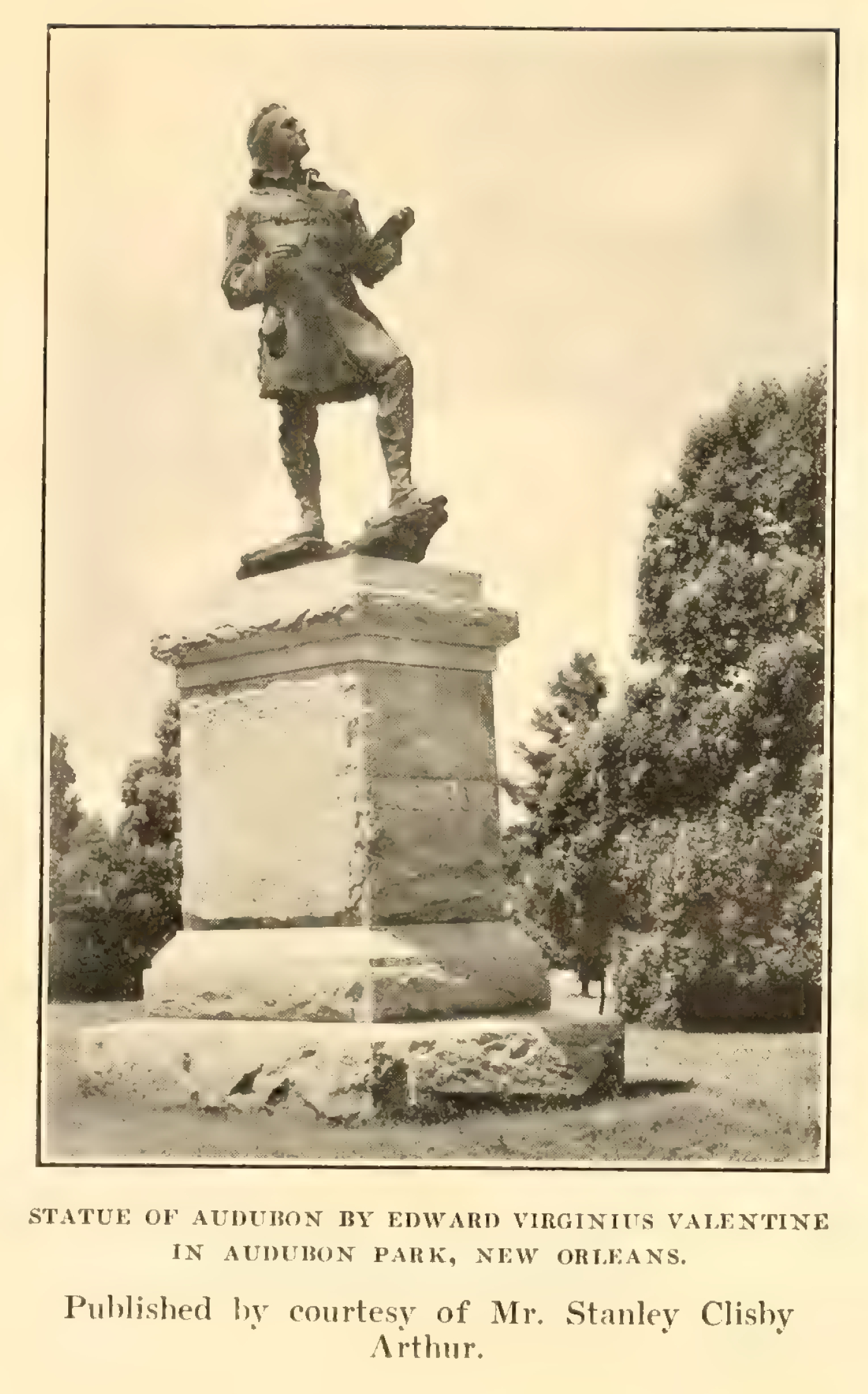
STATUE OF AUDUBON BY EDWARD VIRGINIUS VALENTINE
IN AUDUBON PARK, NEW ORLEANS.
Published by courtesy of Mr. Stanley Clisby
Arthur.
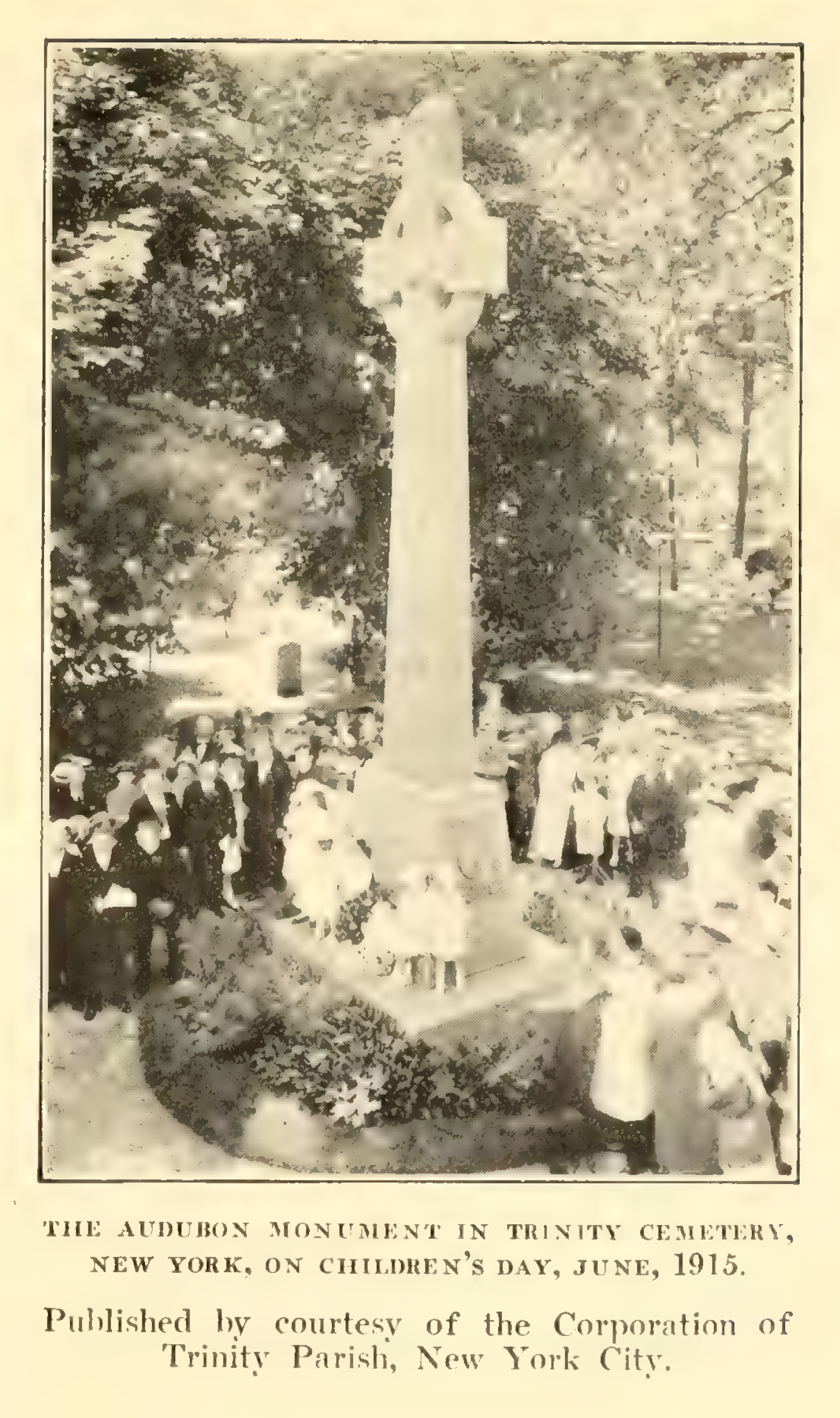
THE AUDUBON MONUMENT IN TRINITY CEMETERY,
NEW YORK, ON CHILDREN’S DAY, JUNE, 1915.
Published by courtesy of the Corporation of
Trinity Parish, New York City.
In recent times Audubon’s name has become a household
word through the medium of the most effective
instrument which has yet been devised for the conservation
of animal life in this or any country, the National
Association of Audubon Societies for the Protection of
Wild Birds and Animals. This has become the coördinating
center for the spread and control of a great
national movement that received its first impulse in
1886.7 Launched anew ten years later, it has advanced
15
with ever increasing momentum, until now it is the governing
head of twenty-nine distinct State societies, as
well as eighty-five affiliated clubs and similar organizations.
In 1916 it counted a life membership of 356,
with 3,024 sustaining members, and realized a total income
of over $100,000. It should be added that during
the past six years over 2,900 Junior Audubon Clubs
have been formed in the schools, through which nearly
600,000 children have been instructed in the principles
of the Audubon Society. Well may it be that this admirable
organization, with its successful efforts for remedial
legislation in state and nation; its initiative, with
the aid of the National Government, in establishing
Federal reservations or sanctuaries for the perpetuation
of wild life; its educational activities through the extension
of its influence to the pupils of the public schools;
and its watch and ward over all the varied interests of
its cause, will keep the name of Audubon greener to all
future time than the most cherished of his works.
Of Audubon’s works the public now sees but little
and knows even less, all without exception having been
long out of print. His admirable plates of birds and
mammals have been widely copied and still serve for the
illustration of popular books, but most of his publications
were projected on too large and expensive a scale
for general circulation, having been first sold to subscribers
only and often at great cost. No complete
reprint, revision or abridgment of his principal volumes
has been made for half a century
(see
Bibliography,
Appendix V). No complete bibliography of Audubon
has ever been prepared, and none will remain completed
long, for it is hard to imagine a time when comment
on his life, his drawings, and his adventures will
altogether cease.
16
In May, 1834, William MacGillivray, who was assisting
him in the technical parts of the Ornithological
Biography, suggested that Audubon write a biography
of himself, and predicted a wide popularity for such a
work. Audubon entertained the idea but was then too
deeply immersed in The Birds of America to give it
much attention; yet in 1835 he wrote out a short sketch,
entitled Myself, addressing it in the fashion of that day
to his two sons, and then laid it aside. Mrs. Audubon
evidently had access to this manuscript when the life of
her husband, to be referred to later, was in course of
preparation, and thus it has furnished, directly or indirectly,
nearly all that has been published concerning the
naturalist’s early life. This fragment, which extends
to about thirty printed pages, was characterized by
Audubon as a “very imperfect (but perfectly correct)
account of my early life,” and though written with an
eye to its possible publication, which was clearly sanctioned,
it was evidently never revised. The manuscript
was long lost but eventually was “found in an old book
which had been in a barn on Staten Island for years”;
it was first published by the naturalist’s granddaughter,
Miss Maria R. Audubon, in 1893, and again in 1898.
As will later appear, this account is inaccurate in many
important particulars.
Audubon expressed the intention of extending his
personal history, which he promised to delineate with a
faithfulness equal to that bestowed on the birds, but
the task was never resumed. Yet more than most
writers have done, he wove the incidents of his own
career into the pages of his principal works, and this
strong personal flavor added much to their charm. Unfortunately,
in giving such personal or historical details
he is most vulnerable to a critic, who insists first upon
17
accuracy, for errors of various sorts and confused and
conflicting statements are far too common.
Of the more formal biographies of Audubon, the
first to appear was a slender volume entitled Audubon:
the Naturalist of the New World, by Mrs. Horace Stebbing
Roscoe St. John, published in England in 1856.8
In the same year this work was expanded and reissued
by the publishers who at that time had charge of the
sale of Audubon’s works in America.9 The American
publishers explained in their edition that inasmuch as
“the fair authoress in preparing her interesting sketch
of Audubon … appears not to have been aware of
the publication of his second great work, the Quadrupeds
of North America (which had not been advertised,
we believe, in Europe) they have taken the liberty of
giving some account of it and making numerous extracts
from its pages.”10 Perhaps the most interesting
or valuable things in this little volume at the present
day are the woodcut on the title page showing Audubon’s
house on the Hudson as it then appeared, surrounded
by tall trees, and, inserted on a flyleaf, a list
of all of Audubon’s published works and the prices at
which they could be procured in New York just prior
to the Civil War (see Note, Vol. II, p. 204).
18
In 1868 there appeared in England a work of combined
and confused authorship, commonly referred to
as “Buchanan’s Life of Audubon,“ the ”sub-editor,“ as
he called himself, having since become better known as
an original, skilled and prolific writer of verse, drama,
fiction and literary criticism. At that time Robert
Buchanan was twenty-six years old, and had published
five volumes of poems in rapid succession, some of which
had been received with favor by the public. A second
and third edition of this Life followed in 1869. Finally
the work was resurrected and again sent to press, unrevised,
in 1912, when it appeared in “Everyman’s
Library,” at a shilling a copy, with an introduction
which had served as a review of the work in 1869.
A recent biographer of Alexander Wilson speaks of
Buchanan as “commissioned by Mrs. Audubon to write
her husband’s life,” but the lady herself, as well as
Buchanan, has told a different story. It seems that in
about the year 1866, Mrs. Audubon prepared, “with the
aid of a friend,” an extended memoir of her husband,
which was offered to an American publisher but without
success. The “friend,” at whose home Mrs. Audubon
was then living, was the Rev. Charles Coffin
Adams,11 rector of St. Mary’s Church, Manhattanville,
now 135th, Street, New York. The Adams manuscript,
which consisted chiefly of a transcript from the naturalist’s
journals, then in possession of his wife, was completed
presumably in 1867. In the summer of that year
it was placed in the hands of the London publishers,
19
Messrs. Sampson Low, Son, & Marston, who without
any authority turned it over to one of their hard-pressed,
pot-boiling retainers, Robert Buchanan, poet and young
man of genius. Buchanan boiled down the original
manuscript, as he said, to one-fifth of its original compass,
cutting out what he regarded as prolix or unnecessary
and connecting “the whole with some sort of a
running narrative.”12 Mrs. Audubon was unable to
recover her property from either publishers or editor
or to obtain any satisfaction for its unwarranted use.
Whatever defects the Adams memoir may have possessed,
this is much to be regretted, since, as her granddaughter
has said, Mrs. Audubon had at her command
many valuable documents, the originals of which have
since been destroyed.
Buchanan, like Audubon, had been reared in comparative
luxury, “the spoiled darling of a loving
mother.” After the failure of his father in various newspaper
enterprises about four years before this time, he
had gone up to London with but few shillings in his
pocket and had begun life there literally in a garret.
The reflection that Audubon had fought a similar but
much harder battle in that same London thirty years
before, and won, should possibly have awakened in him
a somewhat friendlier spirit than was then displayed.
It must be admitted, however, that Buchanan produced
a very readable story, although there was not a word
in his whole book which showed any real sympathy with
20
Audubon’s lifelong pursuits, any knowledge of ornithology,
or any interest in natural science. Though expressing
unbounded admiration for the naturalist, his
foibles and faults seem to have hidden from this biographer
the true value of his distinguished services. In
respect to a knowledge of natural history it should be
added that Buchanan laid no claims, and of Audubon’s
accomplishments in this field comparatively little was
said, the book, like the Adams’ manuscript from which
it was drawn, being mainly composed of extracts from
the naturalist’s private journals and “Episodes,” as he
called his descriptive papers. It was here that Audubon
made the strongest appeal to this literary editor, who
concluded his preface with the following words of praise:
“Some of his reminiscences of adventure … seem to
me to be quite as good, in vividness of presentment and
careful colouring, as anything I have ever read.”
Buchanan dilated on Audubon’s pride, vanity and
self-conceit, faults which may have belonged to his youth
but which were never mentioned by his intimate friends
and contemporaries except under conditions which reflected
rather unfavorably upon themselves. Complaints
on this score were spread broadcast by reviewers
of this work, seventeen years after the naturalist’s
death and with the suddenness of a new discovery. They
were undoubtedly based on the unconscious and allowable
egotisms of such personal records as Audubon
habitually made for the members of his family when
time and distance kept them asunder. Vanity and selfishness
could have formed no essential parts of a character
that merited the eulogy which follows:
Audubon was a man of genius, with the courage of a lion
and the simplicity of a child. One scarcely knows which to
21
admire most — the mighty determination which enabled him to
carry out his great work in the face of difficulties so huge, or
the gentle and guileless sweetness with which he throughout
shared his thoughts and aspirations with his wife and children.
He was more like a child at the mother’s knee, than a husband
at the hearth — so free was the prattle, so thorough the confidence.
Mrs. Audubon appears to have been a wife in every
respect worthy of such a man; willing to sacrifice her personal
comfort at any moment for the furtherance of his great
schemes; ever ready to kiss and counsel when such were most
needed; never failing for a moment in her faith that Audubon
was destined to be one of the great workers of the earth.13
No one will deny, however, that Buchanan was right
in saying that in order to get a man like Audubon understood,
all domestic partiality, the bane of much biography,
must be put aside; but it is equally important to
make such allowances as the manifold circumstances of
time and place demand, and to be a reasoner rather than
a fancier. This work abounds in errors, but it is not
clear to what extent they were due to carelessness on
Buchanan’s part.
It was certainly a mistake to attribute Buchanan’s
attitude to partiality for Alexander Wilson, who, like
himself, was a Scotchman. It was a case of temperament
only, for gloom and poverty had embittered his
life. As his sister-in-law and biographer14 said of him,
“he was doomed to much ignoble pot-boiling…. He
had few friends and many enemies,” and “had received
from the world many cruel blows,” while “no man
needed kindness so much and received so little.” Perhaps
22
the best key to the sad history of this able writer
was given by himself when he said: “It is my vice that
I must love a thing wholly, or dislike it wholly.” His
wife, we are told, was much like himself, and “like a
couple of babies they muddled through life, tasting of
some of its joys, but oftener of its sorrows.” Undoubtedly
Robert Buchanan was a genuine lover of truth and
beauty; he has written numerous sketches of birds and
outdoor scenes, but with no suggestion of nature as
serving any other purpose than that of supplying a poet
with bright and pleasing images.
It was with the purpose of correcting the false impressions
created by animadversions in Buchanan’s Life
that Mrs. Audubon, with the aid of her friend, James
Grant Wilson, revised this work and published it in
America under her name as editor, in 1869. The
changes then made in Buchanan’s text, however, were
of a minor character and most of its errors remained
uncorrected. The naturalist’s granddaughter, Miss
Maria R. Audubon, was inspired in part by similar feelings
in preparing, with the aid of Dr. Elliott Coues, her
larger and excellent work in two volumes, entitled
Audubon and His Journals, which appeared in 1898.
To her all admirers of Audubon owe a debt of gratitude
for giving to the world for the first time a large part
of his extant journals, as well as many new facts bearing
upon his life and character. Other briefer biographies
of Audubon which have appeared have been taken
so completely from the preceding works, and have repeated
and extended their errors to such an extent, as to
call for little or no comment either here or in the pages
which follow.
Through the discovery in France of new documentary
evidence in surprising abundance we are obliged to
23
draw conclusions contrary to those which have hitherto
been accepted, and the new light thus obtained enables
us to form a more accurate and just judgment of Audubon
the man, and of his work.
24
CHAPTER II
JEAN AUDUBON AND HIS FAMILY
Extraordinary career of the naturalist’s father — Wounded at fourteen and
prisoner of war for five years in England — Service in the French merchant
marine and navy — Voyages to Newfoundland and Santo
Domingo — His marriage in France — His sea fights, capture and imprisonment
in New York — His command at the Battle of Yorktown — Service
in America and encounters with British privateers.
Few names of purely Gallic origin are today better
known in America, or touch a more sympathetic chord
of human interest, than that of Audubon, and few, we
might also add, are so rare. John James Audubon first
made his family name known to all the world, and
though he left numerous descendants, it has become well
nigh extinct in America, and is far from common in
France. The great Paris directory frequently contains
no entry under this head; Nantes knows his name no
longer, and it is rare in the marshes of La Vendée,
where at some remote period it may have originated.
The lists of the army of five thousand which Rochambeau’s
fleet brought to our aid in the American War of
Independence show but a single variant of this euphonious
patronym, in Pierre Audibon,15 a soldier in the regiment
of Touraine, who was born at Montigny in 1756;
but in the fleet of the Count de Grasse which coöperated
with our land-forces at the Battle of Yorktown, on
October 19, 1781, a ship was commanded by an officer
with whom we are more intimately concerned. This
25
was Captain Jean Audubon, who was later to become
the father of America’s pioneer woodsman, ornithologist
and animal painter.
By birth a Vendean, at the age of thirty-seven Jean
Audubon had plowed the seas of half the world, and
in the course of his checkered career, as sailor, soldier,
West Indian planter and merchant, had met enough
adventure to furnish the materials for a whole series of
dime novels. Short of stature, with auburn hair and a
fiery temper, he was then as stubborn and fearless an
opponent as one could meet on the high seas, and one
of the gamest fighting cocks of the French merchant
marine. How much Jean Audubon’s son owed to his
French Creole mother will never be known, but to this
self-taught, thoroughly capable, and enterprising sailor
we can surely trace his restless activity, his versatile
mind and mercurial temper, as well as an inherent capacity
for taking pains, which father and son possessed
to a marked degree.
The true story of Jean Audubon’s career has never
been told, but even at this late day it will be found an
interesting human document; and what is more to our
purpose, it throws into sharp outline much that has
hitherto remained obscure in the life of his remarkable
son. The first Audubon to leave any imprint, however
faint, upon the history of his time, this honest,
matter-of-fact sailor, would have been the last to wish
to appear in the garb of fiction, and we shall base our
story solely upon the unimpeachable testimony of public
and private records, which researches in France had
happily brought to light before the beginning of the
war in 1914.16
26
Jean Audubon came by his sailor’s instincts and
fighting prowess naturally, for his father, Pierre Audubon
of Les Sables d’Olonne, was a seaman by trade.
Like his son he captained his own vessel, and for years
made long voyages between French ports in both the
old and the new worlds. Pierre Audubon, the paternal
grandfather of John James Audubon, and the first of
that name of whom we have found any record,17 lived
at Les Sables d’Olonne, where with Marie Anne Martin,
his wife, he reared a considerable family in the first half
of the eighteenth century.
Les Sables, at the time of which we speak, was a
small fishing and trading port on the Bay of Biscay,
fifty miles to the southwest of Nantes, but is now become
a city of over twenty thousand people. Lying on
the westerly verge of the Marais, or salt marshes and
lakes of La Vendée, the inhabitants of the district, and
more particularly of the Bocage, or plantations, to the
north and northeast, were noted from an early day for
their conservatism, as shown in a firm adherence to
ancient law and custom, as well as for their unswerving
loyalty to the old nobility and to the clergy. Like their
Breton neighbors on the other side of the Loire, the
Vendeans were honest, industrious, and faithful to their
civic obligations; they were also independent, resourceful,
and knew no fear. When the neighboring city of
Nantes planted trees of liberty and displayed the National
colors in 1789, the Vendeans were stirred to indignation
and later to arms, while the Chouans on the right
bank of the river were quick to follow their example; in
short, the rebels of La Vendée raised such a storm that
27
for months the very existence of the infant Republic
was threatened. This spirit of revolt to the newer order,
the Chouanerie, as it came to be called, was stamped
out for the time, but a few smoldering embers always
remained, ready to burst into flame at the slightest
provocation; recrudescent symptoms of this tendency
had to be suppressed even as late as 1830, when Charles
X, the last Bourbon king, lost his crown. Pierre Audubon’s
family, no doubt, shared many characteristics of
their Vendean and Breton neighbors, but as the sequel
will show, one at least did not approve of their political
course, for he took up arms against them, and presumably
against many of his own kith and kin.
Jean Audubon was born at Les Sables on October
11, 1744, and was christened on the same day, his godfather
being Claude Jean Audubon, in all probability
an uncle after whom he was named, and his godmother,
Catharine Martin, presumably an aunt. Twenty-one
children, according to the naturalist, blessed the union
of Pierre Audubon and his wife, and were reared to maturity.
Whether this statement is strictly accurate, or
what became of so large a family cannot now be ascertained.18
28
Pierre Audubon was engaged by the French Government
to transport the necessities of war to Cape
Breton Island in 1757, when the world-wide struggle
between France and Great Britain for supremacy in the
New World was at hand. The French were determined
at all hazards to hold their great fortress of
Louisburg, which had been taken by the English but
again restored to the French not many years before.
This was the strongest and most costly fortress on the
American continent, as well as a great center for the
valuable trade in salted fish. By a coincidence, or possibly
out of compliment to his wife, Pierre’s ship bore
the name of La Marianne, and when he sailed from his
home port of Les Sables d’Olonne on April 15, 1757,
he took with him his own son, Jean, as cabin-boy, when
the lad was but thirteen years old. In the following
May Great Britain threw down the gauntlet to France,
and the terrific seven years’ struggle began. The great
fortress of Louisburg fell in the following year to the
English fleet, and was left a heap of ruins. His father’s
ship, the Mary Ann, was involved, and young Jean
Audubon, who thus began his fighting career at fourteen,
was wounded in the left leg and made a prisoner.
With many of his compatriots he was taken to England,
landing on November 14, 1758, where he remained in
captivity for five years; he was released but a short time
29
before the treaty of peace was signed at Paris, February
10, 1763. Apart from her interests in the West Indies,
France was stripped at this time of all her vast possessions
in America, save only the two little islands of
Saint Pierre and Miquelon.
Whether Pierre Audubon shared the fate of his son
we are unable to say, for at this point he drops out
of our records and we do not hear of him again. It
is certain that he never made another voyage with
Jean, who returned to his native town with his passion
for the sea unabated, and at nineteen reëntered the merchant
marine as a novice. His next voyage, on the ship
La Caille, Captain Pigeon, was to execute a governmental
commission at the Island of Miquelon. Five
golden years of his youth had been spent in captivity;
if productive of nothing else they had given him a knowledge
of the English tongue, but they had also engendered
bitter hatred of the English race, a feeling which
his son confessed to have shared in his youthful days.19
The period from 1766 to 1768 was occupied in four
voyages to Newfoundland, probably in the interest of
the codfish trade, first as sailor before the mast in Le
Printemps, and then as lieutenant in a ship called also
La Marianne, with alternate sailings from, and to, La
Rochelle and Les Sables d’Olonne. On his third voyage
to Newfoundland, which was made in 1767, when he
was twenty-three years old, Jean Audubon ranked as
30
lieutenant of his vessel, but in the summer of 1768 he
shipped again from Les Sables as sailor before the mast
for a short trading cruise on the coast of France; in
this instance the vessel, called Le Propre, was captained
by Pierre Martin, who was possibly an uncle. At this
juncture Jean Audubon enlisted in the French navy
(service for the State) as a common sailor, and made
two voyages on governmental business from the port of
Rochefort, serving altogether nearly nine months
(1768-9). After the termination of this last engagement
nothing is heard of Jean for over a year, when
in 1770 he makes his first appearance at Nantes, the
city that was to know him in many capacities for nearly
half a century. There he reëntered the merchant marine,
and on November 1, 1770, began a series of eight
voyages, lasting as many years, to the island of Santo
Domingo, the western section of which was then in possession
of France.
Since much of the mystery which hitherto has
shrouded the early life of John James Audubon is involved
in the West Indian period of his father’s career,
we shall now trace this history in considerable detail.
The great export trade of French Santo Domingo
in those days was in brown and white sugar, then known
as the “Muscovado” and “clayed” sorts, which for the
year 1789 amounted to over 141,000,000 pounds, valued
at more than 122,000,000 francs; and in coffee, which
in the same year totaled nearly 77,000,000 pounds, estimated
to be worth nearly 52,000,000 francs.20 While all
31
such estimates were no doubt very crude, they serve to
illustrate the richness of the prize that attracted Frenchmen
by hundreds to the colony, an island that to many
seemed a paradise in prospect, but which proved to be a
purgatory in disguise.
Jean Audubon’s voyages were all made in the interest
of this valuable trade. Since they commonly
lasted from six months to nearly a year, they became
doubly hazardous to a French sailor after the outbreak
of the American Revolution, for if he escaped his
Scylla, the inveterate pirate, he might expect to encounter
an equally formidable Charybdis in an English
privateer. Though the northwestern corner of
Santo Domingo was the center of their forays, Jean
never lost a ship to the buccaneers, and though sometimes
caught by the English, he never surrendered. He
made three successive voyages from 1770 to 1772 in
La Dauphine, commanded by Jean Pallueau, first as
lieutenant and later as captain of the second grade, but
on his last five voyages to the West Indies he captained
his own ships, known as Le Marquis de Lévy (1774),
32
Les Bons Amis (1775-6), and Le Comte d’Artois
(1777-8).
Captain Audubon was married on August 24, 1772,
at Paimbœuf, to Anne Moynet,21 a widow of some property,
who had been born at Nantes in 1735 and was thus
nine years his senior. Her married name was Ricordel.
She possessed several houses at Paimbœuf, and acquired
one in 1777, which was rented to the Administration at
the time of the Revolution (see Vol. I, p. 80), as well as
a dwelling at Nantes, where she lived while her roving
sailor of a husband was in Santo Domingo or the United
States. Madame Audubon was a woman of simple
tastes, devoted to culture, and, as we shall see, possessed
of a kind heart.
When Captain Audubon left Les Cayes, Santo
Domingo, on his last trading voyage, in the spring of
1779, bound for Nantes with a valuable cargo, his ship,
Le Comte d’Artois, was attacked by four British corsairs
and two galleys. With the odds overwhelmingly
against him, he fought until his crew were nearly all
killed or disabled, and after an abortive attempt to
blow up his vessel, tried to escape in his shallop. For
the second time he was made a prisoner by the English,
who in this instance took him to New York, then in the
possession of British troops. He was landed in that
city on May 12, 1779, and was held there as a prisoner
of war for thirteen months. If our inference be correct,
he finally owed his release to the efforts of the French
Ambassador, Monsieur de la Luzerne, the same, we
believe, who had been a Governor of Santo Domingo,
and who in 1790 became its Minister of Marine. As
33
will be seen presently, this diplomat again exerted himself
in Captain Audubon’s behalf.
It is interesting to find that on this occasion Jean
Audubon was fighting not only for his life, but for his
property. His vessel, Le Comte d’Artois, was very
heavily armed. Though of only 250 tons, she carried
no less than ten cannon, four of which were mounted
on gun carriages, and ten bronze pivot guns, which
might imply that she was originally designed as a privateer.
The ship was not destroyed when her captain was
made prisoner, but was taken by the English to Portsmouth,
New Hampshire (?), and burned there before
December 15 of the following year.22 Before starting on
this disastrous voyage Captain Audubon had sold the
vessel and his interest in her cargo to the Messrs. Lacroix,
Formon de Boisclair and Jacques, with whom
later he had extensive dealings in slaves; but he was not
paid, and though an indemnity seems to have come from
the British Government, he was never able to obtain a
satisfactory settlement of the Formon claim.23
34
Jean Audubon’s release from captivity in New
York, in June, 1780, probably marks the period of his
first intimate acquaintance with the United States.
We know only that he did not return immediately to
either Santo Domingo or France, but became an enthusiast
for the American cause, and sought the earliest
opportunity to avenge his wrongs at the hands of
the British. He did not have long to wait, for through
the exertions of the Ambassador de la Luzerne, he was
placed in command of the corvette Queen Charlotte.
With her, in October, 1781, he joined the fleet of the
Count de Grasse before Yorktown,24 where he soon
witnessed the surrender of Cornwallis and the humiliation
of his enemies. After this turning point of the
war Captain Audubon remained in the United States,
and in April, 1782, commanded a merchantman called
L’Annette,25 in which he was also personally interested,
and delivered a cargo of Virginia tobacco at the port
of Nantes. Shortly after his return to America in the
35
same year he was placed in command of an American
armed vessel The Queen and sent on another mission
to France. Near the Chaussée des Saints he was attacked
by a British privateer, but after a stubborn fight
at close quarters he sank his enemy and entered the
port of Brest. Nothing is said of the taking of prisoners
on such occasions, and there were doubtless few
survivors among the defeated crew. This command
Jean Audubon held until peace was concluded between
Great Britain and her former colonies in America, probably
until the close of 1783. The hostile army was disbanded
in the spring of that year, the treaty of peace
was made definitive in September, and on November
25, 1783, the last British troopers left the city of New
York.
36
CHAPTER III
JEAN AUDUBON AS SANTO DOMINGO PLANTER AND MERCHANT
Captain Audubon at Les Cayes — As planter, sugar refiner, general merchant
and slave dealer, amasses a fortune — His return to France
with his children — History of the Santo Domingo revolt — Baron de
Wimpffen’s experience — Revolution of the whites — Opposition of the
abolitionists — Effect of the Declaration of Rights on the mulattoes — The
General Assembly drafts a new constitution — First blood drawn
between revolutionists and loyalists at Port-au-Prince — Ogé’s futile
attempt to liberate the mulattoes — Les Cayes first touched by revolution
in 1790, four years after the death of Audubon’s mother — Emancipation
of the mulattoes — Resistance of the whites — General revolt of
blacks against whites and the ruin of the colony.
After the American struggle for liberty had been
finally won, Captain Audubon resigned his commission
held in the United States and returned to his home at
Nantes, but town or country could not hold him long.
Lured by the prospects of great wealth which Santo
Domingo offered to the merchant of those days, and
having learned by long experience in her ports the devious
methods by which fortunes were attained, he decided
to give up the sea and embark in colonial trade.
For six years, from 1783 to 1789, he lived almost continuously
in the West Indies, and as merchant, planter,
and dealer in slaves amassed a large fortune. Meanwhile
his wife, who had seen little of him since their
marriage in 1772, remained at Nantes.
Captain Audubon traveled through the United States
early in 1789, and again late in that year when on his
way to France, probably in the first instance returning
37
to Santo Domingo by way of the Ohio and the Mississippi.
Symptoms of unrest were already prevalent
in the northern provinces of the island but had caused
no serious alarm in the south. Jean Audubon’s aim
seems to have been to collect debts due him in the United
States and to leave the capital invested there. At all
events it was on this occasion that he purchased the farm
of “Mill Grove,” near Philadelphia, the history of which
will be given a little later (see Chapter VII). He had
no intention, however, of living in Pennsylvania, for he
immediately leased this estate to its former owner and
hurried away.
July 14, 1789, found the elder Audubon enlisted as
a soldier in the National Guards at Les Cayes. These
colonial troops, which were originally militia organizations
modeled after similar bodies in France, were reorganized
at this time to meet any possible emergencies.
Affairs in the southern provinces of Santo Domingo
had followed, up to this moment, their normal course,
and Jean Audubon, who could have learned nothing of
what had transpired at home, decided to entrust his
various interests to the hands of agents and return to
France. This was probably in late August or early
September, 1789, as we know that he first returned to
the United States and visited Richmond, Virginia, at
the close of that year.26 Strangely enough, on the twentieth
day of the former month the National Assembly at
Paris had voted the celebrated Declaration of Rights,
which was destined to upturn the whole social system
of Santo Domingo and to convert that island into a
purgatory of the direst anarchy, strife, and bloodshed
which the world had ever known, or at least remembered;
but fully six weeks must have elapsed before news
38
of this grave decision could have reached the colony.
At this time Jean Audubon was no doubt regarded
as a very rich man, and though he happened to leave
Les Cayes at a critical moment, little could he have
dreamed of the disaster that awaited him there as well
as in his beloved France. His personal affairs during
this eventful period, involving as they necessarily do
the early life of his distinguished son, have hitherto been
shrouded in the dark and sinister history of that ever
smiling but ever turbulent island. Now, however, the
veil of mist that has settled over the page can be penetrated
at the most important points. In this and subsequent
chapters we shall follow the life of father and
son through the course of events which has been thus
briefly summarized.
To return to the earlier threads of our narrative,
at about the close of 1783, Captain Audubon was engaged
by the Coirond brothers, colonial merchants at
Nantes, to take charge of their foreign trade, which
centered chiefly at Les Cayes,27 Santo Domingo, then a
most thriving and populous town, as it is today the
largest seaport on the southern coast of the Republic
of Haiti. Their ships brought sugar, coffee, cotton and
other West Indian products to France, and laden with
39
fabrics, wines and every luxury known to the colonists
of that day, returned to Les Cayes, as well as to Saint
Louis, an important port a little farther to the east,
where these merchants also possessed warehouses and
stores.
In a short time Jean Audubon had acquired an independent
business of his own, both as a planter and
merchant. He made his home at Les Cayes, but extended
his enterprises to Saint Louis and possibly to
other points. From this time onward he commonly
described himself as négotiant,28 or merchant, and his
son, when writing to his father from America, addressed
him in this way. His business letters and other documents
of the period refer to his house at Les Cayes, his
plantations of cane and his sugar refinery, his exportation
of colonial wares, his purchases of French goods,
particularly at Nantes, and to his trade in black slaves
which eventually assumed large proportions. How important
his sugar plantations may have been is not
known, but a tax-receipt shows that at one time he possessed
forty-two slaves. 29 The naturalist said that his
father acquired a plantation on the Ile à Vaches, an
island of considerable importance at the southern bound
of the roadstead of Les Cayes and nine miles from the
town, but we have found no other reference to it.
Great numbers of negroes must have passed through
Jean Audubon’s hands, as shown by his bills of sale,
which strangely reflect the customs of a much later and
sadder day on the North American continent (see Appendix
I, Documents Nos. 4-6). In one of these bills,
40
dated at Les Cayes, September 16, 1785, Jean is credited
with one-half the net proceeds of the sale of forty
negroes, bought originally of M. Th. Johnston for the
sum of 60,000 francs, and sold by Jean Audubon and
Messrs. La Croix, Formon & Jacques for 71,552 francs;
after deducting 183 francs for food and treatment, the
net returns became 71,369 francs, and Jean’s profits,
on a half-interest basis, 5,684 francs, or about 142
francs per head. The prices of these slaves, which were
sold to planters on the island when not retained for
their own use, ranged from 1,500 to 2,100 francs, or
from $300 to $420, at the present rate of exchange. It
is interesting to notice that while these negroes were held
for sale, the exact period of which is not stated, they received
as food eighty bunches of bananas and three beef
heads; though under the care of a physician, it is not
surprising to find that one of them died. Another bill,
bearing date of August 7, 1785, records the sale to Jean
Audubon of ten negroes and three negresses for a total
sum of 26,000 francs; 16,000 francs of this amount was
paid in sugar, but what is particularly interesting now
is the fact that a balance of 2,000 francs was finally cancelled
on June 9, 1788, a year or more after Jean Audubon,
according to the accepted accounts, is supposed to
have lost his wife and his property and to have fled from
the island. Mme. Anne Moynet Audubon never visited
America, and her husband, as we have seen, left Santo
Domingo in 1789, before the outbreak of the revolution.
His property remained substantially intact until
after 1792, and in some years, it is believed, yielded
him in rents 90,000 francs, which at present rates in
American money would be equivalent to $18,000. In
giving his certificate of residence at Nantes in that
eventful year, Captain Audubon publicly declared that
41
he possessed a dwelling, a sugar refinery, and warehouses
or stores at both Les Cayes and Saint Louis.
Moreover, his West Indian estate was not completely
settled until 1820, two years after his death.
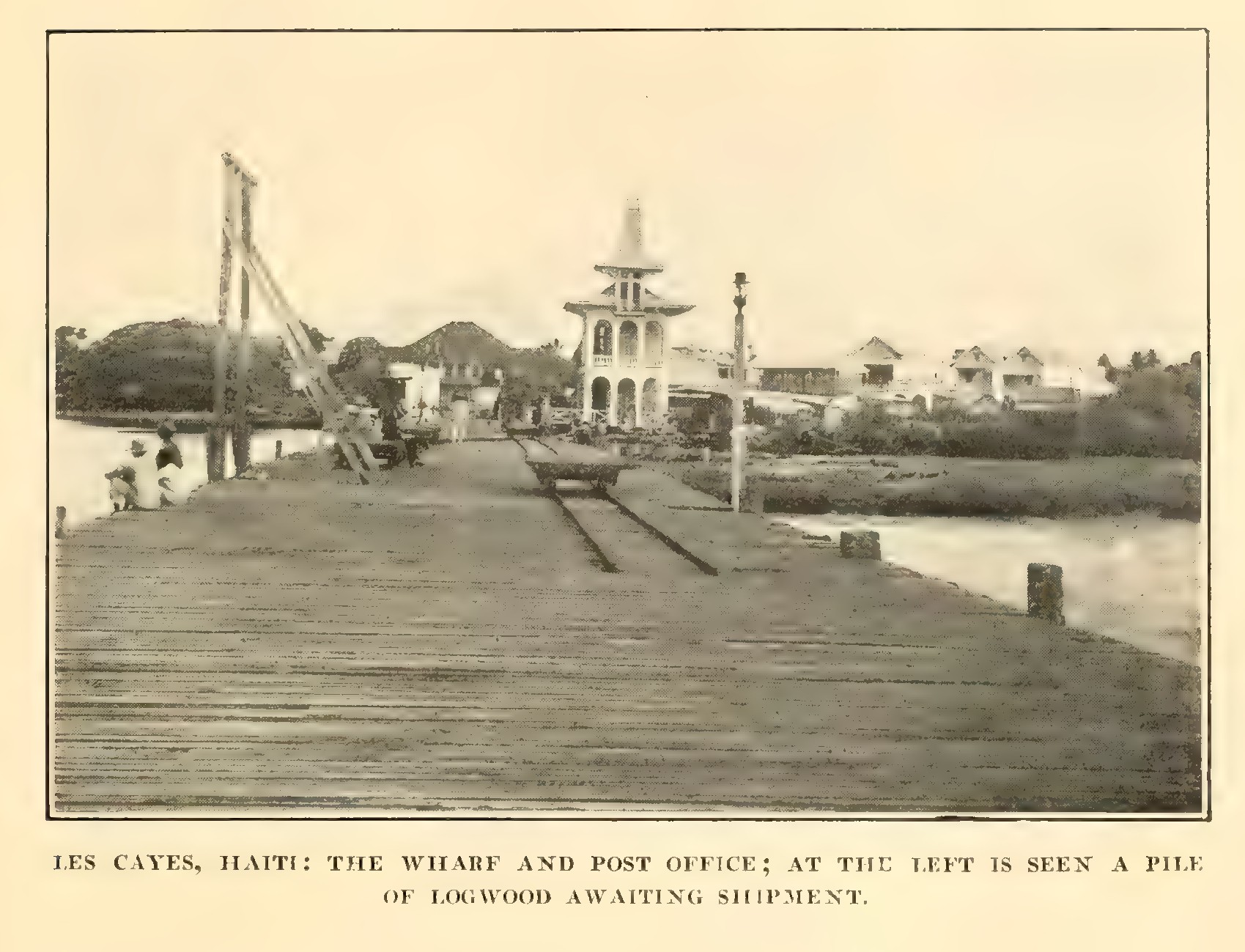
LES CAYES, HAITI: THE WHARF AND POST OFFICE; AT THE LEFT IS SEEN A PILE
OF LOGWOOD AWAITING SHIPMENT.
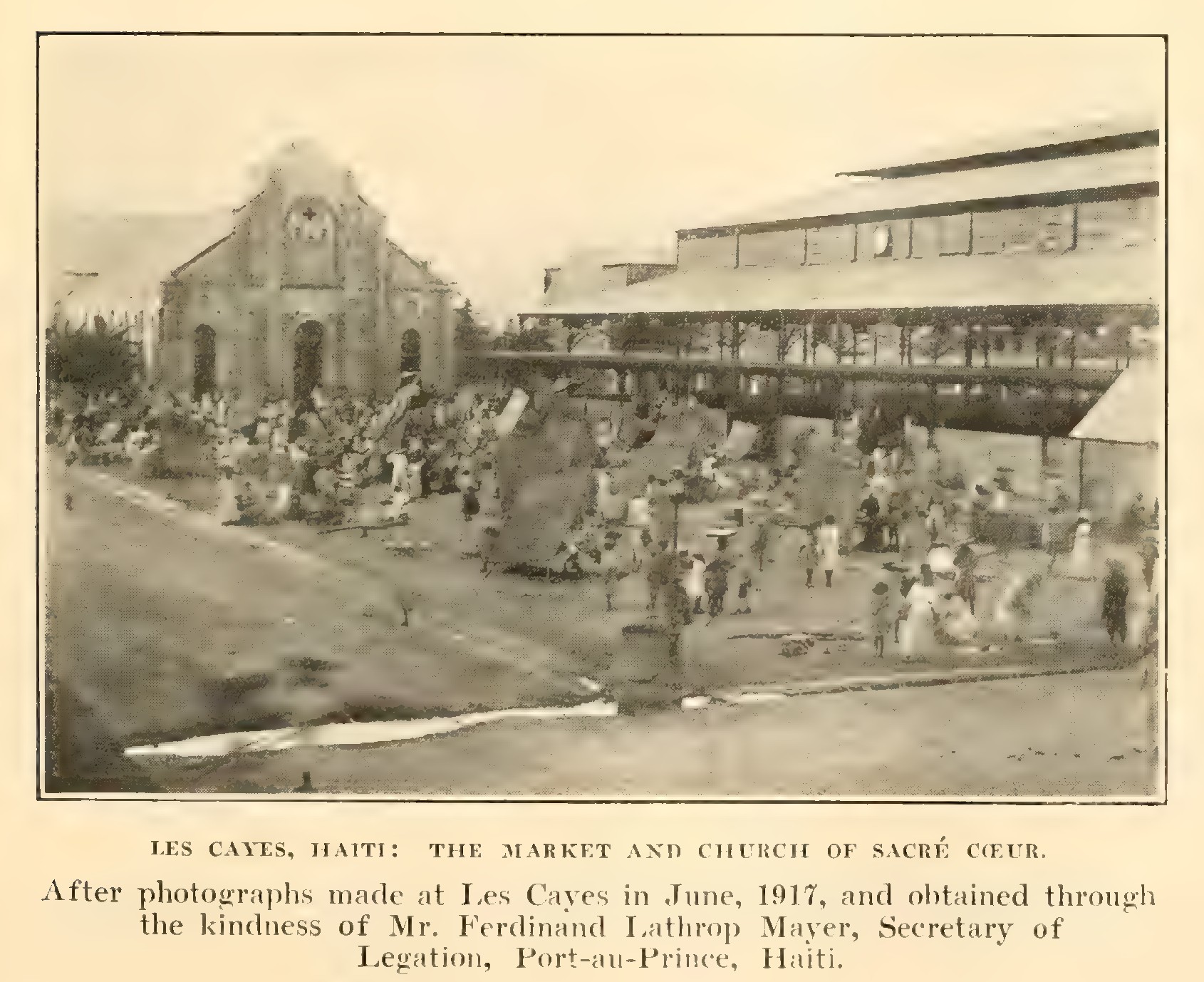
LES CAYES, HAITI: THE MARKET AND CHURCH OF SACRÉ CŒUR.
After photographs made at Les Cayes in June, 1917, and obtained through
the kindness of Mr. Ferdinand Lathrop Mayer, Secretary of
Legation, Port-au-Prince, Haiti.
Slaves were regarded in Santo Domingo as an indispensable
commodity, as they had been in Virginia
and the Carolinas for a century past, and were still to
be for three-quarters of a century to come; the “friends
of the blacks” as the abolitionists were called, were considered
by most planters as the enemies of the whites.
Degradation and cruelty, ever attendant upon a system
that drew its chief support from the self-interest of a
class, were all too common in the island, yet there were
many who earnestly strove to soften the lot of their
slaves. Though a born fighter, Jean Audubon was humane,
and the evidence, so far as it goes, shows that
his own slaves were treated with kindness and consideration.
This period in Santo Domingo, particularly from
the year 1785 to 1789, not only is important for our
story, but happened to mark a crisis in French sovereignty
in America. It will be necessary, therefore, to
follow certain events in a history which can serve only
as a warning to mankind, for it contains little to satisfy
the understanding and nothing to excite the fancy or
gladden the heart. It is to be noticed first, however,
that according to the accepted accounts, John James
Audubon was born of a Spanish creole mother, in Louisiana,
in 1780. Shortly after his birth, his mother is
said to have gone to Santo Domingo, where she perished
in a local uprising of the blacks, when Jean Audubon’s
plantations and property were totally destroyed; Jean
managed to escape with only his two children, a few
faithful slaves, and a part of his money and valuables,
42
to New Orleans, whence he subsequently went to
France. Investigation of existing records has proved
that these statements are not in accord with the facts,
but before entering into further personal details it will
be well to examine those conditions on the island of
Santo Domingo which led many into easy fortune only
to involve them later in a ruin as complete and irretrievable
as it was unforeseen and unnecessary.
For nearly a hundred years the western half of Santo
Domingo had been held by France, and to every outward
appearance it had enjoyed such unbounded and
steadily increasing prosperity that it was regarded with
envy on every side; in fine, it seemed to be one of the
richest and most desirable colonies in the whole world.
Historians, said an observer of a later day,30 were “never
weary of enumerating the amount of its products, the
great trade, the warehouses full of sugar, cotton, coffee,
indigo and cocoa; its plains covered with splendid
estates, its hillsides dotted with noble houses; a white
population, rich, refined, enjoying life as only a luxurious
colonial society can enjoy it.” Few could then see
the foul blot beneath so fair a surface, or realize that
what had been bought by the misery and blood of a
prostrate race would demand an equivalent, and that a
settlement might be forced.
Negroes had been imported into Santo Domingo
from the African coasts in incredible numbers, first by
Spain after she had succeeded in exterminating the inoffensive
native Caribs, and later by France. One hundred
thousand blacks of all ages were entering the colonies
each year, and to secure this number of bossals,
as the native Africans were called, involved the death
43
of nearly as many more, either through the fighting that
preceded their capture on land, or from the terrors of
pestilence or shipwreck that awaited them at sea. By
1790 the blacks of Santo Domingo outnumbered the
whites sixteen to one, and the number of blacks then in
the island was estimated at 480,000, in contrast to 30,800
whites, and about 24,000 free mulattoes or “people of
color.”
Under French rule the blacks had been subjected,
as many believed, to a system of slavery unsurpassed
for cruelty and barbarity. No doubt there were Frenchmen
who, in their fierce struggle to become rich, worked
their slaves beyond human endurance and did not hesitate
to terrorize them with the severest punishment upon
the first symptoms of revolt; but, on the whole, such
sweeping denunciations were probably unjust. An
impartial observer and historian of that day, himself an
Englishman,31 declared that the French treated their
slaves quite as well as the English did theirs, and
clothed them better. He believed that the lot of the
Santo Domingo blacks at the period of which we speak
would compare favorably with that of the peasantry of
Europe, a comment made familiar to American ears
when applied to the slave population of the South. The
real trouble came from the more enlightened disaffection
of the mulattoes and free negroes, fanned by the
fanatic zeal of abolitionists abroad, particularly of those
who formed the society of Les Amis des Noirs in
France, who were determined to carry out their policies
by any means and at whatever cost.
The mulattoes were really in worse plight than the
actual slaves, for they were virtually slaves of the State
44
and had no master to whom they could appeal, being
subject to military service without pay, to the corvée
or labor upon the highways, the hardships of which
were insupportable, as well as to a constant and galling
tyranny. The law was invariably framed in favor of
the white man, who, if he struck a mulatto, was subject
to a trivial fine, while retaliation by the man of color
might cost him his right hand. It should be added,
however, that custom was usually more lenient than the
law, and that such atrocious enactments were generally
a dead letter.
As might have been expected in the circumstances,
the mulattoes took their revenge on the despised blacks,
whom they were permitted to hold as slaves. They
were notoriously the hardest taskmasters in the island,
and in return they were naturally envied and hated by
the ignorant mass of black humanity. The whites, to
complete the discord, were divided among themselves,
the Frenchmen from Europe affecting a superiority
over the white Creoles, the seasoned natives of the
island, a condition that never made for good feeling.
Moreover, the white planter, who endeavored to gain a
foothold by producing sugar, cotton or coffee, seems to
have had a just grievance against the merchants whom
the law favored and who set the price for negroes and
all other commodities that had to be bought in exchange
for produce. Such at least was the conviction and experience
of a keen observer, Francis Alexander Stanislaus,
Baron de Wimpffen,32 who went to Santo Domingo
in 1788, tried to establish himself as a coffee planter at
Jaquemel, on the southern coast not far from Les
Cayes, and after three years of fruitless effort, gave up
the attempt in disgust, glad to escape, as from the flames
45
of purgatory, to the United States, where he settled
in Pennsylvania. Baron de Wimpffen’s lack of success
no doubt colored his impressions of the country to some
extent, but after making due allowance on this score,
we find in his letters, beyond a doubt, an essentially
true picture of Santo Domingan society and plantation
life at the very time and place with which our story is
most intimately concerned. A sketch of the picture
which the Baron has drawn, though in brief outline,
will enable us better to understand the real condition of
affairs.
The prevailing taste in Santo Domingo, according
to this observer, was creolian tinctured with boucan, or
with the characteristics of the buccaneers. White society
on the island was divided into governmental or
town officials, merchants, and planters, the several
classes having their own interests, which were often conflicting.
The planters were concerned only with negroes,
their sugar, their cotton or their coffee, and could
talk of nothing else; values were reckoned in negroes,
or in sugar, for which slaves were commonly exchanged.
The laxity of morals, the absence of schools, and the
total lack of books were patent on every hand. After
sunset dancing was the chief form of amusement in the
towns, and handsome mulattoes were the acknowledged
Bacchantes of the island. It was from this class that
housekeepers were usually chosen by the greater part of
the unmarried whites. They had “some skill,” said
Baron de Wimpffen, “in the management of a family,
sufficient honesty to attach themselves invariably to one
man, and great goodness of heart. More than one
European, abandoned by his selfish brethren, has found
in them all the solicitude of the most tender, the most
constant, the most generous humanity, without being indebted
46
for it to any other sentiment than benevolence.“
Expense of cultivation at this time is said to have
risen out of all proportion to the value of the product.
While negro service was a prime necessity to the planter,
the African mine was becoming exhausted; even then
slave dealers were penetrating a thousand leagues or
more from the Guinea coast. Added to the cost of
slaves, which was yearly increasing and had already
reached to 2,000 or even 3,000 francs per head, the Government
exacted a ruinous capitation tax, which bore
with special weight on the planter.33 Physicians and
lawyers, however ignorant, exacted exorbitant fees;
masons and carpenters, however inefficient, demanded
an unreasonable wage; they, we are told, with the merchant
and official governmental class, were the only
money makers on the island. The merchant whom we
have seen taking the planter’s produce at his own price,
in exchange for slaves again at his own price, had the
advantage in every business transaction; the planter, as
a result, was his chronic debtor, and at usurious rates.
Subject to an enervating climate, which Europeans
with their intemperate habits could seldom endure for
long, the planter, though weak and sick himself, was
often obliged to be overseer, driver, apothecary, and
nurse to his negroes, the slave of his slaves. In spite
of every care, out of one hundred imported negroes the
mortality was nearly twenty per cent in the first year.
Where less oversight was given to their food, the slightest
scratch was likely to degenerate into a dangerous
wound, while the most dreaded disease, then known in
English as the “yaws” and in French as la grosse vérole
47
(to distinguish it from the smallpox, la petite vérole),
was a scourge for which no remedy had then been found.
Every slave was branded with a hot iron on the breast,
with both the name of his master and that of the parish
to which he belonged, but notwithstanding such precautions
desertions were far from uncommon.
The Santo Domingan blacks were put to work in
the morning with a crack of the arceau, a short-handled
whip, delivered on their backs or shoulders, and so accustomed
had they become to the regularity of this
stimulus that they could hardly be set in motion without
it. How to manage the true bossal, as distinguished
from the African creole, with humanity and success was
a problem to which many considerate planters must
have addressed themselves in vain, if, as this one declared,
the black’s ruling passion was to do nothing, and
he was by nature a thief, to whom indulgence was weakness
and injustice a defect of judgment that excited
both his hatred and his contempt.
Stanilaus further observed that the soil of Santo
Domingo was then already becoming exhausted, and he
believed that the day of rapid fortunes for the planter
had passed. “Calculate now,” said he, “the privations
of every kind, the commercial vicissitudes, the perpetual
apprehensions, the disgusting details, inseparable from
the nature of slavery; the state of languor or anxiety
in which he vegetates between a burning sky, and a soil
always ready to swallow him up, and you will allow
with me that there is no peasant, no day-labourer in
Europe, whose condition is not preferable to that of a
planter of San Domingo.” “I never met,” he adds,
“a West Indian in France who did not enumerate to
me with more emphasis than accuracy, the charms of a
residence at Saint Domingo; since I have been here, I
48
have not found a single one who has not cursed both
Saint Domingo, and the obstacles, eternally reviving,
which, from one year to another, prolong his stay in
this abode of the damned.“
Having followed De Wimpffen to this point, the
reader is entitled to hear his parting epigrams. “The
more I know,” he said, of the inhabitants of Saint Domingo,
“the more I felicitate myself on quitting it. I
came hither with the noble ambition of occupying myself
solely in acquiring a fortune; but destined to become a
master, and consequently to possess slaves, I saw, in
the necessity of living with them, that of studying them
with attention to know them, and I depart with much
less esteem for the one, and pity for the other. When a
person is what the greater part of the planters are, he
is made to have slaves; when he is what the greater part
of the slaves are, he is made to have a master.“
Whether Jean Audubon’s long experience would
have confirmed all that has just been said is doubtful,
for he was primarily a merchant or dealer and thus belonged
to the favored class. But what especially interests
us now is that both he and De Wimpffen were
owners of plantations in the southern province of Santo
Domingo at the same time. The one who wished to
retain a valuable property followed the custom of the
time by confiding the management of his affairs to an
agent, either at a fixed salary or on a profit-sharing
basis; while the other, who stayed long enough to discern
the trend of events, was glad to sell his land and
his slaves and shake the dust of the island from his feet
forever.34
Before resuming the intimate details of our narrative,
49
we must follow the whirlwind of political events
already set in motion in the island colony. In the spring
of 1789 the white colonists of Santo Domingo took administrative
matters into their own hands, and without
vestige of legal authority, elected and dispatched eighteen
deputies to the States-General, then sitting in
France. These men reached Versailles in June, a month
after that body had declared itself the National Assembly,
but only six were ever admitted to its counsels.
For a long time opposition to the planters had been
fomented in Paris by the “Friends of the Blacks,” the
abolition society to which we have referred; stories of
cruelty to the slaves, colored and intensified in passing
from mouth to mouth, as invariably happens when
atrocity tales are used as partisan weapons, added to
the arrogance and extravagant habits of many planters
when resident in the mother country, did not tend to
soften the prejudice of the public towards their class.
The planters could get no consideration at home, and,
as we have seen, the Declaration of Rights followed
promptly in August, while a legislative Assembly was
ordered in September. Meantime the mulattoes on the
island were clamoring for the political rights which the
decree had promised them, and, to make matters worse,
some of the influential whites espoused their cause, even
preaching the enfranchisement of the blacks, from whom
up to this time little had been heard. In short, the
whites were divided as effectually as were blacks and
mulattoes.
The dominant party in Santo Domingo, led by the
Governor-General, were determined to uphold the old
despotic régime, while the General Assembly, which met
at Saint Marc in obedience to orders from the mother
country, on April 16, 1790, drafted a new constitution.
50
The clash came in July of this year, and in the northern
province, where the first blood of the revolution was
drawn at Port-au-Prince. On October 12, 1790, James
Ogé, a mulatto, inspired, financed and equipped by the
“Friends of the Blacks” in Paris, landed secretly in
Santo Domingo, established a military camp at Cap
François and called all mulattoes to arms. His plan
was to wage war on the whites as well as upon all mulattoes
who refused to join his standard of revolt; but Ogé
and his company were quickly suppressed, and this incompetent
leader, who fled to Spanish territory, was
later extradited and broken on the wheel. This episode
naturally infuriated the whites against all mulattoes,
who took up arms at Les Cayes and at other points.
The whites also armed, and a skirmish occurred at Les
Cayes, Jean Audubon’s old home, where fifty persons
on both sides lost their lives, but a temporary truce was
immediately effected. This was the first serious incident
in which the town of Les Cayes figured in the
bloody revolution of Santo Domingo; it occurred, we
believe, in the late autumn of 1790. Audubon’s mother
had then been dead four years, and her son, the future
naturalist, had left the country in the fall of 1789; in
order to bring out these facts clearly it has seemed necessary
to enter into this detail.
Later events in Santo Domingo now moved in a
direction and with a velocity which few then were able
to comprehend. The danger and the potency of the
volcano that had long been muttering beneath their
feet needed but a few touches from without to reveal
its full explosive power. These were furnished not only
by the mulattoes, many of whom, after having fought
under French officers in the American Revolution, had
returned to the island and there spread wide the spirit
51
of disaffection and revolt; but also by the National
Assembly in France, which by its vacillating policies
destroyed every hope of reconciliation. In March, 1790,
this Assembly granted to the citizens of Santo Domingo
the right of local self-government, but only a year later,
on May 15, 1791, tore up this decree and emancipated
the mulattoes. When the news reached the island six
weeks later, the colony was thrown into the utmost consternation;
the whites as a class refused point-blank to
accept the decision and summoned an Assembly of their
own, which met in August. The mulattoes again took
up arms, and the blacks, who by this time had been won
to their side, started a general revolt which had its origin
on a plantation called “Noé,” in the parish of Acul,
nine miles from Cap François. They began by burning
the cane fields and the sugar houses and murdering their
white owners. Thenceforth Santo Domingan history
becomes an intricate and disgusting detail of conspiracies,
treacheries, murders, conflagrations, and atrocities
of every description. The only ray of light comes from
the first genuine leader of the blacks, the gallant but
unfortunate Toussaint, in 1793.
As has already been intimated, Jean Audubon’s
Santo Domingo property suffered long after he left the
island, and certainly after 1792 when, as we shall soon
see, revolutions were demanding his attention and all
his energies at home.
52
CHAPTER IV
AUDUBON’S BIRTH, NATIONALITY, AND PARENTAGE
Les Cayes — Audubon’s French Creole mother — His early names — Discovery
of the Sanson bill with the only record of his birth — Medical practice
of an early day — Birth of Muguet, Audubon’s sister — Fougère and
Muguet taken to France — Audubon’s adoption and baptism — His assumed
name — Dual personality in legal documents — Source of published
errors — Autobiographic records — Rise of enigma and tradition — The
Marigny myth.
Santo Domingo, though repeatedly ravaged by the
indiscriminate hand of man, is a noble and productive
land, which, for the diversity and grandeur of its scenery
and the rare beauty of its tropical vegetation, was justly
regarded as one of the garden spots of the West Indies
and worthy to be in truth a “Paradise of the New
World.” For every lover of birds and nature this semi-tropical
island, and especially Les Cayes, upon its south-westerly
verge in what is now Haiti, will have a peculiar
interest when it is known, that there, amid the
splendor of sea and sun and the ever-glorious flowers
and birds, the eyes of America’s great woodsman and
pioneer ornithologist first saw the light of day.
Jean Audubon met somewhere in America, and
probably at Les Cayes, a woman whom he has described
only as a “creole of Santo Domingo,” that is, one born
on the island and of French parentage, and who is now
known only by the name of Mlle. Rabin.35 To them was
53
born, at Les Cayes, a son, on the twenty-sixth of April,
1785. This boy, who was sometimes referred to in early
documents as “Jean Rabin, créole de Saint-Domingue,“
and who again was called ”Fougère“ (in English,
”Fern“), received the baptismal name of Jean Jacques
Fougère six months before his sixteenth birthday.
The bill of the physician, Doctor Sanson of Les
Cayes, who assisted at young Audubon’s birth still
exists, and as the reader will perceive, it is a highly
unique and interesting historical
document.36
Written
in the doctor’s own hand, it is receipted by him, as well
as approved and signed by Jean Audubon himself.
This tardy discovery, along with other pertinent records
in the commune of Couëron, in France, finally resolves
the mystery which has ever hedged the Melchizedek of
American natural history. The child’s name, of course,
is not given in the bill, but authentic records of Audubon’s
subsequent adoption and baptism agree so completely
in names and dates as to establish his identity
beyond a shadow of doubt. Much other documentary
evidence which also has recently come to light is all in
harmony with these facts, and further shows that the
natal spot and time as given in the Sanson bill can refer
only to this talented boy. But before turning to these
legal documents we must examine the personal record
of Jean Audubon’s physician.
Dr. Sanson’s carefully itemized account, to the
amount of 1,339 francs, extends over a period of nearly
two years, from December 29, 1783, to October 19,
1785; it was accepted and signed by Captain Audubon
on October 12, 1786, and receipted by the doctor when
54
paid on June 7, 1787. The bill is interesting as a commentary
on the medical practice of an early day, as well
as for the light which it throws on Jean Audubon’s
Santo Domingan career, his establishment at Les Cayes,
and his treatment of black slaves and dependents. This
quaint document, moreover, tends to confirm a remark
of Baron de Wimpffen to the effect that every doctor in
Santo Domingo grew rich at his profession, and also
recalls what he said in regard to the household remedies
of the period. “Every colonist,” to quote this observer
again, “is commonly provided with a small chest of
medicines, of which the principal are manna, salts, and
rhubarb; the country itself produces tamarinds, and the
leaves of the cassia tree, a slight infusion of which, with
a little orange juice, makes as good a purge as a mixture
more scientifically composed.”
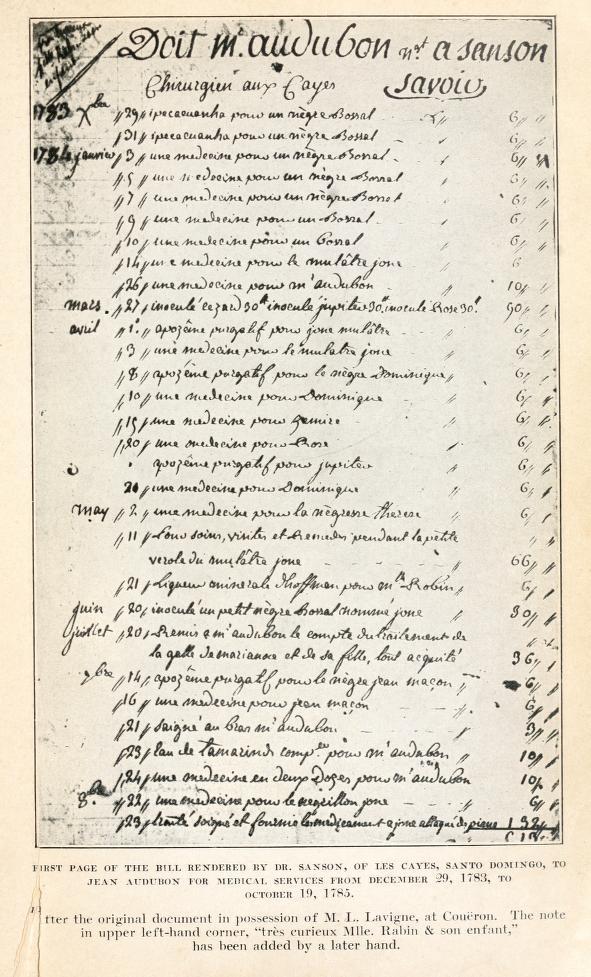
FIRST PAGE OF THE BILL, RENDERED BY DR. SANSON, OF LES CAYES, SANTO DOMINGO, TO
JEAN AUDUBON FOR MEDICAL SERVICES FROM DECEMBER 29, 1783, TO
OCTOBER 19, 1785.
After the original document in possession of M. L. Lavigne, at Couëron. The note
in upper left-hand corner, “très curieux Mlle. Rabin & son enfant,”
has been added by a later hand.
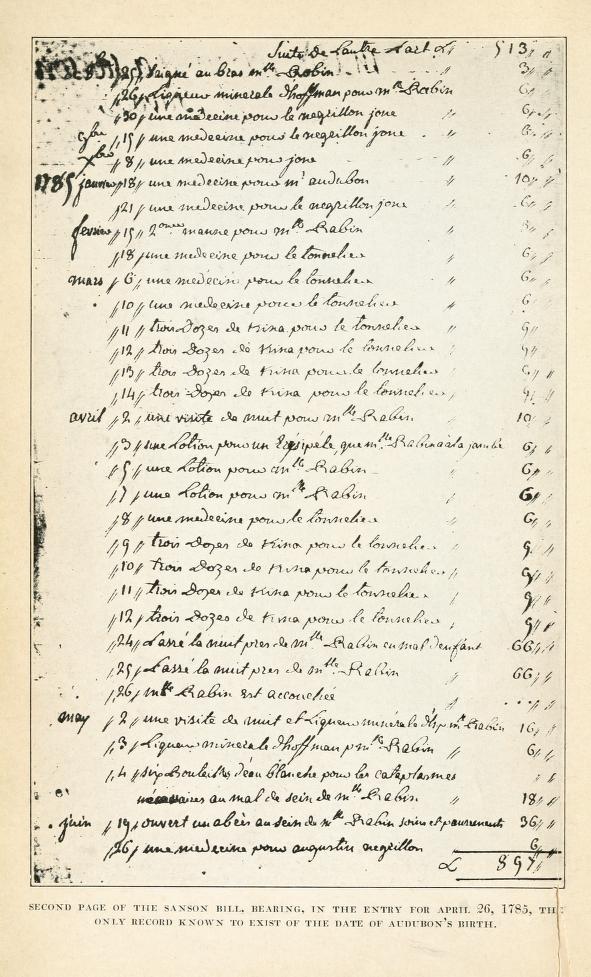
SECOND PAGE OF THE SANSON BILL, BEARING, IN THE ENTRY FOR APRIL 26, 1785, THE
ONLY RECORD KNOWN TO EXIST OF THE DATE OF AUDUBON’S BIRTH.
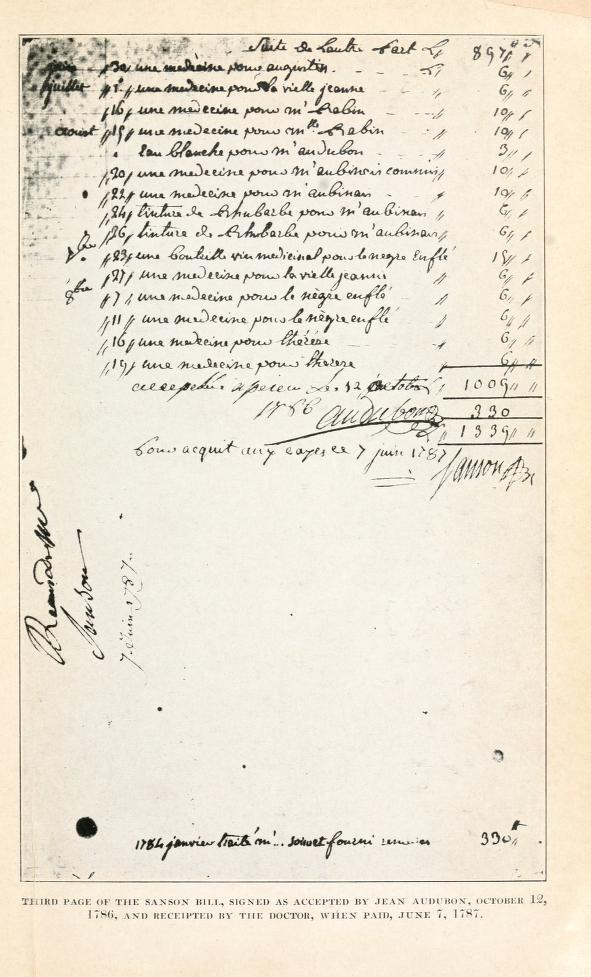
THIRD PAGE OF THE SANSON BILL, SIGNED AS ACCEPTED BY JEAN AUDUBON, OCTOBER 12,
1786, AND RECEIPTED BY THE DOCTOR, WHEN PAID, JUNE 7, 1787.
This physician’s chief resources are seen to have
been ipecacuanha, purgative decoctions, including such
as the tamarind tree provided, manna, mineral waters,
lotions, plasters, and kino, an astringent juice derived
from different leguminous plants, which gave a red color
to the saliva, not to speak of “other medicines,” the nature
of which is not revealed, which were liberally supplied
to whites and blacks, both old and young, alike.
It will be noticed further that the slaves of African
birth when not named are referred to as “bossals“
though many young blacks and mulattoes are called
”Joue“;37 that a cooper, attached presumably to the
55
Audubon sugar refinery, was dosed thrice daily with
kino on four days in succession; and that this favorite
treatment was repeated a month later. A clerk in the
establishment, Monsieur Aubinais, is mentioned as requiring
frequent attention, as well as Jean Audubon
himself, who was once bled at the arm.
In the entry for March 27, 1784, there is this interesting
reference: “Inoculated Cæsar, Jupiter, and
Rose, at thirty francs each, ninety francs”; and if there
were any doubt why Cæsar had been inoculated, a hint
is immediately given under May 11: “For attention,
visits, and remedies, during the smallpox (la petite
vérole) of the mulatto Joue, sixty francs“; again we
read: ”June 30, inoculated a little negro bossal, named
Joue, thirty francs.“ Every fresh batch of negroes
landed in the colonies led to a new outbreak of this
terrible scourge, and but one other disease, la grosse
vérole,38 was more common or more fatal among the
blacks. For a long period it had been a common practice
to inoculate both whites and blacks directly with
the smallpox in order to secure some degree of protection
against its most virulent form, but this method of
fighting the devil with fire had its disadvantages. By
the end of the eighteenth century opinion was about
equally divided upon the advisability of continuing the
measure, since induced variola or smallpox was apt to
be virulent, and was often quite as infectious as when
manifested in the usual and natural way. Then came
Edward Jenner’s grand discovery, made twelve years
before this date but not announced until 1798, that vaccinia
would prevent variola. Almost immediately vaccination
56
spread like wild fire over Europe, and it has
never been appreciated more fully or more highly lauded
by the best representatives of the medical profession
everywhere than at the present day.
The most interesting references in this historic
document are to “Mlle. Rabin,” whose name occurs no
less than seventeen times, beginning May 21, 1784, and
closing with the entry for the seventeenth of August,
1785. We learn that the physician spent the nights of
April 24 and 25, 1785, at the woman’s bedside, and that
her child was born on the twenty-sixth day of that
month, probably in the morning. It will be noticed further
that she had been bled previously at the arm, that
she had suffered also from the erysipelas, and that later
she was treated for abscesses. These frequent attentions
of the physician, extending over several months, the last
record being for August 17, show only too clearly that at
this time Audubon’s mother was in feeble health. All
that is further known about her is that she died either at
the close of 1785 or in 1786, when her infant son was
probably less than a year old. 39
A daughter of Jean Audubon, Rosa, who was first
called Muguet (in English, “Lily of the Valley”), was
also born in Santo Domingo, and probably at Les Cayes,
on April 29, 1787. Her mother, Catharine Bouffard,
“créole de Saint-Domingue,“ who subsequently went to
France, had another daughter, born also at Les Cayes,
named Louise, who was living at La Rochelle in 1819.40
57
When Captain Audubon finally left the West Indies
in the autumn of 1789, he took with him, in the care of
trustworthy slaves, these two children, Fougère or Jean
Rabin, aged four and a half years, and Muguet or
Rosa, an infant of less than two. We know that he
visited Richmond, Virginia, to collect a long outstanding
claim against David Ross, then engaged in an iron industry
near that city (see Chapter VIII, p. 121), and
it is possible that he traveled by way of New
Orleans and the Mississippi and Ohio rivers. After
spending some time at the close of this year in the
United States, he went to France and made a home
for his children at Nantes. This city became essentially
their permanent abode until their father’s retirement
from the navy on January 1, 1801, when he finally
settled in the little commune of Couëron, on the north
bank of the Loire. The storm that burst over Nantes
soon after their arrival revealed the true colors of Jean
Audubon’s patriotism, and the man was seen at his best,
as will be related in the following chapter.
Madame Audubon, who had no children of her own,
tenderly received the little ones, thus wafted from over
the sea to her door in the Rue de Crébillon.41 As the
58
story proceeds we shall see that she was a most kind,
if over-indulgent, foster mother, and became excessively
proud of her handsome boy. “The first of my recollective
powers,” said the naturalist when writing of himself
in 1835,42 “placed me in the central portion of the
city of Nantes … where I still recollect particularly
that I was much cherished by my dear stepmother …
and that I was constantly attended by one or two black
servants, who had followed my father to New Orleans
and afterwards to Nantes.”
Jean Audubon, who spent a good part of his life at
sea and in a country almost totally devoid of morals,
must be considered as the product of his time. He was
better, no doubt, than many who made greater professions,
better certainly than a Rousseau, who gave excellent
advice to parents upon the proper methods of
rearing their children but sent his own offspring to
orphan asylums. As most men have their faults, said
the son, the father “had one that was common to many
individuals, and that never left him until sobered by a
long life”; but, he added, “as a father, I never complained
of him; his generosity was often too great, and
his good qualities won him many desirable friends.”
Whatever his faults, Jean Audubon was just, generous
and possessed of a kind heart. He was in reality a truer
father than many who give their children their name
but deny them sympathy and a wise oversight. Jean
59
Audubon not only cherished the two children but made
them his heirs. On March 7, 1793, Fougère at the age
of eight and Muguet at six were legalized by a regular
act of adoption in the presence of witnesses at Nantes
as the children of Jean and Anne Moynet Audubon.
This step was taken at the very moment when the
storm had burst over La Vendée, when the fate of
Nantes was trembling in the balance and the life of her
citizens was most insecure. The act of adoption reads:43
Extract from the registers of births of the sections of La Halle
and Jean Jacques of the commune of Nantes, department
of the Loire inférieure, on the seventh of March, 1749, the
second year of the Republic, one and indivisible, at ten
o’clock in the morning.
Before us, Joseph Theulier, public officer, elected to determine
the public status of citizens, have appeared in the town
hall, Jean Audubon, commanding the war sloop Cerberus, vessel
of the Republic, aged forty-nine years, native of Les Sables
d’Olonne, department of La Vendée, and Anne Moinet his wife,
aged fifty-eight years, native of the former parish of Saint-Leonard,
of this commune, who, assisted by René Toussaint
Julien Beuscher, manufacturer, aged twenty-five years, living
in the section of La Halle, Rubens Street, and by Julien Pierre
Beuscher, marine surgeon, aged twenty-four years, living in
the section of La Fraternité, Marchix Street, and employed
steadily in the said war sloop Cerberus, have declared before me
that they do adopt and recognize from this moment as their
lawful children, to wit:
A male child named Fougère, born since their marriage, which
took place on the twenty-fourth of August, 1772, in the commune
of Paimbœuf, in this department, to him, Jean Audubon,
and a woman living in America, who has been dead about eight
years, and a female child, named Muguet, born also since the
60
marriage aforesaid, to him and another woman living in America,
named Catharine Bouffard, of whose fate he is ignorant.
The two children being present, the first aged nine years,
that will expire on the 22d of next April, the second aged
seven years, that will also expire on the 26th of April next, and
both having been born in America, according to this declaration
that the witnesses above mentioned have signified as true,
I have drawn up the present act, which the natural father and
the mother by adoption, as well as their witnesses have signed,
together with myself in this said day and year.
It will be noticed that in this legally attested document,
Bouffard, the true name of Muguet’s mother, is
given, while the name of the mother of Audubon is suppressed.
It might therefore be inferred that the name
Rabin, which appears later, was assumed, but as already
remarked, such evidence is not conclusive.
Fougère, who was also called Jean Rabin, was baptized
on October 23, 1800, by a priest of the church of
Saint-Similien at Nantes. The archives of this church
for the period in question have disappeared, but Jean
Audubon’s copy of the record has survived, and reads
as follows:44
The Act of Baptism of Jean Audubon-Rabin
October 23, 1800
We, the undersigned, certify to have baptized on this day
Jean Jacques Fougère Audubon, adoptive son of Jean Audubon,
61
lieutenant of a frigate of the Republic, and of Anne Moinet,
his legitimate wife, who being present bear witness that the
adoption of the said Fougère, made by them, is in accordance
with the present act.
Signed Tardiveau,
priest of Saint-Similien,
of the town of Nantes.
The act of adoption was drawn at a time when Captain
Audubon could have had little leisure to consult
records had he been disposed to do so, but the dates
of birth which he then gave for these two children were
correct both as to the year and month. Fougère, however,
was born on the twenty-sixth, instead of the twenty-second
of April, and Muguet, on the twenty-ninth,
instead of the twenty-sixth, of that month. Audubon’s
mother’s name is indicated in numerous legal documents
of later date, and, as will appear, in every instance her
son’s identity is clearly established.
Young Audubon, who disliked the names of Fougère
and Rabin, and naturally wished to be rid of their early
associations, adopted the fanciful name of “La Forest,”45
but used it only sporadically and for a short time.
Some of his drawings of birds made at Nantes or Couëron
as early as 1805, and in New York in 1806 and 1807,
and possibly others of slightly later date, are signed
“J. L. F. A.,” or “J. J. L. Audubon.”46
Jean Audubon and his wife are said to have settled
62
some property upon “Jean Rabin, créole de Saint Domingue,“
which he refused to accept, saying, “my own
name I have never been permitted even to speak; accord
me that of Audubon, which I revere, as I have cause
to do.”47 The reference in this instance was, I believe, to
the final will of Lieutenant Audubon,48 according to
which his property, after being held in usufruct by his
wife during her lifetime, was to be equally divided between
their two adopted children. In his first will the
son was referred to as “Jean Audubon,” but in the second
and last document, executed in 1816, two years before
the testator’s death, he appears as “Jean Rabin.”
Madame Audubon drew four wills; in the first, dated
December 4, 1814, her adopted son is called “Jean Audubon”;
in the next, of 1816, he is “Jean Rabin, créole
de Saint-Domingue,” while in a draft written December
26, 1819, he is styled simply “Jean Rabin”; finally, in
her fourth and last testament of July 16, 1821, the wording
is “Jean Audubon, called ‘Jean Rabin.’” It is
thus very plain that Audubon’s foster parents considered
it advisable to have his identity clearly set forth
in legal documents. In one of his autobiographical
sketches Audubon remarked that his own mother was
said to have been as wealthy as she was beautiful, and
if this were true, such caution might be explained and
a key found to certain other enigmatical conditions
which seemed to hedge his early life. But to such possibilities
it will be necessary to revert at a later point of
our story.49
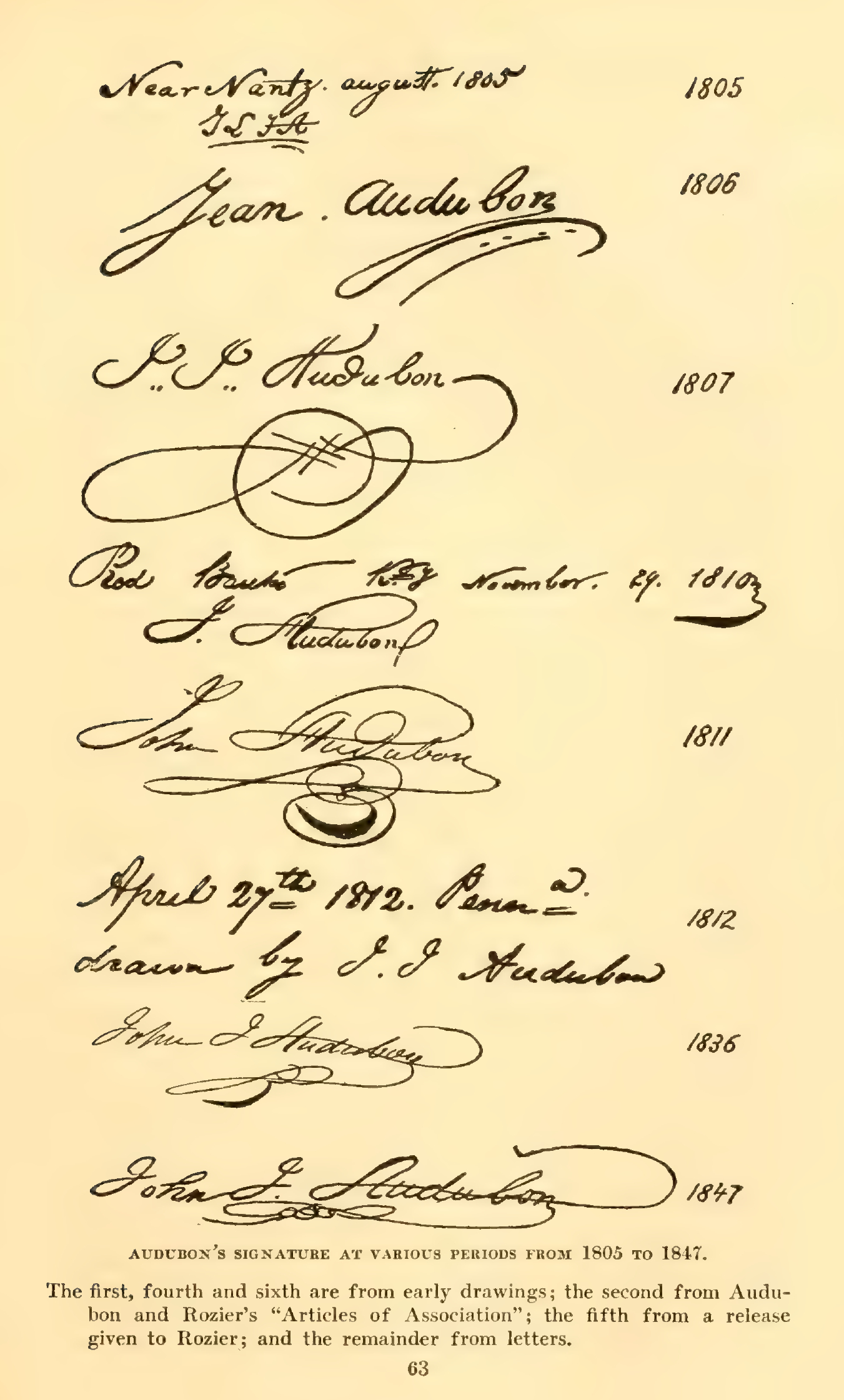
AUDUBON’S SIGNATURE AT VARIOUS PERIODS FROM 1805 TO 1847.
The first, fourth and sixth are from early drawings; the second from Audubon
and Rozier’s “Articles of Association”; the fifth from a release
given to Rozier; and the remainder from letters.
This dual personality was set forth by the naturalist
himself, but in a more curious form, in a power of attorney50
64
executed at Henderson, Kentucky, on July 26,
1817, in favor of his brother-in-law, Gabriel Loyen du
Puigaudeau. This measure was taken more than a year
after Audubon’s father had drawn up his last will, in
which the son was referred to as “Jean Rabin,” and was
evidently designed to facilitate any settlement of this
will which events in France might render necessary.
The naturalist was then engaged in his famous but disastrous
financial enterprises on the Ohio River,51 but
whether any intimation had come to him of possible legal
troubles, which later actually ensued in France, cannot
be stated.
65
In reading the published accounts of Audubon’s
early life many have been puzzled by the absence of definite
dates, as well as by the numerous contradictions in
which they abound. It is needless to burden this narrative
with a tedious reference to all these errors or to
attempt to trace their origin, which no doubt had many
sources, but since we have given the first true account
of the naturalist’s birth, we cannot pass these matters
without a word of comment. The situation is somewhat
involved, since we should possibly differentiate between
what Audubon at different times believed to be true, and
what he wished to make known to his family or to the
public; possibly also we should discriminate between
what he actually published over his own signature during
his lifetime and the material which has appeared
since his death, even though originally written by his
own hand.
The first definite date which Audubon ever gave concerning
his own life was that of his marriage in 1808,
when he was twenty-three years of age, and all that
he ever published of a biographical nature is to be found
in his Ornithological Biography.52 In the introduction
to this work he simply said that he had “received light
and life in the New World,” and further that he returned
to America from France, whither he had gone to receive
the rudiments of his education, at the age of seventeen.
Since Audubon’s first return to America was in the
autumn of 1803, when he was actually about eighteen
and one-half years old, this statement is not so wide of
the mark as to imply that the date of his birth was not
then well understood. Moreover, the record of his adoption,
which was certified to at the time of his baptism in
1800, was carefully preserved among the family documents,
66
and there is no reason to suppose that knowledge
of his age was ever withheld from him. Nevertheless,
Audubon was inclined to overestimate his years, a characteristic
rare in these days; when at Oxford in 1828
he was asked for his autograph, and was begged to inscribe
also the date of his birth; “that,” he said in recording
the incident, “I could not do, except approximately,”
and his hostess was greatly amused that he should not
know.
While going down the Ohio River in 1820, bound for
New Orleans, Audubon took advantage of a rainy day
to write in his journal something about himself that he
thought his children at some future time might desire
to know. This brief record may or may not have been
at hand when in 1835 he wrote the more extended version
that finally saw the light in 1893.53 Since the manuscript
of the later sketch was presumably in possession
of Mrs. Audubon when the biography of her husband
was prepared in New York about the year 1866, that
account in its various versions has furnished biographers
with practically all of the available material, not
purely conjectural, concerning the naturalist’s early life.
Such additions as were made subsequently have proved
to be very inaccurate.
In the first of these sketches, which, so far as it goes,
is more in strict accord with facts, Audubon said nothing
of his birth, and of his mother remarked only that he
had been told that she was “an extraordinary beautiful
woman,” who died shortly after he was born. His
father, he added, saw his wealth torn from him, until
there was left barely enough to educate his two children,
all that remained of the five, his three elder brothers54
67
having been “killed in the wars.” He then believed,
as he said, that his first journey to France was made
when he was two years old.
The later and fuller biography, referred to above as
written in 1835 and published in 1893, begins with these
words:55
The precise period of my birth is yet an enigma to me,
and I can only say what I have often heard my father repeat
to me on this subject, which is as follows: It seems that my
father had large properties in Santo Domingo, and was in the
habit of visiting frequently that portion of our Southern States
called, and known by the name of, Louisiana, then owned by
the French Government.
During one of these excursions he married a lady of Spanish
extraction, whom I have been led to understand was as beautiful
as she was wealthy, and otherwise attractive, and who bore
my father three sons and a daughter, — I being the youngest of
the sons and the only one who survived extreme youth. My
mother, soon after my birth, accompanied my father to the
estate sic of Aux Cayes,56 on the island of Santo Domingo,
and she was one of the victims during the ever-to-be-lamented
period of the negro insurrection of that island.
My father, through the intervention of some faithful servants,
escaped from Aux Cayes with a good portion of his
plate and money, and with me and these humble friends reached
New Orleans in safety. From this place he took me to France,
where having married the only mother I have ever known, he
left me under her charge and returned to the United States in
the employ of the French Government, acting as an officer
under Admiral Rochambeau. Shortly afterward, however, he
68
landed in the United States and became attached to the army
under La Fayette.
The true history of Jean Audubon’s commercial,
naval, and civic career is given in the preceding and following chapters.
The naturalist, in his letters and journals, made frequent
allusions to his age, but, as his granddaughter remarked,
with one exception, no two agree; hence, his
granddaughter concluded that he might “have been born
anywhere from 1772 to 1783.” In the face of such
uncertainty she adopted the traditional date of May 5,
1780, adding that the true one was no doubt earlier.
Audubon was thus five years younger than his biographers
supposed, and twenty-one years were added to the
age of his father, who actually lived to be only seventy-four
years old, while his son died in his sixty-seventh
year.
Wherever there is mystery there tradition is certain
to raise its head, and though the naturalist carried his
“enigma” to the grave, others, building upon his story,
have fixed upon the very house in Louisiana in which
he is said to have been born. Indeed, advocates of
more than one house in that state as the probable scene
of Audubon’s nativity have arisen in recent times. We
are obliged, therefore, to examine somewhat farther the
now universally received but thoroughly erroneous idea
that John James Audubon was a native of Louisiana
at a time when that Commonwealth was part of a province
of France.
Upholding a tradition of rather recent growth, Audubon’s
granddaughter has expressed the belief that the
naturalist was born in a house belonging to the famous
Philippe de Marigny and known as “Fontainebleau.”
69
This was a sugar plantation on the north side of Lake
Ponchartrain, three miles east of what is now the village
of Mandeville and twenty-five miles due north of
New Orleans.
Pierre Enguerrand Philippe de Mandeville, Ecuyer
Sieur de Marigny,57 at one time owner of vast estates in
and about New Orleans, was born in that city in 1750,
and served as its alcade or mayor for two years. A
lavish dispenser of hospitality, in 1798 he entertained
in great state the Duke of Orleans, later known as
Louis Philippe of France, together with his two brothers
who accompanied him. He died at New Orleans,
leaving five sons, of whom the third, Bernard Marigny,
later became the owner of “Fontainebleau,” which it
has been mistakenly assumed was inherited from his
father. At the time of the Duke of Orleans’ visit just
mentioned Jean Audubon had been out of the country
nine years; there is no evidence of his ever having
owned property at New Orleans, or ever having sustained
any relations with the Marigny family.
Before following the Marigny myth further, it will
be interesting to notice a late echo of the “Fontainebleau”
story. In 1910 the Reverend Gordon Bakewell,
then in his eighty-ninth year, gave some interesting reminiscences
of Audubon, and spoke very definitely concerning
both the time and place of his birth. Dr. Bakewell
was a nephew of Mrs. Audubon, and as a youth, in
1834, had passed some time at her home in London.
John W. Audubon, with his father’s assistance, painted
at that time a portrait of young Bakewell, who at a
70
later day was welcomed in their home on the Hudson.
Dr. Bakewell’s contribution was as follows:58
The uncertainty as to the place of Audubon’s birth has been
put to rest by the testimony of an eye witness in the person
of old Mandeville Marigny now dead some years. His repeated
statement to me was, that on his plantation at Mandeville,
Louisiana, on Lake Ponchartrain, Audubon’s mother was
his guest; and while there gave birth to John James Audubon.
Marigny was present at the time, and from his own lips, I have,
as already said, repeatedly heard him assert the above fact.
He was ever proud to bear this testimony of his protection
given to Audubon’s mother, and his ability to bear witness as
to the place of Audubon’s birth, thus establishing the fact that
he was a Louisianian by birth.
We do not doubt the candor and sincerity of the
excellent Dr. Bakewell, but are bound to say that the
incidents as related above betray a striking lapse of
memory and an even greater misunderstanding of recorded
facts. Singularly a footnote to the paragraph
quoted shows that the Marigny to whom he refers was,
as must have been the case, Bernard Mandeville de Marigny,
who was born in 1785, the same year as the naturalist.
Since both were in the cradle at the same time,
he is hardly available as a witness. Moreover, the official
records of the United States Government prove that
the estate called “Fontainebleau” was not in possession
of the Marigny family at the time of Audubon’s birth.
The land in question was granted to a creole named
Antonio Bonnabel, on January 25, 1799, by Manuel
Goyon de Lemore, Governor-General of the Province of
Louisiana and West Florida. Bonnabel sold his tract
71
to Bernard Marigny in 1800, and Congress confirmed
his title to it by a special act in 1836.59
Bernard Marigny served in the French army towards
the close of the Napoleonic period, and his return to the
United States from France, about 1818, is said to have
been hastened by a duel which he fought with one of
his superior officers. On his return he named Bonnabel’s
old tract on Lake Ponchartrain “Fontainebleau,”
in remembrance of the place where his regiment had
been assigned for duty in France, and eventually built
upon the estate a sawmill and a sugar-house, and planted
sugar cane, living meanwhile on another plantation two
and one-half miles away. The latter estate was allotted
by him in 1832, when he gave it the name of Mandeville;
the settlement thus started has since grown to a village
of some 1,500 people. Here a summer house which belonged
to Bernard’s father still exists, although in altered
form; it has been raised to accommodate a lower
story, and is now known as the “Casino.” According to
those who have most carefully investigated existing records,
this is the only house in Mandeville which belonged
to the elder Marigny at the time of which we speak.
72
Bernard Marigny was one of those who befriended
Audubon when he was in desperate straits at New Orleans
in 1821, by advancing him money in return for
portraits or drawings of birds. He died in that city in
1868, when in his eighty-third year, a poor and honest
man.
73
CHAPTER V
LIEUTENANT AUDUBON AS REVOLUTIONIST
Background of Audubon’s youth — Nantes in Revolution — Revolt in La
Vendée — Siege of Nantes — Reign of terror under Carrier — Plague robbing
the guillotine — Flight of the population — Execution of Charette — The
Chouan raid — Citizen Audubon’s service — He reenters the navy and
takes a prize from the English — His subsequent naval career — His
losses in Santo Domingo — His service and rank — Retires on a pension — His
death — His character and appearance.
The ancient city of Nantes, long famed for the beauty
of its situation on the banks of a noble river, within
easy reach of the sea, as well as for its importance in
the arts of war and peace, numbered at the time of the
Revolution 70,000 souls. The modern visitor to this
favored spot will find quiet and orderly streets adorned
with monumental statues (one of these representing
Guépin, the revered historian of the city), the old buildings
nearly all replaced by better, the Loire spanned by
handsome bridges, and the ancient bounds of the town
extended until it has become the sixth city of the Republic.
Since Nantes formed a somber background to
Audubon’s youth, we shall follow in brief some of the
ordeals through which his family, in common with thousands
of other Nantais, were destined to pass during
those eventful years which witnessed the close of the
eighteenth century in France.
When Captain Audubon reached Nantes presumably
not far from the beginning of 1790, he found the city
in a state of the greatest turmoil and agitation. The
74
commons, or third estate, included hundreds of its rich
and influential citizens, and their demands for a fair
hearing and a representation equal to that of the other
orders had then passed the stage of open revolt, for they
had planted their “liberty tree” and were sworn to defend
it. In August of 1789 a permanent Committee
of Public Safety had been constituted at Nantes, and
by the end of that month 1,200 had volunteered for service
in the National Guard. There were many loyalists
in the city but they could not crush the ardent spirit
of this revolt, and when in September money was needed
to equip the revolutionary soldiery, young school children
raised large sums for the popular cause. Jean
Audubon immediately cast his lot with the revolutionists
and joined the National Guard, but how much service
he saw in the field cannot now be determined; it is
known, however, that he was with these troops in the
spring of 1792.60
In March, 1793, the loyalists of La Vendée rose to
arms, and marching on Nantes under the able leadership
of Charette, threatened to put its garrison to the sword
if it were not surrendered within six hours. The National
Guard met these invaders outside the walls and
left the citizens to shift for themselves. Thus thrown
upon their own resources, the Nantais showed that they
could help themselves. They requisitioned and used for
defense everything at hand; they exhumed the leaden
coffins in their grand cathedral and appropriated waterspouts
for ammunition, while their church bells were
molded into cannon. Though held in check, the Vendeans
laid siege to the city, and but for the resolution
of its mayor, Baco, Nantes would probably have fallen — in
which event Audubon would have had a different
75
history and would probably never have become a pioneer
naturalist in America. Baco, disregarding the
advice of his military chiefs, immediately placarded the
walls of Nantes decreeing death to any who should
suggest capitulation, and called all the inhabitants to
arms, sparing neither woman nor child. The Vendeans
had met their match, for they were dealing with many
of their own blood, but though the siege began in early
March, they were not effectually dispersed until the end
of June, and then only after much bloodshed without
the walls. When the immediate crisis had passed, the
Constitution of the Republic was unanimously accepted
by the eighteen sections of Nantes, on the twenty-first
day of July, 1792.
A few months later in that fateful year a more terrible
calamity befell the city, when the reign of terror
under the notorious ultra-revolutionist, Jean B. Carrier,
began. Carrier reached Nantes on October 8 and at
once proposed to exterminate both the Vendean royalists
and their Nantais sympathizers. He reorganized
the entire administration to suit his purposes, and to
carry out his plans recruited from the lowest classes a
revolutionary army to spy upon, denounce and arrest
private citizens, many of whom were sent to Paris for
trial when not secretly dispatched. The whole district
was soon paralyzed by the barbarity of the crimes then
committed, and the unhappy Vendeans were dragged to
Nantes, to be shot, guillotined or drowned, in such numbers
that the city was unable to bury its dead or the
river to discharge them to the sea. Thus perished thousands,
uncounted if not unknown, and the pestilence of
typhoid fever that immediately followed claimed another
heavy toll regardless of political sympathies.
While these dire scenes were being enacted, Jean Jacques
76
Fougère Audubon, then a lad of eight years, was living
in the heart of Nantes, and his father was one of its
leading revolutionists. An aunt of the future ornithologist,
according to his account, who was one of these
wretched victims of revolutionary fury, was dragged
through the streets of Nantes before his eyes, but apparently
she did not actually meet her death at that time.61
That Jean Audubon moved his family out of Nantes
during the revolutionary crisis is possible, and Couëron
would have been available as a place of refuge. Many
Nantais are known to have fled to Lorient on the coast
of Brittany, where they found in the heroic youth Julien
the ardent and fearless patriot who was destined
to become the real savior of their stricken city. Young
Julien denounced Carrier in his letters to Robespierre,
and when one of these was intercepted, defied him in
person. When his stirring appeals finally reached the
Tribunal at Paris, its misnamed representative was recalled,
and left Nantes under cover of night on February
14, 1794. During his mad reign of four months,
Carrier had gone far towards carrying out his theory
of republican government, that should begin, as he
openly avowed, by “suppressing” half of the population
of France. The records show that nearly nine thousand
bodies were buried in Nantes in a little over three
months, from January 15 to April 24, 1794. The plague
of fever no doubt accounted for many of these, but the
wide reaches of the Loire never told their full story.
Though the most grievous affliction of Nantes passed
with the recall of Carrier, the city had no lasting peace
until the execution of the Vendean leader, Charette, in
March, 1796; “Poor Charette,” said Audubon, writing
in his journal at Liverpool, December 24, 1827, “whom
77
I saw shot on the place de Viarme at Nantes.” This
virtually ended the war in the Vendée, but the Chouans,
under their intrepid chief, Dupré, the miller, called
“Tête-Carrée,” managed to furnish considerable excitement,
and raided Nantes in 1799. Dupré’s followers
stole in secretly at three o’clock on the morning of October
19 and left before daylight, after liberating fifteen
royalists from the prison, which seems to have been their
chief purpose. The cannon of alarm was fired from
the Chateau; the tocsin sounded, calling the city to arms;
there was much street fighting, but it was too foggy and
dark to distinguish friend from foe, and when the National
Guard was finally assembled, the enemy had
vanished. This brief attack cost the city twenty-one
deaths and wounds for twice the number,62 but it was
only a passing incident in comparison with events that
had gone before. Thenceforth the history of the town is
blended with that of the nation.63
We have only slight indications of Jean Audubon’s
activities from the close of 1789, when, according to his
own statement, he was in the United States, to the period
of his service in the National Guard at Nantes in the
spring of 1792; he was then living in the house of Citizen
Carricoule, rue de Crébillon, and the lease of his “Mill
Grove” farm, which was renewed in October, 1790, was
dated at Nantes. We may safely assume that he was
78
engaged in revolutionary business during most of this
interval: his name begins to appear in the written records
of Nantes and of the department of the Lower
Loire in January, 1793, and existing documents64 show
that he was engaged as a commissioner and member of
the Department and as a member of the Council of the
Navy until the twenty-fifth of June, when he enlisted for
active service in the navy of the Republic. Jean Audubon
served also on various republican committees, his
duties comprising the enlistment of recruits, organizing
the National Guard, soliciting funds and food supplies
for Nantes, finding cannon and other military or naval
materials, posting proclamations, administering the oath
of allegiance, and watching the movements of loyalist
troops in the district. We have seen that the father
of the naturalist was a game and determined fighter, and
there is ample written testimony to prove that in the
commune of Nantes he was regarded as an ardent
patriot, who could be relied upon to act with tact, and
if necessary with force.
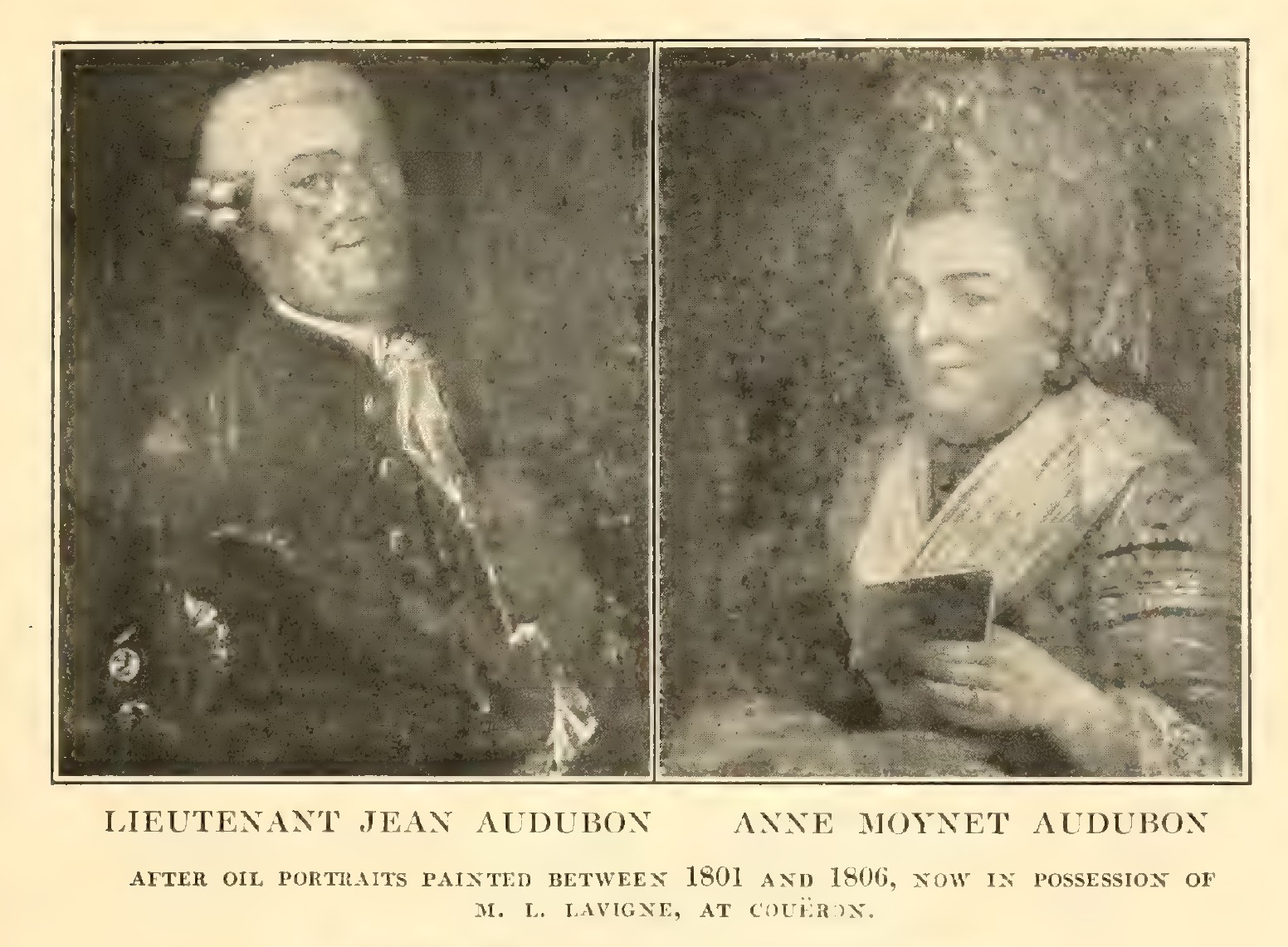
LIEUTENANT JEAN AUDUBON
ANNE MOYNET AUDUBON
AFTER OIL PORTRAITS PAINTED BETWEEN 1801 AND 1806, NOW IN POSSESSION OF
M. L. LAVIGNE, AT COUËRON.
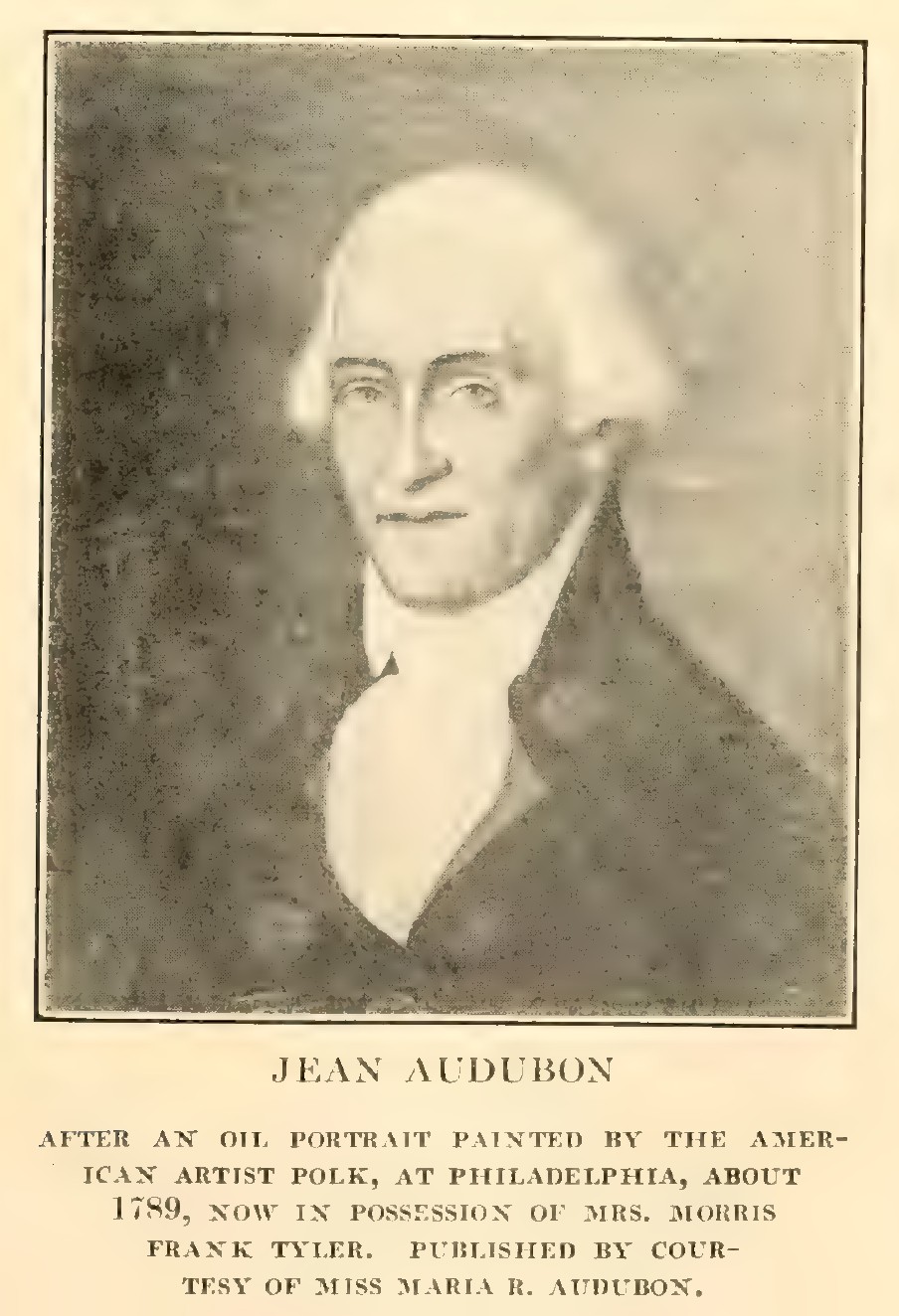
JEAN AUDUBON
AFTER AN OIL PORTRAIT PAINTED BY THE AMERICAN
ARTIST POLK, AT PHILADELPHIA, ABOUT
1789, NOW IN POSSESSION OF MRS. MORRIS
FRANK TYLER. PUBLISHED BY COURTESY
OF MISS MARIA R. AUDUBON.
Having been appointed a Civil Commissioner by the
Directory of the Department on January 17, 1793, Citizen
Audubon was sent to Savenay, a town of some importance
twenty-five miles to the northwest of Nantes.
His instructions on this mission were to gather useful
79
information on the civil, moral and political state of the
district, “in order to bring a remedy,” and to administer
the oath of allegiance to all administrative and judicial
bodies. Jean began operations without delay, and his
report, which was kept in journal form and embraces
the period from January 19 to September 10, 1793, is
an interesting document; it covers fifty-one large foolscap
pages, written now in a fine and again in a bold,
regular hand, in the course of which his characteristic
signature65 occurs no less than twenty-two times, each
section of the report having been signed as completed.
In one section of this journal he wrote: “Our operations
having been finished, we assembled around the tree
of liberty, and there sang the hymn of the Marseillaise,
which was interrupted with frequent shouts of ’Vive la
république!,’ ’Vive la nation!,’ and more than one charge
of musketry.“

ONE OF JEAN AUDUBON’S SIGNATURES IN HIS REPORT TO THE DIRECTORY, 1793.
From the original in the archives of the préfecture at Nantes.
Jean Audubon with eight others was charged with organizing
the National Guard in the canton of Pellerin,
and ordered to accompany the detachment that marched
to the relief of Pornic, March 27, 1793. The Citizen
was busy also in other directions. He said in his report:
80
In virtue of the power conferred upon us by the Central
Committee, on the ninth of April we were transported to the
parish of Couëron, where we arrived at seven o’clock in the
morning. Proclamations were posted both at Couëron and at
Port Launay close by, while some were sent across the river to
Pellerin. We availed ourselves on this occasion of the services
of two officers of a corsair, who demanded that we aid in removing
from Pellerin four cannon with four-pound balls, and
we succeeded in putting to flight a small barque and four
men, who an hour later returned with cannon…. The parish
of Couëron appears very tranquil, and is in a better mood than
at first seemed to us.
A little later Jean proceeded to Paimbœuf on a similar
errand. His letters to the citizen-administrators of
that commune are dated at Nantes on the seventeenth
of April and the fourteenth of May; in one of these he
refers to “the sum of four hundred francs” due from
the Administration “for one year’s rent of my house in
calle Rondineau (à la calle rondino), which you have
taken for a corps de garde“ (see Vol. I, p. 32).
In July and August of this second year of the Republic,
Citizen Audubon was sent to his native town of Les
Sables d’Olonne to follow the movements of the loyalist
generals Westermann and Boulart,66 a mission which
81
could hardly have been agreeable if, as seems to have
been the case, some of his own people were loyal to the
old régime. Correspondence by sea between Les Sables
and Nantes, which was open before the siege, was not
broken at this time, for the royalists had named one of
their representatives, Benoit, as a delegate “to fraternize
with the citizens of Nantes, to invite the authorities to
correspond, and beg them to send food if they had more
than they required.” Four of Jean’s letters, dated at
Les Sables on the fifth and eighth of July and the sixth
of August, besides one from La Rochelle on the fourteenth
of July, all addressed to the Administration of
the Loire inférieure, have been preserved.
In the manuscript records of the Department for
1793 is found also a notice of Jean’s appointment as Special
Commissioner, with a memorandum of all the money
paid to reimburse him for the expenses of his numerous
journeys. Thus, it is noted that he had been paid 145
francs for a service of twenty-nine days, which would
represent the modest allowance of a dollar a day. Another
item shows that he had received 100 francs for a
tour of ten days; a note which was added to this item
to explain the Directory’s sanction for the payment of
another forty-five francs and ten sous reads as follows:
“by its order of the sixth of March last, the Council had,
in effect, named Citizen Audubon as its Commissioner,
to visit the coasts and to secure signatures, with full
power to treat with all people, to acquire materials
for the navy and other objects of his mission; if this
mission did not prove successful, it was solely through
force of circumstances, and not from any lack of zeal
on his part.”67
82
On the twenty-fifth of June, 1793, while engaged in
duties to which we have just referred, Jean Audubon
was appointed, with rank of ensign, to command the
Republican lugger named the Cerberus.68 During this
charge, which lasted until the twenty-second of November
of the following year, he fought one of the stiffest
engagements of his career. On the twelfth of July he
encountered the Brilliant, an English privateer of fourteen
cannon which had captured an American ship laden
with flour; and after a desperate battle which lasted three
hours, in the course of which Jean was wounded in the
left thigh, the Englishman, beaten and obliged to surrender
his prize, was glad to escape under cover of night.
Jean towed the American into the port of La Rochelle,
and afterwards sent to the Administration a full account
of the engagement.69 Ensign Audubon’s next command
was a dispatch boat called L’Eveillé (“The Awakened”),
on which he served for nearly nine months, from
November 23, 1794, to August 14, 1795. He was then
detailed for port duty at La Rochelle from August 15,
1795, to January 24, 1797. His last ship was L’Instituteur
(“The Institutor”), which he commanded with
the rank of lieutenant de vaisseau, January 25 to
October 3, 1797, while he was engaged in governmental
business between the ports of La Rochelle
and Brest.
The financial losses which Lieutenant Audubon sustained
at Les Cayes in consequence of the revolution
in Santo Domingo were a crushing blow to him; he never
recovered his fortune, later estimated by his son-in-law
83
at a sum which at that day would have been fabulous.70
The business house in which he was interested failed; his
plantations, refinery, houses and stores, the rents from
which, as we have seen, in certain years after 1789, had
yielded 90,000 francs, were presumably ravaged and
partially destroyed. When the news of this misfortune
reached him after 1792, his hands were tied by revolutions
at home. Though he applied to his Government
for relief, as undoubtedly did a host of other losers, he
was eventually granted only a small indemnity, not
exceeding 30,000 francs.
Friends of Jean Audubon at Nantes had made repeated
demands of the Ministry of Marine that he be
given a rank more in accord with his patriotism and efficient
service to the State, and on October 11, 1797, he
was commissioned lieutenant-commander (lieutenant de
vaisseau),71 one grade below that of captain. He held
this rank for three years, during which he was engaged
in vigilance service at Les Sables d’Olonne and in military
duty at Rochefort, or until he was retired from
the navy for disability, January 1, 1801 (le 11 nivose,
an 9), at the age of fifty-seven.72 He had served the
84
State for over eight years, and his total period of active
duty on sea and land when employed in the merchant
marine and navy of France, as estimated from port to
port, amounted to nineteen years, nine months and
twelve days, while it had extended with interruptions
over more than forty years.73 After this long period
85
of service, when, suffering from a pulmonary affection,
he applied to his Government for a pension, he received
the paltry annuity of 600 francs or $120.
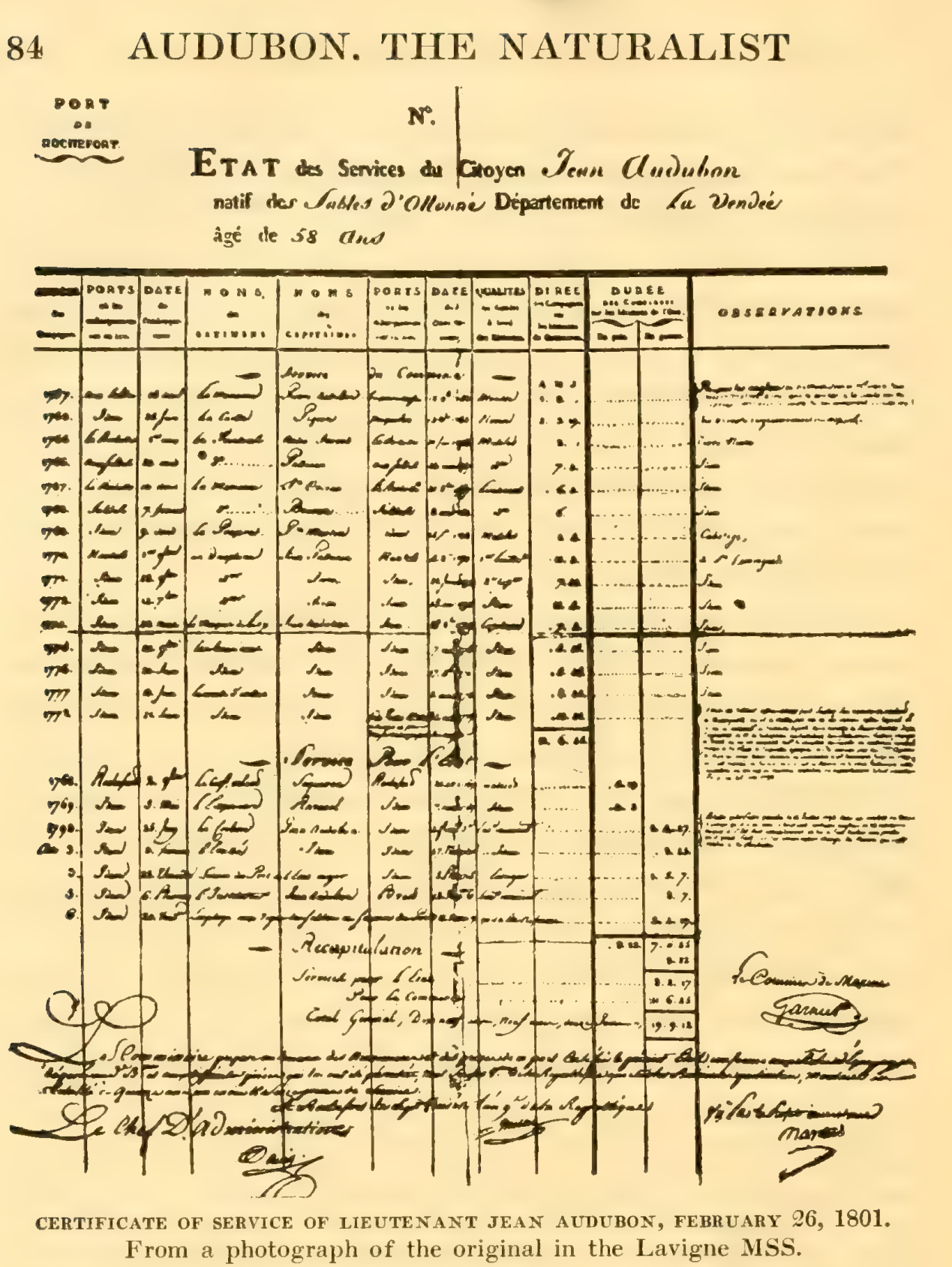
CERTIFICATE OF SERVICE OF LIEUTENANT JEAN AUDUBON, FEBRUARY 26, 1801.
From a photograph of the original in the Lavigne MSS.
With this modest pension and a property yielding
an income not above $2,000 a year74, Lieutenant Audubon
retired to his quiet villa of “La Gerbetière,” at Couëron,
where he could indulge his taste for country life and
for raising his favorite fruits and flowers; he is said to
have kept some live stock, but could have been a farmer
only on a modest scale. Meanwhile he continued to
maintain a house, or at least rooms, at Nantes, whither
he went periodically to conduct his correspondence and
business affairs. The following letter of attorney, issued
by Lieutenant Audubon a year after he had retired from
the navy, shows that he still had interests in Santo Domingo,
and was endeavoring to collect rents, long overdue,
from houses and stores that belonged either to
himself or to his clients. Whether through the dishonesty
of agents or from what other cause, this property
which the elder Audubon held in his own right seems
gradually to have melted away:
The 19th pluviose, in the eleventh year of the Republic,
one and indivisible January 7, 1802, before the public notaries
of the department of Loire inférieure, who reside in
Nantes and Doulon, the undersigned have seen present the
86
citizen Jean Audubon, lieutenant of frigate, retired, and proprietor
at Santo Domingo, aged 59 years, infirm and unable
in consequence of his infirmities to go himself to attend to his
business affairs in Santo Domingo, living in Rubens Street, in
the Mocquard house,75 No. 39, in the city and commune of
Nantes, department of Loire inférieure:
Who has made and constituted for his general and special
attorney Jean François Blanchard, merchant, and originally
from the commune of Chateaubriand, department of Loire inférieure,
living at the town of Les Cayes, in the southern section
of the island of Santo Domingo, opposite Ile à Vaches, to whom
he gives full and complete powers to revoke for him, and in
his name, every preceding bill of attorney, for the purpose of
managing the stores magazins at Les Cayes, in the southern
part of Santo Domingo, opposite Ile à Vaches: To demand and
obtain all accounts from the holders of said properties, who
have had or still have charge of them there; to examine the
said accounts, to debate, close up and stop them … to lease
the said properties, without the power of making any extensive
repairs to them whatsoever, about which he had not informed
the constituent in France, and that he has not authorized
him there to do, at least by a special letter, it being understood
that the actual tenant is obliged to make all the necessary
repairs to the said houses and stores to the extent of
15,000 francs, and he should not use more than 4,000 francs
yearly for the space of five years, counting from the month of
thermidor, year 8 July 19-August 17, 1800.
It is demanded of citizeness Fauveau, or of her assigns, to
know the reason why she has failed, to the present moment, to
pay to the constituent in France for the domicile of the citizeness
Coyron,76 the twelve thousand six hundred francs that
87
she should annually pay to him, according to the act of July
15, 1788, as given by Domergue, notary at Les Cayes. You
will satisfy them with the state of the dwelling house in the
plain of Jacob, opposite Ile à Vaches.
This was sold by the said act to the said citizeness Fauveau
and to her late husband by the said constituents, to whom he
will report regularly on the state of affairs, at least twice in
the year….
Signed at Nantes J. Royer
one of
the undersigned notaries
Lieutenant Jean Audubon died at Nantes,77 when on
a visit to that city, on February 19, 1818, at the age of
seventy-four, “regretted most deservedly,” said his son,
“on account of his simplicity, truth, and perfect sense
of honesty”; “his manners,” he continues, “were those of
a most polished gentleman … and his natural understanding
88
had been carefully improved both by
observation and by self education.” Jean Audubon’s means in
France had been reduced partly by bad debts, for he
seems to have been generous in lending money to his
friends; Madame Audubon found herself greatly hampered
by lack of ready money, although, as her
son-in-law remarked, her hands were full of notes.
When Jean Audubon applied for nomination to the
naval service of the Republic in 1793, we find a
description of his previous life and habits recorded as a part
of the information required by the Committee of Public
Safety. The commune of Nantes at that time gave
a flattering testimonial to his patriotism, in which he
was described as an officer of merit, who had acquired
through long experience at sea an extensive knowledge
of navigation, who was a man of honor, and devoid of
any inclination to vice or gambling; his nautical
experience had been chiefly gained in American waters, the
voyages of his choice being those to Santo Domingo and
the United States.
At the age of forty-eight the elder Audubon thus
briefly described himself: short in stature, measuring five
feet, five inches; figure, oval; eyes, blue; nose and mouth,
large; eyebrows, auburn; hair and beard turned gray.
Contrary to the naturalist’s expressed belief, there seems
to have been little or no physical resemblance between
father and son. At a corresponding age, John James
Audubon, according partly to his own account, stood
five feet, ten inches in stockings; his hair was dark
brown; he had sunken, hazel eyes, flecked with brown,
and of remarkable brightness; while his clean-cut profile
showed an aquiline nose. “In temper,” said the son, to
continue the comparison, “we much resembled each other,
being warm, irascible, and at times violent, but it was
89
like the blast of a hurricane, dreadful for a time, when
calm almost instantly returned.”
Though passionate at times, Jean Audubon was a
man of force and decision, as his career amply shows.
If he does not loom large in the history of his time or
was but little known beyond the limits of his province,
it must be remembered that the time called forth thousands
of the ablest men of his nation.
90
CHAPTER VI
SCHOOL DAYS IN FRANCE
Molding of Audubon’s character — Factor of environment — Turning failure
into success — An indulgent stepmother — The truant — His love of
nature — Early drawings and discipline — Experience at Rochefort — Baptized
in the Roman Catholic Church.
It is now commonly believed that of the three great
factors which mold character — environment, training
and heritage, the last is the most important, since it alone
is predetermined and unalterable. Environment may
be uncertain or unsuitable, training defective or deferred,
but blood is the one possession of which the
child cannot be robbed; and since it sets the limits to
possibility, in no small degree must it determine the acquisitions
and accomplishments of a lifetime. This,
however, is not the whole truth. Race may account for
much, but it does not account for everything; the child
is effectually robbed whenever it is not permitted to
realize to the full upon its inheritance. To be able to
convert possibilities into actualities it must receive fit
training and right incentives, and if at critical times the
proper spur is wanting, its patrimony may be sadly
wasted. The “good environment” for the youth, too
often thought to be the soft conditions of an easy life,
is in truth that only which provides the proper and
necessary stimulus. This may be now fear or pride, now
hard necessity or bitter want; again, an awakened sense
of responsibility or ambition to excel may be induced
91
by concrete examples and fostered, as it often is, by
lofty purposes and the uplift of a high ideal.
Audubon’s life affords a striking proof of the power
which environment can exert in awakening dormant
capacity, in developing talents to their full and calling
into use every force held in reserve. When we consider
what his life work finally became, and what he eventually
accomplished in a field for which he had no training,
except in drawing, we find it easier to wonder
at the man than to criticize him. With a formal schooling
in France of the slenderest sort, in which the writing
of his own language was never completely mastered,
at eighteen he came to America and adopted a new
tongue, which he first heard from the Quakers. Twenty
years more were to elapse before he had a definite plan, — during
which his environment was mainly that of a
trader and storekeeper in the backwoods, never remote
from the white man’s frontier, hardly the soil one would
seek for the development of budding talents in art, literature
or science. Failure in trade was one of the
spurs which started Audubon on his ultimate career,
for it led to the immediate development of the talents
which he possessed; the encouragement which he received
from his wife was undoubtedly another. When he finally
emerged, like a somewhat wild but well ripened fruit,
at the age of forty, rich in experience, ready to absorb
what from lack of earlier motives or opportunities he
had failed to acquire, and with the determination to
succeed, he won recognition as much through his personality
and enthusiasm as by his extraordinary versatility
and talents.
In an early sketch of his life Audubon said that his
father had given both him and his sister an education
appropriate to his purse; his teachers were possessed of
92
agreeable talents, and he might have stored up much
had not the continental wars in which France was then
engaged forced him from school at an early age, when,
much against his will, he entered the navy as midshipman,
at Rochefort. This naval experience terminated,
as he then recorded, in 1802, during the short peace
between England and France; he was then seventeen
years of age.78 This was the year following his father’s
retirement, and the year previous to his first independent
visit to the United States.
More details of this early period were given later,
when the naturalist spoke with great affection of his
foster mother, to whom his education had been mainly
entrusted. “Let no one speak of her as my step-mother,”
said he; “I was ever to her as a son of her own flesh
and blood, and she was to me a true mother.” His every
idle wish was gratified, he tells us, and his every whim
indulged, in accordance with the notion that fine clothes
and full pockets were all that were needed to make the
gentleman: “She hid my faults, boasted to every one
of my youthful merits, and, worse than all, said frequently
in my presence, that I was the handsomest boy in
France.”
If Madame Audubon broke the prevailing tradition
and by going to the other extreme did her best to spoil
this affectionate boy, some allowance must be made for
parental over-indulgence. In 1793, when the future
naturalist was eight years old, the public buildings of
93
his city had been converted into prisons and its streets
were both unsanitary and unsafe, while in the following
year, as we have seen, a mortal plague began to rob
the prisons and the guillotine. Many had lost their all
in the tempest that swept over them; many more had
fled, and public schooling at Nantes must have been at a
stand or disorganized for a considerable period.
Young Audubon could not have tasted much schooling
before the outbreak of the Revolution, when he was
seven years old, and but little after it, since this discipline
practically terminated in 1802. His passionate
love of nature, which was undoubtedly innate, was manifested
at an early day. Living things of every description
which he found by the banks of the Loire or along
the stonewalls and hedgerows of Couëron gave him the
greatest pleasure, but birds were his early favorites.
These he soon began to depict with pencil and crayon,
but to the dryer discipline of the school he ever turned
with laggard feet.
When the versatile Lord Avebury, who became one
of the greatest modern students of the powers of ants
and other social insects, was four years old, his mother
made this record in her diary: “His great delight is in
insects. Butterflies, Caterpillars or Beetles are great
treasures, and he is watching a large spider outside my
window most anxiously.” The same boy at eight, when
writing home from school, added this postscript to a
letter: “I am a favorite with most of the boys because
I do not care about being laughed.” The boy who has
a good inheritance, follows his own bent, and does “not
care about being laughed,” may be on the road to success
and with talents may achieve distinction. John James
Audubon was one of those boys, although his path was
never strewn with the roses that many have imagined.
94
The naturalist tells us that his father hoped that he
would follow in his footsteps, or else become an engineer,
and he saw that his son was instructed in the elements
of mathematics, geography, fencing and music. But as
Lieutenant Audubon was continually on the move, supervision
in those matters fell to the over-indulgent stepmother,
with the result that, instead of doing his duties
at school, young Audubon took to the fields. Every
night, he said, he would return with his lunch basket well
laden with the spoils of the day — birds’ nests, eggs, and
curiosities of every sort destined for the museum into
which his room had already been transformed. He was
then in the “collecting stage,” when that sense of possession
dominates the heart of the boy, which, if well
directed, can be turned to excellent account.
Lieutenant Audubon encouraged his son’s taste for
natural history and for drawing, but did not regard such
accomplishments as a substitute for what he considered
more serious subjects. He himself had suffered too
much from lack of a formal education and was resolved
to give his children the best opportunities within their
reach. “Revolutions,” he once remarked, according to
his son, “were not confined to society, but could also
take place in the lives of individuals,” when they were all
“too apt to lose in one day the fortune they had before
possessed; but talents and knowledge, added to sound
mental training, assisted by honest industry,” could
“never fail, nor be taken from any one when once the
possessor of such valuable means.”
When the elder Audubon returned from one of his
periodic cruises, “my room,” said the naturalist, “made
quite a show,” and the father complimented him on his
good taste; but upon being questioned in regard to the
progress made in his other studies, he could only hang his
95
head in silence. His sister Rosa, on the contrary, who
was also called to account, was warmly commended upon
the improvement shown in her musical exercises. The
next morning at dawn a carriage was drawn up before
the Audubon door, and with the father and son, together
with the latter’s trunk and violin, was soon proceeding
in the direction of Rochefort. The sailor had laid his
plans and was about to execute them in his own way.
Presently, said the son, his father drew forth a book
and began to read, thus leaving him to his own resources.
In this way they traveled for a number of days, not an
unnecessary word being spoken during the entire journey,
until the walls of Rochefort had been passed, and
they alighted at the door of the father’s house in that
city. When they had entered, the naturalist continues,
“my father bade me sit by his side, and taking one of my
hands, calmly said to me: ’My beloved boy, thou art
now safe. I have brought thee here that I may be able
to pay constant attention to thy studies; thou shalt
have ample time for pleasures, but the remainder must
be employed with industry and care. This day is entirely
thine, and as I must attend to my duties, if thou
wishest to see the docks, the fine ships-of-war, and walk
around the wall, thou mayest accompany me.’“
The youth accepted his father’s proposal with good
grace, and was presented to the officers whom they met,
but he soon found that he was like a prisoner of war
on parade. He was enrolled at once in the military
school, where he was placed under the immediate care
of Gabriel Loyen du Puigaudeau, his future brother-in-law.
It was not long, however, before young Audubon
gave his guardian the slip; he jumped from the window
of his prison and made for the gardens of the Marine
Secrétariat, but a corporal, whom he had recognized as
96
a friend, suddenly nipped his plans in the bud; he was
ordered, he said, aboard a pontoon, then lying in port,
and there was obliged to remain until his father, who
was absent at the time, finally released him, “not without
a severe reprimand.” The following record, written
long after, is reminiscent of this period: “This day
twenty-one years since I was at Rochefort in France.
I spent most of the day at copying letters of my father
to the Minister of the Navy…. What has happened
to me since would fill a volume…. This day, January
first, 1821, I am on a keel boat going down to New
Orleans, the poorest man on it.”
Audubon’s stay at Rochefort, the date of which is
no doubt correctly given in the journal just quoted, was
destined to be short. After a year he returned to Nantes,
and later to “La Gerbetière,” where as before he spent
all of his leisure in roaming the fields and looking for
birds, their nests, their eggs and their young. At about
this time, when fifteen years of age, Audubon began
to make a collection of his original drawings of French
birds, which was greatly extended in 1805 and 1806.
He has recorded that at the behest of his foster mother,
who was an ardent Catholic, he was confirmed in that
Church when “within a few months of being seventeen
years old”; he was surprised and indifferent, but “took
to the catechism, studied it and other matters pertaining
to the ceremony, and all was performed to her liking.”
Since no record of this act has been found, it is probable
that the ceremony in question was confused with that
of his baptism, which, as we have noticed, occurred on
October 23, 1800, six months before he attained his
sixteenth birthday.
After having seen something of the character of Audubon’s
early training in France, it will not be surprising
97
to find that when, at the age of forty-five, he first
seriously began to write for publication and in English,
which was not his mother tongue, he found himself handicapped
in many ways. In after life he wrote that the
only school which he had ever attended was that of Adversity,
and that his tuition there had been of a prolonged
and elaborate character. Though this statement
was made under the stress of present feeling, it was
not wholly devoid of truth.
98
CHAPTER VII
FIRST VISIT TO THE UNITED STATES, AND LIFE AT
“MILL GROVE”
Audubon is sent to the United States to learn English and enter trade — Taken
ill — Befriended by the Quakers — Settles at “Mill Grove” farm — Its
history and attractions — Studies of American birds begun — Engagement
to Lucy Bakewell — Sports and festivities.
If there were ever a time when Lieutenant Audubon
wished to see his son following the victorious eagles of
Napoleon, whom he is said to have idolized, the hated
conscription of that day, which was robbing every home
in France of its best blood, might well have brought
counsels of prudence. Little could the father have
thought that by following other eagles of his own choice,
his son was destined to add a far greater luster to the
family name. Whatever may have turned the scale, in
1803 a decision was quickly reached, and the issue was
fortunate for the future of natural science in America;
it was decided that young Audubon should emigrate
at once to the United States, with what end in view we
shall soon see expressed in the sailor’s own words. Accordingly,
to his “intense and indescribable pleasure,”
the future naturalist, who had now passed his eighteenth
birthday, eagerly prepared for the journey, the first of
many that were later to become memorable in the annals
of American science. No record of this voyage has been
preserved, but from evidence derived from a variety of
sources we can fix the time as the autumn of 1803.79
99
Audubon’s introduction to the country of his adoption
proved most inauspicious, for, to follow his account,
when walking to Greenwich in Connecticut, some thirty
miles from New York, to cash the letter of credit that
his father had given him, he was seized with the yellow
fever.80 Fortunately at this critical moment his captain
came to his aid, and placed him in the care of two Quaker
ladies who kept a boarding house at Morristown in New
Jersey. To the faithful ministrations of these kindly
sisters the naturalist believed that he owed his life.
When Jean Audubon finally left the United States
not far from the beginning of 1790, he placed his business
interests in America in charge of an agent, named
Miers Fisher, “a rich and honest Quaker of Philadelphia,”
100
and to the hands of this trustworthy man he now
confided his son. Accordingly, when young Audubon
had been nursed back to health, word was sent to his
father’s friend, who came in his carriage and drove the
lad to his own home in the outskirts of Philadelphia. To
follow the account which the naturalist gave, when writing
of this visit a quarter of a century later, his host,
finding his charge to be a comely youth, and having a
daughter “of no mean appearance,” proposed that he
should remain with them and become one of the family.
Audubon seems to have suspected that this was a premeditated
scheme to entangle him in marriage, and as
he had no liking for the severity of Quaker manners,
determined to make his escape. This, he said, was finally
accomplished by appealing to his own rights and to the
honest Quaker’s sense of duty in seeing him established
on the estate which his father had designed for him.
Though effective for the time, as will presently appear,
this appeal was quite fanciful, for Jean Audubon’s ideas
concerning the future of his son were of a more practical
character, and he had no intention at this time of establishing
him at “Mill Grove,” which was soon to be sold.
The friend to whom the following letter was addressed
is implored to aid in finding a good American family
in which his son could acquire the English language as
a step to entering trade:81
This will be handed to you by my son, to whom, I request
you will render every service in your power, wishing that you
shd. join Mr. Miers Fisher to procure him a good and healthy
place where he might learn english. I come to point out to
101
you Morristown, and look for a good and decent familly in that
place to recommend him to her as your own Son. This service
from you will deserve my everlasting gratitude. I am Sir, with
consideration.
Yr Mo ob Ser — .
Mr. Miers Fisher, who evidently received a copy of this
letter, no doubt considered his own family as good as
the best, and in detaining young Audubon at his home,
we must credit him with the desire of following the instructions
thus received.
“Mill Grove,” which was finally reached in the spring
of 1804,82 was a new-found paradise to the young naturalist.
Here, however, he was destined to spend but little
over a year, though it was doubtless the happiest year
of his life. The farm was then conducted by a Quaker,
named William Thomas, who was installed as tenant
with his wife and family. It was arranged, said Audubon,
that he should receive from them a quarterly allowance
in ready money, in a sum that “was considered
sufficient for the expenditure of a young gentleman.”83
Well might any youth fond of wild life in the country
have fallen in love with this secluded spot, the beauty
and charm of which are suddenly revealed to the visitor
of today as he approaches it from the old Philadelphia
road. Standing high on the rugged banks of the Perkioming
Creek, which empties into the Schuylkill River
just below this point, the old house, facing west, commands
a wide and diversified scene, extending from the
living waters below, over bottom lands of the valley, to
the dim, undulating lines of the Reading hills in the farther
102
distance. This old landmark84 of Colonial times remains
today in perfect preservation, thanks to the never-failing
care and interest of the present owner,85 who has
done all in his power to maintain its historic associations,
and to keep the memory of the naturalist green in one
of the few spots in America where material landmarks
of his career have not been completely effaced. The
place has had an interesting history, and though Audubon’s
occupancy was brief, it affected, as we shall see,
his whole after-life.
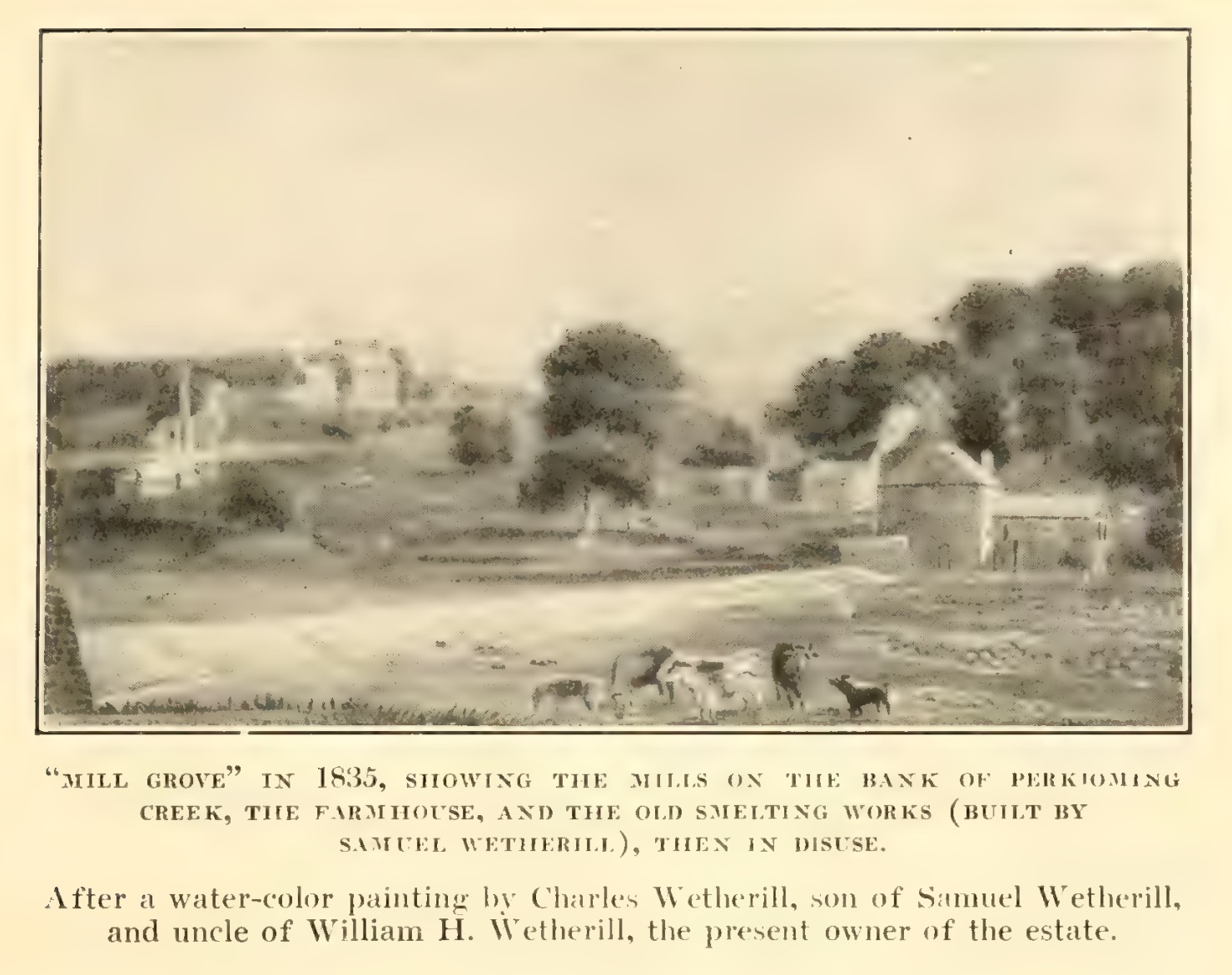
“MILL GROVE” IN 1835, SHOWING THE MILLS ON THE BANK OF PERKIOMING
CREEK, THE FARMHOUSE, AND THE OLD SMELTING WORKS (BUILT BY
SAMUEL WETHERILL), THEN IN DISUSE.
After a water-color painting by Charles Wetherill, son of Samuel Wetherill,
and uncle of William H. Wetherill, the present owner of the estate.
“MILL GROVE” AS IT APPEARS TO-DAY.
The above from photograph by, and this published by courtesy of,
Mr. W. H. Wetherill.
Audubon thought nothing of walking to and from
Philadelphia when no conveyance was at hand, but to-day
the railroad brings the traveler within a mile and
a half of his old farm. Not far to the south, beyond
the present railway station of Protectory, lies Valley
Forge and the wooded hills where Washington’s ragged
veterans passed in log huts the ever memorable winter of
1777-8. Audubon fancied that his father had made the
acquaintance of General Washington at that date, but
this was eleven years before the place had come into the
possession of his family, and at that time Captain Audubon
103
was sailing the seas (see Chapter II, p. 32). Equally
fanciful also was the idea that his mother had once
lived there, which he expressed in a letter (quoted in full
in Chapter XXXIII) written from New York on February
10, 1842, to young Spencer F. Baird, at Carlisle,
Pennsylvania. The naturalist was assuring his young
friend that the slow but beautiful “Little Carlisle” was
to be preferred to “Great New York, with all its humbug,
rascality, and immorality,” and added: “It is now a
good long time since I was young, and resided near Norristown
in Pennsylvania. It was then and is now a very
indifferent place as compared with New York; but still
my heart and my mind oftentime dwell in the pleasure
that I felt there, and it always reminds me that within
a few miles of that village, my Mother did live.”
The soil of this farm region is of a dark red color,
owing to a friable shale which outcrops everywhere.
The high, wooded bank of the Perkioming abounds in
caves, scooped out by the hand of nature or man, as
well as in great pits and shafts, for deep down under its
shale, “Mill Grove” was rich in minerals, particularly
the sulphide of lead, associated with copper and zinc, to
reach which many excavations have been made. The
lead mines of this farm are said to have been famous
in Revolutionary times, and have been worked sporadically
for a hundred years; if traditions are trustworthy,
many a winged bullet that laid a Red-coat low in the
War of Independence was a messenger from “Mill
Grove.” In some of the old conveyances, which go
back to the time of Penn, the place was commonly designated
as the “Mill Grove Mines Farm.” It is recorded
that the original tract of two thousand acres, extending
from the Schuylkill to the Perkioming as far as the
mouth of Skippack Creek, was sold to Tobias Collett by
104
William Penn in 1699 for fifteen shillings. We shall
soon see that the mineral wealth which “Mill Grove”
was supposed to hide beneath its rugged slopes was a
source of no little trouble to the Audubons, the Roziers,
and their successors for many a year.
At the foot of the declivity towards the west, half
hidden by foliage, stood a picturesque stone mill, at a
point where a solid rampart had been thrown across the
stream to divert its power to the use of man. Hard by
was the miller’s house, which antedates the mansion,
and which was built and first occupied by James Morgan,
who came into possession of the property in 1749.
It was this old mill site, originally distinct from the
farm, that gave the name to the place. Behind the
gristmill an extensive sawmill, built over the mill race,
was also in operation. Today the dam is broken
through, and the great mill wheel of wood and iron,
twelve feet in diameter and fifteen feet wide, has come
to rest after turning for more than a century.
Like the mill, the original house on the hilltop was
built of rough-hewn native stone, which is brown or
red and very hard. It consists of two stories, with central
hall, and a curiously divided attic with dormer windows,
which Audubon is said to have converted into a
museum. A marble slab in the south gable bears the
date of 1762; an addition of the same rough stone was
built on the north side, but at a considerably lower level,
in 1763, and the commemorative tablet in this instance
bears the initials “J. M.,” proving that the construction
of the buildings of “Mill Grove” was due to the old
miller, James Morgan. The interior, with its odd chimney-corner,
low ceilings, bold fireplace and hand-wrought
iron-work, bears witness to a time when honest, substantial
construction and pride in workmanship received the
105
first consideration. The present owner of “Mill Grove”
has added attractive porches at the front and back.
Ampelopsis climbs over the walls, which are shaded by
handsome trees; one of these, a fine black walnut at the
easterly porch, which in August bore its great green
balls in full clusters, must have been vigorous in Audubon’s
day, and possibly suggested the introduction of
sprays of this full-fruited tree into some of his plates.
While on a visit from Santo Domingo in 1789, concerned
with his business interests, Captain Audubon
spent some time in Philadelphia. On March 28, 1789,
he purchased the “Mill Grove” property, at that time
consisting of 284½ acres of land, mansion house, mill,
barns, furniture, tools and live stock, from Henry Augustin
Prevost86 and his wife, for the sum of 2,300 English
pounds, in gold and silver. He never lived there,
and that he never intended to make it his immediate residence
is shown by the fact that in less than a fortnight
he leased the farm in its entirety, as already noticed, to
its former owner, and gave him a mortgage which stood
for seventeen years.87
106
Young Audubon lived at “Mill Grove” from the winter
of 1804 to the spring of 1805, and again for a few
months in the summer of 1806, the year of its final sale
by the Audubons and Roziers (see p. 148). In his
journal of 1820 the naturalist wrote that his father had
once the honor of being presented to General Washington,
and also to Major Crogan, of Kentucky, “who was
particularly well acquainted with him.” Jean Audubon
left at “Mill Grove” oil portraits of himself and of
Washington, both by an inferior American artist named
Polk,88 and it is probable that the one of himself was
painted while he was at Philadelphia in the spring of
1789; the drawing is hard and flat, but the appearance
of the face clearly indicates a man past middle life, and
Captain Audubon had then reached his forty-fifth year.
Young Audubon, we may be sure, lost no time in
exploring the resources of this fine estate, where every
bird, tree and flower came to him as a new discovery.
In following the Perkioming above the mill dam he
found a cave, carved out of the rocks, as he thought, by
nature’s own hand, which was a favorite haunt of the
unpretentious but friendly pewees, the first American
birds to attract his serious attention. So delighted was
the youthful naturalist that he decided to make the pewees’
cave his study; thither accordingly he brought his
books, pencils and paper, and there made his first studies
of American bird life, in the spring of 1804, in the third
107
year of the presidency of Thomas Jefferson. It was
early in the season when Audubon chanced upon this
quiet retreat; the buds were swelling and maples had
already burst into bloom, but snow still lingered in
patches through the woods, and the air was piercing chill.
The pewees were not yet at home, but one of their nests,
fashioned of mud and finest moss, was fixed above the
vaulted entrance; their coming was not long delayed,
and Audubon, marking the very night or day’s dawn
when the first pewee arrived, saw them beginning to restore
their old home on the tenth of April.
Strange to say, almost at that very time another pioneer
in American ornithology, Alexander Wilson, who
will enter this history later, was teaching a rough country
school at Gray’s Ferry, Kingsessing, also on the
Schuylkill, and not over twenty-five miles away.
Though Audubon’s early studies were very desultory,
both naturalists began their observations at about the
same time, for on June 1, 1803, Wilson wrote to a
friend that many pursuits had engaged his attention
since leaving Scotland in 1794, and that then he was
“about to make a collection of all our finest birds.”
It must be set down to Audubon’s credit that in the
little cave on the banks of the Perkioming, in April,
1804, he made the first “banding” experiment on the
young of an American wild bird. Little could he or any
one else then have thought that one hundred years later
a Bird Banding Society would be formed in America to
repeat his test on a much wider scale, in order to gather
exact data upon the movements of individuals of all
migratory species in every part of the continent. After
a few trials, “I fixed,” said he, “a light silver thread on
the leg of each, loose enough not to hurt the part, but
so fastened that no exertions of theirs could remove it.”
108
In the following spring he had the satisfaction of catching
several pewees on their nests farther up the creek,
and of “finding that two of them had a little ring on the
leg,” proving that the young of a migratory bird, steering
by the “compass” which is carried in its brain, did
sometimes return to its home region, if not to the actual
cradle or home site.
Across the Philadelphia road, which today leads to
the little railway station, and not more than a quarter
of a mile from Audubon’s farmhouse, stood another but
more pretentious mansion of the Colonial era, called
“Fatland Ford,” pertaining to an extensive farm of
that name which was noted for the fertility of its alluvial
acres. A road from the present village of Audubon to
the Schuylkill River and the ford runs through the “Fatlands
of Egypt,” as the most productive parts of this
old farm were then called. From the house could be seen
the camping grounds of the Revolutionary soldiers,
and James Vaux, its owner and builder, is said to have
entertained General Howe at breakfast and to have
shown him the room which General Washington, his
guest of the previous day, had left just in time to avoid
an introduction.
Shortly before Audubon reached “Mill Grove,”
William Bakewell, an Englishman who had emigrated
to New Haven in 1802, bought this farm, and with his
wife and family took possession in the winter or spring
of 1804.89 Of the six Bakewell children, the two eldest,
Lucy Green and Thomas Woodhouse, were but three
years younger than the naturalist. The senior Bakewell,
said Audubon, called at “Mill Grove” to pay his
respects, but being then from home, and having brought
with him a Frenchman’s dislike for everything English,
109
he failed to respond. In the autumn, however, when
grouse had become plentiful in the woods, a chance
meeting brought them together, and young Audubon,
who was a great admirer of his neighbor’s expert marksmanship
and well trained dogs, duly apologized for his
neglect and forthwith paid a visit to “Fatland Ford.”
We shall let the naturalist tell in his own words of his
first meeting with the young woman who afterwards
became his wife:
Well do I recollect the morning, and may it please God that
I may never forget it, when for the first time I entered Mr.
Bakewell’s dwelling. It happened that he was absent from
home, and I was shown into a parlor where only one young lady
was snugly seated at her work by the fire. She rose on my
entrance, offered me a seat, and assured me of the gratification
her father would feel on his return, which, she added, would
be in a few moments as she would despatch a servant for him.
Other ruddy cheeks and bright eyes made their transient appearance
but, like spirits gay, soon vanished from my sight;
and there I sat, my gaze riveted, as it were, on the young girl
before me, who, half working, half talking, essayed to make
the time pleasant to me. Oh! may God bless her! It was she,
my dear sons, who afterward became my beloved wife, and your
mother.
When Mr. Bakewell returned, his daughter, Lucy,
presided at the tea that was served, and Audubon received
his first experience of hospitality in the English
style, that was to be repeated in Britain at a later day
on a more lavish scale. A hunting expedition was arranged
and the men started out at once. Festivities of
various sorts, and, later, skating parties, became the
order of the day, and it was not long before hospitalities
were exchanged, when Audubon, having secured,
110
with the aid of his tenant’s son, as many partridge as
possible, had the whole Bakewell family to dinner under
his roof at “Mill Grove.”
Audubon’s choice of a wife, thus quickly made,
marked a turning-point in his career, and the curious
fact remains that while he might have ransacked the
country from Florida to Maine, as he afterwards repeatedly
did in his search after birds, and woefully blundered,
the woman who by her sterling qualities of mind
and heart was the one to recognize and call forth the
best that was in him, should have been placed by circumstances
close by his door. Whatever the world has
ever owed to Audubon is a debt due to Lucy Bakewell,
for every leaf of oak that is plaited for his brow, another
of lavender should be twined for hers.
During this gay but brief period of his life, Audubon
has described himself as inordinately fond of dress, often
cutting, as he said, an absurd figure by shooting in
black satin breeches and silk stockings, and wearing the
best shirts which the Philadelphia market could afford;
he took pride, he adds, in riding the best horse that he
could procure, and in having his guns and fishing tackle
of the most expensive and ornate description. “Not a
ball,” he said, “a skating match, a house or riding party
took place without me.”
“MILL GROVE” FARMHOUSE, WEST FRONT, FACING PERKIOMING CREEK.
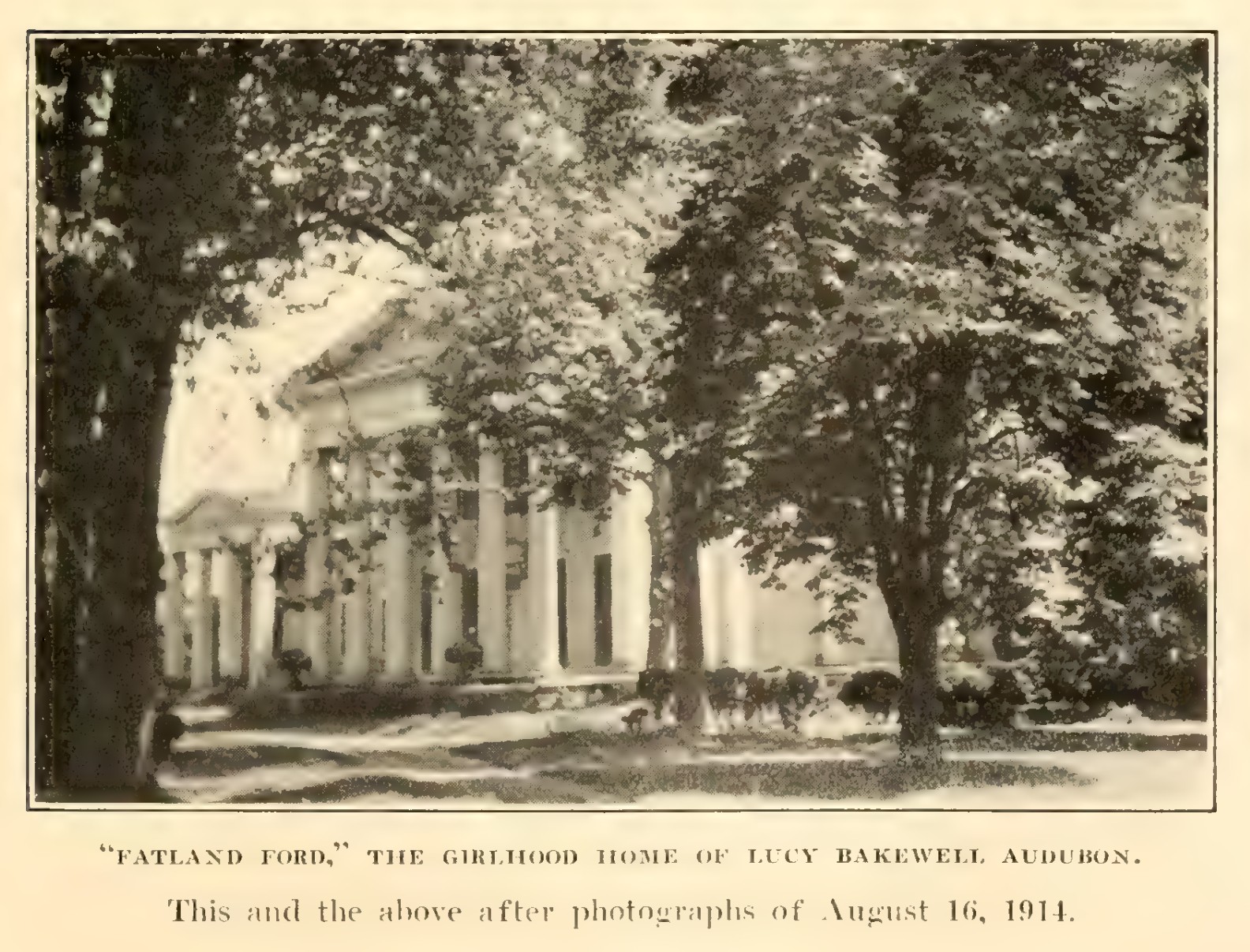
“FATLAND FORD,” THE CHILDHOOD HOME OF LUCY BAKEWELL AUDUBON.
This and the above after photographs of August 16, 1914.
While freely acknowledging his follies at this time,
he was able to say that he was addicted to no vices. His
usual custom was to rise with the dawn, when his bird
studies would begin, in the early hours which are best
for this purpose. According to his own account, Audubon
was extremely abstemious in his youth, for he declared
that he had lived on fruits, vegetables and milk,
with only an occasional indulgence in game and fish, and
that he had not swallowed a single glass of wine or
111
spirits until his wedding day. This was the more remarkable
in a youth coming from a country which flowed
with good wine, where school children are still served
with watered wine for lunch, and where the cooks, as
Goldsmith believed, could concoct seven different dishes
out of a nettle-top, and who, if they had enough
butcher’s meat (a want that has since been abundantly
supplied), would be the best purveyors in the world.
Audubon attributed his iron constitution to this simple
regimen, which had been followed, he said, from his
earliest recollection, though he admitted that while in
France it was extremely annoying to all about him;
for this reason he would not dine out when his peculiar
habits were likely to be the subject of unpleasant comment.
To follow this account of himself:
Pies, puddings, eggs, milk and cream, was all I cared for
in the way of food, and many a time I have robbed my tenant’s
wife, Mrs. Thomas, of the cream intended to make butter
for the Philadelphia market…. All this time I was as fair
and rosy as a girl, though as strong, indeed stronger than most
young men … and why have I thought a thousand times,
should I not have kept to that delicious mode of living, and why
should not mankind in general be more abstemious than mankind
is?90
William Gifford Bakewell, a younger brother of
Lucy, has left this interesting record of a visit paid to
“Mill Grove” in the summer of 1806:
Audubon took me to his house where he and his companion,
Rozier, resided, with Mrs. Thomas, for an attendant. On entering
his room, I was astonished and delighted to find that it
was turned into a museum. The walls were festooned with all
112
kinds of birds’ eggs, carefully blown out and strung on a
thread. The chimney-piece was covered with stuffed squirrels,
racoons, and opossums; and the shelves around were likewise
crowded with specimens, among which were fishes, frogs, snakes,
lizards, and other reptiles. Besides these stuffed varieties,
many paintings were arrayed on the walls, chiefly of birds.
He had great skill in stuffing and preserving animals of all
sorts. He had also a trick in training dogs with great perfection,
of which art his famous dog, Zephyr, was a wonderful
example. He was an admirable marksman, an expert swimmer,
a clever rider, possessed of great activity, prodigious
strength, and was notable for the elegance of his figure and
the beauty of his features, and he aided nature by a careful attendance
to his dress. Besides other accomplishments he was
musical, a good fencer, danced well, and had some acquaintance
with legerdemain tricks, worked in hair, and could plait
willow baskets.
113
CHAPTER VIII
DACOSTA AND THE “MILL GROVE” MINE
Advent of a new agent at “Mill Grove” — Dacosta becomes guardian to
young Audubon and exploits a neglected lead mine on the farm — Correspondence
of Lieutenant Audubon and Dacosta — Quarrel with
Dacosta — Audubon’s return to France.
If young Audubon was playing the rôle of a prodigal
son at the “Mill Grove” farm, which in a certain sense
was doubtless true, an episode soon occurred which put
a check to his carefree existence. Not long after the
naturalist had arrived, William Thomas, the tenant,
called his attention to the lead-ore deposits, which he
thought had been discovered by a Mr. Gilpin in 1791,
and the news of this prospect was promptly communicated
to the elder Audubon in France. Though the
presence of this mineral at “Mill Grove” had been
known, as we have seen, at a much earlier day, its rediscovery
excited great interest, and may have been a factor
of influence in the steps which were soon to be taken. It
should be noticed, however, that before May, 1803, a
young Frenchman from Nantes, bearing the Portuguese
name of Francis Dacosta, had preceded young Audubon
to “Mill Grove,” and apparently had acquired at that
time a certain interest in the farm.91 Dacosta soon succeeded
114
Miers Fisher as Jean Audubon’s agent, and
becoming enthusiastic over the lead mine, was anxious to
exploit it. Acting also upon the senior Audubon’s request,
he assumed a sort of guardianship over the son.
Dacosta began to dig for ore in the following year.
News of his enterprise spread rapidly, and this long
neglected mine was heralded in the newspapers as “one
of the first discoveries yet made in the United States.”92
On December 15, 1804, Dacosta purchased a one-half
undivided interest in “Mill Grove,”93 giving, as we believe,
a mortgage, and hoping to pay for his share out
of the profits of the lead mine. Thereafter for about
two years he continued to conduct the farm and develop
the mine, upon the basis of a one-half interest, in addition
115
to a small salary.94 In case the mine proved a success,
it was understood that young Audubon was to
be taken into the business and thus obtain a means of
self-support.
Dacosta was at first averse to forming a company, but
the Quaker tenant, William Thomas, who caught the
fever, and who was thought to possess more knowledge
of the mine than he was ready to divulge, seems to
have been taken conditionally into the partnership. Dacosta
made full reports of his progress to the old sailor
at Couëron, who came regularly to Nantes to send back
to America his well considered answers and candid advice.
Dacosta also called persistently for money, but
as Lieutenant Audubon was unable to meet these demands,
he applied to his friend François Rozier, a
wealthy merchant at Nantes, to supply the needed capital.
Rozier invested 16,000 francs, and to complicate
matters took a mortgage upon one-half of the value of
“Mill Grove,” in which the earlier proprietor, John
Augustin Prevost, as well as Francis Dacosta, was also
interested. Jean Audubon, Dacosta and Rozier thus
became partners in an enterprise which seems to have
swallowed up all of the money which was advanced and
never to have made any substantial returns.
The eventual failure of the lead mine must be attributed
in part to the high cost of materials, as well
as to the expense involved in uncovering the ore, a
difficulty which all later exploiters seem to have found
insuperable. Dacosta also discovered that the management
116
of his youthful charge was quite as difficult as
making a success of the mine. His grievances on this
score were duly reported at Couëron, and if he was
really trying to carry out the instructions which came
from France, it was perhaps no wonder that he received
the undisguised contempt of his rebellious pupil. How
just the naturalist’s charges against his hated tutor
may have been, will be considered in the sequel, but
Lieutenant Audubon’s letters,95 to be given presently at
length, clearly show that in spite of the strained relations
which later ensued, Dacosta continued to enjoy his
confidence for some time after young Audubon’s return
to France in 1805. The more serious troubles that followed
seem to have arisen from entanglements into
which all were later drawn.
In the first two letters to be given, but the third and
fourth of the series, Jean Audubon refers particularly
to “Mill Grove” and the prospective mine, and to the
proposed marriage of his son to Lucy Bakewell, concerning
which he was reluctant to give his consent for
reasons which he specifies at length; his sanction was
in fact withheld until the young man was on the road to
self-support two years later.
Jean Audubon to Francis Dacosta
Nantes, 1804-5
I told you to sell to W. Thomas the portion on the other
side … but your letter of the 27th of September with that
117
of Mr. Miers Fisher, who is not in favor of it, has made me
change my mind in the meantime. If your plan succeeds, as I
wish it may, this part of the farm would become almost indispensable
for exploitation of the mine. Moreover, has not
Mr. W. Thomas intentions, which we do not know? Might it
not be possible that in this very same part he had made more
valuable discoveries than those which he has shown us? In
all these matters, however, I rely entirely on the wisdom of
Mr. Miers Fisher and of yourself, and I thank you for your
willingness to remain in charge of my affairs,96 by accepting
anew the power of attorney, which he sends me together with
the indenture to be signed by my wife and by myself in presence
of witnesses. But you ask that this should be done before the
mayor of Nantes, while we have been living, since you departed,
in the commune of Couëron; accordingly this will be taken before
the mayor of that commune, and legalized by a prefect of
the department. That, I believe, will fulfil the same obligations,
for should it be necessary for my wife to come to Nantes
in the weather that we are constantly having it might cause a
delay that would be prejudicial to us. Remember, my dear
Sir, I expect that if your plan succeeds, my son will find a
place in the works, which will enable him to provide for himself,
in order to spare me from expenses that I can, with difficulty,
support. Your first letters have almost persuaded me that this
so-called mine was of little or no account, but the arrangement
that you have made with W. Thomas is so important that
I do not doubt you made certain of the value of the object before
deciding to grant him a recompense, which was to be
only in the thing itself. In this work we should then be making
a very great sacrifice, and it would be a loss. If, however,
you propose to forestall the payment of the sums that you owe,
I accept the proposition to be paid in Philadelphia; I will
reflect upon it, and will look into it. If I can arrange matters
for this plan with Mr. Dupuir, my next will be more explicit
118
upon this subject. My son speaks to me about his marriage.
If you would have the kindness to inform me about his intended,
as well as about her parents, their manners, their conduct,
their means, and why they are in that country, whether
it was in consequence of misfortune that they left Europe,
you will be doing me a signal service, and I beg you, moreover,
to oppose this marriage until I may give my consent to it.
Tell these good people that my son is not at all rich, and that
I can give him nothing if he marries in this condition.

Jean Audubon to Francis Dacosta
Nantes, le 19 ventose, an 13 9 March, 1805
Mr. Dacosta, Philadelphia:
I have received at this very moment your duplicate of the
twelfth of November, and your letter of December fifth, which is
not so favorable for several reasons as the one preceding it, yet
this impels us to hope that your last tunnel will not be a deserter,
and that the oxides of iron which are present will not
vanish upon further digging; this, at least, is my hope. You do
well to make every effort to obtain associates. If this does not
succeed, and if you should wish to work for our interests, I
should always approve of everything that you do, since you
have my confidence. In this case I believe … that you should
make the most urgent repairs, above all at the principal house,
before going there to live. As to Mr. W. Thomas, you do
well to keep him for yourself for every reason that you give
me, and I believe that he will not be stubborn about withdrawing
until he has, or has not, deserved his reward.
I am vexed Sir; one cannot be more vexed at the fact that
you should have reason to complain about the conduct of my
son, for the whole thing, when well considered, is due only to
bad advice, and lack of experience; they have goaded his self-esteem,
and perhaps he has been immature enough to boast in
the house to which he goes, that this plantation should fall to
him, to him alone. You have every means to destroy this presumption;
it is known at Philadelphia that you have the same
119
rights as I have, and that you are doing nothing but for our
mutual advantage. I am writing to him on this subject, for
he does not speak of it to me, and I am giving him the rebuke
that his indiscretion deserves. Read this letter, and have the
kindness to seal it before delivering it to him. You tell me
that I can refer, in regard to his conduct, to the report that
Mr. Miers Fisher has given of it in his long letter of the month
of September; that, unhappily, I have not received, for Mr.
Fisher tells me nothing about him, neither what is good nor
bad. As to going to that country, this seems well nigh impossible;
to recall my son is not easier; the reasons which made
me send him out there still remain. Only an instant is needed
to make him change from bad to good; his extreme youth and
his petulance are his only faults, and if you have the goodness
to give him the indispensable, he will soon feel the necessity of
making friends with you, and he can be of great service if you
use him for your own benefit.
It is necessary then, my dear Sir, that we endeavor, by
gentleness, to reclaim him to his duty. If you are indulgent
with him, it will be I who should be under every obligation to
you. I hope that the enclosed letter will work a change with
him. This is my only son, my heir, and I am old. When Mr.
Miers Fisher shall have shown my letter to the would-be father-in-law,
he will see that he is mistaken in his calculation upon
the assumed marriage of his daughter, for if it should take
place without my consent, all help on my part would cease
from that instant; this, if you will have the kindness, is what
you may say to the would-be father-in-law, that I do not wish
my son to marry so young.
Your letters of the 28th of October and the 12th of November
are in the country.97 I cannot reply categorically upon
their contents; I will examine them, and will tell you in my
next what I think about them. Your family, which I have
seen, is well. Our ladies thank you for your kind remembrance.
I am….
120
When the preceding letter was written young Audubon
was on his way to France, to protest, as he said,
against Dacosta’s treatment of him. At the date of the
letter which follows, he was at Couëron, hunting birds
with Dr. d’Orbigny.
Jean Audubon to Francis Dacosta
Nantes, 14 June, 1805
Mr. Dacosta, Philadelphia:
I have received, at this very moment, your letter of the
8th of April. I have replied to your preceding by duplicate.
Like yourself I am greatly astonished that you should not have
received the contracts which I forwarded to you at once. I
have reserved copies of these papers, which I have literally
copied.
If I had the least idea that they would not reach you, and
that an accident had befallen the ship, I should forward them
in duplicate, but as this boat, at the time of its departure, was
long delayed by the embargoes as well as by bad weather, I
am persuaded that this is the sole cause, and that they will
have reached you since.
You are about to appeal to the supreme court to prove
your ownership; is there a living being who can contest it?
If our deeds, granted in France, have not their full force in
that country, nothing can annul them for us who are French.
You shall do in this matter what you like; the greatest objection
is this, that it stops your operations; but who is to blame?
It is due to distance, and not to any negligence.
You say that you will do nothing until you have these
documents; if your intention is to work for our benefit, as you
say in your preceding, a company still being disagreeable to
you, that ought not to stop you; you have every power, and
time lost is irreparable. I am much annoyed at the delay that
this Mr. Miers Fisher causes you; as you say, he is an honest
man, but negligent, and this in consequence of his age, and
absorption in his great business.
121
We now return to Mr. David Ross,98 who in his letter tells
a pack of lies. At the close of 1789 I presented myself at his
house with the power of attorney of Mr. Formon,99 when we
settled the business of the “Count of Artois,” and the “Annette.”100
There never has been, as he said, any dissolution of
the partnership between Mr. Formon and myself. I settled the
accounts at that time both with him and with Samuel Plaisance
concerning these vessels, with the exception of a residue
of three thousand francs which are due me from Mr. Edward,
their associate, who died at London. When I asked him for
his certificates, he gave me for excuse that they were at the
iron factory above Richmond, and that he had given Mr. Formon
a private obligation that he would be very glad to have
an exchange for the certificates. This affair has rested there
ever since, and according to his letter Mr. Formon has taken
out seven thousand, four hundred dollars, which exceeds his
share by 1,650 dollars. If the estate of Mr. Formon is not
without resources, it is to his heirs that you must apply for
this overdraft, and get from Mr. David Ross all that you can,
for with such people one cannot rely upon getting anything
except with iron hooks.
The son-in-law of Mr. Formon doubtless will have found
among his papers all that constitutes the legal basis of my
portion; his certificates, his letter of attorney prove it, and
this is a title, and I believe that I have proofs by accounts
current. I salute you.
Jean Audubon to Francis Dacosta
Nantes, 22 June, 1805
To Mr. Dacosta, Philadelphia:
122
I have just received your letter of April 23, and hasten to
reply to it, in order to prove to you that not one of yours
has been neglected, which could be readily seen by my copybook.
I am not surprised that at this time you have not received
your papers, because they cannot have left before the
10th or 15th of last March, having been held up by the embargoes
and the bad weather, as you will see by the date of
the letters which accompany them.
They were entrusted to the son-in-law of Mr. Paulin, and
if the ship arrives safely as I trust it will, you have now received
them.
What negligence on the part of Mr. Miers Fisher! In
truth it is unpardonable, to let the mortgages stand after
having paid them!101 Will you then, I pray, clear this up for
the sake of our mutual peace of mind? You speak of repairs
to the house,102 it needs a complete cover; would it not be better
for me to send some slate from here? This would perhaps be
less expensive, and well nigh everlasting. Should you consider
it advisable I will send you some at once.
I beg you not to neglect the affair of David Ross; if you
can collect this sum, you will use it for our needs. I am
annoyed that all these mishaps prevent you from working;103
be well persuaded that it is no fault of mine, and that I am
guilty of no negligence.
You speak of my going to that country; if such had been
my intention I should have done it long ago. I am still
123
troubled with an inflammation of the lungs; and one ought not
to be ill in a foreign country, where he does not receive the care
that he enjoys in his own home. You ask me to bring you
money…. You know better than anyone else what was my
financial position when I sold to you; by that alone you must
know how difficult this would be for me. It is necessary to manage
so that our object suffices us or so that the mine pays its
way, and if we cannot work on a grand scale, we must needs
do the best with our affairs on a lower plane; for that I depend
on you. I salute you.
P.S. When you shall have my papers from Mr. Miers Fisher,
you will find a promissory note of Mr. Samuel Plaisance of
Richmond, for the business of the widow Ross. If there
were justice there this sum would be paid to me with the
costs.
The foregoing letters show that Dacosta had been
asked to oppose the proposed marriage of the younger
Audubon to Lucy Bakewell until consent should be
given; that he was calling for more money to exploit the
lead mine and was urging Lieutenant Audubon to come
to America; and that their relations were becoming
strained, Dacosta, to prove his title to a one-half interest
in the mine and farm, having threatened to take
his case to the courts.
This mining experiment was spread over many years.
Before turning to the sequel (see Chapter XI), let us
glance at the picture which the naturalist has left of his
unsympathetic tutor. “Dacosta,” he said, “was intended
to teach me mineralogy and mining engineering, but
in fact” he “knew nothing of either; besides which he
was a covetous wretch, who did all he could to ruin
my father, and indeed swindled us both to a large
amount. I had to go to France to expose him to my
124
father to get rid of him, which I fortunately accomplished
at sight of my kind parent. A greater scoundrel
than Dacosta never probably existed, but peace be with
his soul.” In one respect only, said Audubon, did he
receive any sympathy from his guardian: Dacosta commended
his drawings of birds. “One morning,” Audubon
relates, “when I was drawing a figure of the Ardea
herodias the great blue heron, he assured me that the
time might come when I should be a great American naturalist”;
however curious it might appear, he adds, that
praise “from the lips of such a man should affect me, I
assure you that they had great weight with me and I felt
a certain degree of pride in these words even then.”
To follow Audubon’s story further, not only did Dacosta
take control of his finances, but he interfered with
his personal liberty, first by objecting to his proposed
marriage to Lucy Bakewell, and then by cutting off his
stipend when he rebelled.104 Audubon, being thoroughly
aroused, determined to return to France and lay
the case before his father in person. With this end in
view he walked to Philadelphia, whither Dacosta had
gone, to demand the money necessary to take him to
Nantes. He was given, as he says, what purported to
be a letter of credit to a Mr. Kauman, an agent and
banker in New York. Returning with his letter to
“Mill Grove,” he then started on foot for New York,
where he arrived on the evening of the third day. While
there he stayed at the house of Mrs. Palmer,105 “a lady of
125
excellent qualities,“ who received him most kindly. Audubon
called promptly upon Benjamin Bakewell, for
whom he was the bearer of a letter from his brother, William
Bakewell, of ”Fatland Ford.“ Instead of an order
for money, Kauman’s letter, he said, contained only the
advice that its bearer be ”arrested and shipped to Canton.“
Perplexed and bewildered beyond endurance,
Audubon said that for the first time he felt the call of
murder in his blood, and his outraged feelings were not
assuaged until his landlady, to whom he had opened his
heart, and Mr. Bakewell, had come to his aid. Having
secured from this gentleman the necessary funds, he
bought a passage in the ship Hope, which was then
about to sail direct for Nantes.
Thanks to an old cash account of William Bakewell,
we can follow Audubon’s movements at this time fairly
closely. This record106 extends from January 4, 1805, to
April 9, 1810, during which time he advanced money to
his future son-in-law and received credits due him from
various sources. He did the same for the young partners
when an association in business had been formed
between Audubon and Rozier, and acted as their agent
or attorney after the sale of their farm and their settlement
in the West; as will be seen he aided Audubon
very substantially later when money was needed at
Louisville and for the more ambitious projects at Henderson,
in which his son was also interested. This particular
record shows that he supplied Audubon with
small sums of money on January 4 and 12, 1805, just
before his departure from “Mill Grove,” and that on the
eighteenth of the same month he paid his brother, Benjamin
Bakewell of New York, $150 on the young man’s
account. This was undoubtedly the passage money
126
which Audubon had borrowed from his friend, and as
the ship was then ready to sail, the date of his voyage
on the Hope is very closely fixed.
After his vessel had passed Sandy Hook and was
opposite New Bedford, the captain, in order, as he
averred, to make necessary repairs, ran her into that
port, where they passed a week. This was thought to
be only a ruse on the captain’s part to gain time, for,
having recently married, he wanted a holiday on shore;
accordingly he had ordered a few holes bored below
the waterline in the bows of his ship. When they finally
put to sea in earnest, they passed “through an immensity
of dead fish floating on the surface of the water,”
a remark which now recalls stories of the famous
tilefish, once thought to be extinct, which have been
found floating dead in vast numbers in that part of the
Atlantic. After nineteen days out the Hope entered
the Loire and anchored at Paimbœuf, the lower harbor
of Nantes; this was in February, and not far from the
eighteenth of that month.
127
CHAPTER IX
AUDUBON’S LAST VISIT TO HIS HOME IN FRANCE
Life at Couëron — Friendship of D’Orbigny — Drawings of French birds — D’Orbigny’s
troubles — Marriage of Rosa Audubon — The Du Puigaudeaus — Partnership
with Ferdinand Rozier — Their Articles of Association — They
sail from Nantes, are overhauled by British privateers,
but land safely at New York — Settle at “Mill Grove.”
Reaching his home at Couëron in the spring of
1805, Audubon took his parents completely by surprise.
He found his father, then in his sixty-first year, still
“hale and hearty,” and his “chère maman as fair and
good as ever.“ It was a time of momentous events in
France; Napoleon had placed the crown upon his head
but a few months before; defeat and victory followed
in rapid succession. But this did not prevent the young
naturalist from spending a year in ”the lap of comfort“
at Nantes and in the quiet villa of ”La Gerbetière,“
where as usual he hunted birds and collected objects of
natural history of every sort.
At this time also Audubon formed a friendship with
a young man after his own heart, Dr. Charles Marie
d’Orbigny, who “with his young wife and infant-son”
was then living near his home. “The doctor,” he said,
“was a good fisherman, a good hunter, and fond of all
objects in nature. Together we searched the woods,
the fields and the banks of the Loire, procuring every
bird we could, and I made drawings of every one of
them — very bad, to be sure, but still they were of
assistance to me.”107
128
Charles d’Orbigny, who was Audubon’s most intimate
early friend and in all probability his father in
natural history, was always spoken of in terms of great
affection. While at Paris in October, 1829, Audubon
learned from the naturalist Lesson that D’Orbigny was
then in charge of the museum at La Rochelle and that
“his son, Charles, then twenty-one,” whom “he had held
in his arms many times,” was in the city; on October 8
he wrote in his journal: “this morning I had great
pleasure in meeting my godson, Charles d’Orbigny.
Oh! what past times were brought to my mind.”108
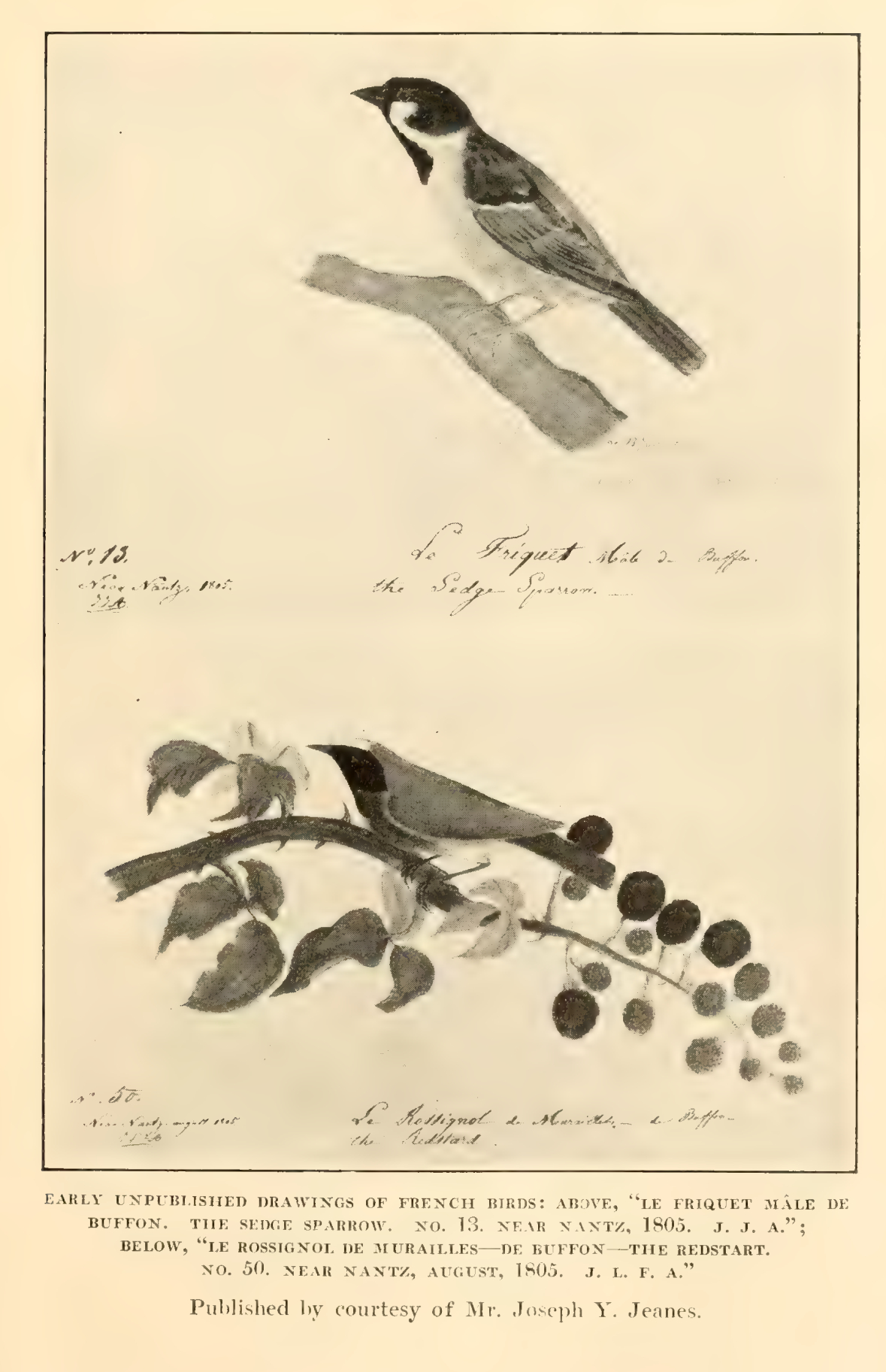
EARLY UNPUBLISHED DRAWINGS OF FRENCH BIRDS: ABOVE, “LE FRIQUET MÂLE DE
BUFFON. THE SEDGE SPARROW. NO. 13. NEAR NANTZ, 1805. J. J. A.”;
BELOW, “LE ROSSIGNOL DE MURAILLES — DE BUFFON — THE REDSTART.
NO. 50. NEAR NANTZ, AUGUST, 1805. J. L. F. A.”
Published by courtesy of Mr. Joseph Y. Jeanes.
In later life the elder D’Orbigny seems to have fallen
on evil times. He appeared as a debtor to Lieutenant
Audubon’s estate, and the cordial relations that had
long existed between the two families were broken; this
is shown only too plainly by the following sharp letter109
written by Gabriel du Puigaudeau and addressed to the
doctor, on August 3, 1819, when the family had become
reduced in means:
Gabriel du Puigaudeau to Charles M. d’Orbigny
Your letter of the twenty-fifth of January reached me in
due time. I am grieved to see that you are annoyed because
129
I addressed you through the voice of the mayor of the town
in which you live, since I had not the honor of knowing the
mayor any more than the enmity which may exist between you;
I was in duty bound to find out where you were; I heard it said
that Esnaudes was your home and I wrote you more than a
year ago; when I received no reply, the supposition was that
I must have been misinformed. I wrote to the mayor of
Esnaudes and he had the kindness to reply that you were practicing
in his commune. I am writing to you under this cover,
persuaded that my last will not have the same fate as my first,
which surely had not reached you.
As to the claim that Madame Audubon has upon you, the
different credits which you mention are assuredly more than
enough to pay the amount, but with forfeitures; unfortunately
there are many creditors who do nothing but this; Madame
Audubon gets nothing, and finds herself in straightened circumstances,
although her hands are full of notes. You say
that your creditors can claim only thirty-five hundred francs.
I have certain knowledge to the contrary, since already the
mortgages on your house reach nearly three thousand francs,
while Madame Audubon is your creditor in the sum of at least
sixteen hundred francs. I wish in business to be frank, and
to have others so with me. You say that you owe rather those
who have supplied you with food; you are unwilling then to
recall that the sums that the late Mr. Audubon lent you repeatedly
were for the same purpose. You tell us to be patient,
and who have been more patient than we for the past four
years? You speak of reduction of interest; indeed it is impossible
that you should have thought of this, or that we should
be content with what you should be so good as to give us, and
that when you deem it convenient, without our being able to
file a protest. I leave you to reflect on what we must think of
this matter, and I beg you to see in my manner of writing to
you the interpretation that I have given to what you write
yourself.
Madame Audubon does not think that she should exact at
once the capital in addition to the interest, but she charges
130
me to say to you that, having a right at least to the interest
accrued, she begs you to have that money paid to her with the
least possible delay.
The following letter concerning D’Orbigny’s affairs
was also written by Gabriel du Puigaudeau to J. Cornet
of Esnaudes, on June 26, 1819:
Gabriel du Puigaudeau to J. Cornet
our honored letter of the sixteenth was duly received.
It is impossible to be more grateful to you than I am for the
information that you have been kind enough to give me about
Mlle. Bouffard110 as well as about M. Delouche. I will use it to
my profit. As to the question that you put to me concerning
M. d’Orbigny, I have the honor to tell you that he has lived
in the commune of Vue in this department, and was highly
esteemed and regretted when he left to come here. He lived
here fifteen years without any one having cause to reproach
him in any way. He has always been very well regarded and
received by the best society here, and he carried from Vue the
regrets of all. He left us to take part in a manufactory of
soda, established at Noismoutiers, in the department of La
Vendée.
I have had no news of him since. As to his pecuniary resources,
I know him to have but one. His wife had a house,
at Paimbœuf in this department, which was sold three years
ago to satisfy the holders of mortgages. This is all that I can
tell you about them; he owes my mother-in-law about fifteen
hundred francs (money received at different times from my
late father-in-law), for which we have his notes, but God only
knows when we shall be paid.
As early as the autumn of 1805, if not before, plans
were laid for getting young Audubon again safely out
of France, for fear, no doubt, that the remorseless conscription
131
officers of Napoleon would send him to the
war if he remained. At that time Lieutenant Audubon
and his wife issued jointly to their son and to Ferdinand
Rozier a power of attorney for the conduct of their
business affairs in America. Parts only of this punctilious
document, which was written in French, have
been preserved,111 and these through the translation of a
“notary public and sworn interpreter of foreign languages
for the Commonwealth of Pennsylvania, resident
in Philadelphia.” The names of the grantors, who
signed this letter on October 21, 1805, were attested
under the signature and seal of the mayor of Couëron;
this official upon the same day declared that, in conformity
with the rigorous requirements of the laws of
the State of Pennsylvania, since “no other act, not even
a notarial instrument, can in any manner supply the
same,” he had examined Anne Moynet Audubon apart,
when she admitted that she perfectly understood the
nature of the act, which she had “signed, sealed, and
delivered of her own free will and accord, without being
compelled thereto by her husband, either by threats, or
by any other means of compulsion whatsoever.” The
mayor’s signature was authenticated three days later
by the subprefect of Savenay, and the formality was
finally closed by the attestation of his signature by the
prefect, on the 27th of November.
It was during this last visit to his home in France
that Audubon’s sister, Rosa,112 was married to Gabriel
132
Loyen du Puigaudeau, who was not, however, as the
naturalist has stated, either “the son of a fallen nobleman”
or his father’s “secretary.” Du Puigaudeau came
from a family of merchants in easy circumstances, and
for a long time lived the life of a country gentleman
of leisure — for a period at Port Launay, below Couëron,
and later, after Lieutenant Audubon’s death, at his own
villa, “Les Tourterelles,” in that commune, not far from
“La Gerbetière.” His father, though of a rich family,
was not a “gentleman,” that is, a member of the aristocracy,
as the term was then used in France. Du
Puigaudeau was without any settled business, but his
revenues, upon which he depended, failed not long after
the death of his father-in-law. He and young Audubon
appear to have been good friends for many years, and
after the latter’s return to America they corresponded
to as late as 1820, when for some reason their relations
were broken.
In the spring of 1806 Lieutenant Audubon arranged
a business partnership between his son and Ferdinand
Rozier, to endure for nine years, and also secured passports
for both to enable them to emigrate immediately
to the United States. To the same hand can also be
traced their “Articles of Association,” which were
drawn with the utmost care and designed to govern
them in all their future business relations in the New
World: these were signed by “Jean Audubon,” and
“Ferdinand Rozier,” at Nantes, on March 23, 1806.
Moreover, eight days before they embarked, a second
and more elaborate letter of attorney was issued to
133
them jointly by the Lieutenant, his wife, and, in this
instance, the aged father of Ferdinand, under date of
April 4, 1806.113 According to the terms of this admirably
executed paper the partners were entitled to conduct
all the affairs of the grantors in reference to their property
in the United States to the best of their judgment
and ability; to carry on the “Mill Grove” farm, to the
extent of their part ownership in the estate, or to dispose
of this interest; “to exploit or cause to be exploited
the mine recently discovered on the said farm, to consult
in every important matter Mr. Miers Fisher, merchant
of Philadelphia, — as a common friend and good
counsellor, to keep all necessary books and registers,
and at the end of each year, or sooner, to strike a balance
of the receipts and expenses of the said farm and
the exploitation of the mine, should there be reason
for it.”
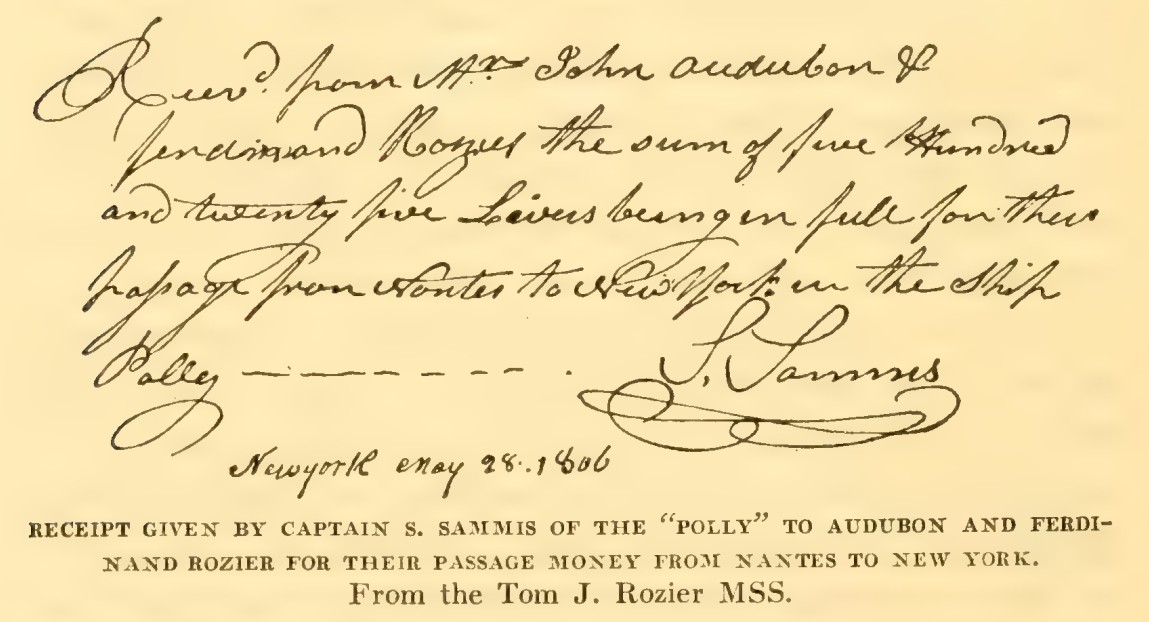
receipt given by captain s. sammis of the “polly” to audubon and ferdinand
rozier for their passage money from nantes to new york.
From the Tom J. Rozier MSS.
To secure at this time the necessary passports for
their young men no doubt taxed all the resources of
the elder Audubon; Rozier’s, said the naturalist, was
written in Dutch, of which he did not understand a
single word, while his own letter stated that he was born
in New Orleans. These subterfuges worked so well
that the inspection officer, after reading Audubon’s paper,
promptly offered him his congratulations, adding
134
that he would be only too glad to leave his unhappy
country under as favorable conditions. Audubon and
Rozier sailed from Nantes on Saturday, April 12, 1806,
on the ship Polly, Captain Sammis, but they did not
land in New York until Tuesday, May 28, after a
perilous voyage of nearly eight weeks. A fortnight had
been passed at sea when they sighted a suspicious looking
vessel which immediately gave chase, fired several
shots across their bows, and compelled the captain to
heave to and submit to being boarded and searched.
This proved to be an English privateer, named the
Rattlesnake. She was rather considerate for a British
cruiser of the period, for she merely impressed two of
their best seamen and robbed them of their provisions,
carrying off, said Audubon, all of their “pigs, sheep,
coffee and wine,”114 in spite of loud remonstrances of the
captain and of an American Congressman who happened
135
to be among the passengers. “The Rattlesnake,“
he continued, ”kept us under her lee, and almost
within pistol-shot, for a day and a night, ransacking the
ship for money, of which we had a great store in the
run under the ballast which was partially removed, but
they did not go deep enough to reach the treasure. The
gold belonging to Rozier and myself I put away under
the ship’s cable in the bow, where it remained until the
privateers had departed.“
Upon reaching a point thirty miles off Sandy Hook,
they learned from a fishing smack that two British
frigates lay off the harbor and were impressing American
seamen, that, in short, they were even more unwelcome
than pirates who sailed under letters of marque.
The captain, thus forewarned of one danger, had the
misfortune to run into another, for upon taking his
vessel into Long Island Sound, she encountered a storm
and was stranded in a gale; no great harm was experienced,
however, for the vessel was finally floated off
and reached New York on the following day. The
passage money paid by Audubon and Rozier to Captain
Sammis amounting to 525 livres, or $125,115 was entered,
according to their articles of agreement, as the
first item of their “social expenses.” After a brief visit
with Benjamin Bakewell they hurried to “Mill Grove,”
and Audubon to the home of his sweetheart, Lucy.
136
CHAPTER X
“LA GERBETIÈRE” OF YESTERDAY AND TODAY
Home of Audubon’s youth at Couëron — Its situation on the Loire — History
of the villa and commune — Changes of a century.
Before following further Audubon’s history in
America, we shall return for a more intimate view of
the happy home which he had left behind him in France.
This was at Couëron, a small commune in the arrondissement
of Saint-Nazaire, on the right bank of the
Loire, nine miles west of Nantes. Here, as we have
noticed, his father had acquired a country place at about
the outbreak of the Revolution. The old house still
stands, though in decay, and is still known as “La Gerbetière,”
a name possibly referring to the wheat which
is harvested from the surrounding fields as of yore. In
the records of that district country places are always
designated by their proper names, and it is a curious
fact that while such names survive, they are seldom or
never displayed on door or gate.
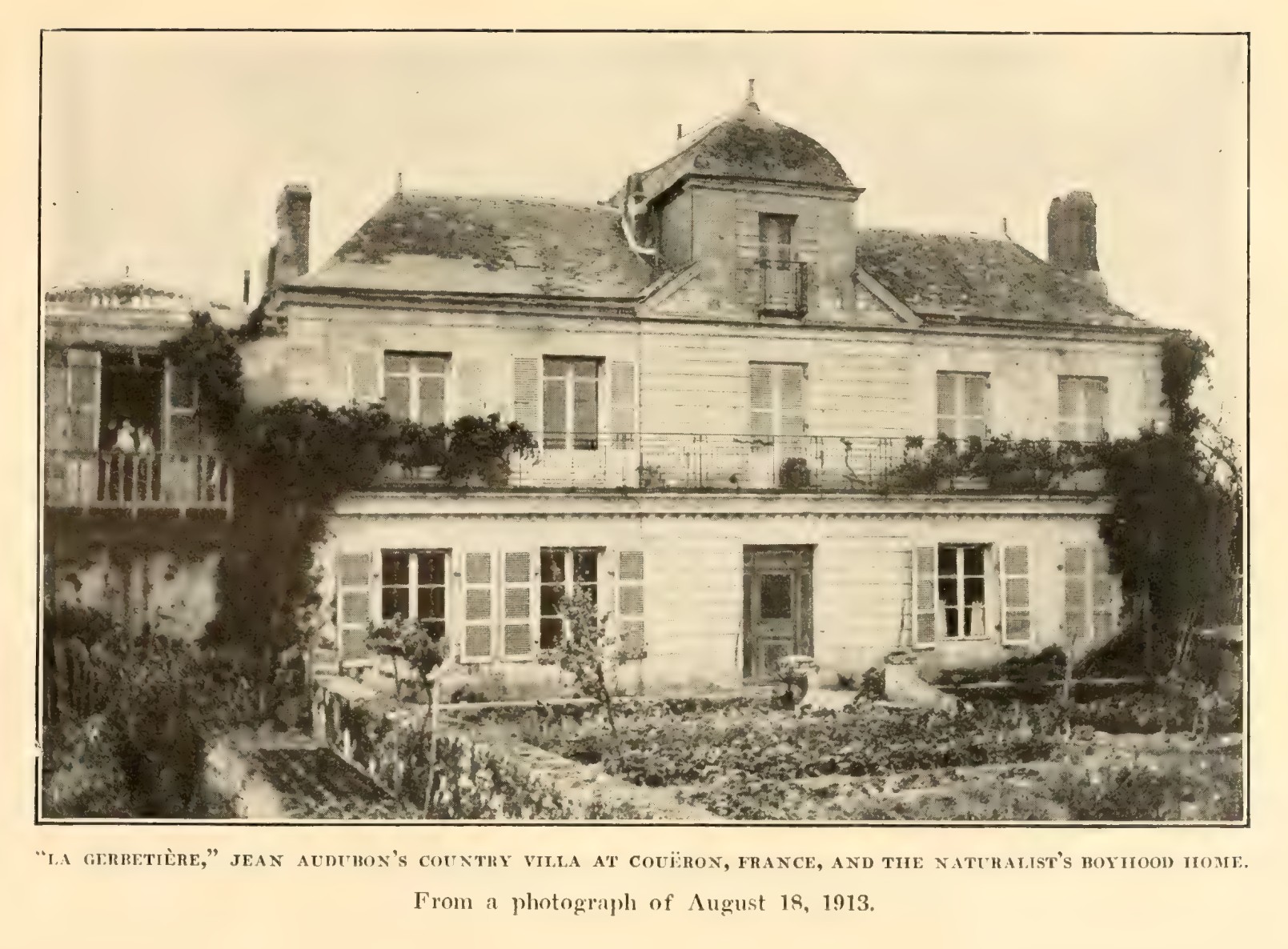
“LA GERBETIÈRE” JEAN AUDUBON’S COUNTRY VILLA AT COUËRON, FRANCE, AND THE NATURALIST’S BOYHOOD HOME.
From a photograph of August 18, 1913.
In a journal written before 1826, Audubon says:
“My father’s beautiful country seat, situated within
sight of the Loire, about mid-distance between Nantes
and the sea, I found quite delightful to my taste, notwithstanding
the frightful cruelties I had witnessed in
that vicinity not many years previously. The gardens,
greenhouses, and all appertaining to it appeared to me
of a superior cast.” Though it was occupied for many
years previously as a refuge from the turmoil or heat
137
of the city, Lieutenant Audubon made “La Gerbetière”
his permanent abode only when he retired from the navy
in 1801, still maintaining, as we have seen, a foothold
in Nantes.
Upon Audubon’s first return from the United States
in the spring of 1805, he said that his vessel entered the
mouth of the Loire and anchored off Paimbœuf, the
lower harbor of Nantes. “On sending my name to the
principal officer of the customs,” the narrative continues,
“he came on board, and afterwards sent me to my father’s
villa, La Gerbetière, in his barge and with his
own men.” It is to be noticed, incidentally, that as the
distance to be covered between the lower and upper
harbors was twenty-five miles, or sixteen miles to
Couëron, such journeys no doubt were made upon the
arrival of incoming vessels for the regular business of
the service.
It has been suggested, without proof, that Couëron
represents the ancient town of Corbilo, mentioned by
Strabo at the beginning of our era. Though unquestionably
ancient, at the time of the Revolution it was a
small and unimportant parish of poor but industrious
farmers. It occupies rolling ground, but little raised
above the Loire, to the east of Port Launay and nearly
opposite Pellerin. As this commune was easily accessible
by river-barge from Nantes, the revolutionists
seem to have thought it worth watching, though Citizen
Audubon found its people in a tranquil mood when he
canvassed their district in behalf of the Central Committee
in April, 1793. Couëron is still a farming community,
but its population116 has been considerably
138
swelled in recent years by the development of a large
industry for the treatment of lead; it is the shot tower
and forest of chimneys of these great metallurgical
works that arrest the eye of the traveler as he approaches
Couëron by river at the present day. The town is also
accessible by railroad, but the steamer journey from
Nantes, which is made in less than an hour, is more
attractive as well as more direct. In this section the
Loire is flanked on either side by bottom lands, reduced
in places to narrow strips, which are followed at intervals
by elevations called, by courtesy, hills or buttes. To
the west of Couëron, and especially at Pellerin, which
stands high, these buttes come close to the river, which
is eating them away.
My visit to Couëron, which was made on a warm
midsummer’s day in 1913, served to correct certain previous
impressions, but I found the old Audubon homestead
in its essential aspects but little changed, considering
that over a century had rolled by since the naturalist’s
visit which we have just described. After leaving
Nantes at the Gare de la Bourse by one of those
quaint little trains which still do service in the less traveled
parts of France, we traversed the broad Quai with
requisite deliberation, passing shops, warehouses and
factories in long array. A slight swerve from the river
soon brought us to Chatenay, now a part of the city;
it is still some distance from that point before the real
countryside is reached, and scenes familiar to southern
Brittany are in a measure reproduced. There were the
old farmhouses of rough stone, dear to every painter’s
heart, mellowed by age and lichens, and surrounded by
great ricks of straw, for the harvest had been gathered
and the stubble fields were brown. There also the farms
were divided into small plats, marked by willows or
139
ramparts of stone. On higher ground stood the windmills,
characteristic of Brittany also, — stalwart towers
of stone, with broad arms of latticed wood ever ready
to take the sails.
The small station for Couëron lies in the commune
of Sautron, and at this isolated point the traveler will
sometimes find a country conveyance to take him to the
village. While we were raising the dust from this old
Couëron pike on the eighteenth day of August, swallows
hawking with characteristic energy for their insect prey
were the only birds we saw to remind us of the ornithologist,
who as a youth had doubtless passed this way
many times, over a hundred years before. The most
direct approach to the old Audubon place from Sautron,
as we afterwards learned, is by a path which diverges
on the right and leads through stubble fields and cabbage
patches, along hedgerows and stone walls. We,
however, fared on to the town and soon began to pass
shops and small modern houses. On the side of the
village the traveler’s eye is certain to be arrested by a
great crucifix in stone,117 which rises high above the street
from a lofty pedestal, and is approached by tiers of
stone steps. Nearly opposite stands the secrétariat, or
official bureau of the commune, where a solitary clerk,
who seemed to welcome my intrusion in a place where
business was utterly stagnant, closed his office and with
characteristic courtesy cheerfully showed me the way.
This led directly westward to one side of the center of
the town, and after passing down a street of old houses
140
of the humblest description, we were again in the region
of brown fields and old farmsteads.
Couëron village, which is marked by a modern
church with an aggressive spire, extends along the river
bank, but since its streets run parallel with it, the river
itself is seen only at certain openings, occurring at irregular
intervals. In going to “La Gerbetière” by the
course I have described, the Loire was not visible at any
point, and was not seen until we emerged from one of
the village streets at the steamer’s pier. My guide had
said that from the rise at the next crossroads we should
see the roof of the house which we had come to visit, and
his prediction was verified when I recognized immediately
its cupola raised above the gray stone walls which
there bound every highway and field. The old villa is
rather less than a mile from the village, but owing to the
rolling nature of the country, it is completely hidden
until at close approach it stands suddenly revealed. It
lies in a fork of the road, securely inclosed by high,
massive walls of stone, now hoary with age, while on
the front it is further screened by a natural growth of
bushes and trees. Immediately behind and to the west
rises a prominent butte which cuts off the view to Port
Launay on the river; this forms the one distinctive landmark
of the district, as its two windmill towers are visible
from all surrounding points. In Audubon’s day
the house commanded a wide view of the Loire, but the
river is now so completely masked by foliage as to be
visible only from the upper windows; apparently it
once flowed nearer to the house but has been pushed
away by the construction of modern dykes. The hilltop
to which I have just referred, like the roof of the
villa, commands a panorama of the whole region, including
Nantes and all the surrounding communes.
141
“La Gerbetière” is now a small estate of less than
fifty ares, or one and a half acres, of land. The buildings,
which form a quadrangle with enclosed court, occupy
a corner next the side street, and stand about 200
feet back from the main highway leading from Couëron
to Port Launay. The extent of the original property
cannot now be determined, but Lieutenant Audubon,
who retired at the age of fifty-seven, was never a farmer
on a large scale. The original house, which probably
dates from early in the eighteenth century, has an easterly
wing or L, continued into a long, low section
through which the court is now entered from the road at
the side; this was probably added by Jean Audubon, but
the westerly end and wing are a more modern accretion,
built for the accommodation of additional tenants, as
many as three families having occupied the place in
1857.
“La Gerbetière” was entered from the main street
by a small door which pierces the high enclosing wall,
and leads the visitor into what was formerly an ornamental
garden, the original design of which can still be
traced. At the time of my visit, however, this entrance
had long ceased to be an avenue of response. Encouraged
by the sight of a peddler’s cart, I walked up the
side street and entered the court. Here the response
was prompt and vigorous enough, and from the guardians
of the place, one of which was chafing at his chain
close to the doorway. I crossed rather gingerly to an
open hallway, opposite the main entrance, and knocked
repeatedly, noting here that rooms opened to this small
entrance hall on either side, and that a steep stairway
led to others above. At last, during a temporary lull
in the barking of dogs, the “tok-tok” of sabots was
heard on the stairs, and I handed up my card with one
142
from the director of the Natural History Museum at
Nantes. After various messages had been shouted back
and forth, I was led through another passage to the
tenant, who was talking with the peddler in the garden.
Julien Lebréton, who was a farmer on a small scale,
received me kindly and answered my questions to the
best of his ability; it did not surprise me that he was
both puzzled and suspicious, or that his first thought was
of our coming to look over the place with a view to its
purchase.
The decayed villa, which stands in the midst of scattered
farmhouses of a humble order, reproduces a style
characteristic of many parts of France. The original
house, of two stories, was built of cream-colored limestone,
similar to that for which many French towns are
famous. It has a swelled slated roof with beveled
gables. Surmounting the roof is a cupola which suggests
a third story, carried out in harmony with the
lower structure. A narrow balcony, resting upon a
molding of stone and protected by an iron grill, without
which no such house would be considered complete,
runs the length of the second story, and is accessible
from every room by glass doors. From the main entrance
below one passes directly through to the court,
about which are now grouped various stables and other
low buildings, not all of which date from Audubon’s
day.
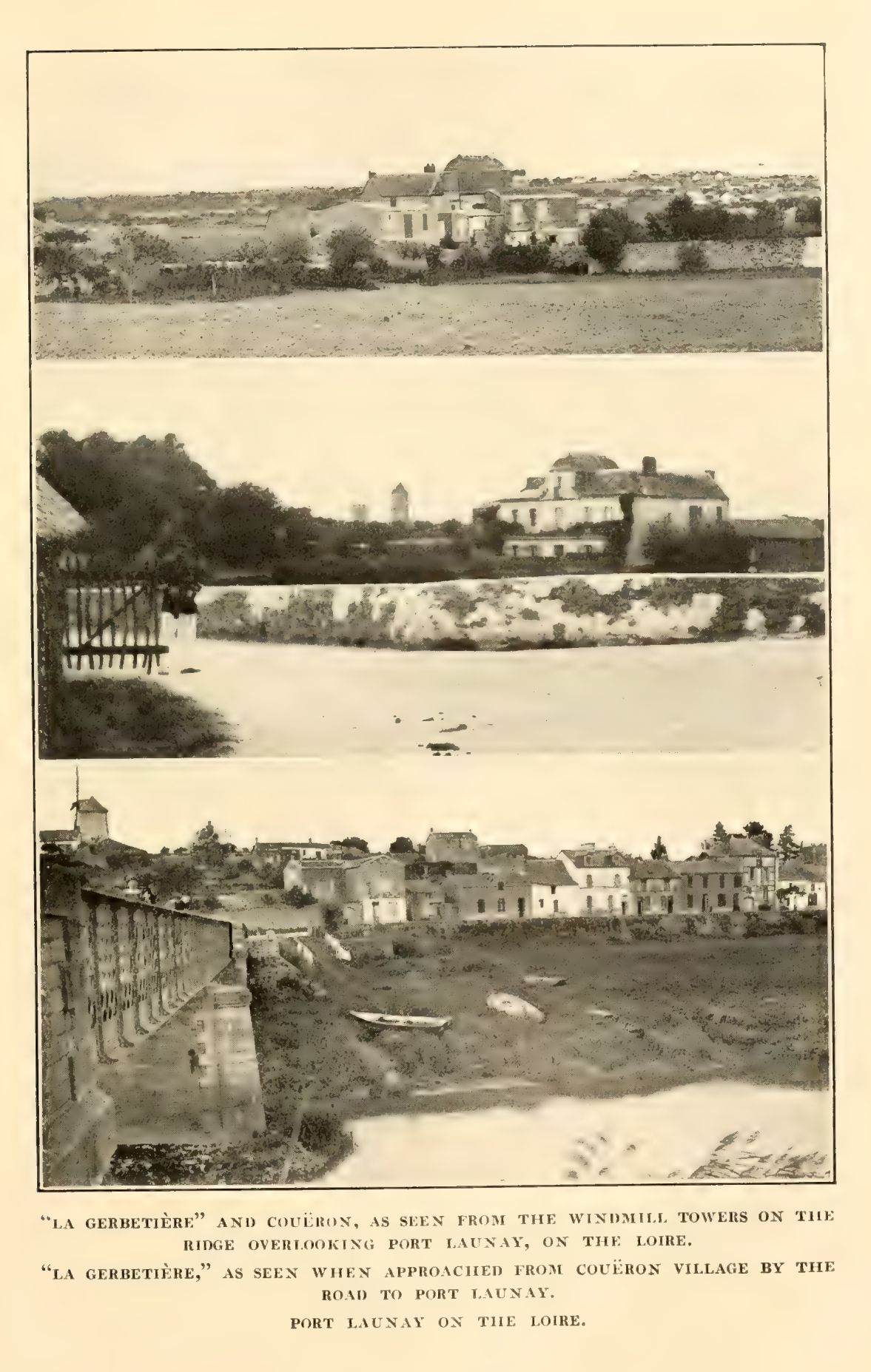
“LA GERBETIÈRE” AND COUËRON, AS SEEN FROM THE WINDMILL TOWERS ON THE
RIDGE OVERLOOKING PORT LAUNAY, ON THE LOIRE.
“LA GERBETIÈRE,” AS SEEN WHEN APPROACHED FROM COUËRON VILLAGE BY THE
ROAD TO PORT LAUNAY.
PORT LAUNAY ON THE LOIRE.
What was once a small formal garden is still marked
by solid boundaries of cut limestone. This was evidently
constructed by Jean Audubon, since it occupies
the area in front of the original house and the easterly
extension which is attributed to him. The remaining
available land was devoted to fruit, vegetables, and possibly
to the greenhouses which the naturalist mentioned.
143
At one time an orangery occupied some part of the
house or court. There are now no large trees on the
property; the fruits are all of recent and inferior
growth, while the garden I saw was planted to cabbage
and running riot with weeds.
When Jean and Madame Audubon passed through
the door leading from the main street, they entered upon
a paved alley which ran parallel with the high wall,
whence they could reach the house by any one of several
walks or enter the fruit garden by another. If so inclined,
they could turn to the right, ascend a flight of
granite steps to a platform on a level with the top of
the wall, and under a shady bower of vines and leafy
shrubbery, look off on the racing waters of the Loire,
scrutinize their visitors before admitting them, or observe
such manifestations of life as lonely country roads
of that period had to offer. As they passed up the central
garden walk they could admire the beds of old-fashioned
flowers, kept, we may be sure, in perfect
order, for Jean was a very methodical man, and his
wife, we believe, an excellent home maker. This walk
led to a low terrace, flanked with a heavy wall, which
ran the whole length of the house.
What little I saw of the interior of “La Gerbetière”
was wholly devoid of interest, which agrees with the
experience of another traveler who visited Couëron at a
slightly earlier date;118 at the time of his visit the place
was unoccupied and forlorn, and the vegetation on the
garden side so dense that it was utterly impossible to
see any distance from the lower windows.
When “La Gerbetière” came into Jean Audubon’s
144
possession it was already venerable with age, and it
was completely restored for him by an architect named
Lavigne.119 In an inventory drawn up shortly after
Madame Audubon’s death in October, 1821, the property
of “La Gerbetière” is described by reproducing the
account given in an early deed bearing date of November
11, 1769, which reads as follows:
A house called La Gerbetière, situated near the port of
Launay, consisting of a sitting room, drawing room, kitchen,
upper chamber … garret, and other quarters serving as a
laundry, stable at the back, with pigeon loft above, court, parterre,
vegetable garden to one side, an orangery with orange
trees, in the middle of the house, the whole in front of a close
surrounded by high walls except on the side of the setting sun,
with land belonging to the heirs of M. de la Haye Moricaud,
held mutually,120 the whole bounded on all other sides by highways.
Notice: The aforesaid house and parterre stand in
an empty field, which serves as a fair-ground, and is partly
planted with young trees in serial rows; held in common with
the Marquis de la Musse, with another empty field containing
about two journals of land….121
“La Gerbetière,” never more than an unpretentious
country house with an attractive garden, was idealized
in the fervent imagination of Audubon when in after
life he drew upon the memories of his youth in France;
for it had meant to him escape from the city, which he
detested, to the fields and river which he loved. Yet,
in spite of the abuse which a long line of poor tenantry
inevitably entails, with intervals of total neglect lasting
145
for nearly a century, this decayed villa of pre-Revolutionary
days still stands in marked contrast to its
neighbors, and bears witness to a taste to which they
were strangers. The greenhouses, the fruit and shade
trees, if such it possessed, and all lesser adornments of
the place have vanished long ago, but thanks to the
durability of French stone and mortar, much about this
old country seat is still well preserved. Whether Audubon
ever saw his old Couëron home again after leaving
it in 1806 is doubtful, though one of his sons visited the
place, and the naturalist incidentally speaks of a pilgrimage
to Les Sables d’Olonne which might have occurred
in 1831 or a little later. In following the fortunes
of the naturalist’s family in France it will be necessary
for us to return to La Gerbetière.122
146
CHAPTER XI
FIRST VENTURES IN BUSINESS AT NEW YORK, AND
SEQUEL TO THE “MILL GROVE” MINE
Audubon and Rozier at “Mill Grove” — Their partnership rules — Attempts
to form a mining company lead to disappointment — Decision to sell
their remaining interests in “Mill Grove” to Dacosta — Division of the
property and legal entanglements — Audubon as a clerk in New York — Business
correspondence and letters to his father — Later history of
the lead mine and Dacosta — Audubon continues his drawings in New
York and works for Dr. Mitchell’s Museum — Forsakes the counting
room for the fields — Personal sketch.
When Audubon and Rozier reached “Mill Grove”
at the beginning of the summer of 1806, they found
the troublesome Dacosta installed as its master by virtue
of his interest in the property and his former position
as agent, to which they were now to succeed. No doubt
they found difficulties in carrying out all the articles of
agreement123 in their business constitution, for they were
to take possession and call Dacosta to account. They
were also in duty bound to investigate the lead mine
on the farm, and ascertain whether it promised any
success, and if the expenses already incurred were warranted,
147
before committing themselves to further development.
One-half the product of the mine and farm
was to be equally divided between them, and in order
to visualize clearly their profit and loss, they agreed to
keep a “special book for the purpose.” “On one side,”
their third “Article” read, “will be entered the items of
expense, day by day, and at the moment this is done,
on the other side shall also be entered the sales and
products of the farms, and of all that can result from
this business, in such a way that the profit shall be
always apparent by the addition of the items which
compose the debit and the credit.”
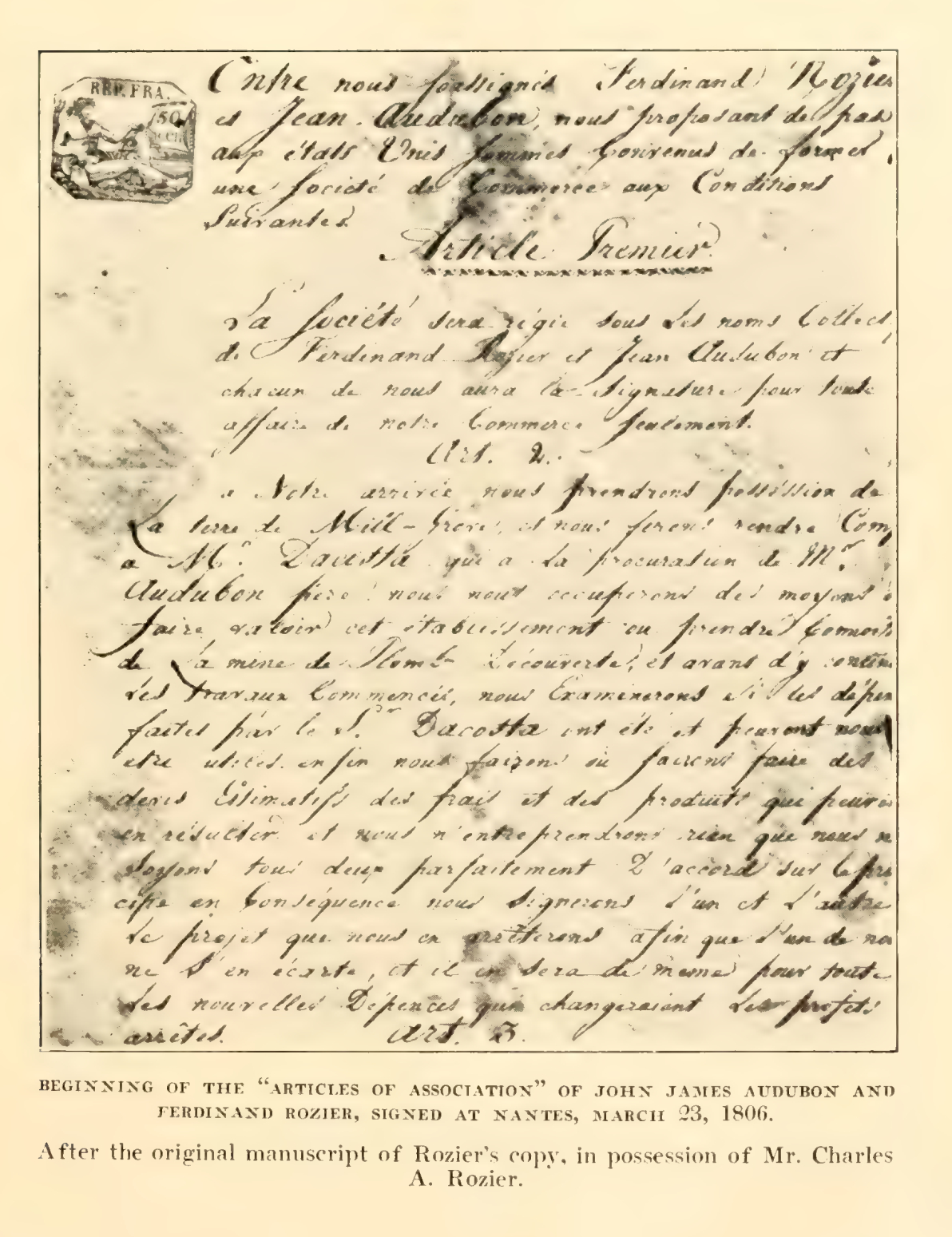
BEGINNING OF THE “ARTICLES OF ASSOCIATION” OF JOHN JAMES AUDUBON AND
FERDINAND ROZIER, SIGNED AT NANTES, MARCH 23, 1806.
After the original manuscript of Rozier’s copy, in possession of Mr. Charles
A. Rozier.
The house at “Mill Grove” was to be treated as an
object separate from all business, “in order,” so the
“Articles” read, “that we may settle matters as completely
as we desire.” It was also agreed, in the fourth
“Article,” that they should “add to the expenses of
this exploitation those necessary for life, and others of
a mutual character, so long as it should suit them to
live and dwell together.” It was further stipulated that
even if the mine proved a failure, they should remain
six months on the farm, in order to gather useful information
from the country, before embarking in any form
of commerce, whether inland or maritime. The cost of
their journey to America was to be entered as the first
item of their “social expenses,” and any expenditure
for travel in their mutual interests was to be considered
under the same head. In case they should persuade any
merchants in America to send goods to M. Rozier,
Senior, at Nantes, he should be entitled to one-half the
profits, while the partners should divide the other half
between them. All other profits and losses resulting
from their commercial transactions were to be shared
equally. The partners resolved to maintain friendship
148
and a mutual understanding, but “upon the least difficulty”
each should choose one arbitrator, and the two
thus chosen were authorized to select a third; the partners
were bound to accept the decision thus reached
without appealing to any court. In the case of the
death of one of the associates, read the tenth “Article,”
the survivor should have sole charge of making a settlement
of the business and should report to the proper
heirs. The survivor, in such an event, would be entitled
to a commission of ten per cent in addition to his
one-half interest, but in no case should the partnership
be dissolved “until after nine years, counting from the
day of the date of the present instrument.” As will
be seen, Audubon and Rozier were unable to fulfill all
the conditions thus carefully laid down.
Young Audubon’s dislike of Dacosta, the uncertainty
of the mining project, and other difficulties of
the situation soon decided the partners to cut short their
stay at “Mill Grove.” Both were equally interested in
the lead mine, but after working several months without
success in an attempt to form a mining company,
they wisely decided to leave such experiments to the
enthusiastic Dacosta and to seek an opening in trade,
where the hazard would be no greater and their ignorance
less profound. Following the advice of their
Quaker friend, Miers Fisher, they decided to sell to
Dacosta their remaining rights in “Mill Grove.” As a
preliminary it was necessary to divide the property
which had been held in common by him and Lieutenant
Audubon since 1804, and this division was effected by
an agreement drawn up at Philadelphia on the fifth day
of September, 1806.124 Ten days later the remainder
149
of “Mill Grove” was conveyed to Francis Dacosta, representing
a number of capitalists whom he had managed
to interest in the mine, of whom the astute
Stephen Girard is said to have been one. The sale
was subject to conditions,125 dependent upon their success
in mining lead, which, as will appear eventually,
could not have been fulfilled. These various transactions
are so clearly set forth by Ferdinand Rozier in
writing to his father at Nantes that we shall reproduce
his letter in full:126
Ferdinand Rozier to Claude François Rozier
Philadelphia, 12 Sept., 1806
Duplicate.
My very dear and venerable father:
Still in hope of cherished news from you, and replies to
my letters of 31 May, 22 June, and 4 July, I have to tell you
that we have since succeeded in closing all our business relations
with Mr. Francis Dacosta, in the following manner: We
are anxious that our method of procedure may be satisfactory
to you; we have followed the advice of Mr. Miers Fisher, and
have had his approval in all that we have done. What should
set you at rest is that as regards your investment, you will find
150
that I have made quite a neat profit. Here is a copy of the
agreement.
“It is agreed between Mr. Dacosta and Mr. J. Audubon
that the farm of ”Mill Grove,“ which they now hold in
common, shall be divided between them as follows:
“1. Mr. Dacosta shall have the lot of 113 and a half
acres, situated on the N.E. side of Perkioming creek, with
all the buildings, mines, et cet., and in general all that it
contains.
“2. Mr. Audubon shall have the lot of 171 acres, situated
on the other side of the creek.
“3. Mr. Dacosta shall pay to Mr. Audubon for the
difference in value of the lot of 113½ acres, and of that
which it contains:
“1. The sum of eight hundred dollars, payable
with interest, in three years from this day;
“2. The sum of four thousand dollars, upon the
first products of the lead mine.
“4. The contract made with Mr. Thomas shall remain
to the charge of the two parties.
“Note. Mr. Duponceau is begged to draw up the necessary
deeds to put this agreement into execution, which
deeds we undertake mutually to exchange at the first
requisition.”
“Executed at Philadelphia, this 5th of Sept, 1806.”
Signed “Fcis Dacosta“
“Ferdinand Rozier“
“J. Audubon“
The futile attempt that we have made to form a company
to work this mine, which is a condition of success, the
slight resources at our command, as well as our lack of knowledge
in work of this kind, all have determined us to abandon
our rights for the offer of four thousand dollars127 upon the first
products that shall come from the mine. The expense that must
151
be incurred in working it will be very heavy; to this must be
added the uncertainty of success. The mine may promise much
at the beginning, and after that yield nothing. In short an
enterprise of this kind can be properly conducted only by a
capitalist or by a company. We have regarded this mine as a
lottery which can make the fortune of the promoter, or lead
him into great losses. As to the agreement with Mr. Wm.
Thomas, we do not consider it as very serious; since it is quite
uncertain whether he will be paid in whole or in part, as he has
not kept his agreements. This is Mr. Dacosta’s opinion. As
to our half we are decided not to let it go under eight thousand
dollars, which is its value as estimated by several farmers.
So you see, my dear papa, that our half as worth 8,000
dollars, at least, the sum of eight hundred dollars by mortgage,
with interest, and that of four thousand dollars upon the first
products from the mine, will cover easily the interest on the
purchase of sixteen thousand francs.
Since expenses are at least double what they would be in
France, owing to the cost of products of every sort, we are determined
to go into trade, to cover our expenses, and to choose
for ourselves some kind of serious work that can lead us to an
honorable establishment. You should be at ease about the
manner we shall adopt for our operations, as we wish only to
go slowly, and especially to be guided by the advice of the
respectable persons whose acquaintance we are so fortunate as
to enjoy, and who beyond a doubt will aid us along this thorny
path.
“By our letter of the 4th July we have sent the account
current of Mr. Dacosta, by which Mr. Audubon is charged with
315 dollars and 5 cents; we have begged you to send the documentary
evidence which may put us in a position to prove that
Mr. Audubon ought not to pay Mr. Dacosta’s private expenses,
as the matter is to be decided here by arbitrators. We beg Mr.
Audubon to use the utmost speed in sending his documents. It
is our ardent hope also that you have received our first
letter of May 31, with that of Mr. Bakewell, the merchant
in New York, with a remittance of 3,000 and a few francs for
152
the purchase of divers objects. I assure you that we are in
the greatest anxiety as to what is the state of your health,128
as well as that of the family, and to learn if you have received
our letters. The nephew of Mr. Bakewell writes us that his
uncle in New York has despatched several vessels consigned to
you, for which I congratulate you sincerely. We have also
received your letter of the 30th of June, but I cannot reply to
it, since the boat is leaving this evening for Amsterdam, but
you can count upon my conforming to its contents. Your personal
letter grieved me particularly by your last expressions,
and I should wish that you would have done me more justice; I
can have made mistakes, but for … the idea alone has made
me shudder. I am delighted that all the family is enjoying
perfect health. Embrace dear Mama for me; my kind regards
to my brother and sisters; do not forget to remember me to all
the family, and to our friend, Mr. Audubon, the father, and
his family. Finally, my dear Papa, be assured that I shall
forget nothing to increase our intimacy. You give me the
means of supporting it with labor. Believe in my sincere and
enduring attachment.
Your respectful son,
Ferdinand Rozier.
We are eager to hear of the receipt of
our letters, and we beg you to address
them to Mr. Bakewell of New
York.
The inbred caution, sound sense, and sterling
integrity which this letter displays would be a good
foundation for any career, and we are not surprised
to find that in after life Ferdinand Rozier became a
keen and successful trader on the western frontier.
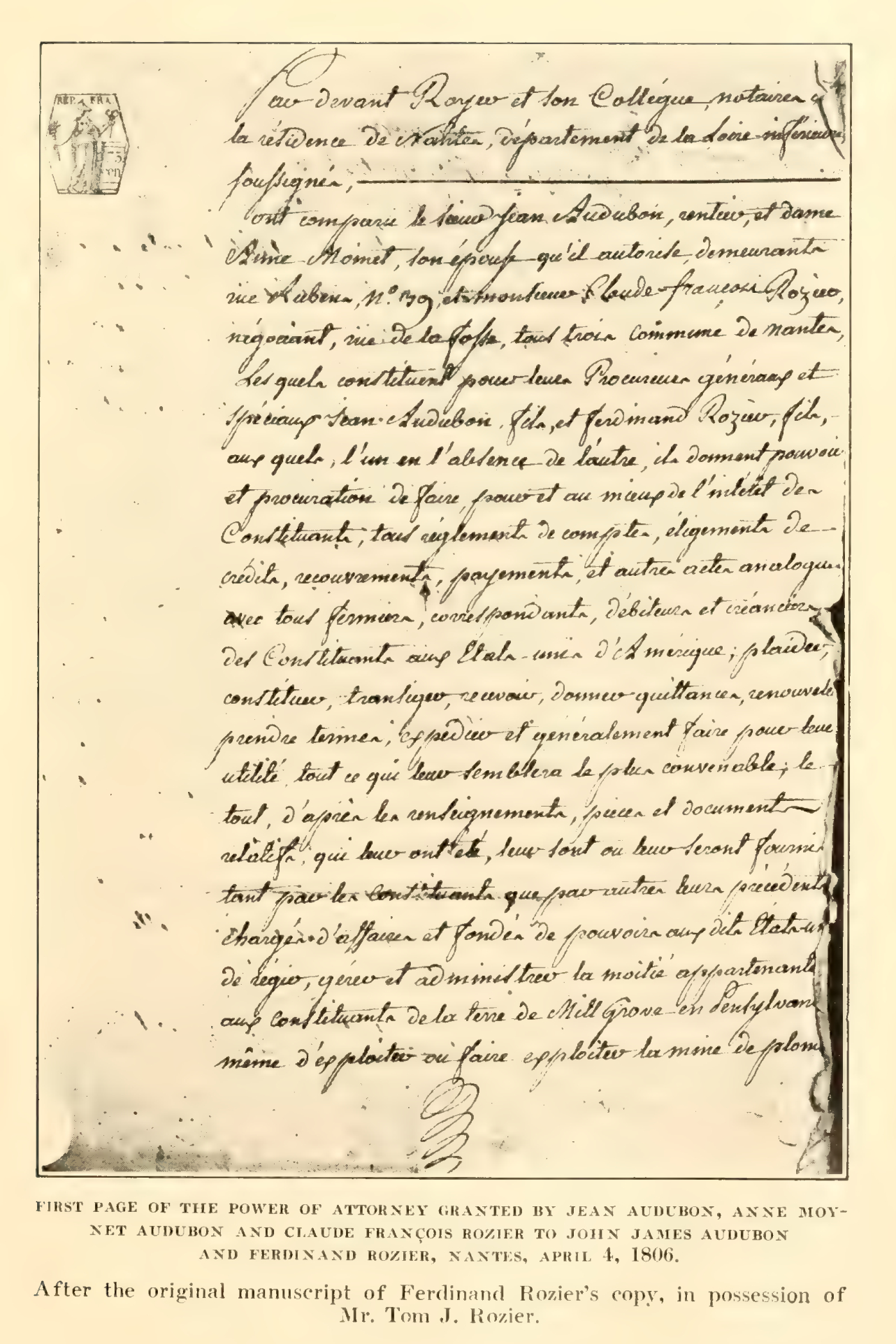
FIRST PAGE OF THE POWER OF ATTORNEY GRANTED BY JEAN AUDUBON, ANNE MOYNET
AUDUBON AND CLAUDE FRANÇOIS ROZIER TO JOHN JAMES AUDUBON
AND FERDINAND ROZIER, NANTES, APRIL 4, 1806.
After the original manuscript of Ferdinand Rozier’s copy, in possession of
Mr. Tom J. Rozier.
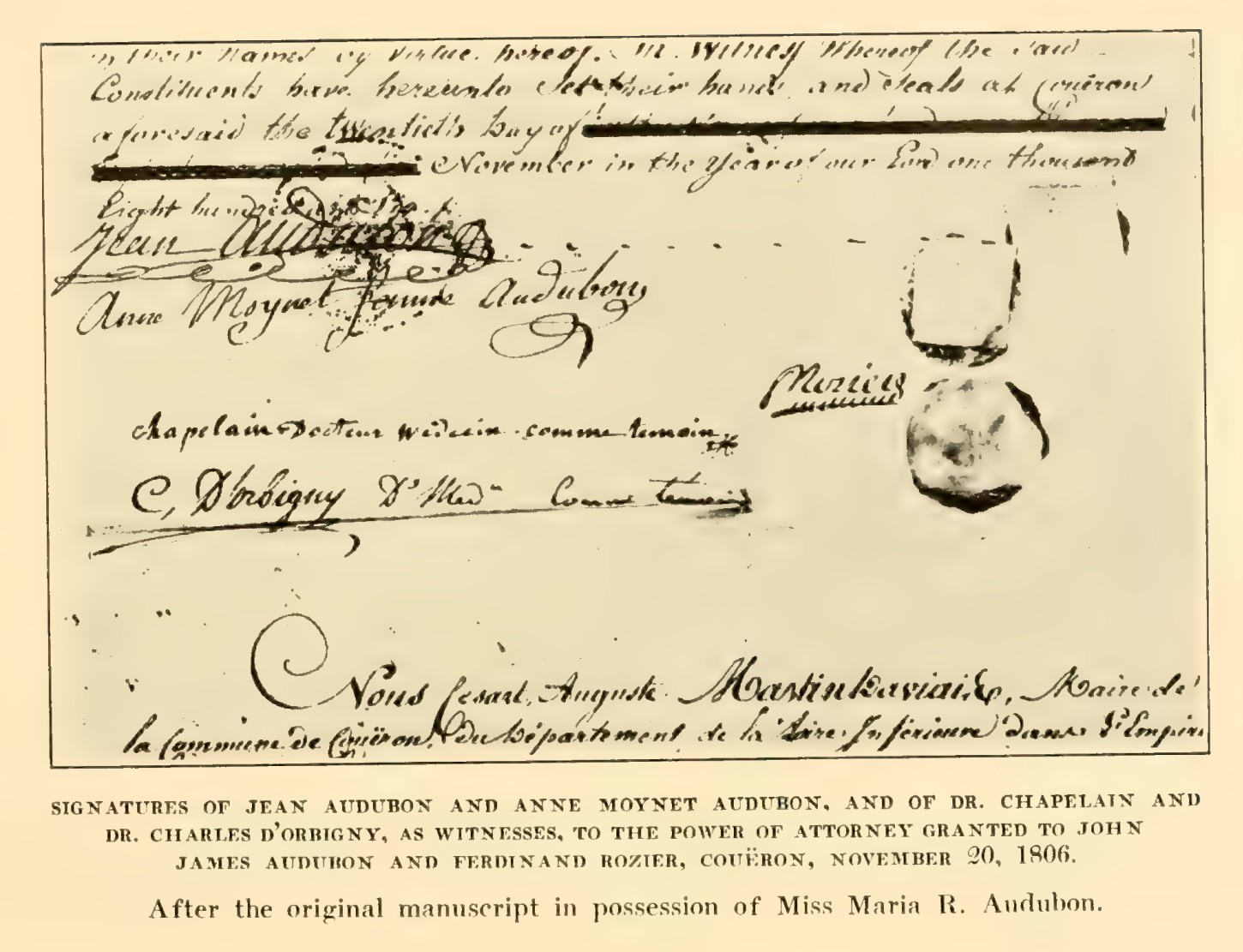
SIGNATURES OF JEAN AUDUBON AND ANNE MOYNET AUDUBON, AND DR. CHAPELAIN AND
DR. CHARLES D’ORBIGNY, AS WITNESSES, TO THE POWER OF ATTORNEY GRANTED TO JOHN
JAMES AUDUBON AND FERDINAND ROZIER, COUËRON, NOVEMBER 20, 1806.
After the original manuscript in possession of Miss Maria R. Audubon.
The division and sale of “Mill Grove” probably
153
ended the joint interests of the elder Audubon and
Rozier, for in November, 1806, a new power of attorney129
was given to the young men by Lieutenant Audubon
and his wife; as later events will prove, however,
their rights in the property were not completely surrendered
with its transfer to Dacosta and his mining
company in the autumn of this year. The partners were
now free to “choose some kind of serious work,” and
Ferdinand, who was then twenty-nine, was anxious to
make a beginning at once. Since he was not as yet
proficient in the English tongue, Rozier engaged as a
clerk in the French importing house of Laurence
Huron, of Philadelphia, while Audubon, following the
advice of his future father-in-law, entered the office of
the latter’s brother, Benjamin Bakewell, in New York.
In the autumn of 1806 Benjamin Bakewell was
conducting a successful wholesale importing business at
175 Pearl Street. He then owned several vessels, and
his correspondents were scattered over England,
France, the West Indies and the Southern States.
With him were associated at this time a number of
young men, including his nephew, Thomas W. Bakewell,
154
Thomas Pears, a nephew of his wife, Thomas
Bakewell, his son, as well as John James Audubon.
The hospitable family to which young Audubon was
now admitted on terms of intimacy, in accordance with
the custom of the day, lived in the rear of the counting-house
during the winter months but in summer migrated
to the country, the Bakewells going five miles out on
the Bloomingdale Road. Benjamin Bakewell had
come to this country in 1794, in the same year as the
famous chemist, Joseph Priestley, whose friendship he
enjoyed and whose religious teachings had drawn both
him and his brother, William, from rigid Calvinism to
the greater tolerance of the Unitarian belief. At
twenty-four he was an independent mercer in Cornhill,
London, and was well acquainted in France, where
he had spent considerable time during the Revolution,
which had destroyed his trade. One of his patrons at
this time was Claude François Rozier of Nantes, and
inasmuch as the correspondence with him had to be
conducted in French, and may possibly in this instance
have been due to young Audubon’s initiative, it was
naturally intrusted to him.
Seven letters of the naturalist, dating from January
10, 1807, to July 19 of that year, by good fortune have
been preserved, and they throw into full light another
shaded corner of his interesting life. From the contents
of these letters,130 as well as from other facts, we
155
know that Audubon remained in Bakewell’s office for
nearly a year, from the autumn of 1806 to the summer
of 1807. Bakewell’s house imported linens, lace, gloves,
wines, firearms and any kind of merchandise that promised
a ready and remunerative sale in New York; in
return they forwarded coffees, sugars and other commodities
to Rozier, receiving from him also prices current
and introductions to other merchants in France.
Another correspondent was the Huron firm in Philadelphia,
so it is probable that Ferdinand owed his employment
there to Benjamin Bakewell.
While Audubon expressed himself at this time as
freely in English as in French, in the former language
the tendencies of his French tongue and the influence of
his Quaker friends were strangely blended. He never
bothered with accents, and took as many liberties with
the spelling of French as of English. Some of these
lapses are purely phonetic, while others are more original,
as “schacket” for “packet,” “fither” for “Fisher”;
two variations of Rozier’s name and of Nantes occur
in the same letter. It should be remembered, however,
that at the beginning of the nineteenth century bad or
random spelling was a very venial offense, which gentlemen
of quality, or even scholars, could commit with
impunity. In this respect Audubon’s early essays in
English would probably compare favorably with Gibbon’s
youthful French.
156
John James Audubon to Claude François Rosier
Letter No. 1, addressed
M. Fr. Rozier,
Merchant-Nantes.
New York, 10 January, 1807.
Dear Sir:
We have had the pleasure of receiving by the Penelope your
consignment of 20 pieces of linen cloth, for which we send our
thanks. As soon as we have sold them, we shall take great
pleasure in making our return.
I am truly sorry that you had not received any letters from
us when you wrote, and I am also very disconsolate at having
no news from my good father. You did us a most acceptable
service in making us acquainted with your friends in different
parts of France, and in offering to send us such goods as you
shall deem suitable. Upon the same proposals I sent you orders
several months ago, and did I dare, I should tell you that all
articles having much show and little value are the very things
that are à la mode, and these in one hundred per cent, and
I assure you that we should be very happy to receive some small
consignments. As soon as we shall have realized our funds,
we will make our orders, in accordance with our means. Mr.
Bakewell has made a great profit on the consignment that you
made him shortly after our arrival. We should be flattered by
another like it. Have the kindness to write us often, and to
send us prices current as far as possible. I hope that you
will have had our letters concerning a plan of business with
Mr. Huron. If you will have the kindness to see him,131 he can
communicate to you his ideas on the subject. His plan, I believe,
will be advantageous both to you and to us.
Your son is just about to come from Philadelphia, to live
in New York until there is some news; but we will write you
more at length by Capt. Sammis, who brought us to this country.
I even venture to hope that you will send back some
merchandise for us. Have the kindness to forward us invoices,
157
with the goods consigned to us, in order to avoid the penalty
and the expense of having them taken to a public warehouse,
a proceeding which is often a great disadvantage on account
of the fees. Consign always to Mr. Benjamin Bakewell,
who treats us, so far as possible, as good friends.
Present my respects to your family, and believe me ever
your faithful servant,
J. J. Audubon.
John James Audubon to Claude François Rozier
Letter No. 2, addressed
Monsieur Fr. Rozier,
Negociant,
Nantes.
Loire Inferieure.
New York, April 24, 1807.
My dear Sir:
I am profiting by a good opportunity for Bordeaux to
apprise you of the receipt of a duplicate of the orders that
you gave us several months ago. You will also know that the
wines, consigned to Mr. L. Huron, have arrived in this city
and the insurance has been saved. Your son has gone to the
spot the dock in Philadelphia, and by one of his letters advised
me that the 60 cases of wine are sold. He tells me that
you can count on a net profit of nearly 20 p. c. If it turns
out very good, the remainder will not fail to find a purchaser.
Mr. Le Ray has arrived and has brought with him a small
box of lace for Mr. Benjamin Bakewell here; it ought to arrive
in a few days from Philadelphia. Mr. B. B. appeared satisfied
with the sale of his squared timber; he is anxious only to see
the returns; he is unhappy that the commerce of your town with
this country cannot be regularly conducted except by Bordeaux,
whence we have vessels every month. As our friend,
Ferdinand, will write you from Philadelphia concerning Mr.
Huron, I shall not enlarge about him. In several of your
letters you intimate that if we decide upon establishing a retail
158
shop, you can keep us constantly employed; our ideas upon
this subject are in perfect accord, and it would be indeed a
pleasure if we could start under the auspices and good advice
of Mr. Bakewell here; objects well chosen, favorably bought,
and shipped with care, are always sure of meeting a good sale.
I venture to hope that the ship La Jeanne, Capt. Sammis, will
have arrived in your port, and that the Indigoes shipped by
Mr. Bakewell will reach there in time for the sale of this
merchandise, of which I have some fears, in view of the sum
they have cost him.
We thank you for the prices current that you have sent
us. In one of my last, directed by way of Bordeaux, I begged
you to call on Mr. Fleury Emery for a box of seeds, from
Martinique and from this country, for you and for my father.
This was aboard the ship, the Virginia, Capt. Roberts, from
this section. We hope shortly to send you some merchandise,
and possibly Mr. Bakewell will profit by an opportunity that
we shall have in a few days for your port. A little more than
three weeks ago I was at Mill Grove, and I rented it for a
year, being unable to do better for the present. Your son, now
in Philadelphia, is trying to settle the accounts of my father
with Mr. Dacotta Dacosta, who does not easily forget the
rôle of chicaner. Present, I pray you, my respects and compliments
to your good family and wife, and believe in me as
your devoted and constant
servant,
J. J. Audubon.
Have the kindness to deliver the enclosed to my good father.
The following quaint and charming letter, which
young Audubon enclosed with the preceding and under
separate seal, but which his “good father” may not
have received, will be transcribed in full, without the
change of a letter or mark. Lieutenant Audubon, who
was then in his sixty-third year, was living, as we have
seen, at Couëron, the small river town nine miles west of
159
Nantes, the center of the mails for the Loire Inférieure,
and came frequently to that city to conduct his business
correspondence.
John James Audubon to Jean Audubon
Letter No. 3, enclosed with No. 2, addressed
John Audubon, Esq.,
Nantes.
pr Bourdeaux
New York April 24th 1807
My dear Father
I send thee by a good opportunity, but going to Bordeaux
I deed send about a month ago a small Box containing some
very curious seeds & some useful ones the whole was directed
to Mr. Fleury Emery it was given here to the Care of Capt..
Roberts of the Virginia I do hope they are now in thy possession
thou have been so often disappointed that it always
pains me to think that they have been Miscarried: thou shalt
found some of the Best Whatter Missions and Girmonds Called
here St. Domingo Schachet132 as in a few days I shall have
again a good opportunity for Nantz I will send thee a Duplicate
of the same Seeds, I have seen in the News Paper that a
ship called the Betzey had been in Nantz do make some Enquiries
for it there are on board of her Many Birds and a collection
of seeds from America for thee The Caps.. McDougal;
pray when thou answer to this be kind enough to mantion
these little things. I hope that the Jane Cap.. Sammis as
reached your Port and given thee some Turtle fit to be eaten in
soupe. Mr. L. Huron deed few days ago. Received some
Wines on a/c of M. Rozier and hits they prove goods133 and
will bring a good profit. Mr. F. Rozier the son speaks of
going to France some time this summer he is now near Mr.
Huron at Philadelphia and will try while he is there to settle
the Business between M.. Dacotta and thee M.. Rozier had
160
shosen M.. Huron for arbitrator but I would not agree to it
until M.. Miers fither134 was to have part in it. I am now
waiting for an answer. I am allways in Mr. Benjamin Bakewell’s
store where I work as much as I can and passes my days
3
happy; about thee weeks ago I went to Mill Grove for a/c of
the latter and had the pleasure of seeing there my Biloved Lucy
who constantly loves me and makes me perfectly happy. I shall
wait for thy Consent and the one of my good Mamma to Marry
her. could thou but see her and thou wouldst I am sure be
pleased of the prudency of my choice; M..B. Bakewell is allways
willing to oblige me and will do many things for me: do
not participate the Ideas of M. Rozier Going to France to his
father it would perhaps Injure us for a while. I wish thou
would wrights to me ofnor and longuely think by thy self
how pleasing it is to read a friend’s letter. Give my love
to all my friends and thine and kiss mamma, Rosa and Brother
Pigaudeau135 for me I hope they continue to be all happy,
do remember to send me thy portrait in miniature dressed as
an officer136 it will cost thee little and will please me much.
Some of thy hair and ask my sister for the Music she does not
want. I wish to receive some letter from M.. Dorbigny137 whom
I have often wrighten and send some curiosities. he is yet to
answer to my first.
When thou seeist Mr Rozier pray him and try to engage
him to send us some-goods then we feel very inclined to set
up in a retail store which would do, us a great deal of good.
161
I will send him a letter by this opportunity — Good by farwell
good father believe me for life thy most sincere friend be
well be happy
thy son,
J.. J.. Audubon.
J’espere que tu poura lire — adieu — adieu.
John James Audubon to Claude François Rozier
Letter No. 4, addressed
Mr. Fccis Rozier,
Merct, Nantes — Ocean.
New York, May 6th, 1807.
Dear Sir:
I wrote you recently by a ship going to Bordeaux; the letters
were carefully intrusted, and I hope that they were received.
I notified you of the arrival of the wines to the address
of Mr. Huron of Philadelphia, and told you that part
of the cases were sold. Your son informed me this morning
that wine of so good quality ought never to be exported in
cask, and that the profit would have been greater if the whole
had been in case. Mr. Benjamin Bakewell has received the bill
of lading of Mess Gereche brothers, and the gloves and the
lace are at present on the road from Philadelphia to this place;
perhaps we shall have them tomorrow; I am afraid that they
may be dear. In several of your letters to Ferdinand you
speak of a retail store, and my friend begs me tell you that
nothing could suit us better than that you should have the
kindness to send us enough goods to set up a shop at once
on a good footing. As soon as advised, we shall order you
to stock it with merchandise of your choice. You should have
already received the bill of sale of a bale of linen cloth. You
can judge that I have learned to shave Messrs the Americans,
since I have been with Mr. B. B. In conscience, however, the
goods have been sold at one third above their value. Should
you decide upon sending another shipment, do not count upon
so good a sale. You must know, however, that I am always
162
disposed to do everything for your interests, and that I shall
always seek to merit your approbation. Should you decide
to make us a consignment for a retail shop, have the kindness
to follow, point by point, the following bill:
| 60 |
doz. morocco leather powder flasks — green or gray,
copper mounted, like those that you sell at the
shop for 25 sols soldos. |
| 60 |
doz. d. d. of leather, mahogany color, at the same
price. |
| 100 |
boxes d. |
| 100 |
music boxes,138 in prices from 10 to 18 francs, good
pieces and gay music. |
| 100 |
boxes of seal-wafers, containing 1 gross each, assorted
in color but more of the red than any other. |
| 10 |
gross of small boxes of seal-wafers. |
| 3 |
boxes of pastels, good, well assorted, and chosen by
the sons of M. Belloc; more would not return us
anything. |
If you could procure us good books in English at Paris,
M. Bakewell assures me that we would realize a great profit
on them, and upon the other articles as given above, if well
chosen. We hope to sell Mill Grove, and we will credit you
with a great part of the profit in colonial merchandise. It is
with impatience that I await some news of the indigo of Mr.
B. Bakewell. Have the kindness, I pray you, to forward the
enclosed letter to my father as soon as possible, and will you
take from the ship Ocean, the carrier of this letter, a little
box sent to your address for him, and will you send this to
him also? Present my respects to your ladies; accept mine and
those of the Bakewell family. Ferdinand is well. I salute you,
and I am
your devoted friend,
Audubon.
Herewith the bill of lading of the box.
The captain did not wish to make any
charge, and has been perfectly polite.
163
John James Audubon to Jean Audubon
Letter No. 5, inclosed with No. 4, in French, and addressed
Mr. Fccis Rozier
Mercht
Nantes
pour Mr. Audubon
père
aussitôt que possible
My dear Friend:
Thou wilt find herewith a bill of lading of a small box containing
nineteen species of seeds, a bottle of reptiles for Mr.
Derbigny D’Orbigny, and some dried plants also for the latter.
I will write thee of Mr. Kauman, by the ship
Mentor,
which is to leave a little while after this one. Adieu, my good
friend! The box will be addressed to Mr. Audubon,
Md,
139
Nantes, with “American seeds” written above; besides two Bs,
like this which follows B.
140
The
B
Capn. promises me to take care
of it, and of my letters also. If thou findest in my letter anything
which displeases thee, remember that I am thy son. Adieu!
Farewell, my good friend! Thine for life.
J. J. Audubon.
New York, May 6, 1807.
Do not forget, I pray thee, to send me for the good Mrs.
Bakewell the complete works of Mr. Genlis
141 by the first opportunity,
and for me an exact copy of the departments of
France like that which I made, and which is in thy cabinet.
I wish thee to copy them for my brother-in-law.
142
164
John James Audubon to Claude Francois Rosier
Letter No. 6, addressed
Monsieur Fccis Rozier,
Merchant
Nantes
p. Brig Mentor
New York, May 30th, 1807.
Mr. Francis Rozier,
Merchant, Nantes.
Dear Sir:
By my last, sent on board the ship Ocean, Capt. Bunken,
I apprised you of the arrival of the gloves and lace, shipped
by your order at Rochelle for the account of my good friend,
Benj. Bakewell. I can now inform you of their sale, which
is also advantageous, although the principal part was fine
and of very great price. The gloves in prices of 23# 28# D,
are what is needed for this market here, and especially if they
are of any other color than yellow or bottle green they are
less apt to soil; further they conceal defects more, and find
in consequence more purchasers. The laces were better, although
there was a heavy duty. You should know that here
the extravagance of the women equals or rather quite balances
the circumspection of the men, so that all articles for women
should be beautiful, that is to say, conspicuous. I await with
a kind of pleasure the arrival of Cap. Sammis, for although
I am convinced that the indigoes will meet with no success
at Nantes, their return here will compensate us. I am sorry
that I did not order from you some little pistols and the guns
which would serve perfectly. Believe nothing as to Mr. Bakewell,
and be well assured that he is our friend. Have then
less fear: I hope shortly to consign, that is to say, Mr. B. B.
will consign for us, coffee and sugar from Martinique to your
address. Your son is still at Philadelphia with Mr. Huron.
They have sold the wines quite well.
But in truth I have been astonished that Mr. Huron did
not make you an immediate return. I thank you sincerely for
165
the little package that you said had been prepared for us. Be
sure that Mr. B. B. will aid us to a sufficient degree, and always
in a way that anything which you send us will be promptly
returned in merchandise assigned to you. The land, which we
cannot sell without a great disadvantage, keeps us very short
of cash, and prevents us for the moment from dealing on as
large a scale as we should desire; but with your kindness in
sending us the materials for starting a grand retail shop with
different articles, it will aid us very much. As you well say,
it is a little unfortunate that there is no longer a boat from
your port here.
I write to my father by the same opportunity. Will you,
I pray, get it to him as soon as possible, and I beg you to go
aboard for the live birds for him and for you.
Present my respects to your good family, and believe me
for ever
Your faithful friend and
servant,
Audubon.
I should be very happy if you would send me a good box
of pastels, chosen by Mr. Belloc, the younger, at 2 c 3 Louis.143
John James Audubon to Claude François Rozier
Letter No. 7, addressed
Monsieur Fr. Rozier,
Negociant,
Nantes.
Loire Inférieure.
New York, July 19, 1807.
Dear Sir:
Mr. Benjamin Bakewell as well as myself have received your
letters by the Comet, which had a passage of 42 days. We
have at present in the warehouse a great part of the merchandise
of the latter vessel, and in good condition; Mr. B. B.
166
appears to be satisfied; he is about to send some teas that you
have ordered from him. It has grieved me much to see him
send a boat to Nantes, and not consigned to you, but his reasons
were, I believe, so sound that I did not dare remonstrate.
The agents of the house of Rossel and Boudet paid him the
⅔ of the invoice, or a draft upon London for an equivalent
sum, that neither Ferdinand nor I were authorized to do; the
latter is at Philadelphia. In a short time we are leaving for
a voyage upon the Ohio, the details of which you will learn
from him, or from my father, and which I believe will be
very advantageous to us. We hope to sell Mill Grove this
autumn, which we shall do, however, only at a profit. We
received this morning a letter from Mr. Fleury Emery, who
urges Mr. B. B. to give him some shipments, but regarding
this I do not know his intentions. I have also received a letter
to-day from our friend, Fd, who is quite well, and longs to be
doing something.
Mr. Emery advises me of the receipt of a little box of seeds
for my father and you. I think that your gardens are now
embellished with foreign trees.
Mr. B. B. is loading tea for you, a thing that gives me
much pleasure. I am sending you a letter from Ferdinand that
I received yesterday. Presenting you as well as your whole
amiable family with humble respects,
I continue to be
your faithful servant,
Audubon.
My regards, I pray to you, to my cousin, the younger.
Audubon’s loyalty to his kind-hearted employer is
evident in every one of these amiable letters, yet it is
plain that they were written upon his own initiative, and
a merchant of today might seriously object to such a
candid exposition of his dealings as young Audubon’s
friendly epistles occasionally revealed.
167
The numerous references which these letters contain
regarding the disposition of the “Mill Grove” farm
may well puzzle the reader who has followed the story
to this point; we must therefore attempt to unravel the
tangled threads of this intricate affair. In the spring
of 1807 Audubon, who was then anxious to start a
“retail shop,” complained that the land, which could not
be sold to advantage, kept them short of capital and
prevented them from dealing on so large a scale as
they could wish. On the 24th of April he wrote that
three weeks before he had gone to “Mill Grove” and
closed an agreement for renting the property (evidently
referring to the farm as distinct from the mine) for a
year, being unable to do better, and that Ferdinand was
then in Philadelphia trying to settle his father’s accounts
with Dacosta, who did not readily forget his trickster’s
rôle. In Audubon’s letter of the same day, inclosed in
the same packet with the request that it be delivered
to his father, there is a similar reference, with the note
that Ferdinand, who had charge of the settlement, had
chosen Mr. Huron as arbitrator, but that he would not
agree unless honest Miers Fisher had a part in it.
Finally, as late as the 19th of July of that year he
wrote to Rozier, the elder, that they were hoping to sell
“Mill Grove” in the autumn, but would do so only at a
good profit; yet at this time the property had been
out of their possession, technically at least, for nearly
a year.
Still more curious is this statement in Audubon’s
autobiography,144 relating to the year 1813; “I bought a
wild horse, and on its back travelled over Tennessee and
a portion of Georgia, and so round till I finally reached
168
Philadelphia, and then to your grandfather’s at Fatland
Ford. He had sold my plantation of Mill Grove to
Samuel Wetherill, of Philadelphia, for a good round
sum, and with this I returned through Kentucky and
at last reached Henderson once more.“
When “Mill Grove” was conditionally sold to
Dacosta and his mining company in September, 1806,
he gave a mortgage and bond to Miers Fisher, who
again became Lieutenant Audubon’s agent. Many
months elapsed before the necessary legal papers could
arrive from France, and meanwhile Dacosta’s yearly
accounts were contested, and gave no end of trouble.145
After operating the lead mine for five years, Dacosta’s
company failed, and “Mill Grove” again passed
into other hands; it was finally sold to Samuel Wetherill
169
in 1813.146 If our inferences are correct, the mortgages
by which the Audubon and Rozier interests were protected
were repeatedly transferred, and the first considerable
amount of ready money that had appeared in the
entire series of transactions was furnished by Mr.
Wetherill. It is doubtful if Jean Audubon ever received
any returns from his American farm after the
advent of Dacosta in 1803. The ultimate failure of the
lead mine was assuredly not the fault of this exploiter,
but his dubious methods of accounting and probable
failure to keep his contracts no doubt led the naturalist
to denounce him as a swindler.
It may be recalled that in their “Articles of Association”
Audubon and Rozier had agreed that the house
at “Mill Grove” should be “an object separate from all
business, in order that we may control this property as
long as we desire,” but the conditional sale to Dacosta
apparently included the farmhouse as well as the land.
Many of Audubon’s references to “Mill Grove”
were apparently wide of the mark, but viewed in the
light which we have endeavored to shed upon this involved
affair, they would be in harmony with the essential
truth; in writing to the elder Rozier, who became a
partner in the enterprise, there was no motive which
could have led him to depart from it.147
170
We will now return to the story of Audubon’s life
in New York. While he was supposed to be learning
the exporting business with Benjamin Bakewell, his
heart was in the woods and fields, and every hour that
could be snatched from the counting-room found him
in the pursuit of birds or drawing their portraits. He
used the pencil and black crayon point combined with
pastels, and while much of his artistic work at this time
was hastily done, he was capable of producing excellent
likenesses. A very delicate drawing of the Wood
Thrush, signed with his initials, and dated at “Mill
Grove, Pennsylvania, 14 aout, 1806,” is numbered 209,
showing that his collection of American birds was already
extensive, even if it did not include many that
were well known. In the winter of 1806-7, while in
New York, Audubon paid most attention to the waterfowl,
frequently visiting the shore and the markets for
his subjects. The sketches which he then made were
all in full size, and, as an evidence of the rapidity with
which he worked, it may be noticed that he would often
171
complete two or more large drawings of ducks on the
same day. New York at this time was a city of about
75,000 people; Audubon said that by walking briskly
he could pass from one end to the other in a few minutes.
In the foregoing letters we have seen young Audubon
sending seeds and live birds to his father and to
Francois Rozier, and reptiles and dried plants to
Charles d’Orbigny, and ordering for his own use the
best drawing materials from France. While at New
York he had the good fortune to become a friend and
protégé of the most distinguished naturalist of the metropolis,
Dr. Samuel L. Mitchell,148 eminent in many
walks of life, and at that time a member of the United
States Senate. Audubon prepared many birds and
mammals for Dr. Mitchell’s collections, and the friendship
thus early formed proved of much service to him
later. He was probably working for Dr. Mitchell when,
as the story goes, some of his neighbors lodged a complaint
with the municipal authorities on account of the
strong odors that habitually issued from his workroom,
and a constable was sent to investigate.
172
Audubon remained in New York as late as August
22, 1807, for on that day he made a drawing of the
“Sprig-tail Duck,” but without doubt he had come to
feel the incongruity of his position in a business to
which his heart was a stranger. As an instance of his
preoccupation at this time, he confesses to have once
forwarded but forgot to seal a letter containing $8,000.
If Benjamin Bakewell failed to make a business man
out of Audubon, it was not from lack of kindness, and
probably no one else would have been more successful.
As it happened, Audubon did not leave his employer
any too soon, for at the close of 1807 Benjamin Bakewell’s
exporting business was ruined by the Embargo
Act, through which President Jefferson had hoped to
bring Great Britain and France to terms by cutting off
their American trade, and for a year or more his estate
was in the hands of creditors for settlement.
The naturalist has left a characteristic sketch of
himself at this time: “I measured,” said he, “five feet,
ten and one half inches, was of fair mien, and quite a
handsome figure; large, dark, and rather sunken eyes,
light-colored eyebrows, aquiline nose and a fine set of
teeth; hair, fine texture and luxuriant, divided and passing
down behind each ear in luxuriant ringlets as far
as the shoulders.” The habit of wearing his hair long,
thus early acquired and later favored by his wandering
mode of life, appears to have lasted more than twenty
years.
173
CHAPTER XII
EARLY DRAWINGS IN FRANCE AND AMERICA
Child and man — His ideals, perseverance and progress — Study under David
at Paris — David’s pupils and studios — David at Nantes arouses the
enthusiasm of its citizens — His part in the Revolution — His art and
influence over Audubon — Audubon’s drawings of French birds — Story
of the Edward Harris collection — The Birds of America in the bud — Audubon’s
originality, style, methods, and mastery of materials and
technique — His problem and how he solved it — His artistic defects.
Audubon began to draw birds and other animals
when a child, and, like most children, was ready to believe
that his crude sketches were finished pictures if
only they possessed some sort of a head, a tail, and sticks
in place of legs. But, unlike the majority of youth, he
went direct to nature for his subjects, and his “family
of cripples” failed to satisfy him long. He gradually
developed a high ideal, and at an early age felt stirring
within him the impulse and the power to express it.
On stated anniversaries his masterpieces, he tells us,
were burned, in spite of the praise and flattery they had
evoked; he would then exert all his powers to do better,
and this commendable practice was kept up for years.
In this respect the child was father of the man, for
on the 5th of March, 1822, when Audubon was living
in New Orleans, too poor to buy even a blank-book for
a journal, he thus wrote of his work during the previous
months: “Every moment I had to spare I drew
birds for my ornithology, in which my Lucy and myself
alone have faith. February was spent in drawing birds
174
strenuously, and I thought I had improved by applying
coats of water-color under the pastels, thereby preventing
the appearance of the paper, that in some instances
marred my best productions. I discovered also
many imperfections in my earlier drawings, and formed
the resolution to redraw the whole of them.“ Seldom
satisfied with the results attained, he kept up this laborious
process of revision and selection by which he approached
more closely to his ideal, the truth of living nature,
for more than forty years, until, in fact, the last
plates of his Birds of America came from the press in
England in 1838. An examination of the originals of
those plates today149 proves that many of their defects
were inevitably caused by the makeshifts to which he
was sometimes forced by lack of time.
Audubon has credited his father with the only judicious
criticism which he ever received at the youthful
stage of his art. “He was so kind to me,” said the son,
“that to have listened lightly to his words would have
been highly ungrateful. I listened less to others and
more to him, and his words became my law.” When he
was about seventeen years old, or probably not far
from the year 1802,150 he was sent to Paris to study drawing
under Jacques Louis David, the acknowledged
leader of French art during the period of the Revolution.
This popular artist, who had uttered fierce invectives
against “the last five despots of France,” became
nevertheless court painter under Napoleon; like
many another Conventional regicide, he was destined
175
to end his career as an exile from France, and died in
Brussels in 1825.
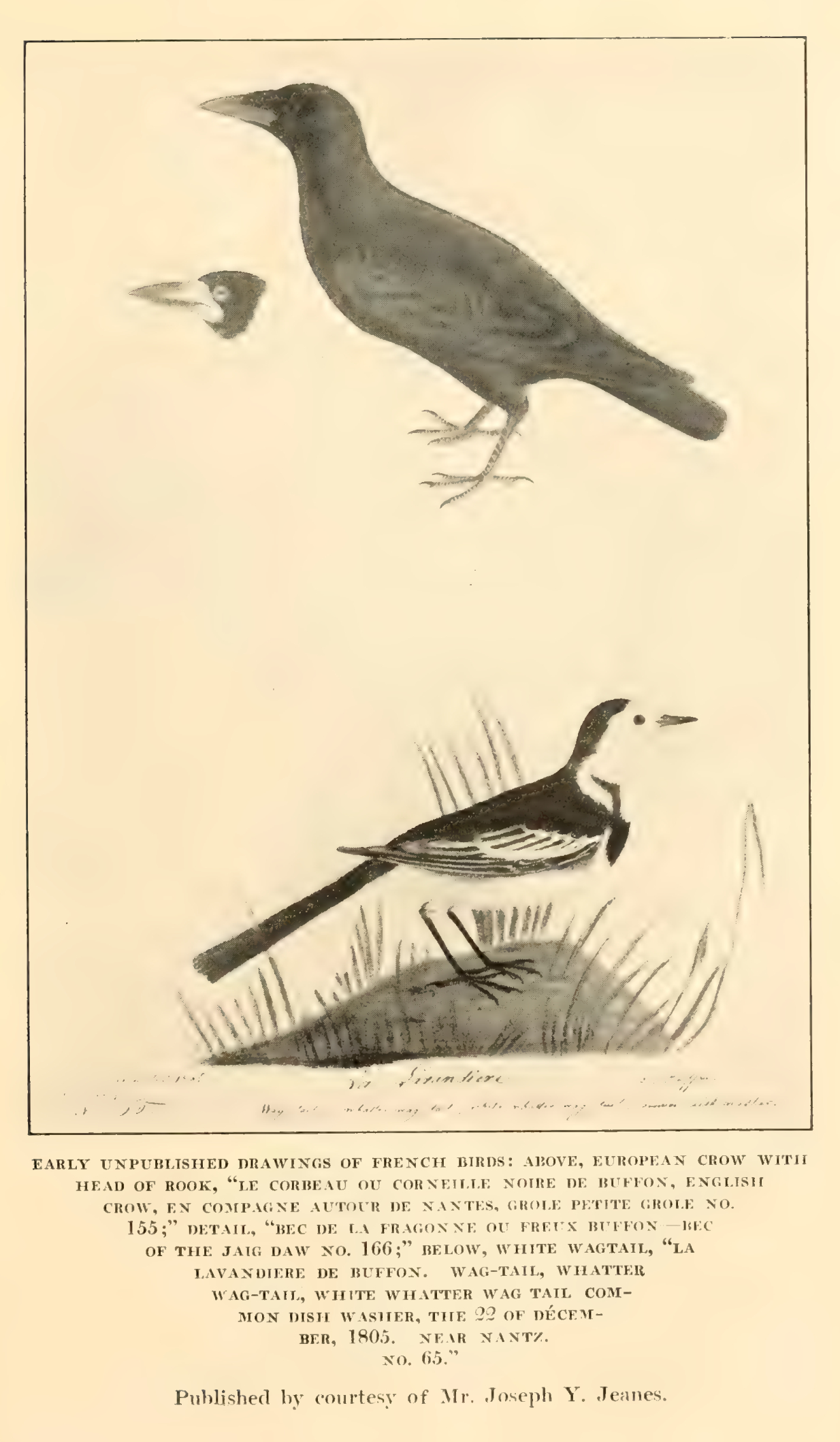
EARLY UNPUBLISHED DRAWINGS OF FRENCH BIRDS: ABOVE, EUROPEAN CROW WITH
HEAD OF ROOK, “LE CORBEAU OU CORNEILLE NOIRE DE BUFFON, ENGLISH
CROW, EN COMPAGNE AUTOUR DE NANTES, GROLE, PETITE GROLE, NO.
155;” DETAIL, “BEC DE LA FRAGONNE OU FREUX BUFTON — BEC
OF THE JAIG DAW NO. 166;” BELOW, WHITE WAGTAIL, “LA
LAVANDIERE DE BUFFON. WAG-TAIL, WHATTER
WAG-TAIL, WHITE WHATTER WAG TAIL, COMMON
DISH WASHER, THE 22 OF DÉCEMBER,
1805. NEAR NANTZ.
NO. 65.”
Published by courtesy of Mr Joseph Y. Jeanes.
Audubon has said but little of this Paris experience,
but he remarked: “At the age of seventeen when I returned
from France, whither I had gone to receive the
rudiments of my education, my drawings had assumed
a form. David had guided my hand in tracing objects
of large size.”151 An interesting sidelight is thrown upon
this incident by the fact that, not many years before,
David had been warmly welcomed in the city of Nantes,
when it is not unlikely that the naturalist’s father was
one of the throng of citizens who made his acquaintance.
The occasion to which I refer was so noteworthy in the
annals of Audubon’s paternal city as to make a digression
at this point of our narrative inevitable. In March,
1790, Daniel de Kervegan, a wealthy merchant who was
then serving his second term as mayor, had aroused so
much enthusiasm by his public spirit and sterling character
that the citizens had voted the sum of 300 livres,
or about $60, for his portrait, to be executed in oils
and placed in one of their public buildings. The
commission was offered to David, who accepted it, and with
such enthusiasm did he set to work, that upon reaching
Nantes he asked the privilege of paying his respects
to the Municipal Assembly, which was in session. Upon
being admitted to the Chamber, on the 24th of March,
he expressed these sentiments:
If ever my art has brought me any gratification, or any
success, never before have I had better excuse for boastfulness.
I have made it a duty to respond to the worthy invitations,
inspired by patriotism and gratitude, that hallow this most
timely and most astounding revolution.
176
It is your work, gentlemen, and the respect which you render
to the chief of your administration which speaks in praise of
your sentiments and virtues and which will transmit their
memory, along with your glory, to posterity.152
David worked on this portrait for about a month,
and on April 23, before his departure for Paris, he
asked the privilege of again addressing the Assembly.
Not only was the request granted, but he was publicly
thanked for the trouble he had taken in coming to their
city, and a committee was appointed to express the
sentiments of esteem with which he had inspired the
whole community. We may add that David seems to
have taken this canvas to his studio in Paris, where it
was subsequently lost or destroyed in the period of
turbulence that followed.
David’s radical speeches from the tribune, added to
his popularity as an artist, no doubt brought him pupils
in plenty from every quarter of republican France.
Young Audubon was probably admitted to the most
elementary class, for he received no instruction in the
use of oils but was directed to study the rudiments of
drawing from the cast. As he had hoped to perfect
himself in the art of depicting animals, he was disappointed.
“Eyes and noses belonging to giants,”
he
said,
“and heads of horses, represented in ancient sculpture,
were my models.” He also spoke of drawing
“heads and figures in different colored chalks,” and of
“tolerable figures” obtained by use of the manikin, but
adds:
“These, although fit subjects for men intent on
pursuing the higher branches of the art, were immediately
177
laid aside by me”; yet he “returned to the woods
of the New World with fresh ardor,”153 and there began
a series of drawings which were later published.
While this is virtually all that has been recorded of
this incident in Audubon’s career, a number of interesting
facts might be added which throw light upon
the surroundings of his life at Paris while under the
tuition of this master. At that time David was enjoying
the privilege, accorded to eminent artists from an
early day, of living with his family and of having his
studios in special quarters set apart for the purpose in
the palace of the Louvre; this was continued until all
the artist tenants were turned out by one of Napoleon’s
peremptory orders in 1806. David’s principal studio
was at the corner of the Quai de Louvre and the square,
facing the church of St. Germain l’Auxerrois, at a
point occupied in the present structure by the grand
staircase leading to the Egyptian Gallery. It was here
that his more advanced pupils studied; the appearance
of its interior, with his pupils at work, as well as the
view from one of its windows, by means of which its
exact position can be determined, may be seen today
in the interesting painting by Matthew Cochereau.
This small picture, first exhibited in the salon of 1814,
now hangs in the Louvre in company with some of the
finest of David’s works, and immediately beneath his
huge canvas representing the coronation of Napoleon.
Over his principal room David had also a private studio,
and at one time he had another on the Quai, opposite
the Institute of France, while his numerous pupils occupied
a series of rooms, one above another, not remote
178
from the first. Access to these apartments was gained
from the street by means of a spiral stairway, the opening
of which may still be seen in the Egyptian Hall.
It is common to speak of this gifted man as if he
alone had stifled all the art of the eighteenth century
in France, as if he were the molder of his age and not
a part of it. Too often has he been judged on the
basis of a few, unfortunately conspicuous, theatrical
pieces, while his excellent portraits, of which there are
many, entitle him to the gratitude of posterity.
Buchanan remarked that the mannerism of David could
“still be traced in certain pedantries discernible in
Audubon’s style of drawing,” which is a fancy without
any basis in fact. If it could be shown that drawing
from the casts of antique statues could develop mannerisms
in the careful delineation of birds and mammals,
it would still appear that Audubon’s style was really
formed at a later period.
This brief Paris episode, which at most could have
lasted but a few months, represented all the formal
instruction which Audubon ever received in drawing,
although he enjoyed some private tuition at a much
later day. As to the sciences now embraced in biology,
that is, zoölogy and botany, which would have been
most useful to him, the score was blank; even books on
any of these subjects were rare in America at the beginning
of the nineteenth century.
When Audubon first came to the United States, he
brought with him all his drawings of French birds, and
a few pieces which may belong to this early period have
been described.154 Done in a combination of crayon and
water color, they represent a European Magpie, a Coot
179
and a Green Woodpecker, the latter especially, which
bore the number “96,” showing evidence of care and
skill. The year passed at “Mill Grove” was not particularly
fruitful, but during the Couëron visit which
followed in 1805 and 1806, Audubon said that he made
drawings of “about two hundred species of birds,” all
of which he brought to America and gave to his Lucy.
After finally reaching this country in the latter year,
these studies were continued, with an alacrity that seldom
failed, until 1822, when he began to revise much
of his earlier work, substituting water colors more completely
for pastels, pencil and crayon point.
In writing to Bachman in 1836, Audubon thus
referred to the work of his apprenticeship: “Some of
my early drawings of European birds are still in our
possession, but many have been given away, and the
greatest number were destroyed, not by the rats that
gnawed my collection of the ’Birds of America,’ but
by the great fire.”155 When the naturalist was in Philadelphia
in 1824, in search of a publisher and sadly in
need of funds, he made the acquaintance of Edward
Harris,156 who looked at the drawings he had for sale
and said at once that he would take them all and at
Audubon’s own prices. Upon his leaving that city, this
generous friend, we are told, pressed a $100 bill in his
hand, saying: “Mr. Audubon, accept this from me;
men like you ought not to want for money.” “I could
only express my gratitude,” continues the naturalist,
“by insisting on his receiving the drawings of all my
French birds.” The worthy Harris cherished this large
series of Audubon’s early studies and added to it many
specimens of his later work. The entire collection remained
180
in his family unbroken and unimpaired until
1892.157
This beautiful and unique collection, which represents
The Birds of America in the bud, illustrates the
development of Audubon’s art from about 1800 or a
little later to 1821,158 and clearly shows that the fuller
mastery which he attained after the latter date was
manifested in no small degree at a much earlier period.
His drawings of the Wood Thrush (1806), the Whippoorwill
and Kingfisher (1810), the Carolina Parrot
(1811), and the Nighthawk (1812), though detached
and less ambitious as pictures, for truth of line and delicacy
of finish would compare favorably with the best of
his later work. After 1820 his ability had so far outstripped
his ambition that there was needed only the
stimulus of a powerful motive and a well defined plan
to bring his powers into full fruition at once. A little
later, when he began to revise, enrich and standardize
all of his previous work, he used the brush and water
colors more freely than ever before. Hundreds of his
earlier studies were cast aside; many, to be sure, were
181
hastily drawn in pastel, crayon and pencil, and had not
time failed him at the end, nothing of his earlier American
period would have remained in the final product.
Nearly all of these rejected drawings bear serial
numbers, which from the lack of sequence now observed,
show that they were subject to constant change and
that their total number must have been great. All bear
the scientific and common names in French or English
or both, and many are signed with the artist’s initials
or name; besides giving the place and date, in some
cases the weights and measurements of his subjects are
added, with detailed sketches of foot, bill, or eggs.159
A large crayon sketch of a groundhog, in excellent
drawing, is labeled “Marmotte de sauvage, No. 159, le
6 juin, 1805.” The Redstart, executed in August of
the same year, is a good example of Audubon’s more
delicate early work; it shows also the attention which
he was then beginning to pay to accessories, his bird
being perched on a spray of ripening blackberries. The
Wagtail, on the other hand, was a rough crayon sketch,
dashed off on December 22 of the same year. A pencil
and crayon drawing of the Mountain Titmouse, which
is a European bird, was probably made from a captive,
and at sea, since it bears the date of January 22, 1805,
when Audubon was, I believe, aboard the Hope.160 The
latest of these French pieces, designated “No. 94.
Woodpecker, le 8 mars, 1806. près Nantes; 12
to the tail,” was executed, about a month before the
naturalist finally left France with Rozier to settle permanently
in the United States. The excellence of such
182
a drawing as that of the Wood Thrush (1806) is in
marked contrast to the more ambitious “Fish Hawk or
Osprey, A. Willson, Perkioming Creek, 1809,” in which
the bird holds a white sucker in its talons but is less
happily rendered. Nine large pastels of waterfowl and
two smaller pieces, representing a Robin and Brown
Thrush, in the same style, are good examples of Audubon’s
cruder efforts of that time; they were merely hurried
sketches or practice work, with no attempt to finish
with all the perfection of detail of which he was then
capable.
In a full-size pastel of the Black Surf or Velvet
Duck, drawn on December 28, 1806, and signed “J. J.
L. Audubon,” the note is added: “the only specimen of
the kind I have ever seen.” He became well acquainted
with the Velvet Ducks, now better known as the White-winged
Scoters, and in his account of the species says:
“As we approached the shores of Labrador, we found
the waters covered with dense flocks of these birds, and
yet they continued to arrive there from the St. Lawrence
for several days in succession. We were all astonished
at their numbers which were such that we
could not help imagining that all the Velvet Ducks in
the world were passing before us.”161
Several of these drawings are credited to “The Falls
of the Ohio,” as the rapids of this river at Louisville
were then generally called; a number to “Red Banks,”
the old name of Henderson, Kentucky; while five were
done in Pennsylvania, probably when Audubon was at
the home of his father-in-law, William Bakewell, in the
spring of 1812. An excellent drawing of the Chuck
Wills Widow was probably made on the Red River,162 in
183
Arkansas, when Audubon was exploring that country
and slowly making his way to New Orleans in June,
1821, though it should be noticed that a steamboat on
which he sometimes traveled was called the Red River.
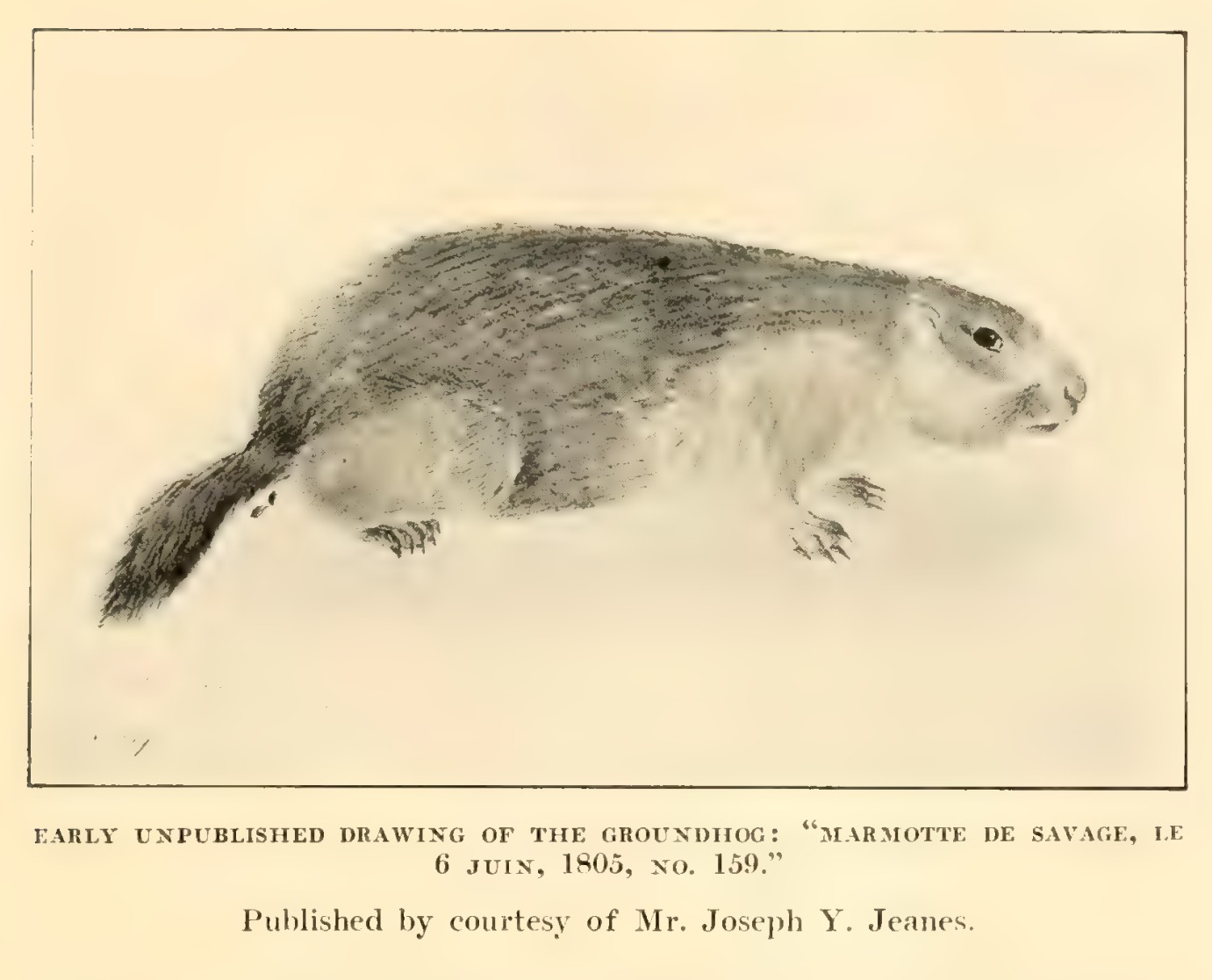
EARLY UNPUBLISHED DRAWING OF THE GROUNDHOG: “MARMOTTE DE SAVAGE, LE
6 JUIN, 1805, NO. 159.”
Published by courtesy of Mr. Joseph Y. Jeanes.
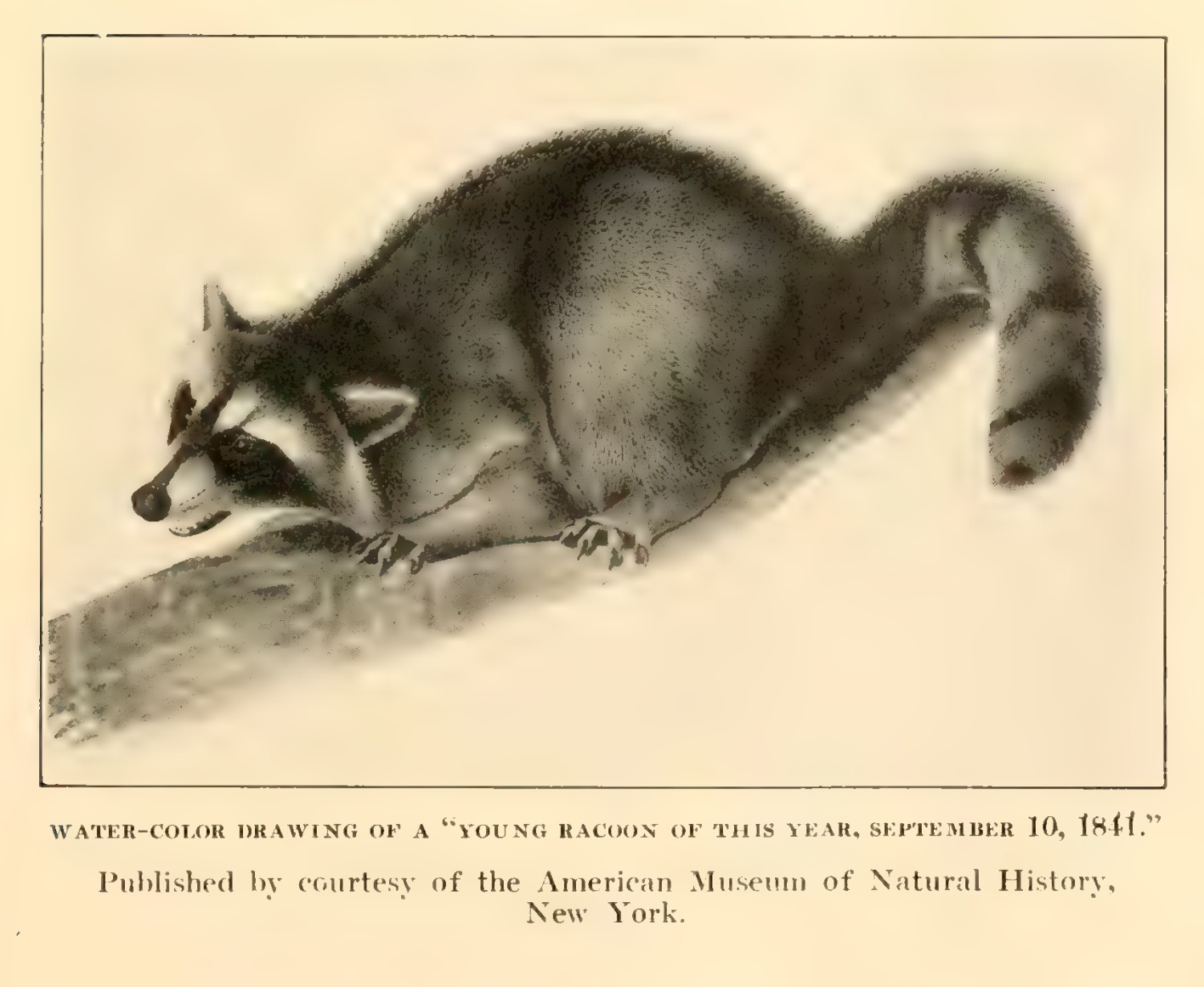
WATER-COLOR DRAWING OF A “YOUNG RACOON OF THIS YEAR, SEPTEMBER 10, 1841.”
Published by courtesy of the American Museum of Natural History,
New York.
Audubon began in the usual way, by representing
his birds in profile, and often on a simple perch, but
gradually introduced accessories which eventually became
such an important part of his plan that, after
1822, his plates took on more the character of balanced
pictures, literally teeming with the characteristic fruits
and flowers of America, as well as with insects and
animals of every sort, suggestive of the food and surroundings
of his subjects, not to speak of American
landscapes drawn from many parts of the country.
Dissatisfied with the older methods of drawing birds
in the stereotyped attitudes of most stuffed specimens,
Audubon made many experiments at “Mill Grove” before
hitting upon what he called his “method” of using
wires to pierce and hold the body of the bird in any
attitude which he desired to represent. His device,
which was simple only for one who possessed the requisite
knowledge and skill, was publicly exhibited at a
meeting of the Wernerian Society at Edinburgh on
December 16, 1826. A recently killed bird was fixed in
the position desired by means of wires, and placed
against a background ruled with division lines in squares
to correspond with similar lines on Audubon’s paper.
The parts, measured if necessary with compasses, were
then drawn in, and every part was rendered in due proportion.
As to the difficulty of thus securing natural
attitudes, aside from any question of draughtsmanship,
we have only to recall the bungling work of most taxidermists;
there are careful students of animal life who
are able to reanimate their subjects, even when reduced
184
to dried and mounted skins, but such ability is not easy
to acquire or impart. Method is always subordinate to
power, and Audubon at his best, when not hampered by
lack of time, was able to represent the living, moving
bird in a hundred attitudes never attempted before,
which surprised the world of his day by the remarkable
skill, freshness and fidelity they displayed.
Some have complained that Audubon, in striving
for effect, too often exaggerated the action of his subjects;
his birds, like the Frenchman he was, gesticulate
too much, while Wilson’s were more cautious or sedate,
as became a canny Scot. The complaint may be well
founded, but the explanation is too trivial for serious
consideration. Wilson, like his predecessors, regardless
of nationality, merely followed custom, which led by
the path of least resistance. Barraband and all the best
French artists before him in depicting bird and animal
life had done the same, and in their hands the perch,
were the subject a bird, became stereotyped to the last
degree, as if inserted with a rubber stamp. Audubon
followed the same course until he became imbued with
the desire of endowing his animals with all the moving
energy of which they were capable, whether in seizing
their prey, feeding their young, or fighting their enemies.
It is well known that many an animal, though
ordinarily cautious or even timid, can be roused to vigorous
action under the spur of emotion, as when its
young are suddenly threatened, and be it warbler, bluebird,
or cuckoo, may become a contortionist at a moment’s
notice. Very few of the 1,065 life-size drawings of
birds which appear in his large plates could be truly
described as fantastic or unnatural.
Audubon’s problem was rendered more difficult by
the fact that all of his animals were drawn to the size
185
of life, and because his desire and style compelled him
to represent the utmost detail, even to the barbs of a
feather or the individual hairs of a mammal. When a
landscape was to be included it was not an easy task
to harmonize life-sized objects in the foreground with
receding objects, and here he sometimes failed. Some
of his least happy compositions, however, were the result
of haste, as an examination of the originals of his
Birds of America has clearly shown; when hard pressed
for time he would resort to the scissors and paste, in
order to combine the parts of several distinct drawings
into one plate, and often leave the backgrounds to be
supplied entirely by the engraver. One of the few
grotesque results of such methods is seen in plate 141,
wherein are represented the Goshawk and the Stanley
Hawk; the latter, which was originally designed for
different surroundings, has quite lost its center of gravity
on an islet amid stream. An early reviewer thought
that the artist must surely have intended this for a caricature,
as in the case of one of Hogarth’s famous prints,
in which a man on a distant hill is lighting his pipe at a
candle held out of a window in the foreground.
The action of Audubon’s subjects was sometimes exaggerated;
his birds on the wing were occasionally ill
drawn, and other defects might be mentioned. But we
must admire his boldness for attempting so many difficult
positions, and admit that, when all is considered,
he succeeded to admiration, and set a new standard for
the illustration of works on natural history.
186
CHAPTER XIII
AUDUBON’S MARRIAGE AND SETTLEMENT IN THE
WEST
Audubon and Rozier decide to start a pioneer store at Louisville, Kentucky — Their
purchase of goods in New York — “Westward Ho” with
Rozier — Rozier’s diary of the journey — An unfortunate investment in
indigo — Effect of the Embargo Act — Marriage to Lucy Bakewell — Return
to Louisville — Life on the Ohio — Depression of trade — William
Bakewell’s assistance — Audubon’s eldest son born at the
“Indian Queen” — The Bakewells — Life at Louisville.
In the summer of 1807 Audubon and Rozier had
decided to try their fortunes in the West, which then
meant the Ohio Valley and the wilds of Kentucky, and
had fixed upon Louisville as a promising point for
pioneer trade. On August 1 they purchased a considerable
stock of goods through the commission house of
their friend, Benjamin Bakewell, and three days later
gave their note, payable in eight months, for over
$3,600.163 Then, or a little later, they had dealings also
with Messrs. Robert Kinder & Company, of New York,
as well as the French importing house of Laurence
Huron, with which Ferdinand had been recently associated
in Philadelphia; apparently also they sent goods
to François Rozier at Nantes, and from him received
imports through the Bakewell firm, but, as we shall see,
all foreign trade was soon cut off. When their plans
were complete and their goods had started for the frontier,
they set out themselves for Louisville on the last
day of August, 1807.
187
Ferdinand Rozier kept a record164 of this journey,
the formidable nature of which will be best appreciated
by reading his matter-of-fact narrative composed from
notes daily jotted down. In these easy-going times,
when oceans and continents are crossed with ever increasing
ease and speed, this simple chronicle of early
travel in America is worth preserving, if only for its
historical contrasts.
On the thirty-first day of August, 1807, in company with
Audubon, I left Mill Grove for Louisville, Kentucky, where
we anticipated engaging in the mercantile business.
Leaving Philadelphia by stage we traveled to Lancaster,
Pennsylvania, a distance of sixty-one miles, where we arrived
at four o’clock in the afternoon; we dined, and proceeded to
Big Chickers, distant nine miles farther, where we spent the
night. The roads from Philadelphia to Lancaster were in excellent
condition, and at about every two miles we found good
taverns. The only remarkable thing we noticed in agriculture
was hemp, there being little else of interest. The city of Lancaster
was attractive, but the short duration of our stay prevented
us from having more than a casual view of it. The
tavern where we slept was not very good; from our chambers,
188
however, we could discern a new bridge, which had two immense
arches spanning the river.
At eight o’clock in the morning we left Lancaster for Elizabethtown,
distant nine miles. The roads were miserable, and
we suffered a severe jolting and shaking up. Arriving there, we
procured two additional horses, which made six all told, and
went on to Middletown, where we breakfasted at a tavern named
the “Eagle”; the village was small, with few houses, and nothing
of interest.
Journeying on to Harrisburg without mishap, over roads
somewhat improved, we finally arrived, and discovered a very
beautiful river called the Susquehanna. The city of Harrisburg
itself appeared very attractive to us, and its situation
is beautiful; proceeding, we were first compelled to cross the
river, which was accomplished by means of a large flatboat
propelled by a sweep of generous proportions. The captain,
who proved a most voluble person, informed us that the river
abounded in fish, and then related marvelous tales of the remarkable
catches that had been made; many of his stories,
however, were of such glaring improbability that we were forced
to doubt his veracity.
Carlisle, sixteen miles distant, was reached in due course,
and there we changed horses at a tavern called the “John
Mason.” This city, though small, presented a fine appearance,
having a market place, two large churches, many brick
buildings, a large academy, and several attractive taverns.
Continuing, we finally came to Walnut Bottoms, where we engaged
chambers at a very imposing tavern; this proved far
superior to any we had hitherto visited; it was clean and inviting;
its appointments were good, and its service excellent.
On our journey we were impressed by a tree of great size, that
resembled an oak, but upon inquiry learned that it was called
Hackberry,165 and produced a fruit similar in size to a cherry.
On the north and south of us were high mountains which presented
189
an imposing appearance; the foliage was heavy and
luxuriant; the soil of the foot-hills appeared fertile, but the
crops were inferior.
We were awakened early in the morning so as to begin
our journey in good season, and having had a heavy storm
during the night we expected to find the roads very bad, but to
our delight they were none the worse for the rain. Journeying
most of the way through woods, we came to Shipensburg and
breakfasted; this village had only one long street, and presented
an appearance far from pleasing. A lady with her sock
knitting work proved a great talker and asked us many questions.
This village was intersected by a creek, called the Middlespring.
We next came to Chambersburg, ten miles away,
and there rested and purchased tickets for continuing our journey.
That village lies in a valley, and is composed of two
squares containing a post office, an academy, a factory, market
place and tavern.
When the stage was at last made ready for its journey
we took our places in it, but no sooner was the village left behind
than we encountered very rough roads, which for a time
caused great discomfort; our feelings were expressed by all the
passengers, but at length we reached a tavern named “Cable
Roussed,” where our horses were changed. We next stopped
at the “John Campbell” tavern, and saw many drunkards
about; then at “Peter White’s,” almost at the foot of the mountains,
where we were each treated to a glass of excellent fresh
milk. Still going on and approaching the mountains, the roads
became so excessively rough that Audubon and myself decided
to proceed on foot. Though this was a three-mile climb, we
managed to cover it in three and a half hours. So bad in
truth was the road that it seemed well nigh impossible for any
vehicle to ascend the mountain; the stage did go up, however,
and reached the summit soon after us. On the heights of the
mountain was a small tavern where refreshments were served,
and while partaking of a light lunch there we were waited on
by a couple named Currie, and James, their hired man. While
we were refreshing ourselves, our host told harrowing tales of
190
wild-animal hunting in the mountains, and assured us that there
were many beasts in the surrounding woods. Leaving the summit
in the stage, we continued for some distance, but the jolting,
rolling and swaying was so frightful that we decided to
descend on foot. The three miles down the mountain was covered
quickly, but we were utterly worn out with fatigue when
we reached McConnelsburg; this village lies in a valley, has
few houses and but little of interest; we made forty miles during
the day. Leaving early on the next morning, after traveling
thirty-two miles, over better roads, we spent the night at
the tavern of B. Mastin.
Having breakfasted at an early hour, we were again on
our way by sunrise, and after driving two miles came to the
Juniata River, which was crossed in a leaky flatboat. Eight
miles beyond this point we saw a very fine and stately mansion
which was said to belong to a Mrs. Haily. Finally after a
hard and tiresome day we arrived at Bedford. The Juniata
River flows along Bedford in a narrow bed, between high mountain
walls; the village is situated in the valley, and boasts many
fine stores and residences. We were told that about fourteen
miles farther on there were mineral springs, the waters of which
possessed great curative properties, and that many people
visited them each season; time, however, did not permit us to
visit this resort.
Six horses were hitched to our stage when we departed the
next morning. The mountain roads ascended more gradually,
and were less rough; the weather being exceptionally fine, forty
miles were easily made before reaching our destination at a
village called Somerset, which contained a courthouse that
marked it at once as the county seat. At four o’clock of the
morning following we were again on our way, and left Somerset
in a heavy fog, which at that early hour sharply accentuated
the chill in the air. At the end of the day we found ourselves
at Laurel Hill, where we passed the night at the tavern of John
Arranats.
Again at four in the morning we resumed our journey, and
after crossing Laurel Creek once more encountered rough
191
roads, but soon reached a tavern called the “Jacob Hoff,” where
we breakfasted. Still pushing forward, at noon we came to the
small house of a family called Margennefs, and procured a
meager lunch. At a short distance from this place a change
of horses was made, and after driving all the afternoon we
entered the attractive village of Greensburg, where we spent
the night. Rising reluctantly at peep of day, we continued
on our course and made ten miles before breakfasting at a
tavern, the “Stewart Auberge” by name. After leaving this
point we came to Turtle Creek, when the road descended so
abruptly that it was decided to dismount and walk, but the
heat was sultry and oppressive, and we suffered greatly. At
last, however, the city of Pittsburgh was reached, and there
we found good and commodious lodgings at the Jefferson Hotel,
conducted by Mr. Galland, a most genial and agreeable host.
We remained in Pittsburgh several days, and became acquainted
with many of its citizens, among whom were several
countrymen of ours who were engaged in business and were
very congenial and hospitable. The city does not present a
pleasing appearance; it has been increasing in size with astounding
rapidity,166 and possesses a remarkable commerce; the Ohio
River there is most beautiful.
The remainder of our journey was by way of the Ohio,
and we made it entirely in an open flatboat, a cumbersome unwieldy
craft, managed by hand, and in this particular instance
very badly. One who has never had this experience can little
understand the terrible monotony, hardships and deprivations
encountered on a long journey such as we endured. We were
unprotected from the elements, and our beds consisted of bare
pine boards, upon which we slept as best we could, enveloped
in our great coats.
There were times without number when our boat would
run upon hidden sand bars to become grounded, and we were
then often obliged to get into the cold water and assist in the
work of extricating her. At other times, unprotected as we
192
were, the rains drenched us to the skin, and our clothing was
so saturated that it took many hours to dry. At night when
it was clear, we continued our course down the river, but, in
bad weather, or when very cloudy and dark, we were obliged
to tie up to the shore, frequently to the bank of some wild,
uninhabited island, and wait there for daylight; then we would
resume our slow, tedious and seemingly never ending journey.
Added to these hardships, our boat was commanded by a most
disagreeable and ungentlemanly captain, named Harris; his
language, and demeanor marked him as a person of low birth
and bad character.
Among some of the places which were passed en route, I
remember the following: Wheeling, Marietta, Market Slough,
famous for the conspiracy of Colonel Burr, Belleville, Litards
Falls, Point Pleasant, Manchester, Maysville, Cincinnati, and
finally our journey’s end, Louisville.
At Louisville the partners were attracted by the
country and its prospects, as well as by the hospitable
character of the people. Their choice, as they then
thought, had been well made, and they decided to make
it their future home. “We marked Louisville,” said
Audubon, “as a spot designed by nature to become a
place of great importance, and had we been as wise as
we now are, I might never have published The Birds of
America; for a few hundred dollars laid out, at that
period, in lands or town lots near Louisville, would, if
left to grow over with grass to a date ten years past
this being 1835, have become an immense fortune, but
young heads are on young shoulders; it was not to be,
and who cares.”167
Rozier did not say when either they or their goods
reached the pioneer settlement, but from an item in
193
their account current with the Bakewell house,168 it is evident
that they opened a retail shop in Louisville at
once, for on September 29 they were charged with $57
for an order of powder horns and shotbags. In the
same record there is a more interesting entry under date
of December 31, 1807: “advanced per sailing packet
Jane, for indigo and expences … $1,516.43,” ordered
evidently through Mr. Bakewell, presumably for export
to France. This incident Audubon must have had in
mind when in after life he wrote: “The mercantile business
did not suit me. The very first venture which I
undertook was in indigo; it cost me several hundred
pounds, the whole of which was lost.” It may be recalled
that in his letter of April 24 of this year, Audubon
wrote Francois Rozier169 that the Bakewell house had
sent him a consignment of indigo by the same ship,
Captain Sammis, and hoped for its favorable sale in
France. No doubt the venture succeeded so well that
the young traders were induced to repeat the experiment.
As it happened, however, on December 22, a
week before this entry for the indigo was made, the
famous Embargo Act of President Jefferson had taken
effect, with the result of cutting off all exports to England
and France and at the same time of paralyzing
American trade. The Bakewell house, as we have already
noticed, like so many others, immediately went
down, and the partners found that their tobacco and
other western produce found so little sale in New York
that by April 7, 1808, they were obliged to call for an
extension of their notes.
Notwithstanding the gloomy outlook for trade,
Audubon had no fears for the future. As early as
194
March, 1808, he left Rozier in Kentucky and returned
to Pennsylvania. No time was lost in making known
his plans to Lucy Bakewell and her family, and having
received their approval, the lovers prepared for the adventurous
journey that was to celebrate their wedding.
Audubon was married to Miss Bakewell, at “Fatland
Ford,” on Friday, April 8, 1808, by the Reverend Doctor
Latimer, an Episcopal clergyman of Philadelphia,
and on the next morning started with his bride for the
frontier. This event must be regarded as the most
auspicious in his career, for in all probability the world
would never have heard of Audubon had it not been for
the spur to his ambition and the balance wheel to his
character which came through his admirable wife.
The first stage of their honeymoon involved the long
ride of over 250 miles to Pittsburgh, the hazards and
discomforts of which we have learned from Rozier’s
description; it was marked in this instance by an accident,
for in crossing the Alleghany mountains their
coach was upset and Mrs. Audubon did not escape without
severe bruises. At Pittsburgh the Audubons met a
number of young emigrants bound westward like themselves,
and in their company they prepared to float down
the beautiful Ohio in a flatboat or ark. Their entire
journey, which, owing to the windings of the river, could
not have been much less than a thousand miles, was
made in twelve days, and without further mishap.
The wild and varied beauty of the Ohio of that day
had great attractions for the naturalist, who often regretted
that no facile writer had left a true and vivid
picture of it for the benefit of posterity, for he foresaw
with great concern the inevitable changes which advancing
civilization would quickly produce along its delightful
banks. Audubon traversed this mighty highway
195
countless times in after life, and some of his musings
have lost none of their interest with the flight of time,
for he had witnessed the advance of the white man and
the retreat of the red, along with the great herds of
deer, elk and buffalo that once found peaceful pasturage
on its banks. Speaking of a later but hardly less romantic
journey,170 he said:
As night came, sinking into darkness the broader portions
of the river, our minds became affected by strong emotions,
and wandered far beyond the present moments. The tinkling
of bells told us that the cattle which bore them were gently
roving from valley to valley in search of food, or returning
to their distant homes. The hooting of the Great Owl, or the
muffled noise of its wings as it sailed smoothly over the stream,
were matters of interest to us; so was the sound of the boatman’s
horn, as it came winding more and more softly from
afar. When daylight returned, many songsters burst forth
with echoing notes, more and more mellow to the listening ear.
Here and there the lonely cabin of a squatter struck the eye,
giving note of commencing civilization. The crossing of the
stream by a deer foretold how soon the hills would be covered
by snow.
Many sluggish flatboats we overtook and passed; some laden
with produce from the different head-waters of the small rivers
that pour their tributary streams into the Ohio; others, of less
dimensions, crowded with emigrants from distant parts, in
search of a new home.
The margins of the shores and of the river were at this
season amply supplied with game. A Wild Turkey, a Grouse,
or a Blue-winged Teal, could be procured in a few moments;
and we fared well, for, whenever we pleased, we landed, struck
up a fire and provided, as we were, with the necessary utensils,
procured a good repast.
196
Louisville at this time was a small trading and agricultural
center of barely a thousand people.171 Though
the early promises of business there were not fulfilled,
Audubon and his wife at once entered upon a happy
period, for they made many friends in a new country
settled by whole-hearted, well-to-do planters; the men
were fond of good horses and of hunting, and the naturalist,
who was also a merchant, was welcomed among
them as a kindred spirit. But, said Audubon, “birds
were birds then as now, and my thoughts were ever and
anon turning towards them as the objects of my greatest
delight. I shot, I drew, I looked on nature only; my
days were happy beyond human conception, and beyond
that I really cared not…. I seldom passed a day
without drawing a bird, or noting something respecting
its habits, Rozier meantime attending the counter.”
To revert again to the business affairs of the Audubon-Rozier
firm at Louisville, an interesting record has
been preserved in a letter172 written by Thomas Bakewell,
a former fellow-clerk of the naturalist in the senior
Bakewell’s counting-house in New York; this was included
with the statement of account, referred to above.
Thomas Bakewell to Audubon & Rozier
At bottom of account sheet New York, Decemr. 13th. 1808
Messrs. J. Audubon & F. Rozier
Louisville
Gentn.
I have now the pleasure to hand you your account current
with my Father’s Estate according to your desire as expressed
197
in your letter to Mess Robt. Kinder & Co. under date the 21st.
of Novr. last. I cannot tell what error you allude to of $93.
I suppose it is the amount of commission returned $93.94/100
which you will perceive is duly at your Cr. in the a/c. I am
sorry to say that the tobacco is still unsold & that there is no
prospect of selling it so as to cover the balance of your a/c.
Messrs R. Kinder & Co. request me to say that they wish the
yarn mentioned in their letter of the word omitted to be made
of water rotted Hemp & that they will write you pr next post
with their account against you as requested by you —
I remain Gentn
with Your mo. obt. Servt.
Thos. Bakewell
for the assignees of my
Father’s estate —
Give my love to Mrs. A. my aunt a recd. hers last night — S.
& is much as usual — she remains very sick yet.
T B
Superscribed Messrs. Audubon & Rozier
Merchants
Louisville
Kentucky
Audubon fraternized with the sporting men of his
district, who gladly sent him every rare bird that fell to
their guns. At Shippingport also, then an independent
center below the falls or rapids, he found a sympathetic
spirit in Doctor W. C. Galt, a local botanist, as well as
in Nicholas Berthoud, who had become his wife’s
brother-in-law, and who was a friend on whom he could
always rely. The spirit of hospitality so manifest in
all these new friends won the heart of Audubon and of
his attractive wife, to whom the door of a neighbor’s
house was sure to open whenever business or adventure
198
called her husband away. “We lived,” said Audubon,
“two years at Louisville, where we enjoyed many of the
best pleasures which this life can afford; and whenever
we have since passed that way, we have found the kindness
of our former friends unimpaired.” It was while
they were living at Gnathway’s hotel of the “Indian
Queen,” in Louisville, that Victor Gifford Audubon,
who was destined to become his father’s right hand in
the publication of his most important works, was born
on June 12, 1809.
When Audubon had reached his twenty-fourth year,
nature, his fond nurse from infancy, was calling to him
more loudly than ever before, but to most of his contemporaries
his devotion to natural history could have
seemed little else than sheer madness, or, at best, an
utter waste of time. By the year 1810 his portfolios
were swelling with upwards of two hundred pictures of
American birds, produced, to be sure, without any plan,
and far inferior to the best of his later work, but still
done to the size of life, in the natural colors, and far
excelling in fidelity and charm anything that had been
attempted before. At this time, however, the young
traders needed money for more practical affairs, and
Audubon’s father-in-law, William Bakewell of “Fatland
Ford,” consented to sell a portion of this estate,
amounting to 170 acres, in order that his daughter,
Lucy, might immediately realize her interest in it. From
this sale nearly $8,000 was obtained; the money was
deposited with Messrs. Robert Kinder & Company of
New York, a firm with which Audubon and Rozier had
dealt from the opening of their business at Louisville.
This is clearly shown by the following interesting
letter:173
199
William Bakewell to Audubon & Rozier
Fatland Ford 10 Apl 1810
Messs Audubon & Rozier
Gentn
I have at last settled the whole business with Mr Josh
Williams I have allowed him for the two thirds in cash 3 per
cent & have emitted to Messrs Kinder’s 7838.50 on your
account. — The quantity was surveyed to 170 acres at 47.5
per acre 7998.50, from which was deducted 160 dols for discount
As I have had a great deal of trouble & anxiety in this
business & had to find assistants in surveying with several days
attendance, dinners &c for the whole party several journeys
to Norris Town and also to Philada with the carriage to convey
the money — postages &c. — I charge you 1½ per cent on the
purchase money which I hope you will think not unreasonable
as I believe it is under the charge of the land brokers in Philada
& they have no trouble in the business compared to what I have
had — I feel as if a great burthen was taken off my back now
it is all finished. Out of this you will please to present Lucy
with 38 dols which was the price the mare sold for — I expected
one of you Gentn would have come to the Eastward before now
it is I expect Mr Roziers turn this Spring
I had one forged note returned at the Bank out of the
money of Mr Williams & one dollar a counterfiet, but I had
stipulated that he should take any faulty ones back. He paid
about a third of the money in specie so that I was obliged to
take the carriage with it. I took it to the Pennsylvania Bank
& got an order on the Manhattan Bank in N York & have Mr
Kinder’s receipt for the order
They have got a considerable quantity of ore out of the
mine174 some lead & some copper but I do not hear of any being
yet sold.
200
Present the kind regards of our family circle to my daughter,
Mr Audubon, & my Grandson175 who I hope are well
I remain Gentn
Yours truly
Wm Bakewell
PS
Mr Kinder is of opinion that there ought to be a renunciation
by Lucy of any claim of dower upon this estate to
make the title good this may be sent on when you are
coming this way
Addressed Messs Audubon & Rozier
Merchs
Louisville
Kentucky —
Endorsed Recd. May 5th. 1810
Lucy Green Bakewell, Audubon’s wife, was three
years younger than her husband, having been born at
Burton-on-Trent, England, in 1788. Her family were
descended from John Bakewell of “Castle Donnington,”
in Leicestershire; Robert Bakewell, the geologist,
who came to the naturalist’s defense many years later,
and who lived until 1843, was a nephew of her grandfather,
Joseph Bakewell of Derby. Left an orphan at
an early age, Lucy’s father, William Bakewell, was
brought up by an uncle, Thomas Woodhouse, a rich
bachelor of Crith, Derbyshire, who eventually left him
a fortune.
When William Bakewell succeeded to his uncle’s estate
and manor, he lived the life of a country gentleman,
devoting himself mainly to shooting and to the study of
chemistry and natural philosophy, while he enjoyed the
friendship of such men as Joseph Priestley and Erasmus
Darwin. His advocacy of Priestley’s republican and
201
liberal religious doctrines is said to have cost him the
honorary office of justice of the peace in his community
and to have determined his emigration to America. His
first visit to America was made in the summer of 1798,
when, with his brother Benjamin,176 he started an establishment
for brewing English ale at New Haven;
through his chemical knowledge and skill he is said to
have reproduced to perfection the famous Burton ales.
William Bakewell brought his family to the United
States in 1802, and when a disastrous fire destroyed his
business at New Haven, he took up the large farm of
“Fatland Ford” in 1804, as already related (p. 108).
In that retired spot he devoted much time to his library
and laboratory, while living a life of easy independence.
If abrupt in manners and inclined to severity in discipline,
he was generous, kind-hearted and an ardent republican.
Mrs. Audubon’s mother, who felt keenly the
separation from her own people, died in September,
1804, a few months after reaching “Fatland Ford,” and
in the following year William Bakewell was married to
Rebecca Smith. This lady seems to have taken a strong
dislike to Audubon, for when her death was announced
in 1821,177 he referred to her as “my constant enemy
… God forgive her faults.”
At this time Audubon studied nature for the pure
love of it, without the faintest expectation that his labors
in natural history would ever be of any service to the
world. But in the year 1810 occurred an event, of seemingly
small moment at the time, which nevertheless left
a distinct mark upon his career, as will be now related.
202
CHAPTER XIV
A MEETING OF RIVALS, AND A SKETCH OF ANOTHER
PIONEER
Alexander Wilson and his American Ornithology — His canvassing tour of
1810 — His retort to a Solomon of the Bench — Descriptions of Pittsburgh,
Cincinnati and Louisville — Meeting with Audubon — Journey to
New Orleans — Youth in Scotland — Weaver, itinerant peddler, poet
and socialist — Sent to jail for libel — Emigrates to the United States — Finally
settles as a school teacher near Philadelphia — His friendships
with Bartram and Lawson — Disappointments in love — Early studies of
American birds — His drawings, thrift, talents and genius — Publication
of his Ornithology — His travels, discouragements and success — His premature
death — Conflicting accounts of the visit to Audubon given by
the two naturalists — Rivalry between the friends of Wilson, dead, and
those of Audubon, living — The controversy which followed — An evasive
“Flycatcher” — Singular history of the Mississippi Kite plate.
On January 30, 1810, a man of rather coarse features,
with a head of sandy hair, and possessed of manners
that could be winning or aggressive according to
his mood, might have been seen leaving Philadelphia
afoot, for he had planned to keep his expenses down
to a dollar a day and traveling by coach or on horseback
suited neither his purse nor the objects of his mission.
His clothing was coarse; his luggage, with the exception
of a fowling-piece and two red-backed volumes of quarto
size, was of the lightest description. But, could we have
peered between the covers of those books, our curiosity
would have been whetted, for they were filled with colored
plates of American birds, the first-fruits of their
bearer’s untrained eye and hand; the text, moreover,
was printed in a style which would have done honor to
any country.
203
This man was Alexander Wilson, who, like Audubon,
was a pioneer in the study of the birds of his adopted
land, but who was twenty years his predecessor in point
of publication. The books which he then carried were
part of the first edition of his now famous American
Ornithology, the second volume of which had appeared
in Philadelphia at the beginning of that year. Though
not destined to be completed until after his death, this
work was to become one of the scientific and literary
treasures of the nation, but it is not likely that
one in ten thousand had then ever heard of him, whether
as poet or as ornithologist, or cared anything about his
work or his mission.
Wilson at that moment was starting on his last long
journey through the West and South, in search of new
birds. He also carried in his pocket a subscription list,
and therefore belonged to that class of visitor which is
seldom welcomed with rapture. At Lancaster, Pennsylvania,
Wilson’s first important stopping-place, and at
that time the capital of the State, Governor Snyder put
down his name for $120, the price of the completed work.
This seemed a good omen, but, at Hanover, in the same
state, an incident occurred which might have discouraged
a less determined man; the interview has become
historical, and we shall give Wilson’s own relation of
it:178
Having a letter from Dr. Muhlenburgh to a Clergyman in
Hanover, I passed on through a well cultivated country, chiefly
inhabited by Germans, to that place, where a certain Judge
Hustetter took upon himself to say, that such a book as mine
ought not to be encouraged; as it was not within the reach of
204
the commonalty; and therefore inconsistent with our Republican
institutions! By the same mode of reasoning, which I did
not dispute, I undertook to prove him a greater culprit than
myself, in erecting a large elegant three story Brick house,
so much more beyond the reach of the Commonalty as he called
them, and therefore grossly contrary to our Republican institutions.
I harangued this Solomon of the Bench more seriously
afterwards, pointing out to him the great influence of
Science on a young rising Nation like ours, till he began to
show such symptoms of intellect, as to seem ashamed of what
he had said.
At Pittsburgh Wilson met Audubon’s old employer
and relative by marriage, Benjamin Bakewell. The
picture which he then drew179 of that growing hive of
industry will be read with interest:
On arriving at the town, which stands on a low flat, and
looks like a collection of Blacksmith shops, Glass houses, Breweries,
Forges, and Furnaces, the Monongahela opened to the
view on the left running along the bottom of a range of hills
so high that the sun at this season sets to the town of Pittsburgh
at a little past four. This range continues along the
Ohio as far as the view reaches. The ice had just begun to
give way in Monongahela, and came down in vast bodies for the
three following days. It has now begun in the Alleghany, and
at the moment I write it is one white Mass of rushing ice. The
country beyond the Ohio to the west appears a mountainous
and hilly region. The Monongahela is lined with Arks, usually
called Kentucky Boats, waiting for the rising of the river, &
the absence of ice, to descend. A perspective view of the town
of Pittsburgh at this season, with the numerous arks and covered
keel boats preparing to descend the Ohio, the grandeur
of its hills, and the interesting circumstance of its three great
rivers — the pillars of smoke rising from its Furnaces Glass
205
works &c. would make a noble picture. I began a very diligent
search, in the place the day after my arrival for subscribers
and continued it for four days. I succeeded beyond expectation
having got 19 names of the most wealthy and respectable
part of the inhabitants. The industry of the town is remarkable;
every body you see is busy; & as a proof of the prosperity
of the place an eminent lawyer told me that there has not
been one suit instituted against a mercht. of the town these
three years! The Glass Houses, of which there are 3, have
more demands for Glass than they are able to answer. Mr.
Bakewell the proprietor of the best, shewed … yesterday a
Chandelier of his manufacture highly ornamented, … for
which he received 300 dollars. It would ornament the … in
Philada. and is perfectly transparent.
Eight days after he had reached Pittsburgh, Wilson
bravely launched a little skiff, which he christened the
Ornithologist, and began an arduous and perilous
journey to Cincinnati, Louisville and New Orleans, a
distance of two thousand miles. “In this lonesome manner,”
he wrote, “with full leisure for observation and
reflection, exposed to hardships all day, and hard berths
all night, I persevered from the 24th of February to
Sunday evening, March 17th, when I moored my skiff
safely in Bear Grass Creek, at the rapids of the Ohio,
after a voyage of seven hundred and twenty miles.”
Cincinnati, then a town of five hundred houses, was
reached on the ninth of March; while there Wilson made
the acquaintance of Dr. Daniel Drake, who was later
Audubon’s friend, and examined a collection of Indian
relics which had been taken from a freshly opened
mound. He left Cincinnati convinced that its well-to-do
class must be a very thoughtful people, so many of
them, when approached for a subscription to his work,
having replied that they would “think about it.” Upon
206
nearing Louisville at nightfall he became alarmed lest
he should be drawn into the suction of the Falls, as no
lights could be seen on the banks: cautiously coasting
along the shore, where he encountered many logs and
sawyers, at last he entered the Creek and secured his
skiff to a Kentucky boat; then, “loading myself with my
baggage,” he wrote, “I groped my way through a swamp
up to the town.”180 When Wilson had seen the Falls by
daylight, he felt that his fears of the night before had
been groundless, and declared that he should have no
hesitation in navigating them single-handed.
It will be interesting to follow Wilson’s journey a
little further, before returning to the Louisville visit.
After passing a few days in Audubon’s town, he struck
out into the heart of Kentucky, calling at Shelbyville,
Frankfort and Lexington, and eventually reaching
Nashville, Tennessee. Not far from the latter place he
met a landlord of admirable discrimination, Isaac Walton
by name, who showed himself worthy of his illustrious
ancestor by declaring that Wilson was evidently
traveling for the good of the world, and added: “I
cannot, and will not charge you anything. Whenever
you come this way, call and stay with me; you shall be
welcome.”
At Nashville Wilson wrote to Miss Sarah Miller, the
lady to whom he was engaged but whom he did not live
to marry: “Nine hundred miles distant from you sits
Wilson, the hunter of birds’ nests and sparrows, just
preparing to enter on a wilderness of 780 miles — most
of it in the territory of Indians — alone but in good spirits,
and expecting to have every pocket crammed with
skins of new and extraordinary birds before he reach
207
the City of New Orleans.“ Continuing on his course
in search of new birds and subscribers, Wilson arrived
at Natchez on May 18, and, passing through Louisiana,
on the sixth day of June he entered New Orleans, where
his spirits were immediately raised by the accession of
sixty new names to his list. After six months of continuous
effort, traveling now in a small boat, now on
the back of a horse, but frequently on foot, drenched by
torrents of rain or scorched by the unaccustomed heat,
often compelled to drink the poisonous water of cane
brakes in Mississippi (to which must be attributed an
attack of malarial fever, which he was able with difficulty
to throw off, but from which, in all probability,
he never fully recovered), he returned to New York
by sea, and on September 2, 1810, was again in Philadelphia.
On this journey Wilson was a pioneer in much of
the territory which Audubon had hardly begun to explore,
but which later became the scene of his wanderings
and adventures for many a year. At Louisville the
two naturalists met, but they did not become good
friends; though devoted to the same objects, differences
in temperament might in any event have kept them
apart. Unfortunately, the feelings of jealousy which
were then aroused, or which were stirred up at a later
day, were fostered by some of Wilson’s injudicious
friends to such an extent that from the moment Audubon’s
work became known, and long before he had published
a line, they became as thorns in his path, and
they continued to vex him for thirty years. It is not
easy to reach a fair judgment in this matter now, and
it would be impossible to do so without a better understanding
of the man who suddenly appeared upon Audubon’s
horizon at Louisville in 1810 and then vanished.
208
Because of the peculiar relations which existed between
these two pioneers, we must follow the history of the
elder man a little more closely.
Alexander Wilson was the son of a weaver at Paisley,
Scotland, where he was born in 1766; he was thus
Audubon’s senior by nineteen years. His father, who
was esteemed for his honesty and intelligence, had tasted
prosperity, but irremediable poverty fell to his lot in
later life. Alexander, the younger son, was motherless
at ten, and the stepmother that soon appeared seems
to have shown him scant sympathy, or, at all events,
never won his affection. Alexander Wilson’s youth
unhappily coincided with an era of bad feeling in his
native land; the times were hard in bonny Scotland,
education was stagnant, and the public morals were
debased. Wilson was a child of his times; like thousands
of other youths, he was bound to suffer from the
conditions of his early environment, but unlike many
thousands of his day, he was possessed of talents and
ambition which bitter adversity tended to sharpen and
could never repress.
At thirteen young Wilson was taken from school and
apprenticed to a weaver, William Duncan, his brother-in-law,
and for three years he was no stranger to hard
work and the birchen rod. For nearly three years more,
as master weaver, he knew little beyond the grind and
grime of the factory and the society of factory hands.
At eighteen, however, his rebellious spirit struck, and
for ten years he appeared in the rôle of itinerant peddler,
poet and orator, and as socialist to the extent of championing
the oppressed weaver class. At one time Wilson
came into correspondence with Robert Burns and
later made his acquaintance. His best dialect poem,
“Watty and Meg, or The Taming of a Shrew,” published
209
anonymously as a penny chap-book in 1782, was
his one popular success in the character of poet; according
to report it was attributed to Burns, who admitted
that he would have been glad to have written the verses,
which sold so freely that a hundred thousand copies
were disposed of in a few weeks.181 In the disputes between
capital and labor which arose at Paisley, Wilson
took an active part. In connection with them he published
a number of lampoons in verse, for which he was
convicted of libel and was compelled to burn his satires
at the town cross. In one instance, which occurred in
February, 1793, a petty tyrant whom he had riddled
exacted the fine,182 and because of his inability to pay
Wilson was sent to jail, where he languished for over
three months.
Under the pressure of such persecutions, hard times,
and possibly from disappointment in an affair of the
heart, Wilson decided to emigrate. Practically driven
out in rags from the country which one day was to raise
a monument to his memory, at the age of twenty-eight
he sailed from Belfast with his nephew, William Duncan,
for the Eldorado of the New World. Wilson slept
on deck throughout the entire voyage of fifty-three
days, and landed at New Castle, Delaware, with the
clothes on his back and an old fowling-piece as his only
possessions. This was on July 14, 1794, nine years before
John James Audubon left Nantes. Taking train
“number 11,” in the parlance of knights of the road,
the two immigrants first walked to Wilmington in search
of employment, and finding none there, went on twenty-nine
miles farther to Philadelphia.
210
The story is told that while they made their
way through the woods of Delaware, Wilson
shot a Red-headed Woodpecker and met with
the Cardinal Grosbeak; as he often referred to the
pleasure which the sight of these beautiful birds had
given him, the incident, if it really occurred, may have
played a part in the inspiration, which later came to
Wilson, of becoming the historian of American bird
life.
After eight hard years of shifting about, during
which Wilson tried day-labor, weaving, peddling and
school teaching, working long hours at miserable pay, he
finally settled as a country school teacher near New
York. On the twelfth of July, 1801, he wrote to a fellow
teacher and friend, Charles Orr, who was then living at
Philadelphia: “I live six miles from Newark and twelve
miles from New York, in a settlement of canting,
preaching, praying, and snivelling ignorant Presbyterians.
They pay their minister 250 pounds for preaching
twice a week, and their teacher 40 dollars a quarter
for the most spirit-sinking, laborious work — 6, I may
say 12 times weekly.” To the same friend, in 1802,
he confided: “My disposition is to love those who love
me with all the warmth of enthusiasm, but to feel with
the keenest sensibility the smallest appearance of neglect
or contempt from those I regard.”
In 1802, at the age of thirty-six, Wilson decided to
take up a school at Gray’s Ferry, on the Schuylkill
River, in Kingsessing Township, then a small settlement
four miles from Philadelphia. A year later, in 1803,
John James Audubon was sent to America to learn
English and enter trade, and, as chance would have it,
settled on the banks of the same river, not many miles
from Wilson’s old schoolhouse. In one respect the
211
older man was the more fortunate, for, as will be seen,
he found close by his door an excellent naturalist who
played the part of mentor.
On February 14, 1802, while at Philadelphia, Wilson
wrote to Orr:
On the 25th. of this month I remove to the schoolhouse beyond
Gray’s Ferry to succeed the present teacher there. I
shall recommence that painful profession once more with the
same gloomy, sullen resignation that a prisoner re-enters his
dungeon or a malefactor mounts the scaffold; fate urges him,
necessity me. The agreement between us is to make the school
equal to 100 dollars per quarter, but not more than 50 are to
be admitted. The present pedagogue is a noisy, outrageous
fat old captain of a ship, who has taught these ten years in
different places. You may hear him bawling 300 yards off.
The boys seem to pay as little regard to him as ducks to the
rumbling of a stream under them. I shall have many difficulties
to overcome in establishing my own rules and authority.
At Gray’s Ferry, where he was then settled, Wilson
again wrote in July: “Leave that cursed town at least
one day. It is the most striking emblem of purgatory,
at least to me, that exists. No poor soul is happier to
escape from Bridewell than I am to smell the fresh air
and gaze over the green fields after a day or two’s residence
in Philadelphia….”
George Ord, Wilson’s staunch friend, literary executor,
biographer, and editor of the last two volumes of
the American Ornithology, thus characterized him: “He
was of the genus irritabile, and was obstinate in opinion.“
He would acknowledge error when discovered by
himself, ”but he could not endure to be told of his mistakes.
Hence his associates had to be sparing of
criticism, through fear of forfeiting his friendship. With
212
almost all his friends he had occasionally, arising from
a collision of opinion, some slight misunderstanding,
which was soon passed over, leaving no disagreeable
impression. But an act of disrespect he could ill brook,
and a wilful injury he would seldom forgive.“
In 1801, while teaching and studying German at
Milestown, Pennsylvania, Wilson had another unfortunate
love affair, in this instance with a woman already
married. To this he alluded in letters written in the
summer of that year to his friend Orr, with whom he
later quarreled. On August 7, 1801, he wrote: “The
world is lost forever to me and I to the world. No time
nor distance can ever banish her image from my mind.
It is forever present with me, and my heart is broken
with the most melancholy reflections.”
At Gray’s Ferry, however, Wilson soon found in the
estimable William Bartram, then in his sixty-first year,
the sympathetic adviser, kind teacher, and judicious
friend that he most needed, for though Wilson took the
initiative in his ornithological plans, it was the kindly
Bartram who eventually extended a helping hand. Both
Bartram and Lawson, the engraver, urged him to devote
his leisure to drawing, as a foil to his melancholic tendencies.
Wilson did not hesitate long, for on June 1, 1803,
he confided to a friend in Scotland that he had begun to
make a “collection of our finest birds.” Early in 1804
his purpose was clearly fixed, and on March 12 of that
year he wrote to Alexander Lawson: “I am most
earnestly bent on pursuing my plan of making a collection
of all the birds in this part of North America….
I have been so long accustomed to the building of airy
castles and brain windmills, that it has become one of
my earthly comforts, a sort of rough bone, that amuses
me when sated with the dull drudgery of life.” A
213
little later in the same month we find him appealing to
Bartram for exact names, when he writes:
I send for your amusement a few attempts at some of our
indigenous birds, hoping that your good nature will excuse their
deficiencies, while you point them out to me…. They were
chiefly coloured by candle-light. I have now got my collection
of native birds considerably enlarged, and shall endeavor, if
possible, to obtain all the smaller ones this summer. Be pleased
to mark on the drawings, with a pencil, the names of each bird,
as, except three or four, I do not know them.
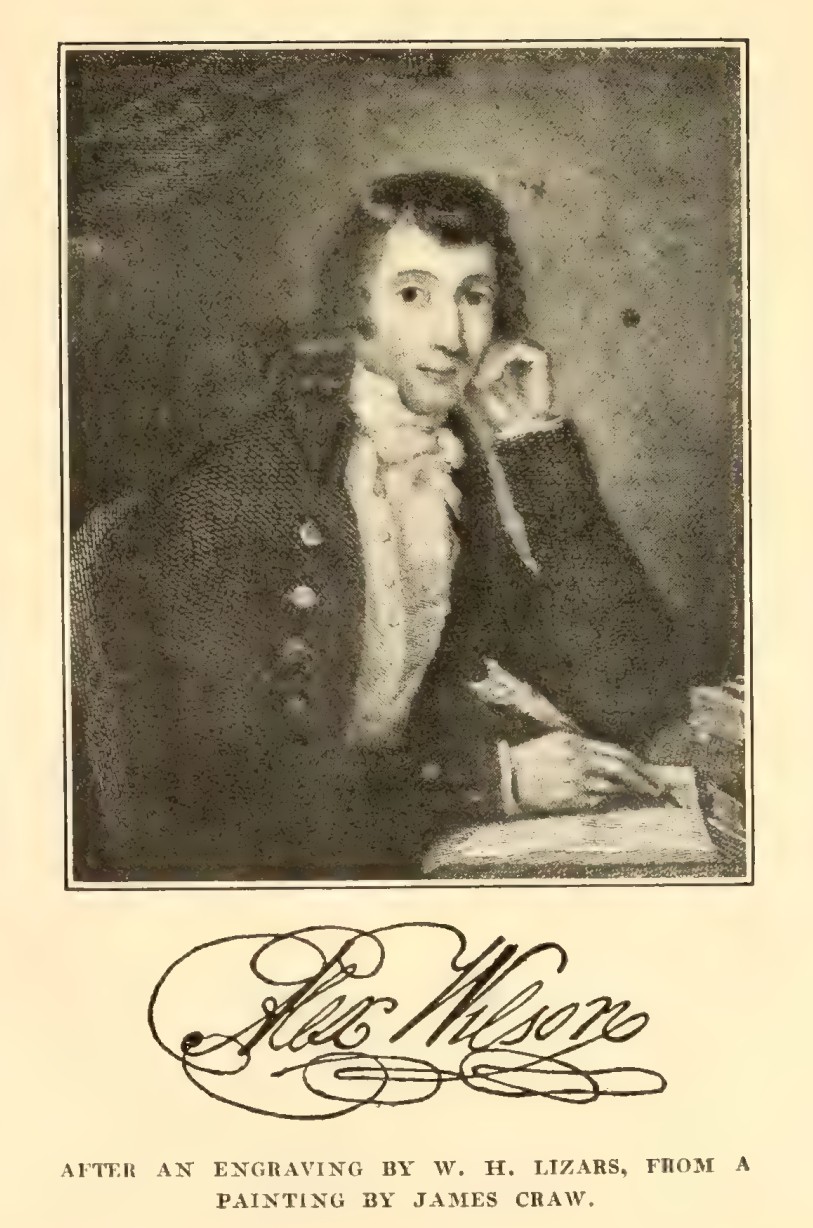
Alex Wilson
AFTER AN ENGRAVING BY W H. LIZARS, FROM A
PAINTING BY JAMES CRAW.
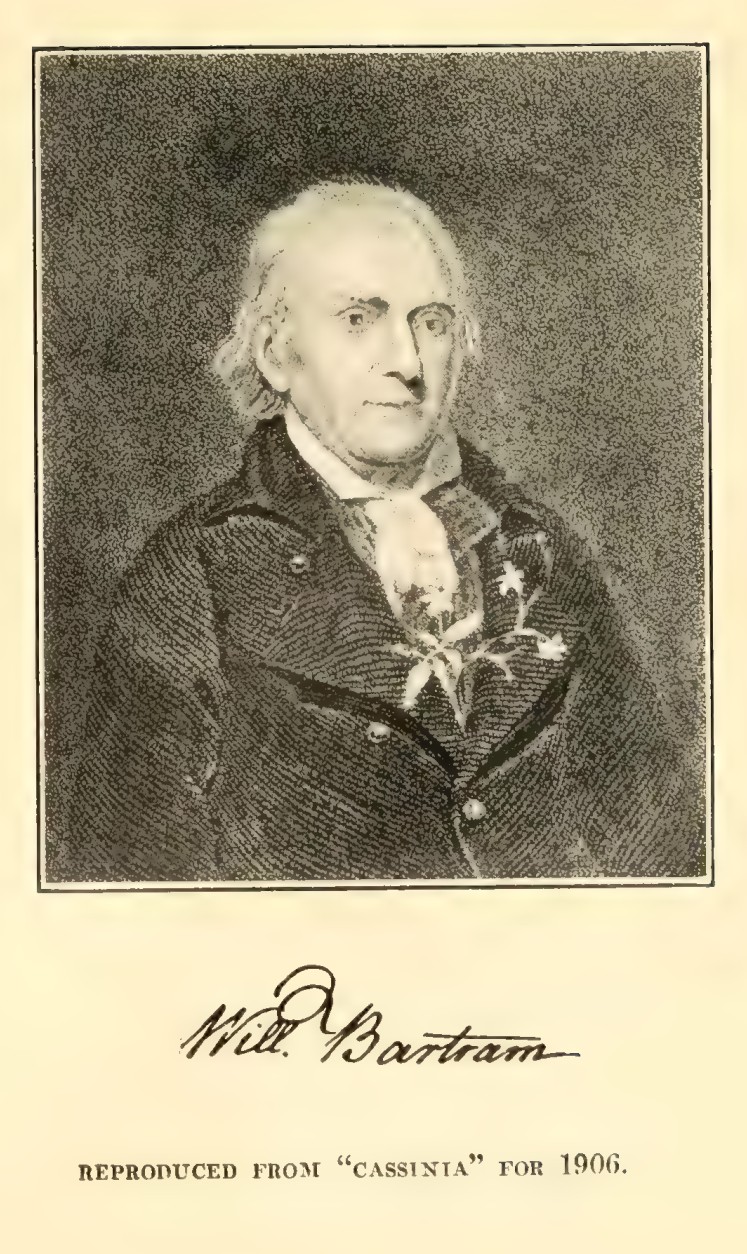
Will. Bartram
REPRODUCED FROM “CASSINIA” FOR 1906.
Wilson, practically self-taught in everything, with
no experience or training in drawing from nature, thus
began at the age of thirty-eight to make his drawings
of birds, before he knew the names of his subjects, and
twenty years before Audubon’s talents were known to
any but members of his own family and a few intimate
friends. The only aid in drawing which Wilson ever
received appears to have come from the hints which
Lawson supplied. Nevertheless, the best of Alexander
Wilson’s original drawings represent a degree of excellence
and honest workmanship of which he had no
need to be ashamed, and in many instances he owed
far less to his engraver, Alexander Lawson, than did
his great rival to Robert Havell.
In 1880 Dr. Elliott Coues examined a large collection
of original Wilson and Audubon drawings and manuscripts,
“owned and kept with the greed of a genuine
bibliomaniac” by Joseph M. Wade, then editor of Familiar
Science and Fancier’s Journal. If not Wilson’s
portfolio itself, its contents, at least, said Dr. Coues,
were then in Mr. Wade’s possession, and this series of
Wilson’s drawings included, he thought, more than half
214
of the originals of his famous plates. To quote Dr.
Coues:183
In handling these drawings and paintings, of all degrees
of completeness, one of sensibility could but experience some
emotions he would not care to formulate in words…. I was
fairly oppressed with the sad story of poverty, even destitution,
which these wan sheets of coarse paper told. Some of Wilson’s
originals are on the fly-leaves of old books, showing binder’s
marks along one edge. One of the best portraits, that of the
Duck Hawk, is on two pieces of paper pasted together. The
man was actually too poor to buy paper! Some of the drawings
are on both sides of the paper; some show a full picture
on one side, and part of a mutilated finished painting on the
other. Some show the rubbing process by which they were
transferred. They are in all stages of completeness, from the
rudest outlines to the finished painting.
I know full well that in 1804, when Wilson had fairly
begun his work on birds, he was poor enough, but I
hesitate to believe upon such evidence that he was too
poor to buy decent drawing materials. Wilson doubtless
practiced economy in these matters as in everything
else, through his ingrained habit of Scotch thrift, and
he was probably quite as well-to-do then as five years
before, when out of his slender earnings he was able to
lay money aside.184 Later, to be sure, his modest savings
were quite consumed by his Ornithology, and then William
Bartram came to his aid, even giving him a home
in his own house. It is also wide of the mark to conclude
215
from his fugitive letters or from his drawings, as
this critic has done, that Wilson was possessed of genius
only, and “had nothing else, not even talent and ability.”
Wilson certainly had a talent for writing and cultivated
it with marked success; even his verse was not all of a
“despicable mediocrity.” In the art of drawing, however,
his natural gifts were of a very modest sort, and
what he achieved was the result of the most painstaking
effort. Of course he was not a finished scholar, as graduates
from the school of adversity seldom are, but he
had a passion for knowledge and the determination to
excel. His genius was not fully displayed until a powerful
motive, the ambition to make known the birds of
his adopted land, had possessed his spirit and taxed his
powers to their utmost capacity.
Shortly after he had settled at Gray’s Ferry, Wilson’s
susceptible nature was touched by another romance,
which was again unfortunate for the poet and
dreamer, but was probably the making of the ornithologist.
Bartram’s Botanic Gardens, on the outskirts of
Philadelphia, had long been famous for their large and
choice collection of native plants, gathered by the indefatigable
zeal of their worthy founder, John Bartram,
Quaker philosopher, traveler, botanist, agriculturalist
and nurseryman; but the fairest flower in the whole collection
at that time is said to have been Miss Anne
Bartram, daughter of John the younger, niece of William,
who then superintended the “Kingsess Gardens,”
granddaughter of the founder, and heiress to the estate.
To this Quaker maid Wilson addressed a number of his
poems, and he interested her in the drawing of birds;
on March 29, 1804, he wrote to her uncle: “I send a
small scroll of drawing papers for Miss Nancy. She
will oblige me by accepting it.” This little incident
216
would show that Wilson was no stranger to the use of
good drawing materials, however frugal his habits in
this respect may have been. The young lady is said
to have been not indifferent to her poet lover, and some
of her family were friendly; the father, however, had
no notion of bestowing his daughter’s hand upon a poor
schoolmaster, and for the third time Wilson’s dreams of
domestic bliss were shattered.
Such experiences no doubt tended to chasten the sensitive
spirit of this real genius, whose whole life seemed
to have been a continuous and losing struggle, while he
felt within him an inspiration and a power that had failed
to find adequate expression in labor at the loom, in verse,
or in the hated vocation of teaching rough country
schools at starvation wages. Though depressed by his
misadventures in love, Wilson does not seem to have
been embittered, and by way of diversion, he set out
in the autumn of 1804, on a long walking tour from
Philadelphia to Niagara Falls and back; in the following
winter the experiences of this journey were embodied
in a descriptive poem of 2,018 lines which he called “The
Foresters,” an effort which would have been less prosaic
if frankly expressed in prose. Wilson’s friendship for
the Bartrams continued under the changed conditions,
and he was invited to make his home under their hospitable
roof. He was now free to devote himself heart
and soul to birds and to birds alone.
Wilson etched the first two plates of his American
Ornithology before he had obtained an engraver or a
publisher. In April, 1806, he resigned his school at
Gray’s Ferry to accept an editorial position on a New
American Cyclopædia,185 then in course of preparation,
217
at a salary of $900 a year. Samuel F. Bradford, the
publisher of this work, soon became interested in Wilson’s
projected American Ornithology and agreed to
publish it. It became the ambition of both author and
publisher to produce the work in a superior style, and
to make it as perfect and complete an American product
as possible. Only the pigments used in coloring
some of the plates were imported from Europe.186
Wilson issued in April, 1807, an elaborate prospectus
of his proposed Ornithology, in which he stated that the
completed work would comprise ten volumes, to cost
$120, and that it would be illustrated by plates, engraved
and colored by hand, after the manner of a carefully
prepared sample which was issued with the printed announcement.
In September, 1808, as already intimated,
the first volume of the American Ornithology187 appeared
218
in an edition of 200 copies. Wilson immediately started
on a canvassing tour of New England, in the course of
which he visited the principal towns and colleges, going
east to Portland, Maine, and as far north as Dartmouth
College, in New Hampshire, where President John
Wheelock and the professors received him with marked
attention. On this journey Wilson did not average one
subscriber a day, and he was forced to conclude that he
had “been mistaken in publishing a work too good for
the country”; “it is a fault,” he said, “not likely to be
repeated, and will pretty severely correct itself.” Daniel
D. Tompkins, Governor of New York, coolly said
to him: “I would not give one hundred dollars for all
the birds you intend to describe,” not even if “I had them
alive”; but a future Governor of that State, De Witt
Clinton, the friend of science and scientific men, gave
him the substantial encouragement he craved. When
his second volume was ready for issue, Wilson wrote to
Bartram: “This undertaking has involved me in difficulties
and expenses which I never dreamt of, and I
have never yet received one cent from it. I am, therefore,
a volunteer in the cause of Natural History impelled
by nobler views than those of money.”
In the autumn of 1808 Wilson made a long and
arduous tour of the South, in the course of which he
visited every important town along the southern Atlantic
seaboard, and though it cost him dear, he obtained
219
250 subscribers; it was then that his publishers decided
to extend the original edition of his work to 500 copies.
His longer and more perilous journey of 1810, when his
meeting with Audubon occurred, has already been described.
In 1812, after the sixth volume of the Ornithology
had appeared, he again resumed his travels in
the East and went as far north as Burlington, on Lake
Champlain; at Haverhill, New Hampshire, he was summarily
arrested and thrown into jail, the people of the
town, utterly unable to comprehend the nature of his
pursuits, suspecting that in his real capacity he was acting
as a spy in the employ of the Canadian Government.
The seventh and last volume of the Ornithology which
Wilson lived to complete made its appearance in the
spring of 1813. He had then been obliged to relinquish
his work on the Cyclopædia, and was reduced to the pittance
derived from the coloring of his own plates.
Alexander Wilson died at Philadelphia, after a brief
illness, on August 23, 1813. A story was current that
his end was saddened, if not hastened, by the dishonesty
of his publishers, but I cannot vouch for it. Audubon
may have had this report in mind when he wrote his
name in the hotel register at Niagara Falls188 on August
24, 1824; and added that he would never die, like Wilson,
“under the lash of a bookseller.” Even as late as 1879
Miss Malvina Lawson, daughter of Wilson’s friend and
engraver, left no doubt as to her belief when she wrote:
“and to his other trials was added the fact that killed
him, — the dishonesty of his publisher.”189
When we consider that Wilson’s entire working period
on the Ornithology was not over ten years, and that
220
at the age of forty-seven he was called to lay down his
pen and brush forever; that he produced in this brief
space a work of great originality and charm, which did
inestimable service in promoting the cause of natural
history in both America and England, and which is likely
to be read and prized for centuries to come, the achievement
of this man is little short of marvelous. Knowing
also the disabilities under which he labored, we are more
than ready to temper our judgment with sympathy, and
to overlook any faults which his character may have
displayed. These indeed, we believe, were for the most
part of a very trifling nature; those who knew Wilson
best have all testified to his kindness of heart, his liberality,
and his high sense of honor.
We must now return to the meeting of our two pioneers,
which has been the bone of so much acrimonious
contention. On his long journey to the Middle West
and South, Wilson reached Louisville on a Saturday
evening, the seventh of March, 1810, and put up at the
tavern of the “Indian Queen,” where, as it happened,
Audubon was then living with his family; after spending
five days in and about the town, he again set out on foot
for Frankfort, on the morning of Friday, the twenty-third.
Audubon has given the following account in the
“Episode” of “Louisville in Kentucky”:190
One fair morning, I was surprised by the sudden entrance
into our counting-room at Louisville of Mr. Alexander Wilson,
the celebrated author of the “American Ornithology,” of
whose existence I had never until that moment been apprised.
This happened in March, 1810. How well do I remember him,
as he then walked up to me! His long, rather hooked nose,
the keenness of his eyes, and his prominent cheek-bones, stamped
his countenance with a peculiar character. His dress, too, was
221
of a kind not usually seen in that part of the country; a short
coat, trousers, and a waistcoat of grey cloth. His stature
was not above the middle size. He had two volumes under his
arm, and as he approached the table at which I was working,
I thought I discovered something like astonishment in his
countenance. He, however, immediately proceeded to disclose
the object of his visit, which was to procure subscriptions for
his work. He opened his books, explained the nature of his
occupations, and requested my patronage.
I felt surprised and gratified at the sight of the volumes,
turned over a few of the plates, and had already taken a pen to
write my name in his favour when my partner rather abruptly
said to me in French, “My dear Audubon, what induces you to
subscribe to this work? Your drawings are certainly far better,
and again you must know as much of the habits of American
birds as this gentleman.” Whether Mr. Wilson understood
French or not, or if the suddenness with which I paused, disappointed
him, I cannot tell; but I clearly perceived that he was
not pleased. Vanity and the encomiums of my friend prevented
me from subscribing. Mr. Wilson asked me if I had many drawings
of birds. I rose, took down a large portfolio, laid it on the
table, and shewed him, as I would show you, kind reader, or any
other person fond of such subjects, the whole of the contents,
with the same patience with which he had shewn me his own engravings.
His surprise appeared great, as he told me he never
had the most distant idea that any other individual than himself
had been engaged in forming such a collection. He asked
me if it was my intention to publish, and when I answered in
the negative, his surprise seemed to increase. And, truly, such
was not my intention; for, until long after, when I met the
Prince of Musignano in Philadelphia, I had not the least idea
of presenting the fruits of my labours to the world. Mr. Wilson
now examined my drawings with care, asked if I should
have any objections to lending him a few during his stay, to
which I replied that I had none: he then bade me good morning,
not, however, until I had made an arrangement to explore
222
the woods in the vicinity along with him, and had promised to
procure for him some birds, of which I had drawings in my
collection, but which he had never seen.
It happened that he lodged in the same house with us,
but his retired habits, I thought, exhibited either a strong
feeling of discontent, or a decided melancholy. The Scotch
airs which he played sweetly on his flute made me melancholy
too, and I felt for him. I presented him to my
wife and friends, and seeing that he was all enthusiasm,
exerted myself as much as was in my power, to procure
for him the specimens which he wanted. We hunted together,
and obtained birds which he had never before seen;
but, reader, I did not subscribe to his work, for, even at that
time, my collection was greater than his. Thinking that perhaps
he might be pleased to publish the results of my researches,
I offered them to him, merely on condition that what I had
drawn, or might afterwards draw and send to him, should be
mentioned in his work, as coming from my pencil. I at the same
time offered to open a correspondence with him, which I thought
might prove beneficial to us both. He made no reply to either
proposal, and before many days had elapsed left Louisville, on
his way to New Orleans, little knowing how much his talents
were appreciated in our little town, at least by myself and my
friends.
Some time elapsed, during which I never heard of him, or of
his work. At length, having occasion to go to Philadelphia,
I, immediately after my arrival there, inquired for him and
paid him a visit. He was then drawing a White-headed Eagle.
He received me with civility, and took me to the Exhibition
Rooms of Rembrandt Peale, the artist, who had then portrayed
Napoleon crossing the Alps. Mr. Wilson spoke not of birds
or drawings. Feeling, as I was forced to do, that my company
was not agreeable, I parted from him; and after that
I never saw him again. But judge of my astonishment some
time after, when on reading the thirty-ninth page of the ninth
volume of American Ornithology, I found in it the following
paragraph: —
223
“March 23, 1810. — I bade adieu to Louisville, to which
place I had four letters of recommendation, and was taught
to expect much of everything there; but neither received one act
of civility from those to whom I was recommended, one subscriber,
nor one new bird; though I delivered my letters, ransacked
the woods repeatedly, and visited all the characters likely
to subscribe. Science or literature has not one friend in this
place.”
What actually happened at this meeting of the two
naturalists will never be certainly known, beyond what
can be gathered from their rather widely divergent accounts.
It should be noticed, however, that the paragraph
which Audubon quoted was extracted from Wilson’s
private diary; it was no doubt written on the spur
of the moment, possibly to humor his own mood, and
certainly with no thought of its later publication. It
was inserted by George Ord in the biographical sketch
of his friend appended to the ninth volume of the American
Ornithology, which appeared in 1814, the year after
Wilson’s death. Audubon was not concerned, either
directly or by implication, except in the last sentence,
for it is evident that he was not one of those to whom
Wilson had carried letters of introduction. Thus the
matter stood until 1828, when Audubon’s Birds of
America were being engraved in England. In all probability
the incident would never have been noticed by
Audubon, had not Ord seen fit to revive it when his life
of Wilson191 was issued as a separate volume in that
year. In this edition of the biography Ord inserted
fuller extracts from Wilson’s journal, with the evident
224
purpose of placing the rival of his friend in an unenviable
light.
Wilson’s diary, which apparently was never seen by
any of Audubon’s friends, is now known to us only
through such extracts as Ord and Waterton, his bitter
enemies, have seen fit to make public; the original has
probably been destroyed, for it cannot be traced later
than 1840, when it was still in the hands of George Ord.192
Charles Waterton gave similar extracts from this famous
journal in one of his philippics against Audubon in 1834,
when he said that it was the testimony of this record
that defeated Audubon’s friends in their initial attempt
to bring him into the Academy of Natural Sciences at
Philadelphia. Wilson’s narrative of his adventures at
Louisville in 1810, as given by Ord and Waterton, is
as follows:193
March 17. Take my baggage and grope my way to Louisville — put
up at the Indian Queen tavern, and gladly sit down to
rest myself.
March 18. Rise quite refreshed. Find a number of land-speculators
here.194
March 19. Rambling round the town with my gun. Examined
Mr. —— ’s drawings in crayons — very good. Saw two new
birds he had, both Motacillæ.
March 20. Set out this afternoon with the gun — killed nothing
new. People in taverns here devour their meals. Many
225
shopkeepers board in taverns — also boatmen, land-speculaters,
merchants &c. No naturalist to keep me company.
March 21. Went out shooting this afternoon with Mr. A. Saw
a number of Sandhill Cranes. Pigeons numerous.
March 22.
March 23. Packed up my things which I left in the care of a
merchant here, to be sent on to Lexington; and having
parted with great regret, with my paroquet, to the gentleman
of the tavern, I bade adieu to Louisville, to which
place I had four letters of recommendation, and was taught
to expect much of everything there, but neither received
one act of civility from those to whom I was recommended,
one subscriber, nor one new bird; though I delivered my
letters, ransacked the woods repeatedly, and visited all the
characters likely to subscribe. Science or literature has
not one friend in this place. Everyone is so intent on
making money, that they can talk of nothing else; and they
absolutely devour their meals, that they may return sooner
to their business. Their manners correspond with their
features.
In this fuller record we learn that Wilson spent five
days in Louisville; he examined Audubon’s drawings on
Monday, March 19, hunted alone on the 20th, went out
shooting with Audubon on the 21st, and finally left
Louisville on the morning of the 23d; no record was
admitted by Ord for Sunday, the 18th, or for the 22d,
a Thursday. Wilson noticed the drawings of two new
Motacillæ, or Warblers, in Audubon’s collection, and
it would have been only natural that he should have felt
a strong desire to copy them, yet not a word was said
about the loan of drawings to which Audubon refers;
Wilson merely stated that from those to whom he was
recommended he had received not “one act of civility, — one
subscriber, nor one new bird.” Audubon was evidently
226
regarded as one of the “many shopkeepers” who
boarded “in taverns,” and not as a “naturalist,” for
Wilson said that he had none to keep him company, and
it is rather significant that Audubon’s name is not once
mentioned in his Ornithology.
Twenty-nine years after Wilson’s visit to Louisville,
when Audubon came to publish the fifth and last volume
of his Ornithological Biography, he maintained that
Wilson had copied his drawing of a certain bird, called
the Small-headed Flycatcher,195 without any acknowledgment.
To quote Audubon’s words:
When Alexander Wilson visited me at Louisville, he found
in my already large collection of drawings, a figure of the
present species, which being at that time unknown to him
he copied and afterwards published in his great work, but
without acknowledging the privilege that had thus been granted
to him. I have more than once regretted this, not by any
means so much on my own account as for the sake of one to
whom we are so deeply indebted for the elucidation of our
ornithology.
This troublesome bird was first described by Wilson
in 1812, when he rightly pronounced it “very rare,” and
said that the specimen from which his drawing was
made had been shot in an orchard, presumably near
Philadelphia, on the twenty-fourth day of April, and
that several had been obtained also in New Jersey.
His friend Ord, who came to his defense in 1840, confirmed
this statement by declaring to the American
Philosophical Society of Philadelphia that he had been
with Wilson on the day in question and had examined
227
the specimen. Lawson also affirmed that in engraving
the plate he had worked directly from the bird which
Wilson had given him.
What has become of this mysterious phantom that has
been a wandering and disturbing voice among ornithologists
for over a century? It has given rise to no end of
conflicting and sharp discussions between the partisans
of the two naturalists chiefly concerned, the only thing
certain being that if this supposititious species ever existed,
it has forsaken its old haunts, if not the earth itself,
and has never returned. No doubt it was simply a case
of mistaken identity, and both Wilson and Audubon
were wrong, each having had in hand and mind an immature
representative of one of our numerous Warblers,
which are now so much better known.196 If Wilson
copied Audubon’s drawing of the bird, he must have
replaced it with one of his own, for the figures of the
two naturalists are very unlike. Certainly Audubon
should not have made so serious a charge without offering
more substantial evidence in proof; perhaps what he
had intended to convey was that Wilson had obtained
from him his first knowledge of the bird, and he was
nettled to find that he had been studiously ignored.197
228
Among the originals of Audubon’s Birds of America
in possession of the Historical Society of New York,
there is an early drawing of a Warbler which bears in
pencil, in the naturalist’s hand, the following note: “This
bird was copied by Mr. Willson at Louisville.”198 The
misspelling of Wilson’s name, which was common with
Audubon as late as 1820, would indicate that the note
was not added after that time, but if Wilson copied this
drawing, there is no evidence that he ever used it.
Ord made another charge in which Audubon does not
appear to such good advantage; though it refers to a
later day, it is best to consider it now. This critic
thought that a complaint of misappropriation came with
ill grace from one who had been guilty of it himself,
and maintained that Audubon had copied Wilson’s figures
of the female Red-wing Blackbird (The Birds of
America, Plate LXVII), and had also stolen his drawing
of the Mississippi Kite (Plate CXVII). Ord was
probably mistaken in regard to the blackbird, but without
a doubt the lower bird in the Kite plate was taken
from Wilson (American Ornithology, Plate 25), though
the copyist has reversed the outlines, left out one of the
toes, added minor details, and misnamed the sex, which
in the Wilson original represents a male. Without a
doubt also the odium in this case must fall upon Audubon,
but we are not at all certain that he was directly
responsible for the theft. Audubon’s plate of this species,
which is finished in elaborate detail, was probably
published towards the close of 1831, when he was in
America. He furnished his engraver, we believe, with
229
the drawing of the upper bird only, which he designated
as a male, and the original still exists, with clearly written
notes showing that it was executed in Louisiana in
1821.199
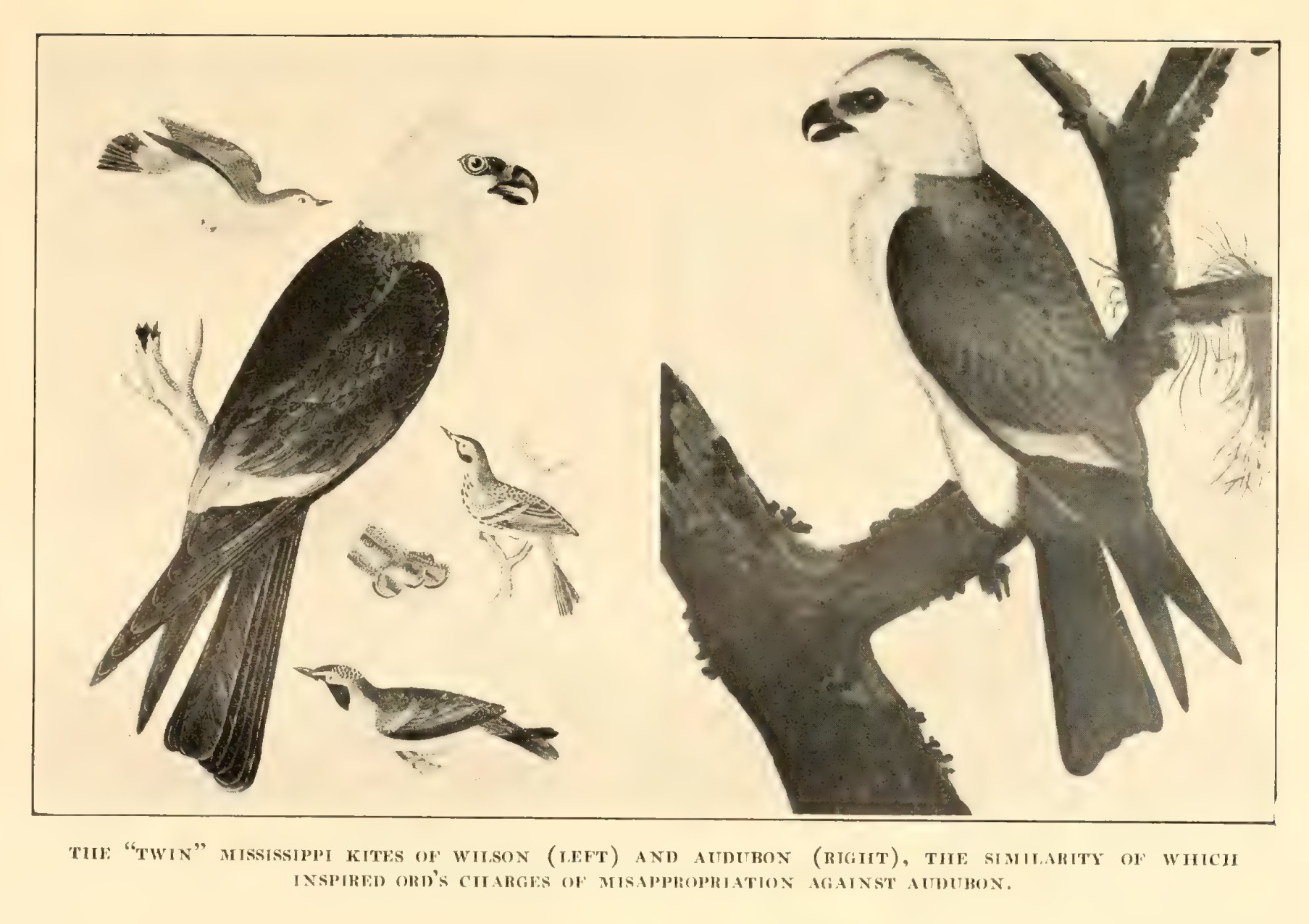
THE “TWIN” MISSISSIPPI KITES OF WILSON (LEFT) AND AUDUBON (RIGHT), THE SIMILARITY OF WHICH
INSPIRED ORD’S CHARGES OF MISAPPROPRIATION AGAINST AUDUBON.
Audubon usually made up his drawings for the engraver
with great care, but when pressed for time, Havell’s
skill was such that he often depended upon him to
complete or change his figures, to fill in backgrounds,
or even to combine several distinct figures into one
plate, specific directions for all such changes being usually
written on the drawing itself.200 Inasmuch as no
penciled directions whatever occur on this particular
drawing, is it possible that Havell, in piecing it out to
improve the composition, followed his own initiative,
not fully appreciating the stigma that is rightly attached
to such methods? The bird in the lower half of the plate,
which was appropriated from Wilson, is misrepresented
as a female, so that the composite, as it stands, is a remarkable
product, supposedly depicting a pair but in
reality showing two males. Although the apparent difference
in sex in this bird was admittedly slight, it is
improbable that so gross an error could have escaped
the naturalist’s eye had he been directly concerned with
the result.
When Audubon was descending the Mississippi in
December, 1820, he saw the kites busily engaged “in
catching small lizards off the bark of dead cypress trees,”
but “having at that time no crayons or paper,” he “did
230
not draw one, and determined,“ as he then wrote in his
journal, ”never to draw from a stuffed bird.“ ”I first
saw the Mississippi Kite,“ he added, when ”ascending
in the steamboat Paragon, in June, 1819.“ Wilson,
on the other hand, in his knowledge of this interesting
bird was far in advance of his later rival, for his first
observations were made in 1810, ”in the Mississippi territory,
a few miles below Natchez, on the plantation of
William Dunbar, esquire, when the bird represented in
the plate was obtained, after being slightly wounded;
and the drawing made with great care from the living
bird.“ ”For several miles, as I passed near Bayo Manchak,“
Wilson continues, ”the trees were swarming with
a kind of cicada, or locust, that made a deafening noise;
and here I observed numbers of the Hawk now before
us sweeping about among the trees like Swallows, evidently
in pursuit of these locusts; so that insects, it
would appear, are the principal food of this species.“201
Wilson never succeeded in procuring the female of this
graceful hawk, and his editor, George Ord, evidently
continued the quest, for we find his correspondent, John
Abbot, writing him from “Scriven County Georgia Mar.
1814”: “Are you acquainted with the female yet of
the Louisiana Kite?”202
We have entered into the detailed history of this plate
because of the unfavorable comment which it has provoked,
but it is easier to be critical than to be either just
or correct, and without more definite knowledge than
we possess, it would be unfair to censure Audubon too
much or to shift the blame too completely upon the
shoulders of another.
231
To return again to the story of Wilson’s diary, it
is evident that Wilson would never have published his
sentiments in the form in which they later appeared.
They were perfectly characterized by a just critic of an
early day,203 who said that Wilson’s words were without
doubt written in a moment of keen depression and disappointment
and were an exact description of his feelings,
though, as we should also add, not of the facts. “A
man who has given his heart to the accomplishment of
an object, believing that he has no rival, must be somewhat
more than human, if he be delighted to find that
another is engaged in the same purpose, with equal
energy and advantages far greater than his own.” Barring
his usual inaccuracies, it must be admitted that Audubon’s
account bears the thumbmarks of truth. He
could not have known the bitter struggles of the proud
spirit whose history we have briefly told; he saw only a
stranger, an ardent devotee of nature, it is true, but a
man of unbending disposition, who with a little more
suavity of address could probably have won his friendship,
if not his subscription. Of the literary quality of
Wilson’s work, now so well appreciated, he could have
known nothing at all; after turning its pages in his
Louisville store for the first time in 1810, he probably
did not see it again for over ten years.
That Wilson was jealous of Audubon as a future
rival is probable, but the real “rivalry” between these two
pioneers was of later growth. It was fostered in this
country chiefly by George Ord and some of his friends,
together with others who were interested in the sale of
Wilson’s work. Ord, who seems to have felt that the
mantle of this naturalist had fallen on his own shoulders,
232
strove continually, and after 1826 with the aid of
Charles Waterton in England, to hamper Audubon’s
progress, to discredit him as a man of integrity, and
to break down his growing reputation as a naturalist.
Though Ord was justified to some extent in his attacks
upon Audubon which were made over Wilson’s shoulders
long after that estimable man was laid in the grave,
the matter was carried too far. Neither of the rivals
was wholly without fault, and a century is far too long
to continue any quarrel, especially when one of those
whose reputation was concerned was never a party to
it.
Audubon, as we have seen, frankly attributed to personal
vanity his failure to patronize Wilson’s work,
and added that “even at that time my collections were
greater than his.” But it should be noticed that money
was far from plentiful with him at that moment. He
was, in short, at the point of failure in the Louisville
enterprise, and with Rozier was obliged to move down
the river not long after the date of Wilson’s visit. Audubon
has been represented as at this time a well-to-do
man of leisure, of fastidious tastes. Nothing could have
been wider of the mark. He was still more of a sportsman
than a naturalist, and when not occupied with
drawing, he spent most of his time in the forest, to the
neglect of his trade. We may be sure that he was
quite as used to roughing it as any man on the frontier.
233
CHAPTER XV
EXPERIMENTS IN TRADE ON THE FRONTIER
The Ohio a hundred years ago — Hardships of the pioneer trader — Audubon’s
long journeys by overland trail or river to buy goods — The
“ark” and keelboat — Chief pleasures of the naturalist at Louisville — The
partners move their goods by flatboat to Henderson, Kentucky,
and then to Ste. Geneviève, (Missouri) — Held up by the ice — Adventures
with the Indians — Mississippi in flood — Camp at the Great Bend — Abundance
of game — Breaking up of the ice — Settle at Ste. Geneviève — The
partnership dissolved — Audubon’s return to Henderson — Rozier’s
successful career — His old store at Ste. Geneviève.
At the beginning of the nineteenth century the banks
of the Ohio River were but thinly settled, and over vast
areas the virgin forest still reigned in undisturbed vigor
and beauty. Yet traders were eagerly pushing westward
in ever growing numbers, and by 1810 Audubon
and Rozier found that competition at Louisville was
already keen. This city, wrote Alexander Wilson in
describing his experiences in the spring of that year,
was as large as Frankfort, and possessed a number of
good brick buildings and valuable shops; it would have
been salubrious, he thought, “but for the numerous
swamps and ponds that intersect the woods in its neighborhood,”
and the indifference of the people, whom he
found too intent upon making money to give any heed
to the drainage and sanitation of their town.
The prosperity of the partners, as already intimated,
was shortlived. Audubon was doubtless right in admitting
that his business abandoned him because he
could not bear to give it the necessary attention. The
234
conditions of life for the merchant-trader at that early
day were at best far from easy, and an honest success,
as then understood, required not only plenty of rough
work but careful planning as well. His goods, purchased
in the East, were laboriously transported across
the State of Pennsylvania, and if they came from Philadelphia
they must needs traverse the rough wagon
roads that led through Bedford to Pittsburgh. There
was an overland trail from Pittsburgh to Kentucky,
but merchants with heavy loads would naturally take
the easier river route. In going east to renew his stock
in trade, it was a common practice to travel on horseback
from as far west as St. Louis, but on returning the
merchant would often sell his mount at Baltimore, Philadelphia
or Pittsburgh, where a boat could be taken
for the remainder of the journey.
The “ark” or flatboat was considered most convenient
for the transportation of either passengers or merchandise
down the Ohio, for any well-to-do traveler, while
floating leisurely with the current, could make himself
comfortable by fitting up snug sleeping quarters and
a kitchen on deck, and could go ashore at will, with the
certainty of satisfying his appetite for wild turkey, venison
and other game in the season. Wilson, who descended
the river in April, 1810, boarded and passed
many of these “arks,” which he described as built in
the form of a parallelogram, from twelve to fourteen
feet wide and from forty to seventy feet long, with a
canopy to protect them from the weather; they were
casually helped along by means of two oars in the bow,
and steered by another and more powerful one in the
stern. “Several of these floating caravans,” said Wilson,
“were loaded with store goods for the supply of
the settlements through which they passed, having a
235
counter erected, shawls, muslins,” and the like, “displayed,
and everything ready for transacting business.
On approaching a settlement they blew a tin trumpet,
which announced to the inhabitants their arrival.” These
“arks,” he added, descended from all parts of the Ohio
and its tributary streams, but in greatest numbers in
the spring months. Although they cost originally about
$1.50 per foot of length, when arrived at their destination
they would seldom bring more than one-sixth of
that amount. From forty to fifty days were commonly
required to cover the entire distance of two thousand
miles from Pittsburgh to New Orleans.
Another means of conveyance on the river, frequently
used by Audubon, was the keel boat or barge, which,
in some cases, was also roofed and would hold about
two hundred barrels of flour.204 When assisted by oars in
the bow, it could reduce the time of a journey to New
Orleans by ten or fifteen days. These barges were
pushed up stream with the aid of setting poles at an
average rate of about twenty miles a day, or, if loaded,
they were laboriously “cordelled,” or drawn by the hands
of men who trudged along the banks pulling at the cordelle.
The chief pleasures which Audubon’s business ventures
in the West seem to have afforded him were his
leisurely journey by river and long horseback rides to
Philadelphia to buy goods, when he could roam through
his “beautiful and darling forests of Kentucky, Ohio,
and Pennsylvania,” which gave him grand opportunities
to make observations upon birds and animal life of
every sort. He would seldom hesitate to swerve from
his course to study his favorites, and has related how
on one occasion, when driving before him several horses
236
laden with merchandise and dollars, he quite lost sight of
the pack saddles and the cash they bore, in watching the
motions of a warbler. But few coaches, said Audubon,
were available in those days, and the post roads were
often unfit for lighter carriages. To cover the distance
from Louisville to Philadelphia on horseback required
about twenty days, and only a capable animal and rider
could make forty miles a day; when steamer traffic on
the Ohio205 was well in hand this time was reduced to six
or seven days, in performing a journey which the modern
railroad has shortened to not far from as many hours.
Discouraged by the gloomy prospects which their
business at Louisville presented, Audubon and Rozier
determined in the spring of 1810 to move 125 miles
down the river to Henderson.206 Loading the residue of
their stock on a flatboat, they resolutely set out for the
new field, but great was their surprise to find, in place
of the thriving settlement which their imaginations had
pictured, only a cluster of log houses on the river bank,
with a population of less than 200 people and a demand
for little else than whisky, gunpowder and coarse woolen
goods. When the partners arrived, the little town was
eighteen years old, as the first log cabins were built
there in 1792, but the whole country above and below
237
them was, and for a considerable time remained, one
vast canebrake. All the commodities known to the pioneer
store were scarce, but the people of Henderson
were friendly, and the new settlers had been provident in
bringing with them a goodly supply of flour and “bacon
hams.” Moreover, the Ohio, which was half a mile wide
at that point, was well stocked with fish, and the woods
and canebrakes were alive with birds, not to speak of
larger and more important game. Not many years before,
wild turkeys had been so plentiful that they were
not sold but were given away, while a large buck deer
could be bought in the season for fifty cents.
During their stay at Henderson, Rozier was in his
habitual place behind the counter and attended to what
little business was done, while Audubon with a Kentucky
lad named John Pope, who was nominally a
clerk, roamed the country in eager pursuit of rare birds,
and with rod and gun bountifully supplied the table.
Audubon’s first abode in the town was, as he said, “a
log-cabin, not a log-house,” in which the richest piece of
furniture was their child’s cradle. He soon began to
cultivate a garden, but his experience in horticulture
must have been limited, for he naïvely remarks that
the rankness of the soil kept the seeds they planted
“far beneath the tall weeds which sprang up the first
year.”
Financial distress and hard times were already being
felt in the Blue Grass State, and these conditions were
not destined soon to improve. After experimenting for
six months, or more, at Henderson, our two “rolling
stones” determined to push still farther west and try
their luck at a more promising point. They had hoped
to reach St. Louis but finally went instead to Ste. Geneviève,
then a small French settlement in Upper Louisiana,
238
on the right bank of the Mississippi, a hundred
miles north of the mouth of the Ohio.
This new venture promised to be both hazardous and
uncertain, and as Mrs. Audubon and Rozier were not
on the friendliest terms, Audubon decided to leave his
family at Henderson, where a home for his wife and
infant son could always be had under the hospitable roof
of Dr. Adam Rankin, who became one of the naturalist’s
staunchest friends. If their stock in trade at this time
actually consisted of “three hundred barrels of whisky,
sundry dry-goods and powder,” as Audubon affirmed,
the keel boat which they then engaged was certainly
calculated to bear a goodly load.207 At all events the
partners, with young Pope, their clerk, set out bravely,
in a snow storm, in December, 1810. They floated with
the current at a rate of about five miles an hour, while
they helped their craft along by means of four oars in
her bow and steered it with the aid of a slender tree
trunk, “shaped at its outer extremity like the fin of a
dolphin.”
This journey of upwards of 165 miles lasted altogether
more than nine weeks. It proved adventurous enough,
but it was of no use to Audubon except in furnishing
him with drawings of new birds and the raw materials
for many “Episodes.” The journal of his experiences
on the great rivers during that eventful winter of 1810
and 1811 is interesting for the sidelights which it throws
both upon his character and upon the state of the country
at an elder day. Held up by the ice for several
weeks at Cash Creek, near the mouth of the Ohio, to
his own delight but to Rozier’s sorrow, Audubon
tramped the country and hunted wild swans and larger
game with the friendly Shawnee Indians. “When one
239
day’s sport was over,” he said, “we counted more than
fifty of these beautiful birds whose skins were intended
for the ladies of Europe. There were plenty of geese
and ducks, but no one condescended to give them a shot.”
This was Audubon in 1810, when such “sport” was regarded
as legitimate enough, and the feather-hunting
of such Indians was not considered the nefarious trade
that it proved to be. If we shift the scene to twenty
years later, when William MacGillivray needed thousands
of specimens of American birds for his studies
upon their anatomy and variability, we find Audubon
supplying him liberally, but he could not then bear to see
them killed wantonly or for mere sport; more than
once, out of compassion for individual birds that he
chanced to be studying, whether in Florida or in Labrador,
he would not permit them to be shot even when
needed for his collections.
At the Shawnee Indian camp, to relate a characteristic
anecdote, Audubon noticed that a squaw who “had
been delivered of beautiful twins during the night” was
busied on the next day at her usual task of tanning
deer skins. “She cut two vines,” his record reads, “at
the roots of opposite trees and made a cradle of the bark,
in which the new born ones were wafted to and fro with
a push of her hand, while from time to time she gave
them the breast, and was apparently as unconcerned as
if the event had not taken place.”
When at last our adventurers gained the Mississippi,
the mighty volume of which was running three miles an
hour, the patron ordered all hands ashore to pull at the
bow rope. This characteristic remark of the naturalist
is delightful, as showing the “single eye” which it has
been declared of old shall be “full of light”: “we made,”
said Audubon, “seven miles a day up the famous river;
240
but while I was tugging with my back at the cordella, I
kept my eyes fixed on the forests or the ground, looking
for birds or curious shells.”
Warping against the current was both difficult and
dangerous, and though they rose two hours before the
sun, they could make but one mile an hour or ten miles
in the day. At night they would go ashore, light a
good fire and cook their supper; then, after posting a
sentinel to guard against unfriendly surprises, they
would roll in their buffalo skins and sleep without further
concern. Notwithstanding all their efforts, when
they reached the Great Bend at Tawapatee Bottom,
they were obliged to unship their cargo, protect their
boat as best they could from being crushed in the growing
pack, and await the final breaking up of the ice. “The
sorrows of Rozier,” at this dismal announcement, said
Audubon, “were too great to be described; wrapped in
a blanket, like a squirrel in winter quarters with his
tail about his nose, he slept and dreamed his time away,
being seldom seen except at meals.” There was not a
white man’s cabin within twenty miles, but a new field
opened to the naturalist, who tramped through the deep
forests, and soon became acquainted with all the Indian
trails and lakes in the neighborhood.
The six weeks spent at this camp passed pleasantly
for Audubon, who devoted much of the time in studying
the Osage Indians, whom he thought superior to the
Shawnees, as well as in watching for wolves, bears, deer,
cougars, racoons and wild turkeys, some of which were
attracted by the bones and scraps of food thrown out for
them: “I drew,” said he, “more or less, by the side of our
great camp-fire, every day.” While detained at this
point, they used for bread the breasts of turkeys, buttered
with bear’s grease, and opossum and bear’s meat,
241
until their stomachs revolted and they longed for a little
Indian meal, which was procured only with the greatest
difficulty.
When at last the ice broke up, splitting with reports
like the thunder of heavy artillery, their prospects were
dismal indeed, for their boat was immediately jammed
by the rushing ice, and they were powerless to move
her. “While we were gazing on the scene,” to continue
Audubon’s record, “a tremendous crash was heard,
which seemed to have taken place about a mile below,
when suddenly the great dam gave way. The current
of the Mississippi had forced its way against that of
the Ohio, and in less than four hours we witnessed the
complete breaking up of the ice.” Having reloaded
their goods, they were ready to start at a favorable moment,
and taking leave of the friendly Indians, “as when
brothers part,” they pushed on through the floating ice,
past Cape Girardeau, to Sainte Geneviève, a town which
Audubon characterized as “not so large as dirty,” declaring
that the time spent there did not yield him half
the pleasure he had felt at Tawapatee Bottom. It was
near a granite tower which rose from a dangerous rock
in the river below Ste. Geneviève that Audubon caught
sight of what he afterwards described as “Washington’s
Eagle,” a bird now believed to have been the true “bird
of freedom,” the “Bald-” or White-headed Eagle, but
in an immature state.
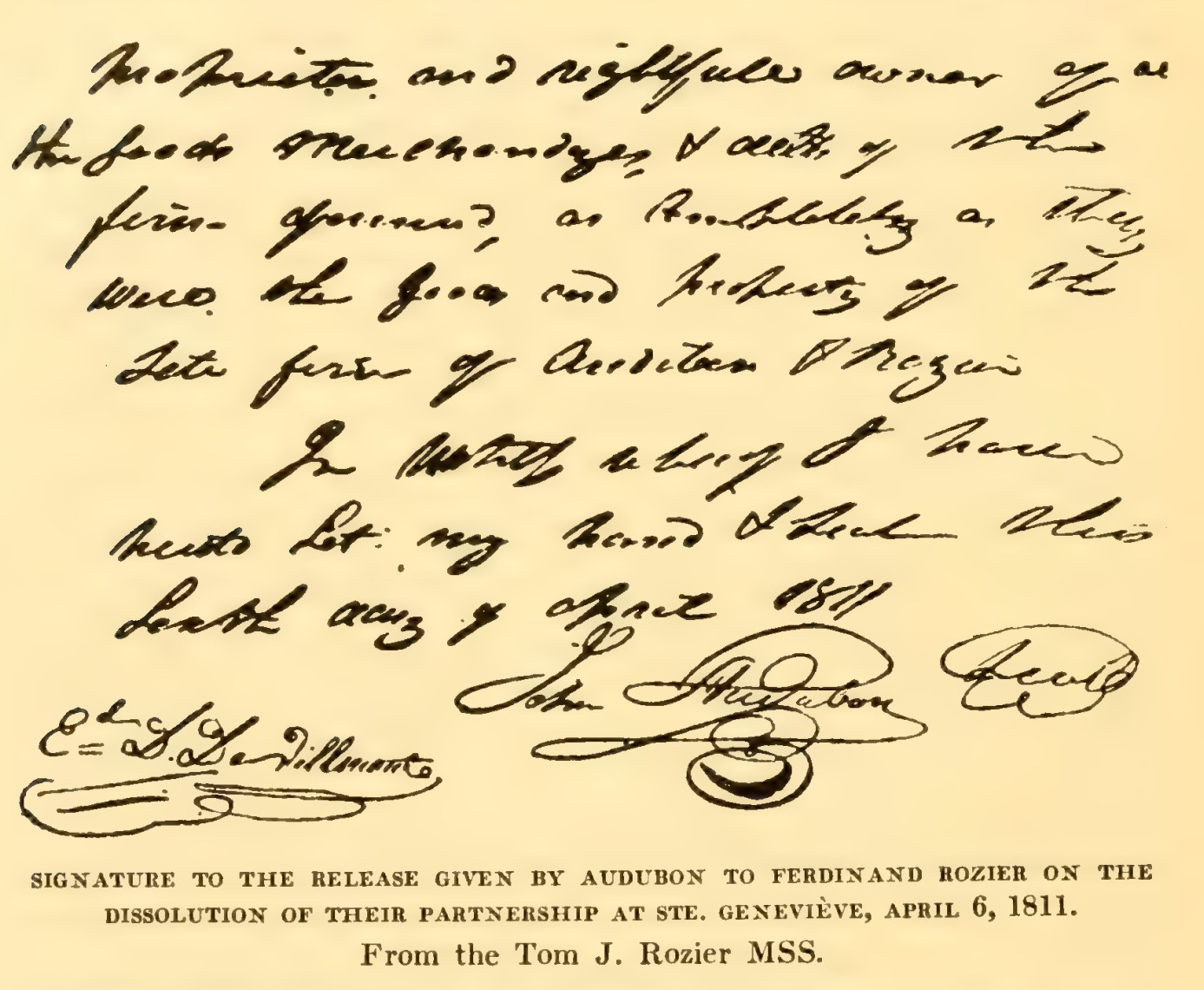
SIGNATURE TO THE RELEASE GIVEN BY AUDUBON TO FERDINAND ROZIER ON THE
DISSOLUTION OF THEIR PARTNERSHIP AT STE. GENEVIÈVE, APRIL 6, 1811.
From the Tom J. Rozier MSS.
Though their whisky was welcomed at Ste. Geneviève
and what had cost the traders twenty-five cents,
brought them two dollars, a gallon, Audubon heartily
disliked the place and its people. Rozier, on the contrary,
who had found plenty of Frenchmen with whom
he could freely converse, was resolved to stay. Audubon
accordingly proposed to sell out his share in the business,
242
and the partnership was dissolved on April 6, 1811,
Rozier paying part of the price in cash and the remainder
in notes. In referring to the incident in his
journal of 1820, Audubon wrote: “I parted with Mr.
Rozier, and walked to Henderson in four days — 165
miles”; but this does not agree with a later account, in
which he spoke of having “purchased a beauty of a
horse,” and, happy in the prospect of again seeing his
family, set out for Dr. Rankin’s house in Kentucky.
In the earlier record he also wrote that he once had a
friend in trade, referring to Ferdinand Rozier, “with
whom he did not agree, and so they parted forever”;
but Audubon visited Ste. Geneviève in the autumn of
1811 and in the winter of 1812, probably for the purpose
of collecting his money and settling his affairs,
while the following letters of this period show that
243
friendly relations with his old partner were not seriously
impaired:208
John James Audubon to Ferdinand Rozier
Louisville, 2d November 1811.
Mr. F. Rozier
St. Geneviève.
My Dear Rozier;
I reached here on the 31st of last month a little fatigued,
as you can well imagine. Yesterday I wrote to T. W. Bakewell
at New Orleans, and doubt not he is sending you regularly
the prices current of the market there. I have found here a
letter addressed to my brother-in-law from Benj. Bakewell, who
complains of us, and says that we ought to settle with him in
one way or another; write to him at Pittsburgh; I will be with
him, possibly at the same time, and will speak with him; by the
bill which he inclosed you will see that we are his debtor for
55$. I am leaving here in 2 or 3 days. I wish you health and
prosperity, and with the respects of my wife, I am always your
friend &
Servant
J. Audubon.
Addressed
Mr. Fd. Rozier
Merchant
St Genevieve
u.L.
John James Audubon to Ferdinand Rozier
Shippingport. 10th Augst. 1812
My Dear Rozier; —
As it is quite likely that the present opportunity is safe,
I take pleasure in writing you a few words.
Your letter sent to Philadelphia was duly received, and answered
244
promptly; since I have heard news of you only by the
most indirect means, I would be happy if you can give a few
moments to your friends, if you would count me in their
number, and would write me from time to time; I left Philadelphia
last month with my wife and son; most of this time
was spent in descending the Ohio, which is at present very low;
we had the barge and crew of Genl. Clark, with the company
of Mr. R. A. Maupin, and of Mrs. Galt, who had spent
several months at New York & at Phil
a. I shall probably descend
the river to New Orleans this autumn with N. Berthoud;
all kinds of merchandise are extremely scarce and very
dear, everywhere, but even more is this true of coarse woolens,
which one does not find at all.
I have no doubt your lead is selling very well, this article
having increased considerably in value since the war. In the
latter part of my stay in the East I received a letter from my
father, and one from your brother; all your family were then
well, that is, four months ago; your brother is very anxious
to hear from you; if peace should come at a day not far remote
(and may it please God that this be so), I hope to get into
communication with him.
I have written to him and I urge you to do the same; your
letters can be delivered, if sent to New York, and from thence
on the Cartel.
209 My wife is well and so is my son; may you
be the same, and count among the number of your friends him
who would esteem you always.
Adieu
J. Audubon.
Addressed
Mrs F. Roziers
Mercht
St Genevieve
u.L.
Friendly relations with his former partner in trade
were occasionally renewed by the naturalist in after life.
245
At one of their last meetings, in 1842, Rozier, who had
then returned from France, visited Audubon at his home
on the Hudson, and both were entertained in New York
by their mutual friend, Nicholas Berthoud.
Ferdinand Rozier, with whom we now part company,
lived to enjoy abundant prosperity as a trader and merchant
at Ste. Geneviève. Born in Nantes on November
9, 1777,210 at the age of twenty-five he entered the French
navy, at a time when Napoleon was contesting with
England the supremacy of the sea. He made numerous
voyages, and we hear of him at the Cape of Good Hope,
the Island of France or Mauritius, at Cadiz, Teneriffe,
and at the Island of Bartholomew. Eventually, on
April 8, 1804, he embarked on the cutter Experiment,
with Captain Upton in charge, bound for the United
States, where he visited a number of American ports,
including Philadelphia and Norfolk. In the following
year he returned to France in the frigate President,
Captain Gallic Lebrosse, and entered the harbor of
Nantes on March 1, 1805.211 In the spring of that year
John James Audubon, as we have seen, had also returned
to that city, and plans were eventually laid for
their commercial aggrandizement in the New World
which both had so lately visited. To what extent Audubon’s
dreams failed of realization may be gathered
from the following chapters.
Having settled finally at Ste. Geneviève, Rozier, at
thirty-six, married Constance Roy, a girl of eighteen,
who bore him ten children, four of whom, all octogenarians,
were living in 1905. Ferdinand Rozier’s thrift
and industry soon brought him substantial rewards. In
his earlier days he is said to have made six journeys to
246
Philadelphia on horseback to purchase merchandise, and
these trading expeditions were uniformly successful.
His trade extended over the whole of Upper Louisiana,
and he lived to see the great growth of Missouri as a
sovereign state, along with the development of the fabulous
mineral wealth of the district.212
Rozier’s old store at Ste. Geneviève, for long a landmark
in that community and considered a pretentious
building in its day, was undoubtedly built after the
date of Audubon’s visit. The front was devoted to the
service of customers and a large shed or stock room
was placed at the rear, while the family lived in the
main section, which was entered by a door not shown in
our illustration.213 When this building was demolished
to make way for modern changes, the wooden pins used
in joining the frame were treasured by many as souvenirs
of pioneer times.
Ferdinand Rozier, who outlived Audubon by thirteen
years, died at Ste. Geneviève on January 1, 1864, at the
age of eighty-seven years. If he were one of those
who thought that Audubon was wasting his time in his
ardent zeal for natural history, it should not surprise
us, for their ideals were in conflict, and the naturalist’s
way of working was certainly not conducive to success
in trade.
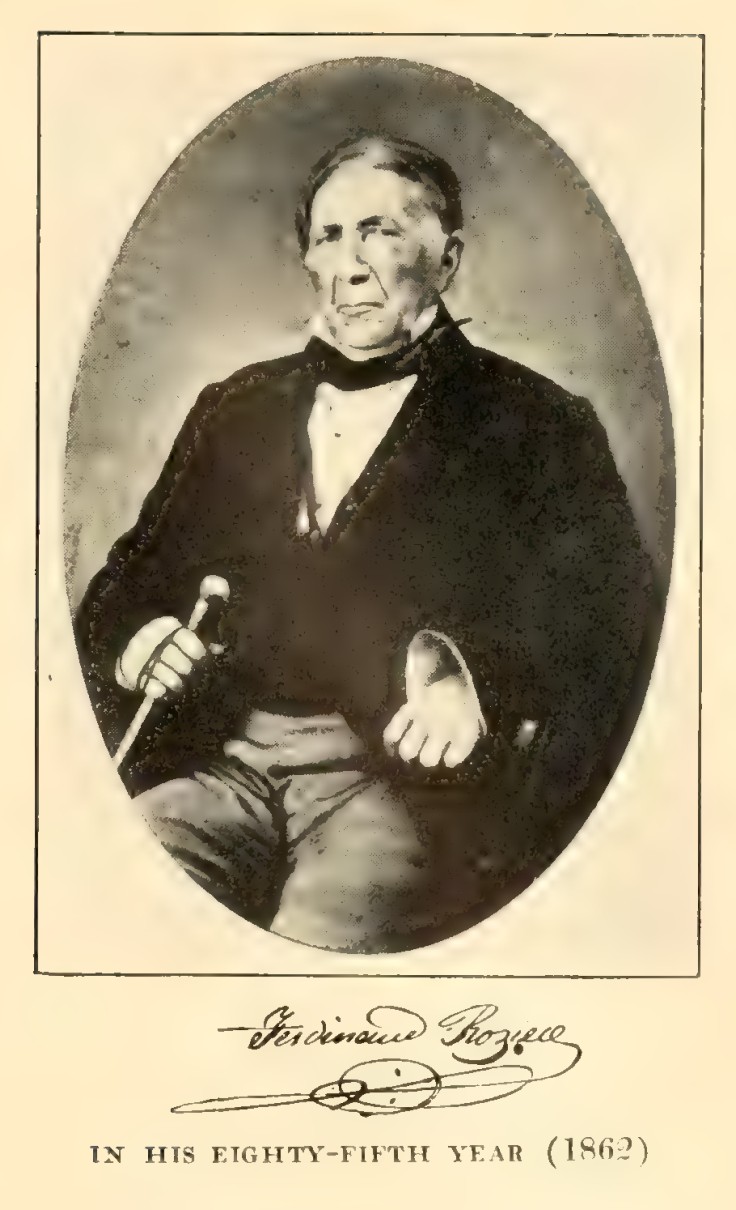
FERDINAND ROZIER
IN HIS EIGHTY-FIFTH YEAR (1862)
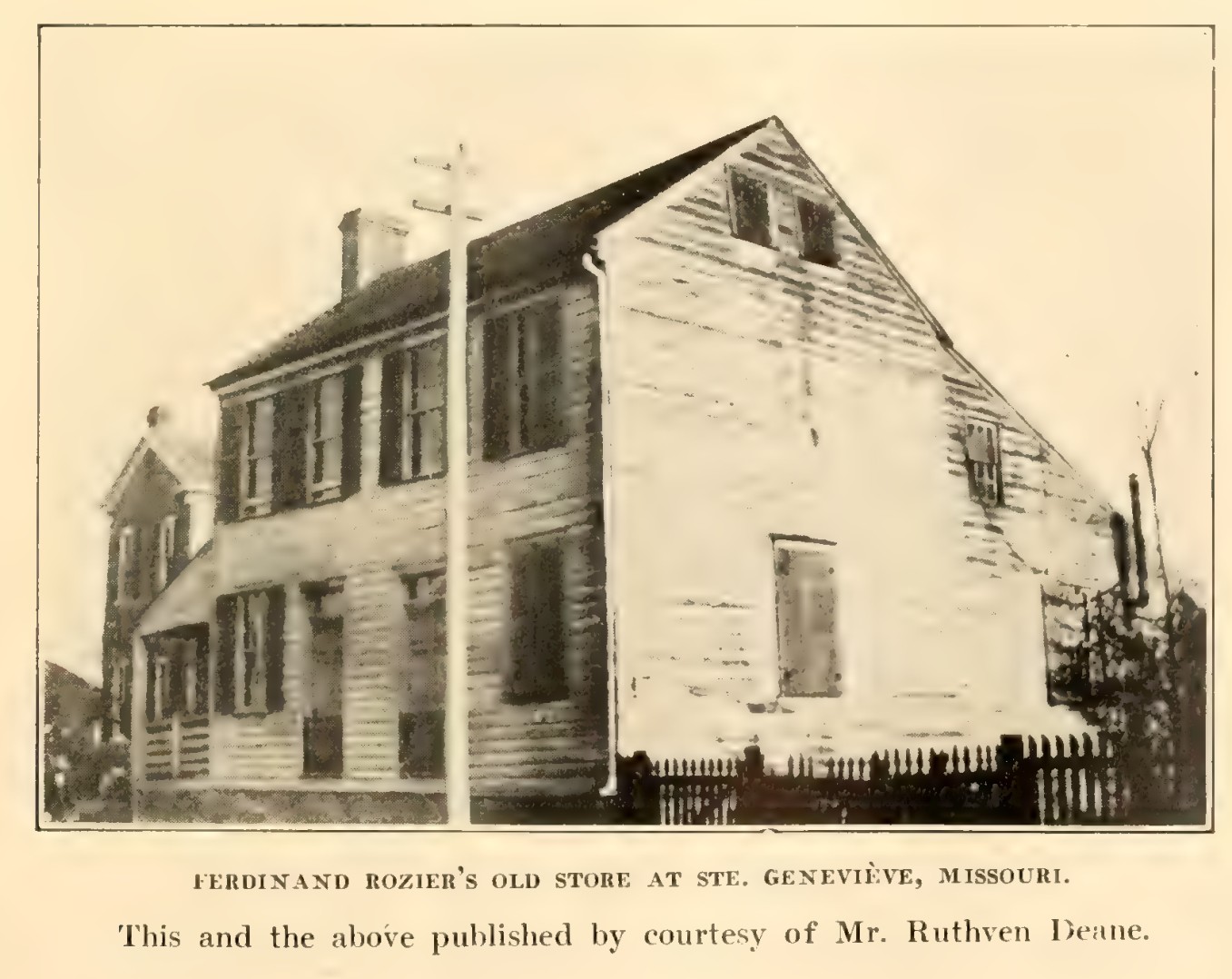
FERDINAND ROZIER’S OLD STORE AT STE. GENEVIÈVE, MISSOURI.
This and the above published by courtesy of Mr. Ruthven Deane.
247
CHAPTER XVI
AUDUBON’S MILL, AND FINAL REVERSES IN BUSINESS
Dr. Rankin’s “Meadow Brook Farm” — Birth of John Woodhouse Audubon — The
Audubon-Bakewell partnership — Meeting with Nolte — Failure
of the commission business — Visit to Rozier — Storekeeping at Henderson — Purchases
of land — Habits of frontier tradesmen — Steamboats on
the Ohio — Popular pastimes — Audubon-Bakewell-Pears partnership — Their
famous steam mill — Mechanical and financial troubles — Business
reorganization — Bankruptcy general — Failure of the mill — Personal encounter — Audubon
goes to jail for debt.
The seven years which followed the outbreak of war
with England in 1812 were the most disastrous in the
naturalist’s career. In many respects they were critical
for the entire country, since hundreds who were not
affected directly by the war were ruined by the financial
troubles which followed in its wake. To Audubon
reverses came at this time in rapid succession. Bereft
of one and then another of his children,214 with his family
in straitened circumstances in France, and reduced to
bankruptcy himself, he finally resolved to throw up
trade, for which he was never fitted, and to make his
avocation the real business of life. We shall see how,
by the unstinted use of such talents as he possessed,
through unremitting effort, and with the aid of his energetic
and capable wife, he was able, at the age of forty-five,
to turn failure into success.
After his return to Henderson in the spring of 1811,
Audubon began to look for another opening in trade,
248
living meanwhile with his family at the home of Dr.
Adam Rankin, called “Meadow Brook Farm.” Dr.
Rankin was the first educated physician in his district,
and was for many years an officer of the court. A doctor
of the older school and a genuine lover of his kind,
with a large heart and an open hand, he made his home
a hostelry where anyone in need could find refuge without
money and without price. No doubt he was attracted
to the naturalist by kindred tastes, and it is
known that they became life-long friends. The old
house, to which Audubon refers in one of his “Episodes,”215
was built of logs, and stood at some distance
from the pike, about two miles from the village in a
southeasterly direction. There were experienced in
greatest frequency, in the winter of 1811 and 1812, the
terrific earthquakes that repeatedly shocked the country
at that time; there also Audubon’s younger son, John
Woodhouse, was born on November 30, 1812. The Rankin
farm became at a much later day the site of the village
of Audubon, which still later was to be incorporated
in the growing city of Henderson, when most of the old
landmarks had been obliterated. Dr. Rankin built a
more commodious and pretentious brick house in the
village itself, and was neighbor to the naturalist for
many years, their houses being on the same or adjoining
lots. He was thrice married and had many children,
the eldest of whom, William Rankin, became Audubon’s
favorite companion in the field; together they ransacked
the country for birds and animals of every sort.
Audubon’s unfortunate business relations with his
brother-in-law, Thomas W. Bakewell, began in the autumn
or winter of 1811, when the naturalist was in the
249
East and Bakewell was about to return to New Orleans
in the employ of a firm of Liverpool merchants who
dealt in cotton. Bakewell, who had seen much of the
South since the failure of his uncle in New York, induced
Audubon to join him in an independent commission
business, with the assurance that his French
nationality would help their undertakings. According
to Vincent Nolte, when they were descending the Ohio
in December, 1811, Audubon displayed a business card,
showing the firm name of “Audubon and Bakewell,”
and indicating that they were to deal in such homely
products as pork, lard and flour. Thomas Bakewell,
we are told, taking with him all the disposable funds of
Audubon, who continued to send him “almost all the
money” that he could raise, opened their business at New
Orleans in the winter or spring of 1812, just in time for
the war, which broke out in June, to destroy it. When
he returned north, in August of that year, Thomas
Bakewell, said the naturalist, suddenly appeared one
day at “Meadow Brook Farm,” while he was making
a drawing of an otter, and after bewailing their
misfortune in trade, departed.
At the approach of spring in 1812 Audubon was hard
pressed for funds, and Rozier’s notes to him being then
overdue he set out on foot for Ste. Geneviève to collect
his money in person. He went out with a party of
friendly Osage Indians, but returned, still afoot and
unpaid, with his faithful dog as his only companion.216
The prairies were then flooded and converted into vast
250
lakes, but Audubon, anxious to reach his home, pressed
on, walking, as he said, “one hundred and sixty-five miles
in a little over three days, much of the time nearly ankle-deep
in mud and water.” It was probably on this journey,
though it may have been in the previous year, that
an incident occurred which he has related in “The
Prairie,”217 when, as he declared, for the first time in
the course of his wanderings for upwards of a quarter
of a century, his life was in actual danger from his
fellow man.
When at last he had obtained some ready money, Audubon
rode to Louisville, where he purchased on the
half-cash, half-credit basis a small stock of goods, and
again set up a retail shop at Henderson. This modest
venture promised so well that he bought land with the
intention of making that town his permanent home.
“I purchased,” said he, “a ground-lot of four acres, and
a meadow of four more at the back of the first.” On
the latter, to follow this account, were several buildings
and an excellent orchard, “lately the property of an
English doctor, who had died on the premises and left
the whole to a servant woman as a gift, from whom it
came to me as a freehold”: other land, he added, adjacent
to the first, was later secured.
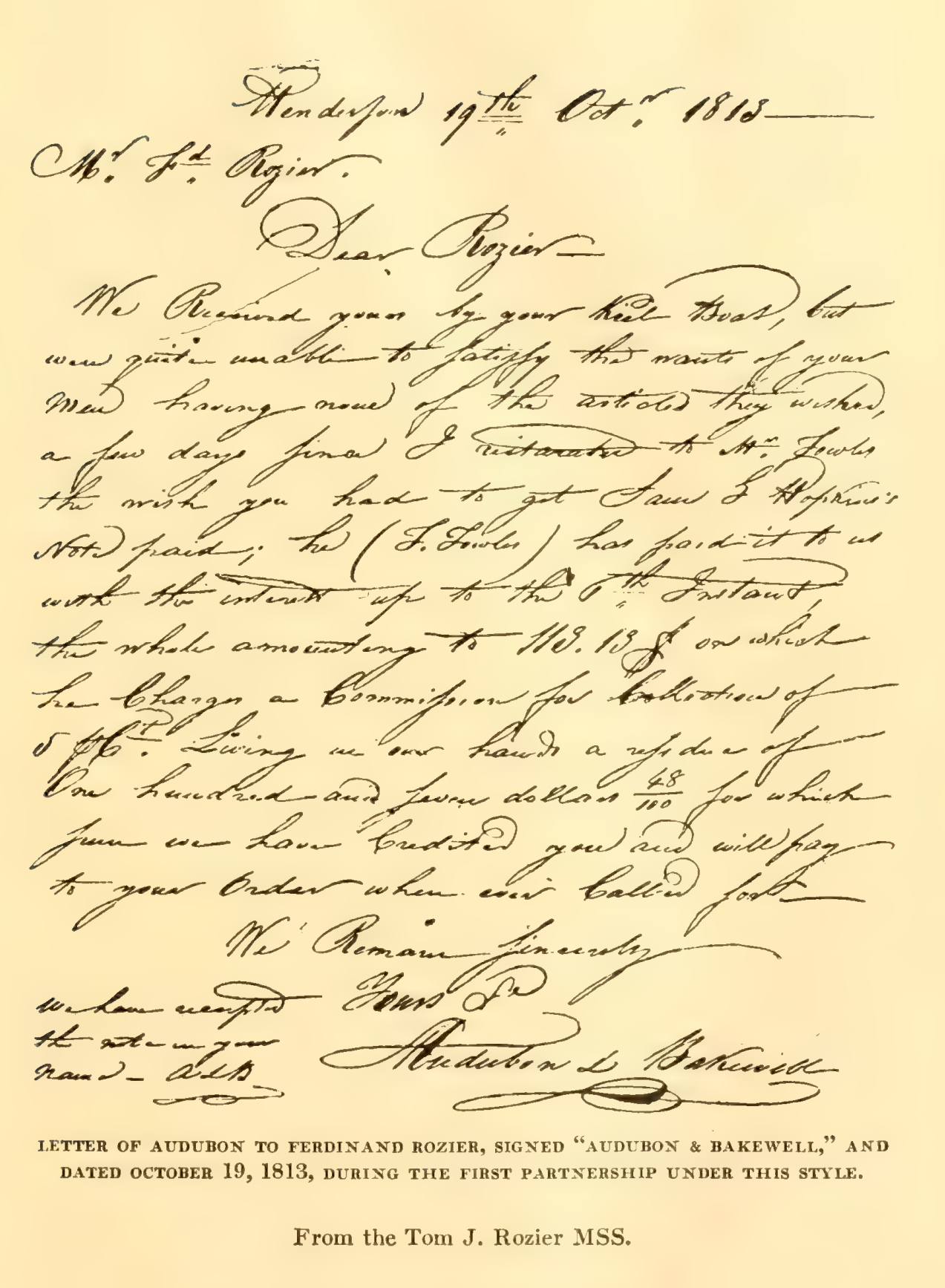
LETTER OF AUDUBON TO FERDINAND ROZIER, SIGNED “AUDUBON & BAKEWELL,” AND
DATED OCTOBER 19, 1813, DURING THE FIRST PARTNERSHIP UNDER THIS STYLE.
From the Tom J. Rozier MSS.
These curiously embroidered statements regarding
land transactions at Henderson in 1813 are not in harmony
with the existing records of that frontier town.
Henderson, as its historian218 tells us, was laid out originally
252
in 1797 into 264 one-acre lots, of which comparatively
few had been sold at the time of which we speak,
though nominal prices were asked and a few had been
given away to encourage settlement.219 Audubon is recorded
as having purchased four one-acre lots from the
town, two in 1813 and two in the following year, while
a long lease was taken upon land adjacent to the river
where later rose his famous mill.220
The old Audubon store for general merchandise, built
of hewn logs, in a single story, stood at the corner of
Main and Mill Streets (now Second Street), fronting
the latter, at a point where a modern departmental
establishment has since risen. Adjoining this primitive
store, on the main street, was his log dwelling,221 of one
and a half stories, with a square porch at the entrance.
Immediately opposite, on the two-acre strip of land purchased
in 1814, lay a small pond which Audubon is
said to have stocked with turtles in order to gratify his
special fondness for this delicacy.
Audubon’s winning manners made him a popular
253
figure among the early settlers of this region, and for
the space of three years he enjoyed life as never before;
“the pleasures,” he said, “which I have felt at Henderson,
and under the roof of that log-cabin, can never be
effaced from my heart until after death.” But in a
community of exacting business men he could never
have made a permanent success; he was too good a
target not to be riddled by many who were ready to
take advantage of his liberality and easygoing ways.
Traveling from Frankfort to Lexington in 1810, Wilson
complained that the people were all traders but
no readers, even of the newspaper; every man, he
said, had “either some land to buy or sell, some law-suit,
some coarse hemp or corn to dispose of; and if the
conversation does not to lead to any of these, he will
force it.”
Many stories, and no doubt much idle gossip, concerning
Audubon’s life and habits, were current at Henderson
long after he left the village. It was said that
he would often go into the woods in his pursuit of birds
and remain from home for weeks at a time; that he was
once known to have followed a hawk for three days in
succession and in practically a straight course, swimming
creeks when necessary, until it finally fell to his gun.
When steamboats made their first appearance on the
Ohio, they naturally excited the greatest interest, and
a favorite pastime of many of the men and boys was
diving from the side of a boat into the river. On one
of these occasions Audubon is said to have made his
appearance in the crowd of sightseers and to have astonished
everyone by plunging from the bow and emerging
from beneath the stern of the vessel after swimming
under her entire length. According to traditional accounts,
Mrs. Audubon, who was also an expert swimmer,
254
would enter the river clad in a regular bathing costume
and cross with ease to the Indiana shore.
In spite of the hard times Audubon managed to keep
out of serious business troubles until he entered into
another partnership with Thomas Bakewell, his brother-in-law.
Their project in this second association was to
erect a steam lumber and grist mill at Henderson, which
of all mortal follies the naturalist considered in the retrospect
to have been one of the worst. It is recorded that
on the sixteenth day of March, 1817, John James Audubon
and Thomas W. Bakewell, under the designation
of “Audubon and Bakewell,” applied to the trustees of
the village for a ninety-nine year lease of a section of
land on the river front. Their petition was granted,
upon a consideration of $20 per annum, and the partners
began to build their mill on the property and completed
it within that year. Thomas W. Pears,222 a former
fellow-clerk of both Audubon and Bakewell in New
York, early joined the enterprise, which was regarded
at the time as one of considerable magnitude. Their
mill, which stood for ninety-five years, became famous
in the annals of the Ohio Valley.223 Said the historian of
Henderson County, writing in 1879:
The weather boarding, whip-sawed out of yellow poplar, is
still intact on three sides. The joists are of unhewn logs, many
of them over a foot in diameter, and raggedly rough. The
foundation walls are built of flat, broken rock and are four and
a half feet thick. Mr. Audubon operated the mill on a large
scale for those times. His grist-mill was a great convenience,
and furnished a ready market for all of the surplus wheat
raised in the surrounding country. His saw-mill also was a
wonderful convenience, doing the sawing for the entire county.
255
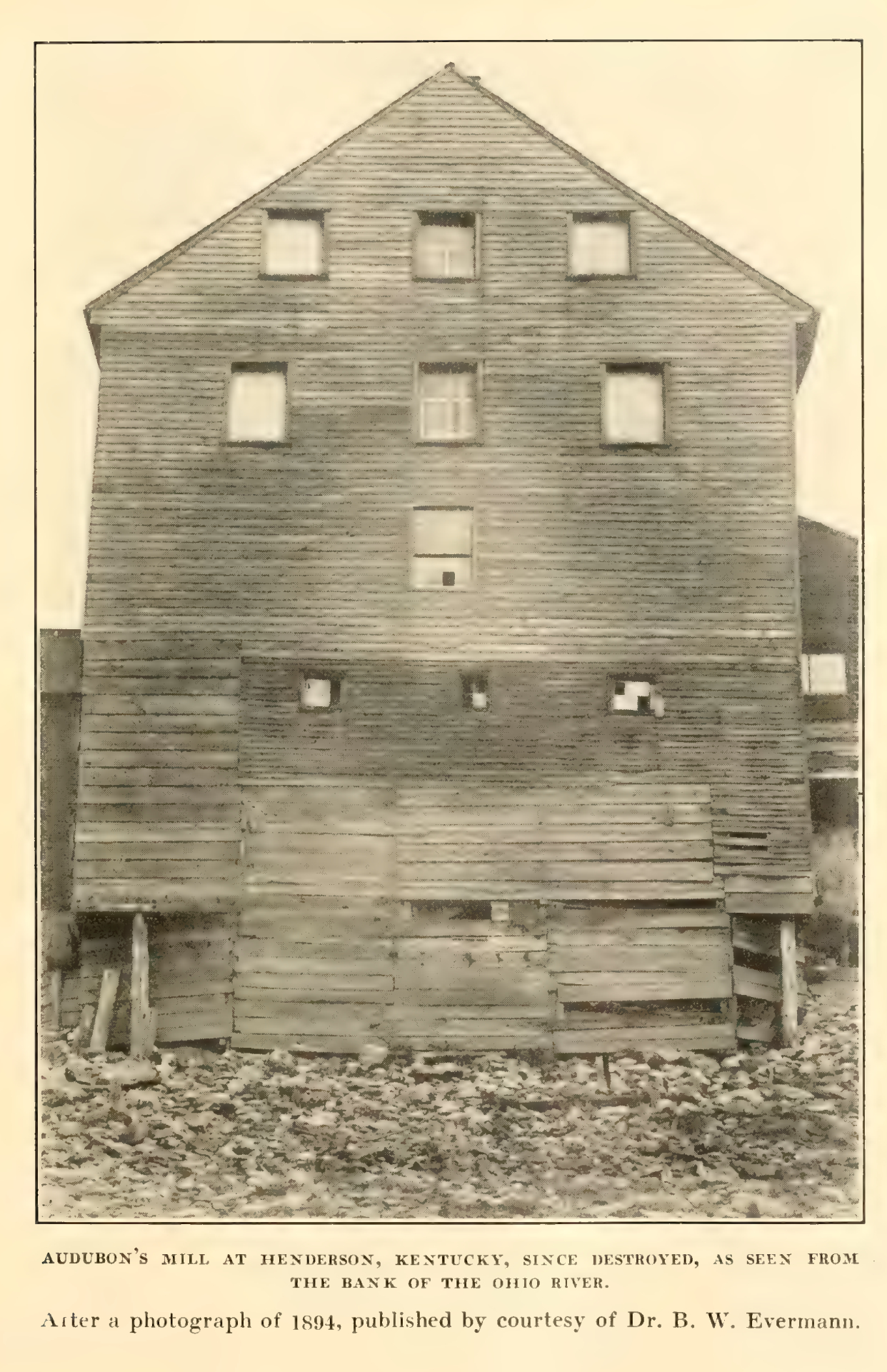
AUDUBON’S MILL AT HENDERSON, KENTUCKY, SINCE DESTROYED, AS SEEN FROM
THE BANK OF THE OHIO RIVER.
After a photograph of 1894, published by courtesy of Dr. R. W. Shufeldt.
Mr. and Mrs. Pears, who had no liking for Henderson,
early withdrew and sold their interest in the mill224
to Audubon and Bakewell, thus adding to their financial
embarrassment. The engines, which seem to have given
no end of trouble, were constructed by David Prentice,
an intelligent Scotch mechanic; since his first work after
coming to this country was to erect a steam threshing
mill at “Fatland Ford,” his services were probably secured
by William Bakewell, who afterwards helped to
establish him at Philadelphia. While at Henderson he
is said to have fitted a small engine and paddlewheels to
a keel boat, which was christened the Pike, and to
have taken it up the river to Pittsburgh. Prentice
seems to have entered the partnership and to have retired
with Bakewell.
In order to extend the sphere of their operations, Audubon
is said to have purchased at this time a tract of
1,200 acres of government land,225 and to have engaged a
band of stalwart Yankees to fell and deliver the timber.
According to one account, they were a party of emigrants
who had come to Henderson with their families
and encamped on the river bank. For a time all went
well, but one day when they failed to deliver their usual
256
supply of logs, it was found that they had decamped
and fled down the river towards the Mississippi, taking
on their flatboat Audubon’s draft oxen and in fact all
the plunder that they could lift. Nothing was ever
recovered and but one of the fugitives was ever seen
again; this man boarded a river boat on which the naturalist
happened to be traveling, and it is said that upon
being recognized he jumped into the river and swam
to the shore like a frightened deer.
When Bakewell finally withdrew, Audubon appears
to have been left stranded, and the business was taken
over by a new set of men, including another brother-in-law,
Nicholas Berthoud, and Benjamin Page of Pittsburgh,
who continued it under the name of J. J. Audubon
& Company.226 Agents were also secured at various
points on the Ohio and Mississippi rivers. Excepting,
as we must assuredly do, his ever staunch friend, Nicholas
Berthoud, Audubon believed that he was “gulled by
all of these men.”
In 1818 a new era of building and general prosperity
seemed to dawn in the valley of the Ohio. A new bank
was chartered at Henderson, and the woodwork of its
brick structure was furnished by Audubon’s mill.227
257
This bank, however, failed in the course of two
years, and forty others scattered throughout that section
broke in rapid succession, after having done little
more than add to the flood of worthless paper notes that
was demoralizing business and sending hundreds into
bankruptcy.
The mill was in operation barely two years. The machinery,
of which a wooden bolting shaft and wooden
cog wheels remained as a curiosity to recent times, seems
to have worked badly from the start. But aside from
the inexperience of the builders and the financial troubles
of the day, the enterprise was foredoomed to failure
in a district which raised but little wheat, and in
which the demand for lumber was then comparatively
slight. “How I labored,” said Audubon, “at that infernal
mill! But it is over now; I am old, and try to
forget as fast as possible all the different trials of those
sad days.”
In the course of the Audubon and Bakewell partnership228
the naturalist became involved in a personal quarrel
with a man whose initials are given as “S ——
B ——.” It seems that in 1817 Audubon’s mechanic,
David Prentice, had built for him a small steamboat,
though for what purpose is not known. When their interests
were severed, we are told, Mr. B —— purchased
this steamer, but paid for it in worthless paper. The
captain of the craft ran her down to the Mississippi and
thence to New Orleans, and Audubon, who was determined
to arrest this man if necessary, started in pursuit
in a skiff. He failed, however, to overhaul the fugitive,
and reached New Orleans only to find that his vessel
258
had been surrendered to another claimant. This was
probably in May, 1819, for in his journal of the following
year, under date of November 23, when he was again
moving down the rivers but in more leisurely fashion,
he speaks of two large eagle’s nests, one of which he
remembered having seen as he “went to New Orleans
eighteen months” before.
Through the researches of a later historian I am now
able to give a more exact account of this affair. The
purchasers of the steamboat were William R. Bowen,
Samuel Adams Bowen, Robert Speed, Edmund
Townes, Obediah Smith, George Brent and Bennett
Marshall, who immediately sued Audubon in the sum of
$10,000, on the plea that he had maliciously taken out
an attachment upon the vessel in New Orleans, where it
had been detained. They represented to the judge of
the circuit court, Henry P. Broadnax, that Audubon
was about to leave Kentucky, and a warrant was issued
to arrest him; he was taken into custody, said the narrator
whom I am following, “but executed a bail bond in
the sum of $10,000 with Fayette Posey as surety, and
was released.” Convinced that a trial at Henderson
would lead only to a defeat of justice, Audubon now
served notice that he would apply for a change of venue
to another county. “That notice together with the other
papers in the action, is among the records of the Daviess
circuit court, at Owensboro, Kentucky. It was written
and signed by Audubon. Application for a change of
venue was made at Hardinsburg and the case was transferred
to the Daviess circuit court.” When the case was
called, the plaintiffs asked for a continuance, and it was
granted them, but when the case was called again at the
next term of court, the plaintiffs failed to appear, and
the action was finally dismissed.
259
Returning home, Audubon was obliged to walk from
the mouth of the Ohio River to Shawnee Town. Upon
reaching Henderson he found that Mr. Bowen had anticipated
him. Acting upon advice, he was prepared for
an encounter with this man, who as his neighbors declared,
had sworn to kill him, and “whose violent and
ungovernable temper was only too well known.” The
anticipated encounter ensued. Audubon, who was then
carrying his right hand in a sling from a recent injury
received in his mill, waited, as he said, until he had received
twelve severe blows from his assailant’s bludgeon;
then with his left hand he drew a dagger and struck in
his own defense. His assailant was felled to the ground,
but happily the wound inflicted was not mortal. Mr.
Bowen was carried away on a plank, and when the affair
was settled in the judiciary court, according to a Henderson
tradition, Judge Broadnax gravely left the
bench, approached the man who had been under charge
of assault, and said: “Mr. Audubon, you committed a
serious offense — an exceedingly serious offense Sir — in
failing to kill the d—— rascal.”229 “Thomas Bakewell,”
added the naturalist, “who possessed more brains than I,
sold his town lots and removed to Cincinnati, where he
has made a large fortune, and I am glad of it.230
When the mill was finally closed and the company
dissolved in 1819, Audubon as usual was the heaviest
260
loser. Arrested and sent to the Louisville jail for debt,
he was able to obtain release only by declaring himself
a bankrupt in court. “I paid all I could,”231 he said in
his journal of the following year, “and left Henderson
poor and miserable in thought. My intention to go to
France and see my mother and sister was frustrated,
and at last I resorted to my poor talents to maintain
you and your dear mother, who fortunately became easy
at her change of condition, and gave me a spirit such
as I really needed, to meet the surly looks and cold reception
of those who so shortly before were pleased to
call me their friend.” “I parted,” to revert to his later
account, “with every particle of property I held, to my
creditors, keeping only the clothes I wore on that day,
my original drawings, and my gun.” Without a dollar
in his pocket he left Henderson and walked to Louisville
alone; “this,” he said on reflection, “was the saddest of
all my journies, the only time in my life when the Wild
Turkeys that so often crossed my path, and the thousands
of lesser birds that enlivened the woods and the
prairies, all looked like enemies, and I turned my eyes
261
from them, as if I could have wished that they never
existed.“
Passing down the Ohio in the following year Audubon
made these entries in his diary:
November 2nd, 1820. Floated down slowly within two miles
of Henderson. I can scarcely conceive that I stayed there
eight years, and passed therein comfortably, for it is undoubtedly
on the poorest spot in the country, according to my present
opinion.
Nov. 3rd, 1820. We left our harbor at daybreak, and
passed Henderson about sunrise. I looked on the mill perhaps
for the last time, and with thoughts that made my blood almost
run cold bid it an eternal farewell.
262
CHAPTER XVII
THE ENIGMA OF AUDUBON’S LIFE AND THE HISTORY
OF HIS FAMILY IN FRANCE
Death of Lieutenant Audubon — Contest over his will — Disposition of his
estate — The fictitious $17,000 — Unsettled claims of Formon and Ross — Illusions
of biographers — Gabriel Loyen du Puigaudeau — Audubon’s
relations with the family in France broken — Death of the naturalist’s
stepmother — The du Puigaudeaus — Sources of “enigma.”
Lieutenant Jean Audubon, as already recorded, died
at Nantes in 1818, at a time when his son’s financial
troubles in America were culminating, and left an estate,
then none too large, for the sole enjoyment of his widow
during her lifetime. The naturalist, so far as is known,
never received a penny in payment of bequests made by
either his father or stepmother, but the reasons for this
fact were far different from those which his biographers
have assigned.
We have referred to the curious wording which
appears in the six different wills that were executed by
Lieutenant Jean Audubon and Anne Moynet, his wife,
between the years 1812 and 1821.232 The first four of
these documents233 were of a mutual nature, and were
so drawn that the survivor should enjoy the entire
property of the other during his or her lifetime, but this
eventually was to be divided between their two children,
or heirs of the latter should any exist. In Jean Audubon’s
last will, made at Couëron on the 15th of March,
263
1816, he added the provision that in case his “dispositions
in favor of Jean Rabain and Rose Bouffard, wife
of Loyen du Puigaudeau, should be attacked and annulled,”
he bequeathed his entire estate, without exception,
to his wife, Anne Moynet, for her sole use. His
fears, as already intimated, were well grounded, and
his will was immediately contested by four nieces,
Mme. Lejeune de Vaugeon of Nantes, Mme. Jean
Louis Lissabé, whose husband was a pilot, and Anne
and Domenica Audubon, seamstresses at Bayonne.234
This trial dragged on in the courts for a long time, and
served further to impoverish Madame Audubon, who
was obliged to dispose of most of her valuable effects,
but it was finally settled by a compromise in 1820. In
that year, at the age of eighty-five, she left “La Gerbetière”
to live with her daughter and son-in-law at
“Les Tourterelles” close by, where she remained until
her death on October 18, 1821.
It seems incredible that Audubon should not have
heard of the death of his foster mother, since he had been
devotedly attached to her in his youth and was moreover
a beneficiary under her will. Yet on August 6, 1826,
he wrote in his journal: “My plans now are to go to
Manchester, to Derbyshire to visit Lord Stanley, Birmingham,
London for three weeks, Edinburgh, back to
London, and then to France, Paris, Nantes, to see my
venerable stepmother, Brussels, and return to England.”
On September 30 of the same year he wrote
from Liverpool: “I long to enter my old garden on
the Loire and with rapid steps reach my mother, — yes,
my mother! the only one I truly remember; and no son
264
ever had a better, nor more loving one.“235 Again in
1828 he spoke of this estimable woman as if she were
then alive, although she had been dead seven years.
In Madame Audubon’s last will, which was made in
the July preceding her death, she left her property to
be equally divided between her two adopted children,
“Mr. Jean Audubon, called Jean Rabin, husband of
Lucy Bakewell, and who I believe is at present in the
United States of America, and to Rose Bouffard, wife
of M. Gabriel Loyen du Puigaudeau, my son-in-law,
who is living at Couëron”; she also took care to guard
against the pretensions of any spurious heirs, and to
make provision for her grandchildren in case of the
death of either or both of her heirs direct.
Having given the precise, if somewhat prosaic, recorded
facts of the case, we will quote the story narrated
by the naturalist’s biographers, who never could
have seen the legal documents and who thus had only
hearsay and conjecture on which to build:
At this juncture of critical business affairs at Henderson,
the father of Audubon died; but for some unfortunate cause
he did not receive legal notice for more than a year. On becoming
acquainted with the fact he traveled to Philadelphia to
obtain funds, but was unsuccessful. His father had left him his
property in France of La Gibitère Gerbetière, and seventeen
thousand dollars which had been deposited with a merchant
in Richmond, Virginia. Audubon, however, took no steps
to obtain possession of his estate in France, and in after years,
when his sons had grown up, sent one of them to France, for
the purpose of legally transferring the property to his own
sister Rosa. The merchant who held possession of the seventeen
thousand dollars would not deliver them up until Audubon
265
proved himself to be the son of Commodore Audubon. Before
this could be done the merchant died insolvent, and the legatee
never recovered a dollar of his money.236
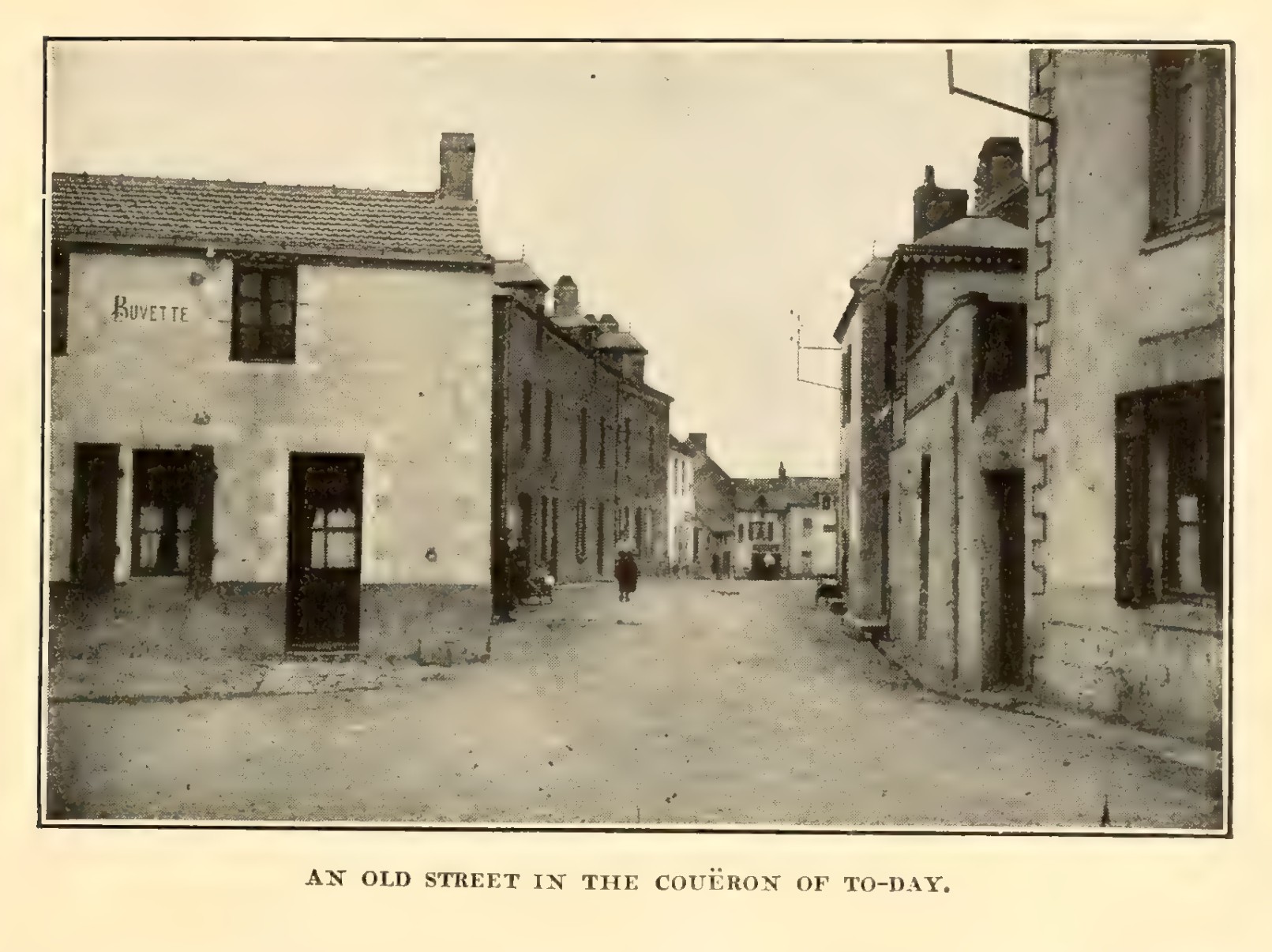
AN OLD STREET IN THE COUËRON OF TO-DAY.
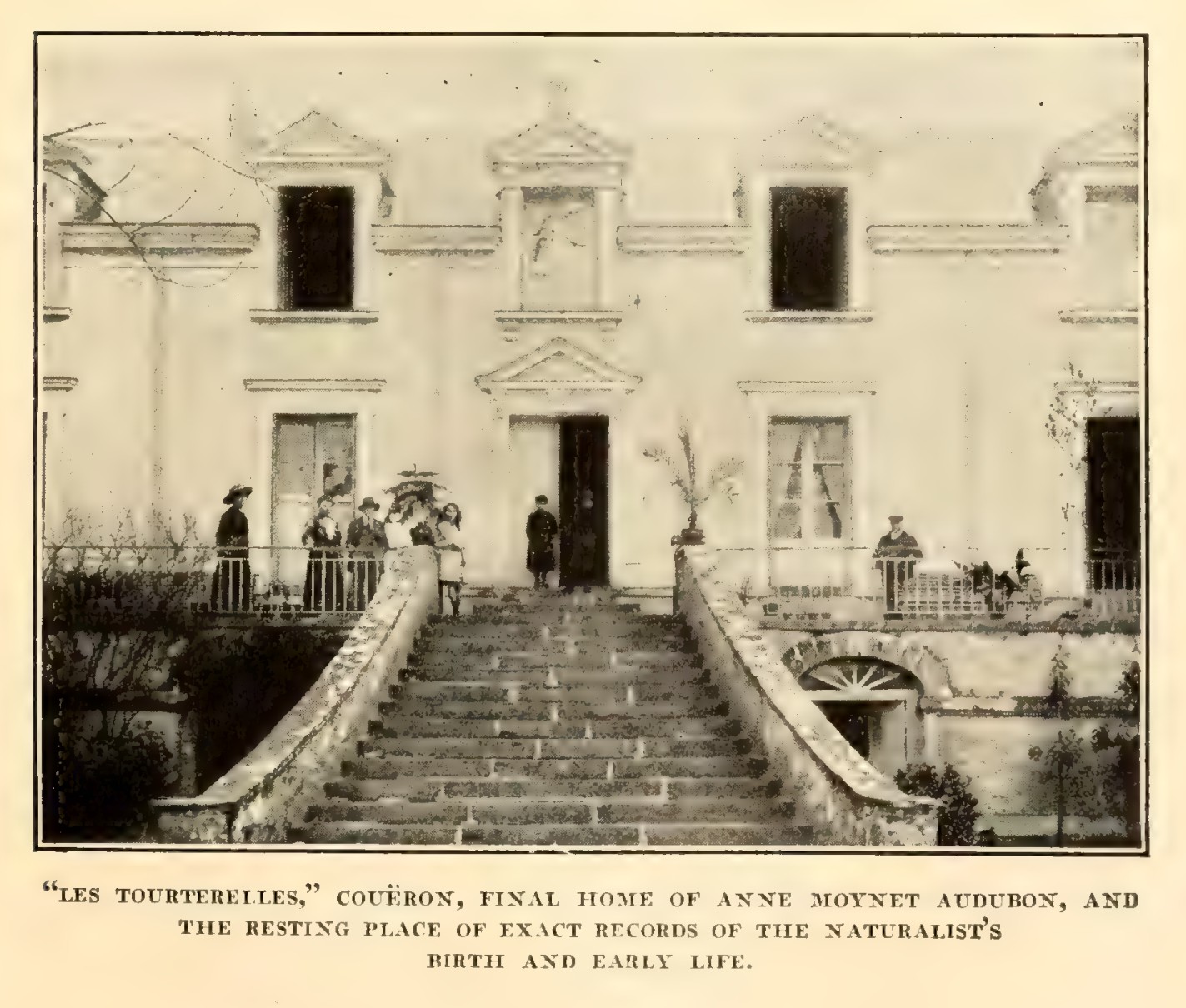
“LES TOURTERELLES,” COUËRON, FINAL HOME OF ANNE MOYNET AUDUBON, AND
THE RESTING PLACE OF EXACT RECORDS OF THE NATURALIST’S
BIRTH AND EARLY LIFE.
A key to the origin of the fictitious seventeen thousand
dollars is probably to be found in the letters of
Jean Audubon to Francis Dacosta, written in 1805,237
where he refers to certain unsettled business claims
against his former partners, Messrs. Formon and Ross,
who had been respectively interested with him in two
vessels, Le Comte d’Artois and the Annette, the history
of which has already been noticed.238 They were also engaged
at a later time in certain iron-works above Richmond,
Virginia, but with these Lieutenant Audubon was
not directly concerned. Formon, his partner in Santo
Domingo trade, who was charged with having drawn
$1,650 in excess of his share, had died without making
any final settlement of their accounts; another associate,
Edward, had died in London leaving an unsettled
claim of $300; while David Ross, who was owing
a certain sum, had also died without liquidating his debt.
The amount of the latter claim probably was not large,
since Dacosta was instructed to use this sum for his
needs in developing the mine at “Mill Grove” should
he be so fortunate as to collect it; “when you receive my
papers from Miers Fisher,” said Lieutenant Audubon
in his letter of the 22d of June, 1805, “you will find a
promissory note of Mr. Samuel Plaisance of Richmond,
for the business of the widow Ross. If there were justice
there this sum should be paid to me with the costs.”
Lieutenant Audubon was never able to collect these
266
different amounts, which probably did not much exceed
$2,000, but an echo of one of these transactions appeared
as late as 1819, when Audubon’s brother-in-law
sent him a document referring to the claim on the Ross
estate, in the hope that some money might still be forthcoming,
writing as follows:239
In turning over some letters I have found a letter of Mr.
David Rost Ross, and a memorandum that I thought pointed
to what was referred to in it. As I have sometimes heard it
said that this Mr. David Rost owed a considerable sum, it
should be possible that this letter, which is in English, might
be of use to you. I cannot say anything about it, not knowing
your language, and not having ventured to get it translated,
from fear of compromising us, I am sending it to you, and
you will judge of its importance. Should chance will that it
bring you money, send me some of it, I beg you, for I am in
great need of it.
The same biographer whom we have just quoted
said in reference to “La Gerbetière”: “This estate was
left by Commodore Audubon to his son John James,
who conveyed it to his sister without even visiting the
domain he so generously willed away.” We have now
seen what provisions were actually made for the disposition
of this property under the terms of the various
wills of Lieutenant Audubon and his wife. We need
only add that not long after his father’s death, the naturalist
lost touch with his family in France; his one-half
interest in his stepmother’s estate, which was heavily
encumbered, was never claimed, and at a much later
day was informally relinquished in favor of his sister
and her family.
267
During his Henderson period Audubon was in
communication with his brother-in-law, Gabriel Loyen
du Puigaudeau, who kept him informed in regard to
all that transpired in their French home; on July 26,
1817, the naturalist had given him a power of attorney,
the curious wording of which has already been noticed.240
Whether deterred by the legal complications which soon
followed, displeased by the mode of settlement, or for
what other cause now unknown to us, Audubon seems
to have severed all relations with his family at Couëron,
or to have written to them only after long lapses of
silence. On New Year’s Day, 1820, Gabriel du Puigaudeau
dispatched to him a friendly letter241 of greeting:
I take the opportunity at the renewal of the year, to offer
you the good wishes of the entire family. Our every desire is
that you, your beloved wife, and dear children may be happy,
that you may prosper, that you may enjoy good health, and
this is the wish of your nieces also. But, awaiting the pleasure
of seeing you all, by what fatality during the past eighteen
months have I not had any news of you, why no reply to at
least twenty letters that I have written to you? Can I have
been so unfortunate that some one has given you any report
that would prejudice you against me? I do not believe that
there could exist any one who would be able to do this, at least
with truth; if some one has really sought to estrange your
friendship for me, act with frankness, and tell me your suspicions.
I do not believe it would be difficult to destroy them,
and I even promise that I would offer you no reproach for
having momentarily believed it, should this after all have occurred.
For what concerns our business affairs, I refer you to
my letters which have preceded this.
268
This letter was sent to Henderson, Kentucky, more
than a year after the naturalist had finally left that
state; at the moment it was written he was making his
way down the Ohio River to New Orleans in a flatboat,
“the poorest man aboard,” as he thought at the time.
Writing in his journal on December 26, 1820, when
they had touched at Natchez, Audubon said that on
that day he had received letters from his wife, who was
then at Cincinnati, written on November 7 and 14, and
that the last “contained one from my brother, G. Loyen
Dupuigaudeau, dated July 24, 1820.” If the month in
this instance was misnamed, this might have been the
following letter, which was written at Couëron on the
twenty-fourth of June, 1820, and sent to Henderson
like the last.
Two years have passed without our having any news of
you. What a long lapse of time, and in what anxiety are we
plunged! In God’s name give us some news about yourself, if
it be but a word to set us at rest in regard to your condition.
I should not know how to persuade myself that you were not
on friendly terms with me, since I have given you no cause
for grievance; if it is so, be generous enough to relieve me
from this anxiety. The business matters of Mr. Audubon are
at last concluded, and I await only the return of the papers
from Cayes to set them in order with justice to all.242
Profiting by an opportunity for New York, I have only
time to refer to my letters of 15 September, 30 October, 19
December, 1818, 1st February, 15 April, 15 May, 3d August,
1819, in all their contents.
Madam Audubon is coming to live with us; she found herself
isolated at “La Gerbetière,” and was very dull there; I
wish that she may be contented here. She does not cease to
269
speak of you, and is as much astonished as I am that we receive
no news of you.
The naturalist’s elder son, Victor, visited Couëron
about the year 1835, when his cousin, Gabriel Loyen du
Puigaudeau the second, who was nearly of the same age,
returned from military service to meet him. He was
disappointed at the appearance of his father’s old home,
“La Gerbetière,” which had not been occupied by the
family for fifteen years.243
Rosa Audubon du Puigaudeau, the naturalist’s sister,
died at “Les Tourterelles” after August 3, 1842,
leaving a daughter, Rose du Puigaudeau, who died
without issue, October 20, 1881, and, if we are correctly
informed, one son, Gabriel Loyen du Puigaudeau the
second, who died at “Les Tourterelles,” Couëron, June
23, 1892, when past his eightieth year; a daughter of
this only son was married to Monsieur L. Lavigne,
notary at Couëron. At the time of her uncle’s death,
his property, including the personal records of Lieutenant
Jean Audubon, passed into the hands of Madame
Lavigne, who is a grand step-niece of the naturalist, and
who aside from her children, so far as known, is the
only surviving member of his family in France.
At this point we must examine a little more carefully
the peculiar status of what Audubon referred to
270
as the “enigma” of his life. In some of his private
journals and letters244 he dramatically declared that a
mystery had surrounded his early existence, which he
was bound by a solemn oath exacted by his father never
to reveal, and that this secret must be carried by him
to the grave. If it be the duty of a biographer to make
the true character of his subject known, the passage of
time would now seem to sanction reference to many
personal matters which a century ago should have been
more rigidly guarded. I enter upon this task solely
with the view of placing Audubon’s character in a truer
and fairer light.
The essential facts regarding Audubon’s birth and
early years have now been given, and this is the true,
though possibly not the complete, story. Anything
which we now add, however, can be regarded as little
better than speculation. Audubon is said to have received
through his father a large sum of money from an unknown
or unnamed source,245 but as such stories are apt
to be exaggerated, especially when an ocean intervenes
between a testator and his heir, the statement may be
erroneous; we have seen that Lieutenant Audubon was
not in a position to make such gifts himself had he been
so disposed. If the report were true, the money may
have come from the estate of his mother, and through
the agency of the mysterious “Audubon of La Rochelle,”
271
who is said to have been a politician.246 In some
of the passages which we do not quote, the naturalist
would have his family believe that he was of noble birth,
that his adoptive father was not his true father, and
that both he and Lieutenant Audubon had received
irremediable injury through the treachery of the mysterious
uncle, “Audubon of La Rochelle.” Now these
strange statements of the naturalist, though not in
accord with the facts as they are known to us, should be
interpreted, I believe, in the light of possible stories that
may have come to him in the glamour of his youth; his
mind may have been diverted by them, he may have
believed them, but of this nothing now can positively
be known. To continue our conjectures, it is possible
that the plain conflict between these supposititious tales
and the facts that were revealed at his adoption, his
baptism, and in the wills of his father and stepmother,
as well as by the lawsuit which followed the former’s
death, all led him to resort to “enigma.” We should
also remember that the naturalist, who was careless of
dates and historical facts, had finally left his home at
the age of twenty, when young men as a rule are not
curious about their family history, and that he reached
the reminiscent stage late in life. It seems probable
that the wording of his father’s will and the later attempt
to annul it finally induced him to wash his hands
of the whole matter, even to breaking off relations with
his family in France. Feeling, as undoubtedly he did,
that public knowledge of those conditions, for which
he was in no way responsible, might be a bar to all
future aspirations, he was not loath to let the matter
rest, so far as he and his immediate family were concerned,
under a cloak of mystery. If such were in truth
272
the case, I think few would find cause to blame him.
When we view the whole subject in this double light,
of a duty owed to his family and of the possibility that
conflicting stories had come to him at an earlier day,
any embroidery or confusion which appears in many of
his statements of a personal nature can be better understood.
Such an explanation would be quite convincing
if payments had actually come to him from his own
mother’s estate.
We will only add that Mrs. Audubon, who seemed
to have shared her husband’s intimate thoughts, apparently
believed to the last in his high birth. When
her younger son, John Woodhouse Audubon, lay at the
point of death, in February, 1862, she was summoned
to his bedside, but reached it too late to see him alive;
upon entering the room Mrs. Audubon is said to have
exclaimed: “Oh, my son, my son! to think that you
should have died without having known the secret of
your father’s early life!” When asked by members of
her family to what she then referred, she turned their
questions aside, saying only that such remarks were
common in moments of intense grief and excitement.
273
CHAPTER XVIII
EARLY “EPISODES” OF WESTERN LIFE
Methods of composition — “A Wild Horse” — Henderson to Philadelphia in
1811 — Records of Audubon and Nolte, fellow travelers, compared — The
great earthquakes — The hurricane — The outlaw — Characterization
of Daniel Boone — Desperate plight on the prairie — Regulator law in
action — Frontier necessities — The ax married to the grindstone.
Audubon’s sketches of life and scenery in America,
which he designated as “Episodes,” were interspersed
in his Biography of birds247 to brighten the narrative
and beguile the reader. Extending to the number of
sixty, and dealing mainly with events between the years
1808 and 1834, they abound in tales of adventure and
graphic pictures of pioneer life which for their personal
charm, local coloring, and human interest are
worthy of high praise. Some of these sketches have
been copied widely and some have been translated into
Audubon’s native tongue; some have even found their
way into schoolbooks. While they have deservedly won
the naturalist many readers, not a few have subjected
him to harsh criticism on the score of too vivid coloring
or historical inaccuracy, a fault to which he was particularly
prone. Whenever Audubon went directly to
nature to exercise his pencil or brush or wrote with his
subject before him, he was truth itself, but in writing
offhand and from memory of past events he was wont
274
to humor his fancy, disregarding dates as readily as
he did the accents on French words. This tendency is
particularly apparent in the accounts of some of his
early adventures in the western country, such as “Louisville
in Kentucky” (1808-10), “The Prairie” (1812),
“A Wild Horse” (1811-13), and “The Eccentric Naturalist”
(1818), the history of which is detailed in the
following chapter. We shall examine some of these
stories at this point, though their composition belongs to
a later period, in order to reach a just conclusion in
regard to the author’s method, as well as for the intrinsic
interest of the narratives themselves.
During Audubon’s early life in Kentucky, as we
have seen, he frequently visited the East, whether in the
interest of birds or business, traveling by way of the
river and the forest roads. Incidents of these journeys
frequently occur in the “Episodes,” but since dates commonly
are omitted and the order of events is liable to be
blended or confused, they cannot be trusted always for
historical accuracy. Thus, “The Wild Horse” episode248
professes to be an account of a single journey from
Henderson, in Kentucky, to Philadelphia and back
again, whereas some of the events recorded occurred in
reality at least two years apart, such as the meeting with
Nolte at the Falls of the Juniata River in December,
1811, and the naturalist’s return from Pennsylvania
with the proceeds of “Mill Grove,” which could not have
been earlier than 1813, the date of its sale to Mr. Samuel
Wetherill, Junior.249
Audubon visited Philadelphia in November, 1811,
275
and returned to Kentucky in December of that year,
but whether it was upon this or some other journey
that he rode a wild horse through seven states in going
from his home at Henderson to the Quaker city, or
whether such a journey ever occurred, is immaterial
to the interest of the narrative. In this instance, however,
we have the advantage of comparing the notes of
a fellow traveler, Vincent Nolte, then a merchant at
New Orleans.250 First to follow Audubon’s account, as
given in his “Episode,” we are told that he rode a wild
mustang, named “Barro,” that had never known a shoe,
having been recently captured near the headwaters of
the Arkansas. In going east he diverged from the
beaten track to extend his knowledge of the country and
of its bird life. From Henderson he passed through
the heart of Tennessee to Knoxville, thence to Abington,
the Natural Bridge, and Winchester in Virginia,
crossed the corner of West Virginia to Harper’s Ferry,
then to Frederick, Maryland, and on through Lancaster
to Philadelphia; there, he said, he remained four
days, and returned by way of Pittsburgh, Wheeling,
Zanesville, Chillicothe, Lexington and Louisville, to
Henderson. He estimated the whole distance traversed
at “nearly two thousand miles,” and at a rate of “not
less than forty miles a day.” Much is said in praise of
his favorite bay horse, and its food and daily treatment
are duly recorded. This horse was very docile, and
would wade swamps, swim rivers, and clear a rail fence
like an elk; corn blades as well as corn and oats entered
into his daily ration, to which a pumpkin and fresh eggs,
when procurable, were occasionally added.
It was upon his return journey that the naturalist
met with Vincent Nolte, who twelve years later did his
276
chance acquaintance a good turn, when the latter was
about to sail for England in 1826.251 Nolte, said
Audubon,
was mounted on a superb horse, for which he had paid three
hundred dollars, and a servant on horseback led another as a
change. I was then an utter stranger to him, and when I
approached and praised his horse, he not very courteously observed
that he wished I had as good a one. Finding that he was
going to Bedford to spend the night, I asked him what hour he
would get there: “Just soon enough to have some trouts ready
for our supper, provided you will join when you get there.”
I almost imagined that Barro understood our conversation;
he pricked up his ears, and lengthened his pace, on which Mr.
Nolte caracolled his horse, and then put him to quick trot, but
all in vain; for I reached the hotel nearly a quarter of an hour
before him, ordered the trouts, saw to the putting away of my
good horse, and stood ready at the door to welcome my companion.
From that day to this Vincent Nolte has been a friend
to me.
Audubon added that they rode together as far as
Shippingport, now a part of Louisville, where his
brother-in-law, Nicholas Berthoud, was then living.
We shall now follow the equally circumstantial but
widely divergent account of this meeting and the subsequent
journey as given by the other traveler. Nolte
had sailed from Liverpool in September, 1811, and
landed in New York after a perilous voyage of forty-eight
days. He had no servant, but was accompanied
by a young Englishman, named Edward Hollander,
whom he had engaged in a business capacity while in
London and with whom he was making his way to New
Orleans. Hollander had been sent in advance to Pittsburgh
277
to purchase two flatboats, for in addition to their
horses they had planned to carry 400 barrels of flour,
from the sale of which in the South they expected to
defray the expenses of their journey. Having purchased
a fine horse in Philadelphia, Nolte left that city
in December, and with saddle-bags strapped to his
horse’s back, rode on “entirely alone.” He crossed the
highest point of the Alleghany ridge at ten o’clock of a
winter’s morning and later in the same day reached a
small inn “close by the Falls of the Juniata River.”
“The landlady,” to quote his narrative, “showed me into
a room, and said, I perhaps would not mind taking my
meal with a strange gentleman, who was already
there.” This stranger, who immediately struck him as
“an odd fish,” “was sitting at a table, before the fire,
with a Madras handkerchief wound around his head,
exactly in the style of the French mariners, or laborers,
in a seaport town.” In the course of the conversation
which then ensued he declared that he was an Englishman,
but Nolte was the last person to be deceived on a
question of nationality and remarked at once that his
speech betrayed him. “He showed himself,” to quote
our senior traveler again, “to be an original throughout,
but at last admitted that he was a Frenchman by birth,
and a native of La Rochelle. However, he had come
in his early youth to Louisiana, had grown up in the sea-service,
and had gradually become a thorough American.”
When asked how this account squared with his
earlier statement, said Nolte, “he found it convenient
to reply in the French language: ’when all is said and
done, I am somewhat cosmopolitan; I belong to every
country.’ This man,” to conclude, “who afterwards
won for himself so great a name in natural history, particularly
in ornithology, was Audubon, who, however,
278
was by no means thinking, at that time, of occupying
himself with natural history.“
In the interview as thus far recorded, Audubon was
clearly chaffing his new acquaintance, for not one of
the statements attributed to him was true, if we accept
the fact of his French extraction. Nolte, to be sure,
writes as a somewhat vain and garrulous man, and after
a lapse of forty-three years, but he professes to speak
the truth and there is no reason to suppose that his narrative
is pure invention. Nolte further informs us that
Audubon’s father-in-law, Mr. Bakewell, “formerly of
Philadelphia,” was “then residing and owning mills at
Shippingport,” which was not the case. To continue,
finding that Audubon, who was bound for Kentucky,
was a companionable man and devoted to art, a field
which he had cultivated himself, Nolte proposed that
they should travel together, and offered the naturalist
a berth on one of his flatboats.
He thankfully accepted the invitation, and we left Pittsburgh
in very cold weather, with the Monongahela and Ohio
rivers full of drifting ice, in the beginning of January, 1812. I
learned nothing further of his traveling plans until we reached
Limestone, a little place in the southwestern corner of the State
of Ohio.252 There we had both our horses taken ashore, and I
resolved to go with him overland, at first to visit the capital,
Lexington, and from there to Louisville, where he expected to
find his wife and parents-in-law…. We had hardly finished
our breakfast at Limestone, when Audubon, all at once, sprang
to his feet, and exclaimed in French; “Now I am going to lay
the foundation of my establishment.” So saying, he took a
small packet of address cards from his pocket, and some nails
from his vest, and began to nail up one of the cards to the
door of the tavern, where we were taking our meal.
279
Later they rode on together as far as Lexington, where
they appear to have parted company.
The discrepancies between these accounts could
hardly be greater, and they serve to illustrate the liberties
which Audubon sometimes took with facts in composing
his “Episodes.” The travelers met, not on horseback,
but at the supper table of a country inn; Nolte
was then alone and had but one horse, while the greater
part of the return journey was made by flatboat with
Audubon as his guest; corn blades, pumpkins and trout
suggest any other season than midwinter, with heavy
snows on the mountains and rivers choked with ice.
Audubon in this instance, as already explained, combined
the incidents of two different journeys and colored
the narrative to suit his fancy. There was no apparent
motive to mislead the reader, and one of his
readers he must have known would probably be Vincent
Nolte, though he was not a subscriber to The Birds of
America; Nolte did read the story, and was pleased with
the “flattering acknowledgment of the little service”
that he was able to render Audubon at that time as well
as later in his career.
Both travelers felt the great earthquakes while making
this journey, but probably not until they had parted
company at Lexington. Audubon has given a vivid
account of this experience in a characteristic sketch, but
as usual there are no dates.253 He was overtaken, as he
said, while “traveling through the Barrens of Kentucky
… in the month of November,” when he thought his
terrified “horse was about to die, and would have sprung
from his back had a minute more elapsed, but at that
instant all the shrubs and trees began to move from
their very roots; the ground rose and fell in successive
280
furrows, like the ruffled waters of a lake.“ For
”November“ he should have written ”January“ of the
year 1812.254
This series of memorable earthquakes was followed
in 1813 by a hurricane, more terrific than destructive,
which swept the lower part of Henderson County, Kentucky,
and cut a wide swath through the virgin forests,
without causing any loss of life. Audubon’s account
of this event255 is that of a close observer who escaped
destruction by a hair’s breadth and who related only
what he himself had experienced. Critics inclined to be
supercilious have complained that he exaggerated the
importance of a merely local event and stretched the
course of the storm some 800 miles until it had covered
several states. “Sir,” said Waterton, in pointing a dart
through Audubon to another target, “this is really too
much even for us Englishmen to swallow, whose gullets
are known to be the largest, the widest, and the most
elastic, of any in the world.” What Audubon said was:
“I have crossed the path of this storm, at a distance of
a hundred miles from the spot where I witnessed its
fury, and, again four hundred miles farther off, in the
State of Ohio. Lastly, I observed traces of its ravages
on the summits of the mountains connected with the
281
Great Pine Forest of Pennsylvania, three hundred
miles beyond the place last mentioned. In all these
different parts, it appeared to me not to have exceeded
a quarter of a mile in breadth.“ Audubon was doubtless
mistaken in his hasty inference that marks of forest
devastation observed at such widely separated points
were due to the same storm, but this would only illustrate
a lack of caution which he sometimes displayed.
A contemporary writer256 declared that Audubon’s
account of “Mason,” the outlaw, whose name we are
told should be spelled “Meason,” was altogether fabulous;
that he was not killed by a regulator party, nor
was his head stuck upon a tree in the way described.257
The same critic further discredited the naturalist’s account
of Daniel Boone, whom he had characterized as
follows:258 “The stature and general appearance of this
wanderer of the western forests approached the gigantic.
His chest was broad and prominent; his muscular
powers displayed themselves in every limb; his countenance
gave indication of his great courage, enterprise,
and perseverance.” “Boone,” said this writer,
“was under six feet high, probably not more than five
feet, ten inches, and of that round, compact build, which
makes little show. Though very active, he had the appearance
of being rather slender and did not seem as
large as he really was.” In the case of the outlaw,
Audubon no doubt retold a story that had passed from
mouth to mouth, but he later learned to be wary of
second-hand information, which in matters of natural
history sometimes led him into more serious difficulties.
In his description of Boone there was no more apparent
282
motive to deceive than in the case of his own father, to
whom his imagination had added nearly half a foot in
stature.259
When Audubon was returning from Ste. Geneviève
in the spring of 1812, an incident occurred in
which, for the first time in the course of his wanderings
for upwards of twenty-five years, he felt his life to be
in danger from his fellow man.260 Overtaken by night
on the prairie, he approached the hearth fire of a small
log cabin, which at first was mistaken for the campfire
of some wandering Indians. On craving shelter, he
was admitted by a tall, surly woman in coarse attire,
who displayed both an evil eye and a repellent countenance;
but she offered him a supper of venison and
jerked buffalo meat and bade him to make his bed upon
the floor. When she espied his gold watch and chain,
her demeanor suddenly changed and she asked to take
them in her hand; she put the chain around her brawny
neck and by her manner betrayed every token of covetous
desire. Meanwhile, a young Indian stoic, who
was nursing a recent arrow wound, had been sitting in
silence by the fire; though he spoke not a word, he cast
an expressive glance in Audubon’s direction whenever
the woman’s back was turned, and having drawn his
knife from its scabbard, expressed in pantomime what
the confiding stranger might eventually expect.
Audubon’s suspicions were at last thoroughly
aroused. He asked for his watch, and under pretense
of forecasting the weather, took up his gun and sauntered
out of the cabin; in the darkness outside he slipped
a ball in each of the barrels of his gun, scraped the edges
of his flints, renewed the primings, and returned with a
283
favorable report of his observations. Then laying some
deer skins on the floor in a corner and calling his faithful
dog to his side, he lay down and to all appearances
was soon asleep. Presently sounds of approaching
voices were heard, and at length two sturdy youths,
who were evidently the woman’s sons, appeared bearing
a dead stag, which they had slung to a pole; they
asked at once about the stranger, and called loudly for
whisky. Audubon tapped his dog, who showed by eye
and tail that he was already alert. Observing that the
whisky bottle was paying frequent visits to the mouths
of the trio, he hoped that they would soon be reduced
to a state of helplessness, but the woman was seen to
take in her hands a large carving knife and go deliberately
outside to whet its edge on a grindstone; then,
calling to her drunken sons, she asked them to settle
the stranger and bade them do their bloody work without
delay. Audubon cocked both barrels of his gun,
touched his dog again, and was resolved to shoot at the
first suspicious move. At this dramatic moment the
door suddenly opened and two burly travelers with
rifles on their shoulders entered the cabin. Audubon
sprang to his feet, and welcoming the strangers with
open arms, lost no time in making known to them his
desperate position. No parley was necessary, for, said
he, they were regulators, who then and there took the
law into their own hands. The woman and her sons
were promptly secured, bound, and left until morning to
sober off; they were then led into the woods and shot.
“We marched them into the woods off the road,” said
Audubon, “and having used them as Regulators were
wont to use such delinquents, we set fire to the cabin,
gave all the skins and implements to the young Indian,
and proceeded, well pleased, towards the settlements.”
284
Would you believe, he added, that not many miles from
where this happened, “and where fifteen years ago, no
habitation belonging to civilized man was expected, and
very few ever seen, large roads are now laid out, cultivation
has converted the woods into fertile fields; taverns
have been erected, and much of what we Americans
call comfort is to be met with? So fast does improvement
proceed in our abundant and free country.”
I have given a paraphrase of this “Episode” as a
further illustration of Audubon’s tales of adventure.
There is doubtless a certain amount of invention, and
it reads like the setting of a dime novel incident, but we
see no reason to doubt the substantial truth of either
the local coloring or the fact. In answer to the question
of a recent commentator,261 “Did remote prairie cabins
have grindstones and carving knives?” we would reply
that the knife and the ax have followed man to the
frontier posts of civilization everywhere, and without
the grindstone the ax is useless. As a concrete instance
in point, compare this minute entered in the Proprietors’
Book of Records of Perrytown, afterwards Sutton,
New Hampshire,262 for the third day of September,
1770: “Voted a grindstone of about 8 shillings to be
sent up to Perrystown, for the use of the settlers there”;
the first settler had entered that wilderness but three
years before, and at the time this vote was taken the
number was five.
285
CHAPTER XIX
AUDUBON AND RAFINESQUE
The “Eccentric Naturalist” at Henderson — Bats and new species — The
demolished violin — “M. de T.”: Constantine Samuel Rafinesque
(Schmaltz) — His precocity, linguistic acquirements and peripatetic
habits — First visit to America and botanical studies — Residence in
Sicily, and fortune made in the drug trade — Association with Swainson — Marriage
and embitterment — His second journey to America ends
in shipwreck — Befriended — Descends the Ohio in a flatboat — Visit with
Audubon, who gives him many strange “new species” — Cost to
zoology — His unique work on Ohio fishes — Professorship in Transylvania
University — Quarrel with its president and trustees — Return to Philadelphia — His
ardent love of nature; his writings and fatal versatility — His
singular will — His sad end and the ruthless disposition of his
estate.
Audubon’s humorous sketch of “The Eccentric
Naturalist” has often been quoted, and it presents a
picture which is amusing, however short of the truth
it may fall or however it may fail in doing justice to
its subject. Though his real hero is not named, no
doubt as to his identity has ever been entertained. This
episode occurred at Henderson in the late summer of
1818, and was published thirteen years after in the
Biography of birds.263 Since the story was not fully told
then and the after-effects were productive of much harsh
criticism, it cannot be overlooked if we would do justice
to both the writer and his subject.
When walking one day by the river, to follow Audubon’s
story, he saw a man landing from a boat with
what appeared like a bundle of dried clover on his back;
286
he concluded from his appearance that the stranger
must be “an original,” a term which had been applied
also to himself. A meeting followed, and the stranger,
who had inquired for Mr. Audubon’s house, explained
that he was a naturalist, and had come to see Audubon’s
drawings of birds and plants; he bore also a letter from
a friend, introducing “an odd fish” which might “prove
to be undescribed.” The visitor was made welcome in
Audubon’s Henderson home, where, to quote the
naturalist,
at table his agreeable conversation made us all forget his singular
appearance…. A long loose coat of yellow nankeen,
much the worse of the many rubs it had got in its time, and
stained all over with the juice of plants, hung loosely about
him like a sac. A waistcoat of the same, with enormous pockets,
and buttoned up to the chin, reached below over a pair of tight
pantaloons, the lower parts of which were buttoned down to
the ankles. His beard was as long as I have known mine to be
during some of my peregrinations, and his lank black hair hung
loosely over his shoulders. His forehead was so broad and
prominent that any tyro in phrenology would instantly have
pronounced it to be the residence of a mind of strong powers.
His words impressed an assurance of rigid truth, and as he
directed the conversation to the study of the natural sciences,
I listened to him with as much delight as Telemachus could have
listened to Mentor.
All had retired for the night when of a sudden a
great uproar was heard in the visitor’s room. To his great
astonishment, Audubon found his guest running about
the apartment naked, holding the “handle” of his host’s
favorite violin, the body of which had been battered
to pieces against the walls in the attempt to secure a
number of fluttering bats which had entered by an open
window. “I stood amazed,” said Audubon, “but he
287
continued jumping and running round and round, until
he was fairly exhausted, when he begged me to procure
one of the animals for him, as he felt convinced they
belonged to ‘a new species.’ Although I was convinced
to the contrary, I took up the bow of my demolished
Cremona, and administering a sharp tap to each of the
bats as it came up, soon had specimens enough.” Other
incidents of this visit, which Audubon said lasted three
weeks, are fully recorded. The eccentric naturalist
collected an abundance of plants, shells, bats and fishes.
One evening he failed to appear, and after a prolonged
search was nowhere to be found; nor were the Audubons
wholly assured of his safety until some weeks later
they received a letter with due acknowledgments of their
hospitality.
The “M. de T.” of this episode was Constantine
Samuel Rafinesque, in many respects the most singular
figure that has ever appeared in the annals of American
science. Although young in years, for Rafinesque
was then but thirty-five, he was already old in experience
and that of the bitterest sort; and although already
known to many in both hemispheres, he had few friends.
It is certain that neither Audubon nor anyone else in
that part of Kentucky had ever heard of him before.
Born in Constantinople, of a father who was a
French merchant from Marseilles and of a mother with
a German name who by nativity was Greek, Rafinesque
had known life in many lands, and was destined, as he
said, to be a traveler from the cradle to the tomb.264 His
288
first voyage, made with his parents on their return to
France, by way of Scutari in Asia, Smyrna, and Malta,
led to his first discovery, when he was a year old, for he
was able to announce that “infants are not subject to
sea-sickness.” At eleven he read Latin and collected
plants; at thirteen he wrote his first scientific paper,
“Notes on the Apennines,” which he had seen when
traveling from Leghorn to Genoa. His father, who
set out for China in 1791, fell in with pirates, but managed
to reach America; he died of the yellow fever in
Philadelphia in 1793. To escape the Reign of Terror in
France, Rafinesque’s mother fled with her children to
Italy, where four years were passed at Leghorn. There
Constantine studied with private tutors, but his education
was never formal and he was allowed to follow
his omnivorous tastes, reading, as he said, ten times
more than was taught in the schools. His writings are
mainly in French, Italian, and English, and his facility
with languages was no doubt remarkable, even if we
discount his egotized estimate of his own attainments:
“I have undertaken to read the Latin and Greek, as
well as the Hebrew, Sanskrit, Chinese, and fifty other
languages, as I felt the need or inclination to study
them.”
In 1802 Rafinesque was sent with his brother to
America and became a shipper’s, clerk at Philadelphia,
where he spent all of his spare time in the study of
nature, plants being his first and greatest love. Here
he was befriended by Dr. Benjamin Rush, and during
this period he made the acquaintance of many pioneer
naturalists in the United States. In 1805 the offer of
a lucrative situation in Sicily lured him back to the Old
World and to a country already known to him. There
he soon discovered the medicinal squill, of ancient repute
289
and thought to be an antidote, which in the form
of syrup was long the bane of childhood; this and other
medicinal drugs he exported to the European and
American markets in such quantities that before the
secret of his trade became known to the jealous Sicilians,
he had reaped from it, in conjunction with his
other enterprises, a small fortune. During the ten years
that were spent in Sicily we find him the manager of a
successful whisky distillery, the chancellor or secretary
of the American Consulate at Palermo, editor, writer,
and correspondent of learned men in Europe, as well as
traveler and explorer in every part of the island, which
he proposed to monograph with all of its contents. At
Palermo Rafinesque met the English naturalist,
William Swainson, his lifelong correspondent; together
they tramped over the island and together they worked
for a number of years on the fishes of the western coast.265
Swainson, who became the friend of Audubon, was one
of the few who later defended Rafinesque.
Rafinesque espoused a Sicilian woman of the Catholic
faith, and had by her two children, of whom a
daughter lived to maturity; this experience seems to
have embittered him against the sex, for no other
woman excepting his mother, to whom his Life of
Travels was dedicated, was ever mentioned in his writings,
and this one was disinherited in his extraordinary
will. Through fear of being drafted into the French
wars, he assumed for a time his mother’s family name of
Schmaltz, and finally left Sicily in disgust; taking with
him his fortune and “fifty boxes of personal goods,”
290
he set out again for America in 1815. Sicily, he declared
in epigram, offered “a fruitful soil, a delightful
climate, excellent productions, perfidious men, deceitful
women.”
This second voyage to the New World began late
in July but did not end until 100 days later, when, on
the night of November 2, his ship ran on the Race Rocks
near New London, at the western end of Long Island
Sound, and eventually went down within sight of land
with all his possessions. “I had lost everything,” he
said, “my fortune, my share of the cargo, my collections
and labors for twenty years past, my books, my
manuscripts, my drawings, even my clothes … all
that I possessed, except some scattered funds, and the
insurance ordered in England for one third of the value
of my goods.” “I have found men,” he continued, “vile
enough to laugh without shame at my misfortune, instead
of condoling with me! But I have met also with
friends who deplored my loss, and helped me in need.”
One of these friends was Dr. Samuel L. Mitchell of
New York, who had given a helping hand to Audubon,266
and it was probably through him that Rafinesque obtained
a position as private tutor in a family living on
the Hudson. Traveling up and down the country, collecting
objects in natural history, writing, with frustrated
attempts at business, occupied a number of the
following years; meanwhile he had aided in founding
the Lyceum of New York and had become a member of
the Literary and Philosophical Society. At Philadelphia
he found another friend in Mr. John O. Clifford,
of Lexington, Kentucky, who encouraged him to visit
the West, and in the spring of 1818 he descended the
Ohio in an “ark” in company with several others who
291
had joined him in the enterprise. At Shippingport he
was welcomed by the Tarascon brothers, flour merchants,
formerly of Marseilles and Philadelphia, and it
was through them, possibly, that he first heard of Audubon’s
drawings of birds.
Such was the “odd fish” who a little later greeted
Audubon on the river bank at Henderson. Had Audubon
known the true history of his visitor either then or
at a later time, he would not, we believe, have held him
up to ridicule in the “Episode” quoted above, and could
he have foreseen the unpleasant consequences that
ensued, his conduct would assuredly have been different.
A part of the episode, which Audubon does not relate,
was supplied by another naturalist at a much later day.267
Audubon, it seems, was at that time a good deal of a
wag, and whether to vent his dislike of species-mongers,
to avenge the loss of his violin, or to gratify some spirit
of mischief, he played upon the credulity of his guest,
in a way that could be deemed hardly creditable, in
giving him detailed descriptions and even supplying
him with drawings of sundry impossible fishes and mollusks.
Rafinesque took the bait eagerly, duly noted
down everything on the spot, and, what was more unfortunate
292
for American zoölogy, a year later began to
publish the results. The fictitious species of fish, to the
number of ten, “communicated by Mr. Audubon,” first
appeared as a series of articles in a short-lived and long
forgotten western magazine,268 but in 1820 they were
gathered into a little volume 269 now considered so quaint
and rare that it has been reproduced in its entirety. In
this pioneer work on the ichthyology of the Ohio River
and the great Middle West, 111 kinds of American
fresh-water fishes are briefly described. Those ten “new
species,” representing apparently a number of new
genera, “so like and yet so unlike to anything yet
known,” long remained a stumbling block to American
zoölogists; naturally they tended to discredit the work
of Rafinesque.
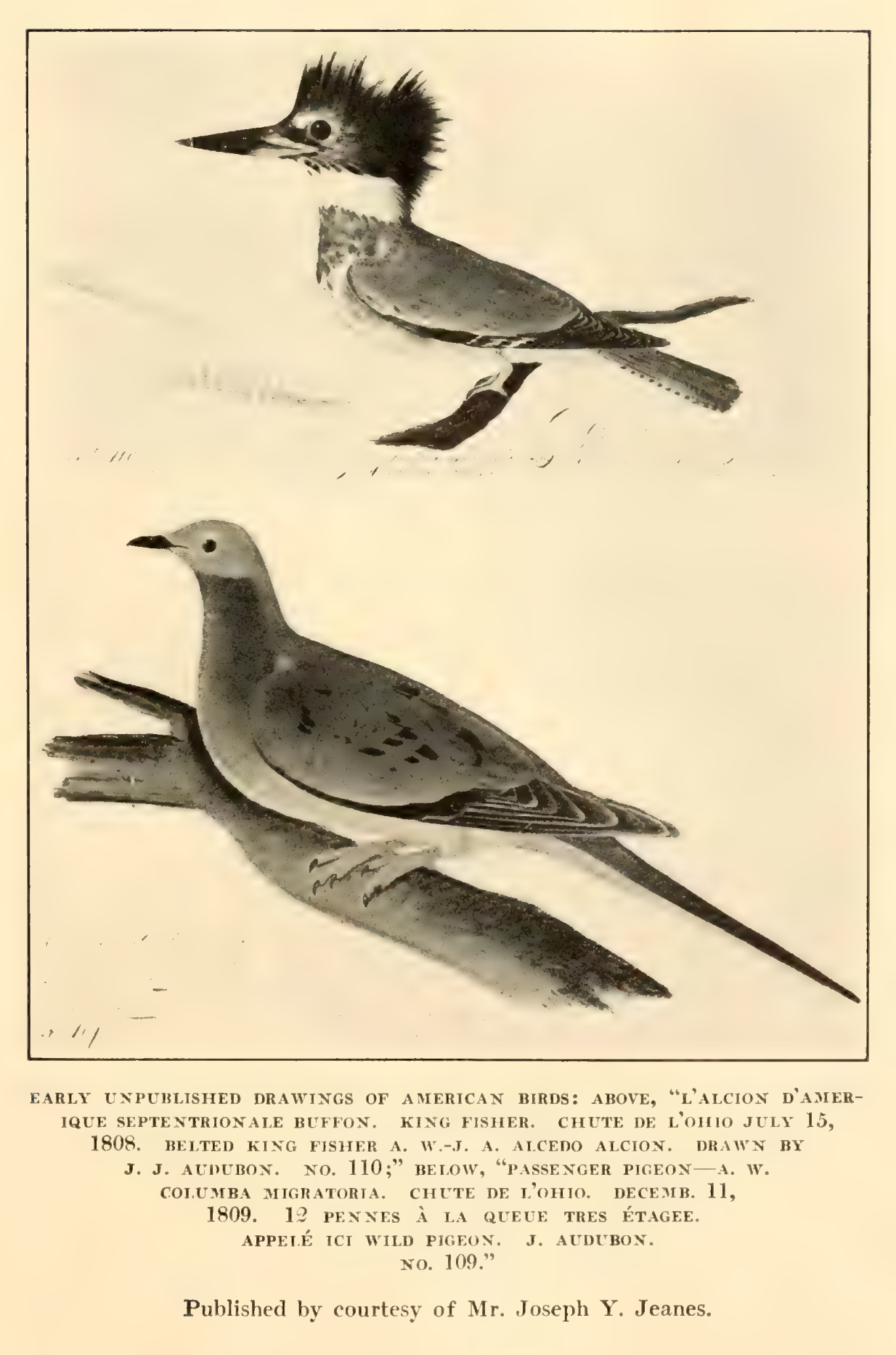
EARLY UNPUBLISHED DRAWINGS OF AMERICAN BIRDS: ABOVE, “L’ALCION D’AMERIQUE
SEPTENTRIONALE BUFFON. KING FISHER. CHUTE DE L’OHIO JULY 15,
1808. BELTED KING FISHER A. W.-J. A. ALCEDO ALCION. DRAWN BY
J. J. AUDUBON. NO. 110;” BELOW, “PASSENGER PIGEON — A. W.
COLUMBA MIGRATORIA. CHUTE DE L’OHIO. DECEMB. 11,
1809. 12 PENNES À LA QUEUE TRES ÉTAGEE.
APPELÉ ICI WILD PIGEON. J. AUDUBON.
NO. 109.”
Published by courtesy of Mr. Joseph Y. Jeanes.
293
As a specimen of these spurious fish stories, which
were previously published in both America and Europe,
we reproduce a part of Rafinesque’s description of the
“91st. Species. Devil-Jack Diamond-fish. Litholepis
adamantinus”:
This may be reckoned the wonder of the Ohio. It is only
found as far up as the falls, and probably lives also in the
Mississippi. I have seen it, but only at a distance, and have
been shown some of its singular scales. Wonderful stories are
related concerning this fish, but I have principally relied upon
the description and figure given me by Mr. Audubon. Its
length is from 4 to 10 feet. One was caught which weighed
four hundred pounds. It lies sometimes asleep or motionless
on the surface of the water, and may be mistaken for a log
or a snag. It is impossible to take it in any other way than
with the seine or a very strong hook, the prongs of the gig
cannot pierce the scales which are as hard as flint, and even
proof against lead balls! Its flesh is not good to eat. It is a
voracious fish: Its vulgar names are Diamond fish, (owing to its
scales being cut like diamonds) Devil fish, Jack fish, Garjack,
&c…. The whole body covered with large stone scales laying
in oblique rows, they are conical, pentagonal, and pentædral
with equal sides, from half an inch to one inch in diameter,
brown at first, but becoming of the colour of turtle shell when
dry: they strike fire with steel! and are ball proof!
While we cannot defend Audubon in his treatment
of Rafinesque, it would be hardly fair to judge such
incidents wholly in the light of after events, for, as our
narrative will show, it is unlikely that he ever saw
Rafinesque or heard of him again until long years after
this incident, certainly not until after his “Episode”
was published in 1831.270 Rafinesque evidently enjoyed
294
this sketch of himself, for he gave unstinted praise to the
work in which it was published. As late as 1832, when
the appearance of The Birds of America seems to have
stimulated him to even more grandiose conceptions of
his own merits than was usual, he declared that his discoveries
were counted by the thousand, and that he had
traveled twenty thousand miles, always collecting and
drawing. In view of the fact that drawing was a talent
which nature had unequivocally denied him, it is interesting
to read this boast that an unfriendly critic drew
forth: “My illustrations of 30 years’ travels, with 2,000
figures will soon begin to be published, and be superior
to those of my friend Audubon, in extent and variety,
if not equal in beauty. I shall study and write as long
as I live, in spite of all such mean attempts against my
reputation and exertions, trusting in the justice of liberal
men.”271
After leaving Audubon at Henderson in the summer
of 1818, Rafinesque passed down the Ohio into the
Mississippi, pausing only to pay his respects at the
famous communistic settlement of New Harmony, by
the mouth of the Wabash in Indiana, then the abode
of Thomas Say, David Dale Owen, and Charles Le
Sueur, all of whom have left bright and honored names
in the annals of American science. He eventually returned
to Philadelphia by way of Lexington, Kentucky,
where he was induced to settle and teach natural history
and the modern languages in the Transylvania
University, at that time the most important seat of
learning in the West. After closing up his business
295
affairs in Philadelphia, Rafinesque entered upon his
new labors at Lexington in the autumn of 1819. He
was probably the first teacher of these subjects west
of the Alleghanies, and certainly the first in that section
of the country to use the present object method in the
elucidation of natural history. The lot of a pioneer in
education has never been a sinecure, and the post which
Rafinesque then filled was not a “chair” but a hard
“settee.” In those days the classics were in the saddle
and “rode mankind,” while the natural sciences, when
tolerated at all, were given short shrift; yet this eccentric
foreigner held his position for seven years and accomplished
an extraordinary amount of work. As
usual he spread his energies over the whole field of
knowledge, lecturing, writing and publishing on almost
every subject, but concentrating upon none. Meanwhile,
he roamed far and wide and made extensive collections.
While at the Transylvania University Rafinesque
seems to have applied for the master of arts’ degree, but
was at first refused, as he said, “because I had not studied
Greek in a college, although I knew more languages
than all of the American colleges united, but it was
granted at last; but the Doctor of medicine was not
granted, because I would not superintend anatomical
dissections.”
One of his many projects, as meritorious as it was impractical,
at that time, was a Botanic Garden with a
Library and Museum for Lexington, which was then
but a small village; though land was actually secured
and a start in tree planting begun, the project of course
came to nothing and had to be abandoned. Rafinesque
also invented, as he believed, the present coupon system
of issuing bonds, the “Divitial Invention,” as he called
296
it; in 1825 he set out for Washington in order to secure
his patent rights, but his journey and idea never brought
him any returns. On the contrary, the incident marked
the culmination of his troubles with the president of the
University and its governing board, whom he seems to
have constantly nettled by his independent ways and
roaming habits. Upon returning from Washington he
found that Dr. Holley, who, he said, “hated and despised
the natural sciences” and wished to drive him out
altogether, had broken into his rooms during his absence,
and had “given one to the students, and thrown
all my effects, books and collections in a heap in the
other,” besides depriving him of certain other privileges.
“I took lodgings,” he continued, “in town and
carried there all my effects; thus leaving the college with
curses on it and Holley; who were both reached by them
soon after, since he died next year at sea of the yellow
fever, caught at New Orleans; having been driven from
Lexington by public opinion; and the College has been
burnt in 1828 with all its contents.”
After this unpleasant experience Rafinesque returned
to Philadelphia, where he spent the last and
saddest part of his checkered career. His insistent
ideas, which were undoubtedly the index of an unbalanced
mind, increased, especially his mania for describing
“new species” of animals and plants; this mania
perverted everything that he wrote, especially toward
the end of his life, and made him a thorn in the side of
every naturalist who tried to verify his work. A non-conformist
and a respecter of no authority but his own
is never popular, though a part of the antagonism which
Rafinesque aroused was due to the conservatism of his
age. He boldly advocated organic evolution when almost
the whole world believed that species were fixed
297
and unchangeable things, and in many other respects
was fifty years ahead of his time; but nothing was ever
carefully worked out in his fertile mind, with the consequence
that the world paid no heed to his crude and
undigested ideas.
The great mass of Rafinesque’s books and monographs,
his “tracts,” broadsides, and ephemeral papers
of all sorts, extending to nearly a thousand titles, must
have gone into paper rags, when not used to kindle
fires, for he was generous in their distribution, and they
are now exceedingly rare. He touched nearly everything,
it is true, but little that he touched, especially
in this later period of his life, did he ever truly ornament.
His best pioneer work, in the opinion of competent
students, was that done upon the fishes of Sicily
and the natural history of the Ohio Valley; his Medical
Flora, in two volumes (1828 and 1830), is also admitted
to have possessed real value; but his writings are now
sought after as literary or scientific curiosities, and as
such they are unique.
No doubt Rafinesque was often treated unjustly,
either through ignorance or intent, while many naturalists
were exasperated by the barbed arrows which he
shot into the air or direct at the mark. Others through
sheer inability to follow him gave up the attempt, one
writer272 saying that such an attitude was justified when
it appeared that he had made six species out of one,
not to speak of several different genera and two sub-families.
If anyone still believes that Rafinesque has
been misjudged, says Günther,273 let him read his letters
to Swainson, from 1809 to 1840, fifty-three in number,
298
covering 178 closely written quarto or folio pages, now
in possession of the Linnæan Society of London.
“Rafinesque,” continues this critic, “was a man deeply
to be commiserated, not merely on account of the unfortunate
circumstances which left him in his youth to
himself, without teacher or guide, but still more on the
ground of that natural disposition by which his universal
failure in life was brought about. He was possessed
of a feverish restlessness which entirely disqualified
him from serious study of any of the multitudinous
subjects which attracted his mind in rapid succession.”
Rafinesque, bereft of friends and fortune, unknown
even to his neighbors, by whom he seems to have been
regarded as a harmless herb doctor, was left to struggle
on alone, without recognition and without sympathy or
support. Reduced finally to abject poverty, he concocted
and sold medicines which were advertised much
like quack remedies at the present day, especially his
“Pulmel,” which without a doubt he thought had cured
him of the pulmonary consumption. To advertise this
he wrote a little treatise, hoping to realize something
from its sale and at the same time to avoid any undue
appearance of empyricism.
Toward the very end of his life, Rafinesque projected
a savings bank, and, strangely enough, this seems
to have been a success, though just how is not clear,
since it both borrowed and loaned money at six per
cent. He had already attempted to secure rights on a
“steam-plough,” a “submarine boat,” “incombustible
houses,” and similar novelties which abler inventors have
later perfected. For a long time he led the life of a
perfect recluse in a garret in a poor quarter of Philadelphia,
in the midst of his collections, his books and
his manuscripts, never the world forgetting but ever by
299
the world forgot. There, in the direst misery, he died
in 1840, at the age of fifty-six, without a word of cheer
or a tear of regret. His body was barely saved from
the dissecting table and given decent burial through the
loyalty and promptitude of one of his few remaining
friends, Dr. William Mease, who with undertaker
Bringhurst, broke into the room where his body lay and
let it down through a window by ropes.274 Even his will
was ruthlessly violated, and all of his effects, in eight
dray-loads, were hurried off to the public auction rooms
and sold in bargain lots, his books and all else bringing
but a mere pittance, not even enough to pay his landlord
and the administrator of his estate.
Thus died the “eccentric naturalist” whom Audubon
had portrayed, and for whom the world in general had
shown scant sympathy. Rafinesque, nevertheless, possessed
a mind of extraordinary acumen and an energy
and versatility little short of marvelous. He dipped
into every field of knowledge, looking for precious
metal, but much that he brought to the surface was
dross. His restless versatility alone would probably
have ruined him, for nothing short of an analysis of
the globe with all of its contents would have satisfied
his ambitious spirit. His was the ardor of the traveler
and the explorer, with a passionate love for nature seldom
equaled, but without the incentive and the patience
of the investigator or a balance-wheel in the judgment.
His ambition in early life was to become the greatest
naturalist of his age; had his early training and environment
300
been suited to his needs, and had fortune favored
him more consistently with her smiles, this ambition
possibly might have been realized, but we suspect that
in this case nature would have proved stronger than
nurture, and that he would have been Rafinesque to
the end.
301
CHAPTER XX
AUDUBON’S ÆNEID, 1819-1824: WANDERINGS THROUGH
THE WEST AND SOUTH
Pivotal period in Audubon’s career — His spur and balance-wheel — Resort
to portraiture — Taxidermist in the Western Museum — Settles in Cincinnati — History
of his relations with Dr. Drake — Decides to make his
avocation his business — Journey down the Ohio and Mississippi with
Mason and Cummings — Experiences of travel without a cent of capital — Life
in New Orleans — Vanderlyn’s recommendations — Original drawings — Chance
meeting with Mrs. Pirrie, and engagement as tutor at
“Oakley” — Enchantments of West Feliciana — “My lovely Miss Pirrie” — The
jealous doctor — Famous drawing of the rattlesnake — Leaves St.
Francisville and is adrift again in New Orleans — Obtains pupils in
drawing and is joined by his family — Impoverished, moves to Natchez,
and Mrs. Audubon becomes a governess — Injuries to his drawings — The
labors of years destroyed by rats — Teaching in Tennessee — Parting
with Mason — First lessons in oils — Mrs. Audubon’s school at “Beechwoods” — Painting
tour fails — Stricken at Natchez — At the Percys’
plantation — Walk to Louisville — Settles at Shippingport.
Audubon’s failure at Henderson was the crucial
turning point in his career. For the five years that
immediately followed he led a peripatetic existence in
the southern and western states, seldom tarrying long
at one point, often leaving his family for months at a
time, living from hand to mouth, but ever bent on perfecting
those products of his hand and brain, his life
studies of American birds and plants.
At this crisis Audubon could have accomplished
nothing but for the intelligent devotion of his capable
wife. Generous, emotional, inclined to be self-indulgent,
Audubon needed both the example and the spur
of a strong character such as his wife possessed, and at
this time Lucy Audubon furnished both the motive
302
power and the balance-wheel that were requisite for the
development of her husband’s genius. Without her
zeal and self-sacrificing devotion the world would never
have heard of Audubon. His budding talents eventually
would have been smothered in some backwoods
town of the Middle West or South. For the space of
nearly twelve years, Mrs. Audubon, now as the head
of a small private school, now as a governess in some
friendly family who appreciated her worth, practically
assumed the responsibility for the support and education
of their children in order that her husband’s hands
might be free, and with her hard-earned savings was
able to aid him materially in the prosecution of his
labors. When relatives or friends upbraided him for
not entering upon some form of lucrative trade, she
recognized his genius and always came to his support,
being fully persuaded that he was destined to become
one of the great workers of the world. Whatever others
may have said or done at that time, both Audubon
and his wife were confident of the ultimate success of
his mission. In short, the work in which the naturalist
was engaged became a family interest, in which every
member was destined sooner or later to bear a part.
Audubon recalled a somber incident of this time
which he thought might furnish a lesson to mankind,
and he shall relate it in his own words:
After our dismal removal from Henderson to Louisville,
one morning when all of us were sadly desponding, I took you
both, Victor and John, from Shippingport to Louisville. I had
purchased a loaf of bread and some apples; before you reached
Louisville you were hungry, and by the river side we sat down
and ate our scanty meal. On that day the world was with me
as a blank, and my heart was sorely heavy, for scarcely had I
enough to keep my dear ones alive; and yet through those dark
303
days I was being led to the development of the talents I loved,
and which have brought so much enjoyment to us all….
At Shippingport Audubon was welcomed by his
brother-in-law, Nicholas A. Berthoud. Wasting no
time in vain regrets, he began doing portraits in crayon,
and with such success that he was able to rent a modest
apartment and have his family about him again. From
no charges for his tentative efforts the price was gradually
raised until he received five dollars or more a
head; with the spread of his fame orders filled his hands,
and he was called long distances to take likenesses of
the dying or even of the dead. Audubon’s facility in
portraiture was a valuable resource, and it kept him
from the starving line at many a pinch in later years.
Through the influence of friends the naturalist was
offered a position as taxidermist at a museum which had
just been started at Cincinnati; here his family joined
him in the winter of 1819-20, and here he remained for
nearly a year. The published accounts of this Cincinnati
experience are strangely confused and have led to
aspersions of bad faith which were, we believe, quite
undeserved. “I was presented,” said Audubon, “to the
president of the Cincinnati College, Dr. Drake, and
immediately formed an engagement to stuff birds for
the museum there, in concert with Mr. Robert Best, an
Englishman of great talent,” adding that his salary was
large; so industrious were they, to continue his account,
“that in about six months we had augmented, arranged,
and finished all that we could do,” but they found to
their sorrow “that the members of the College museum
were splendid promisers and very bad paymasters.”275
304
It has been stated that Audubon got nothing from Dr.
Drake, but that “Mrs. Audubon afterwards received
four hundred dollars, of the twelve hundred due,” and
that the remainder was never paid.276 This matter can
now be fully cleared up, and it will appear that the
Cincinnati College was in no way involved; Dr. Drake
was not its president, although he drew its charter and
was one of its trustees; the Museum in which the naturalist
worked was an independent foundation; and
Mrs. Audubon was probably paid in full for the service
which her husband had rendered.
Audubon wrote in his journal in 1820, when this
experience was fresh in his mind, that owing to his
talent for stuffing fishes he entered the service of the
Western Museum at a salary of $125 a month; he made
no complaint at that time of any lack of pay. Moreover,
on the day before he started on his cruise down
the Ohio River on the 11th of October of that year,
the Rev. Elijah Slack gave him a letter of introduction
in which he said that Audubon had “been engaged in
our museum for 3 to 4 months, and that his performances
do honor to his pencil.” Since Mr. Slack, like
Dr. Drake, was one of the managers of the Western
Museum, he must have known of Audubon’s term of
service. We are convinced that Dr. Daniel Drake,277
305
whose character was above reproach and who was a
keen naturalist himself, was Audubon’s good friend,
and that no misunderstanding ever rose between them.
In writing offhand from memory, years after the events,
Audubon misstated the facts but evidently without
design.
In 1818 Dr. Drake organized the Western Museum
Society, of which he said: “I have drawn up the constitution
in such a manner as to make the institution a
complete school for natural history, and hope to see
concentrated in this place, the choicest natural and artificial
curiosities in the Western Country.” The first
meeting of the Society was held in the summer of 1819,
not long before Audubon was engaged to work for it.
The membership fee was $50, a considerable sum for
that period, but the enterprise was well patronized. It
was in charge of a board of whom Dr. Drake was the
moving spirit; another member, as we have seen, was
Rev. Mr. Slack, who became the first president of the
Cincinnati College, which was organized in 1818-19.
The collections of the Museum were placed in one of
the buildings of the College in order better to serve the
students and public, which would account for some of
the confusion noted above.
Dr. Drake’s hands at this time were more than full;
in October, 1819, he wrote to a friend: “The ties which
bind me to the world at large seem every day to increase
in strength and numbers. The crowd of mankind with
306
whom I have some direct or indirect concern, thickens
around me, and I see little prospect of more leisure,
nor any of retirement and seclusion.“ At this juncture
also, when Audubon and Best were working for his
Museum, Dr. Drake was experiencing the first disastrous
check in his energetic career. In January, 1820,
in spite of the opposition and intrigue of professional
rivals, he succeeded in organizing the Medical College
of Ohio, and Robert Best became the assistant in chemistry
and the curator of the Western Museum. Opposition
did not abate, but instead of strangling the College
which he had founded, the marplots succeeded in expelling
the Doctor from its staff. At last, feeling
obliged to leave the city, Dr. Drake accepted in 1823
a position in the rival medical school of Transylvania
University, and thus became a colleague of Constantine
Rafinesque. It will be seen that Audubon’s engagement
at Cincinnati fell in a troubled era, and the annoyance
which he may have felt at lack of pay was probably
no fault of the harassed doctor.
While at Cincinnati Audubon was obliged to resort
to his crayon portraits; and he also started a drawing
school, but it required all of Mrs. Audubon’s skill in
management to keep the family out of debt. In 1820
he began for the first time seriously to consider the possibility
of publishing his drawings, and under the spur
of this incentive began to exert himself as never before.
He planned a long journey through the Middle West
and South, his intention being to descend the Ohio and
Mississippi Rivers, explore the country about New Orleans,
and then proceed as far east as the Florida Keys;
he wished also to ascend the Red River, cross Arkansas,
and visit the Hot Springs, before returning again by
river to Cincinnati. Lack of ready money was no drawback,
307
for he was now confident of being able to live
by his talents alone.
Accordingly, he left his wife to care for their two
boys, and on October 12, 1820, started down river in a
flatboat, bound for New Orleans. His companions on
this journey were Captain Cummings,278 an engineer who
had been in the government service, to whom Audubon
became much attached; Joseph R. Mason, a promising
artist of eighteen, in the rôle of pupil-assistant, and his
dog “Dash.” Although Audubon had no funds, he was
careful to provide himself with letters to or from men
of mark who could be of assistance to him and this custom
was followed to good effect at a much later day.
On this occasion he bore recommendations from
William H. Harrison, who afterwards became President,
to Governor Miller of Arkansas, and from Henry
Clay, as well as his letter from Rev. Elijah Slack, in
which it was stated that the naturalist was traveling to
complete his collection of the birds of the United States
which he intended to publish at some future time.
Audubon also wrote a personal letter to Governor
Miller, fully outlining his plans, and asking for information;
he told the Governor that he had been working
fifteen years, and that his drawings of birds and plants
were all from nature and life-size, showing that the idea
of publication which was afterwards realized was then
fixed in his mind. Audubon kept a careful journal on
this journey, which extended over a year, the last entry
being for the close of 1821.279
308
As their flatboat stopped at many towns and plantations
on the rivers, Audubon could hunt game and birds
to his heart’s content. Having resolved, as he said,
never to draw from a stuffed specimen, he worked at
every new bird with the greatest diligence. It seems
almost incredible that he should never have met with
the Hermit Thrush before this journey, yet under date
of “Oct. 14, 1820,” there is this entry: “We returned
to our boat with a Wild Turkey, a Telltale Godwit and
a Hermit Thrush, which was too much torn to make a
drawing of it; this was the first time I had met with this
bird, and I felt particularly mortified at its condition.”280
Their visit to Natchez furnished Audubon with materials
for at least two of his “Episodes.”281 This incident
of his generosity may be taken as characteristic;
finding that one of his companions was down at the
heel and as short of ready money as himself, he sought
out a shoemaker and offered to do a portrait of the
man and his wife for two pairs of boots; the proposal
was accepted forthwith, and he set to work; the sketches
were finished in the course of two hours, and Audubon
309
and his companion, having selected their boots, went on
their way rejoicing.
Audubon left Natchez on December 31, 1820, on a
keel boat belonging to his brother-in-law, Nicholas A.
Berthoud, who accompanied him, and at one o’clock the
steamer Columbus hauled off from the landing and
took them in tow. Towards evening, when they were
looking up their personal belongings, the naturalist
found to his dismay that a portfolio containing all of
the drawings that he had made on the voyage down the
river was missing. Letters were despatched to Natchez
friends, but it was not until the 16th of March that his
anxiety was relieved; the missing portfolio had been
found and left at the office of The Mississippi Republican,
whence it was forwarded on his order, and reached
his hand on the 5th of April. “So very generous had
been the finder of it,” he said, “that when I carefully
examined the drawings in succession, I found them all
present and uninjured, save one, which had probably
been kept by way of commission.”
On New Year’s Day, 1821, they came to at Bayou
Sara, at the mouth of the inlet of that name, which
later saw much of Audubon and his family. On the
following day he made a likeness of the master of their
craft, Mr. Dickenson, for which he was paid in gold;
he also outlined two warblers by candle-light in order
to have time to finish them on the morrow. The captain
of their steamer in his anxiety to make haste had set
them adrift at this point, and they were obliged to make
their way as best they could, by aid of the current and
oars, to the port of New Orleans, which was finally
entered on Sunday, January 7, 1821.
Audubon landed at New Orleans without enough
money to pay for a night’s lodging, for someone had
310
relieved him of the little he possessed, and he was obliged
to pass several nights on the boat while looking for work.
Undismayed by his financial straits, his first visit at daybreak
on Monday was to the famous markets of the
southern city, where he found dead birds exposed for
sale in great numbers — mallard, teal, American widgeon,
Canada and snow geese, mergansers, tell-tale god-wits,
and even robins, bluebirds and red-wing blackbirds;
he added that the prices were very dear.
Upon leaving Cincinnati Audubon had resolved
upon making one hundred drawings of birds; this was
actually accomplished, but only after repeatedly modifying
his plans and working in more humble capacities
than he was at first inclined to consider. On the 12th
of January he wrote in his diary of meeting an Italian
painter at the theater, and of showing him his drawing
of the White-headed Eagle282 at the rooms of Mr. Berthoud;
“he was much pleased,” and took him “to his
painting apartment at the theater, then to the directors,
who very roughly offered me one hundred dollars per
month to paint with Monsieur l’Italien. I believe really
now that my talents must be poor,” said Audubon. His
refusal of this offer in view of his straitened circumstances,
and the entry which followed, were characteristic:
“Jan. 13th, 1821. I rose up early, tormented by
many disagreeable thoughts, again nearly without a
cent, in a bustling city where no one cares a fig for a
man in my situation.” The following day Audubon
applied to a self-taught portrait painter, John W.
311
Jarvis, and after showing his drawings, was engaged
to assist him in finishing the “clothing and ground”; but
this artist’s manners were declared to be so uncouth
and the pay so poor that he left him in disgust.
When he had made a hit, as he said, with the likeness
of a well known citizen, orders came to him, and
he was able to resume his drawing of birds. On February
22 he recorded that he had spent his time in
“running after orders for portraits, and also in vain
endeavors to obtain a sight of Alexander Wilson’s
‘Ornithology,’ but was unsuccessful in seeing the book,
which is very high priced.” Later, however, he appears
to have succeeded in this quest, for on the 17th of that
month he was able to send his wife twenty drawings of
birds, eight of which were marked as “not described by
Willson.” Among them were the originals of some of
the most famous of his plates, such as the Great-footed
Hawk, the White-headed Eagle, and the Hen Turkey.283
Having seen in a newspaper a notice of an expedition
which the Government was about to send to the
312
Pacific Coast, to survey the boundary of the territory
that had been recently ceded by Spain, Audubon became
much excited over a possible appointment as
draughtsman and naturalist. He sat down at once and
wrote a personal letter to President Monroe, while hundreds
of imaginary birds of new and interesting kinds
seemed to come within the range of his gun; on the 31st
of March he was still pondering on the project, and although
it is not likely that his letter ever reached the eye
of the President, he did receive a recommendation from
Governor Robertson of Louisiana. It was with this
expedition in view that he sought an interview with John
Vanderlyn,284 an eminent painter of historical subjects,
then working in New Orleans; according to one version
Vanderlyn treated him as a mendicant, and ordered
him to lay down his portfolio in the lobby, but ended
by giving him a very complimentary note, in which he
praised his drawings without stint, particularly his
studies of birds.
During the five months spent at New Orleans in
1821, Audubon attempted to support himself and his
companion by means of their artistic talents, while he
was pushing forward his ambitious design of figuring all
of America’s birds and most characteristic plants. That
he received scant encouragement but many rebuffs is
not surprising. They did succeed in obtaining a few
pupils in drawing, and Audubon made a number of
rapid portraits, but after living for a time on Ursuline
Street, near the old Convent, and later shifting from
313
one quarter to another, their finances had reached so
low an ebb by the beginning of June that a move was
imperative. Audubon then decided to go to Shippingport,
Kentucky, and on the 16th of June, with young
Mason, he again boarded the steamer Columbus, John
D’Hart, captain, and started up river. An incident
now occurred which affected the naturalist’s whole after
life by introducing him to one of the most favored spots
in Louisiana, if not in the whole country, for the study
of bird life, not to speak of the impressions which the
charm of new scenery, a rich flora, and natural products
of the most varied description must have then made
on his mind. Mrs. James Pirrie, wife of a prosperous
cotton planter of West Feliciana Parish, happened to
be their fellow-passenger. Doubtless her curiosity was
piqued by the winning manners and flowing locks of
the artistic traveler, whose Gallic accent at once betrayed
his nationality. Whether Audubon had made
her acquaintance previous to this journey or not is not
known, but before it was ended his fine enthusiasm and
ambitious plans had found a sympathizer, and he was
engaged as tutor to Mrs. Pirrie’s daughter at $60 a
month. To further his ornithological pursuits it was
understood that he and his companion should live at
“Oakley,” her husband’s plantation, five miles from St.
Francisville, on Bayou Sara, and that one-half of his
time should be absolutely free for hunting and drawing.
Thus, on June 18, 1821, was forged the link that
bound the heart of Audubon to the State which was
first in his affections, and which he would fain believe
might have been the scene of his nativity. Well may
the Louisianians of today adopt him as their son, for
from that early time he cherished their State as in a peculiar
sense his own.
314
It was a hot and sultry day when our wanderers
landed at Bayou Sara,285 a small settlement at the junction
of the sluggish stream which bears that name and
the Mississippi, and proceeded to climb to St. Francisville,
the village a mile away on the hill. Mrs. Pirrie,
who seems to have preceded the travelers by carriage,
sent some of her servants to relieve them of their luggage,
which Audubon said they found light. They
rested in the village at the house of Mr. Benjamin
Swift, where they were invited to stay to dinner, then
at the point of being served, but feeling somewhat ill
at ease, they thanked their host and again took to the
road. Following their leisurely guides, they now
traversed a country so new, so strange, and so enchanting,
that the five miles to the Pirrie house seemed short
indeed. “The rich magnolias, covered with fragrant
blossoms, the holly, the beech, the tall yellow poplar, the
hilly ground, and even the red clay,” to quote Audubon’s
record made at the time, “all excited my admiration.
Such an entire change in the face of nature, in
so short a time, seems almost supernatural, and surrounded
once more by numerous warblers and thrushes,
I enjoyed the scene.”
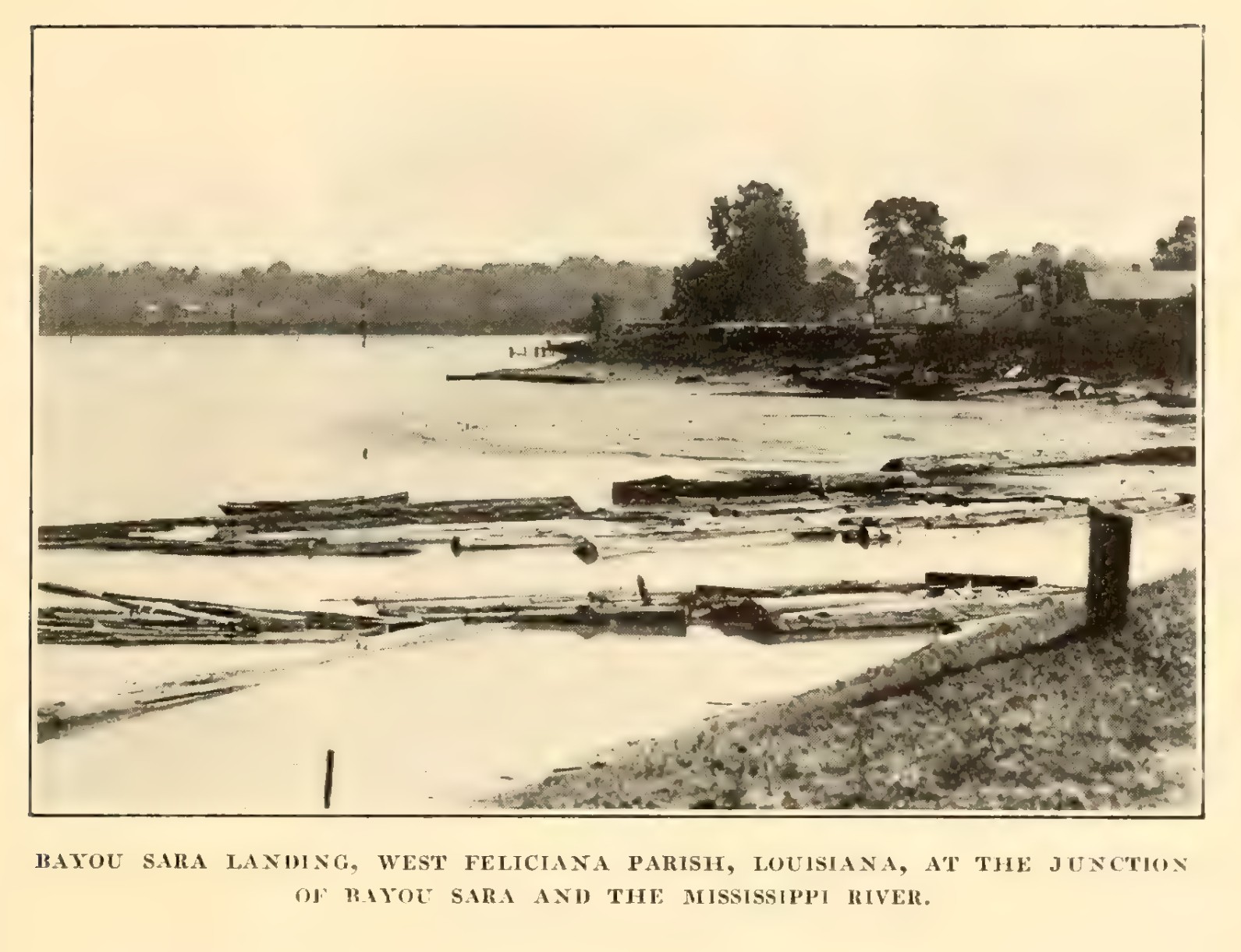
BAYOU SARA LANDING, WEST FELICIANA PARISH, LOUISIANA, AT THE JUNCTION
OF BAYOU SARA AND THE MISSISSIPPI RIVER.
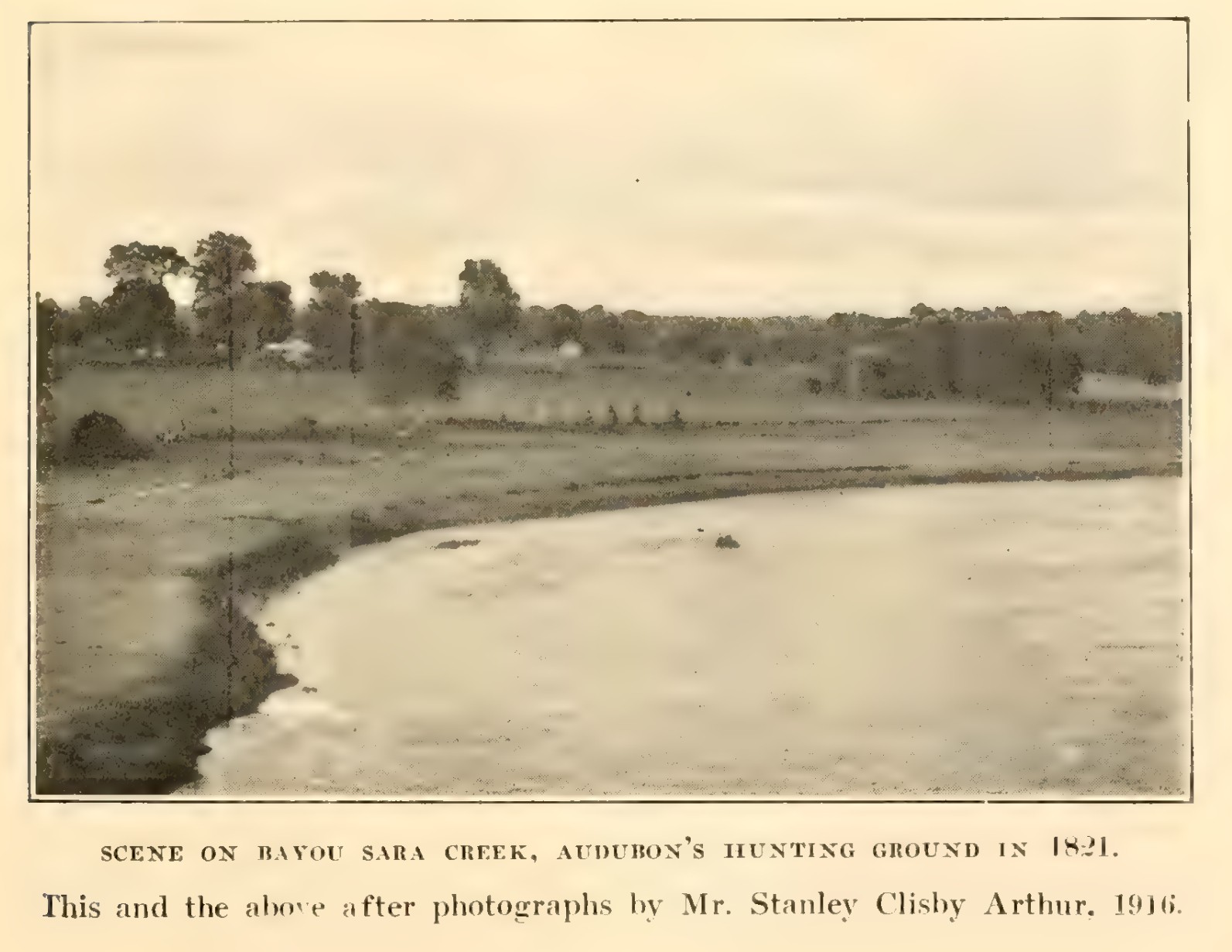
SCENE ON BAYOU SARA CREEK, AUDUBON’S HUNTING GROUND IN 1821.
This and the above after photographs by Mr. Stanley Clisby Arthur, 1916.
In passing up the Mississippi from New Orleans,
the topography of the country suddenly changes at
315
about this point; in the parish of West Feliciana the
alluvial lowlands of the river valley give place to beautiful
highlands, which still harbor as rich and distinctive
a flora and fauna as in Audubon’s day. Following
Audubon’s course in June, 1916, or ninety-five years
later, Mr. Arthur found the region about St. Francisville
wonderfully rich in birds, and there noted seventy-eight
resident kinds which were seen on the same day,
from shortly before noon to seven o’clock in the evening.
Upon reaching the plantation house, Audubon and
his companion were kindly received by the Scotchman,
James Pirrie, who introduced to them his daughter,
Eliza, then a beautiful and talented girl of seventeen — “my
lovely Miss Pirrie, of Oakley,” as Audubon once
characterized her in his journal — who was to become his
pupil in drawing, and who, as after events proved, was
destined to a romantic and checkered career.
The “Oakley” house, which by a strange turn of
fortune’s wheel thus became the naturalist’s home in the
summer of 1821, has changed but little since that time,
but the century that has nearly sped its course has added
strength and beauty to the moss-hung oaks which now
encompass it and temper the heat of the southern sun
in the double-decked galleries which adorn its whole
front. Built of the enduring cypress, as my correspondent
remarks, the house stands as firm and sound as the
gaunt but living sentinels of that order which tower
from the brake not far away.
Audubon spent nearly five months at the Pirrie
estate. He worked with great ardor at his Ornithology
and produced the originals of many of his plates that
were afterwards published, while his assistant, Joseph
Mason, who had followed him from Cincinnati, labored
with equal diligence at the plants that were chosen as a
316
setting for the birds.286 An early drawing of the Chuck
Will’s Widow is dated “Red River, June, 1821,” and it
is probable that he followed this stream into Arkansas,
for on leaving Cincinnati in the autumn of the previous
year, he had planned to enter that State, and later references
in his journals clearly imply that this object
was attained. Another favorite hunting ground was
Thompson’s Creek, and he often recalled its heated
banks, where, on a Fourth of July, he once satisfied his
hunger by “swallowing the roasted eggs of a large soft
shelled turtle.”
On August 11, 1821, while Audubon was living at
“Oakley,” he made this entry in his journal:
Watched all night by the dead body of a friend of Mrs.
P——; he was not known to me, and he had literally drunk
himself to an everlasting sleep. Peace to his soul! I made a
good sketch of his head, as a present for his poor wife. On
such occasions time flies very slow indeed, so much so that it
looked as if it stood still, like the hawk that poises over its
prey.
In the same journal also, for August 25, occurs a
record which throws light on one of Audubon’s most
discussed and questionable pictures, that of the mocking-birds
defending their jessamine-embowered nest
from the sinister designs of a rattlesnake;287 little did he
317
think at the time how much discord this venomous reptile,
when coiled in the branches of a tree, could later
breed.288 The entry was:
Finished drawing a very fine specimen of a rattlesnake,
which measured five feet and seven inches, weighed six and a
quarter pounds, and had ten rattles. Anxious to give it a
position most interesting to a naturalist, I put it in that which
the reptile commonly takes when on the point of striking madly
with its fangs. I had examined many before, and especially
the position of the fangs along the superior jaw-bones, but
had never seen one showing the whole of the fangs exposed at
the same time.
He then described the generous provision which nature
has made to keep the rattlesnake in fighting trim, by
giving it a dental arsenal on which it can draw in case
of loss; he added that the heat of the day was such that
he could devote only sixteen hours to the drawing.
At this time Audubon was a handsome and attractive
man; his pupil, who did not enjoy the best of health,
was attended by a young physician who was also her
lover. It is not surprising therefore to learn that jealousy
on the part of the doctor led to a misunderstanding,
and that the naturalist suddenly made his departure and
returned to New Orleans. In recording this incident
Audubon could not repress his amusement at the prescription
of the physician, who ordered the young lady
to abstain from all writing and drawing for a period of
four months, but meanwhile permitted her to eat anything
which pleased her fancy, in spite of the relapses
of fever that occasionally occurred. Audubon was allowed
to see her only at appointed hours, as if, he said,
he were an extraordinary ambassador to some distant
318
court, and was obliged to preserve the utmost decorum
of manner; he expressed the belief that he had not once
laughed in the presence of the young lady during the
entire term of his tutorial engagement, which lasted
from the 18th of June to the 21st of October. Later,
in December of the same year, when his former pupil
passed him without recognition in the streets of New
Orleans, he indulged in the reflection that she had apparently
quite forgotten the great pains with which at
her own request he had done her portrait in pastels,
but, thanks to his talents, he thought that he could run
the gauntlet of the world without her help.289
At New Orleans Audubon soon found new pupils,
particularly through the aid of Mr. R. Pamar and Mr.
William Braud,290 who came to his assistance, Mrs.
Braud and her son paying him at the rate of three dollars
for a lesson of one hour. On November 10, 1821,
he wrote:
Continued my close application to my ornithology, writing
every day, from morning until night, omitting no observations,
correcting, re-arranging from my notes and measurements, and
posting up; particularly all my land birds. The great many
errors I found in the work of Wilson astonished me. I try to
speak of them with care, and as seldom as possible, knowing
the good will of that man, and the vast many hearsay accounts
he depended on.
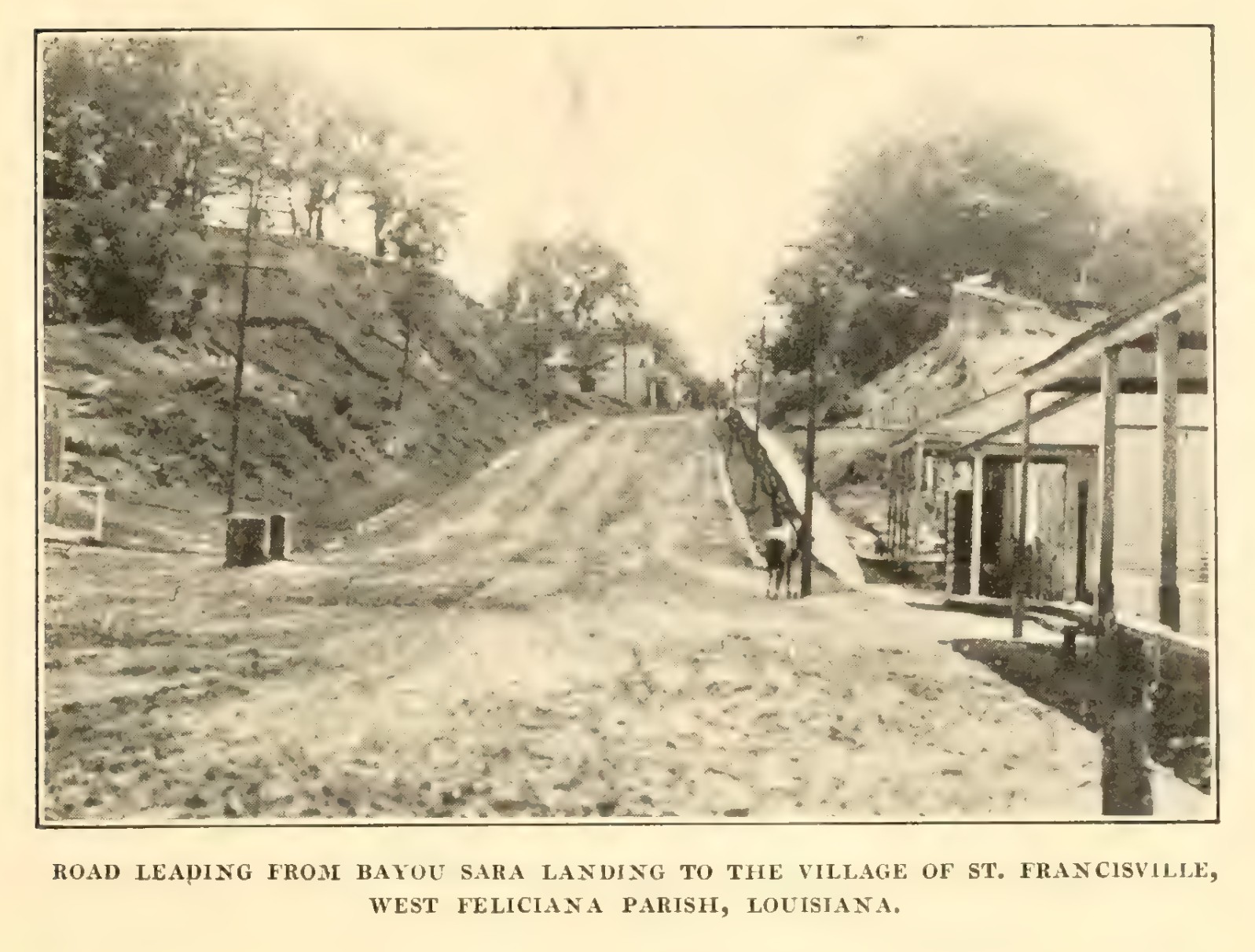
ROAD LEADING FROM BAYOU SARA LANDING TO THE VILLAGE OF ST. FRANCISVILLE,
WEST FELICIANA PARISH, LOUISIANA.
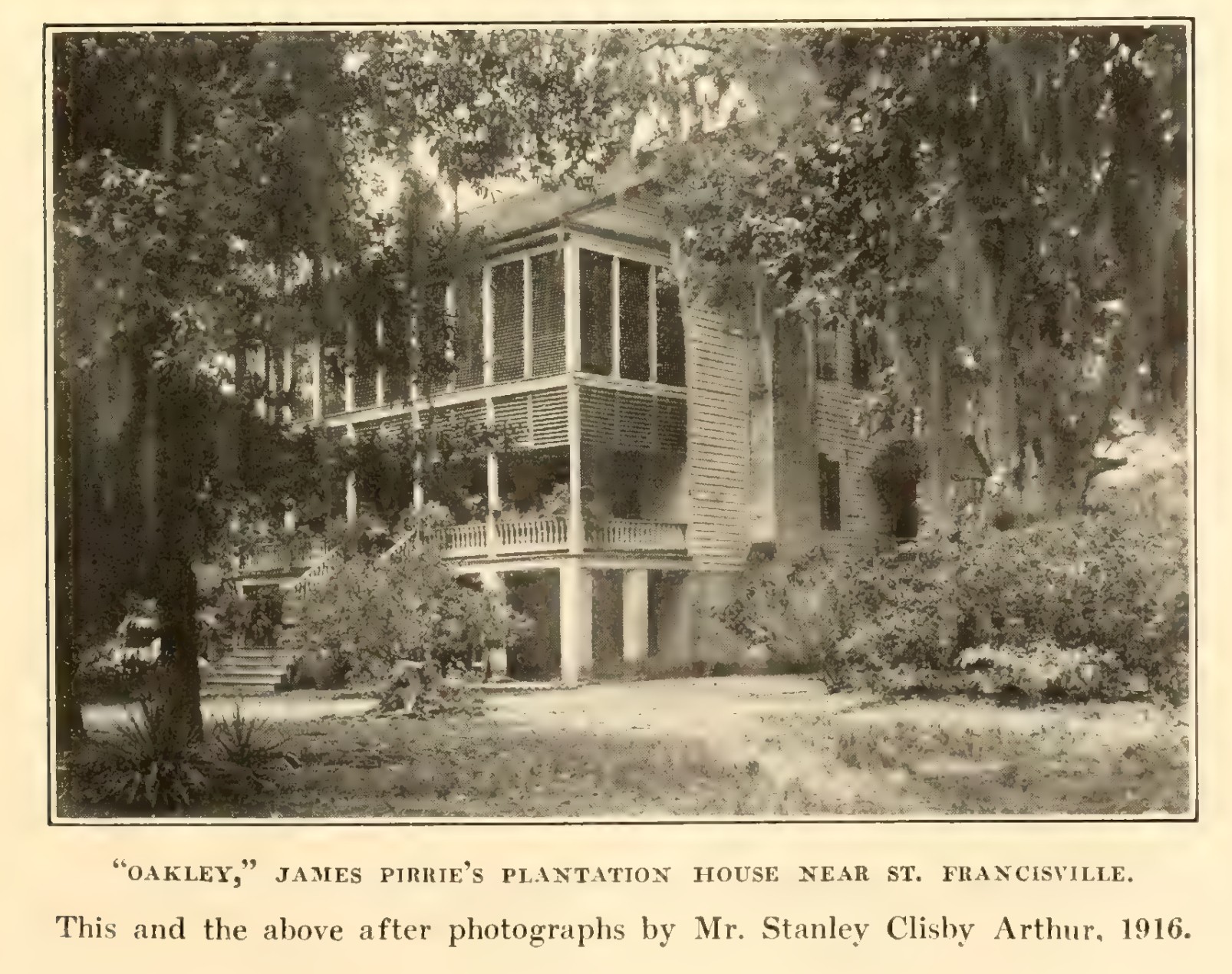
“OAKLEY,” JAMES PIRRIE’S PLANTATION HOUSE NEAR ST. FRANCISVILLE.
This and the above after photographs by Mr. Stanley Clisby Arthur, 1916.
Again, on the 25th of that month is this entry:
I have been very busy in my work, and have made out to
Since I left Cincinnati I have finished 62 drawings of birds
and plants, 3 quadrupeds, 2 snakes, fifty portraits of all sorts,
and the large one of Father Antonio,291 besides giving many
lessons, and I have made out to send money to my wife sufficient
for her and my Kentucky lads, and to live in humble comfort
with only my talents and industry, without one cent to
begin on. I sent a draft to my wife, and began to live in New
Orleans with forty-two dollars, health, and much anxiety to
pursue my plan of collecting all the birds of America.
The close of the year 1821 found Audubon teaching
a few pupils at New Orleans, where, he said, his style of
work and the large prices he received caused him the
ill will of every artist in the city. The figure which he
cut in the streets, with his loose dress of nankeen and
long, flowing locks, made him wish to appear like other
people, and he was soon able to rejoice in a new suit of
clothes. Though still in need of work, when he was
asked to aid in painting a panorama of New Orleans,
he refused, begrudging the time, saying that he did not
wish to see any other perspective than that of the last
of his drawings.
Having been from home for over a year, Audubon
now wished to have his family about him again.292 His
320
plan did not appeal to his practical wife, who had many
friends at Cincinnati, where she was assured of a good
income through her teaching; Mrs. Audubon also felt
that to be constantly shifting about was anything but
favorable to the education of their children. Her reluctance,
however, gave way, and in December she
joined her husband in New Orleans, but only to find
that the city could afford them no settled means of support.
The situation of the Audubon family during the
winter of 1821-22 became precarious in the extreme, and
for two months Audubon gave up his habit of journalizing,
one reason being that he could not afford the
paltry sum necessary to buy a blank book for this purpose.
Compelled at last to make a new move, Audubon
started for Natchez, on the 16th of March, 1822, paying
for his passage on the steamer Eclat by doing a crayon
portrait of the captain and his wife. It was while going
up the river at this time that he opened a chest containing
two hundred of his drawings to find them sadly damaged
by the breaking of a bottle of gunpowder, but the
loss then sustained was apparently slight in comparison
with that which he had experienced in an earlier disaster.
To follow his account of this earlier and better known
incident, when leaving Henderson for Philadelphia,
he carefully placed all of his drawings in a wooden
box and entrusted them to the care of a friend, with injunction
that no harm should befall them; upon returning
several months later, his treasure chest was opened,
but only to reveal that “a pair of Norway rats had taken
possession of the whole, and had reared a young family
amongst the gnawed bits of paper, which but a few
months before represented nearly a thousand inhabitants
of the air.” The heat that was immediately felt
321
in his head, said the naturalist, was too great to be endured,
and the days that followed were days of oblivion
to him; but upon recuperation he took up his gun, his
notebook and his pencils, “and went forth to the woods
as gaily as if nothing had happened”; after a lapse of
three years his portfolio was again filled, and the earlier
work replaced by better. Audubon’s drawings and
plates were also repeatedly ravaged by fires, but this
was at a much later day.
While Audubon was engaged in teaching French,
music, or drawing, now to private pupils at Natchez,
now in a school at Washington, Mississippi, nine miles
away, the summer of 1822 passed with the outlook as
ominous as ever. On August 23 he wrote: “My friend,
Joseph Mason, left me today, and we experienced great
pain at parting. I gave him paper and chalks to work
his way with, and the double barrelled-gun … which
I had purchased in Philadelphia in 1805.” Mason, who,
for a year and nine months, was Audubon’s aid and constant
companion, seems to have settled eventually as an
artist in Philadelphia, where we hear of him in 1824
and again in 1827. 293
In the following December Audubon received a
fresh impetus towards the goal of his ambition by the
arrival at Natchez of a traveling portrait painter, named
John Stein, who gave him his first lessons in the use
of oils; his initial attempt was the copy of an otter from
one of his own drawings. Audubon and Stein together
later painted a full-length portrait of Father Antonio
which was sent to Havana. Artists who have worked
long in one medium are not always successful in another,
but those who have seen some of Audubon’s later and
better works in oil, such as his large canvas of the Wild
322
Turkeys,294 must admit that he attained a high degree
of skill. As will be seen, this acquisition was a strong
string to his bow; when in England his brush helped
largely to pay for the issue of his early plates.
Mrs. Audubon, who joined her husband in New
Orleans on December 8, 1821, soon felt obliged to seek
employment. She engaged as nurse or governess in the
family of Mr. Braud, presumably the same whose wife
and son had received instruction in drawing from the
naturalist the previous autumn, and remained with that
family until September, 1822, when the death of the
child that was placed in her charge left her free to follow
her husband to Natchez. After attempting a similar position
in the home of a clergyman there and finding it
impossible to obtain her salary, in January, 1823, she
was invited by the Percys to West Feliciana,295 then a
prosperous cotton district, at the apex of the salient
made by the neighboring state of Mississippi and bordered
on two sides by the great river. Her worth was
evidently appreciated, for she was encouraged to establish
a private school on the Percys’ plantation, which
she conducted successfully for five years.
325
Captain Robert Percy, who before coming to America
in 1796 had been an officer in the British Navy,
was living at this time with his wife and five children
at their plantation of “Weyanoke,” on Big Sara Creek,
fifteen miles from St. Francisville; this town, owing to
its large shipments of cotton, was then at the height
of prosperity, and its population no doubt exceeded
that of the present day; it now stands at about one thousand
souls. Letters and journals of the period constantly
refer to “Beechwoods,” which was not the mansion
house, though it undoubtedly belonged to the Robert
Percy estate. There it was that the wife of the naturalist
lived, and there she started her school, for the benefit
not only of the Percy boys and girls, but also of a limited
number of children of their wealthy neighbors; her
own son, John Woodhouse Audubon, then eleven years
of age, at this time received instruction at her hands.
The parish of West Feliciana, at this early period, was
one of the richest cotton-producing sections of the entire
State; its care-free planters led an easy life until the
“king” was unceremoniously dethroned by a small, but
not insignificant insect which has proved mightier than
either fire or sword, namely, the boll-weevil; now many
a fine old estate which has languished under the influence
of the pest could probably be bought for a song.
“Beechwoods,” thus devoted to educational purposes,
later came into the hands of Thomas Percy, but the
house, like that of “Weyanoke,” was long since burned
to the ground.
While Mrs. Audubon was establishing her rules and
authority at the Percy school, the naturalist was painting
with Stein at Natchez, and he remained there with
his elder son until the spring of 1823. At this period
he wrote in his journal: “I had finally determined to
break through all bonds, and follow my ornithological
pursuits. My best friends solemnly regarded me as a
madman, and my wife and family alone gave me encouragement.
My wife determined that my genius should
prevail, and that my final success as an ornithologist
should be triumphant.”
In March, 1823, Audubon and friend Stein bought
a horse and wagon, and in the hope of raising money
through their joint efforts as itinerant portrait painters,
set out with Victor on a tour of the Southern States.
This venture, however, did not succeed, and after visiting
Jackson and a number of other towns, they disbanded
at New Orleans. Audubon then started north with
his son for Louisville, but upon paying a visit to his wife
at the “Beechwoods” school, he was invited by the Percys
to remain there for the summer and “teach the young
ladies music and drawing.” According to a tradition
which has survived among the Percy descendants, Audubon
spent most of his time in roaming through the woods,
but he also taught his wife’s pupils to swim in the large
spring house at “Weyanoke,” where the water could be
deepened at pleasure. It was also said that he painted
the Wild Turkeys in the woods of Sleepy Hollow near
by, but I have already given Audubon’s own record in
regard to one of these pictures, and, as Mr. Arthur remarks,
the places in Louisiana where he drew these
famous subjects are as numerous as the beds in which
Lafayette slept when at New Orleans.
Audubon remained with the Percys during the
greater part of the summer, or until some misunderstanding
arose, when he was again adrift and upon a sea
of difficulties. While visiting a plantation near Natchez,
both he and Victor were stricken with fever; his faithful
wife hastened to them, and after nursing both back to
health, she returned with them to the Percy plantation,
where they remained from the 8th to the 30th of September.
In the autumn of 1823 Audubon was determined to
visit Philadelphia, in the hope of finding a sponsor for
his “Ornithology.” Although the work was then far
from ready for publication, he felt that at least he might
better his condition, and with this end in view he sent
his drawings from Natchez to that city; a hasty visit
was made also to New Orleans, for the purpose, no
doubt, of obtaining credentials to possible patrons in
the East. At last, on October 3, he started with Victor
on the steamer Magnet296 for Louisville. Low water
quickly held them up after entering the mouth of the
Ohio, and they were obliged to disembark at the little
village of Trinity, at the mouth of Cash Creek, the scene
of Audubon’s misadventures with Rozier thirteen years
before. The remoteness of the situation and the state
of their funds, which corresponded with that of the
river, left no alternative but to walk, and they undertook
to reach Louisville, several hundred miles distant,
afoot. Two other travelers joined them, and with Victor,
then a lad of nearly fourteen, the party left the creek
at noon on October 15 and struck across country through
the forests and canebrakes. At Green River, which was
reached on the 21st, Victor gave out from sheer exhaustion,297and the remainder of the journey was finished
in a Jersey wagon. At length, said Audubon, “I entered
Louisville with thirteen dollars in my pocket.”
At Shippingport, then an independent town at the Falls
of the Ohio, he was obliged to settle down for the winter.
A place for Victor was found in the counting-house
of Nicholas A. Berthoud, while the father undertook
anything that came to hand, painting portraits,
landscapes, panels for river boats, and even street signs,
326
so hard pressed was he at times to eke out a subsistence
for them both. Yet Audubon was as sanguine as ever,
and on November 9 he recorded the resolution “to paint
one hundred views of American scenery,” and added:
“I shall not be surprised to find myself seated at the
foot of Niagara,” a prediction which was fulfilled in
the following year.
During the winter spent at Shippingport, Audubon
lost a gentle friend in Madame Berthoud,298 the mother
of Nicholas. In his journal for January 20, 1824, we
read his emotional words:
I arose this morning by the transparent light which is the
effect of the moon before dawn, and saw Dr. Middleton passing
at full gallop towards the white house; I followed — alas! my
old friend was dead!… many tears fell from my eyes, accustomed
to sorrow. It was impossible for me to work; my
heart, restless, moved from point to point all round the compass
of my life. Ah Lucy! what have I felt to-day! … I
have spent it thinking, thinking, learning, weighing my
thoughts, and quite sick of life. I wished I had been as quiet
as my venerable friend, as she lay for the last time in her
room.
327
Audubon makes his bow at Philadelphia — Is greeted with plaudits and
cold water — Friendship of Harlan, Sully, Bonaparte and Harris — Hostility
of Ord, Lawson and other friends of Alexander Wilson — A
meeting of academicians — Visit to “Mill Grove” — Exhibits drawings in
New York and becomes a member of the Lyceum — At the Falls of
Niagara — In a gale on Lake Erie — Episode at Meadville — Walk to
Pittsburgh — Tour of Lakes Ontario and Champlain — Decides to take his
drawings to Europe — Descends the Ohio in a skiff — Stranded at Cincinnati — Teaching
at St. Francisville.
In 1824 after five hard years of struggle and embarrassment,
Audubon decided that the time had come
to bring his labors to the light of day. At thirty-nine,
he read and spoke two languages but was without adequate
training in either; he had never written a line for
publication, and to the scientific world he was a stranger.
Though without a definite plan, he cherished the ardent
hope of presenting the birds of his beloved America as
he had depicted them, to the size of life, and with all
the added interest and zest that a natural environment
could give them.
To Philadelphia the naturalist now turned his steps,
for that city was then a Mecca for scientific men. Leaving
Shippingport in March, he reached the Quaker
capital on the fifth day of April. There he purchased
a new suit of clothes, and, dressed “with extreme neatness,”
paid his respects to Dr. William Mease, the one
friend there whom he had known intimately in his
younger and more prosperous days. It was primarily
328
through this excellent man’s interest that Audubon met
the leading artists and scientific men of the city, including
Thomas Sully, Robert and Rembrandt Peale,
Richard Harlan, Charles Le Sueur, and Charles L.
Bonaparte, the latter then a rising young ornithologist
of one and twenty. It was Bonaparte who introduced
Audubon to the Academy of Natural Sciences, where
his drawings were exhibited and generally admired.
Among his critics on that occasion was George Ord,
who from their first interview seems to have looked upon
the new luminary with jealous eyes. Whether this was
true or not, there is no doubt that Ord became one of
his few really bitter and implacable adversaries, and
not many days elapsed before Audubon came to feel
that many in Philadelphia would be glad to see him
return to the backwoods of the Middle West, from
which, like an apple of Sodom, he seemed suddenly to
have dropped into their midst. Those who were most
interested in the continued sale and success of Wilson’s
Ornithology, he declared, advised him not to publish
anything, and threw not only cold water but ice upon
all his plans. Thus began that unseemly rivalry, fostered
for many years by George Ord in this country,
between the friends of Alexander Wilson and those of
John James Audubon, the dead embers of which are occasionally
stirred even to this day.299
Ord, who was about Audubon’s own age, was a quiet,
persistent, and unassuming worker, held in high esteem
by many of his associates. Audubon seems to have done
his best to conciliate him then and at a later day, but
all to no purpose; Dr. Harlan once advised him to give
up the attempt, since Ord, he declared, had no heart
for friendship, having been denied that blessing by
329
nature herself. Ord, as we have seen, had edited the
eighth and written the ninth, or concluding, volume of
Wilson’s American Ornithology, as well as a life of its
author; the appearance of a new star in the ornithological
horizon may not have been a welcome sight. At
all events, we soon find him engaged upon a new edition
of Wilson’s work.300 Ord had objected to Audubon’s
method of combining plants and other accessories with
his drawings of birds, a criticism that in the case of
purely technical works could be easily sustained, and
some of his later charges, though carried too far, were
not wholly without foundation.301
Bonaparte,302 on the other hand, was captivated by
330
Audubon’s drawings and anxious to secure his services
for his own work, then well in hand. This was the
American Ornithology, for which Titian R. Peale was
then making the drawings, and Thomas Lawson, who
had been Wilson’s engraver, was engaged on the plates;
though quite distinct in itself, this was much in the style
of Wilson’s earlier work, of which it was virtually a
continuation. When Bonaparte introduced Audubon
to these men, it is not surprising that the meeting was
not productive of the best of feeling on either side.
Peale’s stiff and rather conventional portraits of birds
naturally failed to awaken enthusiasm in “the trader
naturalist,” as some who looked upon him as a rival
rather contemptuously called him. The interview with
Lawson, if correctly reported by his friend,303 shows that
his interest could not have been of the most disinterested
sort. “Lawson told me,” said this reporter, “that he
spoke freely of the pictures, and said that they were ill
drawn, not true to nature, and anatomically incorrect.”
Thereupon Bonaparte defended them warmly, saying
that he would buy them and that Lawson should engrave
them. “You may buy them,” said the Scotchman,
“but I will not engrave them … because ornithology
requires truth in the forms, and correctness in the lines.
Here are neither.” Other meetings are said to have followed,
but to have ended only in mutual dislike. Nevertheless,
one of Audubon’s drawings was engraved by
Lawson and appeared in Bonaparte’s work,304 but most
331
of the figures in Bonaparte’s concluding volumes were
by the hand of a German named Alexander Rider. It
was doubtless a fortunate circumstance that the prejudice
and obstinacy of this overbearing Scot was a bar
to any further absorption of Audubon’s talents.305
Audubon met at this time a more appreciative engraver
in Mr. Fairman, who urged him to take his drawings
to Europe and have them engraved in a superior
style; on July 12 the naturalist wrote that he had drawn
“for Mr. Fairman a small grouse to be put on a banknote
belonging to the State of New Jersey.” By some
lucky chance this incident brought him the acquaintance
of Edward Harris,306 whom he met that summer in Philadelphia,
and who became one of his most constant and
disinterested friends. It was Harris who a few days
after their meeting took all of the drawings which Audubon
had for sale and at the artist’s own prices;307 who
for years was continually sending him rare or desirable
specimens of birds; who accompanied him through the
Southern States to Florida in 1837 and on the famous
333
Missouri River Expedition in 1843. Edward Harris
became a patron of science through his friendship with
scientific men, and many besides Audubon were indebted
to him for judicious advice as well as more substantial
benefits.
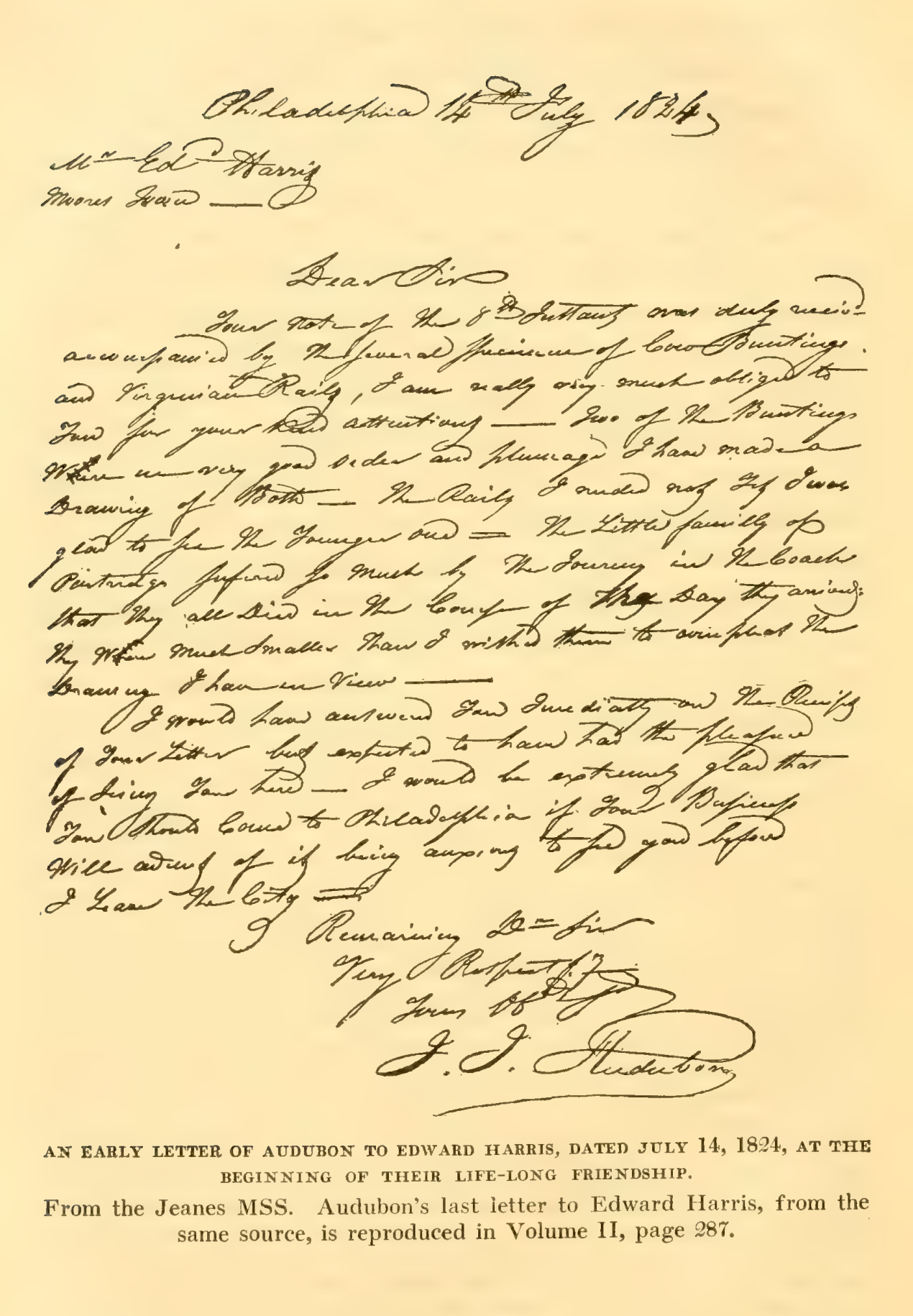
AN EARLY LETTER TO EDWARD HARRIS, DATED JULY 14, 1824 AT THE
BEGINNING OF THEIR LIFE-LONG FRIENDSHIP.
From the Jeanes MSS. Audubon’s last letter to Edward Harris, from the
same source, is reproduced in
Volume II, page 287.
The Academy of Natural Sciences, founded in 1812,
was well established at this time, and its rapidly growing
Museum was already the largest and most valuable
in the New World; ornithology was a favored subject,
and the Academy’s roll embraced every American pioneer
worker of note in the entire field of the natural
sciences. The following account of a meeting of the
Academy, held on October 11, 1825, when Ord presided,
has been preserved in a letter of the period:308
A few evenings since I was associated with a society of gentlemen,
members of the Academy of Natural Sciences. There
were present fifteen or twenty. Among the number were Le
Sueur, Rafinesque, Say, Peale, Pattison, Harlan, and Charles
Lucien Bonaparte.
Among this collection life was most strikingly exemplified:
Le Sueur, with a countenance weather-beaten and worn, looked
on, for the muscles of his ironbound visage seemed as incapable
of motion, as those on the medals struck in the age of Julius
Cæsar. Rafinesque has a fine black eye, rather bald and black
hair, and withal is rather corpulent. I was informed that he
was a native of Constantinople; at present he lives in Kentucky.
Dr. Harlan is a spruce young man…. Peale is
the son of the original proprietor of the Philadelphia Museum,
and one who visited the Rocky Mountains with Major Long;
he is a young man, and has no remarkable indications of
countenance to distinguish him. Say, who was his companion
334
in the same expedition, is an extremely interesting man; to
him I am particularly obligated for showing me their Museum
and Library. I think he told me that their society had published
nine volumes…. Bonaparte is the son of Lucien Bonaparte
and nephew to the Emperor Napoleon; he is a little set,
black-eyed fellow, quite talkative, and withal interesting and
companionable.
Among the working naturalists at Philadelphia Dr.
Richard Harlan was possibly one whose friendship was
most valuable to Audubon; the artist from whom he
received most encouragement was Thomas Sully, the
portrait painter, who took him into his studio and gave
him lessons in the use of oils. Sully was one of those
who saw the good side of Audubon’s character, discerned
his talent, and predicted for him a great future; at a
later day Sully was able to rejoice in finding his prediction
amply fulfilled.309
Convinced that the advice which Fairman and Bonaparte
had given him was sound, Audubon decided to
look to Europe for a publisher of his Birds, and with this
end in view, set hard to work at his drawings. “I had
some pupils offered,” he said, “at a dollar per lesson;
but I found the citizens unwilling to pay for art, although
they affected to patronize it. I exhibited my
335
drawings for a week, but found the show did not pay,
and so determined to remove myself.” Audubon remained
in Philadelphia until August, and while in doubt
as to what step he should take next, he was cheered by
a visit to “Mill Grove,” made in the carriage of his
Quaker friend, Reuben Haines. To quote his journal:
As we entered the avenue, which led to the farm, every
step brought to my mind the memory of past years,
and I was bewildered by the recollections until we reached the
door of the house, which had once been the residence of my
father as well as of myself. The cordial welcome of Mr. Wetherill,
the owner, was extremely agreeable. After resting a few
moments, I abruptly took my hat and ran wildly to the woods,
to the grotto where I first heard from my wife that she was
not indifferent to me. It had been torn down, and some stones
carted away; but raising my eyes towards heaven, I repeated
the promise we had mutually made. We dined at Mill Grove,
and as I entered the parlor I stood motionless for a moment
on the spot where my wife and myself were forever joined.
In this dramatic rehearsal the naturalist clearly implies
that he was married in the parlor of his own home,
but his excellent wife, who was surely in this instance
the better authority, explicitly states that their marriage
took place in her father’s house at “Fatland Ford.”
Since Audubon was in the habit of sending extracts
from his journal to his family, it is clear that errors
of this sort were the simple result of an impulsive temperament;
the moment his imagination pictured his
wedding as having taken place in his old abode, down
went the jotting in the journal, which was written at
odd moments anywhere, often at late hours, and with
no care in revision or thought of future publication.
On August 1, 1824, Audubon recorded in his diary
336
that he had left Philadelphia for New York on the day
before, “in good health, free from debt, and free from
anxiety about the future.” Sully had given him glowing
letters of introduction to Gilbert Stuart, Washington
Allston and Colonel Trumbull, but then as now midsummer
was not a propitious time to find city people
at home, and he began to consider the advisability of
visiting both Albany and Boston. Alternately elated
or depressed by the prospects of the day or the hour,
Audubon wrote on August 4 that he had called with a
letter of introduction on Dr. Mitchell, who had given
him “a kind letter to his friend Dr. Barnes.” This hurriedly
penciled note from the Nestor of American science
of that day has been carefully preserved, and reads
as follows:310
Dr. Samuel L. Mitchell to Dr. Barnes
Mr. A. who brings strong testimonial of excellence from
our friends in Pha is now sitting with me — I have been delighted
and instructed by a Display of his Port Folio containing
Drawings Done from Life of North American Birds and
illustrating the Connect, of ornithology with Botany. he has
Superior attainments & skill in the natural sciences which he
has cultivated for more than 20 y.
he wishes to show his Elegant performances to the Members
of the Lyceum and to be made a Member of that Society — it
is his intention to Leave this City for Boston on Sunday
morning. Meanwhile I recommend him to your good offices.
Yours Truly as ever
Sam, L. Mitchell
Aug t 4 t 1824
337
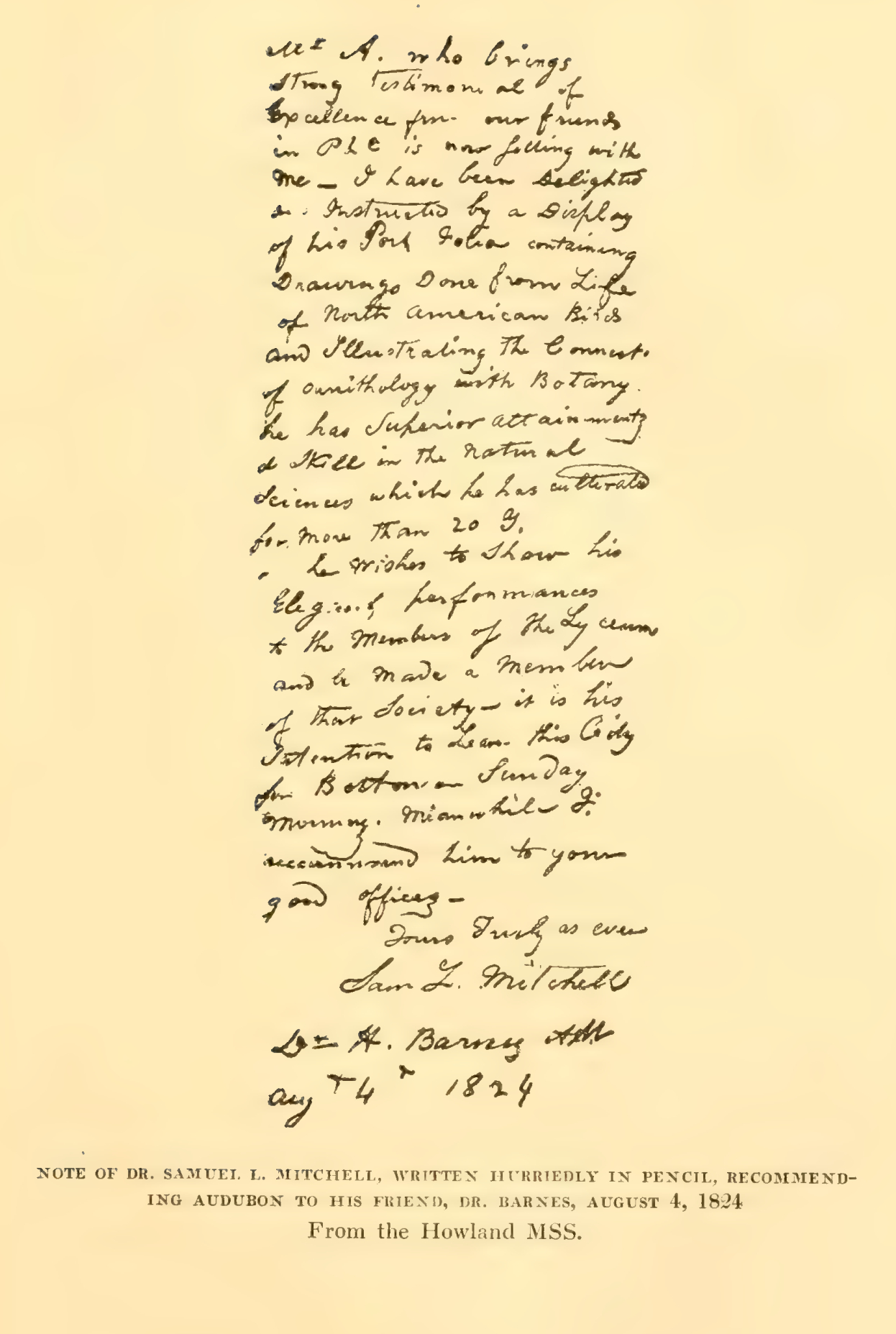
NOTE OF DR. SAMUEL L. MITCHELL, WRITTEN HURRIEDLY IN PENCIL, RECOMMENDING
AUDUBON TO HIS FRIEND, DR. BARNES, AUGUST 4, 1824
From the Howland MSS.
338
Dr. Mitchell, who was the father and first president
of the Lyceum of Natural History, had been a friend
of young Audubon when he was clerking in New York
in 1807.311 His recommendation was accepted, and the
naturalist was enrolled on the Lyceum’s list of members;
to justify his election, two papers, representing
his first contribution to ornithology, were presented to
the Society, and appeared in its Annals of that year.312
Audubon visited the Lyceum with Dr. DeKay and exhibited
his drawings, but said that he felt awkward and
uncomfortable. On August 3 he called on John Vanderlyn,
the artist, examined his pictures, and “saw the
medal given him by Napoleon, but was not impressed
with the idea that he was a great painter.” Upon
meeting Vanderlyn again a little later, he was asked to
sit for a portrait of Andrew Jackson; his journal entry
regarding the incident was as follows:313
August 10. My spirits low, and I long for the woods again;
but the prospect of becoming better known prompts me to
remain another day. Met the artist Vanderlyn, who asked me
to give him a sitting for a portrait of General Jackson, since
my figure considerably resembled that of the General, more than
any he had ever seen. I likewise sketched my landlady and
child, and filled my time.
The context shows that the sitting was given, and
as Mr. Stanley C. Arthur remarks, Vanderlyn’s portrait,
which now hangs in the City Hall in New York,
shows “Old Hickory” from the shoulders up, but from
the shoulders down it is John James Audubon.
On the 14th Audubon wrote cheerfully to Sully:
339
Audubon to Thomas Sully
My reception in New York has surpassed my hopes. I
have been most kindly received, and had I seen Col. Trumball,
I would have found him the gentleman you represented, but his
absence at Saratoga Springs has deprived me of that pleasure.
New York is now an immense city. Strangers are received
here with less reserve generally than at Philadelphia. I found
the Academy well supplied with paintings, and sculptures of the
Greek masters. The steam boats of the Sweet Ohio, with all
their swiftness of motion and beautiful forms, do not interest
the eye like those that are here tossing over the foaming billows
with the grace of the wild swan. Were I a painter — ah
could I, like ——, carry in my mind’s eye all my mind feels
when looking at the Battery at the moon’s tender reflections on
the farthest sails, forcing the vessel they move with the very
wind’s heart, — express as he does the quick moving tar hauling
in a reef at the yard’s end, — and make on the canvas a noble
commander speak, as you have done; then, my dear friend, I
could show you New York’s harbor and all its beauties….
I cannot part with that Fair City Philadelphia this soon;
I cannot help thanking Fairman, Peale, Neagle, Le Sueur, and
many others besides Mc Murty for their attentions to me.
Should you see honest Quaker Haines, beg him to believe me
his friend; should you see Mr. Ord, tell him I never was his
enemy. Think of me some time, and accept the truest best
wishes of
John J. Audubon.
I leave for Boston tomorrow. Should you please to write
to me, direct to Care of Messrs. Anshutz & Co, Pittsburgh,
where I shall be in about 40 days.
The very next day Audubon changed his plans and
sailed up the Hudson to Albany, where he hoped to meet
De Witt Clinton, then at the height of his fame, who in
the course of his great undertakings had found time to
340
write letters on the natural history and antiquities of his
State, and Dr. Beck, the botanist. Failing to find either
at home, Audubon was compelled by the depleted state
of his pocketbook to give up his plan of visiting Boston,
and being determined to see Niagara Falls, he took passage
on a canal boat to Buffalo instead. The Falls
were reached on the 24th of August, and it was then, on
recording his name at an hotel, that Audubon wrote underneath:
“Who, like Wilson, will ramble, but never,
like that great man, die under the lash of a bookseller.”314
Upon his first view of the Falls he was satisfied
that Niagara never had been and never could be
painted. He wanted to cross the bridge at Goat Island
but was deterred by the necessity of economy. Visitors
it seems, had already learned to venture under a small
section of the American Falls, and Audubon said that
while looking through the falling sheet of water, “at
their feet thousands of eels were lying side by side, trying
vainly to ascend the torrent.” After strolling through
the village to find some bread and milk, the naturalist
recorded that he ate a good dinner for twelve cents, and
that he went to bed “thinking of Franklin eating his
roll in the streets of Philadelphia, of Goldsmith traveling
by the aid of his musical powers, and of other great
men who had worked their way through hardships and
difficulties to fame, and fell asleep, hoping, by persevering
industry, to make a name for himself among his
countrymen.”
The schooner from Buffalo to Erie, Pennsylvania,
on which Audubon had taken deck passage, as he was
unable to afford a berth in the cabin, was caught in a
violent gale on the way and was obliged to anchor in
the harbor of Presque Isle. “It was on the 29th of August,
341
1824,” his diary reads,
“and never shall I forget
that morning.” Captain Judd, of the United States
Navy, had sent a gig with six men to its relief, and
“my drawings,” he continues, “were put into the boat
with the greatest care. We shifted into it, and seated
ourselves according to direction. Our brave fellows
pulled hard, and every moment brought us nearer the
American shore; I leaped upon it with elated heart.
My drawings were safely landed, and for anything else
I cared little at the moment.”
At this point Audubon set out with a fellow traveler,
who was also an artist, for Meadville, Pennsylvania.
The earliest version of his journal315 which gives an
account of this experience reads as follows:
On the shore of upper Canada, my money was stolen. The
thief, perhaps, imagined it was of little importance to a naturalist.
To repine at what could not be helped would have been
unmanly. I felt satisfied Providence had relief in store. Seven
dollars and a half were left to us, two persons, 1500 miles from
home, at the entrance of Presque-Isle Harbor.
Five dollars was paid to their driver, and when they
reached Meadville, and entered J. E. Smith’s “Traveler’s
Rest,” they had but one hundred and fifty cents between
them. No time was to be lost, and Audubon at
once started out with his portfolio and his artist friend
to look for work:
I walked up the Main Street, looking for heads, till I saw
a Hollander gentleman in a store, who looked as if he might
want a sketch. I begged him to allow me to sit down. This
granted, I remained perfectly silent till he very soon asked:
“What is in that portfolio”? This sounded well; I opened it.
342
He complimented me on my drawings of birds and flowers.
Showing him a portrait of my Best Friend, I asked him if he
would like one of himself. He said “Yes, and I will exert myself
to gain as many more customers as I can.”
According to a story current at Meadville long after
the event Audubon made the acquaintance of Mr. Benedict,
a merchant, lately come from New Haven, whose
attractive daughter, named Jennett,316 was then one and
twenty; his family lived at the village tavern, called the
“Torbett House,” in which Mr. Augustus Colson had
a store. It was Mr. Colson, to whom Audubon probably
refers, who responded generously to his appeal for work,
and called in a number of his young friends as possible
patrons. Among them was Miss Jennett Benedict, and
the naturalist, attracted by her agreeable manners and
pleasing appearance, asked permission to make a portrait-sketch,
saying that he would pay for the privilege
by presenting her with a copy. This was evidently good
business enterprise, for, according to the story, a grain
bin in the Colson store was soon converted into a studio,
and Audubon was rewarded by a number of sitters.
Here is his account from the record just quoted:
Next day I entered the artist’s room, by crazy steps of the
store-garret; four windows faced each other at right angles; in
a corner was a cat nursing, among rags for a paper-mill; hogsheads
343
of oats, Dutch toys on the floor, a large drum, a bassoon,
fur caps along the walls, a hammock and rolls of leather.
Closing the extra windows with blankets, I procured a painter’s
light.
A young man sat to try my skill; his phiz was approved;
then the merchant; the room became crowded. In the evening
I joined him in music on the flute and violin. My fellow traveller
also had made two sketches. We wrote a page or two in
our journals, and went to rest.
The next day was spent as yesterday. Our pockets replenished,
we walked to Pittsburgh in two days.
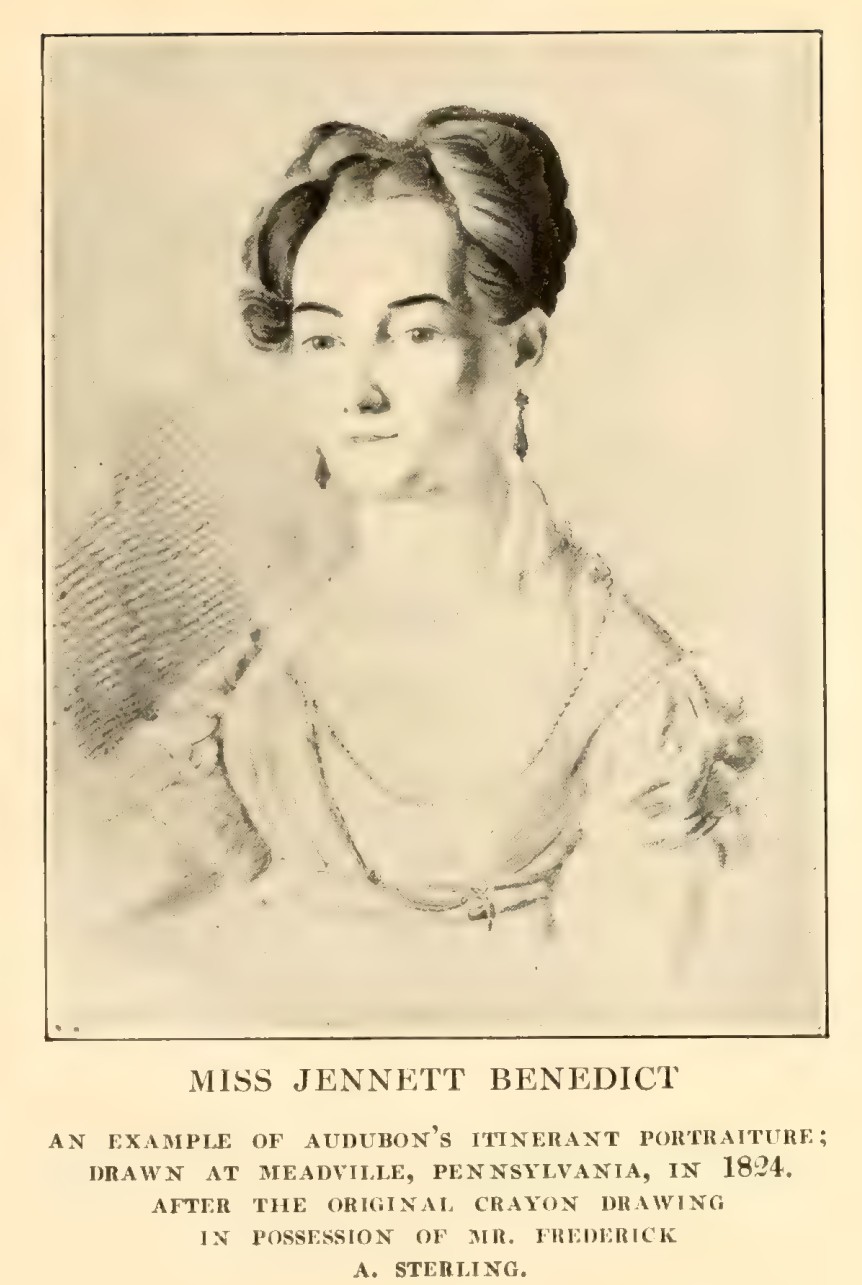
MISS JENNETT BENEDICT
AN EXAMPLE OF AUDUBON’S ITINERANT PORTRAITURE; DRAWN AT MEADVILLE, PENNSYLVANIA, IN 1824. AFTER THE ORIGINAL CRAYON DRAWING IN POSSESSION OF MR. FREDERICK A. STERLING.
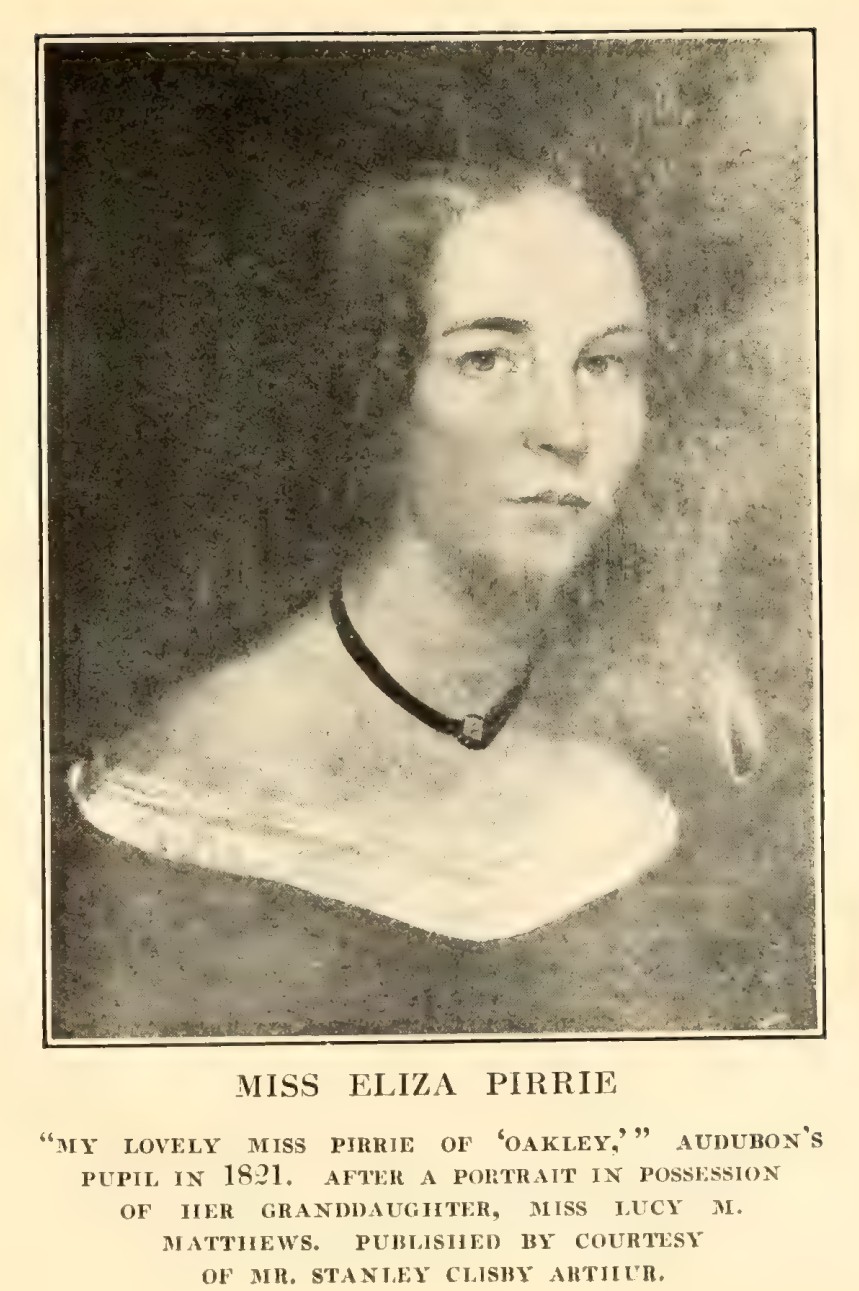
MISS ELIZA PIRRIE
“MY LOVELY MISS PIRRIE OF ‘OAKLEY,’” AUDUBON’S PUPIL IN 1821. AFTER A PORTRAIT IN POSSESSION OF HER GRANDDAUGHTER, MISS LUCY M. MATTHEWS. PUBLISHED BY COURTESY OF MR. STANLEY CLISBY ARTHUR.
A month was spent at Pittsburgh, where Audubon
searched the country for birds and continued his drawings.
While there he made the acquaintance of the
Reverend John Henry Hopkins, a man of superb appearance
and rare conversational and oratorical powers,
later known as the learned and versatile first Episcopal
Bishop of Vermont. Audubon attended some of the
ministrations of this remarkable man, through whose
influence, he said, “I was brought to think, more than
I usually did, of religious matters; but I never think of
churches without feeling sick at heart at the sham and
show of some of their professors. To repay evil with
kindness is the religion that I was taught to practice,
and this will forever be my rule.”
In the autumn of 1824 Audubon planned another
visit to the Great Lakes in search of new birds, and
tried to induce his friend, Mr. Edward Harris, to accompany
him. While wandering in the forests along
those lakes he thought out the plan which was finally
followed in the publication of his Birds of America:
Chance, and chance alone, had divided my drawings into
three different classes, depending upon the magnitude of the
objects to be represented; and, although I did not at that time
344
possess all the specimens necessary, I arranged them as well as
I could into parcels of five plates — I improved the whole as
much as was in my power; and as I daily retired farther from
the haunts of man, determined to leave nothing undone, which
my labor, my time, or my purse could accomplish.317
Audubon’s journal kept on the lakes has been lost,
but that journey was fresh in mind when he wrote the
following letter to Edward Harris.318
Audubon to Edward Harris
Beechwoods. Near Bayou Sara, La.
Jany. 31 1825.
Surely I have not dismerited your esteem; when on the
Lakes, both Ontario and Champlain, I wrote to you — again
from Pittsburgh, all without any answer, and I am sorry to
say that I have been either abandoned or forgotten by all those
other persons who had promised to keep up a correspondence
with me….
The country I visited was new, in great measure, to me. I
have been delighted with the tour, but will forever regret that
your sister’s indisposition could not allow you time to augment
my pleasure by your company.
Audubon offers to send his friend shrubs and fruits from
the South, and concludes; In fact, my dear Mr. Harris, I am
yet the same man you knew at the corner of 5th, and Minor
Streets in Philadelphia, and will continue forever the same.
After his tour of the Lakes Audubon returned to
Pittsburgh, and on October 24, 1824, started down the
Ohio in a skiff, intending to descend to the Mississippi
and thence reach his family in Louisiana. Bad weather
and lack of funds interfered with this plan, and ere long
he was once more stranded in Cincinnati, where he was
345
beset by claimants for payment upon articles ordered
for the Western Museum five years before. Finding it
difficult at this time to replenish an empty purse, Audubon
felt that he must borrow fifteen dollars, but could
not make up his mind how to ask the favor until he had
several times walked past the house where he had once
been known. Nevertheless, he succeeded in obtaining
the necessary funds, took passage on a boat bound for
Louisville, and slept cheerfully that night on a pile of
shavings which he managed to scrape together on deck.
“The spirit of contentment which I now feel,” he wrote,
“is strange; it borders on the sublime; and, enthusiastic
or lunatic, as some of my relatives will have me, I am
glad to possess such a spirit”; later he added: “I discover
that my friends think only of my apparel, and
those upon whom I have conferred acts of kindness
prefer to remind me of my errors.”
Louisville was reached on November 20, and a number
of days were spent in visiting his eldest son,
Victor, who was then at Shippingport.319 He finally
arrived at Bayou Sara in late November, 1824. The
captain of his vessel, which was bound for New Orleans,
put him ashore at midnight, and he was left to
grope his way to the village on the hill. St. Francisville,
to his dismay, was nearly deserted, a scourge of
yellow fever having driven most of its inhabitants to
the pine woods. The postmaster, however, was able to
assure him that his wife and son were well, and Mr.
Nübling, a friendly German, whom he described as “a
346
man of cultivation and taste, and a lover of Natural
Science,“ gave him refreshment and a horse. In his
eagerness to cover the fifteen miles to the Percy house
as rapidly as possible, he tried to strike a straight course
through the dark forest, but missed his way, and dawn
found him on unfamiliar ground; he then learned from
a negro that he was two miles beyond the place. When
he arrived at last ”with rent and wasted clothes, and
uncut hair, and altogether looking like the wandering
Jew,“ his wife was busily engaged in teaching her pupils.
During his absence of nearly fourteen months she had
prospered greatly, and she was not only ready but eager
to place her earnings at her husband’s disposal.
When he had finally decided to take his drawings to
Europe for publication, Audubon set to work to increase
his capital, and soon had pupils in French, music, and
drawing, while a dancing class of sixty was organized
in a neighboring town. His country lads and lassies
proved rather awkward material, and he broke his bow
and nearly ruined his violin in his impatience to evoke a
single graceful step or motion; when, however, he consented
to dance to his own music, he never failed to bring
down thunders of applause. These efforts were continued
for over a year, until he had realized a considerable
sum. With this money in hand, supplemented by
what his wife could spare, he determined to seek his fortunes
in the Old World.
347
Audubon sails from New Orleans — Life at Sea — Liverpool — The Rathbones — Exhibition
of drawings an immediate success — Personal appearance — Painting
habits resumed — His pictures and methods — Manchester
visited — Plans for publication — The Birds of America — Welcome at
Edinburgh — Lizars engraves the Turkey Cock — In the rôle of society’s
lion — His exhibition described by a French critic — Honors of science
and the arts — Contributions to journals excite criticism — Aristocratic
patrons — Visit to Scott — The Wild Pigeon and the rattlesnake — Letter
to his wife — Prospectus — Journey to London.
When Audubon had reached the age of forty-one,
his fortunes were destined to undergo still further kaleidoscopic
changes, but the patterns and hue were now
of a more agreeable character. He had failed repeatedly
in business ventures of various kinds; he had failed
also to find either encouragement or support for his
ambitious schemes of publishing his drawings in the
United States. But there was still a chance for success
in the Old World, and thither he was determined to go
to try the hazard of fortune in either England or France.
Accordingly, he left his family at St. Francisville and
went to New Orleans, where he engaged passage on a
cotton schooner bound for Liverpool, named the Delos,
Captain Joseph E. Hatch. With his drawings, a few
books, and a purse, if not ample, at least sufficient for
his immediate needs, and fortified with numerous letters,
he finally set sail on the 17th of May, 1826.
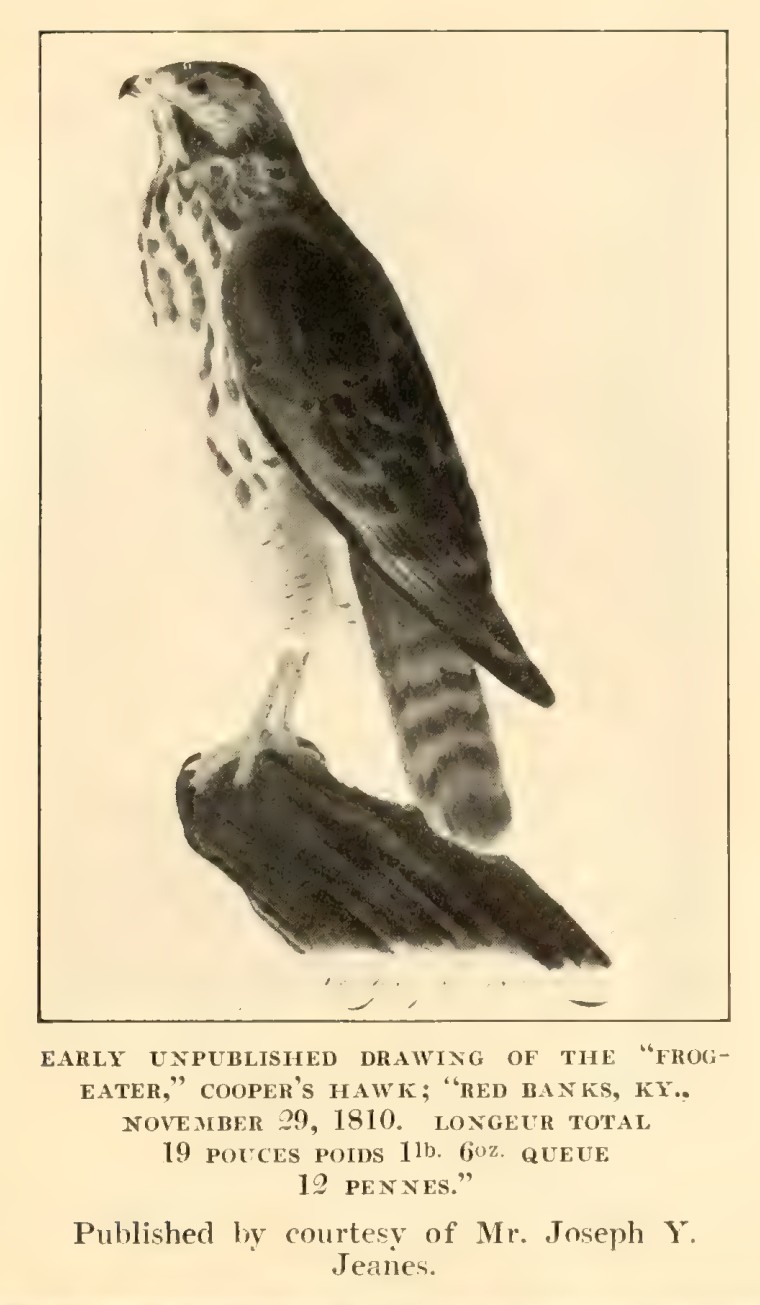
EARLY UNPUBLISHED DRAWING OF THE “FROG-EATER,” COOPER’S HAWK; “RED BANKS, KY. NOVEMBER 29, 1810. LONGEUR TOTAL 19 POUCES POIDS 1lb. 6oz. QUEUE 12 PENNES.”
Published by courtesy of Mr. Joseph Y. Jeanes.
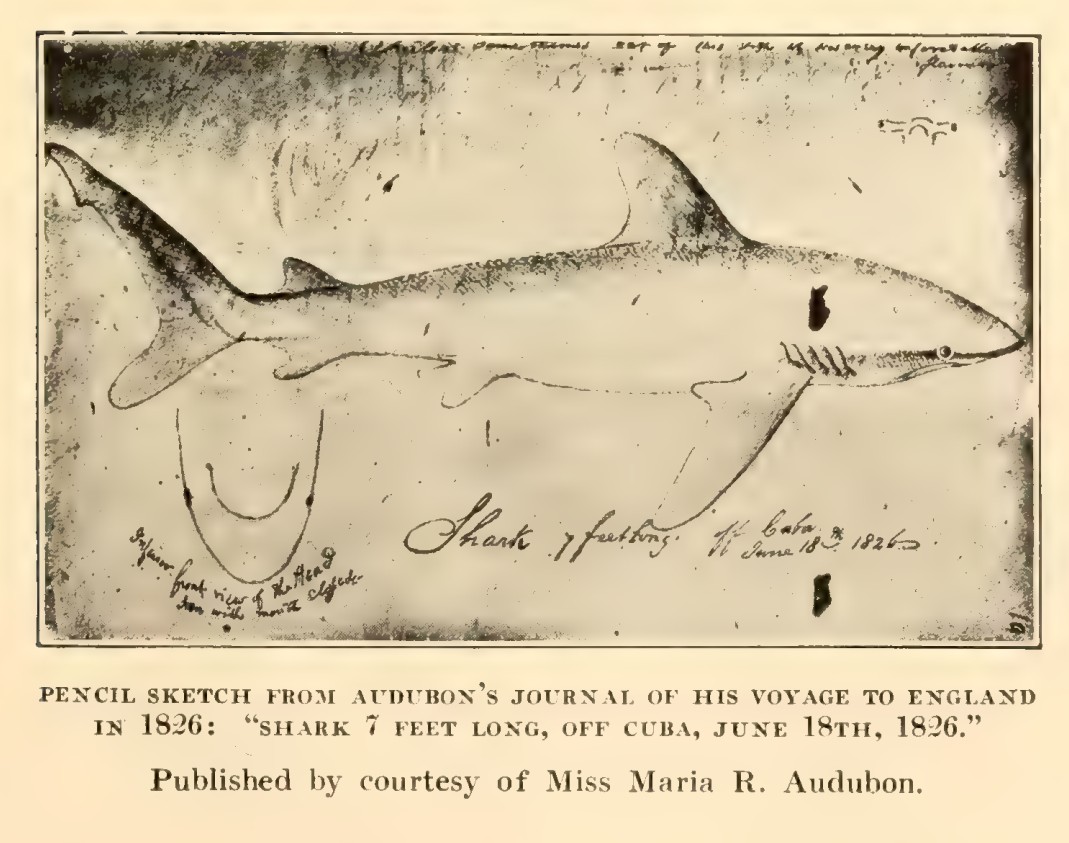
PENCIL SKETCH FROM AUDUBON’S JOURNAL OF HIS VOYAGE TO ENGLAND IN 1826: “SHARK 7 FEET LONG, OFF CUBA, JUNE 18TH, 1826.”
Published by courtesy of Miss Maria R. Audubon.
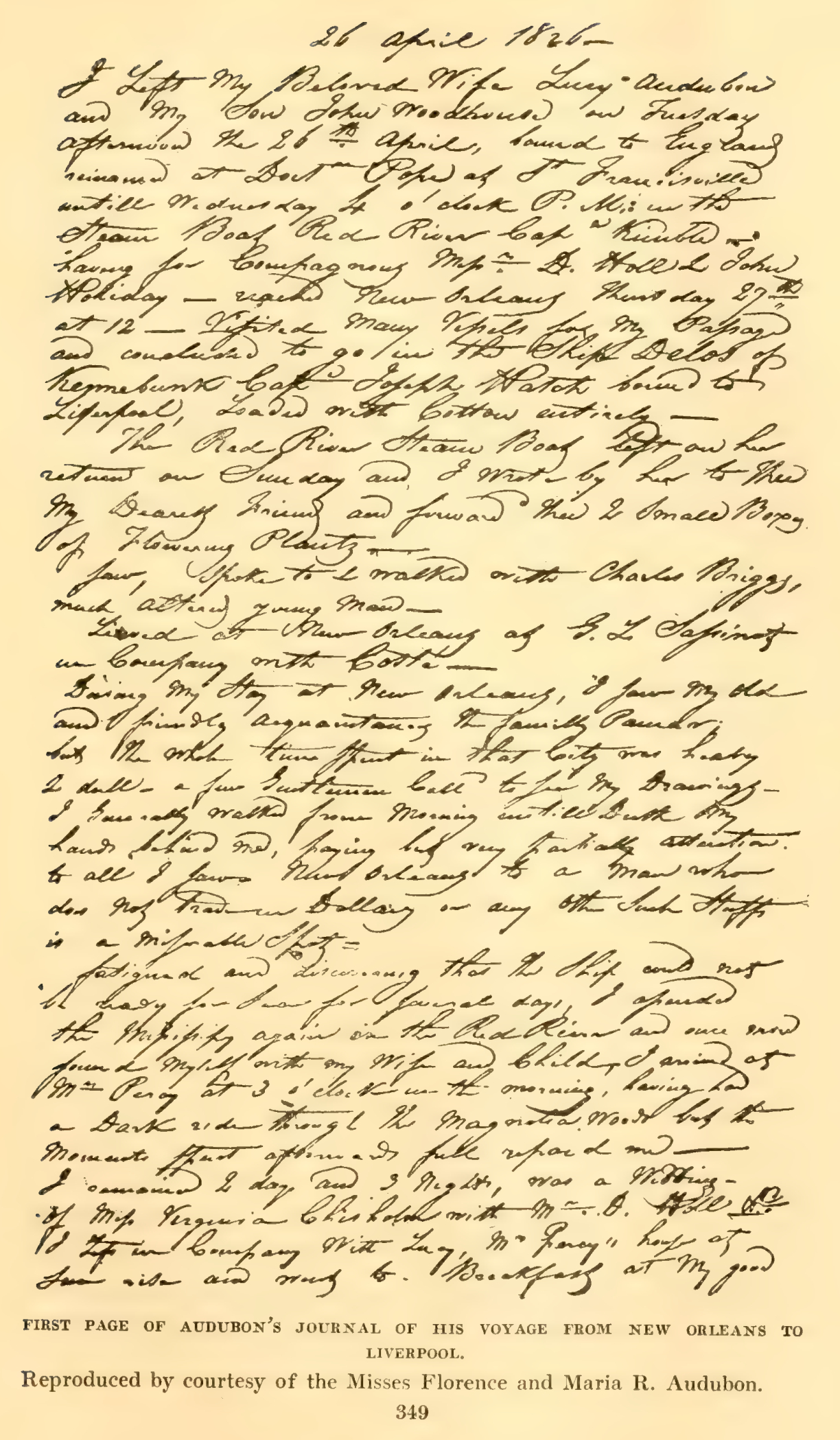
FIRST PAGE OF AUDUBON'S JOURNAL OF HIS VOYAGE FROM NEW ORLEANS TO LIVERPOOL.
Reproduced by courtesy of the Misses Florence and Maria R. Audubon.
This voyage, like every other which the naturalist
ever made, was turned to good account; the log book
348
or journal kept on this occasion abounds in interesting
observations upon the life of the sea, particularly on
the fishes and birds which were encountered in the Gulf.
The first page of this journal,320 reproduced with orthographic
exactness, reads as follows:
26 April 1826 —
I Left My Beloved Wife Lucy Audubon and My Son John
Woodhouse on Tuesday afternoon the 26th April, bound to
England, remained at Doctr Pope at St Francisville untill
Wednesday 4 o’clock P. M.: in the Steam Boat Red River
Cape Kimble — having for Compagnons
Messrs D. Hall & John
Haliday — reached New Orleans Thursday
27th at 12 — Visited
Many Vessels for My Passage and concluded to go in the
Ship Delos of Kennebunk
Cape Joseph Hatch bound to Liverpool,
Loaded with Cotton entirely —
The Red River Steam Boat left on her return on Sunday
and I Wrote by her to Thee My Dearest Friend and forwardd
Thee 2 Small Boxes of Flowering Plants —
saw, spoke to & walked with Charles Briggs, much altered
young man —
Lived at New Orleans at G. L. Sapinot in Company with
Costé —
During My Stay at New Orleans, I saw my old and friendly
acquaintances the familly Pamar; but the whole time spent
350
in that City was heavy & dull — a few Gentlemen Calld to see
My Drawings — I Generally Walked from Morning untill Dusk
My hands behind me, paying but very partial attention, to all
I saw — New Orleans to a Man who does not trade in Dollars
or any other Such Stuffs is a miserable Spot
fatigued and discovering that the Ship could not be ready
for Sea for several days, I ascended the Mississipy again in
the Red River and once more found Myself with my Wife
and Child. I arrived at Mrs Percy at 3 o’clock in the morning,
having had a Dark ride through the Magnolia Woods but
the Moments spent afterwards full repaid me — I remained 2
days and 3 Nights, was a Wedding — of Miss Virginia Chisholm
with Mr. D. Hall &c. I Left in Company With Lucy Mrs
Percy house at Sun rise and went to Breakfast at My good
friend’s, Augustin Bourgeat.
The captain and mates of the Delos were friendly,
and whenever their vessel was becalmed, they would
let down a boat so that Audubon could procure the
stormy Petrel and numerous other birds which he was
anxious to examine in the flesh or depict for his “Ornithology.”
During his long voyage of sixty-five days our adventurous
traveler was alternately elated or depressed by
hopes or fears for the future, until land was at last
reached on Friday, July 21, 1826. The appearance of
Liverpool, said Audubon, “was agreeable, but no sooner
had I entered it than the smoke became so oppressive to
my lungs that I could hardly breathe.” At the customs
he was charged two pence on each of his drawings, “as
they were water-colored,” but on his American books
he had to pay “four pence per pound,” a circumstance
in which he was possibly favored by the following letter
which he had brought with him from a friend in New
Orleans:
351
Edward Holden to George Ramsden
New Orleans, May 26th., 1826.
George Ramsden, Esq.
Dear Sir.
The present will be handed to you by Mr. J. J. Audubon
of this city, whom most respectfully I beg to introduce to
you.
The principal object of Mr. Audubon’s visit to England is
to make arrangements for the publication of an extensive and
very valuable collection of his drawings in Natural History,
chiefly if not wholly of American Birds, and he takes them
with him for that purpose. Can you be of any assistance to
him by letters to Manchester and London? If you can I have
no doubt that my introduction of him will insure your best attention
and services. — Mr. Audubon is afraid of having to pay
heavy duties upon his drawings. He will describe them to you,
and if in getting them entered Low at the Custom House, or
if in any other respect you can further his views, I shall consider
your aid as an obligation conferred upon myself. Pray introduce
him particularly to Mr. Booth, who I am sure will feel
great interest in being acquainted with him, were it only on account
of the desire he has always expressed to be of service to
the new Manchester Institution, to which Mr. Audubon’s drawings
would be an invaluable acquisition.
I am Dr. Sir
Yours truly,
Edward Holden.
Among the letters which Audubon carried on this
occasion, but which apparently he did not deliver, was
the following, addressed by a friend in New Orleans to
General Lafayette:321
352
Louis P. Caire to General Lafayette
New Orleans, 15 May, 1826.
My dear General,
Monsieur Audubon, after having spent twenty-two years in
the United States, is returning to Europe in order to publish a
work to which he has devoted his entire life. This distinguished
ornithologist, who bears letters from the most eminent citizens
of the Union, will find, I trust, the encouragement to which
his talents and his perseverance so fully entitle him, and however
flattering may be the recommendations which his friends
are eager to give him, these are yet, my dear General, beneath
his merits. I have presumed to assure him of your patronage,
and in introducing him to you I am convinced that it will
be agreeable to you both.
Adieu my General: give my kind regards to all your family,
and permit me to embrace you as I love you.
Louis P. Caire.
Before Audubon left New Orleans, an old acquaintance,
Mr. Vincent Nolte322 of that city, had also furnished
him with credentials, in which it was stated that
the naturalist was carrying with him four hundred original
drawings, and that his object was “to find a purchaser
or a publisher.” “He has a crowd of letters,”
continued Nolte, “from Mr. Clay, De Witt Clinton, and
others for England, which will do much for him; but
your introduction to Mr. Roscoe and others will do
more.” This judgment was sound, but the most valuable
letter which Audubon carried proved to be that of
Nolte himself addressed to Richard Rathbone, Esq., of
Liverpool, for it brought him into immediate friendly
relations with an influential family of merchants which
also included William Rathbone, a brother, as well as
their father, William Rathbone, Senior, whose interest
353
in birds had made him in his younger days an amateur
collector and student. Seldom has the rôle of Mæcenas
been played more effectively and with less ostentation
than by those intelligent men of affairs, to whom Audubon,
with his fine enthusiasm and bold literary plans,
seemed to embody all the romance of the New World.
They stood sponsor for his work and worth, and did
all in their power to make their new discovery known.
At the home of the senior Rathbone, called “Greenbank,”
three miles out of Liverpool, the naturalist was
warmly welcomed, and his excellent hostess, Mrs. William
Rathbone, the “Queen bee,” as he called her, received
from him lessons in drawing and became his first
subscriber.
At this period Audubon often complained of shyness
felt in meeting strangers, but his “observatory
nerves,” as he said, never gave way. He studied his
English friends as closely as he had the birds of America,
and the results of his shrewd observations were
often turned to practical account. That he was as diffident
as he declared himself to be may be doubted, for
he seems to have met nearly everyone of prominence
wherever he went, and a list of his acquaintance at the
end of his sojourn abroad would read much like a “Blue
Book” of the British Isles.
At Liverpool Audubon received much assistance
also from Edward Roscoe, botanist and writer, Dr.
Thomas S. Traill323 and Adam Hodgson, who introduced
354
him to Lord Stanley. When he came to write his Ornithological
Biography, these early friends were all publicly
called by name, and we thus had (though, as it
afterwards appeared, in name only) the “Rathbone
Warbler,”324 “Stanley Hawk,” “Children’s Warbler,”
“Cuvier’s Regulus,” “Roscoe’s Yellow-throat,” “Selby’s
Flycatcher,” and still possess “Bewick’s Wren,”
“Traill’s Flycatcher,” “Henslow’s Bunting,”325 “MacGillivray’s
Finch,” and “Harlan’s Hawk,” to cite a few
instances of this form of acknowledgment.
Within barely a week after landing at Liverpool a
total stranger, Audubon was invited to show his drawings
at the Royal Institution. The exhibition, which
lasted a month, was a surprising success; 413 persons,
as he recorded, were admitted on the second day, and it
netted him one hundred pounds although no charge for
admission was made during the first week.
Everyone, said the naturalist, was surprised at his
appearance, for he wore his hair long, dressed in unfashionable
clothes, rose early, worked late, and was
abstemious in food and drink. Shortly after his arrival,
355
his sister-in-law, Mrs. Alexander Gordon, urged him
to have his hair cut and to buy a fashionable coat, but
he could not then bear to sacrifice his ambrosial locks,
which continued to wave over his shoulders until the
following March. If we can accept Sir Walter Besant’s
characterization of the period, the “long-haired Achæan”
was no stranger to the streets of London as late as 1837:
“brave is the exhibition of flowing locks; they flow over
the ears and over the coat-collars; you can smell the
bear’s grease across the street; and if these amaranthine
locks were to be raised you would see the shiny coating
of bear’s grease upon the velvet collar below.”
Audubon had not been in England three weeks
before he resumed his drawing and painting habits, at
first in order to repay his friends for their kindness,
and later as a means of support; at times he would
devote every spare moment to this work, and he was
then able to paint fourteen hours at a stretch without
fatigue. On October 2 he recorded that he had made in
less than twenty minutes a diminutive sketch of the
Turkey Cock from his large twenty-three hour picture.
This was for Mrs. William Rathbone, Senior, who later
presented it to him in the form of a handsome gold-mounted
seal, inscribed with his favorite motto, “America,
my country.”326 The facility which Audubon displayed
in producing his pictures of animal life — American
wild turkeys, trapped otters, fighting cats, English
game pieces, and the like, in a style both novel and individual,
added much to his immediate popularity in England,
356
as it later did to his purse. His painting devices
are thus referred to in a journal entry for January,
1827:
No one, I think, paints in my method; I, who have never
studied but by piece-meal, form my pictures according to my
ways of study. For instance, I am now working on a Fox; I
take one neatly killed, put him up with wires and when satisfied
with the truth of the position, I take my palette and work as
rapidly as possible; the same with my birds; if practicable I
finish the bird at one sitting, — often, it is true, of fourteen
hours, — so that I think they are correct, both in detail and
composition.
When he was painting pheasants and needed a white
one as “a keystone of light” to his picture, a nobleman
sent word that he would be given “leave to see the pictures”
in his hall, but this Audubon characteristically
refused, being determined to pay no such visits without
invitation.
On the 10th of September, 1826, Audubon left Liverpool,
in a hopeful mood, for Manchester, with the intention
of visiting the chief cities of England and Scotland.
He was fortified with a bundle of letters to a
long list of distinguished people, including Baron von
Humboldt, General Lafayette, Sir Walter Scott, Sir
Humphry Davy and Sir Thomas Lawrence. His first
step proved a disappointment, and when he finally left
the City of Spindles six weeks later, he found himself
poorer than when he had entered it. At Manchester,
however, he added to his list of interested friends and
possible patrons, and acting upon their suggestion,
opened a subscription book for the publication of his
long meditated work, to be called The Birds of America.
The Rathbones, as well as other friends whose advice
357
he esteemed, tried to dissuade him from the plan of
publishing his drawings in their full size, which was
that of life, on account of the great expense involved
and the enormous bulk such a work would assume; but
he could not bring himself to give up the idea, in which
he received the support of the London bookseller, Mr.
Bohn, who, after seeing Audubon’s drawings reversed
his opinion, saying that they must be brought out in
their full size, and that they would certainly pay.
After coming to England Audubon often thought
of the shifting scenes and strange contrasts his life had
brought. One day he felt the pinch of poverty, but
on the next fared sumptuously at the tables of the rich;
now a rambler in the wilds of America, glad to accept
the hospitality of the humblest prairie squatter, now the
guest of some metropolitan aristocrat. “The squatter,”
he said, when writing in England, “is rough, true, and
hospitable; my friends here polished, true, and generous.
Both give freely, and he who during the tough
storms of life can be in such spots may well say that
he has tasted happiness.”
While at Manchester Audubon was driven to the
town of Bakewell, “the spot,” he wrote in deference to
his wife, “which has been honored with thy ancestor’s
name.” Shortly after, on October 23, he started by
stage for Edinburgh, and the distance of 212 miles was
covered in three days; the fare was £5 5s. 5d., which he
regarded as exorbitant, but he complained not so much
of the charge as of the beggarly manner of the drivers,
who never hesitated to open the door of their coach
and ask for a shilling at the slightest provocation.
At Edinburgh Audubon was welcomed so warmly
that he began to feel that ultimate success was at last
within his reach. Professor Robert Jameson of the
358
University did much to make his work known, and invited
him to coöperate in an enterprise upon which he
was then engaged;327 this was pronounced by Dr. Knox
of the Medical School to be a “job book,” but whatever
its merits may have been, Audubon decided after due
reflection to stand on his own feet.
Not long after reaching the Scottish capital, Audubon
made the acquaintance of Mr. W. Home Lizars,
styled “a Mr. Lizard” by a snapshot biographer of a
later day, a well known, expert engraver and painter,
who engaged in various publishing enterprises. When
Audubon had held up a few of his drawings for his
inspection, Lizars rose, exclaiming: “My God! I never
saw anything like this before.” The picture of the
Mockingbirds attacked by a rattlesnake particularly
struck his fancy, but when he came to the drawing of
the Great-footed Hawks, “with bloody rags at their
beaks’ ends, and cruel delight in their daring eyes,”
Lizars declared that he would both engrave and publish
it. “Mr. Audubon,” said he, “the people here don’t
know who you are at all, but depend upon it, they shall
know.“ Lizars eventually agreed to engrave and bring
out the first specimen number of The Birds of America,
and about the 10th of November made a beginning with
the first plate. On November 28, 1826, he handed Audubon
a first proof of the Wild Turkey Cock, a subject
chosen to justify the great size of the work, which was
to be in double elephant folio, and which in point of
size is perhaps to this day the largest extended publication
in existence.328 This and the second plate, which
represented the Yellow-billed Cuckoo329 in the act of
359
seizing a tiger swallowtail butterfly on a branch of the
paw-paw tree, were finished by December 10; the first
number of five plates was ready some weeks later. Lizars
engraved at Edinburgh the first ten of Audubon’s
plates, but most of these were subsequently retouched,
colored and reissued by his successor in London, as will
presently appear.
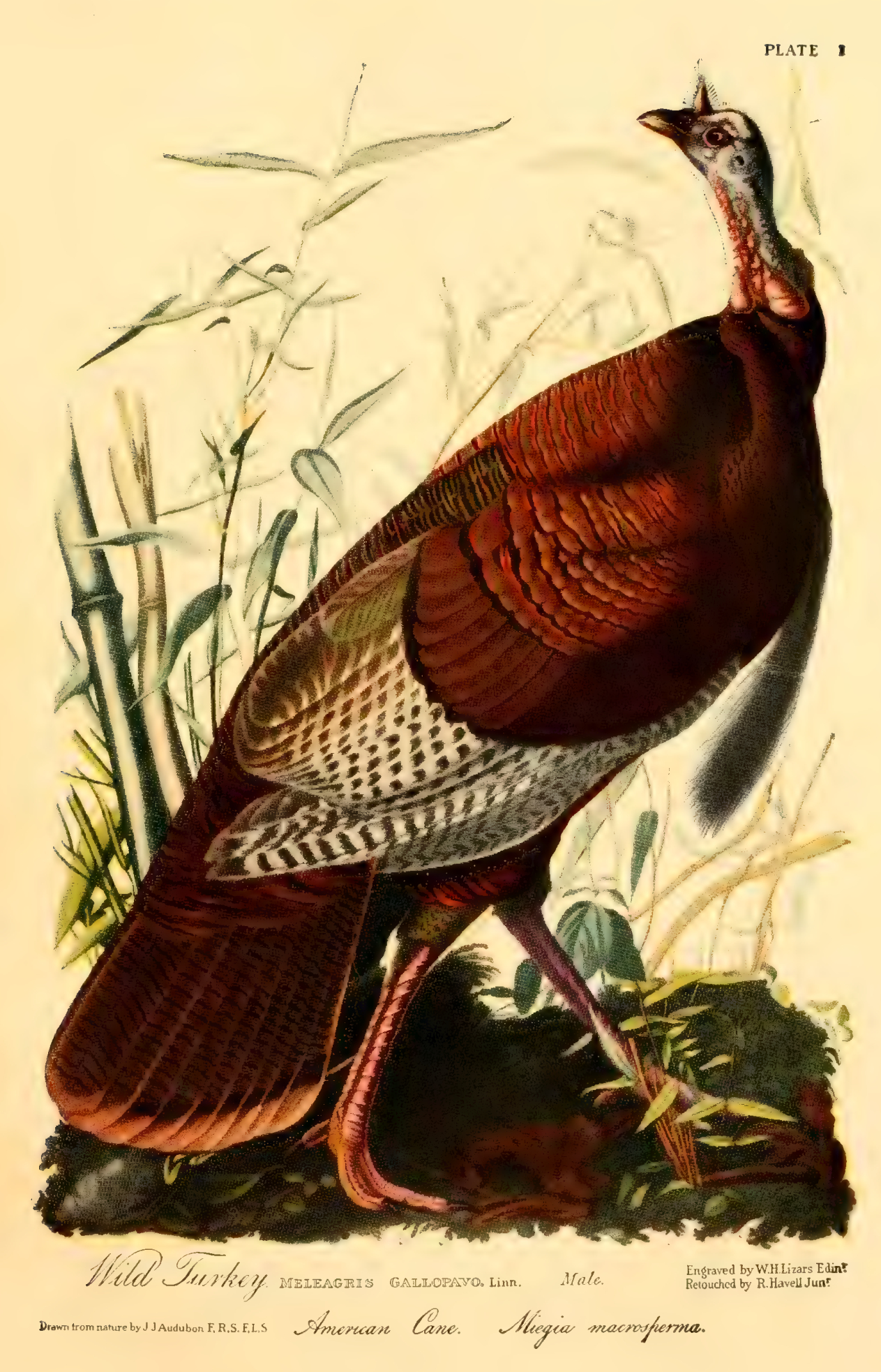
PLATE I
Wild Turkey MELEAGRIS GALLOPAVO.
Linn. Male.
Engraved by W. H. Lizars Edinr.
Retouched by R. Havell Junr.
American Cane. Miegia macrosperma.
Drawn from nature by J. J. Audubon F.R.S.F.L.S.
When Audubon’s pictures were exhibited at the
Royal Institution of Edinburgh, their success was immediate,
and like the appearance of a new Waverley novel,
they became the talk of the town; the American woodsman
had provided a new thrill for the leaders of fashion,
as well as for the literati and the scientific men.
The “noblest Roman of them all,” Sir Walter Scott,
refused to attend, but after having met the naturalist
he wrote this in his journal: “I wish I had gone to see
his drawings; but I had heard so much about them that
I resolved not to see them — ‘a crazy way of mine, your
honor.’”
Philarète-Chasles, a well known French critic of the
period, has left the following record330 of the effect
which this exhibition made on his impressionable mind:
We have admired in the rooms of the Royal Society of
Edinburgh the public exhibition of Audubon’s original watercolor
drawings. A magic power transported us into the forests
which for so many years this man of genius has trod.
360
Learned and ignorant alike were astonished at the spectacle,
which we will not attempt to reproduce.
Imagine a landscape wholly American, trees, flowers, grass,
even the tints of the sky and the waters, quickened with a life
that is real, peculiar, trans-Atlantic. On twigs, branches, bits
of shore, copied by the brush with the strictest fidelity, sport
the feathered races of the New World, in the size of life, each
in its particular attitude, its individuality and peculiarities.
Their plumages sparkle with nature’s own tints; you see them
in motion or at rest, in their plays and their combats, in their
anger fits and their caresses, singing, running, asleep, just
awakened, beating the air, skimming the waves, or rending one
another in their battles. It is a real and palpable vision of the
New World, with its atmosphere, its imposing vegetation, and
its tribes which know not the yoke of man. The sun shines
athwart the clearing in the woods; the swan floats suspended
between a cloudless sky and a glittering wave; strange and
majestic figures keep pace with the sun, which gleams from the
mica sown broadcast on the shores of the Atlantic; and this
realization of an entire hemisphere, this picture of a nature so
lusty and strong, is due to the brush of a single man; such an
unheard of triumph of patience and genius! — the resultant
rather of a thousand triumphs won in the face of innumerable
obstacles!“
Another French writer331 remarked that Audubon
produced the same sensation among the savants of England
that Franklin had made at the close of the eighteenth
century among the politicians of the Old World;
his works, he added, should be translated into his native
tongue, and produced in a form which would enable
them to reach the library of every naturalist in France.
One after another the scientific, literary, and arts societies
361
of the modern Athens elected Audubon to honorary
membership; Combe, the phrenologist and author of
The Constitution of Man, examined the naturalist’s head
and modeled it in plaster, for of course it proved to be a
perfect exemplification of his system; Syme, the artist,
did his portrait for Lizars to engrave. Meanwhile the
press was giving such flattering accounts of the man
and his work that Audubon confessed that he was quite
ashamed to walk the street. At the annual banquet of
the Royal Institution, held at the Waterloo Hotel and
presided over by Lord Elgin, Audubon was toasted,
and it required all his resolution to rise and, for the
first time in his life, address a large assembly; this, however,
he managed to do in the following words: “Gentlemen;
my command of words in which to reply to your
kindness is almost as limited as that of the birds hanging
on the walls of your Institution. I am truly obliged for
your favors. Permit me to say; may God bless you
all, and may this society prosper.” On the 10th of December
he wrote: “My situation in Edinburgh borders
on the miraculous,” and he felt that his reception in that
city was a good augury for the future. But the life
that he was compelled to lead was extremely fatiguing,
and he often longed to return to his family and to his
favorite magnolia woods in Louisiana. “I go to dine,”
he wrote, “at six, seven, or even eight o’clock in the evening,
and it is often one or two when the party breaks
up; then painting all day, with my correspondence,
which increases daily, makes my head feel like an immense
hornet’s nest, and my body wearied beyond all
calculation; yet it has to be done; those who have my
best interests at heart tell me I must not refuse a single
invitation.” But notwithstanding the tax which society
always levies upon the lion’s strength, he wrote almost
362
daily in his journal or diary,332 and its pages, from which
we have been quoting, became a mirror of all that he
saw, heard, or did. Audubon was generous with his
time, as with everything else, and would never hesitate
to lay aside his own work for the sake of a friend who
was eager to acquire his method of drawing. But when
his entertainment commenced with an invitation to
breakfast, he began to be alarmed at the large share of
his working hours which had to be surrendered to his
friends. “I seem, in a measure,” he said, “to have gone
back to my early days of society and fine dressing, silk
stockings and pumps, and all the finery with which I
made a popinjay of myself in my youth…. It is Mr.
Audubon here, and Mr. Audubon there, and I can only
hope they will not make a conceited fool of Mr. Audubon
at last.”
In response to urgent appeals he began at this time
to contribute to the scientific journals of the Scottish
capital, a step which only served to remind him that
the rose was more prolific in thorns than flowers. Dr.
Brewster, however, in his Journal of Science, and John
Wilson in Blackwoods, sang pæans in his praise, and
there is no doubt that “Christopher North,” so like and
yet so unlike the American woodsman, did much to
smooth his path in his own country as well as in Europe.
Though keenly feeling the need of literary advice in
those early contributions, Audubon was quite shocked
at the alterations which Dr. Brewster had made in one
of these articles, for though the editor had “greatly improved
the style,” he had quite “destroyed the matter.”
On December 21, 1826, Audubon wrote to Thomas
Sully that he would send him a copy of the first number
of his Birds, with the request that he forward it in his
363
name “to that Institution which thought me unworthy
to be a member…. There is no malice in my heart,”
he continued, “and I wish no return or acknowledgment
from them. I am now determined never to be a member
of that Philadelphia Society.“ Let it be noted,
however, that Audubon was elected to membership in
the American Philosophical Society, when their recognition
could no longer be withheld and when mutual
animosities had died down. Three days later he recorded
that all of his drawings had been taken from
the walls of the Royal Institution, where they had been
on exhibition a month, and that he was intending to
present to the Society his large canvas of the Wild Turkeys,
for which Galley, the picture dealer, had offered
him a hundred guineas on the previous day.333
Among Audubon’s early patrons were Lord and
Lady Morton, and more than once he was invited to
visit them in their beautiful country seat of “Dalmahoy,”
where a large, square, half-Gothic building,
crowned with turrets and adorned with all the signs
of heraldry, overlooked a beautiful landscape to Edinburgh,
marked by its famous castle, seen in miniature
on the horizon, eight miles away. Being somewhat apprehensive
of meeting the former Chamberlain to the
late Queen Charlotte, Audubon had imagined the Earl
364
to be “a man of great physical strength and size”; instead,
however, he saw
a small, slender man, tottering on his feet, weaker than a
newly hatched partridge; he welcomed me with tears in his
eyes, held one of my hands, and attempted speaking, which was
difficult to him, the Countess meanwhile rubbing his other hand.
I saw at a glance the situation, and begged he would be seated
… and I took a seat on a sofa that I thought would swallow
me up, so much down swelled around me. It was a vast room,
at least sixty feet long, and wide in proportion, let me say
thirty feet, all hung with immense paintings on a rich purple
ground; all was purple about me. The large tables were covered
with books, instruments, drawing apparatus, a telescope,
with hundreds of ornaments.
After luncheon Audubon’s “Book of Nature” was produced,
and his drawings spread out and admired. Next
day the Countess, who was “a woman of superior intellect
and conversation,” was given “a most unnecessary
lesson” in drawing, for, said the naturalist, “she drew
much better than I did; but I taught her to rub with
cork, and prepare for water-color.” Before he left the
Countess wrote her name in his subscription book, and
arranged that he should return and resume his instruction.
One of Audubon’s early friends at Edinburgh was
Captain Basil Hall,334 traveler and writer, who was then
about to start on a journey through the United States;
he told the naturalist that he was a midshipman on board
the Leander “when Pierce was killed off New York,”
at the time of Audubon’s return with Rozier to America
in 1806, when Captain Sammis, upon seeing the British
365
frigate, “wore around Long Island Sound, and reached
New York by Hell Gate.” It was at Captain Hall’s
home that Audubon met Francis Jeffrey. The indomitable
critic and reviewer was described as “a small (not
to say tiny) man,” who entered the room “with a woman
under one arm, and a hat under the other.” “His looks
were shrewd,” said the naturalist, his eyes “almost cunning”
and though he talked much, he appeared unsympathetic.
Their meeting was productive of no friendly
feelings on either side.
Three months after reaching Edinburgh, the long
awaited opportunity of meeting the greatest literary
figure of the day came to Audubon unexpectedly, for
he did not wish to be introduced in a crowd. Under
date of January 22, 1827, he wrote that Captain Hall
came to his rooms and said: “Put on your coat, and
come with me to Sir Walter Scott: he wishes to see you
now.” “In a moment,” said Audubon, “I was ready….
My heart trembled; I longed for the meeting, yet
wished it over.” When they were ushered into Sir
Walter’s study, the great Scot came forward, and
warmly pressing the hand of his visitor, said he was
glad to have the honor of meeting him. Audubon’s
record of the meeting continues:
His long, loose, silvery locks struck me; he looked like
Franklin at his best. He also reminded me of Benjamin West;
he had the great benevolence of William Roscoe about him, and
a kindness most prepossessing. I could not forbear looking at
him; my eyes feasted on his countenance. I watched his movements
as I would those of a celestial being; his long, heavy,
white eyebrows struck me forcibly. His little room was tidy,
though it partook a good deal of the character of a laboratory.
He was wrapped in a quilted morning-gown of light purple
silk; he had been at work writing on the “Life of Napoleon.”
366
He writes close lines, rather curved as they go from left to
right, and puts an immense deal on very little paper…. I
talked little, but, believe me, I listened and observed.
Two days later Audubon paid Scott a second visit, this
time with his portfolio, but little was recorded of this
interview other than that it was more agreeable than
the first, and that he greatly admired the accomplished
Miss Scott, to whom he later sent as a gift the first
number of his plates. Audubon’s drawings were exhibited
at a meeting of the Royal Society over which
Sir Walter presided, and Scott was also in attendance
at the Royal Institution when Audubon’s large painting
of the Black Cocks was shown. “We talked much”
on this occasion, said the naturalist, “and I would have
gladly joined him in a glass of wine, but my foolish
habits prevented me.” This restriction on wine was
soon removed, as was that on whisky, whether of the
Scotch or Kentucky brand, and during his later life in
America Audubon was never a teetotaler by any means.
While at the Exhibition Sir Walter pointed to Landseer’s
picture of the dying stag, saying, “many such
scenes, Mr. Audubon, have I witnessed in my younger
days.” Audubon was doubtless too polite to express an
opinion of that popular artist, though of that very picture
he had written in his journal three days before that
there was no nature in it, and that he considered it a
farce; “the stag,” he said, “had his tongue out, and his
mouth shut! The principal dog, a greyhound, held the
deer by one ear, just as if a loving friend; the young
hunter had laced the deer by one horn very prettily,
and in the attitude of a ballet-dancer was about to cast
the noose over the head of the animal.”
Scott and Audubon were kindred spirits in their love
367
of sport, of wild and untameable nature, as well as of
man in his Homeric relation to it. Shortly after their
first interview the great Scotsman wrote this handsome
tribute in his journal:
January 22 1827. — A visit from Basil Hall with Mr.
Audubon, the ornithologist, who has followed that pursuit by
many a long wandering in the American forests. He is an
American by naturalization, a Frenchman by birth; but less of
a Frenchman than I have ever seen — no dash, or glimmer, or
shine about him, but great simplicity of manners and behaviour;
slight in person, and plainly dressed; wears long hair, which
time has not yet tinged; his countenance acute, handsome and
interesting, but still simplicity is the predominant characteristic.
Of the later visit of which we just spoke we find this
account:
January 24. — Visit from Mr. Audubon, who brings some
of his birds. The drawings are of the first order — the attitudes
of the birds of the most animated character, and the
situations appropriate; one of a snake attacking a bird’s nest,
while the birds (the parents) peck at the reptile’s eyes — they
usually, in the long-run, destroy him, says the naturalist. The
feathers of these gay little sylphs, most of them from the
Southern States, are most brilliant, and are represented with
what, were it not connected with so much spirit in the attitude,
I would call a laborious degree of execution. This extreme
correctness is of the utmost consequence to the naturalist,
but as I think (having no knowledge of vertu), rather
gives a stiffness to the drawings. This sojourner in the desert
has been in the woods for months together. He preferred associating
with the Indians to the company of the Back Settlers;
very justly, I daresay, for a civilized man of the lower order — that
is, the dregs of civilization — when thrust back on the savage
state becomes worse than a savage….
368
The Indians, he says, are dying fast; they seem to pine and
die whenever the white population approaches them. The
Shawanese, who amounted, Mr. Audubon says, to some thousands
within his memory, are almost extinct, and so are various
other tribes. Mr. Audubon could never hear any tradition
about the mammoth, though he made anxious inquiries. He
gives no countenance to the idea that the red Indians were ever
a more civilized people than at this day, or that a more civilized
people had preceded them in North America. He refers the
bricks, etc., occasionally found, and appealed to in support of
this opinion, to the earlier settlers, — or, where kettles and other
utensils may have been found, to the early trade between the
Indians and the Spaniards.
Audubon was anxious to receive a written recommendation
from the great “Wizard of the North” touching
the merits of his work, the publication of which had
just begun, but Sir Walter Scott sensibly demurred, on
the ground that his knowledge of natural history was
insufficient to qualify him to pass expert judgment.
“But,” he added, “I can easily and truly say, that what
I have had the pleasure of seeing, touching your talents
and manners, corresponds with all I have heard in your
favor; and I am a sincere believer in the extent of your
scientific attainments.”
While Audubon was playing the rôle of society’s
pet lion at Edinburgh in the winter of 1827, he was
painting to meet the expense of engraving his first
plates, and writing at odd times of the day or night.
On February 20 he recorded that his paper on the
“Habits of the Wild Pigeon of America” was begun on
the previous Wednesday, and finished at half past three
in the morning; so completely, said he, was he transported
to the woods of America and to the pigeons,
that his ears “were as if really filled with the noise of
369
their wings“; yet he added that were it not for the facts
it contained, he would not give a cent for it, ”nor anybody
else, I dare say.“ Four days later, at the Wernerian
Society, he read his paper on the rattlesnake,
but the torrent of abuse which soon rewarded his efforts
in this direction finally led him to reserve all literary
efforts for a future and more propitious time.335
A large painting begun in January of this year,
called “Pheasants attacked by a Fox,” was probably a
variant of the “Pheasants attacked by a Dog” (illustrated
at page 394), the original of which is now in the
American Museum of Natural History, New York
City. This canvas, which was exhibited by the Scottish
Society of Artists in February, 1827, measured nine by
six feet, and was the largest piece he had ever attempted.
“Sometimes I like the picture,” he said, and “then a
heat rises in my face and I think it a miserable daub.”
“As to the birds,” he added, “so far as they are concerned
I am quite satisfied, but the ground, the foliage,
the sky, the distance, are dreadful.”336
In the spring of 1827 Audubon enjoyed the novel
sensation of going to church in a sedan chair, and of
hearing Sidney Smith preach. “He pleased me at
times,” he said, “by painting my foibles with care, and
again I felt the color come to my cheeks as he portrayed
my sins.” Later there was an opportunity to
meet the famous preacher with his fair daughter, and
to show them his drawings of American birds.
The following letter337 was sent at this time to his
wife in America:
370
Audubon to his Wife
Edinburgh March 12th, 1827.
My Dearest Friend:
I am now proud that I can announce thee the result of the
last meeting of the Royal Society of Edinburgh. I was
unanimously elected a Foreign Member of that Institution on
the 5ṭḥ
Instant and am at last an F. R. S.. — Wilt thou not
think it wonderful; to me it is like a dream, and quite as much
so when I see the particular attentions paid me by all ranks of
the best Society. On the 6ṭḥ
I received the official Letter from
the Secretary with the seal of the Society and the arms of
Scotland — this along with my other diplomas and Letters, I
assure thee enable me to be respected and well received in any
portion of the Civilized World. Sir Walter Scott has also
been so kind as to give me a Letter that I may exhibit wherever
I may go
I have Two Letters from him very kind
all this I
think will afford thee great Pleasure.
I am now preparing to leave Edinburgh and will do so in
a few days, I am now anxious to visit London as soon as I
possibly can, and yet want to spend a few days at New Castle,
York, Liverpool, Dublin, then back again to England, go by
Cambridge and Oxford. — If I meet the success that I expect
in that Tour it is very probable that soon after my reaching
London, I will write for thee to Come, and when I do so, my
Lucy may come without the least Hesitation for I will then be
ready to receive her!
Since my last of the 22d of February, I have received thine
of the 31t of December, 3d of January and 8th of Do. this last
mostly John’s, I am particularly glad that thou hast left the
Beech Woods, yet thou might as well have given me at once
thy good reasons for doing so. I hope that at this Instant
that I am writing, thou art snug and comfortably settled afresh.
The Trees and Segments have not yet arrived, but I hope
to hear soon that they have — I have not a word about the
Seeds reaching yet. do my Love always say by what vessel any
thing comes, as John as concluded to take Lessons of Music
371
I have no wish to sell my Gun but wish to give it him as his
own in Fee Simple, as soon as he deserves it from thy own
Hands. May God bless him! — if all continues well with me
Victor and him may rise to eminence and therefore try Johny’s
Spunk. do beg or make him draw all kinds of Limbs of Trees
or Flowers for me and whenever he kills a bird of any kind tell
him to measure the Guts particularly and make a regular list
of the names of the Birds, length and thickness of those Guts
and their contents
338
I wrote a long letter to each Victor and N. Berthoud on
the 27 February, but not a word from either of them as yet
reached me. I was quite shocked to see thy last letter of the
8th of January without the print of thy new Seals, I am quite
frightened at thy watch not having reachd thee, yet I hope every
new Letter will bring me better tidings. I now collecting Letters
from all my Friends here and will have God knows enough
of them. I only hope I may soon be in a regular way of making
a comfortable living for ourselves all:
All the papers and books I send thee mention my name. My
work is lookd upon as unrivalled in any Country, I will soon
know how it will pay. — I can only add that I will write to thee
from all the places I visit
Let Victor have a copy of this
Collect
all kinds of Curiosities whatever
try to send or bring
with thee but send first if Possible Live Birds of hardy kinds
such as Blue Jays by THEMSELVES. Red Birds Do. red wingd
Starling Do, Partridges &c &c. — present my humble respects to
Mr & Mrs Johnsons and remembrances to good Friend bourgeat — try
to send me an account of the growing of Cotton from
A to Z, written by an able Planter — I wish thee to make regular
memorandums thyself respecting all about Habits & Localities
&c &c.
thou wilst scarce believe that this day there
are in many places 16 feet of snow. the weather has been
tremendous — yet with all this no Invitation is ever laid aside
372
and the other evening I went to Diner in a Hackny Coach
drawn by 4 Horses, and to church on Sunday last in a Sedan
chair to hear the famous Sidney Smith, curious diferences of
manners here I assure thee.
I have seen and know personally all the great men of Scotland
and many of England.
What a curious interesting book a Biographer — well acquainted
with my Life could write, it is still more wonderfull and extraordinary
than that of my Father!
Fear not my connecting myself in any way with Charles M.
he is a mere worm on the hearth, and since he has abandoned
his Grand Flora is out of my books — it has perhaps been an
error in our Lives that thou didst not come with me. So much
indeed do I now think so that I have advised Capn Hall to
take his Lady and child with him. be sure to pave the way for
them to Judge Mathews and N. Berthoud to whom I have given
him letters to. — I send thee his Travels, read his interview with
Napoleon; I write my Journal every day, it seems that that
portion of it forwardd thee long ago as never reachd thee as
thou dost not mention it. I am sorry for all these little misfortunes
and can hardly a/c for them. I have not heard from
H. Clay but will refresh his memory, I hope at the same time to
receive a Letter from the President
I hope this day the last
beautiful broach I sent thee as a new Years gift is shining on
thy bosom, as I have witnessed the brightness of thy own sweet
Eyes, oh my Lucy what would I give now in my possession for
a kiss on thy Lips and ——— God for ever bless thee thine
Husband and Friend for ever —
John J. Audubon
| F.R.S.E. |
Fellow |
Royal Society Edinburgh — |
| F.A.S. — |
Fellow |
Royal Society antiquarians — |
| M.W.S.N.H. — |
Member |
Wernerian Society of Natural History |
| M.S.A. — |
Member |
Society of Arts of Scotland — |
| M.P.L.S. — |
Member |
Philosophical & Literary Society Liverpool |
| M.L.N.Y. — |
Member |
Lyceum of New York. |
373
My Dear John —
I am very thankfull to you for your Letters continue
to write from time to time, draw, and study music
closely, there is time for all things — I give you my Gun
with all my Heart best wishes, but earn it at your Dear
Mamma’s will — God bless You —
Your Father and Friend —
John J. Audubon
At Edinburgh Audubon met a young landscape
painter, Joseph B. Kidd, and the two worked together
for some time, Kidd receiving instruction in animal
painting and Audubon hints on the treatment of his
landscapes, which had always been a source of trouble
to him. Kidd was Audubon’s Edinburgh agent for a
time, and later entered upon the ambitious project of
reproducing all of his birds in oils, as will be noticed
later.339
On March 17, 1827, when the second number of his
Birds was in preparation, Audubon boldly issued his
“Prospectus,” contrary to the advice of some of his
friends, who could see only egregious folly in such an
undertaking and regarded it as foredoomed to failure.
As everybody knows, it is easier to say things than to
do them, but all these friendly critics sang a different
tune later on, when they had seen more of the indomitable
will and self-reliance of the man, who was to
carry steadily forward to a successful issue a work
which was in press nearly twelve years and which cost
over $100,000 to produce. In Audubon’s original
prospectus of The Birds of America the specifications
as to the form, size, and cost of the work, which had
been determined for some months, underwent little
374
change in subsequent editions of this printed statement.340
Audubon left Edinburgh for London on April 5,
1827, with locks shorn but energy unabated. He followed
a roundabout course, visiting Belford, “Mitford
Castle,” Newcastle-upon-Tyne, York, Leeds, Liverpool,
and Shrewsbury, at every point extending his acquaintance,
showing his drawings to many, and adding
appreciably to his growing list of subscribers. Several
days were spent in hunting and drawing birds with the
Selbys, at their beautiful country place called “Twizel
House,” at Belford, in Northumberland, where he was
soon made to feel as much at home as with his older
Liverpool friends, the Rathbones, at “Green Bank.”
P. J. Selby, after whom Audubon named a Flycatcher
which appeared in his second number, was an amateur
artist and ornithologist, and at that time was engaged
upon an extensive publication to which Audubon was
375
invited to contribute, a single volume of plates and text
having then been published.341
At Newcastle, where Audubon spent a week, he
saw much of its grand old man, Thomas Bewick, “the
first wood cutter in the world,” and conceived a deep
regard for him, which he afterwards expressed in one
of his “Episodes.” As they parted, this great son of
nature held him closely by the hand, and for the third
time repeated, “God preserve you!” “I looked at him
in such a manner,” said Audubon, “that I am sure he
understood I could not speak.”
376
As he proceeded southward, his subscription list
augmented apace, Manchester alone giving him eighteen
new names, and he began to feel more sanguine of success,
if, he added, “I continue to be honest, industrious,
and consistent.”
377
Impressions of the metropolis — A trunk full of letters — Friendship of
Children — Sir Thomas Lawrence — Lizars stops work — A family of
artists — Robert Havell, Junior — The Birds of America fly to London — The
Zoölogical Gallery — Crisis in the naturalist’s affairs — Royal
patronage — Interview with Gallatin — Interesting the Queen — Desertion
of patrons — Painting to independence — Personal habits and tastes — Enters
the Linnæan Society — The White-headed Eagle — Visit to the
great universities — Declines to write for magazines — Audubon-Swainson
correspondence — “Highfield Hall” near Tyttenhanger — In Paris
with Swainson — Glimpses of Cuvier — His report on The Birds of
America — Patronage of the French Government and the Duke of
Orleans — Bonaparte the naturalist.
Audubon reached London on May 21, 1827, and
put up at the “Bull and Mouth” tavern, but soon moved
into more permanent lodgings at number 55 Great
Russell Street, near the British Museum. Though for
a long time eager to see the capital, no sooner had he
reached it than he was anxious to be away and more
homesick than ever for his family and his beloved
America. London then seemed to him “like the mouth
of an immense monster, guarded by millions of sharp-edged
teeth,” from which he could escape only by
miracle.
He had brought with him a formidable array of
letters addressed to the élite of the capital,342 and he bore
378
besides nearly a trunkful for the Continent, as well as
general letters from Henry Clay, Andrew Jackson and
others in America for our consular and diplomatic representatives
in Europe. His epistolary basis for the
acquisition of useful acquaintances could hardly have
been better, and further testimonials were gathered at
every stage of his progress to the city of his hopes, but
Audubon’s best letter of credit, which could be read by
all the world, was an open, winning countenance. After
he had wandered over London for the greater part of
three days without finding a single individual at home,
he was tempted to consign his valuable documents to
the post, an error which he did not repeat, as it deprived
him of the acquaintance of fully one-half of the people
to whom they were addressed. One of these London
letters which follows, written by Captain Basil Hall to
John Murray, the noted publisher and founder of the
Quarterly Review, is particularly interesting in showing
that Audubon was far from pleased with the progress
of his work in Edinburgh, and that he was then
contemplating a change which was later effected.
Basil Hall to John Murray
Edinb 23rd Feby. 1827
My Dear Sir
This will be delivered to you by my friend Mr John Audubon,
an American Gentleman who has been residing here this
winter, & I beg in the most particular manner to introduce him
to your acquaintance and to ask for him the advantage of your
good offices.
Mr Audubon has spent a great part of his life in making
a collection of drawings of the Birds of North America, & in
studying their Habits, with the intention of publishing a Complete
Ornithology of America. For such a work his materials,
both in the shape of drawings and of written notes, are immense
379
and he is now going to London in order to set this gigantic work
in motion.
Mr Audubon, however, is not very well versed in the details
of such matters, & therefore I beg of you to have the goodness
to aid him with your advice on the occasion — to introduce engravers
printers & so forth to him, and generally speaking to
put him in the way of bringing out his work in an advantageous
manner to himself.
I trust all this will give you no more trouble than you will
be willing to take at my earnest solicitation.
I remain Ever, My Dear Sir,
Most Sincerely Yrs
Basil Hall.
John Murray Esqr
Audubon carried also a long letter from “Mr.
Hay,”343 dated at “16 Athol Crescent, Edinburgh, 15
March, 1827,” and addressed to the care of his brother,
Robert William Hay, of Downing Street, West, in
which this curious statement occurs: “Mr. A. is son of
the late French Admiral Audubon, but has himself lived
from the cradle in the United States, having been born
in one of the French colonies.”
The document which was to prove of greatest service
to him, however, was addressed to John George Children,344
then in charge of the Department of Zoölogy in
380
the British Museum and secretary of the Royal Society.
Children assumed the management of Audubon’s work
when he returned to America in 1829 and again in
1831; to him and Lord Stanley, in 1830, the naturalist
probably owed his nomination to membership in the
Royal Society.
Soon after reaching London Audubon paid his respects
to Sir Thomas Lawrence, for whom he had two
letters, and made an appointment for showing his work
to this famous artist. He was also gratified to receive
the subscription of Lord Stanley and of Charles Lucien
Bonaparte, who was then in London.
Audubon had not been in London a month before
word was received from Lizars that all his colorers had
struck work and that everything was at a stand. Accordingly,
he began to search London for skilled workmen,
and on June 18 wrote: “I went five times to see
Mr. Havell, the colorer, but he was out of town. I am
full of anxiety and greatly depressed. Oh! how sick
I am of London!” Three days later another discouraging
letter came from Lizars, who shortly after threw
up his contract and left his patron in a sad predicament — with
an enormously expensive work, still-born,
on his hands, without adequate funds, and, in short,
with all his cherished plans suspended in mid-air. Audubon
no doubt realized that if his grand undertaking
were to succeed at all, it must experience a new birth
in London, where an expert engraver of the requisite
enterprise and zeal must be found without delay. He
closed his journal on the second day of July with the
382
remark that he was too dull and mournful to write a
line, and it was not opened again for nearly three months.
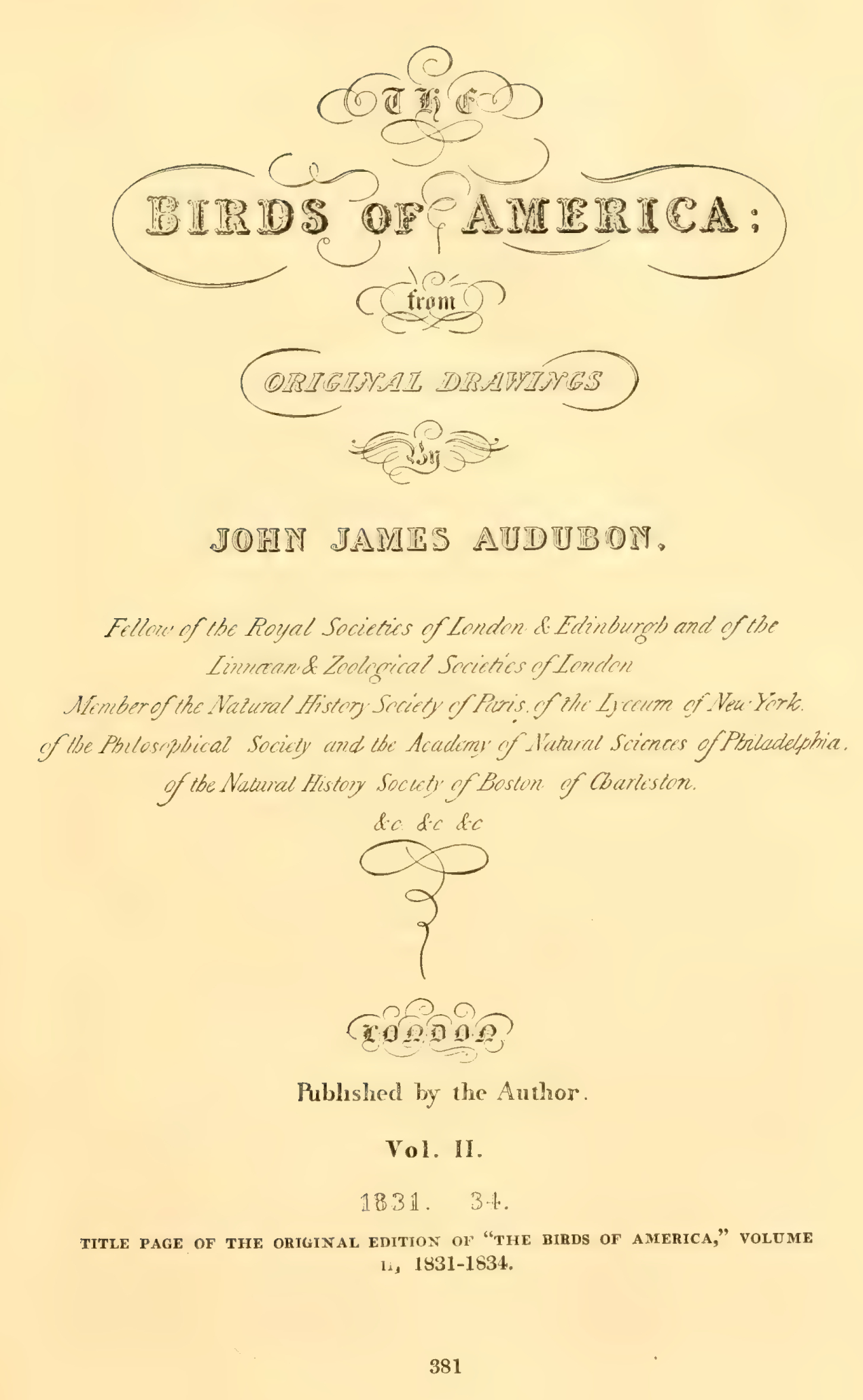
TITLE PAGE OF THE ORIGINAL EDITION OF “THE BIRDS OF AMERICA,” VOLUME II, 1831-1834.
This gap in Audubon’s record can now be filled in
reference to some important particulars, for in the interval
he made his greatest discovery in England, in
Robert Havell, Junior, then a young and unknown
artist of thirty-four, who through eleven years of the
closest association with his new patron was to become
one of the greatest engravers in aquatint the world has
ever seen. Until recently the intimate story of Audubon’s
relation to the Havells has been much obscured.345
The reference in the journal record of June 19, just
given, was undoubtedly to Robert Havell, Senior, who
for many years was associated with his father, Daniel
Havell, the first of five generations of artists of that
name, in the engraving and publishing business, but
who at this time was established independently at 79
Newman Street, London; he also conducted a shop
called the “Zoölogical Gallery,” at which were sold engravings,
books, artists’ materials, naturalists’ supplies,
and specimens of natural history of every sort. His
three sons, Robert, George, and Henry Augustus, all
became artists, but the eldest, who bore his father’s
name, was educated for a learned profession. Contrary
to his father’s injunctions and advice, Robert, who was
bent on becoming an artist, abruptly left his home in
1825, determined to shift for himself. He began with
an extensive sketching tour on the River Wye, in Monmouthshire,
and produced numerous paintings which,
383
as his biographer remarks, display all the charm found
in the work of his distinguished cousin, William Havell.
These won immediate recognition in London, where he
received commissions from various publishers, including
the house of Messrs. Colnaghi & Company.
Robert Havell, Senior, then in his fifty-eighth year,
though deeply interested in Audubon’s adventurous
plans, felt himself too old to embark on so extended a
work, which it was then believed would require from
fourteen to sixteen years for completion; he volunteered,
however, to do his best to find a substitute.
With this in view, he applied to Mr. Colnaghi, the publisher,
and was immediately shown the unsigned proof
of a beautiful landscape, exquisitely drawn and engraved
by one of the youthful retainers of his establishment.
The elder Havell, after scrutinizing it carefully,
exclaimed, “That’s just the man for me!”
“Then,” replied the publisher, “send for your own son!”
Through this singular coincidence, father and son became
reconciled and a partnership between them was
soon announced.
As a test of young Havell’s skill, to follow the
story of his biographer, Audubon gave him his drawing
of the Prothonotary Warbler, which had already been
engraved and issued by Lizars as Plate iii of The Birds
of America earlier in that year. Havell finished the
engraving in two weeks, when a proof was struck and
the naturalist summoned. Audubon examined the
print with the utmost keenness and deliberation; then
he seized the sheet, and holding it up, danced about
the room, calling out in his French accent: “Ze jig is
up, ze jig is up!” The Havells, who at first thought
this might signify disapproval, were quickly disabused
when Audubon approached young Robert and, throwing
384
his arms about his neck, assured him that his long-sought
engraver had been found at last. Having given
this story, I wish it were possible to confirm it, but a
close examination of this plate proves either that the
story is a fiction, or that some other drawing was used
as a test of Havell’s skill.346
The part which this interesting family played in
Audubon’s success will be unfolded later.347 Suffice it
now to say that Messrs. Robert Havell & Son, in London,
undertook afresh the production of The Birds of
America in the summer of 1827. The partnership was
divided or dissolved in 1828, when Robert, junior, who
from the first did all of the engraving, took entire
charge of that part of the business, and moved his engraving
establishment around the corner to 77 Oxford
Street; there it remained until broken up in 1838. Robert
Havell, Senior, continued in charge of the printing
and coloring until 1830, when he seems to have permanently
retired, two years before his death in 1832,
events which, as will be seen, are indirectly registered
in the legends of some of Audubon’s plates.348

THE PROTHONOTARY WARBLER PLATES, “THE BIRDS OF AMERICA,” PLATE XI, BEARING THE LEGENDS OF THE ENGRAVERS W. H. LIZARS (LEFT) AND ROBERT HAVELL, JR. (RIGHT), BUT IDENTICAL IN EVERY OTHER DETAIL OF ENGRAVING, ANY APPARENT DIFFERENCE BEING DUE TO THE COLORING, WHICH WAS ADDED BY HAND.
385
Under the younger Havell’s guiding hand, Audubon
found that his illustrations could be produced in
better style, more expeditiously, and at far less cost
than in Edinburgh. When Lizars was later shown the
third number which the Havells had produced, he called
his assistants and observed how completely the London
workmen had beaten them; he even offered to resume
work on the engraving and at Havell’s price, but Audubon
was averse to further experimenting. “If he can
fall,” said he, “twenty-seven pounds in the engraving
of each number, and do them in a superior style to his
previous work, how enormous must his profits have
been; a good lesson to me in the time to come, though I
must remember Havell is more reasonable owing to
what has passed between us in our business arrangements,
and the fact that he owes so much to me.”
This characteristic note was sent from Liverpool,
December 6, 1827, to his agent, Daniel Lizars, father
to W. H. Lizars, at Edinburgh:
I will not ask if you have any new name for me, as I might
be disappointed were I to expect an affirmative answer.
If you see Sir Wm. Jardine tell him that Charles Bonaparte
has left the U. S. for ever, and has gone to reside in Florence,
Italy.
I have wrote to Mr. Havell to send you a No. 5, which I
wish you to send to Professor Wilson, or indeed a whole set, to
enable him to write the notice he has promised for me the 1st.
of next month.
386
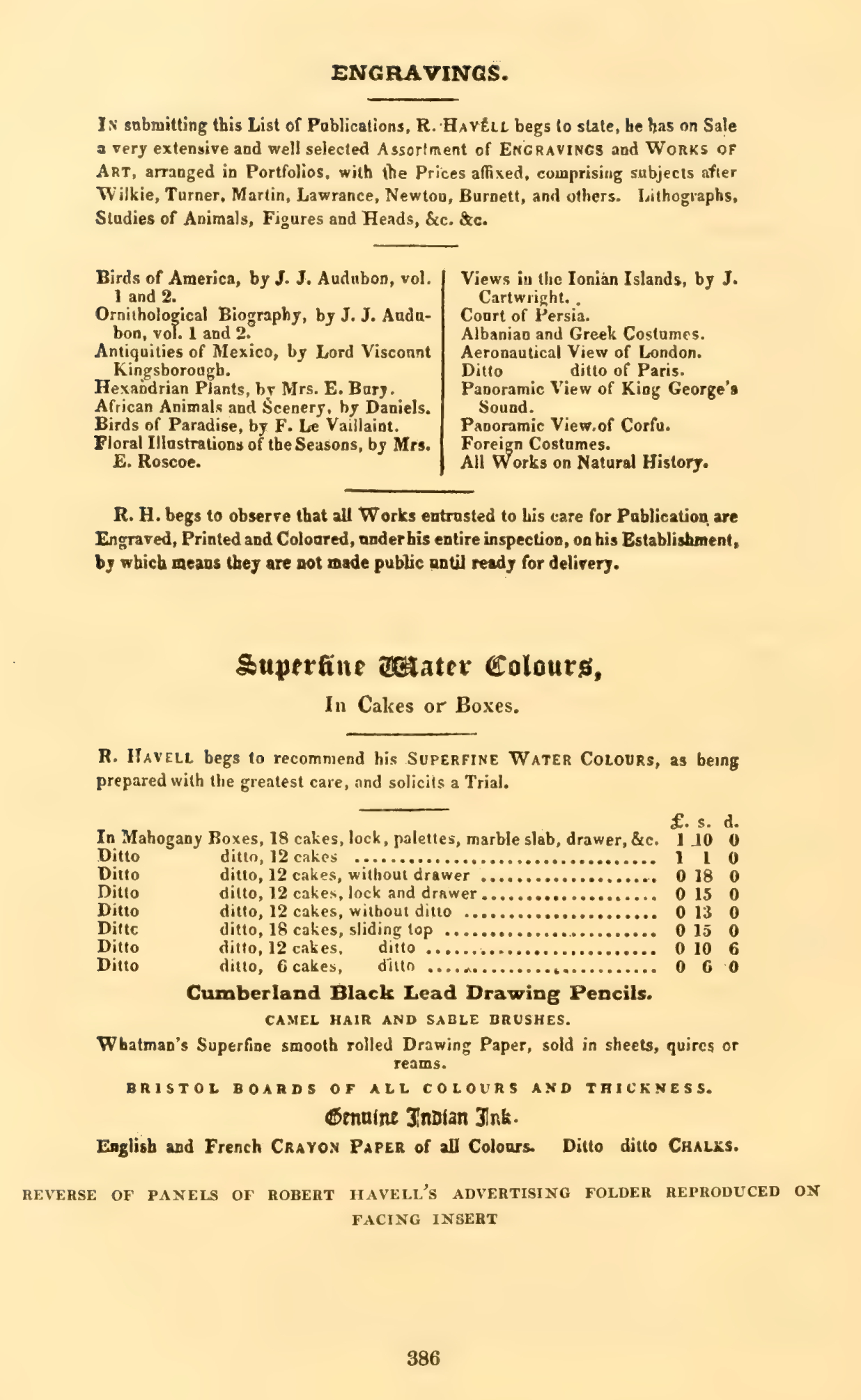
REVERSE OF PANELS OF ROBERT HAVELL’S ADVERTISING FOLDER REPRODUCED ON FACING INSERT.
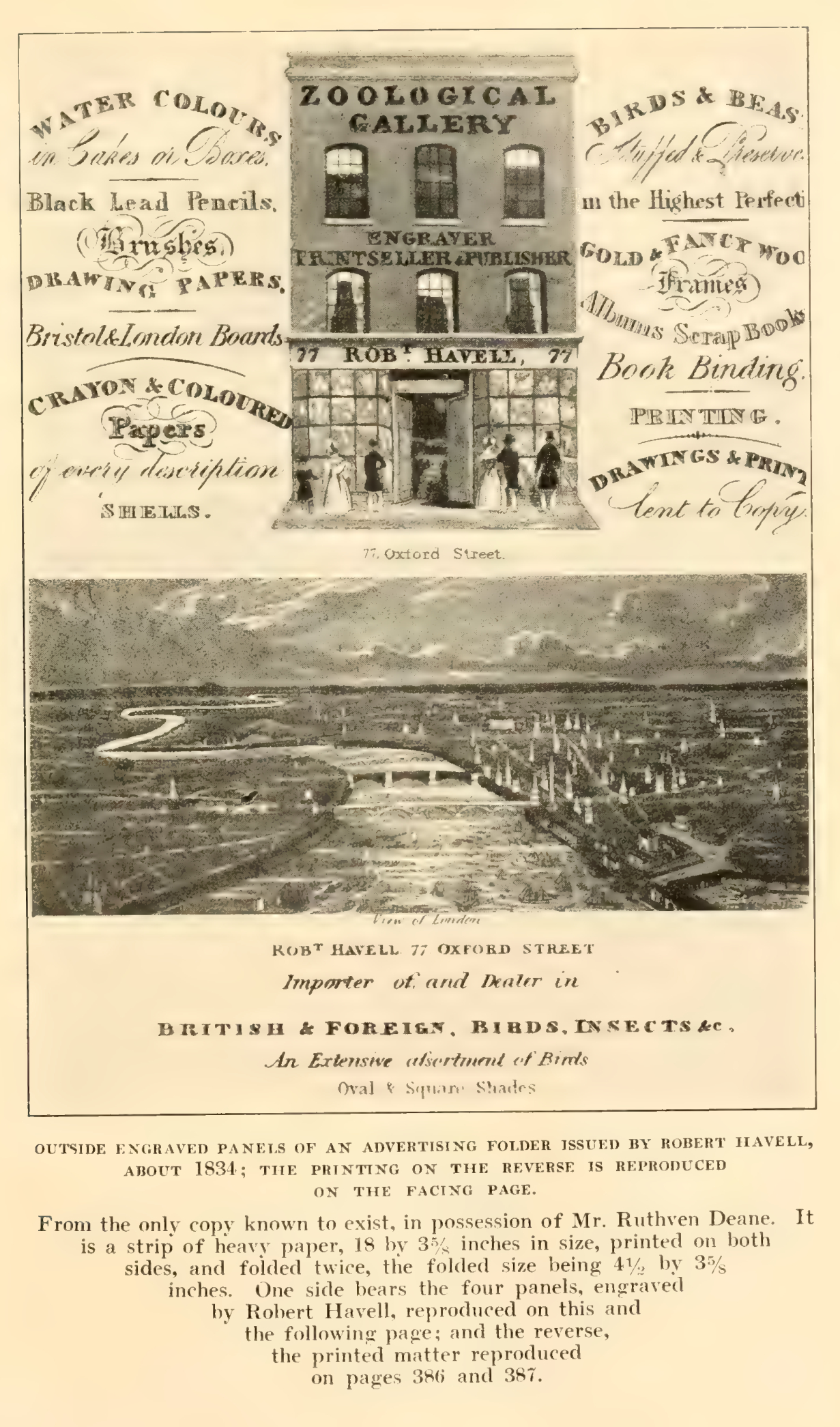
OUTSIDE ENGRAVED PANELS OF AN ADVERTISING FOLDER ISSUED BY ROBERT HAVELL, ABOUT 1834; THE PRINTING ON THE REVERSE IS REPRODUCED ON THE FACING PAGE.
From the only copy known to exist, in possession of Mr. Ruthven Deane. It is a strip of heavy paper, 18 by 3
5⁄
8
inches in size, printed on both sides, and folded twice, the folded size being 4½ by 3
5⁄
8
inches. One side bears the four panels, engraved by Robert Havell, reproduced on this and the following page; and the reverse, the printed matter reproduced on pages
386 and
387.
387
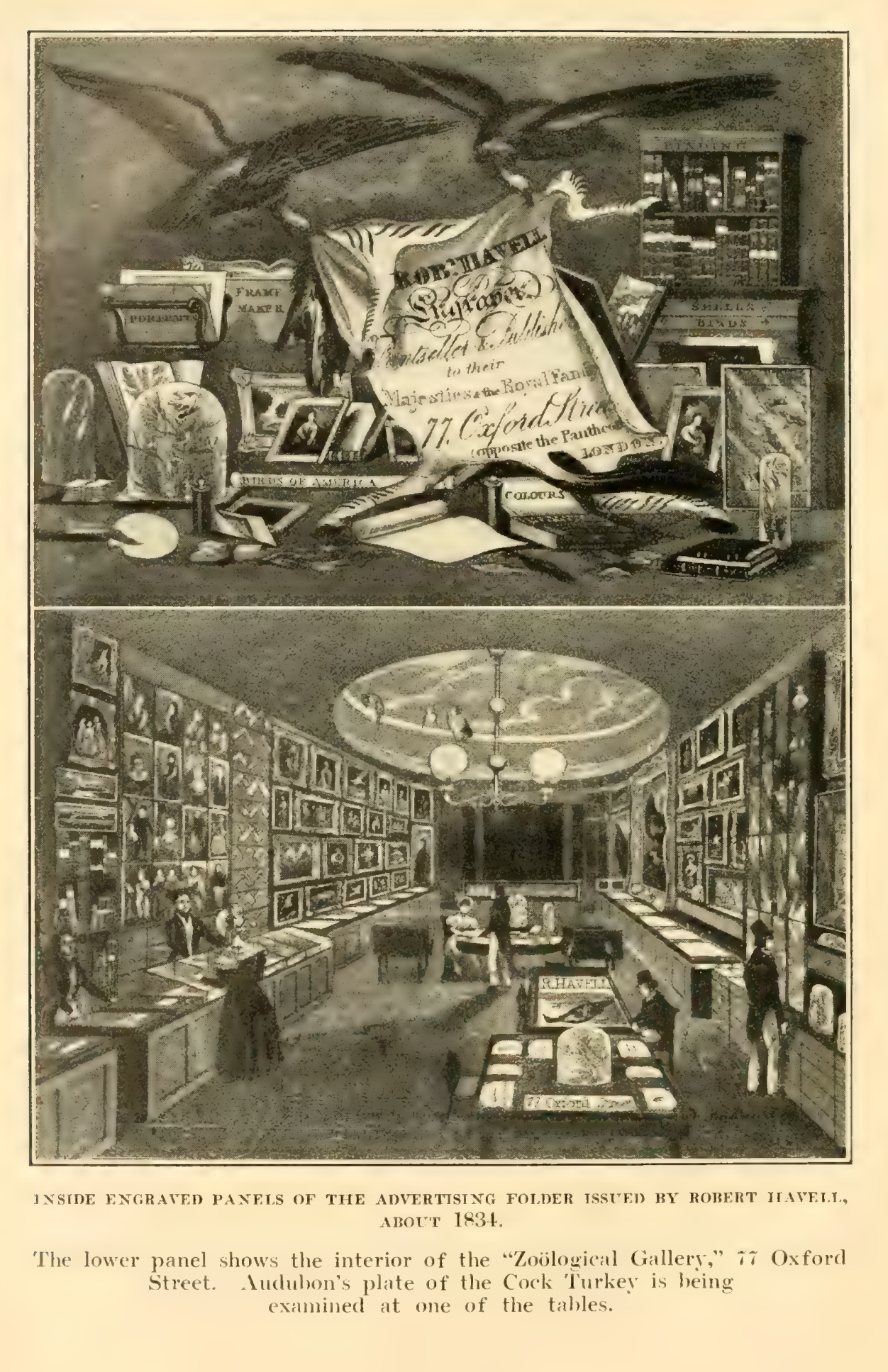
INSIDE ENGRAVED PANELS OF THE ADVERTISING FOLDER ISSUED BY ROBERT HAVELL, ABOUT 1834.
The lower panel shows the interior of the “Zoölogical Gallery,” 77 Oxford Street. Audubon’s plate of the Cock Turkey is being examined at one of the tables.
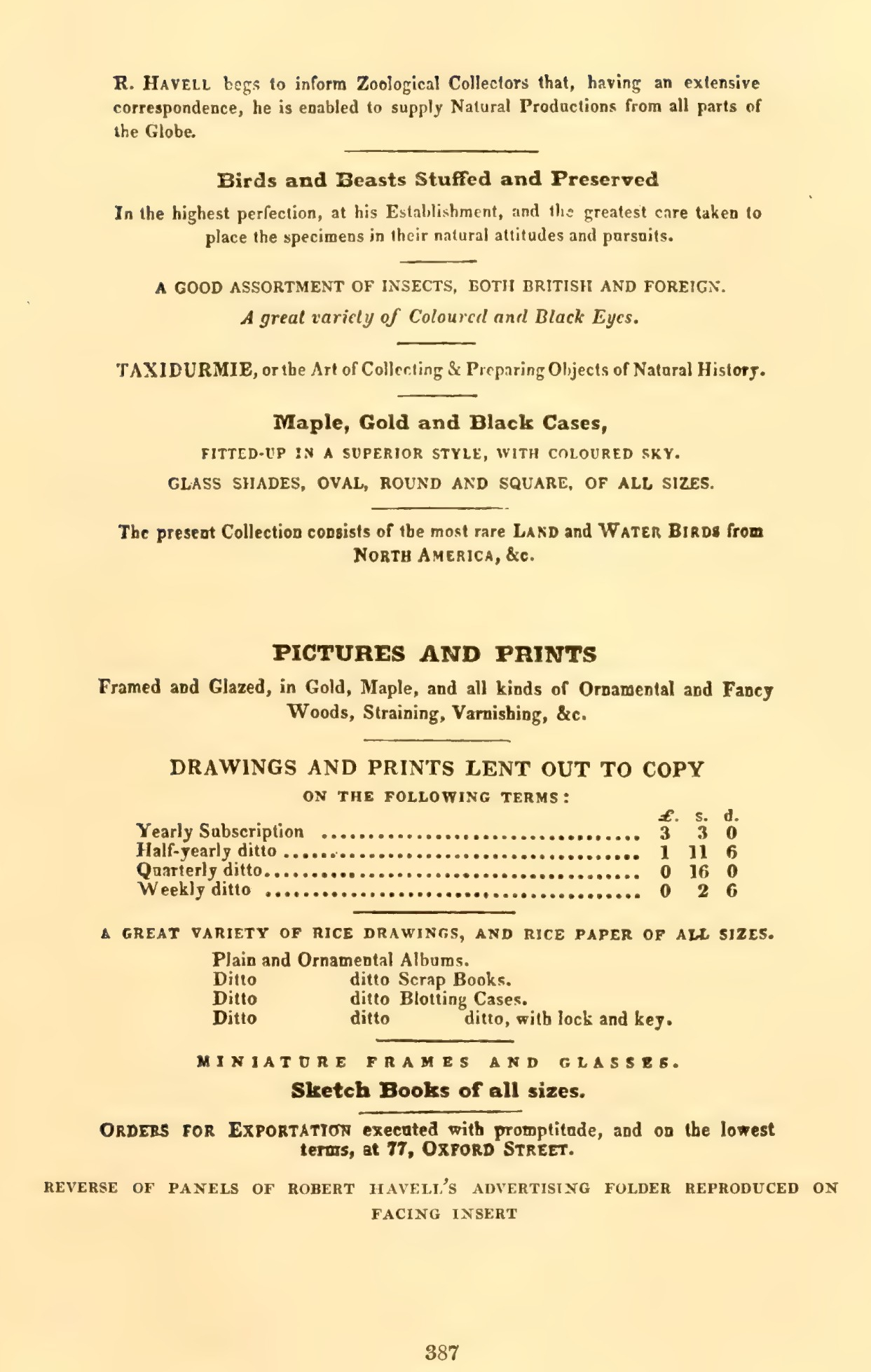
REVERSE OF PANELS OF ROBERT HAVELL’S ADVERTISING FOLDER REPRODUCED ON FACING INSERT.
Audubon sent another letter to this agent, from
London, January 21, 1828, when he was still waiting
for an answer to his last: “When I write to any one I
expect an answer, but when I write to a man I esteem,
and to whom I entrust a portion of my business, I feel
388
miserable until I hear from him…. I am extremely
anxious to close my business for 1827, and cannot do so
without receiving your a/c, and the money due by my
subscribers.“
The summer of 1827 was probably Audubon’s most
critical period in England. His work was then in the
air and ruin of all his hopes seemed inevitable, but with
palette and brush he again extricated himself from
financial difficulties. At this time, he said, “I painted
all day, and sold my work during the dusky hours of
the evening as I walked through the Strand and other
streets where the Jews reigned; popping in and out of
Jew-shops or any others, and never refusing the offer
made me for the pictures I carried fresh from the
easel.” He sold seven copies of the “Entrapped Otter”
in London, Manchester, and Liverpool, and from seven
to ten copies of some of his other favorite subjects; once
when he inadvertently called at a shop where he had
just disposed of a picture, the dealer promptly bought
the duplicate and at the same price that he had paid
for the first.
In the autumn of this year, when it was found that
his agents were neglecting their business, Audubon
determined to make a sortie to collect his dues and
further augment his subscription list. He left London
on September 16, and visited in succession Manchester,
Leeds, York, Newcastle-on-Tyne, Alnwick Castle and
Belford, to see the Selbys, finally reaching Edinburgh
on the 22nd of October.
Audubon had set his mark at obtaining 200 subscribers
by May, 1828, but he fell far short of realizing
it. On August 9 he wrote: “This day seventy sets
have been distributed; yet the number of my subscribers
has not increased; on the contrary, I have lost some.”
389
At York he found that a number of his Birds, which had
been forwarded from Edinburgh before he had taken
his departure, “was miserably poor, scarcely colored
at all”; and a copy of his first number which was later
examined at the Radcliffe Library in Oxford was so
unsatisfactory that he rolled it up and took it away, with
the reflection that Lizars, whom he had paid “so amply
and so punctually,” could have made him a better return.
The colorists gave no end of trouble, but he
never hesitated to reject their work when it did not
meet his requirements, and the defective plates were
invariably sent back to Havell’s shop to be washed, hot-pressed,
and done over again. To such watchful care
must be ascribed, in large measure, the high degree of
perfection which his big work eventually attained.
When it is remembered that upwards of one hundred
thousand of his large plates had to be colored laboriously
by hand, and that at one time fifty persons were
engaged at the Havell establishment, we can understand
the difficulties involved in maintaining a uniform standard
of excellence in a work that was issued piecemeal and
spread over a long period of time.
In August, 1827, Audubon wrote to Mrs. Thomas
Sully of Philadelphia to announce the removal of his
business to London. By this change he expected to
save “upwards of an hundred pounds per annum, a
large sum,” as he remarked, “for a man like me.” His
third number had then been issued, and he expressed
the hope that all would go smoothly after “this first year
of hard trials and times,” and that he would be able to
send for his wife and one of his sons in the coming
autumn or winter. He was then painting “a flock of
Wild Turkeys for the king, who had honored him with
his particular patronage and protection.” When writing
390
to his young son, John W. Audubon, on the 10th
of the same month, he charged him to devote two hours
daily to the preparation of bird skins, and to send him
not only the skins but live birds and mussel shells, for
which he would be duly paid. Said the father:
I would give you 500 dollars per annum, were you able
to make for me such drawings as I will want. I wish you would
draw one bird only, on a twig, and send it to me to look at,
as soon as you can after receiving this letter…. I should
like to have a large box filled with branches of the trees, covered
with mosses &c., such as Mama knows I want; now recollect,
all sorts of Birds, males and females, ugly or handsome.
Audubon had come to London with the idea of having
his work published under the patronage of King
George IV; in order to gain a personal interview with
the Sovereign he had brought a letter to Robert Peel,
who was then the Home Secretary, but a change in
the Cabinet had upset his plans and the letter was returned.
He then applied to the American Ambassador,
Mr. Albert Gallatin, who upon their first meeting addressed
him in French and showed “the ease and charm
of manner of a perfect gentleman”; but when the question
of an audience with the King was broached, Gallatin
laughed at the idea as preposterous. “The king,”
he declared, “sees nobody; he has the gout, is peevish,
and spends his time playing whist at a shilling a rubber.
I had to wait six weeks before I was presented to him
in my position of ambassador, and then I merely saw
him six or seven minutes.” When Audubon then suggested
that the Duke of Northumberland might interest
himself in his behalf, Gallatin, who disliked the English
heartily, replied: “I have called hundreds of times on
like men in England, and have been assured that his
392
grace, or lordship, or her ladyship was not at home,
until I have grown wiser, and stay at home myself, and
merely attend to my political business, and God knows
when I will have done with that.“
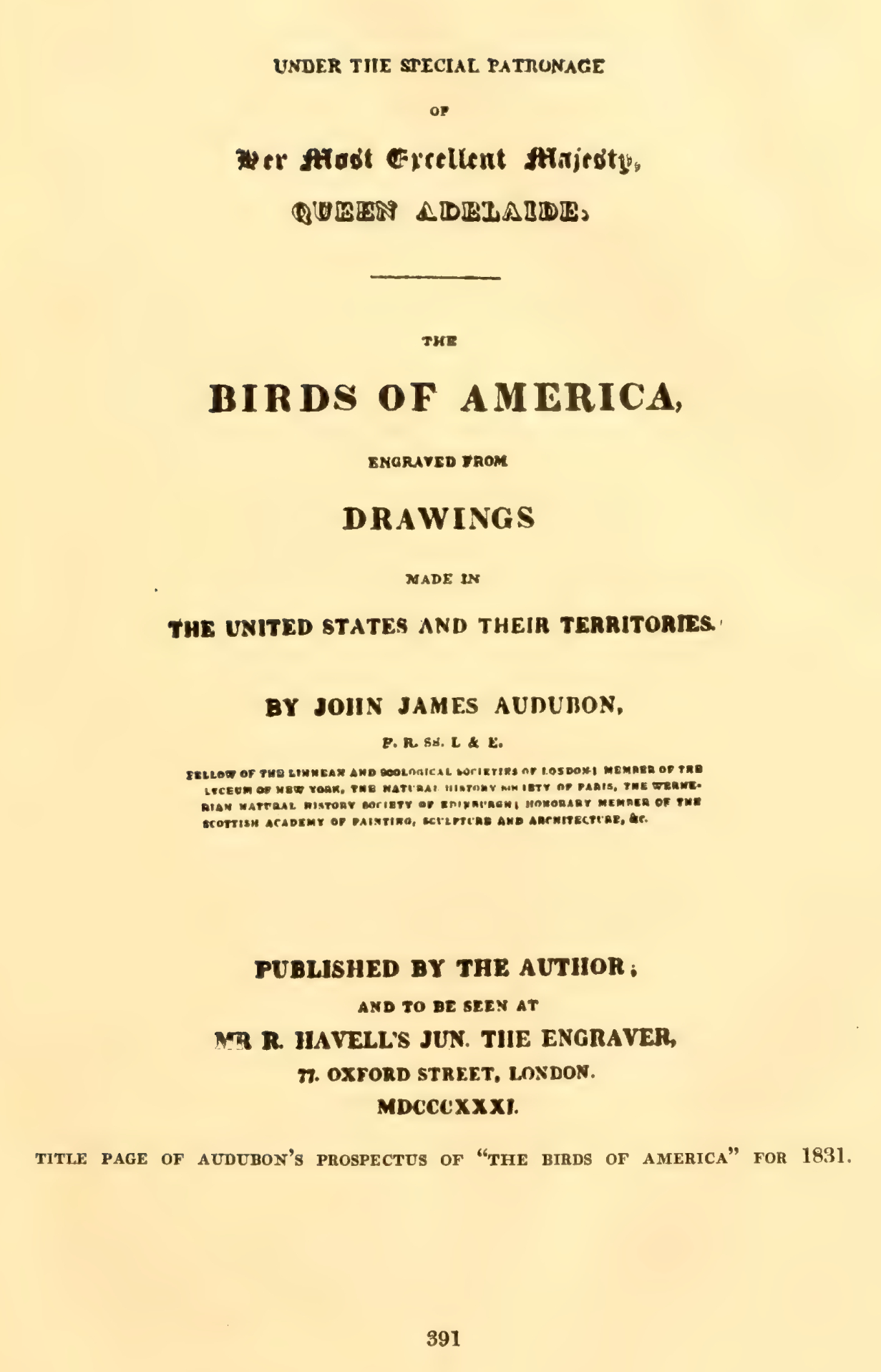
TITLE PAGE OF AUDUBON’S PROSPECTUS OF “THE BIRDS OF AMERICA” FOR 1831.
As the American Ambassador had predicted, King
George evinced no ardent desire to meet the American
woodsman, though he consented to take the work under
his patronage and to become a subscriber on the usual
terms; this plan, however, fell through, for the King,
who was reported to have taken his copy, failed to pay
for it. With Queen Adelaide, on the other hand, the
naturalist was more successful, and in his “Prospectus”
of 1831 she was announced as his special patron, with
her name heading his list. Negotiations to interest the
Queen were going on when the following note was sent
to Audubon by Sir J. W. Waller, who occupied some
position in the king’s household and was spoken of as
“oculist to his majesty”:
Sir J. W. Waller to Audubon
Saturday 9 o clock 1830.
I have scarce an Instant as I am going to Town to breakfast
with the Dk. of Gloucester, but yr. Letter is urgent &
therefore I can only desire Mr. A. to send his Number immediately
to the Stable Yard, directed to her Majesty, & the first
moment I can see her, I will speak on the subject, but at this
Moment I will not promise to mention it to the King for reasons
I cannot put on paper.
Yrs. ever,
J. W. Waller
At Edinburgh Audubon was alarmed to find that
subscribers were rapidly deserting him, six having cancelled
their names without the formality of giving reasons.
393
He hoped to supply their places at Glasgow, then
a rich city of one hundred and fifty thousand people,
but after a visit there of four days in November, 1827,
he was obliged to return to Edinburgh with but one
new name on his list.
On October 22 he expressed the resolve for the coming
year “to positively keep a cash account” with himself
and others, “a thing” he had “never yet done.” The
wisdom of that decision was apparent upon settling his
accounts for 1827 with both Lizars and Havell, as appears
from this note, written in his journal on January
17, 1828: “It is difficult work for a man like me to see
that he is neither cheating nor cheated. All is paid for
1827, and I am well ahead in funds. Had I made such
regular settlements all my life I should never have been
as poor a man as I have been; but on the other hand I
should never have published the “Birds of America.”
Again, for February 7 we find this record: “Havell
brought me the sets he owed me for 1827, and I paid
him in full. Either through him or Mr. Lizars I have
met with a loss of nearly £100, for I am charged with
fifty numbers more than can be accounted for by my
agents or myself. This seems strange always to me,
that people cannot be honest, but I must bring myself
to believe many are not, from my own experiences.”
Shortly after reaching London, as we have seen,
Audubon had made the acquaintance of Sir Thomas
Lawrence, then at the head of the Royal Academy and
favorite painter of the Court and fashionable society.
The friendship of this influential artist at a critical moment
proved most fortunate, for Sir Thomas called
repeatedly at his lodgings, and at each visit brought
patrons who went away with some of his pictures but
not without leaving a handsome toll of sovereigns in
394
his lap; the “Entrapped Otter” again did duty by
bringing him twenty-five pounds, while others returned
from seven to thirty-five pounds. At a later time the
artist visited the “Zoölogical Gallery,” as the Havell
establishment in Newman Street was then known, and
saw Audubon’s large paintings called “The Eagle and
the Lamb,” and “English Pheasants Surprised by a
Spanish Dog” or “Sauve qui peut.“ Audubon, who
on this occasion missed seeing his distinguished visitor,
had written in his journal three days before (December
23, 1828) that the paintings were what he called
“finished,”
but that, as usual, he could not bear to look at
either. Sir Thomas praised the “Eagle,” admired an
“Otter,” which was later exhibited in London, but gave
no opinion on the “Pheasants.” Afterwards, however,
when Audubon proposed to present this canvas to King
George, the artist assured him that this picture was
worth 300 guineas and that it was too good to be given
away; if offered to the King, no doubt, said he, “it
would be accepted and placed in his collections, but you
would receive no benefit from the gift.” According to
a later record, this canvas was sold to Mr. John Heppenstall
of Sheffield; whether it was ever delivered, or
not, I do not know, but either the original or a copy,
here reproduced, now forms the central figure in the
large Audubon collection in the American Museum of
Natural History in New York, and is an excellent illustration
of the elaborate and ambitious character of
Audubon’s larger compositions. These fortunate windfalls
came none too soon, for to follow the journal:
Mr. Havell had already called to say that on Saturday I
must pay him sixty pounds. I was then not only not worth a
penny, but had actually borrowed five pounds a few days before
to purchase materials for my pictures. But these pictures
395
which Sir Thomas sold for me enabled me to pay my
borrowed money, and to appear full-handed when Mr. Havell
called. Thus I passed the Rubicon.
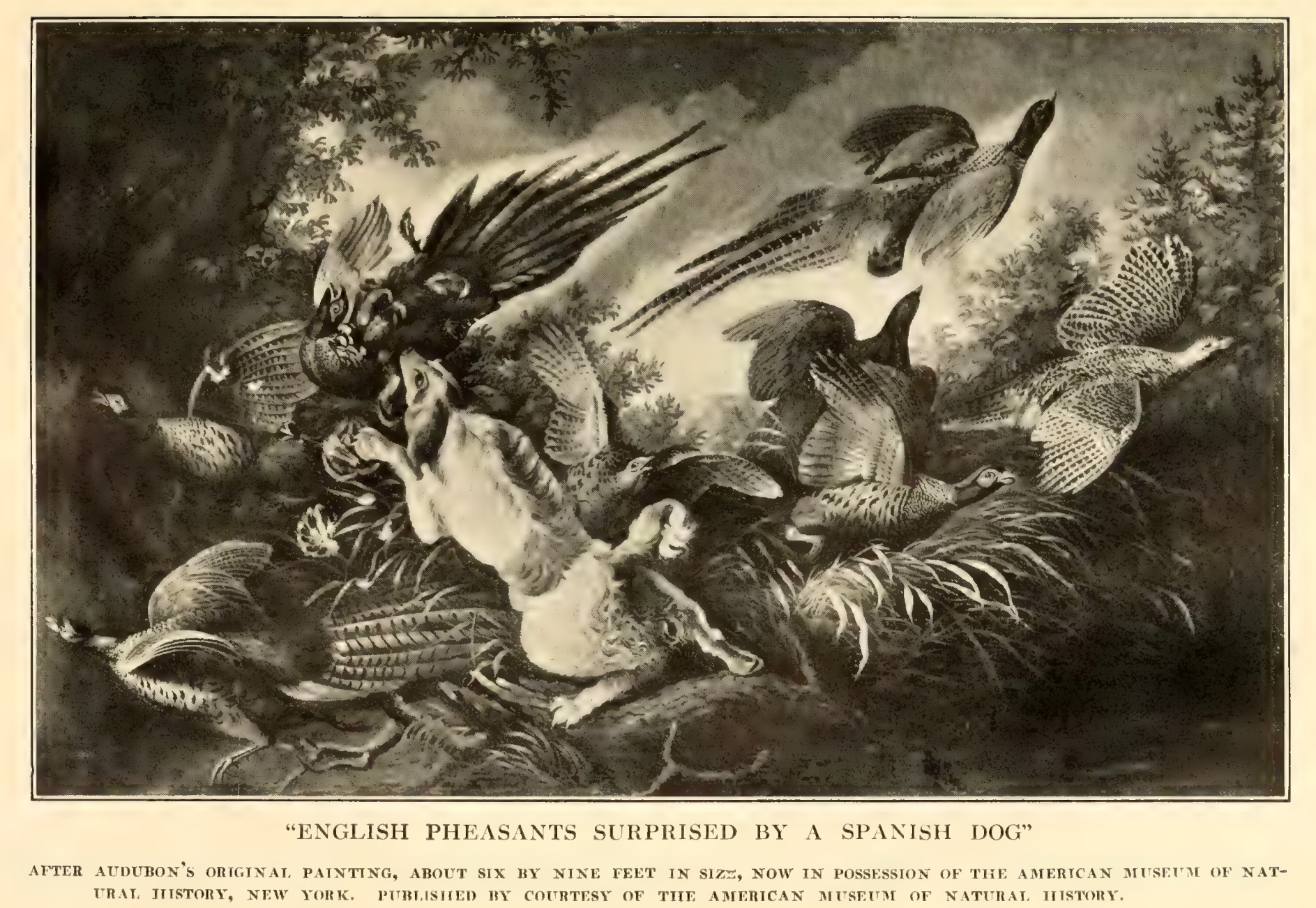
“ENGLISH PHEASANTS SURPRISED BY A SPANISH DOG”
AFTER AUDUBON’S ORIGINAL PAINTING, ABOUT SIX BY NINE FEET IN SIZE, NOW IN POSSESSION OF THE AMERICAN MUSEUM OF NATURAL HISTORY, NEW YORK. PUBLISHED BY COURTESY OF THE AMERICAN MUSEUM OF NATURAL HISTORY.
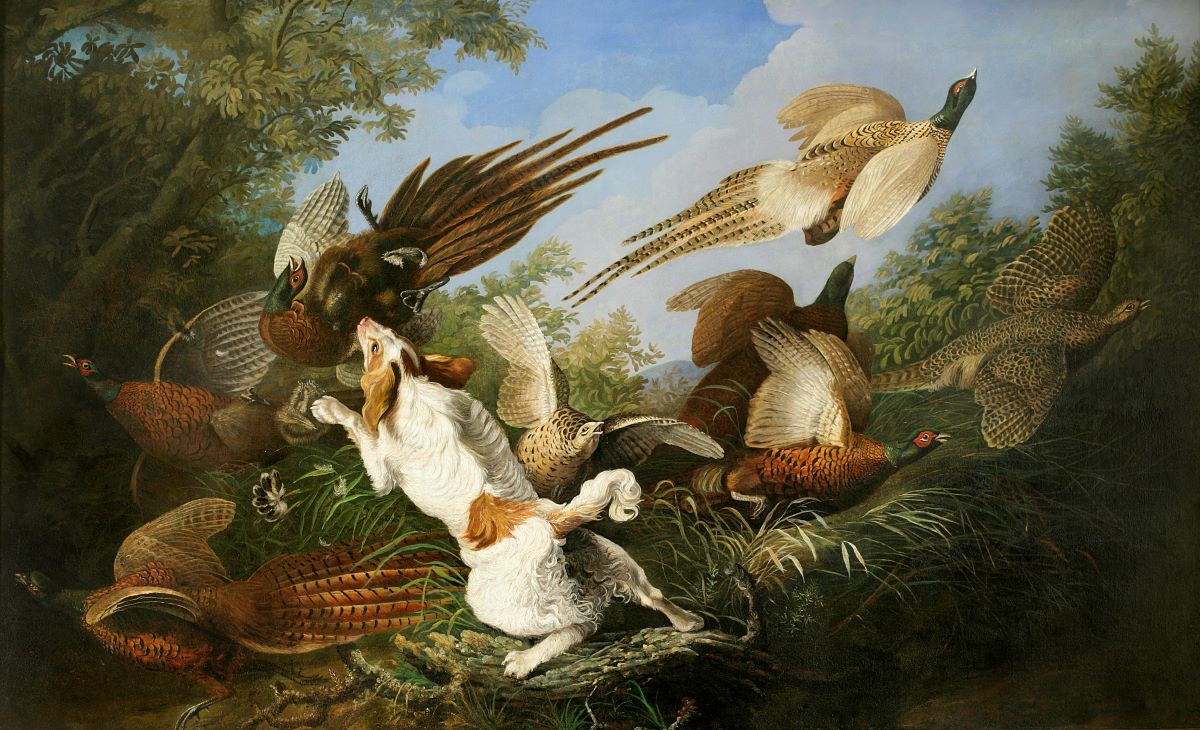
“ENGLISH PHEASANTS SURPRISED BY A SPANISH DOG”
This was before the reform of the penal laws in England,
when it seems to have been hard for a man to
escape hanging, not to speak of being sent to prison
for debt, the chief terror of life in certain circles.
There were 223 capital offenses, and in 1829 in the
city of London alone 7,114 persons were sent to the
debtors’ prison.349
Without the sale of his pictures in the summer of
1827, Audubon felt that he must certainly have become
a bankrupt, yet he was periodically displeased with the
results of his efforts in oil colors, and resolved to “spoil
no more canvas” but to draw “in my usual old untaught
way, which is what God meant me to do”; “I can draw,”
he continues, “but I shall never paint well.” In the
fall of 1828, however, he was again working in oils,
and produced four large pieces, one of which was called
“The Eagle and the Lamb,” and two others which were
doubtless variations of his “Pheasant” and “Otter” pictures.
“It is charity,” said the artist, “to speak the
truth to a man who knows the poverty of his talents,
and wishes to improve; it is villainous to mislead him,
by praising him to his face, and laughing at his work
as they go down the stairs of his house.” Sir Thomas
Lawrence had praised some of these pictures and had
promised to select one for exhibition at Somerset House.
As regards “The Eagle and the Lamb,” which Audubon
hoped would go to Windsor Castle, William
Swainson would give no opinion; the same canvas, or
396
else a replica, was in possession of the Audubon family
in 1898.350
On December 14, 1827, Audubon wrote that, acting
upon the advice of Mr. Maury, the American consul
at London, he had presented a copy of his Birds to
John Quincy Adams, the President of the United
States, and another, through Henry Clay, to the American
Congress; in order that the latter should be as
perfect as possible, Havell was asked to do the coloring
himself, but these proposed gifts do not appear to
have been executed.351
New Year’s, 1828, found the naturalist in Manchester,
where but a few days before he had received
the fifth and last number of his plates for 1827 and
expressed himself well pleased with it. While returning
to London by coach, he consented to take a hand
at cards to accommodate his fellow passengers, but
declined to play for money; “I never play,” he confessed,
“unless obliged to by circumstances; I feel no
pleasure in the game, and long for other occupation.”
“I missed my snuff,” he added, and whenever his hands
went into his pockets in search of the box, he “discovered
the strength of habit thus acting without thought”;
but he remembered a resolution he had formed to give
up the habit and stuck to it for a time at least; doubtless,
like his later friend, John Bachman, he reformed
more than once, for in a letter to Victor Audubon, of
November 5, 1846, Bachman added this postscript:
“To Audubon: The snuff — the snuff, it is here! I have
just taken a pinch, and the ladies have blown you up — sky-high,
for teaching me such a bad practice; I say,
397
however, that you beat me all to pieces in that art.”
The first winter in London dragged heavily for the
naturalist, who exclaimed in January, 1828: “How
long am I to be confined in this immense jail”; when
Daniel Lizars reported from Edinburgh the loss of four
of his subscribers, he writes, “I am dull as a beetle.
Why do I dislike London? Is it because the constant
evidence of the contrast between the rich and the poor
is a constant torment to me, or is it because of its size
and crowd? I know not, but I long for sights and
sounds of a different nature,” such, we might add, as
the flocks of wild duck which were occasionally seen
from Regent’s Park as they passed over the city and
made him more homesick than ever. Audubon
hated the city quite as cordially as Charles Lamb ever
affected to detest the country, and when leaving it,
afoot or by stage, it seemed as if he could never be
rid of it. “What a place is London,” he would say, but
naïvely add: “many persons live there solely because
they like it.”
On February 4, 1828, Audubon was elected to membership
in the Linnæan Society, and in November he
presented it with a copy of his work, which was then
well under way. This was noticed in a letter to Swainson,
written on November 7, when no acknowledgment
of the gift had then been received; and he mentioned
also the sale of his picture of “Blue Jays” for ten
guineas. At a meeting of the Linnæan Society not
long after his election, copies of Selby’s Illustrations of
British Ornithology and of his own work were placed
side by side for inspection, and “very unfair comparisons
were drawn between the two”; had Selby, Audubon
reflected, been given “the same opportunities that
my curious life has granted me, his work would have
398
been far superior to mine”; “I supported him,” he
added, “to the best of my power.”
Revision of his older drawings demanded much of
Audubon’s attention during these years. On February
10, 1828, he began the Whiteheaded Eagle (No. 7,
Plate xxxi), the original of which had been procured on
the Mississippi, where the bird was represented as dining
on a wild goose; now, he said, “I shall make it
breakfast on a catfish, the drawing of which is also with
me, with the marks of the talons of another eagle, which
I disturbed on the banks of the same river, driving him
from his prey.” On the 16th of that month he was
engaged with this drawing from seven in the morning
until half after four, stopping only to take the glass of
milk which his landlady would bring to him. This plate
was engraved in the following April, and on May 1,
1828, a first proof was sent to the Marquis of Landsdowne,
president of the Zoölogical Society, as a mark
of appreciation by its author, who had become a member
of that body in the preceding winter.
A striking characteristic of Audubon’s work was its
diversity, produced not only by attractive embellishments
of many kinds, but by the moving force and
action with which he ever sought to vitalize his subjects.
It is therefore not surprising that he was nettled
by an incident like this:
February 28. To-day I called by appointment on the Earl
of Kinnoul, a small man, with a face like the caricature of an
owl; he said he had sent for me to tell me all my birds were
alike, and he considered my work a swindle. He may really
think this; his knowledge is probably small; but it is not the
custom to send for a gentleman to abuse him in one’s house. I
heard his words, bowed, and without speaking, left the rudest
man I have met in this land.
399
Audubon had not yet visited the great university
towns of England, the support of which he knew would
be a valuable asset, and on March 3, 1828, he set out
by stage for Cambridge. His driver, he remarked,
“held confidances with every grog-shop between London
and Cambridge, and his purple face gave powerful
evidences that malt liquor was more enticing to him
than water.” His reception at Cambridge was hearty;
he was entertained by Professors Sedgwick, Whewell,
and Henslow, dined repeatedly “in Hall” with the dons,
and received the subscription of the librarian of the
University. It is interesting to recall that young
Charles Darwin, “the man who walks with Henslow,”
as some of the dons called him, was then an undergraduate
at King’s College, and that thirty-one years were
to pass before modern biology was born in 1859, the
year of the appearance of the epoch-making Origin of
Species.
By the 15th of March Audubon was again in London,
and on the 24th he started for Oxford. Dr.
Williams, as he noted in his journal, subscribed for his
Birds in favor of the Radcliffe Library, as did also Dr.
Kidd for the Anatomical School; but, though hospitably
treated by all, not one of the twenty-four colleges
of that great University emulated their example, and
the naturalist went away disappointed.
Upon his return to London in early April, Audubon
received a call from John C. Loudon, editor of the
Magazine of Natural History, and was invited to contribute
to that journal. “I declined,” he said, “for I
will never write anything to call down upon me a second
volley of abuse. I can only write facts, and when I
write these, the Philadelphians call me a liar.“ He was
then chafing under the criticism which his rattlesnake
400
stories had produced.352 On April 6 the persistent Mr.
Loudon called again and offered Audubon eight
guineas for an article, only to be again refused. Still
unwilling to admit defeat, the editor proposed to engage
William Swainson to prepare an extended review
of the naturalist’s work, and in this he succeeded so well
that Audubon immediately relented and sent him a
paper.353 Swainson offered to write the review for a
copy of the work at its cost price, and Audubon replied
in the following letter:354
Audubon to William Swainson
London, April 9th 1828.
London, April 9th 1828.
My Dear Sir,
Mr. Loudon called on me yesterday and showed me a letter
from you to him, in which many very flattering expressions respecting
myself and my works you are so kind as to offer to
401
review the latter so as to have your opinion in writting in time
for the first no. of the magazine that will appear next month. — you
also desire that I should send you a sett of the works as far
as publishing which you wish to keep provided I will let you
have it at the price it costs me. I assure you my Dear Sir, that
was I to take you at your word it would be a sore bargain for
you as the a/m would be very nearly double that for which it
is sold to my subscribers. — therefore you will permit me to
alter your offer and to say that if it suits you to pay 35
shillings per number I will be contented; I would be still more
so was I rich enough to present it to you. —
It is the only set on hand at present except one which I
must have to exhibit. —
The answer respecting the Shrieke Shrike has I hope met
with your wishes. —
Ever since I became acquainted with our mutual friend Dr.
Fraill Traill I have had a great desire to see and speak to
you & I regret that I never have had an opportunity. My time
is so completely taken up that it is with difficulty that I can
enjoy a day’s rest — Should you come to town pray call on me
when I may have the pleasure of shaking your hand and to assure
you verbally that I am truly and sincerely
yours obe st
John J. Audubon
95 Great Russell St.
Bedford Sq.
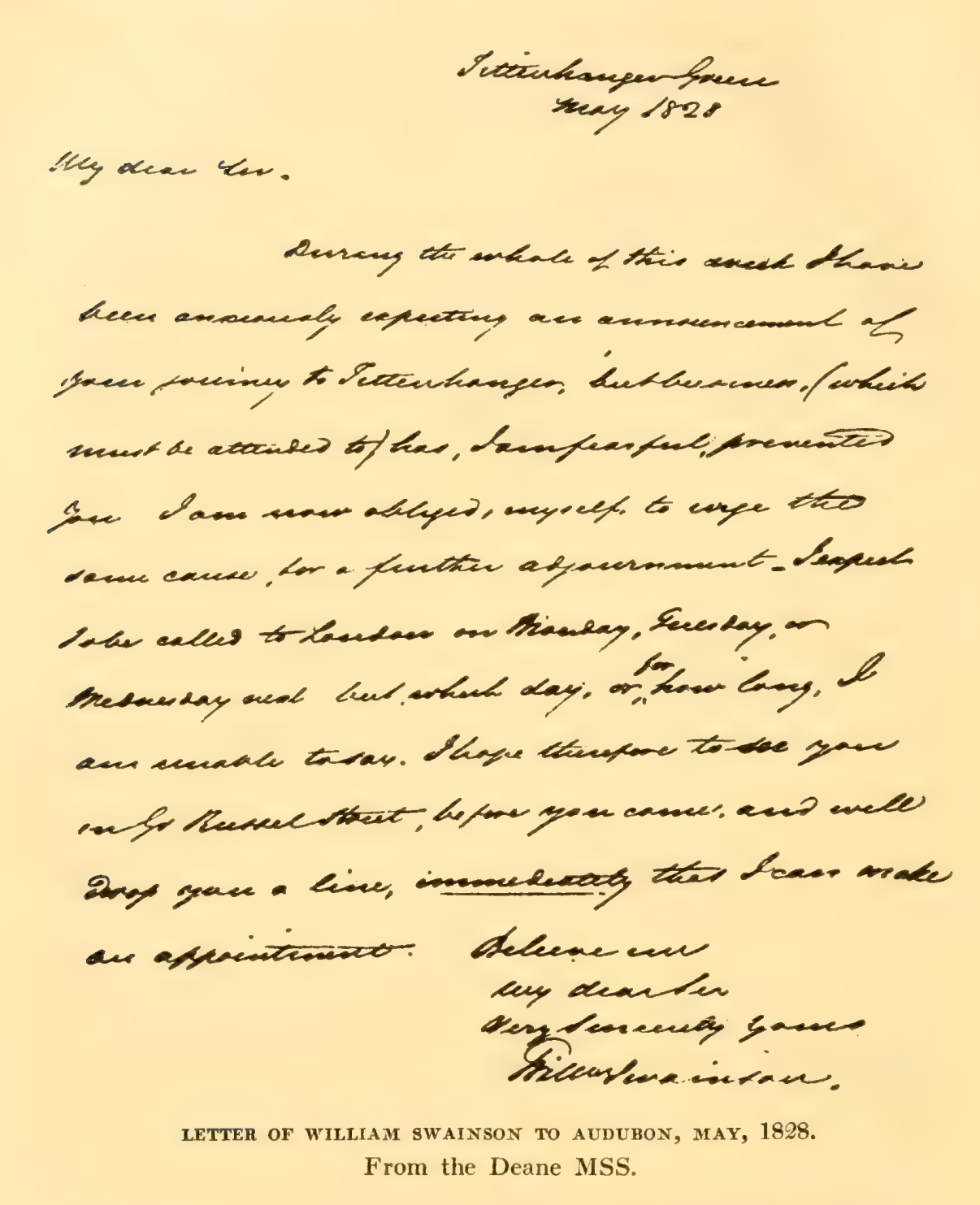
LETTER OF WILLIAM SWAINSON TO AUDUBON, MAY, 1828.
From the Deane MSS.
Thus began an intimate friendship between William
Swainson and John James Audubon which lasted until
1830, and their intercourse did not wholly cease before
402
1838. In his use of English at this time Audubon
was not far behind Swainson, whose mother tongue it
was. Swainson, according to Dr. Günther, was “extremely
careless in orthography and loose in his style
of writing: he persistently misspelt not only technical
terms, but also the names of foreign authors, and even
of some of his familiar friends and correspondents; he
403
knew no other language but his own, and the application
of Latin and Greek for the purpose of systematic
nomenclature was a constant source of error.“
At this time Swainson was living in semi-retirement
at a farmstead of considerable size, called “Highfield
Hall,”355 near Tyttenhanger Green, a small settlement,
off the highroad, two miles southeast of the historic
town of St. Albans, in Hertfordshire; though his letters
were always dated from “The Green” at Tyttenhanger,
his associations were with the more considerable village
of London Colney, but a mile to the south, on the road
to Barnet. Audubon had brought a letter of introduction
from Dr. Traill, a valiant champion of Swainson
at Edinburgh, but was unable to go to the country
to deliver it. Swainson, however, attended promptly
to the review, and on April 11, 1828, sent it to Mr.
Loudon, who published it in the May number of his
Magazine.356
Swainson’s review was extremely laudatory, and
Audubon reproduced extracts from it in later editions
of his “Prospectus.” To quote a characteristic paragraph,
he said that the naturalist’s ornithological papers
404
printed in one of the Scotch journals, are as valuable to the
scientific world, as they are delightful to the general reader.
They give us a rich foretaste of what we may hope and expect
from such a man. There is a freshness and an originality
about these essays, which can only be compared to the animated
biographies of Wilson…. To represent the passions and the
feelings of birds, might, until now, have been well deemed chimerical.
Rarely, indeed, do we see their outward forms represented
with any thing like nature. In my estimation, not more
than three painters ever lived who could draw a bird. Of these
the lamented Barrabaud Barraband, of whom France may
be justly proud, was the chief. He has long passed away; but
his mantle has at length been recovered in the forests of
America.
Audubon spent four days with Swainson and his
family at Tyttenhanger, from May 28 to June 1, 1828,
when they talked birds and made drawings; Audubon
also showed Swainson “how to put up birds in his style,
which delighted him.“ The friendship between these
men, though very intimate while it lasted, received a
sudden check two years later, when Audubon was about
to publish the letterpress to his plates, as will be related
farther on.357
Though his hands were already more than full at
this time, Audubon seems to have played with the idea
of publishing a work on the birds of Great Britain, but
on May 1 he wrote to Swainson that the plan did not
meet with favor, and later he relinquished all claims in
such a project to his assistant, William MacGillivray.358
In the spring of 1828 Audubon began to think of
returning to the United States, to renew or revise his
drawings and extend his researches. “I am sure,” he
405
said, “that now I could make better compositions, and
select better plants than when I drew mainly for amusement.”
In order to raise the necessary funds, he resorted
again to picture painting, his never failing resource,
and worked in oil colors daily from morning light
until dusk, unless called to Havell’s to decide some question
of necessary detail. The following letters to
Swainson shed further light on this work and on the
progress of The Birds of America, the eighth number of
which was published early in July:
Audubon to William Swainson
London, July 1st 1828.
My dear Sir. —
I have been expecting to have the pleasure of seeing you for
upwards of a week, having mentioned in your last note that
you intended spending a couple of days in London before the
end of June. — When are you coming? — the beautifull lamb
came quite safe and is now on the canvas (in efigy) for ages to
come — I bought a superb Golden Eagle from Mr. Cross that
also has helped to fill it —— Here apparently some words
have been deleted, and it is impossible to read them. I long
to shew them to you. — I have finished the picture of the Turkeys,
and painted a white headed eagle — in fact I have worked
from 4 every morning untill dark — but the best news I have
to tell is; that I have received 4 letters from my wife, one dated
2nd of May, all well — but not quite settled about coming before
the end of summer. I have changed quarters and am now at
79 Newman Street Oxford Street, in Mr. Havell’s house where
I have taken 3 rooms and feel more comfortable although I
have not the little piece of ground to walk on. — I imagine the
country to be now quite beautifull and had I time to spare
would walk out to see you Mrs S & the dear little folks at
Tittenhanger Green. — I received a visit on Saturday last of
the whole of Lord Milton’s family who after complimenting the
author of the “Birds of America” very kindly subscribed for
406
two copies of the work. — I have mended my pen — I should have
sent the Blackwood magazine to you, but I so much expected
to see you here that it is yet on my table, and will keep it untill
you come. — All my exertions to procure live grouses have been
abortive here — I have written to Scotland to a friend and perhaps
will have some soon. — The 8th number is now printing and
colouring and will be out this month — the 9th is began. — If you
are hungry or thirsty when you come to town please make for
my here a word is omitted, and I will try to manage matters
in this way. — May I ask what you are doing? — I saw Dr
Fraill’s Traill’s son a few days ago — he inquired after your
son and family. — I expect a copy of Loudon’s magazine this
evening. I feel anxious to see what sort of a cut the Doves
make, as well as the birds of Washington. —
With sincerest regards & esteem to yourself and Lady —
I am yours most truly
John J. Audubon.
79 Newman Street,
Oxford Street.
Audubon to William Swainson
London Thursday July 1828.
My dear Mr Swainson,
Although your last note said that you knew not when I
should have the pleasure of seeing you in town, I have hoped
every morning to see you that day. — When will you come? — There
is a talk of my picture of the Eagle and the Lamb going
to her Majesty, Sir Walter Waller has been written to on the
subject and every thing is in train to lead poor I like a lamb to
Windsor Castle! — I am told the picture is a grand one but you,
my dear Sir, have not said so! When you come I will show you
13 grouses pretty fairly grouped on one canvas, with seven
pheasants with a Fox on another, etc. etc. I have worked hard
this month from 4 p.m. untill 7 a.m. sic every day — I regretted
that your brother did not come to see me — I have a
great desire to see you but I cannot at present leave town. — My
407
8th No. is just out. — The 9th & 10th are engraving. — I
have sent word to my son to land ? & bring some skins for
you & perhaps you may have a rare assortment bye and bye. — I
hope your Lady and dear Children are all quite well Pray remember
me kindly to them. ———— I wish to name a bird after
you in the 1st No. of 1829 & wish you to choose a name.
Believe yours ever and truly obliged
J. J. Audubon
79 Newman Street,
Oxford Street.
By the 9th of August eight pictures had been begun,
but none was finished, and the number of his subscribers
had fallen to seventy. At about this time Captain
Basil Hall359 returned from his journey through
the United States, and brought direct news from Victor
Audubon, who was then at Louisville, from Dr. Richard
Harlan and Thomas Sully, to all of whom the naturalist’s
letters had been delivered the previous year.
Towards the end of the month Audubon received the
following note from the secretary of the Zoölogical Society,
N. A. Vigors, who was also anxious to obtain
from him an article for his Journal:
N. A. Vigors to Audubon
Bruter Ct
Aug. 23, 1828.
My dear Sir: —
I hope you do not forget your promise of giving us a
paper for the Zoölogical Journal. We should be much gratified
by having your name with us: and, if possible, should wish
to have whatever you may favour us with within the next ten
days. I have been but a few hours in town, and shall leave
town again tomorrow for a few days, or I should have called
408
upon you to speak personally upon the subject. I believe I
have already mentioned, that we are in the habit of remunerating
those of our correspondents who wish for payment for
their labours, at a rate not exceeding £10.10.0 per sheet.
A letter from you in answer will reach me, if sent to Bruter
Ct: before Wednesday on which day a parcel will be forwarded
to me from thence.
Believe me my dear Sir,
Yours faithfully,
N: A: Vigors.
Addressed
J. J. Audubon Esq.,
69 Great Russell St.;
Bloomsbury.
Readdressed
Newman Street,
Oxford Street
Audubon refused this request, saying that “no
money can pay for abuse,” and this time he did not
retract.
Without immediate prospect of seeing his family,
for neither Mrs. Audubon nor her sons were enthusiastic
over the proposal that they should go to England, the
naturalist was momentarily depressed; he turned to
Swainson for advice, at the same time suggesting that
they visit Paris together. Audubon wrote in his journal
for August 16, 1828, that he had invited Swainson to
accompany him to France, whither his friend had expressed
a desire to go when the subject had been
broached at Tyttenhanger; on the 25th of that month
he added: “I do not expect much benefit by this trip,
but I shall be glad to see what may be done.” The
letter just referred to follows:
409
Audubon to William Swainson
London, Wednesday Augt. 13, 1828.
My dear Mr. Swainson,
I reached my lodging in great comfort by the side of your
amiable Docr Davie two hours and a half after we shook hands — I
wish I might say as much of my Journey through Life. — I
have had sad news from my dear wife this morning, she has positively
abandoned her coming to England for some indefinite
time, indeed she says that she looks anxiously for the day when
tired myself of this country I will return to mine and live although
a humbler (Public) Life, a much happier one — her
letter has not raised my already despondent spirits in somethings
and at the very instant I am writing to you it may perhaps
be well that no instrument is at hand with which a woeful
sin might be committed — I have laid aside brushes, thoughts of
painting and all except the ties of friendship — I am miserable
just now and you must excuse so unpleasant a letter — Would
you go to Paris with me? I could go with you any day that
you would be please to mention, I will remain there as long and
no longer than may suit your callings — I will go with you to
Rome or anywhere, where something may be done for either of
our advantage and to drive off my very great uncomfortableness
of thoughts — My two sons are also very much against coming
to England, a land they say where neither freedom or simplicity
of habits exist and altogether uncongenial to their mode
of life. — What am I to do? As a man of the World and a man
possessed of strong unprejudiced understanding I wish that you
would advise me. — But now on your account I will change the
subject — I called on Newman two days ago & to the following
enquiries he gave me yesterday the following answers
What the price of
| ½ doz best Pure Lake |
dowards ? |
answer |
12/ — |
| ½ doz best Carmin |
“ |
“ |
20/ — |
| ½ doz best UltraMarine |
“ |
“ |
84/ — |
| ½ doz best Vermillion |
“ |
“ |
6/ — |
| ½ doz best Terra di Verona |
“ |
“ |
4/ — |
410
As I thought the above prices enormous I have declined advising
chalks for you & will await your advent. —
Should you not feel inclined to go to France at present
which by the bye is the very best season on account of seeing
the vintage etc. etc. — please write to me so or come to town
which would be still more agreeable & talk the matter over as
I think I would persuade you to absent yourself for a month
or so — I hope your kind lady continues quite well & your Dear Little ones —
Believe me yours most sincerely
John J. Audubon.
Please write by return of Post —
79 Newman Street
Oxford Street.
On this journey to Paris Audubon was accompanied
by Mr. and Mrs. Swainson and an American artist,
named Parker, who had been at work on a portrait of
the naturalist in oils. For Audubon it was mainly a
canvassing tour; Parker hoped to obtain orders for portraits,
and Swainson, new ornithological material at the
great museum in the Jardin des Plantes, for a work
upon which he was then engaged.360
The party set out on the 1st of September, traveling
by way of Dover and Boulogne, and reached Paris
on Thursday, September 4. They alighted at the Messagerie
Royale, Rue des Victoires, and, after looking
up lodgings, went at once to the Jardin des Plantes to
pay their respects to Cuvier. The Museum of Natural
History was closed, but they knocked and asked for the
Baron. “He was in,” said Audubon, in the journal of
his Paris experience,
411
but, we were told, too busy to be seen. Being determined to
look at the great man, we waited, knocked again, and with a
certain degree of firmness sent in our names. The messenger
returned, bowed, and led the way up stairs, where in a minute
Monsieur the Baron, like an excellent good man, came to us;
he had heard of my friend Swainson and greeted him as he
deserves to be greeted; he was polite and kind to me, though
my name had never made its way to his ears. I looked at him,
and here follows the result: age about sixty-five; size corpulent,
five feet five, English measure; head large; face wrinkled and
brownish; eyes gray, brilliant and sparkling; nose aquiline,
large and red; mouth large, with good lips; teeth few, blunted
by age, excepting one on the lower jaw, measuring nearly
three-quarters of an inch square.361
They were immediately invited to dine on the following
Saturday at six o’clock, and later saw Cuvier at his
home, at his Museum, and at the Academy of Sciences,
over which he presided.
Geoffroy Saint-Hilaire pleased Audubon greatly
and proved to him by his conversation that he understood
perfectly the difference between the French and
the English. The Duke of Orleans, who then occupied
the Palais Royal, seemed to him the finest physical type
of man he had ever met. “He had my book brought
up,” said the naturalist, “and helped me untie the strings
and arrange the table, and began by saying that he felt
great pleasure in subscribing to the work of an American,
for he had been most kindly received in the United
States and should never forget it.” When the plate of
the Baltimore Orioles was held up to view, the Duke
exclaimed: “This surpasses all I have seen, and I am
not astonished now at the eulogiums of M. Redouté.”
He conversed in both English and French, had much
412
to say of American cities and rivers, and added: “You
are a great nation, a wonderful nation.” The Duke
wrote his name in Audubon’s subscription book, promised
to try to enlist a number of the crowned heads of
Europe in his behalf, and gave him besides a number
of orders for pictures of animals.
Audubon had already made friends with the veteran
painter of flowers, Pierre Joseph Redouté, and when
it was proposed that they should exchange works, the
“Raphael of Flowers” consented, gave Audubon at once
nine numbers of his Belles Fleurs, and promised to send
“Les Roses.”
During this visit of eight weeks Parker painted portraits
of both Cuvier and Redouté; Swainson worked
steadily at the Museum, where Isidore Geoffrey Saint-Hilaire
gave him the use of his private study; while
Audubon, for the most part, was driving from post to
pillar in his not altogether successful efforts to extend
his subscription list. As already intimated, his greatest
success in Paris was in winning the friendship and endorsement
of Cuvier, who reported upon his work at a
meeting of the Royal Academy of Sciences held on
September 22.362 Audubon has related how on this occasion
he had an appointment to meet the Baron in the
library of the Institute at precisely half past one
o’clock; he waited; the hall filled, and the clock ticked
on, but the great savant did not appear. Finally, said
Audubon, after an hour had passed, “all at once I heard
his voice, and saw him advancing, very warm and apparently
fatigued. He met me with many apologies,
and said, ’Come with me’; and as we walked along, he
explaining all the time why he had been late, while his
hand drove a pencil with great rapidity, and he told me
413
that he was actually now writing the report on my
work!“363 Cuvier’s published report, which was extremely
laudatory, showed little signs of haste. After
speaking of Audubon’s talents and accomplishments he
said:
The execution of these plates, so remarkable for their size,
seems to us equally successful in the drawing, the engraving,
and coloring, and though it may be difficult to represent relief
in a colored print with as much effect as in painting proper,
this is no disadvantage in works on natural history; naturalists
prefer the true color of objects to those accidental shades
which result from the diverse inflections of light; necessary
though these be for completing the truth of a picture, they are
foreign as well as prejudicial to scientific accuracy.364
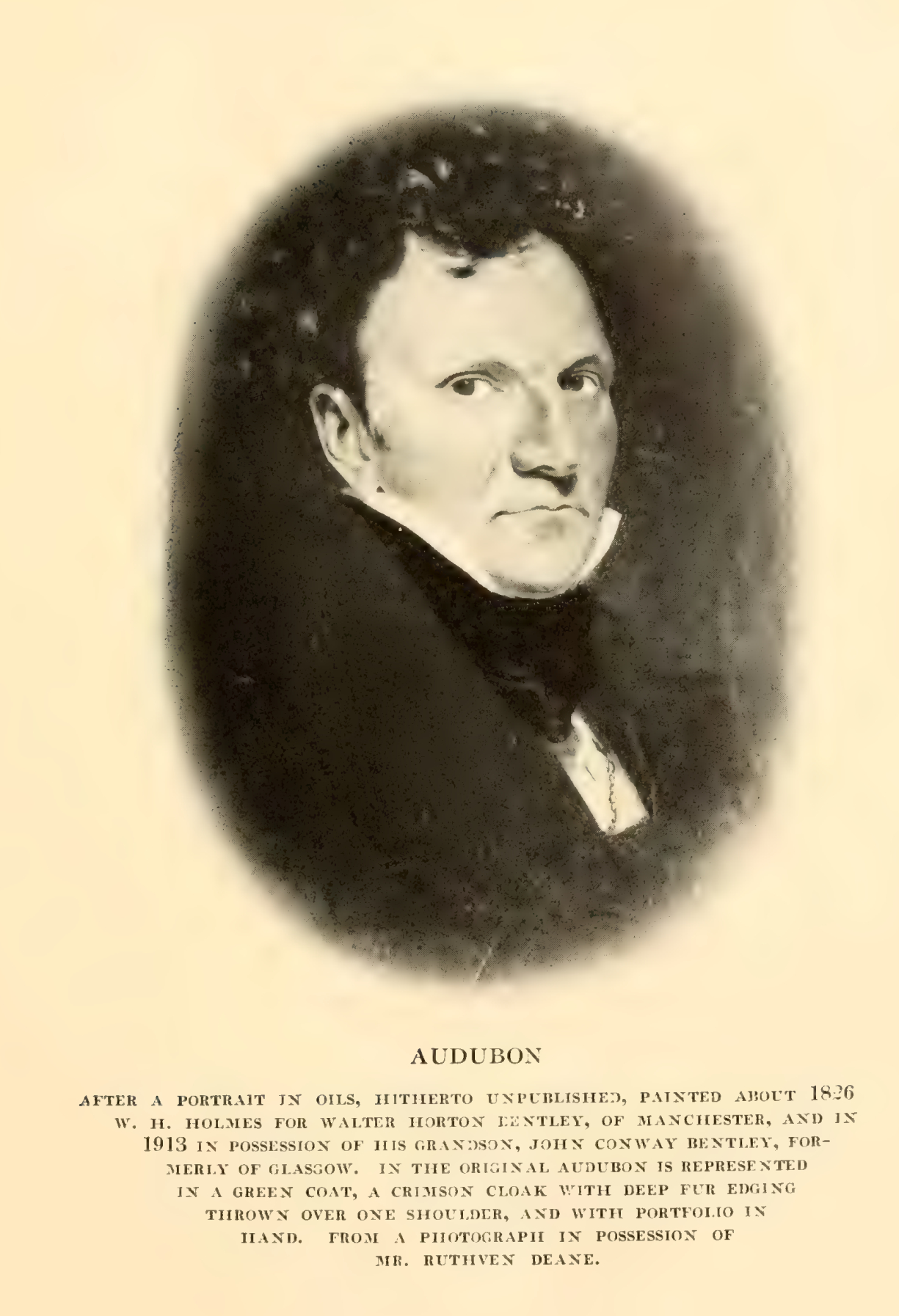
AUDUBON
AFTER A PORTRAIT IN OILS, HITHERTO UNPUBLISHED, PAINTED ABOUT 1826 W. H. HOLMES FOR WALTER HORTON BENTLEY, OF MANCHESTER, AND IN 1913 IN POSSESSION OF HIS GRANDSON, JOHN CONWAY BENTLEY, FORMERLY OF GLASGOW. IN THE ORIGINAL AUDUBON IS REPRESENTED IN A GREEN COAT, A CRIMSON CLOAK WITH DEEP FUR EDGING THROWN OVER ONE SHOULDER, AND WITH PORTFOLIO IN HAND. FROM A PHOTOGRAPH IN POSSESSION OF MR. RUTHVEN DEANE.
By November Audubon was once more in London,
busy at painting to fill his orders and his purse. On
the 11th of the month, we find Swainson, whose own
exchequer was empty, writing to Audubon for a loan;
this letter, and one soon to follow, illustrate some of the
characteristics to which we have referred:
William Swainson to Audubon
Tuesday 11 Nov. 1828.
I had written the enclosed, my dear Mr. Audubon, before
your letter of Monday reached me. It has come this instant,
Dreams, you know, must always be interpreted contrawise, we
might have lifted up our arms, as you saw in your dream but,
if you had not awoke, it was no doubt to have shaken hands!
But that my regard for you may be evinced, I will bring myself
to lay under an obligation, which I would only ask for one of
my own family. I was that moment thinking to which I should
414
write, to ask the loan of 80 £ for a few months, and now I
will ask it of you. If you was aware of the peculiar feelings
which we Englishmen have on such occasions, perhaps you
would smile, but so it is that we never ask any one, from whom
we have the least idea of a refusal. Now, did I not believe
you to be a sincere friend, do you imagine I should have told
you I was in want of Money much less have asked you to lend
me some. The fact is, I have suffered a severe loss during my
being in Paris, what little I had on hand has been spent there
and in making preparations for the publication of my Zool.
Illustrations. Two or three months however, hard work will
bring me round again & repay you.
Let me see your letter to the President of the Zool. Soc.
before it goes, and you shall see mine.
I shall be most thankful for the Grouse. I send 2 drawins
to Havell to be engraved spur him on for I want to have
every thing ready before the new year.
Yours most sincerely,
W. Swainson.
John J. Audubon, Esq.
79 Newman St.
In December the Swainsons invited Audubon to
dine with them at Christmas; in his letter Swainson
said:
Why are you so sad? I would lay ten shillings that old
Havell has been disappointing you as he has done me. He is
in matters of business a complete daudle — an old woman, and
I have done with him. His son I think better of he has a good
idea of punctuality in business…. In one of your walks I
hope you have thought about the French Wine that we talked
so much about and have ascertained the particulars from your
friend, so that we may order a cask. I hope you have not mistaken
the price, — for if not, nothing that can be drank in this
country is one half as cheap.
415
In the following letter Swainson refers to the second
series of his Zoölogical Illustrations,365 the sale of which
was irritating him, and to N. A. Vigors, with whom he
had entered upon a notorious controversy in 1828:
William Swainson to Audubon
18 January, 1829.
My Dear Mr. Audubon,
I write this in utter uncertainty whether it will find you in
London. My first number has now been out three weeks — it
has been seen and universally admired, and how many copies
do you think the Publisher has sold? now pray guess as the
Americans say. 100 — no. twentyfive, no. fifteen, no. ten? yes.
positively ten copies and no more, has been sold. I blush almost
to confess this mortification to even, you, but so it is. Now,
my dear Sir, what am I to think of the “generally diffused
taste,” as the phrase is, for Natural History.
This allthough vexing to me, may be a consolation to you,
who are able to exhibit on what I call your Red Book the names
of a good portion of 150 subscribers to a 200 guinea Book.
Think yourself my friend exceedingly well off.
The amount of sale must be kept silent, it would be a nice
nut to crack for V igors. & his friends.
I shall be able to do without the water birds, if you have
not found any.
I have had a most extraordinary letter from Waterton,
which will highly amuse you. The man is mad — stark, staring
mad.
Yours very faith’ly
W. Swainson.
Can you tell me any safe expeditions made of sending and
receiving letters and Parcels from Philadelphia.
J. J. Audubon Esq.
79 Newman St.
Oxford St.
416
Early in 1829 Bonaparte wrote from Rome, where
he had then settled, and the following letter shows that
he had then heard of Audubon’s visit to France, and
was keenly interested in his success:
Charles L. Bonaparte to Audubon
Rome January 10 th 1829.
Dear Sir,
I received in due time your favours of November 3d. & December
21 st. & now come to thank you for them, wishing you
or rather expressing to you at the occasion of the renewal of
the year, the warm wishes I constantly have for your health,
happiness & especially for the success of your work. From the
contents of your letter I clearly perceive that one at least of
my letters to you must have miscarried. Nothing could be
more interesting to me than the narrative of your journey to
France, though I had heard from other quarters the good &
well deserved reception you met with. Your letter of August
20 th. never came at hand, & it must have been the same with
at least one of mine to you. What you mention about Temminck
quite astonishes me! … I thought he would have undertaken
even a journey to see you & your drawings!!! Please
let me know when you write whether the Ornithological Illustrations
of Jardine, Vigors & Co are stopped or still going
on. — The animals I spoke to you of were reported as delivered
to you by Mr Gray of the British Museum who had received
them for me from the U. States. Is it not so? … Corvus
Cornix with us is very fond of the sea shore & feeds
occasionally on fish, but I never observed it had the singular
habits of C. ossifragus at least as described by Wilson.
I am surprized at Messrs J B’s conduct; I have always
found them extremely kind and well disposed towards me; &
although we have settled our accounts I had no reason to believe
they would refuse our box. However we can do without
their interference quite as well, & I hope you have already forwarded
the box to Leghorn recommending it to the care of my
417
agent in that port. Messrs F. & A. Filuchs.(?) I shall keep a
good lookout for it being extremely anxious to see your new
number. I should never have done if I was to repeat to
you all the praise given to your work by our Italian artists &
men of science!… I shall merely state that on my part I
prefer the plate of Goldfinches to any other, birds and plants,
being life itself; & that I am most anxious to see Astur Stanleyi
which I strongly suspect to be my Falco Cooperii….
By this time, however you may have been able to ascertain the
fact … please let me know how the thing stands. It is only
418
by your letter that I hear of my work (2 d) being in London:
I have not yet seen a copy myself nor did I know positively that
it had been published. You must surely have received one
from myself at all events, for I directed Messrs Gay & Lea to
let you have one of the very first out. Let me know whether
you have it & your opinion about it. — I think you are right in
going to Russia, especially as in giving them the American
Birds you will probably give us the Russians, some of which
are hardly known. Try to get for me Pyrrhula longicauda, P.
rosea & Scalopax — thalina, the latter especially. I shall not
loose sight of the portrait, but it will be still more difficult to get
the signature. I will however endeavor from some of my relations.
You were right in supposing me “dans les bras de la
paix & le bonheur d’un heureux père de famille” but greatly mistaken
to think I was taking “le plaisir des sciences”. Settling
and other cursed worldly affairs have so much taken up my
time, that I have not looked a specimen or a book since I am
in Rome … my small library itself & my Cabinet have not
even been arranged & I tremble to find all my birds destroyed
when the happy day will come to look into them. In the mean
time an addition has been made six weeks ago to my small family.
I have another son who has received the names of Lucien
Louis Joseph Napoleon & better than that who is the porthrait
of health itself. I am sure you will divide my happiness &
excuse my delay in answering you principally on that account.
I am in debt with half the scientific world & this has been the
first letter I scratched since I am in Rome!… I hope to be
more regular & less in a hurry in future … though God
knows!… I will not however close this letter without mentionaing
the pleasure I had the other day in getting you a
new subscriber & that among the English themselves.! The
Earl of Shrewsbury & his good Lady highly admired your work
the other day at my house & were so pleased with it that they
said they would write immediately to add their name to the list.
The Earl of Shrewsbury is as you know the first Earl of Great
Britain a catholic & what is more to you a man of great taste.
His not having heard of your work shows that you have not
419
made enough noise about it: & I am sure his name will be
followed by a great many others to which Mr. Chapittar (Lord
Shrewsb. friend) has promised me to show the work & deliver
the prospectuses. Did you hear of the death of poor Mr
Barnes killed by a stag (?). It is a great loss for the Queen.
I remain, Dear Sir, begging you the London news
your most obliged friend
Charles L. Bonaparte.
Addressed Mr. J. J.
Audubon
79 Newman Street
Oxford St.
London
Inghilterra.
Endorsed Answered Feby. 8 th. 1829.
J. J. A.
Audubon continued to work on his paintings during
the winter of 1828-9, hoping to put his affairs in
such order that he might be able to start for America
in the following year.
420
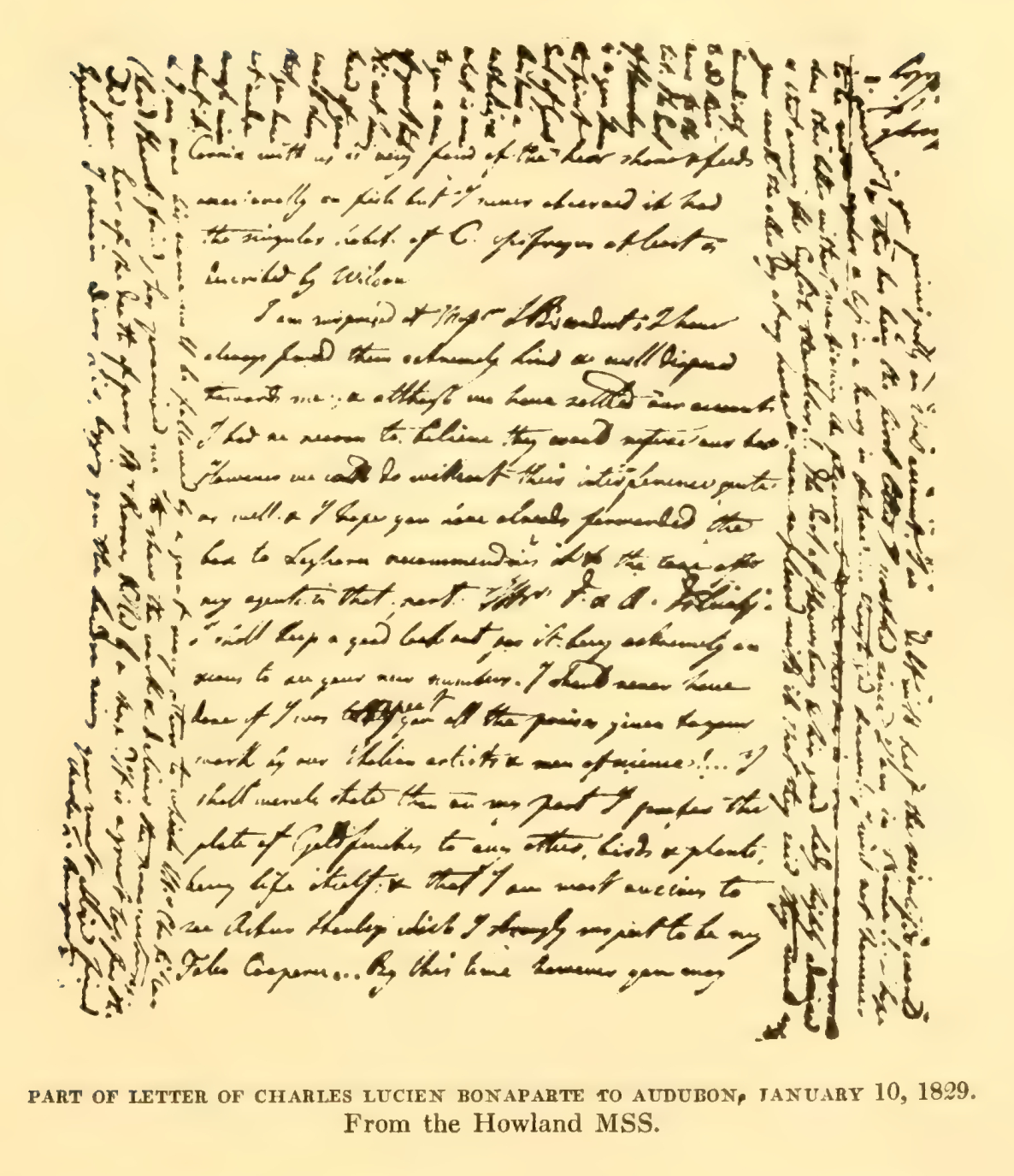
PART OF LETTER OF CHARLES LUCIEN BONAPARTE TO AUDUBON, JANUARY 10, 1829.
From the Howland MSS.
CHAPTER XXIV
FIRST VISIT TO AMERICA IN SEARCH OF NEW BIRDS
Audubon settles for a time in Camden — Paints in a fisherman’s cottage
by the sea — With the lumbermen in the Great Pine Woods — Work
done — Visits his sons — Joins his wife at St. Francisville — Record of
journey south — Life at “Beechgrove” — Mrs. Audubon retires from
teaching — Their plans to return to England — Meeting with President
Jackson and Edward Everett.
Audubon laid his plans to visit America in 1829
with unusual care, and was fortunate in being able to
entrust his publication to the competent hands of John
George Children, of the British Museum. This was
to be actually his third voyage to the United States,
but it was the first which he made from English soil,
and after he had become known as an ornithologist and
animal painter. He wished to renew at least fifty of his
earlier drawings and to obtain new materials of every
description. Although he was naturally anxious to see
his wife, from whom he had been absent for nearly three
years, and his boys, the elder of whom had been left
at Shippingport five years before, he felt constrained
to devote to his work every moment that could be spared.
When writing to his wife of his difficulties and prospects
at this period, he assured her that he would act
cautiously, with all due diligence and sobriety, and continued:
Thou art quite comfortable in Louisiana, I know; therefore
wait there with a little patience. I hope the end of this
year will see me under headway sufficient to have thee with
421
me in comfort here, and I need not tell thee I long for thee
every hour I am absent from thee. If I fail, America will still
be my country, and thou, I will still feel, my friend. I will
return to both and forget forever the troubles and expenses
I have had; when walking together, arm in arm, we can see
our sons before us, and listen to the mellow sounding thrush,
so plentiful in our woods of magnolia.366
A little later in 1829 he also wrote: “I have finished
the two first years of publication, the two most difficult
to be encountered.” At that time he fully expected
that fourteen years would be required for the completion
of his task, owing to the many difficulties experienced,
especially in securing competent workmen, as
well as the necessity of distributing the expense for the
benefit of his subscribers.
When Havell had been provided with all the drawings
needed for the remainder of the year 1829 and the
first issue of 1830, Audubon sailed from Portsmouth on
the 1st of April, 1829, in the packet ship Columbia,
which reached New York on the opening day of May.
“I chose the ship,” he said, “on account of her name, and
paid thirty pounds for my passage.”
He paused in New York to exhibit his drawings
at the Lyceum of Natural History, of which he had
become a member in 1824, but soon hurried to Philadelphia,
and finally settled down for work at Camden,
in New Jersey, later known to fame as the home of
“the good gray poet.” There, at a boarding house kept
by a Mr. Armstrong, he remained three weeks, from
about May 23 to June 13, hunting and painting every
day. From Camden he went to Great Egg Harbor,
then a famous resort of both land and water birds in
great variety, and for three weeks more he lived and
422
worked in a fisherman’s cabin by the sea. It is interesting
to recall that Alexander Wilson, in company with
George Ord, had spent a month at this point in the
spring of 1813.
The following letter367 from Swainson was probably
the one to which Audubon replied from New Jersey on
September 14:
William Swainson to Audubon
My dear Mr. Audubon
I welcomed the news of your arrival in America yesterday,
and as I am making up a packet for Liverpool today, I seize the
opportunity of wishing you joy and happiness in the new world.
I am surprised and disappointed as not receiving one line
from Ward it is at the best negligent, and somewhat ungrateful.
Hope you have begun your studies among the birds on
a better plan than formerly, that is, in preserving the skins
of every one on which there is the least doubt whether the
bird is young or old, particularly the former. If you are to
give scientific descriptions and definitions of the species
this precaution is absolutely necessary. What your Americans
do with their money I know not, Mr. Lea tells me
he cannot procure one purchaser for my new Illustrations:
here it is now going on very well.
You asked me what you can do for me in America. I will
tell you. Send me a cart load of shells from the Ohio, or from
any of the Rivers near New Orleans. The very smallest, as well
as the very largest — all sizes. I have been long expecting those
which your son promised you for me near twelve months ago!
but I have heard nothing of them! you may spend a few dollars
for me and send people to fish the shells at the dry season,
when the waters are low, that is the best time.
Things go on here much as usual, but I have not been in
London since Xmas. The first volume, containing the Quadrupeds,
423
of Dr. Richardson’s work, is out. I am now busy in
preparing the second, which contains the Birds. Let me particularly
direct your attention to the manners of the Cedar
Bird, Ampelis Americana. I suspect it feeds much on Insects
in default of fruit, but what is desirable, is to know the way
in which it captures Insects, whether as a flycatcher i.e. by
seizing them on the wing, or like the Gold crest — by picking
them up among the branches or leaves. I am now in close
correspondance with Charles Bonaparte, & a most valuble correspondant
he is.
Mrs. Swainson is just recovering from her confinement after
giving me another little son I am happy today they are
both going on well.
Wilson I believe mentions two birds very like the Red eyed
Flycatcher, this is a point deserving your attention, but the
manners of these birds are much more important. I feel convinced
there are several species of my Genus Ammodramus
shore finch, in the So. States, they all have narrow pointed tails,
like the seasidefinch of Wilson. I further suspect there is more
than one species confounded with the Towee Buntling.
I hope soon again to hear more fully from you, and of your
ornithological acquisitions. The dear little ones are quite
well.
Yours very sincerely,
Wm. Swainson
The Green 26 June 1829.
Mr. John J. Audubon
scare of
Mess. Thomas E. Walker & Co.
Merchants.
New York Philadelphia
On the 4th of July Audubon returned to Philadelphia
and prepared for a longer sojourn in the Great
Pine Forest, or Great Pine Swamp, as it was sometimes
called, in Northumberland County, Pennsylvania. In
424
this letter to his son we shall find an account of his
plans and accomplishments:
Audubon to his son, Victor
Philadelphia, July 5 th., 1829.
My dear Victor: —
I have been in America two months this day, and not a
word from you have I had in answer to my several letters, dated
New York, and at this place. I am also without answer from
your Mama, but do not feel so surprised as I know that about
2 months is the time necessary to have a return from Louisiana.
I have come to take your Mama over to England, if her
wish inclines her to do so, and have wrote fully to her, giving
her all the particulars respecting my situation that I thought
could possibly be trusted to a letter.
I have also come to America to redraw some of my earliest
productions, and am now closely engaged at this. I remained
near this city for 3 weeks, and since have spent 3 more at
Great Egg Harbour, from which place I returned yesterday.
I have already 13 drawings by me. I have letters from London,
up to 30 th. April, when all my business was going on
well with an increase of 4 subscribers. I have no news to
transmit; on the contrary, I was in hopes that ere this I
should have had at least one long letter from you. I beg you
will write me when you last heard from your Mama. Direct
your letter to the care of Messrs Thos. E. Walker, & Co, merchants
here, who know all my movements, and will see anything
forwarded to wherever I may choose to go to.
I hope your uncle Berthoud & family are all well; present
them my best regards, and to all others who may feel interested
in my welfare, and believe me
your affectionate father,
John J. Audubon.
I have bought a good gold time-keeper, intended for you,
and a copy bound, of my work, and wish to know how it can
be forwarded. God bless you.
425
After outfitting himself in Philadelphia, Audubon
proceeded to Mauch Chunk; his provisions for this journey
to the forest consisted of a “wooden box containing
a small stock of linin, drawing-paper, my journal, colors
and pencils, together with twenty pounds of shot, several
flints, a due quantum of cash, my gun ’Tear
Jacket,’ and a heart as true to nature as ever.” From
Mauch Chunk he traveled fifteen miles into the heart
of the wooded hills, and was received into the family
of Jedediah Irish, lumberman and philosopher, whose
praise was celebrated in a later “Episode.”368 “What
pleasure,” said the naturalist, “I had in listening to
him, as he read his favourite poems of Burns, while my
pencil was occupied in smoothing and softening the
drawing of the bird before me. Was this not enough
to recall to my mind the early impressions that had been
made upon it by the description of the golden age, which
I here found realized?”
During his stay in the forest Audubon paid particular
attention to the smaller land birds, such as
finches, warblers and flycatchers, and many of the original
drawings which were made in the summer of 1829
still bear his penciled designations of time and place369.
426
About ten weeks370 were spent in the woods, from late
July until the 10th of October, when the naturalist returned
to Philadelphia and settled again for a time in
Camden. At this period he was enjoying the best of
health and spirits, and he worked during the entire season
under the highest pressure of which he was capable.
At Camden, October 11, 1829, he wrote:
I am at work, and have done much, but I wish I had eight
pairs of hands, and another body to shoot the specimens, still
I am delighted at what I have accumulated in drawings this
season. Forty-two drawings in four months, eleven large,
eleven middle size, and twenty-two small, comprising ninety-five
birds, from Eagles downwards, with plants, nests, flowers,
and sixty kinds of eggs.371 I live alone, see scarcely any one,
besides those belonging to the house where I lodge. I rise long
before day, and work till night-fall, when I take a walk, and
to bed.
At about the middle of October Audubon set out
to join his family in the South. Crossing the mountains
by mail-coach to Pittsburgh, where he met his former
partner in business, Thomas Pears (see p. 254), he descended
once more his favorite river, the Ohio. It was
no longer necessary to rough it on a flatboat or to sleep
on a steamer’s deck; it was to be “poor Audubon” no
longer. To be sure, he was not rich, but he had made
his way and his mark, and the attention which he now
427
began to receive when traveling in his adopted land
must have gratified his heart. He paused at Louisville
to visit his two boys, the elder of whom, Victor, was
then a clerk in the office of his uncle, William G. Bakewell,
while John was with another uncle, Nicholas A.
Berthoud. Hastening on he reached Bayou Sara on
November 17, where he finally joined his wife, who was
living at the home of William Garrett Johnson, in West
Feliciana Parish, near Wakefield. Some account of
this journey is given in the following letter,372 written
on the eighteenth to Dr. Richard Harlan; in the postscript
Audubon gives the first reference to a new hawk
which he proposed to name after his friend, and which
has given no little trouble to ornithologists ever since:373
Audubon to Dr. Richard Harlan
Superscribed Richd Harlan Esqr. M. D. &c &c &c
Philadelphia Pensa
St Francisville Louisiana Novembr 18th
1829 —
My Dear Friend. —
You will see by the data of this the rapidity with which I
have crossed two thirds of the United States. I had the happiness
of pressing my beloved wife to my breast Yesterday morning;
saw my two sons at Louisville and all is well. — from
Philadelphia to Pittsburgh I found the Roads, the Coaches,
horses Drivers and Inns all much improved and yet needing a
great deal to make the traveller quite comfortable — The slownesse
of the stages is yet a great bore to a man in a hurry — I
remained part of a day at Pittsburgh where of course I paid
my respects to the Museum! I was glad to see the germ of
428
one — it is conducted by a very young man named Lambdin — I
made an arrangement with him place of seal — paper gone
&c. &c. &c. at Cincinnati I also visited the Museum paper
gone it scarsely improves since my last view of it, except
indeed by wax figures and such other shows as are best suitable
to make money and the least so to improve the mind. — I could
not see D illegible my time was very limited. — The Ohio was
in good order for Navigation and I reached Louisville distant
from you about 1,000 Miles in one week.
as you spoke of
travelling westwardly I give you here an a/c of the Fare. — to
Pittsburgh all included 21$. — to Louisville 12$. — and 25$
more to Bayou Sarah where I Landed. 30$ is the price from
Louisville to N. Orleans. our Steam Boats are commodious
and go well — but my Dear Friend the most extraordinary
change has taken place in appearance as I have proceeded. — The
foliage had nearly left the Trees in Pensylvania, the Swallows
had long since disapeared severe frost indeed had rendered
Nature gloomy and uninteresting — Judge of the contrast:
I am now surrounded by Green Trees and Swallows gambole
around the house as in Pensylvania during June & July The
mock bird is heard to sing and during a Walk with my Wife
yesterday I collected some 20 or 30 Insects that is not all,
a friend of mine here says that he has discovered 2 or 3 New
Birds!!! — new Birds are new birds our days, and I shall endeavour
to shew you the Facts Simile when again I shall have
the pleasure of shaking your hand —
although so lately arrived, I have established the fact that
Mrs A. and myself will be on our way towards “Old England”
by the 15th of Jan.y. we will ascend the Mississipi and after
resting ourselves at Louisville with our sons and other relatives
about one month and then proceed with the Rapidity on
the Wild Pigeon should God grant our wishes! —
have you seen or heard any thing of Ward? — have you
the little sketch of Dear?
we had a passenger on Board the
Huntress named Potts from your City who knows you well as
lively young Gentleman; has a Brother (a Clergyman) established
and married at Natchez. —
429
I will begin Drawing next week having much scratching
with the Pen to perform this one, and I am also desirous to
make paper gone Large Shipment of aborigines both animal
and vegetal as soon as possible. — Turkeys, Aligators, Oppossums,
Paroekett, and plants, as Bignonias &c &c &c. will be
removed to the Zoological Gardens of London, from the Natural
ones of this Magnificent Louisiana! — meantimes I will not forget
my Friends in Phila. no I would rather forgive all, to all
my Ennemies there. — assure Dr. Hammersley that Ivory Billed
and Peleated Woodpeckers will be skinned, and who knows but
I may find something more for him. — I will give free leave to
Dr. Pickering to chuse amongst the Insects and who knows but
I may find something new for him. remember me most kindly
to both, nay not in the common manner of saying “Mr Audubon
begs to be remembered” no not at all. This way Mr A remembers
you and you and I will remember you and you and I
always!! —
May I also beg to be remembered in humble words to a
fine pair of Eyes; divided, not by the Allegany Mountains;
but by a nose evidently imported from far East, to a placid
forehead, to a mouth speaking happiness to —— dash
nearly across page.
Should you see Friend Sully remember me to him also — and
should you see George Ord Esqr. Fellow of all the Societies
Imaginable present him my most humble ———— dash line
more than across the page.
Should you see that good woman where I boarded at
Camd’den tell her that I am well and thankful to her for her
attentions to me. —
I cannot hope the pleasure of an answer from you here
but you may do so, and I say pray do so, directed to the care
of N. Berthoud Esqr Louisville Kentucky. — by the bye my
sons are taller than me, the eldest one so much altered that I
did not know him at first sight, and yet I have Eyes —
God bless You, Your Friend
John J. Audubon.
430
The following is written across the first page:
I reopened my letter to say that I have Just now killed a
Large New Falcon yes positively a new Species of Hawk almost
black about 25 Inches Long and 4 feet broad tail square Eye
yellowish White, Legs and Feet bare short & strong.
—— I will
skin it!!! —
remember me to Lehman ———
What I have said about the Hawk to You must be Lawful
to Academicians and you will please announce Falco Harlanii
by
John J. Audubon
F. L. S. L.
The following extracts are from a letter374 written by
Swainson, January 30, 1830, and sent to Havell in
London to be readdressed:
William Swainson to Audubon
I know not in what part of the Wilds of America you may
now be wandering, but I hope you are fully intent upon your
great object, and that you are not only making drawings, and
taking notes, but preserving Skins, of all your little favorites.
Don’t forget the Shrikes, of which I have strong suspicions
there are 2 or 3 species mixed up with the name of Loggerhead.
Should you be in the land of the Scarlet Ibis, do pray
procure a dozen or two of the best skins, they are the most
magnificent birds of No. America, and are said to be common
towards New Orleans.
You will learn frm the Newspapers how uncommonly severe
is our winter the snow has now been upon the ground five weeks
and it is still falling. I manage, however, to walk out every
day, and thus have acquired better health than I have enjoyed
for many years.
Previous to your embarking to England, which I hope you
will do very early in the spring you must do me one favor.
431
Bring me two Grey Squirrels alive, and a cage full of little
birds, either the painted or non-Pareil finch the Blue finch, or
the Virginian Nightingale, as they are called, 3 or 4 of each
to guard against casualties by death on the voyage. I do not
care one farthing whether they sing or not, so that I presume
they may be got for a mere trifle. The Squirrels would delight
the little people beyond measure, and would prove a never-failing
source of amusement to them. I believe you have other
kinds than the grey, so that any will do. If you cannot get
them pray supply their place by two Parrots of America.
We continue pretty well at the Green. Seldom go to town,
but I find people begin to discover the true character of V
igors. and many that were formerly his friends now speak
very differently of him. His father having died the property
has come to him. He has now taken a fine house in the Regents
park, and holds conversaziones (in humble imitation of
those of the President of the Royal Society) every Sunday
evening during the season!! all this is very grand, and he appears
to have abandoned writing any more papers on ornithology,
since I have begun to point out his errors.
Ward wrote to me since my last, he is a poor weak fellow,
with a good natural disposition, but so little to be depended
upon, that he is turned round by every feather, after inserting
that he could not go on “in my service” as he called it,
under ten dollars a week, he now says he should be most happy
to receive four. He says not a word of his marriage, which
proves his wish to decive one. I have done with him…. I
hope you have got me lots of River shells.
About the beginning of the year 1827 Mrs. Audubon
gave up her “Beechwoods” school, and thereafter
took a position as governess in the home of Mr. William
Garrett Johnson, whose plantation, called “Beechgrove,”
was situated in the same parish. An anonymous
writer thus referred to this house in 1851.375
432
In the hospitable mansion of W. G. J — — , in the parish of
West Feliciana, if one will look into the parlor, they will see
over the piano a cabinet sized portrait, remarkable for a bright
eye and intellectual look. The style of it is free, and there is
an individuality about the whole that gives assurance of a
strong likeness. Opposite hangs a proof impression of the
bird of Washington, a tribute of a grateful heart to an old
friend. The first is a portrait of Audubon painted by himself;
the other is one of the first of his engravings that ever
reached the United States.
There Audubon spent nearly two months at the close
of 1829, and followed his usual occupations of hunting
and drawing, while his wife prepared for their contemplated
journey to Europe. He is said to have drawn
at this time the “Black Vulture attacking a herd of
Deer,” several large hawks, squirrels, and heads of deer
which were never finished.
Although Audubon’s business affairs in England
had been left in charge of his trustworthy friend, John
G. Children, his engraver, Havell, had become alarmed
at the loss of subscribers and the failure of certain of
their agents, and particularly M. Pitois of Paris,376 to
render due returns. Havell, as it proved, was unduly
disturbed, but his gloomy accounts tended to hasten
the naturalist’s departure, a circumstance that was later
deplored. These matters are clearly reflected in the
following letter written from the Johnson home in Louisiana
when the Audubons were preparing to leave it;
particularly interesting are the included statements
433
through which it was hoped that a competent successor
might be secured for the duties of the position which
Mrs. Audubon had so ably filled:
Audubon to Robert Havell
Beech Grove, Louisiana
Decr 16th 1829
My Dear Mr. Havell. —
I received yesterday from New York your letter of the
29th. Sept. which must have reached Philadelphia 3 days after
my departure for home
I am sorry that Bartley should have made you suffer a
moment by sending you the intelligence of the failure of the
several subscribers you mention in your favor — it cannot be
helped — there is none of your fault and I must repair these
matters when I reach England again
I am considerably more sorry and much vexed that Sowler
should have failed in his written promise to accept your Dfts. — even
in a case of the diminution of subscribers he could certainly
have sent you a progressional amount — I am now almost
sure that Pitois has failed or acted the Rogue
We are making all preparations in our power to leave
Louisiana on the 5 or 10th. of Jan.y and we will proceed as
fast as Steam Boats, Coaches and the weather will admit of
and we will sail for England from New York with all possible
dispatch. I have made a shipment of Forest trees to England
that I hope will turn to good account as they are to be presents
to Public Institutions &c and that I think it necessary to
be remembered myself. —
We are both well — our sons are at Louisville, Kentucky
where we will see them about the 20th. of next month. — I sent
you in my letter a proposal for your sister and should you
not have received it I send it you again here in Mrs A.’s. hand
writing. — I would advise your sister to come if the money is
an object. — I think that besides she will be comfortable with
the familly Johnson — if she thinks fit to wait untill we see
her, we can tell her all about it.
434
I have received only one letter from friend Children during
all this absence against my very many — I
hope the insects I sent him by the Annibal have reached safely. — have
no news to give you — Keep up a good heart — we will
be in London as soon as possible. — I have not had a letter
from Miss Hudson for a long time — I hope her mother & her
are well — Remember me kindly to your Dear Wife and Little
ones — Mrs Audubon joins me in all good wishes — If you see
Parker my remembrances to him I will carry with me some
Drawings that I know will make the graver and the Acid Grin
again. —
Believe me your friend —
John J. Audubon.
When you present my sincere regards to friend Swanson
Swainson tell him that I have had only one letter from him
and that I am now quite unable to say where Mr Ward is I
had a letter from Henry Havell377 the other day merely acknowledging
the money I have paid him — he was in New York,
I hope quite well —
Enclosure
A friend of ours here named Wm. Garrett Johnson (a
cotton planter) a gentleman who resides in a perfectly healthy
and agreeable part of the country, desires that I should write
to England to procure for him a Governess, one who can teach
music, drawing and the usual branches of education to young
Ladies. Mr. Johnson will pay the sum of one thousand dollars
per annum, board, lodging &c, also and considered in all
respects as a member of the family, to any lady who will undertake
occupation (the sum is about 230£) the governess will
have to instruct ten or twelve young persons of various ages,
and may make the arrangement for five years if desirous of it.
I have thought this would suit your sister precisely, and for
my part knowing the family Johnson as I do I should think it
an excellent thing for her. if not I will look for some one when
435
I am in England, Sailing from England direct for New Orleans,
steam Boats reach the place of Mr Johnson in two days.
Duplicate.
I, Wm. Garrett Johnson do authorize my friend J. J. Audubon
to make the above proposition and do by these present obligate
myself to comply with them punctually and particularly.
Wm. Garrett Johnson.
Addressed
Mr Robt Havell Jur
Engraver
79 Newman Street
Oxford Street
London
England
“On January 1, 1830,” said the naturalist, “we
started for New Orleans, taking with us the only three
servants yet belonging to us, namely, Cecilia, and her
two sons, Reuben and Lewis. We stayed a few days at
our friend Mr. Braud’s, with whom we left our servants,
and on the seventh of January took passage on the
splendid steamer Philadelphia for Louisville, paying
sixty dollars fare.“378 After a long visit with their
sons, on the seventh of March they ascended the Ohio
to Cincinnati, and at Wheeling took the mail-coach to
Washington. At the national capital Audubon met
the President, Andrew Jackson, and was befriended by
Edward Everett, at that time a leader in the House of
Representatives. “Congress,” said the naturalist, “was
then in session, and I exhibited my drawings to the
House of Representatives, and received their subscription
436
as a body.” He also recorded that he obtained
three subscribers in Baltimore, and left for Philadelphia,
where they remained a week. The following note,
which Edward Everett gave Audubon for New York,
is particularly interesting, since it expressly states that
at that time the ornithologist had not received a single
subscriber in the United States:
Edward Everett to Dr. Wainwright
Washington 18 March 1830
My dear Sir,
Allow me to introduce to your acquaintance, the bearer
of this letter, Mr. Audubon of Louisiana. His drawings of
American Birds, of which he will show you some, will I am
sure command your approbation, as they have the applause
of Europe. — I am sorry to say, that he has not yet procured
a single subscriber, in the United States of America. Will not
one of your Institutions in New York — or your wealthy and
liberal individuals — take a copy? I pray you endeavor to
procure him at least one subscriber, in New York. —
Yours with great regard
E. Everett.
Rev Dr Wainwright
Audubon had evidently reconsidered his expressed
intention of presenting a copy379 to Congress, and to
Edward Everett belongs the credit of subscribing to
The Birds of America in behalf of the Congressional
Library. At about this time also he obtained another
subscriber at Washington, in the person of Baron
Krudener, the Russian envoy, but later experienced difficulty
in collecting his dues.380
437
CHAPTER XXV
AUDUBON’S LETTERPRESS AND ITS RIVALS
Settlement in London — Starts on canvassing tour with his wife — Change of
plans — In Edinburgh — Discovery of MacGillivray — His hand in the
Ornithological Biography — Rival editions of Wilson and Bonaparte — Brown’s
extraordinary atlas — Reception of the Biography — Joseph
Bartholomew Kidd and the Ornithological Gallery — In London again.
On the 1st of April, 1830, Audubon and his wife
sailed from New York in the packet ship Pacific, bound
for Liverpool, where they landed after a voyage of
twenty-five days. Upon returning to London the naturalist
found that upon the 18th of the preceding March
he had been elected to membership in the Royal Society,
an honor for which he felt indebted to Lord Stanley
and his friend Children, of the British Museum; after
paying the entrance fee of £50, he took his seat in that
body on the 6th of May. The painting of pictures was
at once resumed to meet his heavy expenses, but towards
the end of July he started with Mrs. Audubon on a
canvassing tour, in the course of which his plans suddenly
were changed so that London did not see him
again for nearly a year.381 On this journey they touched
at Birmingham, Manchester, Leeds, York, Hull, Scarborough,
Whitby, New Castle, and Belford, to visit the
Selbys, and on the 13th of October reached Edinburgh,
where they were soon comfortably settled in the naturalist’s
old lodging place, the house of Mrs. Dickey, Number
26, George Street.
438
Audubon was now ready to begin the text of his
Birds of America, to be called Ornithological Biography,
which is often referred to as his “Biography of
Birds.” This work, which was eventually extended to
five large volumes of over three thousand pages, was
published at Edinburgh from 1831 to 1839. He had
made crude beginnings with this in view as early as
1821, and on October 16, 1830, he wrote: “I know
that I am not a scholar …” but, “with the assistance
of my old journals and memorandum-books, which were
written on the spot, I can at least put down plain truths,
which may be useful, and perhaps interesting, so I shall
set to at once. I cannot, however, give scientific descriptions,
and here must have assistance.” To supply
this need, as we have seen already, he had earlier applied
to William Swainson, but the negotiations with that
naturalist were soon broken off, and led to a sharp and
acrid discussion upon the authorship of the work
itself.382
By a rare stroke of genius or good fortune, Audubon
chose for his assistant a young Scotch naturalist, William
MacGillivray, who had been introduced to him by
another naturalist, James Wilson, soon after he reached
the Scottish capital. MacGillivray agreed “to revise
and correct” his manuscript at the rate of two guineas
per sheet of sixteen pages, and in the latter part of
October, 1830, they set to work. We shall soon have
occasion to speak more fully of his debt to this estimable
Scotchman,383 and will only add here that a better
trained or more competent helper than MacGillivray
could hardly have been found in Great Britain or elsewhere.
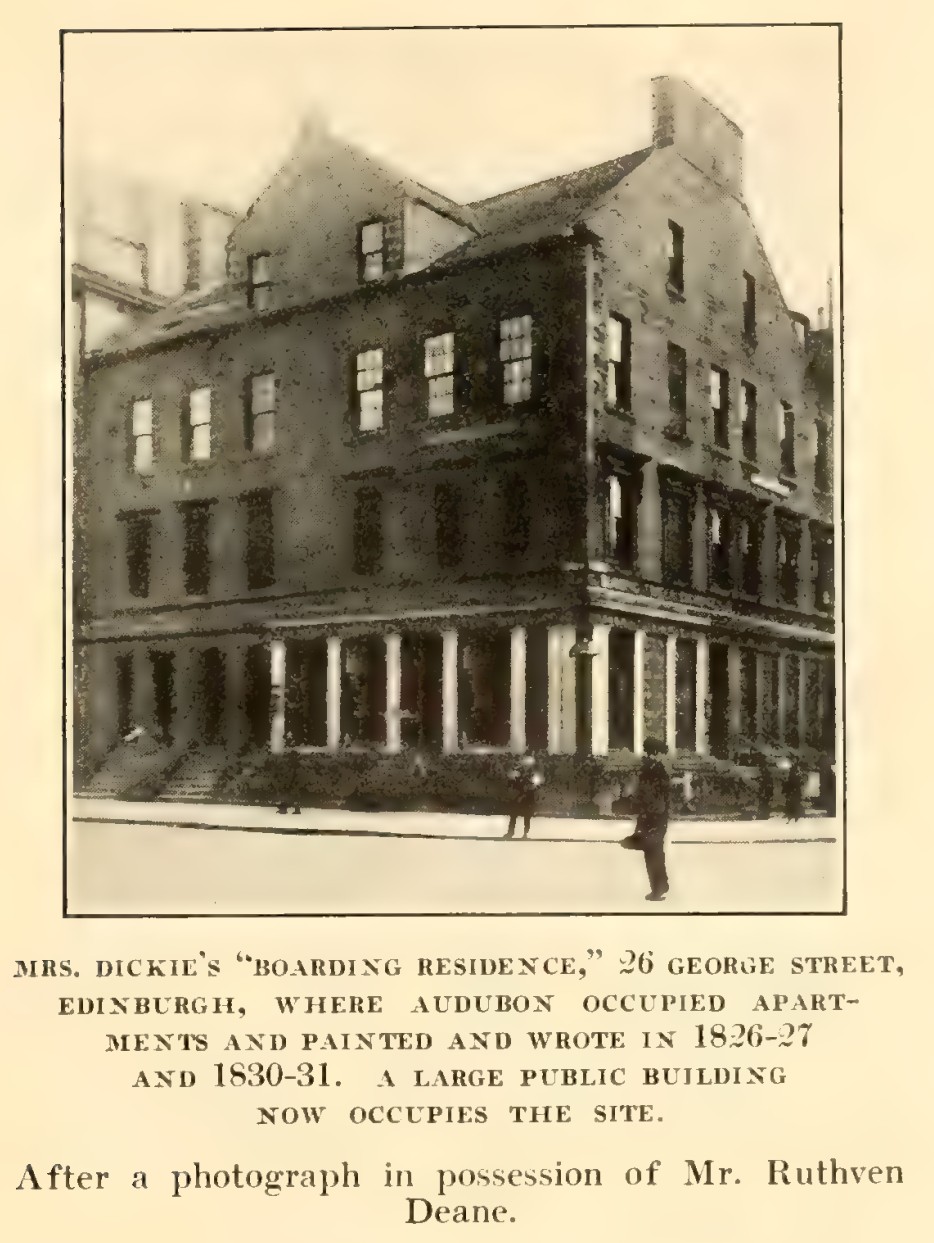
MRS. DICKIE’S “BOARDING RESIDENCE,” 26 GEORGE STREET, EDINBURGH, WHERE AUDUBON OCCUPIED APARTMENTS AND PAINTED AND WROTE IN 1826-27 AND 1830-31. A LARGE PUBLIC BUILDING NOW OCCUPIES THE SITE.
After a photograph in possession of Mr. Ruthven Deane.
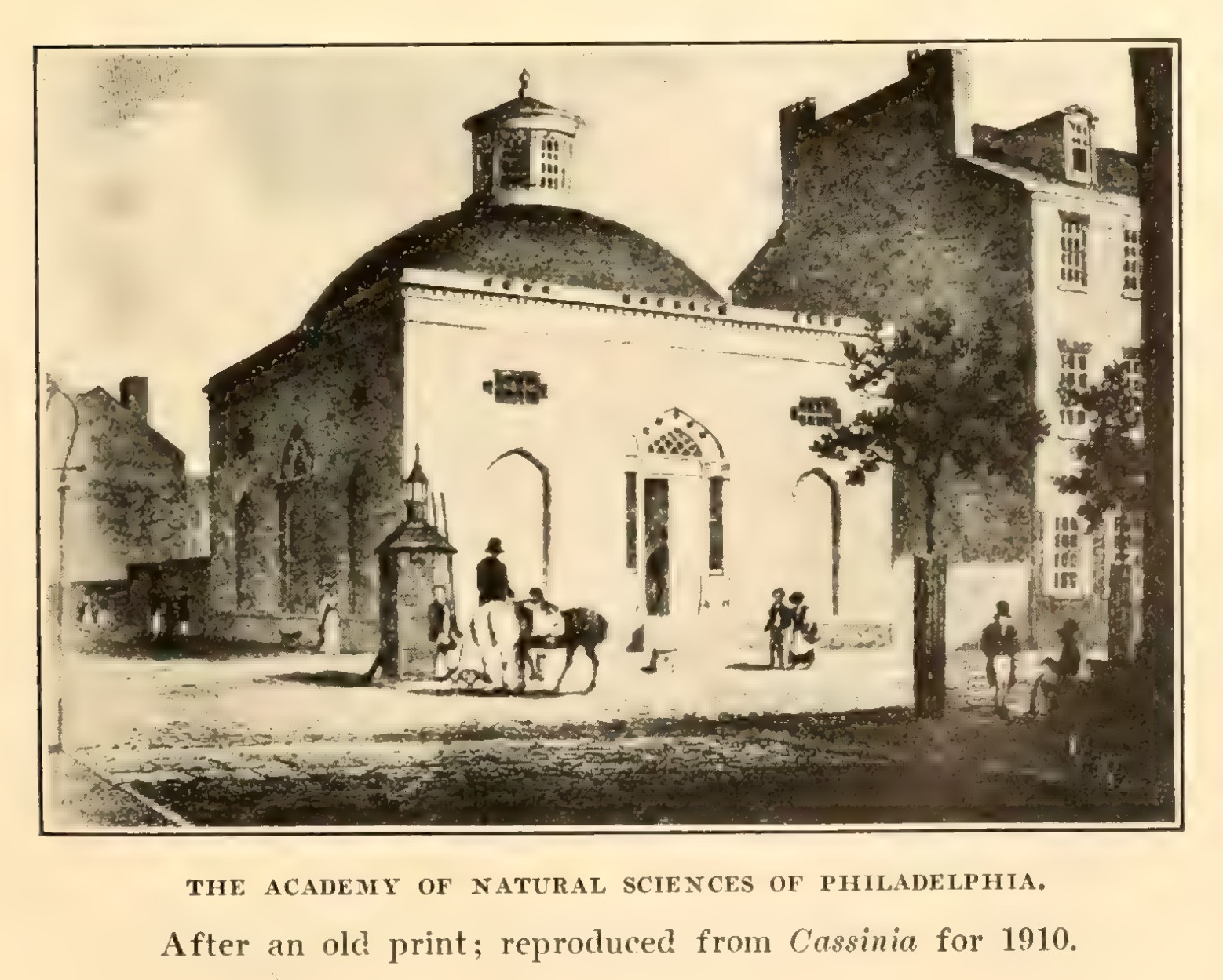
THE ACADEMY OF NATURAL SCIENCES OF PHILADELPHIA.
After an old print; reproduced from Cassinia for 1910.
439
No sooner had Audubon begun to write than it was
learned that “no less than three editions of ’Wilson’s
Ornithology’ were about to be published, one by
Jameson, one by Sir W. Jardine, and another by a Mr.
Brown.” The outlook could not be considered encouraging,
but this intelligence only nerved him to greater
effort, and he was determined to push his own publication
with such unremitting vigor as to anticipate them
all. “Since I have been in England,” he wrote in his
journal, “I have studied the character of Englishmen
as carefully as I have studied the birds in America,
and I know full well that in England novelty is always
in demand, and that if a thing is well known it will not
receive much support.” Audubon worked continuously
at his Biography, rising before the dawn and writing all
day, while the able worker at his side carried his efforts
far into the night, and in three months the first volume
was ready for the printer; Mrs. Audubon meanwhile
copied their entire manuscript to be sent to the United
States in order to secure the American copyright.
When this work was offered to the publishers at Edinburgh,
however, not one of them, said the naturalist,
would offer a shilling for it, but this did not deter him
from publishing it at once and at his own expense.384 On
March 13, 1831, he wrote: “The printing will be completed
in a few days, and I have sent copies of the sheets
to Dr. Harlan, and Mr. McMurtie, at Philadelphia, and
also one hundred pounds sterling to Messrs. T. Walker
& Sons, to be paid to Dr. Harlan to secure the copyright,
and have the book published there.”
440
The following friendly letter from one of Wilson’s
editors belongs to this period:
Sir William Jardine to Audubon
Jardine Hall 3 d Decr. 1830 —
My dear Sir,
I only learnt a few days since that you were to winter in
Edinburgh, and perhaps since you are not Hurried for time in
Trovelly ? will come out to spend a day or two with me — If
you can come out before the 10 th. when I shall have the pleasure
of shewing you some Blackgame Shooting — The season
expires on the Tenth of the Month partridges have bred so
ill that there is scarsely any in the whole country, and pheasants
have been so lately introduced that they are yet rather
scarce — In a wet day you may have your easel & brushes I
should wish much to hear your account of Wilson during the
times you hunted with him — and also some account of the
New Species you figure in the american Ornithology —
I am happy to learn you intend figuring the learned Men
of America as accompanyment to your work particularly the
ornithologists, do you know the painter of the portrait of
Wilson — I have three portraits of him in the House, and also
a profile taken by the machine I should like to have your opinion
of them one of the portraits was painted from an original
that went to America —
I shall expect to hear you are coming soon — Mr Lizars will
tell you about coaches — &c
With best regards believe me
Sincerely yours
Wm Jardine
Addressed
J. Audubon Esqr
Care of W. H. Lizars Esqr
3 James Square
Edinburgh
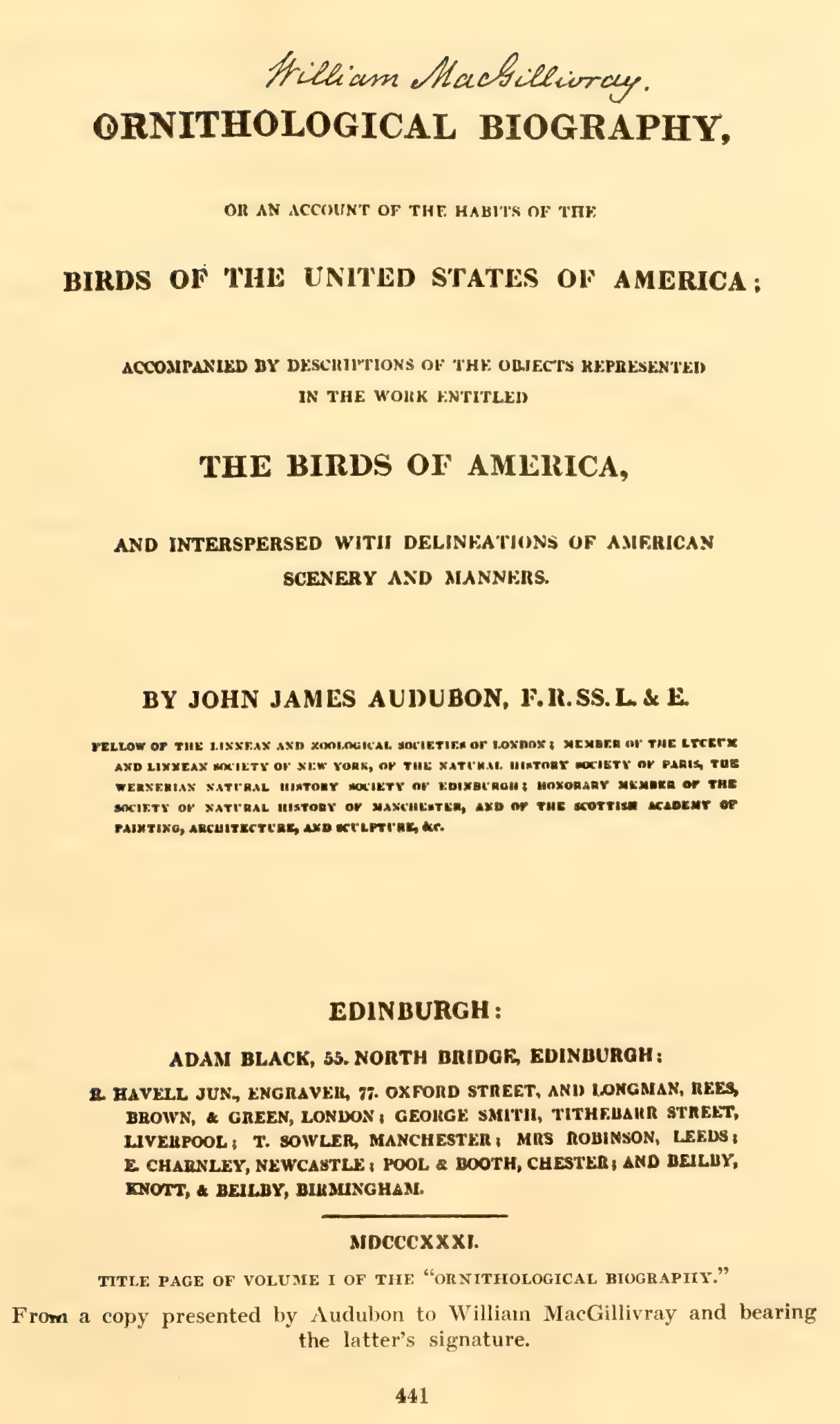
TITLE PAGE OF VOLUME I OF THE “ORNITHOLOGICAL BIOGRAPHY.” From a copy presented by Audubon to William MacGillivray and bearing the latter’s signature.
Audubon was not outstripped by his Edinburgh
rivals, who to all appearances had planned to cover the
442
field of American ornithology so thoroughly as to render
his work a drug on the market, if not to make it superfluous.
Whether this were really true or not, there is
no doubt that Audubon’s activity furnished the stimulus
to the sudden appreciation of the work of his predecessor
that was manifested in Edinburgh at this very moment
of time. It will be interesting to see just what
these rival enterprises were. Professor Jameson, who
had been of great service to Audubon at the beginning
of his undertaking, prepared a pocket edition of Wilson’s
and Bonaparte’s Ornithology, with miniature
plates which were issued separately, and the two works,
which were intended to go together, were published in
1831.385 Sir William Jardine brought out an edition of
Wilson’s and Bonaparte’s work, in three large volumes,
with plates engraved by W. H. Lizars after the originals
and carefully colored by hand.386 This was thoroughly
443
legitimate enterprise, but the climax was reached
when Captain Thomas Brown began to publish an
“Audubonized edition” of Wilson’s and Bonaparte’s
plates, or an attempt to present their plates of American
birds in the Audubonian manner, to the extent at least
of showing the characteristic flowers, trees, and insects
of the American continent, a plan to which some of
Audubon’s earlier critics in Philadelphia had offered
strenuous objection. Brown’s large atlas of plates387 was
444
issued in parts, from 1831 to 1835, and was intended as
a further companion to Jameson’s text for all who could
afford that expensive form of illustration. By a curious
coincidence Audubon’s Ornithological Biography (vol.
i), Jameson’s edition of Wilson and Bonaparte (vol. i),
and Brown’s Illustrations (pt. i), were all noticed on
the same page of the London Literary Gazette for
April 9, 1831. “This day is published,” so reads the
445
advertisement of Audubon’s work, “price 25s. in royal
octavo, cloth, Ornithological Biography….” If the
desire of these various editors were to cripple the work
of the American naturalist, their efforts were certainly
vain, for he was able to make his way against all competitors.
Brown’s work was a failure, so few copies
having been distributed that it is doubtful if more than
one ever came to this country, and only one is known
to be in possession of any large library in England.
Audubon’s initial volume of the Biography was well
received and drew forth immediate and unstinted praise
from many sources. He was anxious that MacGillivray
should contribute some account of it to the London
Quarterly Review, then under the editorial management
of John Gibson Lockhart, but his suggestion was
coldly received and drew forth the following declaration
of independence from his able, if as yet undistinguished,
coadjutor:388
With respect to the review, I can only say that if Mr.
Lockhart is so doubtful as to my powers, he may doubt as
long as he lists. I shall not submit any essay of mine to his
judgment. If you had informed me that he or the conductor
of my other review would print a notice of your works, I should
have agreed to write one with pleasure, but under existing circumstances
I shall not, it being repugnant to my feelings and
contrary to my practice and principles to sue for favor with
any man. I have already written three reviews of your books
which have been printed, and when I am applied to for a
fourth I shall write it too, with “an elegance of style, a power
of expression, and knowledge of the subject” equal to those
usually displayed by the editor of the Quarterly.
446
Some of the criticism, whether friendly or hostile, which
this work eventually evoked will be considered in a later
chapter.
Shortly after his arrival in London, Audubon received
a call from Joseph Bartholomew Kidd, a young
artist whom he had met at Edinburgh the previous
March, and was attracted so much by his “youth, simplicity
and cleverness” that he again invited him to
paint in his rooms. On the 31st of March, 1831, an
agreement was made with Kidd389 to copy some of his
drawings in oils and put in appropriate backgrounds.
“It was our intention,” said Audubon, “to send them
to the exhibition for sale, and to divide the amount
between us. He painted eight, and then I proposed, if
he would paint the one hundred engravings which comprise
my first volume of the Birds of America, I would
pay him one hundred pounds.” In 1832 Captain
Thomas Brown gave this notice of the undertaking in
the Caledonian Mercury:
About a year ago Audubon conceived the grand idea of a
Natural History Gallery of Paintings, and entered into an
agreement with Mr. Kidd to copy all his drawings of the same
size, and in oil, leaving to the taste of that excellent artist to
add such backgrounds as might give them a more pictorial
effect. In the execution of such of these as Mr. Kidd has finished,
he has not only preserved all the vivacious character of
the originals, but he has greatly heightened their beauty, by
the general tone and appropriate feeling which he has preserved
and carried throughout his pictures.
Kidd worked intermittently on some such scheme
for about three years, and produced numerous pictures
447
on canvas or mill-board. He was thus engaged in 1833
when he wrote to ask for an advance of from twelve to
fourteen pounds on account of an accident that had
befallen him on the 16th of May of that year. Kidd
said in his letter that while he was attending a sale of
Lord Eldin’s pictures, the floor of the building suddenly
gave way with a crash and precipitated the whole
company, together with the furniture, into a room below;
that he had sustained many bruises himself, not
to speak of a dislocated arm, but what with blisters,
cupping, nurses and remedies of all sorts, he was then
slowly mending. Another of their projects was to
publish Kidd’s copies of Audubon’s drawings as individual
pieces, and a notice of this appeared in Blackwood’s
Magazine for 1831. John Wilson, in reviewing
Audubon’s work in the magazine for that year said:
“it is expected that there will be completed by Audubon,
Kidd, and others, — Four Hundred Subjects.
Audubon purposes opening, on his return from
America, an Ornithological Gallery, of which may the
proceeds prove a moderate fortune!” All such plans,
however, seem to have been delayed or frustrated, and a
misunderstanding with Kidd brought them suddenly to
a close in 1833. Audubon’s explicit directions under
this head were given in a letter to his son Victor, written
at Charleston on Christmas Day of that year.390
When his letterpress was finished, Audubon left
Edinburgh with Mrs. Audubon on April 15, 1831.
Newcastle, York, Leeds, and Manchester were again
visited, and a pause of several days was made at Liverpool
before proceeding to London, when, as the naturalist
recorded, they “traveled on that extraordinary road,
called the railway, at the rate of 24 miles an hour.” In
448
May391 they visited Paris, Audubon no doubt wishing
to collect the money due from his agent there, as well
as to introduce his wife to the unrivaled attractions of
the great city. Upon returning to London in July he
had the pleasure of again meeting his fidus Achates,
Edward Harris,392 of Moorestown, New Jersey, and
immediately began to put his affairs in order for a long
period of absence.
While Audubon was in Paris, the following letter393
was written by his staunch friend and supporter in Congress,
Edward Everett, who, as has been seen, fully appreciated
the national character of his great undertakings.
The effort of this able advocate to give The Birds
of America free passage to their native land, however,
do not appear to have been successful until two years
later, as a letter to be quoted in due course clearly indicates.
Edward Everett to Audubon
Charlestown, Mass., May 19th, 1831.
My dear Sir
I duly received your favor of the 1st. of Nov. accompanied
with some copies of the Prospectus, and a few days since your
letter of the 5th. March reached me. I owe you an apology
for being so tardy in my reply to the former letter. It reached
me at Washington, while I was confined with a severe illness,
449
with which, since Oct. last, I have till lately been much afflicted.
I was, most of the session, in such a state of health, as to be
kept at my lodgings, and when in my place, in the House of
Representatives, little able to attend to business. As soon as
I went abroad, after the receipt of your letter, I consulted
some of the most influential members of Congress, as to the
probability of being able to pass a bill for the free introduction
of your work. Last winters session was the short session,
terminating by the Constitution on the 3d. of March. At this
session, it is always very difficult to pass any bills, originating
during the session. The time is regularly taken up by bills,
prepared the previous winter. In addition to this circumstance,
more than half of the last session was taken up, by an
impeachment before the Senate. A procedure, which suspended
during its continuance, the legislative business of the two
Houses, and left no time for scarce anything, beyond the
annual appropriation bills for the support of the government.
Under these circumstances, the gentlemen, whom I consulted,
were of opinion with me that it was impossible, for want of
time, to pass a bill in your favor, and that it was therefor
better not to attempt it, at the late session, but to reserve it
for next winter, when it can be brought up seasonably, and
with good hope of success. I shall take great pleasure to seize
the first moment, at the opening of the next session, to bring
the subject before Congress.
The portions of your work, which arrived at Washington
before I left it, were publicly exhibited in the library, and
attracted great attention and unqualified admiration. The
same is true of the copy received by the Boston Athenaeum.
The plates were specially exhibited in the great hall of the
Athenaeum, to the entire satisfaction and delight of those who
saw them.
The copy-right law authorizes any citizen of the U. States
to take out a copy-right of his work, on depositing a printed
copy of the title page in the office of the District Court. I
infer from your letter of the 5th. of March, that you had sent
copies of the printed sheets of your work to Drs. Harlan and
450
M. Mertrie McMurtie of Philadelphia with a view of having
the copy-right.
I have distributed a part of your prospectuses, and shall do
the same with the rest, in the manner that may seem most likely
to promote your interest. I regret to say, that I have not yet
been able to add another, to the list of your subscribers.
You mention, in each of your letters, the little picture you
were so kind, as to propose sending me. This alone leads me
to say, that whenever it comes to hand, it will be most welcome:
but that, engaged as you are in laboring in the cause
of science and of America, you must not feel obliged to consume
one hour of your precious time at the sacrifice of those
higher objects.
I am happy to be able to say to you, that my health, though
not wholly restored, is greatly improved, and that if you will
continue to favor me with your commands, I will prove myself,
hereafter, a more punctual correspondent.
I look forward with sincere pleasure, to the prospect of
meeting you again, on this side of the Atlantic, and with my
respectful compliments to Mrs. Audubon, I beg leave, dear sir,
to tender you the assurance of my high respects, and with it
my most friendly salutations.
Edward Everett.
P.S. Since the foregoing was written, I have received your
favor of the 23d. of April. I beg leave particularly to thank
you for your kindness in reference to the picture. I shall
prize it, not merely on account of its scientific value and beauty
as a work of art, (both of which I feel assured it will be found
to possess) but as a token of your friendly regard. It will
give me great pleasure to furnish you any letters in my power,
for your adventurous south western tour. These I shall have
the pleasure of handing you, when we meet this side the
water.
You were elected in November last a fellow of the American
Academy of Arts and Sciences, on the nomination which I had
the honor to submit to that body. Owing to a change in the
secretaryship a delay arose in preparing your diploma, which
will however be forwarded in a few days.
451
Upon balancing his accounts with The Birds of
America at about this time, Audubon thought it was
truly remarkable that $40,000 should have passed
through his hands for the completion of the first volume.
Who would believe that once in London I had only a
sovereign left in my pocket, and did not know to whom to
apply for another, when at the verge of failure; above all,
that I extricated myself from all my difficulties, not by borrowing
money, but by rising at four o’clock in the morning, working
hard all day, and disposing of my works at a price which
a common labourer would have thought little more than sufficient
remuneration for his work? To give you an idea of my
actual difficulties during the publication of my first volume, it
will be sufficient to say, that in the four years required to
bring that volume before the world, no less than fifty of my
subscribers, representing the sum of fifty-six thousand dollars,
abandoned me! And whenever a few withdrew I was
forced to leave London, and go to the provinces, to obtain
others to supply their places, in order to enable me to raise
the money to meet the expenses of engraving, coloring, paper,
printing …; and that with all my constant exertions, fatigues,
and vexations, I find myself now having but one hundred
and thirty standing names on my list.
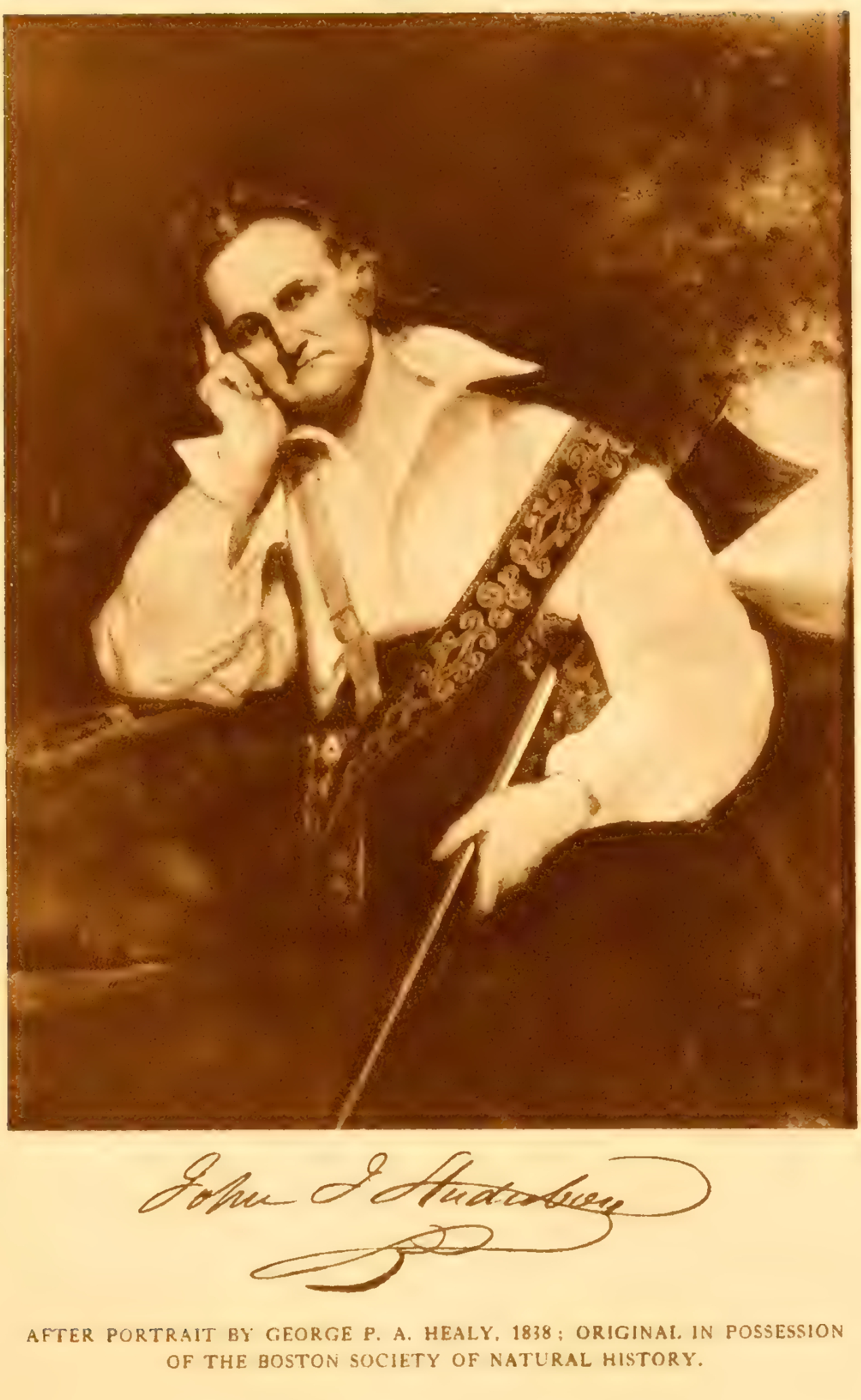
John J. Audubon
AFTER PORTRAIT BY GEORGE P. A. HEALY, 1838; ORIGINAL IN POSSESSION OF THE BOSTON SOCIETY OF NATURAL HISTORY.
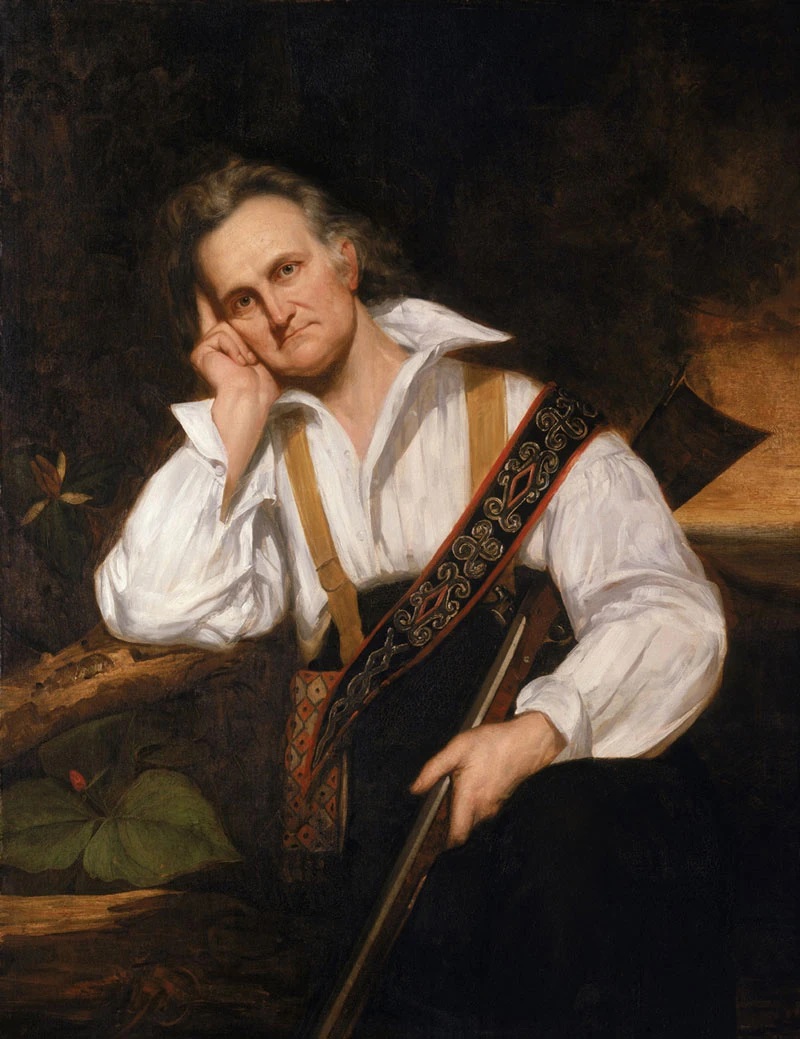
John J. Audubon
PORTRAIT BY GEORGE P. A. HEALY, 1838; ORIGINAL IN POSSESSION OF THE BOSTON SOCIETY OF NATURAL HISTORY.
Port de Rochefort.
| “Signed in the register:- |
{ Gabriel Loyen du Puigaudeau, |
| { Guillet, and
Joseph de la |
| { Tullaye, deputy |
| Oxyd of lead |
85 |
| Oxyd of iron |
1 |
| Sulphuric acid |
13 |
| Water |
1 |
|
100 |
“Signed — John Laval.”
“Laurence Huron.“
| “To three pieces of scantling, 56 feet, 4½ c |
$2.52 |
| “To ten pieces of scantling, 34 feet |
— — |
| “To sixty rafters, 714 feet, at 4 c |
28.56 |
| “To five pieces scantling, 40 feet, at 3 c |
1.20 |
| “To fifteen joists ?, 278½ feet, at 6 c |
16.71 |
| “J. J. Audubon & Co.” |
$48.99 |
- “Common gallinule; Not described by Willson;
- “Common gull; Not described by Willson;
- “Marsh hawk;
- “Boat tailed grackle; Not described by Willson;
- “Common Crow;
- “Fish Crow;
- “Rail or Sora;
- “Marsh Tern;
- “Snipe; Not described by Willson;
- “Hermit Thrush;
- “Yellow Red poll Warbler;
- “Savannah Finch;
- “Bath Ground Warbler; Not described by Willson;
- “Brown Pelican; Not described by Willson;
- “Great Footed Hawk;
- “Turkey Hen; Not described by Willson;
- “Cormorant;
- “Carrion Crow or Black Vulture;
- “Imber Diver;
- “White Headed or Bald Eagle.”
- Black Poll Warbler, New Jersey, May.
- Wood Pewee Flycatcher, New Jersey, May.
- Small Green-crested Flycatcher, New Jersey, May.
- Golden-crowned Thrush, New Jersey, May.
- Warbling Flycatcher, Vireo gilvus, New Jersey, May 23.
- Yellow-breasted Chat, New Jersey, June 7.
- Sea Side Finch, Great Egg Harbour, June 14.
- Marsh Wren, New Jersey, June 22.
- Bay-winged Bunting, Great Egg Harbour, June 26.
- Canada Flycatcher, Great Pine Swamp, August 1.
- Pine Swamp Warbler, Great Pine Swamp, August 11.
- Black and Yellow Warbler, Great Pine Swamp, August 12.
- Hemlock Warbler, Great Pine Swamp, August 12.
- Autumnal Warbler, Great Pine Swamp, August 20.
- Connecticut Warbler, New Jersey, September 22.
- Mottled Owl, New Jersey, October.
Text prepared by:
Source
Herrick, Francis Hobart. Audubon the Naturalist: A History of His Life and Time. D. Appleton-Century Company, New York and London, 1938.
Internet Archive, posted 2 May 2008,
archive. org/ details/ audubon naturalis 1938herr/.
Accessed 19 Mar. 2026.
Herrick, Francis Hobart. Audubon the Naturalist: A History of His Life and Time.
Vol. 1, D. Appleton and Company: New York, 1917.
Project Gutenberg, published 27 Feb. 2019,
www. gutenberg.org/ cache/ epub/ 58983/ pg58983-images.html.
Accessed 19 Mar. 2026.
L’Anthologie Louisianaise