
Territory of Orleans.
A Digest of the Civil Laws. 1808. Extracts.
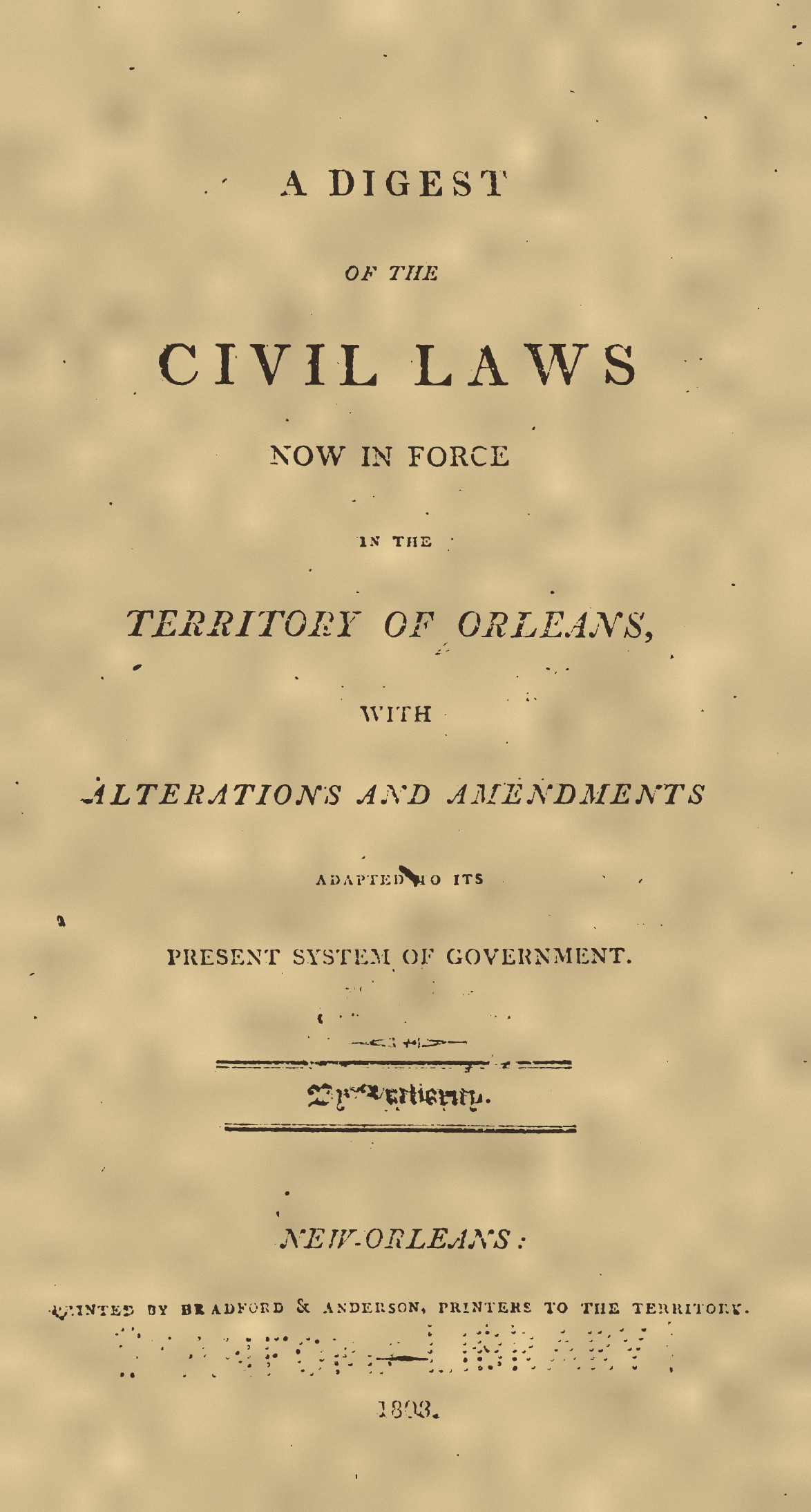
A DIGEST
OF THE
CIVIL LAWS
NOW IN FORCE
IN THE
TERRITORY OF ORLEANS,
WITH
ALTERATIONS AND AMENDMENTS
ADAPTED TO ITS
PRESENT SYSTEM OF GOVERNMENT.

Printed by Bradford & Anderson, Printers to the Territory.
Table of Contents
- Preliminary Title.—
- Of the general definitions of rights and the promulgation of the laws. 2
- Book I.—
- Of persons. 10
- Title 1.—
- Of the distinction of persons, and the privation of certain civil rights in certain cases. 10
- Chapter II.—
- Of the distinctions of persons which are established by law. 10
- Title 3.—
- Of absent persons. 16
- Chapter II.—
- Of the putting into provisional possession the heirs of the absentee. 16
- Title 4.—
- Of husband and wife. 24
- Chapter II.—
- How marriages may be contracted or made. 24
- Title 5.—
- Of the separation from bed and board. 32
- Chapter III.—
- Of the provisional proceedings to which a suit for separation may give occasion. 32
- Title 6.—
- Of master and servant. 36
- Chapter I.—
- Of the several sorts of servants. 36
- Chapter II.—
- Of free servants. 36
- Chapter III.—
- Of slaves. 38
- Title 7.—
- Of father and child. 50
- Chapter III.—
- Of illegitimate children. 50
- Book II.—
- Of things and of the different modifications of property. 96
- Title 1.—
- Of things or estates. 96
- Chapter II.—
- Of immoveables. 96
- Title 3.—
- Of usufruct, use and habitation. 114
- Book III.—
- Of the different manners of acquiring the property of things. 158
- Title 1.—
- Of successions. 158
- Chapter V.—
- Of the incapacity and unworthiness of the heirs. 158
- Title 3.—
- Of contracts and of conventional obligations in general. 306
- Chapter VI.—
- Of the proof of obligations and of that of payment. 306
- Title 4.—
- Of engagements formed without agreements, or of quasi contracts, and quasi offences. 320
- Title 5.—
- Of marriage contract. 332
- Chapter II.—
- Of the various kinds of matrimonial agreements. 332
- Title 6.—
- Of sale. 350
- Chapter III.—
- Of the obligations of the seller. 350
- Title 19.—
- Of privileges and mortgages. 452
- Chapter I.—
- Of the nature of a mortgage and of its several sorts. 452
- Title 20.—
- Of occupancy, possession and prescription. 486
- Title 21.—
- Of the title by judgment or seizure. 490
A Digest
OF THE
Civil Law.
Preliminary Title.
Of the general definitions of rights and the
promulgation of the laws.
10
BOOK I.
OF PERSONS.
TITLE I.
OF THE DISTINCTION OF PERSONS, AND THE PRIVATION OF CERTAIN CIVIL RIGHTS IN CERTAIN CASES.
CHAPTER II.
OF THE DISTINCTIONS OF PERSONS WHICH ARE ESTABLISHED BY LAW.
Art. 13. A slave is one who is in the power of a master and who belongs to him in such a manner, that the master may sell him, dispose of his person, his industry and his labor, and who can do nothing, possess nothing, nor acquire any thing, but what must belong to his master.
Art. 14. Manumitted persons are those who having been once slaves, are legally made free.
Art. 15. Free men are those who have preserved their natural liberty, which consists in a right to do whatever one pleases, except in so far as one is restrained by law.
TITLE III.
OF ABSENT PERSONS.

CHAPTER II.
OF THE PUTTING INTO PROVISIONAL POSSESSION THE HEIRS OF THE ABSENTEE.
16
Art. 15. It shall be the duty of such as shall have obtained provisional possession, or of the husband or wife who shall have been continued in the administration of the community, to cause an inventory of moveables, slaves 18 and credits of the absentee to be made by the parish judge or by any notary public duly authorised to that effect by the said judge.
The judge shall order, if necessary, that the whole or part of the moveables be sold ; at the time of sale, both the amount of the sale and the produce which may be due, shall be either laid out in the purchase of some real property or placed at interest in a solid manner.
Art. 18. Those persons who enjoy only in virtue of the provisional possession can neither alienate nor mortgage the immoveables and slaves of the absentee.
TITLE IV.
OF HUSBAND AND WIFE.
CHAPTER II.
HOW MARRIAGES MAY BE CONTRACTED OR MADE.
24
Art. 8. Free persons and slaves are incapable of contracting marriage together ; the celebration of such marriages is forbidden, and the marriage is void ; it is the same with respect to the marriages contracted by free white persons with free people of color.
TITLE V.
OF THE SEPARATION FROM BED AND BOARD.
CHAPTER III.
OF THE PROVISIONAL PROCEEDINGS TO WHICH A SUIT FOR SEPARATION MAY GIVE OCCASION.
32
Art. 14. From the day on which the action of separation shall be brought, it shall not be lawful for the husband to contract any debt on account of the community nor to dispose of the immoveables or slaves belonging to the same ; and any alienation by him made after that time, shall be null, if it be proved that such alienation was made with the fraudulent view of injuring the rights of the wife.

36
TITLE VI.
OF MASTER AND SERVANT.
CHAPTER I.
OF THE SEVERAL SORTS OF SERVANTS.
Art. 1. There are in this territory two classes of servants, to wit : Free servants and the slaves.
CHAPTER II.
OF FREE SERVANTS.
Art. 2. Free servants are in general all free persons who let, hire or engage their services to another in this territory, to be employed therein at any work, commerce or occupation whatever, for the benefit of him who has contracted with them for a certain price or retribution or upon certain condition.
Art. 3. There are two sorts of free servants in this territory, to wit : — Servants properly so called, or those who let or engage themselves to another, to be employed at some ordinary or hard labor ; such are workmen, laborers, and all those who engage to serve in husbandry or upon plantations ;
And apprentices, who are those who engage to serve some person for the purpose of learning some art, trade or profession.
Art. 4. When a person has bound himself to serve another during a settled time, for a certain sum of money paid, such contract being equivalent to a sale, the engagement resulting therefrom, is much more strict and rigorous than that which is entered into by persons who merely let their daily services for certain wages.
The obligations of the latter, their extent and limits are defined under the title of letting and hiring.
Art. 5. Those who have sold or engaged their services for a settled time and for a certain sum of money paid, as well as the apprentices who have engaged to serve for a certain time, for the purpose of learning some art, trade or profession, shall be compelled to the specific execution of their engagements, respectively, during all the time expressed in the contract, unless they have just cause to be discharged from the same, as is hereafter directed.
Art. 6. The manner in which the indentures of indented servants and apprentices must be executed, is directed by a special act of the legislature of this territory.
Art. 7. An implied condition of the contract entered into between the master and indented servant or apprentice, is, that the latter binds himself to serve the former, during all the time of his engagement and the master on his side, binds himself to maintain the indented servant or apprentice during the same time.
The master is also bound to instruct the apprentice in his art, trade or profession and in consequence of this, it is not unusual for the master to 38 receive a certain sum of money as a premium or recompense for the instruction which it is his duty to give.
Art. 8. The indentures made between indented servants or apprentices and their masters, may be rescinded before the time fixed by the indenture, either at the suit of such indented servants or apprentices, respectively, or at the demand of the master, if they have a just cause to claim such rescision ; and in such case the judge shall direct a restitution of such part of the money received on account of such engagement, in proportion to the time not yet elapsed on that which has been fixed by the said indenture, unless such rescision is occasioned by the fault of him who paid the money, in which case no restitution shall be made.
Art. 9. If any master shall abuse or cruelly or evilly treat his indented servant or apprentice, or shall not discharge his duty towards him, or if the said indented servant or apprentice shall abscond or absent himself from the service of his master, without leave, or shall not discharge his duty to his master, in any of these cases, there will be a sufficient cause to release the aggrieved party from his engagement or to grant him such other redress as the equity and the nature of the case may require at the discretion of the judge.
Art. 10. A master may correct his indented servant or apprentice for negligence or other misbehaviour, provided he does it with moderation ; but he cannot exercise such right with those who only let their daily services.
Art. 11. The master may bring an action against any man for beating or maiming his servant, but in such case, he must assign as a cause of action his own damage arising from the loss of his service and this loss must be proved upon the trial.
Art. 12. A master may justify an assault in defence of his servant and a servant in defence of his master ; the master, because he has an interest in his servant, not to be deprived of his service ; the servant, because it is part of his duty for which he receives wages, to stand by and defend his master.
Art. 13. The master is answerable for the offences and quasi offences committed by their servants according to the rules which are explained under the title of quasi contracts and quasi crimes or offences.
Art. 14. The master is answerable for the damage caused to individuals or to the community in general, by whatever is thrown out of his house into the street or public road, in as much as the master has the superintendance and police of his house, and is responsible for the faults committed therein.
CHAPTER III.
OF SLAVES.
Art. 15. The rules prescribing the police and conduct to be observed with respect to slaves in this territory, their enfranchisement and the punishment of their crimes and offences are fixed by special laws of the legislature. 40
Art. 16. The slave is entirely subject to the will of his master who may correct and chastise him, though not with unusual rigor, nor so as to maim or mutilate him, or to expose him to the danger of loss of life, or to cause his death.
Art. 17. The slave is incapable of contracting any kind of engagement. He possesses nothing in his own right and can transmit nothing by succession, legacy or otherwise ; for whatever he possesses, is his master’s property.
Art. 18. The slave is incapable of excercising any public offices or private trusts, he cannot be tutor, curator, executor, nor attorney, he cannot be a witness in either civil or criminal matters, except in cases provided for by the particular laws of this territory. He cannot be a party in any civil action either as plaintiff or defendant, except when he has to claim or prove his freedom.
Art. 19. Slaves may be prosecuted in the name of the government for crimes or offences by them committed without making their masters parties, unless the master shall be accessary to such crime or offence.
Art. 20. Masters are bound by the acts of their slaves, done by their command, as also by their transactions and dealings with respect to the business in which they have entrusted or employed them ; but in case they should not have authorised or entrusted them, they shall be answerable only for so much as they shall have thereby benefitted.
Art. 21. Independently of the public punishment which may be pronounced against slaves having committed crimes or offences, their masters shall be bound to indemnify those who shall have suffered any damage by such crimes or offences.
Ast. 22. The master however, may discharge himself from such responsibility by abandoning his slave to the person injured ; — in which case the said person shall sell such slave at public auction in the usual form to obtain payment of the damages and costs ; and the balance, if any, shall be returned to the master of the slave, who shall be completely discharged although the price of the slave should not be sufficient to pay the whole amount of the damages and costs ; provided that the master shall make the abandonment within three days after the judgment awarding such damages shall have been rendered ; provided also that it shall not be proved that the crime or offence was committed by his order, for in case of such proof the master shall be answerable for all damages resulting therefrom whatever be the amount, without being admitted to the benefit of the abandonment..
Art. 23. Slaves cannot marry without the consent of their masters ; nor do their marriages produce any of the civil effects which result from such contract.
Art. 24. Children born of a mother then in a state of slavery whether married or not, follow the condition of said mother, they are consequently slaves and belong to the master of their mother.
Art. 25. A master may manumit his slave in this territory, either by an act inter vivos or by a disposition made in prospect of death, provided such manumission be made with the forms and under the conditions prescribed by the special law enacted thereupon by the legislature. But an enfranchisement when made by a last will must be express and formal, and shall not be implied from any other circumstances of the testament, such as a legacy, an institution of heir, testamentary executorship or other like dispositions which in such case shall be considered as not written and void.
42
Art. 26. Any enfranchisement made in fraud of creditors, or of the portion reserved by law to forced heirs, is null and void ; and such fraud shall be considered as proved when it shall appear that at the moment of executing the enfranchisement, the person granting it, had not sufficient property to pay his debts or to leave to his heirs, the portion to them reserved by law ; the same rule will apply, if the slave thus manumitted, was specially mortgaged.
Art. 27. No master of slaves shall be compelled either directly or indirectly, to enfranchise any of them ; except only in cases where the enfranchisement shall be made for services rendered to the territory by virtue of an act of the legislature of the same, and on the territory satisfying to the master, the appraised value of the manumitted slave or slaves.
In like manner, no master shall be compelled to sell his slave or slaves, but in one of two cases, to wit : 1stly, when being only co-proprietor, of the slave, his associates demand the sale, in order to distribute the property, 2dly, when the master shall be convicted of cruel treatment of his slave and the judge shall deem proper to pronounce, besides the penalty established for such cases, that the slave shall be sold at public auction, in order to place him out of the reach of the power which his master has abused.
TITLE VII.
OF FATHER AND CHILD.
CHAPTER III.
OF ILLEGITIMATE CHILDREN.
SECTION II.
OF THE ACKNOWLEDGMENT OF ILLEGITIMATE CHILDREN.
50
Art. 30. Illegitimate children who have not been legally acknowledged, may be allowed to prove their paternal descent, provided they be free and white.
96
BOOK II.
OF THINGS AND OF THE DIFFERENT MODIFICATIONS
OF PROPERTY.
TITLE I.
OF THINGS OR ESTATES.
CHAPTER II.
OF IMMOVEABLES.
Art. 13. Real estate or immoveable things are in general such as cannot be carried from one place to another, or such as those which cannot move.
But this definition strictly speaking is applicable only to such things as are immoveable by their own nature and not to such as are so only by the disposition of the law.
Art. 14. There are things immoveable by their nature, others by their destination, and others by the object to which they apply.
98
Art. 19. Slaves in this territory are considered as immoveable by the operation of the law, on account of their value and utility for the cultivation of the lands, and therefore they may be mortgaged.
TITLE III.
OF USUFRUCT, USE AND HABITATION.
SECTION III.
OF THE OBLIGATIONS OF THE USUFRUCTUARY.
114
Art. 23. The usufructuary is bound to give security for the amount of the inventory, as a pledge for his enjoying as a good father, if it be an immoveable estate ; that he shall return the property in the state in which it is found, not grown worse through any fraud or neglect of his, if it be ordinary furniture ; and that he shall pay the estimated value specified in the inventory, if it consists of things liable to be worn out by use.
This security may be dispensed with, in favor of the usufructuary by the act by which the usufruct is established.
The father and mother having the legal usufruct on the estate of their children, neither the seller nor the donor under a reservation of the usufruct, is required to give this security.
Art. 24. If the usufructuary is unable to give security, the immoveable and the slaves subject to the usufruct, shall be either leased, hired or sequestered.
116
Sums of money, the usufruct of which has been given, shall be put out at interest in a solid way.
And commodities subject to the same usufruct, shall be sold, and the amount of said sale shall be likewise put out at interest.
The interest of said sums, the amount of the real rent of the estate and of the hire of slaves and the produce of the sequestered estate, shall, in such case, belong to the usufructuary.
144
BOOK III.
Of the different manners of acquiring the property of things.
TITLE I.
OF SUCCESSIONS.
Chapter V.
OF THE INCAPACITY AND UNWORTHINESS OF THE HEIRS.
158
Art. 64. All free persons, even the minor pupil, the lunatic, and idiots, and the like may transmit their estates ab intestate and inherit from others. Slaves alone are incapable of either.
260
TITLE III.
OF CONTRACTS AND OF CONVENTIONAL OBLIGATIONS IN GENERAL.
Chapter VI.
OF THE PROOF OF OBLIGATIONS AND OF THAT OF PAYMENT.
Section I.
OF THE LITERAL PROOF.
§ 2.
OF THE ACTS UNDER PRIVATE SIGNATURE.
306
306
Art. 228. Acts under private signature expressing a sale or exchange of immoveables or slaves must be acknowledged and registered in the office of a notary public, six days from their date, if they be passed in the city of New-Orleans or within its liberties; and within ten days from its date, if they be passed without the city and its liberties, in any part of the territory.
When acts under private signature expressing a sale or exchange of immoveable property or slaves have been registered within the above mentioned time, they shall have effect against third persons from the day of their date, otherwise they shall have effect only from the time of their being registered; but the want or delay of registering cannot be pleaded by any one of the contracting parties, their heirs or assigns.
Art. 229. Acts under private signature expressing a sale or exchange of moveable things, have effect against third persons, and can prejudice them 308 only from the day of their being registered in the office of a notary public, unless it be proved that the sale or exchange was accompanied with the actual delivery of the object sold or exchanged, or with some of the circumstances that are equivalent to the actual delivery, according to law or usage.
There is an exception to this rule in favor of the sales of produce or merchandise, if the truth of the date at which they appear to have been passed, be attested on oath or affirmation by at least one credible and disinterested witness.
318
TITLE IV.
OF ENGAGEMENTS FORMED WITHOUT AGREEMENTS, OR OF QUASI CONTRACTS, AND QUASI OFFENCES.
Section II.
OF QUASI CRIMES OR OFFENCES.
320
Art. 20. Every person is responsible not only for the damage which he causes by his own act, but also for that which is caused by the act of any person for whom he is answerable, or by any thing which is in his keeping.
The father, and after the death of the husband, the mother is responsible for the delinquency of their minor children.
322
Masters and principals are responsible for the delinquency of their servants and agents in the functions in which they have employed them.
Institutors of youth or artisans are answerable for the delinquency of their scholars or apprentices.
The above responsibility takes place only when the parents, masters or principals could have prevented the delinquency and have failed to do it.
They are considered to have been able to prevent the delinquency when it was committed through their neglect to watch over the conduct of those for whom they are answerable, or when it was committed in their presence.
The owner of an animal is responsible for the trespass or damage that the animal has caused, whether the animal was in his keeping or was strayed or runaway.
Art. 21. The master is, in like manner, answerable for the delinquency or damage committed by his slaves, although the fact has been committed out of his presence, or though he could not have prevented it, and cannot be reproached with negligence; but he may give up the slave to be sold that the price of him may serve to repair the damage caused, as is prescribed in the title of master and servant.
324
TITLE V.
OF MARRIAGE CONTRACT.
Chapter II.
OF THE VARIOUS KINDS OF MATRIMONIAL AGREEMENTS.
Section II.
OF DOWRY OR MARRIAGE PORTION.
332
Art. 50. If the dowry consists in whole or in part of herds or flocks not valued in the marriage contract, or valued with a declaration that the said estimated value does not deprive the wife of her property in the same, the husband shall be bound only to deliver such proportion of the increased or young proceeding from said flocks and herds during the marriage as shall be necessary to complete the whole number of head of cattle that he originally received.
But with respect to slaves constituted as a dowry and not estimated in such a manner as to operate their sale, the husband is not bound to give others in the room of those who may have or who died, to supply the deficiencies which may have happened among them during the marriage, without any fault of his, he is bound only to deliver such as shall remain, in the state in which they may be, but he must include in this delivery, such living children as may have been born from said slaves.
344
TITLE VI.
OF SALE.
Chapter III.
OF THE OBLIGATIONS OF THE SELLER.
Section I.
OF THE TRADITION OR DELIVERY OF THE THING SOLD.
350
Art. 26. The tradition or delivery is the transferring of the thing sold, into the power and possession of the buyer.
Art. 28. The tradition or delivery of slaves, takes place either by real delivery made to the buyer or by the mere consent of the parties, when the sale mentions that the thing has been sold and delivered to the buyer, or when the said buyer was already in possession under another title.
356
Section III.
OF THE WARRANTY OF THE DEFECTS OF THE THING SOLD OR OF THE REDHIBITORY VICES.
Art. 65. Redhibition is the cancelling of the sale on account of some defect in the thing sold, such as may be sufficient to oblige the seller to take it back again and have the sale annulled.
358
Art. 78. The redhibitory defects concerning slaves are divided into two classes, to wit: the vices of the disposition or temper, and the defects of the body.
Art. 79. The redhibitory vices and defects inherent in the disposition of slaves shall hereafter be limited to cases where it is proved that the slave has been guilty of some capital crime, or that he is addicted to robbery, or in the habit of running away.
Art. 80. The redhibitory defects owing to the sickness or infirmities of slaves consist principally in the three following diseases, to wit:
The Leprosy;
Madness;
And the Epilepsy.
With regard to other ailments or infirmities with which slaves may be attacked, they form or constitute redhibitory defects only when they are incurable by their nature, so that the slave subject thereto is absolutely unfit for the service for which he is destined, or that his services are so inconvenient, difficult and interrupted, that it is to be presumed the buyer would not have bought him at all, if he had been acquainted with the defect, or that he would not have given so high a price, had he known that the said slave was subject to that sickness or infirmity.
364
Section II.
OF THE RESCISSION OF SALES ON ACCOUNT OF LESION.
366
Art. 114. Rescission beyond moiety is not granted even to the vender against sales of moveables, slaves and produce, nor when rights to a succession made assignment to a stranger, nor can it be obtained by persons having virtue of any decree or process of a court of justice.
452
Title XIX.
OF PRIVILEGES AND MORTGAGES.
Chapter I.
OF THE NATURE OF A MORTGAGE AND OF ITS SEVERAL SORTS.
Art. 1. The mortgage is a contract by which a person affects the whole of his property or only some part of it, in favor of another, for security of an engagement, but without divesting himself of the possession thereof.
Art. 2. The mortgage is a sort of pawn, the mortgaged thing being bound for the payment of the debt or of the obligation.
It agrees with the pawn, 1st, inasmuch as both are granted to the creditors for security of their debts, 2d, inasmuch as both produce a lien on the thing which it subjects to it, and that one cannot engage the same thing to a second creditor to the prejudice of the other.
It differs from the pawn, 1st, inasmuch as the term mortgage is only applied to immoveables and slaves and that of pawn to moveables; 2d, inasmuch as in the pawn the moveables and effects which are subject to it must be put into the hands and possession of the creditor, whereas the mortgage does but affect the immoveables and slaves to the right of the creditor, without any need of putting him in possession of them.
472
Title XX.
OF OCCUPANCY, POSSESSION AND PRESCRIPTION.
486
Section III.
OF THE SEVERAL SPECIES OF PRESCRIPTION.
Art. 66. Immoveable estates may also be prescribed for, after thirty years possession, though thus possessed without any title and knavishly.
Art. 67. A man who becomes possessed of an immoveable estate fairly 488 and honestly and by virtue of a just title, may prescribe for the same, after the expiration of ten years, if the true proprietor resides in the territory and after twenty years, in case said proprietor resides abroad.
Art. 74. Slaves may be prescribed for in half the time required for the prescription of immoveable estate and in the same manner and subject to the same exceptions.
490
TITLE XXI.
OF THE TITLE BY JUDGMENT OR SEIZURE.
Art. 1. The seizure or forced sale of the goods and chattels of a debtor transfers the property of the thing seized to the purchasee or vendee thereof. Such sales are made either by virtue of a judgment or of an executory act, confirmed by the judge. Such seizures and sales are made according to certain rules and formalities provided by special laws.
Art. 2. All species of property may be seized on execution, moveables as well as immoveables, without any exception and whether the immoveable estate be or be not a sugar establishment.
Art. 3. The sale or adjudication after seizure, cannot be made, until the things seized have been appraised by appraisers appointed by the parties respectively. The said appraisers shall be sworn, and in case the defendant should refuse to name an appraiser, such nomination shall be made by the sheriff or by the judge who shall make the sale.
The things seized shall be exposed to sale at auction and adjudged, after the delays and in the manner provided by the particular regulations made and provided for that subject.
Art. 4. The debtor alone is liable to seizure and execution. The creditors may nevertheless proceed against a third person having possession of the immoveable property mortgaged for their debt, in the manner provided by the title of privileges and mortgages.
Art. 5. A seizure on execution may be made on a person having a full property and likewise on one having only the right of enjoyment or the usufruct of the thing.
Art. 6. The undivided share belonging to a co-heir in a succession, cannot be seized on execution, but the creditors have the right to demand a partition of the estate between the co-heirs.
Art. 7. No seizure can be made on a widow in community or on the heir, until after having caused to be declared executory against them, the title executed by the deceased or by the husband.
Speaker of the House of Representatives.
J. POYDRAS,
President of the Legislative Council.
Approved March 31st, 1808.
Governor of the Territory of Orleans.
Text prepared by:
- Bruce R. Magee
Source
Territory of Orleans. A Digest of the Civil Laws Now in Force in the Territory of Orleans, with Alterations and Amendments Adapted to Its Present System of Government. Compiled by James Brown and Louis Moreau Lislet. Bradford & Anderson, 1808. Google Books, books. google.com/ books?id= HW1GAQAAIAAJ. Accessed 8 Nov. 2026.
Territory of Orleans. A Digest of the Civil Laws Now in Force in the Territory of Orleans, with Alterations and Amendments Adapted to Its Present System of Government. Compiled by James Brown and Louis Moreau Lislet. Bradford & Anderson, 1808. Digest Online, Center of Civil Law Studies, Paul M. Hebert Law Center, Louisiana State University, digest of 1808. law. lsu. edu/. Accessed 8 Nov. 2026.