
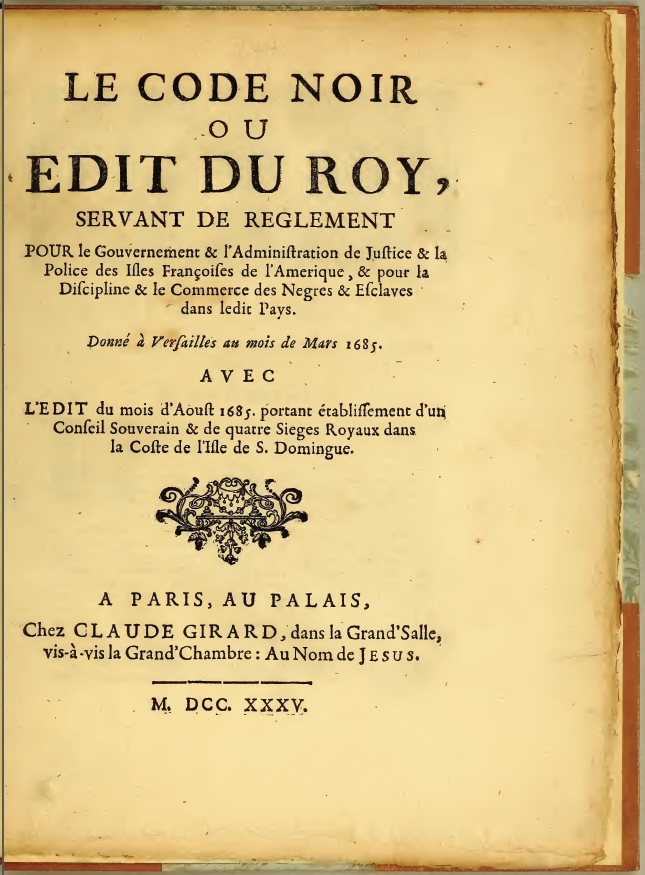
Louis XIV and Jean-Baptiste Antoine Colbert, Marquis of Seignelay.
John Garrigus, Trans.
The Code Noir
© John Garrigus.
Used by permission.
All rights reserved.
|
|
 OUIS, by the grace of God, King of France and Navarre, to all present
and to come, greetings. Since we owe equally our attention to all the
peoples that Divine Providence has put under our obedience, We have had
examined in our presence the memoranda that have been sent to us by our
officers in our american islands, by whom having been informed that
they need our authority and our justice to maintain the discipline of
the Catholic, Apostolic, and Roman church there and to regulate the
status and condition of the slaves in our said islands, and desiring to
provide for this and to have them know that although they live in
regions infinitely removed from our normal residence, we are always
present to them, not only by the range of our power, but also by the
promptness of our attempts to assist them in their needs. For these
reasons, by the advice of our Council, and by our certain knowledge,
full power, and royal authority, We have said, ruled, and ordered, we
say, rule, and order, wish, and are pleased by that which follows.
OUIS, by the grace of God, King of France and Navarre, to all present
and to come, greetings. Since we owe equally our attention to all the
peoples that Divine Providence has put under our obedience, We have had
examined in our presence the memoranda that have been sent to us by our
officers in our american islands, by whom having been informed that
they need our authority and our justice to maintain the discipline of
the Catholic, Apostolic, and Roman church there and to regulate the
status and condition of the slaves in our said islands, and desiring to
provide for this and to have them know that although they live in
regions infinitely removed from our normal residence, we are always
present to them, not only by the range of our power, but also by the
promptness of our attempts to assist them in their needs. For these
reasons, by the advice of our Council, and by our certain knowledge,
full power, and royal authority, We have said, ruled, and ordered, we
say, rule, and order, wish, and are pleased by that which follows.
First Article We wish and intend that the edict by the late King of glorious memory our very honored lord and father of 23 April 1615 be enforced in our islands, by this we charge all our officers to evict from our Islands all the Jews who have established their residence there, to whom, as to the declared enemies of the Christian name, we order to have left within three months from the day of the publication of these present [edicts], or face confiscation of body and property.
II. All the slaves who will be in our Islands will be baptized and instructed in the Catholic, Apostolic, and Roman religion. We charge the planters who will buy newly arrived negres to inform the Governor and Intendant of the said islands within a week at the latest or face a descretionary fine, these [officials] will give the necessary orders to have them instructed and baptized within an appropriate time.
III. We forbid any public exercise of any religion other than the Catholic, Apostolic, and Roman; we wish that the offenders be punished as rebels and disobedient to our orders. We prohibit all congregations for this end, which we declare "conventicules," illicit and seditious, subject to the same penalty which will be levied even against masters who allow or tolerate them among their slaves.
IV. No overseers will be given charge of negres who do not profess the Catholic, Apostolic, and Roman religion, on pain of confiscation of the said negres from the masters who had given this charge to them and of discretionary punishment of the overseers who accepted the said charge.
V. We forbid our subjects of the so-called reformed religion to disturb or prevent our other subjects, even their slaves, from the free exercise of the Catholic, Apostolic, and Roman religion, on pain of exemplary punishment.
VI. We charge all our subjects, whatever their status and condition, to observe Sundays and holidays that are kept by our subjects of the Catholic, Apostolic, and Roman religion. We forbid them to work or to make their slaves work on these days from the hour of midnight until the other midnight, either in agriculture, the manufacture of sugar or all other works, on pain of fine and discretionary punishment of the masters and confiscation of the sugar, and of the said slaves who will be caught by our officers in their work.
VII. Equally we forbid the holding of negre markets and all other markets the said days on similar pains, including confiscation of the merchandise that will be found then at the market and descretionary fine against the merchants.
VIII. We declare our subjects who are not of the Catholic, Apostolic, and Roman religion incapable in the future of contracting a valid marriage. We declare bastards the children born of such unions which we desire to be held and considered, we hold and we consider to be truly concubinage.
IX. The free men who will have one or several children from their concubinage with their slaves, together with the masters who permitted this, will each be condemned to a fine of two thousand pounds of sugar; and if they are the masters of the slave by whom they have had the said children, we wish that beyond the fine, they be deprived of the slave and the children, and that she and they be confiscated for the profit of the [royal] hospital, without ever being manumitted. Nevertheless we do not intend for the present article to be enforced if the man who was not married to an other person during his concubinage with his slave would marry in the church the said slave who by this means will be manumitted and the children rendered free and legitimate.
X. The said solemnities prescribed by the Ordonnance of Blois, Articles XL, XLI, XLII, and by the declaration of November 1629 for marriages will be observed both for free persons and for slaves, nevertheless without the consent of the father and the mother of the slave being necessary, but that of the master alone.
XI. We forbid priests to officiate at the marriages of slaves unless they can show the consent of their masters. We also forbid masters to use any means to constrain their slaves to marry [them?] against their will.
XII. The children who will be born of marriage between slaves will be slaves and will belong to the master of the women slaves, and not to those of their husband, if the husband and the wife have different masters.
XIII. We wish that if a slave husband has married a free woman, the children, both male and girls, will follow the condition of their mother and be free like her, in spite of the servitude of their father; and that if the father is free and the mother enslaved, the children will be slaves the same.
XIV. Masters are held to put into Holy Ground in cemeteries so designated [as will] their baptized slaves; and those who die without having received baptism will be buried at night in some field near the place where they died.
XV. We forbid slaves to carry any weapon, or large sticks, on pain of whipping and of confiscation of the weapon to the profit of those who seize them; with the sole exception of those who are sent hunting by their master and who carry their ticket or known mark.
XVI. In the same way we forbid slaves belonging to different masters to gather in the day or night whether claiming for wedding or otherwise, whether on their master's property or elsewhere, and still less in the main roads or faraway places, on pain of corporal punishment, which will not be less than the whip and the fleur de lys [branding with the symbol of the kings of France; this was a punishment for deserters and habitual criminals in France] and which in cases of frequent violations and other aggravating circumstances can be punished with death: this we leave to the decision of judges. We charge all our subjects to approach the offenders, to arrest them and take them to prison, even if they are not officers and there is not yet any decree against them.
XVII. Masters who are convicted of having permitted or tolerated such assemblies composed of slaves other than those belonging to them will be condemned in their own and private name to pay for all the damage that will have been done to their neighbors by these said assemblies and a fine of 10 ecus for the first time and double for repeat offenses.
XVIII. We forbid slaves to sell sugar cane for whatever reason or occasion, even with the permission of their master, on pain of whipping for the slaves and 10 livres tournois for their masters who permitted it, and a similar fine against the buyer. [Translator's note: In this period a slave might cost about 1,000 livres and a fine horse, about 400. A day laborer in France might earn 1/2 to 1 livre per day.]
XIX. We forbid them also to expose for sale, at the market or to carry to private houses for sale any kind of commodity, even fruits, vegetables, firewood, herbs for their food and animals of their manufacture without express permission of their masters by a ticket or by known marks, on pain of confiscation of the things thus sold, without restitution of the price by their masters, and of a fine of six livres tournois to their profit for the buyers.
XX. We wish, to this end, that two persons be charged by our officers in each market to examine the commodities and merchandises that will be carried by the slaves, together with the tickets and marks of their masters.
XXI. We permit to all our subjects living in our islands to take all the things slaves are carrying when these slaves are without tickets from their masters, or known marks, to be returned instantly to their masters, if the plantations are neighboring the place were the slaves are surprised in this crime, if not they will be instantly sent to the [royal] hospital to be held there until the masters have been notified.
XXII. Each week masters will have to furnish to their slaves ten years old and older for their nourishment two and a half jars in the measure of the land, of cassava flour or three cassavas weighing at least two-and-a-half pounds each or equivalent things, with two pounds of salted beef or three pounds of fish or other things in proportion, and to children after they are weaned to the age of 10 years half of the above supplies.
XXIII. We forbid them to give to the slaves cane brandy in place of the subsistence mentioned in the previous article.
XXIV. We similarly forbid them to unburden themselves of the food and subsistence of their slaves by permitting them to work a certain day of the week for own ends.
XXV. Each year masters will have to furnish each slave with two outfits of canvas or 4 aulnes [about one square yard or meter] of canvas, at the master's discretion.
XXVI. The slaves who are not fed, clothed and supported by the masters according to what we have ordered by these articles will notify our attorney of this and give him their statements, based on which and even as a matter of course, if the information comes to him from elsewhere, the masters will be prosecuted by him and without cost, which we want to be observed for the cries [crieries] and barbarous and inhumane treatments of masters towards their slaves.
XXVII. Slaves who are infirm due to age, sickness or other reason, whether the sickness is curable or not, shall be nourished and cared for by their masters. In the case that they be abandoned, said slaves shall be awarded to the hospital, to which their master shall be required to pay six sols per day for the care and feeding of each slave.
XXVIII. We declare that slaves may possess nothing that does not belong to their master; and everything that comes to them through their own industry, or through the generosity of other persons, or otherwise under any title whatsoever, shall be acquired in full ownership by their masters. The children of slaves, their fathers and mothers, their relatives, and all others, free or enslaved, may claim nothing by succession, by inter vivos disposition, or by cause of death; and we declare such dispositions null, together with all promises and obligations they may have made, as being made by persons incapable of disposing or contracting on their own behalf.
XXIX. Nevertheless, we will that masters be held responsible for what slaves have done by their order and command, as well as for what they have managed and negotiated in the shops and in the particular type of commerce to which the masters have assigned them. They shall be liable only up to the amount that has turned to the profit of the masters. The peculium of said slaves — which their masters have permitted them to hold — shall be liable for such debts, after the masters have first deducted what may be owed to them; unless the peculium consists wholly or partly of merchandise which the slaves have permission to trade separately, in which case the masters shall come in only by contribution, pro rata, with the other creditors.
XXX. Slaves will not be allowed to be given offices or commissions with any public function, nor to be named agents by any other than their masters to act or administer any trade or judgement in loss or witnesses, either in civil or criminal matters; and in cases where they will be heard as witnesses, their dispositions will only serve as memorandum to aid the judges in the investigation, without being the source of any presumption, conjecture or proof.
XXXI. Masters shall be held, in cases of theft or other damage caused by their slaves, in addition to the corporal punishment of the slaves, to make reparation for the injury in their name; unless they prefer to abandon the slave to the person who has suffered the injury. They shall be required to make this choice within three days, counting from the day of the judgment; otherwise they shall lose the right to do so.
XXXII. A fugitive slave who has been absent for one month, counting from the day his master has reported him to the authorities, shall have his ears cut off and shall be branded with a fleur‑de‑lys on one shoulder. If he runs away again for another month, likewise counting from the day of denunciation, he shall have his hamstring cut and shall be branded with a fleur‑de‑lys on the other shoulder; and the third time he shall be punished with death.
XXXIII. The slave who will have struck his master or the wife of his master, his mistress or their children to bring blood, or in the face, will be punished with death.
XXXIV. Freed persons or free Blacks who have given refuge in their houses to fugitive slaves shall be condemned, in the master’s favor, to an amende of thirty livres for each day of harboring; and other free persons who have given them similar refuge shall be fined ten livres for each day of harboring. And if said freed persons or free Blacks are unable to pay the fine, they shall be reduced to the condition of slaves and sold; and if the price of the sale exceeds the amount of the fine, the surplus shall be delivered to the hospital.
XXXV. We permit our subjects of said colony who have fugitive slaves, in whatever place they may be, to have them searched for by such persons and under such conditions as they shall judge appropriate, or to conduct the search themselves in whatever manner they see fit.
XXXVI. The slave condemned to death upon the denunciation of his master, provided that the master was not an accomplice to the crime, shall be appraised before the execution by two of the principal inhabitants who shall be officially appointed by the judge; and the price of the appraisal shall be paid; to satisfy which, there shall be imposed by our Superior Council upon each head of négre the sum fixed by the appraisal, which shall be assessed on each of the said negroes, and collected by those who shall be appointed for this purpose.
XXXVII. We forbid all officers of our said Council, and other officers of justice established in the said country, from taking any fee in criminal proceedings against slaves, under penalty of concussion (extortion by a public official).
XXXVIII. The fugitive slave who has been on the run for one month from the day his master reported him to the police, shall have his ears cut off and shall be branded with a fleur de lys on one shoulder. If he commits the same infraction for another month, again counting from the day he is reported, he shall have his hamstring cut and be branded with a fleur de lys on the other shoulder. The third time, he shall be put to death.
XXXIX. The masters of freed slaves who have given refuge to fugitive slaves in their homes shall be punished by a fine of three hundred pounds of sugar for each day of refuge.
XL. The slave who has been punished with death based on denunciation by his master, and who is not a party to the crime for which he was condemned, shall be assessed prior to his execution by two of the principal citizens of the island named by a judge. The assessment price shall be paid by the master, and in order to satisfy this requirement, the Intendant shall impose said sum on the head of each Negro. The amount levied in the estimation shall be paid for each of the said Negroes and levied by the [Tax] Farmer of the Royal Western lands to avoid costs.
XLI. We do not intend, however, to deprive our subjects of the power to stipulate them as personal property to themselves and to theirs on their side and line, just as is practiced for sums of money and other movable things.
XLII. The masters may also, when they believe that their slaves so deserve, chain them and have them beaten with rods or straps. They shall be forbidden however from torturing them or mutilating any limb, at the risk of having the slaves confiscated and having extraordinary charges brought against them.
XLIII. We enjoin our officers to criminally prosecute the masters, or their foremen, who have killed a slave under their auspices or control, and to punish the master according to the circumstances of the atrocity. In the case where there is absolution, we allow our officers to return the absolved master or foreman, without them needing our pardon.
XLIV. We declare slaves to be charges, and as such enter into community property. They are not to be mortgaged, and shall be shared equally between the co-inheritors without benefit to the wife or one particular inheritor, nor subject to the right of primogeniture, the usual customs duties, feudal or lineage charges, or feudal or seigneurial taxes. They shall not be affected by the details of decrees, nor from the imposition of the four-fifths, in case of disposal by death or bequeathing.
XLV. The judicial lessee of lands or plantations (habitations) seized along with the slaves shall be bound to pay the price of his lease without being able to count among the fruits he collects the children who shall be born of the slaves during the said lease.
XLVI. We will, notwithstanding any contrary agreements, which we declare null, that the said children belong to the seized party if the creditors are satisfied otherwise; or to the purchaser if a decree intervenes; and to this effect, mention shall be made in the last poster of the interposition of the said decree, of the children born of the slaves since the actual seizure; as well as of the slaves who have died since the said actual seizure in which they were included.
XLVII. Husband, wife and prepubescent children, if they are all under the same master, may not be taken and sold separately. We declare the seizing and sales that shall be done as such to be void. For slaves who have been separated, we desire that the seller shall risk their loss, and that the slaves he kept shall be awarded to the buyer, without him having to pay any supplement.
XLVIII. Lineal heirs and lords of the manor shall not be received to withdraw (retirer) decreed lands, whether requested or sold voluntarily, if they do not also withdraw the slaves sold jointly with the lands where they were currently working; nor shall the purchaser or acquirer be allowed to retain the slaves without the lands.
XLIX. We enjoin noble and bourgeois guardians, usufructuaries, lessees (amodiateurs), and others enjoying lands to which are attached slaves who work there, to govern the said slaves as good fathers of families (en bons pères de familles); in return for which they shall not be held, after their administration has ended, to return the price of those who have died or diminished through sickness, old age, or otherwise, without their fault; and also they may not retain as fruits for their profit the children born of the said slaves during their administration, whom we will to be preserved and returned to those who are their masters and owners.
L. Masters aged twenty-five years may manumit (affranchir) their slaves by all acts inter vivos (between the living) or by cause of death; and yet, as there may be found masters mercenary enough to put a price on the liberty of their slaves, which leads the said slaves to theft and brigandage, we forbid all persons, of whatever quality and condition they may be, from manumitting their slaves without having obtained permission by decree from our said Superior Council, which permission shall be granted without fee when the motives set forth by the masters appear legitimate. We will that manumissions made in the future without these permissions be null, and that the manumitted persons (les affranchis) may not enjoy them nor be recognized as such; we ordain, on the contrary, that they be held, deemed, and reputed as slaves, that the masters be deprived of them, and that they be confiscated for the profit of the Company of the Indies.
LI. We will, nevertheless, that slaves who have been named by their masters as tutors to their children, be held and reputed, as we hold and repute them, to be manumitted.
LII. We declare manumissions performed in the forms prescribed above to stand in place of birth in our said province of Louisiana; and the manumitted persons shall have no need of our letters of naturalization to enjoy the advantages of our natural subjects in our kingdom, lands, and countries of our obedience, even though they were born in foreign countries; we declare, however, the said manumitted persons, together with the free négre, incapable of receiving from whites any donation inter vivos, by cause of death, or otherwise; we will that in the event any is made to them, it shall remain null in their regard, and be applied to the profit of the nearest hospital.
LIII. We command manumitted persons to show a singular respect to their former masters, to their widows, and to their children, such that the injury they have done them shall be punished more severely than if it were done to another person; the masters, however, being clear and quit toward them of all other charges, services, and useful rights that their former masters might claim, both over their persons and over their property and successions, in the capacity of patrons.
LIV. We grant to manumitted persons the same rights, privileges, and immunities enjoyed by free-born persons; we will that the merit of an acquired liberty produce in them, as much for their persons as for their property, the same effects that the happiness of natural liberty causes to our other subjects; all this, however, with the exceptions set forth by Article LII of the present decree.
LV. Masters twenty years old will be able to manumit their slaves by all [legal] deeds or by cause of death, without being required to provide the reason for this manumission, neither will they need the permission of parents, provided that they are minors twenty-five years of age.
LVI. Children made universal beneficiaries by their masters, or named executors of their testaments or tutors of their children, will be held and regarded as manumitted.
LVII. We declare their manumissions enacted in our islands to serve in place of birth in our islands and manumitted slaves will not need our letters of naturalization in order to enjoy the advantages of our natural subjects in our kingdom, lands and countries under our obedience, although they be born in foreign lands.
LVIII. We command manumitted slaves to retain a particular respect for their former masters, their widows and their children; such that the insult that they will have done be punished more severely that if it had been done to another person: we declare them however free and absolved of any other burdens, services and rights that their former masters would like to claim, as much on their persons as on their possessions and estates as patrons.
LIX. We grant to manumitted slaves the same rights, privileges and liberties enjoyed by persons born free; desiring that they merit this acquired liberty and that it produce in them, both for their persons and for their property, the same effects that the good fortune of natural liberty causes in our other subjects.
LX. We declare the confiscations and the fines which have no particular destination by these presents, to belong to the said Company of the Indies, to be paid to those who are appointed to the collection of its rights and revenues; we will, nevertheless, that a deduction of one-third of the said confiscations and fines be made for the benefit of the hospital nearest to the place where they shall have been adjudged.
This we give and command to our loved and loyal supporters the persons holding our sovereign council established in Martinique, GadeLoupe [sic], Saint Christophe, that they read, publish and register .... [signed Louis, Colbert, LeTellier]
Page prepared by:
- Arthur Assamoi
- Daniel Bankard
- Kevin Fontenot
- Bruce R. Magee
- Charles Sprague
- Jacob Williams
Source
Louis XIV and Jean-Baptiste Antoine Colbert, Marquis of Seignelay. “The ‘Code Noir’ (1685).” Trans. Garrigus, John. Web. 13 May 2012. <http://les. traitesnegrieres. free.fr/ 39_esclavage_ code_noir_ agl.html>. © John Garrigus. Used by permission. All rights reserved.