
Governor Pierre de Rigaud, Marquis de Vaudreüil.
Regulation of the Public Order.
18 February 1751.
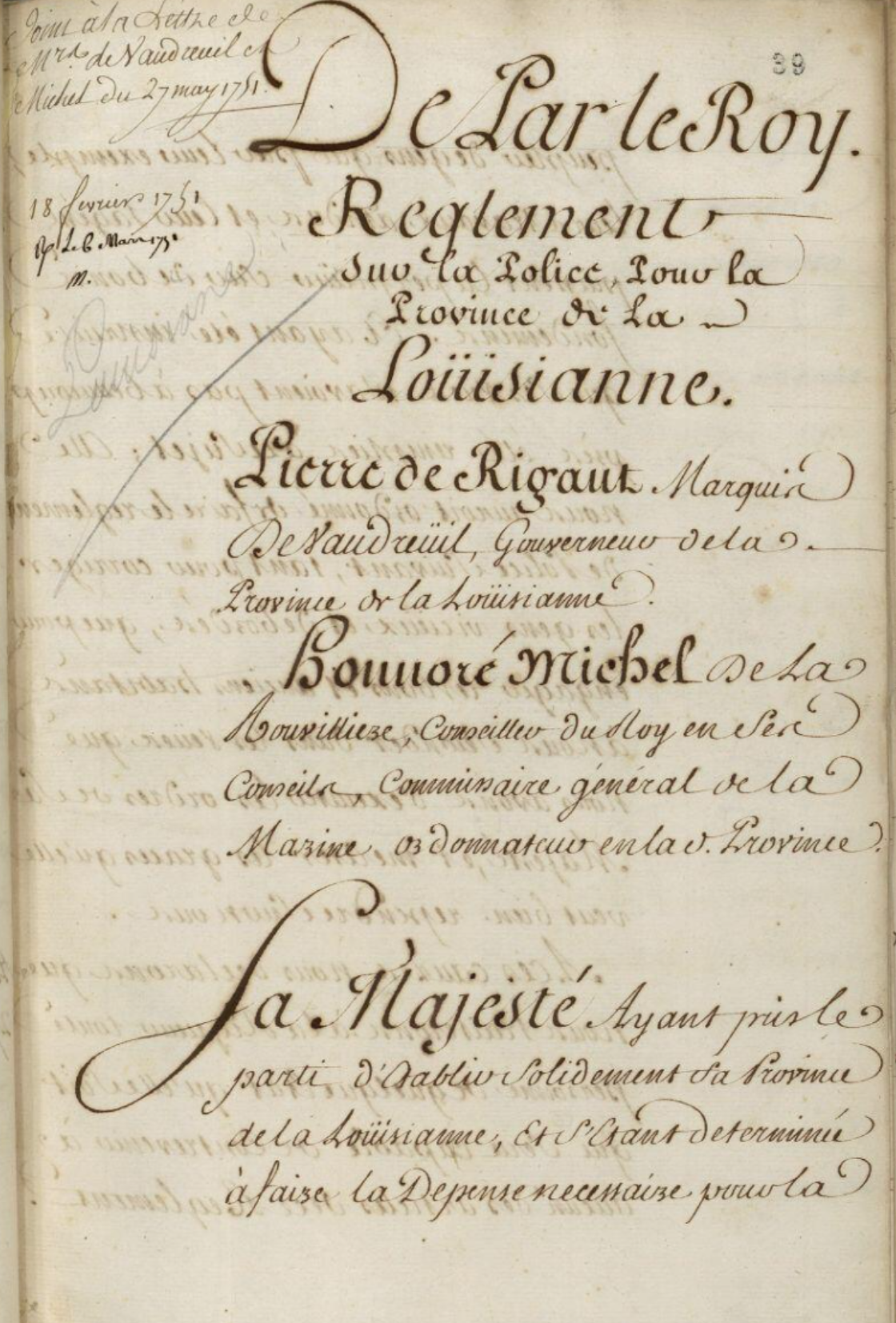
By Order of the King.

Regulation
of the Public Order, for the
Province of
Louisiana.
de Vaudreüil, Governor of the
Province of Louisiana.
Rouvillière, Counselor to the King in his
Councils, Commissary-General of the
Marine, Intendant in the said Province.
fol. 39r
[Marginal note: Annexed to the letter of Messrs. de Vaudreüil and Michel of 27 May 1751.]
[Marginal note: 18 February 1751]
[Marginal note: R. the 6th of March 175[?] (partly obscured)]
His Majesty having taken the resolution to establish solidly His Province of Louisiana, and having determined to make the expenditure necessary to fol. 39v people it with persons who, by their example in their labors, their morals, and their wisdom, may perpetuate it on good foundations; and having been informed that His views have been far from fulfilled in this regard; He has ordered us to make the following regulation of Police, both to correct vicious and disorderly persons, and to engage the good and old inhabitants to second us in the views we have of executing the orders of His Majesty, and meriting the favors He is pleased to bestow upon us.
For these causes we declare that we shall treat with rigor every person, of whatever station, who shall be capable of contravening any article of this Regulation.
fol. 40r
We hope from all good citizens that they will aid us, by their example and by their vigilance, in apprising us of the disorders which may come to their knowledge; and thereby they will put us in a condition to remedy all abuses, and to establish the order and discipline which they have so long awaited. But they must be forewarned, that all the force of this regulation can have no effect unless they contribute, by their exact inquiries, to make known to us the source of the disorders. We presume that it comes in part from too little attention being paid to confining the Negroes on the plantations, and to correcting them in town; from their being allowed to wander at all times, and especially at night. It would be easy to put an end to this disorder fol. 40v by making frequent calls on the plantations during the night, and solid and well-built camps.
We give the public notice that, for the full execution of this Regulation, there shall be a particular judge of Police, who shall make his visits punctually, and shall condemn to the lesser penalties set down herein, saving appeal to Mr. Michel, first judge of the particular Police; who, for grave and difficult cases, shall be at liberty to take assessors to judge them.
Finally, to satisfy the desire of His Majesty, to put an end to the disorders which have lasted too long, and to procure for the public the tranquility which it ought to enjoy, we order fol. 41r as follows.
First Article.
From the day of the publication of these present regulations, all persons, whatever may be their social condition, and under any pretext whatever, even with permissions from our predecessors, which we annul, are prohibited from distributing any intoxicating beverage, whatever may be its nature, and from allowing it to be used for drinking at their respective houses, or even to be carried away in large or small measures; and any person, contravening this provision of our ordinance, shall be sentenced to be imprisoned for one month, to pay ten crowns in favor of the poor, and to have all the liquors found at his house confiscated on behalf of the king’s treasury.
2.
There shall be established six taverns in the fol. 41v town of New Orleans, under commissions to be issued to that effect.
3.
The keepers of these six taverns are permitted to supply, with wine or spirits, no other persons than travellers, sick people, the inhabitants, and sea-faring men; and this they must do with the requisite moderation. We forbid them to furnish these articles to a soldier, under the severest penalties, and to Indians and Negroes, under the penalty of paying a fine of ten crowns, of being sentenced to the pillory, and of forfeiting, by confiscation, all the wines and liquors found in the house and shop of the offender; and should there be a repetition of said offence, said offender shall be sentenced to fol. 42r the galleys for life.
4.
We also forbid tavern-keepers, under the penalty of losing their privileges as such, to retail refreshments, on Sundays and other holidays, during divine worship.
5.
We also decree that said taverns shall be closed, under arbitrary penalties, at nine in the evening of every day, and, after that time, that no one be entertained in said taverns.
6.
Said tavern-keepers shall pay for their privilege, each, the sum of two hundred livres to the ecclesiastical treasury of this parish, which needs very much such relief, and also the additional sum of one hundred livres, for fol. 42v the maintenance of the poor of this town, who are in a great state of destitution.
7.
There shall also be granted the privilege of keeping two liquor shops (canteens), the one to the Major in command of New Orleans, and the other to the officer commanding the Swiss company. One of these shops shall be appropriated to the French soldiers, and the other to the Swiss — so that the military shall drink at the places only designated for them; and the inhabitants, travellers, and seafaring-men, shall no more be received in these liquor shops, than the soldiers shall be received in the other taverns, which they must not even approach. The soldiers, however, must not be forced into going to drink at any one of these two liquor shops; but they must do so of their own free will; and the keepers of said shops, should they give any thing to drink to the inhabitants, travellers, seafaring-men, Indians, and Negroes, shall undergo fol. 43r the same penalties inflicted on the other tavern-keepers in the 3d article of this ordinance.
8.
Whereas we have been informed that certain individuals, instead of improving their lands by cultivation, have come to the town of New Orleans, or have removed to certain localities in the rural districts of this province, in order to establish therein some drunken hedge pot-houses, by which means, they do not only tempt the fidelity of the slaves, but also induce them to rob their masters by giving them intoxicating liquors in exchange for the produce of their pilferings, we request all the honest planters to watch the deportment of these individuals in the country, in order to fol. 43v make us acquainted with the disorders of which they are the authors, so that we may punish them with all the rigor prescribed by the ordinances.
9.
[The scribe first wrote 8.]
In order to check the disorders originating in the town of New Orleans, from the increased multiplicity of taverns which have been established therein without permission, we decree, that eight days from and after the date of the present publication, all the inhabitants of the German Parish, and of other parishes, who have abandoned their lands to come and settle here, shall return to their former places of residence, under the penalty of being treated as vagrants and perturbers of the public peace, and therefore driven away from the country fol. 44r as people of an infamous character.
10.
All free Negroes and Negresses, living either in the purlieus of this town or in its vicinity, who may become guilty of harboring slaves, in order to seduce them and excite them to plunder their masters, and lead a scandalous life, shall lose their freedom and become the slaves of the king. We beg his Majesty to make them part of his domain, by paying per head, for every one of them, five hundred livres, to be applied to the restoration of the church of this parish, which stands in extreme need of such repairs.
fol. 44v
11.
Any Frenchman who shall be so infamous as to become guilty of the offence described in the preceding article, shall be whipped by the public executioner, and, without mercy, be sentenced to end his life on the king’s galleys, &c.
12.
We order that all the regulations of Police of the Custom of Paris, for merchants, bakers, butchers, and others, as regards weights and measures, shall be established in this Province on the same footing, and shall be followed there with the same rule.
13.
As regards the markets, it is forbidden to all persons to sell or buy any provisions not fol. 45r brought to the market-place, exposed there for sale, and inspected by the judge of Police, who shall appoint the hour of sale after persons of rank have been supplied; under penalty of two hundred livres’ fine against the buyer, and as much against the seller, and of a greater fine in case of repetition.
14.
Those who go, either in the town or outside the town, to meet the Cocassiers and other persons bringing provisions to market, and who buy from them, shall pay a fine equal to that fixed by the preceding article, as shall those who have sold to them.
fol. 45v
15.
And if they are Negroes who contravene what is set forth in the two articles 13 and 14, they shall have thirty lashes with the whip in the market-place, unless their masters, if they have any, will pay the fine ordained.
16.
All Negro men and women slaves who come to market or into the town laden with goods to sell, without express permission in writing from their masters, shall be put in prison for eight days, and the said goods confiscated without appeal for the benefit of the hospital of the Poor.
17.
Any individual who shall buy from a slave any object fol. 46r whatever, without a specific written permission from the master of said slave, shall be sentenced, for the first offence, to the pillory, and, for the next, shall be condemned to serve on the king’s galleys for life.
18.
It is expressly forbidden to all traders and merchants to go, under any pretext whatever, into the river to meet the vessels arriving there, in order to buy merchandise from them, under penalty of confiscation of the said merchandise, and of punishment if the case requires it; His Majesty’s intention being that His vessels come to unload and sell before the town, so that everyone may profit by the advantages to be found there.
fol. 46v
19.
It having always been the intention of his Majesty that every individual, on his plantation or elsewhere, should punish his Negroes with moderation, as a kind father would correct his children; and most of the inhabitants of this colony having misunderstood the king’s wishes on this subject, and overlooking in their slaves such faults as are too important not to be repressed, we cannot recommend too much to the owners of slaves, to be more energetic in checking their disorders, and to chastise them without passion on all proper occasions. We give them notice that, if we discover any undue laxity in the exercise of the authority herein mentioned, we shall cause the slaves whom they treat with too much lenity, to be seized and fol. 47r punished with exemplary severity.
20.
We forbid all the inhabitants or citizens of this colony to permit on their plantations, or at their places of residence, or elsewhere, any assembly of Negroes or Negresses, either under the pretext of dancing, or for any other cause, that is to say, excepting the Negroes whom they may own themselves. We also forbid them to allow their slaves to go out of their plantations or premises for similar purposes, because his Majesty has prohibited all assemblies of the kind.
21.
We also forbid the town and country Negroes to assemble in the town of New Orleans, or in its vicinity, or elsewhere, under any pretext fol. 47v whatever, under the penalty, for said Negroes, of being imprisoned and whipped, and, besides, under the penalty, for the masters, of a fine of ten livres, for every Negro who may thus have assembled with said master’s consent.
22.
Should any inhabitant or citizen of the province permit on his plantation or premises an assembly of negroes other than his own, under any pretext whatever, he shall, for the first offence, pay one hundred crowns to the treasury of the church, and shall, for the next offence of the kind, be sentenced to work for life on the King’s galleys.
23.
Any negro which shall be met in the streets or public roads, carrying fol. 48r a cane, a rod, or a stick, shall be chastised by the first white man who shall meet him, with the very same instrument of which he, said negro, shall be the bearer; and should said negro be daring enough to defend himself or run away, it shall be the duty of the white man to denounce the fact, in order that the black man be punished according to the exigencies of the case.
24.
Any negro or other slave, proceeding either on foot or on horseback, in the streets of New Orleans, or on the public roads, during the day, and particularly during the night, shall be stopped by any white person meeting said negro or other slave, in order to inquire for his written pass; and should said slave endeavor to escape, we exhort the citizen, cognizant of the fact, to endeavor to know who that slave may be, and to denounce him, so as to have him punished fol. 48v according to his desert.
25.
Whereas Negroes break down all the horses of the colony by using them immoderately, and by stealing them, not only out of parks, but also out of their stables; and whereas this is infinitely injurious to the agricultural labors of the colony and to the interests of individuals, we permit said negroes to be shot at when they are thus met on horseback, and when they refuse to stop on their being hailed.
26.
Being informed that the negroes of the town are so licentious as to come out, at night, of the houses of their masters, which they leave fol. 49r abandoned and open, and thereby exposed to all sorts of casualties, in order to assemble with those of the country, who come prowling through the town, to commit every kind of malfeasances, and to be drinking at the taverns, to the amount of what they can obtain for what objects they have stolen from the public and from their masters; we exhort and even order all the citizens carefully to watch these nocturnal excesses, to which our police shall be actively alive; and if, through our combined efforts we can discover the authors of such iniquities, the severe justice which shall be administered to them, shall intimidate all others who may be disposed to produce such scandalous disorders.
The inhabitants of the country may powerfully contribute to put an end to this fol. 49v state of things, by retaining their negroes on their respective plantations.
27.
Every negro and other slave who shall be arrested at night in the streets and roads without a ticket from his master shall be taken directly to prison, to be punished the next morning, by order of the judge of Police, according to the case.
28.
Any negro or other slave, either in town or in the country, who shall fail in the respect and submission which he owes to white people — that is to say, who may be so insolent as to elbow them on the high roads and public ways, and who, finally, fol. 50r forgetting that he is a slave, shall offend them in any way whatsoever, shall be punished with fifty lashes, and shall be branded with the fleur de Lys on his back (sur la fesse), in order to make known, in case of need, the nature of his crime.
29.
All the negroes and other slaves who go to church, shall attend the first mass said in the morning. In the country they shall be led to church by the overseer of each gang, who shall take them back immediately after divine worship is over; and should there be servants in the habit of following their masters to any other mass than the first one in the morning, said servants shall stop at the door of the church, and fol. 50v wait there for their masters, under the penalty of being chastised.
30.
We have just explained the respect and obligations due by the blacks to the whites, and particularly to their masters. But it is proper to inform the public that this does not apply indifferently to everybody. A private person, a soldier, or any other individual, has not the right to ill-treat a negro who is guilty of no offence towards him. In certain cases, the person offended may arrest him, and ask that he may be dealt with according to the dictates of justice, because the negro is subject only to the police regulations of the country and to the tribunal of his own master. Consequently, and in compliance with the fol. 51r orders of his Majesty, we forbid that any one should take the liberty to ill-treat slaves; and for any violation of this prohibition, the person so offending shall undergo an arbitrary punishment, according to the circumstances of the case.
31.
As for the rest of the Police concerning the negroes, we refer to the Code Noir, which has provided for all cases.
And the present Regulation shall be read, published, and posted in all the crossroads of this town, and elsewhere; sent to the posts of the Colony, and registered in the office of the clerk of the Superior Council of this province, so that no one may be ignorant of it, and that the citizens who have need of it may obtain copies of it.
fol. 51v
We command, &c.
Given at New Orleans, under the seals of our arms and the countersignatures of our Secretaries, the eighteenth of February, one thousand seven hundred and fifty-one. Signed Vaudreüil, Michel, and below, by their Lordships, Demain, Roumillon.
Registered in the registers of the office of the clerk of the Superior Council of the Province of Louisiana, fol. 12, fol. verso 13, fol. verso 14, and fol. 15, at New Orleans, this sixth of March, one thousand seven hundred and fifty-one. Signed Henry, Clerk.
Read, published, and posted, a copy of the present regulation above and six other copies — to wit, one at the principal door of the parish church of this town, one at the door of the Intendance, fol. 52r and another at the door of the King’s warehouses — and published to the sound of two drums at the close of High Mass in the parish church, as the inhabitants and others were coming out of the said church in great numbers, having heard the said High Mass; I read aloud, in a loud and intelligible voice and by public cry, the present Regulation word for word, having first published it to the sound of two drums at all the crossroads of this town; and as above, I read aloud, in a loud and intelligible voice and by public cries, the present regulation and the other copies, so that no one may plead ignorance of it. By me, Marain Lenormand, usher of audience of the Superior Council of this province, undersigned. At New Orleans, fol. 52v this twenty-eighth of February and first of March, one thousand seven hundred and fifty-one. Signed Lenormand.
A true copy.
[Paraph.]
Text prepared by:
- Bruce R. Magee
Source
de Vaudreüil, Governor Pierre de Rigaud de, Marquis. “Regulations of Police.” History of Louisiana, by Charles Gayarré, Third Series, J. Wiley, 1852, pp. 359–365. Internet Archive, archive.org/ details/ cihm_58151. Accessed 13 Nov. 2026.
de Vaudreuil, Governor Pierre de Rigaud de, Marquis. “Reglement Sur La Police, Pour La Province de La Loüisianne.” 18 Feb. 1751. 1751. Louisiane. M. de Vaudreüil, Gouverneur et M. Michel, Ordonnateur. Archives nationales d’outre-mer, Col. C13A 35, fols. 39–52v. IREL, recherche-anom. culture.gouv.fr/ ark:/ 61561/ 664443.2269375. Accessed 14 Nov. 2026.