The traveler who follows the meandering Mississippi River through southeastern Louisiana can still view monuments to the state's antebellum culture: the plantation homes of the lands' former owners. These homes, called "great houses," are testimonies to a life of wealth that was unequaled in the South up to that time.
These great houses were the centerpieces of vast plantations, rich, fertile farmlands which drew people from throughout the South, from the northeastern United States, and from as far away as the Caribbean and Europe. The planters hoped to capitalize on the nation's growing demand for cotton and sugar. Those who were successful acquired riches, and celebrated their wealth by erecting great houses as symbols of their affluence and power.
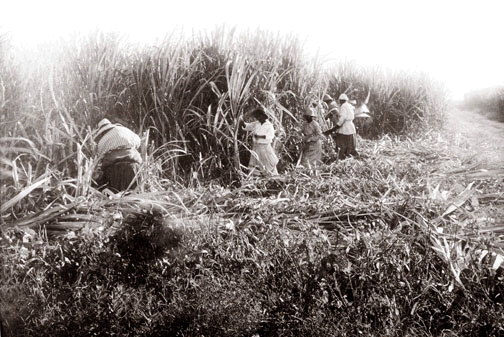
But there was another life beyond the great house, a life that cannot be understood by glancing at these grand estates from the riverfront roadways. The antebellum plantation was not just a place, it was a way of life. For many people, it was their whole life. The sweat and hard labor of slaves converted the fertile land into wealth and prestige for the planter. To get a true grasp of a plantation and its history, it is important to understand the people and processes that kept the plantation alive. Archaeology can help with that understanding.
Ashland-Belle Helene Plantation is located in Ascension Parish on the natural levee of the Mississippi River. A natural levee is slightly elevated land bordering a river channel. Settlers were attracted by the rich land along the Mississippi River natural levee and the access to markets that the river could provide.
In recent years, the great house has been the only visible evidence of what was once the grandeur of Ashland-Belle Helene Plantation. This house and the surrounding 34 acres were listed on the National Register of Historic Places on May 4, 1979. In 1989, excavations at the property proved that archaeological remains of the quarters complex, where slaves and freedmen lived, and the sugarhouse, where cane was processed into sugar, were also eligible for inclusion on the National Register. In 1992, Earth Search, Inc., of New Orleans, was contracted to excavate in the quarters and the sugarhouse areas by the current owners of the property, Shell Chemical Company. This study revealed the rich history contained at the site. Information from the excavations makes it possible to go beyond the verandahs and the front door of the great house into the two-room cabins, the sugarhouse, and the lives of the laborers who worked on the plantation.
The site of the sugarhouse, which had been leveled to its foundations, was almost completely excavated with a backhoe and by hand. Although there is a great deal of information on how cane was processed into sugar, and even what the machinery looked like, historians have recorded very little about how the equipment was organized within a sugarhouse. They also provide virtually no information about how sugarhouses evolved through time to accommodate changing technology. Archaeology at Ashland has provided insight into these issues.
Over 958 sq. ft. of area was excavated by hand at each of the two slave cabin sites. In addition, artifacts were collected and the remains of buildings were mapped throughout the rest of the quarters and around the sugarhouse as these areas were cleared for construction. This phase of the project, called archaeological monitoring, provided an opportunity to examine the remains of 18 cabins, the overseer's house, a blacksmith shop, and other buildings. As a result of this work, insights have been gained into how the land at Ashland was used.
Few plantations exist today with all of their buildings intact. Some maps showing structures on plantations have survived, but these only suggest what a plantation looked like at one particular date. Archaeology is an important means of studying how plantations were organized, and how that organization changed through time. The design and location of buildings were just as important as the architectural plans for the great house. Archaeology also can provide the details of daily life of the common people-- information that is not recorded in history books. This includes what kind of houses they lived in, what they ate, what kind of dishes they used, and how they spent their leisure time.
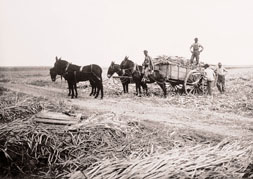
A sugarcane cart

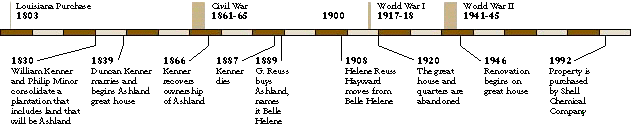
The earliest known owners of the land that would eventually become "Ashland" and later "Belle Helene" were William Kenner, a New Orleans merchant and planter, and his brother-in-law, Philip Minor. By 1830, William Kenner and Philip Minor had consolidated a sugar plantation of more than 1,800 acres, including a portion of the future Ashland tract. After William Kenner's death in 1830, his share of the plantation eventually ended up under the control of his two sons, Duncan F. Kenner and George R. Kenner. The Kenner brothers immediately began to expand their holdings.
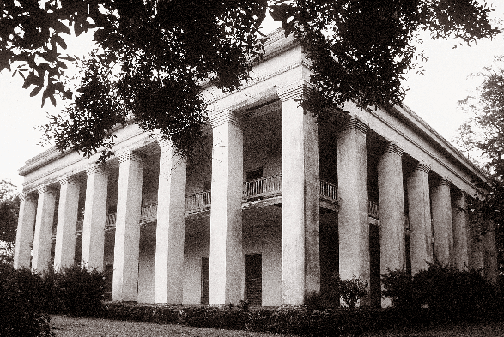
In 1839, Duncan Kenner married Nanine Bringier, daughter of a prominent French Creole family. As a wedding present, he commissioned construction of the great house at Ashland. Construction began in 1840, and the project was completed by 1842. The Greek Revival great house at Ashland is considered an architectural masterpiece. The quarters and the sugarhouse were built at about the same time the great house was erected. It is likely that the great house, the sugarhouse, and the quarters were all built by the plantation's slaves.
Duncan Kenner bought his brother's interest in the plantation in 1844. He named his property "Ashland" after U.S. statesman Henry Clay's plantation in Kentucky. Kenner eventually expanded his land holdings to over 2,200 acres. His estate included the neighboring Bowden Plantation, complete with its own sugarhouse, which he bought in 1858.
Ashland-Belle Helene great house

Duncan Kenner was an extremely wealthy planter. This wealth allowed him to become increasingly important in local political circles. He served in the Louisiana legislature before the Civil War, then held office in the Confederate legislature. In July 1863, during a recess in the legislature, Kenner was visiting his family at Ashland and narrowly avoided capture by the Union army. One of his slaves warned him that the Federal troops were coming, and Kenner was able to make his escape. All of Kenner's prized racehorses, most of his wine and liquor, and the Kenner family silver were captured by the Federal troops. In 1865, in a desperate attempt to get funding for the southern cause, Kenner undertook a difficult trip to Europe as a minister for the Confederate States. He had the authority to negotiate for financial support from France and Great Britain.
Even though Ashland had been captured by the Union army, sugar was still produced by the estate. The sugarhouse and its machinery were left undamaged. The overseer maintained control of the plantation and its labor force throughout the war. During the last two years of the war, Ashland was rented, and then confiscated by the Freedmen's Bureau, a Federal agency formed to assist the freed slaves. In 1866, Kenner returned from Europe, swore an oath of allegiance to the Union and was repatriated, thereby recovering the ownership of Ashland.

Not long after the Civil War, Duncan Kenner moved to New Orleans to pursue his law practice. The workers on Ashland Plantation, probably including Kenner's freed slaves, continued to live in the antebellum quarters. Continued residence in the quarters is partly explained by the nature of labor on sugar plantations in the post-Civil War period. Following Emancipation, working for wages replaced slavery on sugar plantations. As was the custom on sugar plantations before the Civil War, sugar laborers were organized into groups of workers who performed specific jobs directed by an overseer. On many plantations, the antebellum quarters were used to house these workers. The laborers were paid either in cash or in credits for use at the plantation store. A store, which was probably established soon after the war, was operating at Ashland at the time of Kenner's death.

The death of Duncan Kenner in 1887 signaled a period of change at Ashland. In March 1889, Kenner's estate was sold to George B. Reuss, an Ascension Parish planter. The Reuss family moved into the Ashland great house. Reuss renamed the plantation "Belle Helene" in honor of his recently born daughter, Helene. Belle Helene remained a major sugar plantation into the second decade of the twentieth century. The cabins continued to be used by the plantation workers.
Helene Reuss moved from the Ashland-Belle Helene great house soon after her marriage in 1908. However, other members of the Reuss family lived there until sometime in the 1920s. The house had deteriorated significantly by the time a restoration effort began in 1946. Although it subsequently fell victim to further decay and haphazard renovation, the house is being stabilized by its present owners, Shell Chemical Company.
As was the case with almost all the other great Louisiana plantations, Ashland passed into anonymity along the banks of the Mississippi. The quarters fell silent, the sugarhouse collapsed, and the land was divided and sold. Much of the former Ashland-Belle Helene Plantation tract currently serves as the site for major chemical production facilities owned by Shell Chemical Company and the Vulcan Materials Corporation.