Voodoo in New Orleans
"Blake Touchstone"
As the bewitching hour of midnight approaches, the warm swamp air is filled with the throbbing beat of drums, the chant of emotion-wrought voices, the smells of fire, gumbo, whisky and boiling cauldrons, and the heightened sense of excitement and passion which accompanies revivals and political rallies. Dark forms sway with the eerie music, and then dance wildly about the leaping flames. Flickering light is reflected on their black, brown and yellow bodies.
The Voodoo Queen arises from her throne-the embodiment of power and mystery. She calls for the final ingredients to be added to the devil's stew: a live rooster or cat or, possibly, a small child. The animal is sacrificed and oaths are sworn in its blood. Then, procuring a large snake from a decorated box on the altar, the queen leads her faithful court through secret prayers and rituals invoking the diabolical voodoo spirit embodied in this serpent. The writhing snake is used as an oracle or is itself sacrificed. Awful voodoo powers are imbibed in the brew from the steaming cauldron and ac- quired in the form of charms known as gris gris for the working of good or evil.
Dancing and shouting continue at an increased pace. Some of the ecstatic worshippers begin foaming at the mouth; others, having worked themselves into a state of frenzy, are struck to the earth unconscious. At midnight there is a piercing scream as the naked voodoos race into the lake to swim or into the bushes to pursue further orgies. These savage rites will continue unabated until dawn of St. John's Day.
Such is the account of voodoo in post-Civil War New Orleans as narrated in innumerable works by Lyle Saxon, Robert Tallant, Henry C. Castellanos, Herbert Asbury, Alcee Fortier, George Washington Cable and Charles Dudley Warner. Continual reiteration in guide books, newspapers, magazines and old history books has endowed these and other New Orleans voodoo stories with the aura of truth.
The truth, however, has been embellished with legend, much like that which surrounds Jean Laffite, Davy Crock- ett, Jim Bowie or Crispis Attucks. Voodoo did exist in New Orleans-in some of its facets it probably still exists. The cult undoubtedly possessed many black and more than a few white adherents.
The true nature of voodoo activities should interest both scholars and the general public because the unusual beliefs and practices of voodoo provide fascinating insights into a little known segment of society. Given the secretive and mysterious nature of voodoo ac- tivities, reliable documentation is indeed minimal; however, this fact did not deter the authors cited above from romanticizing and mythologizing voodoo for popular consumption. In the ensuing pages an attempt is made to separate such voodoo folklore from the few historical incidents which can be documented by newspaper sources.
Notes
- Charles Dudley Warner. Lyle Saxon, Fabulous New Orleans (New York, 1928), 237-46; Lyle Saxon, Robert Tallant, et al., Gumbo Ya-Ya (Boston, 1945), passim; Robert Tallant, Voodoo in New Orleans (New York, 1946), esp. 79-83; Henry C. Castellanos, New Orleans as It Was (New Orleans, 1895), 90-101; Hebert Asbury, The French Quarter (New York, 1936), 259-65; Alcee Fortier, Louisiana Studies (New Orleans, 1894), 130; George Washington Cable, "Creole Slave Songs," Century Illustrated Monthly Magazine, XXXI (April 1886), 807-28; Charles Dud- ley Warner, Studies in the South and West (New York, 1899), 64-74. The sec- tions in Castellanos and Warner are similar to previous articles written by both authors; see Castellanos, "The Voudous," Times Democrat, June 24, 1894, and Warner, "A Voudoo Dance," Harper's Weekly, June 25, 1887. A discussion of voodoo in Dorothy Rose Eagleson, "Some Aspects of the Social Life of the New Orleans Negro in the 1880's," (unpublished masters thesis, Tulane University, 1961), 110-12, relies heavily upon Tallant, Asbury, Castellanos and Warner. For recent examples of undocumented voodoo history see Jacques D'Argent, Voodoo (Los Angeles, 1970), 80-82, and Ed Cocke, "Voodoo," New Orleans Magazine, IV (January 1970), 50-53.
- newspaper sources. This study is based primarily upon accounts found in the New Orleans newspapers of the 1870s and 1880s. Two serious students of black culture in New Orleans, David Rankin and John W. Blassingame, are finding references to voodoo in police and court records.
The word "voodoo" is spelled and defined in several ways. George Washington Cable called it "the name of an imaginary be- ing of vast supernatural powers residing in the form of a harmless snake." A broader definition of the term is the belief in fetishes which manifest the great powers of such a diabolical spirit or nega- tive being. Those who worship this mysterious spiritual potentate or believe in these fetishes are themselves labeled voodoos. They wish to use the powers of a fetish, known as gris gris, to bring good fortune to themselves and harm to their enemies. In common usage as a noun, adjective or verb, voodoo refers to the black magic historically associated with Negroes in the West Indies or in the Deep South region of this country.
The origins of voodoo, as well as its practice, remain shrouded in mystery. The word itself has been variously credited by re- searchers as having both African and French or European origins. VODu as used by the Ewes of West Africa means fear of the gods, and VODUN in Dahomey, West Africa, is purportedly a name for all deities. In France VAUDOis referred to a witch, a follower of Peter Valdo. A white Southern sociologist, N. N. Puckett, has found many close relationships between Southern Negro folklore, superstitions, language and customs, and their counterparts in West Africa. However, Puckett concluded that what was often considered a "relic of African heathenism" was, in four cases out of five, European dogma.
Notes
- ways. New Orleans blacks often pronounce it "hoodoo." In Haiti it is frequently "Vodun." Other related renderings "Voodoo," 'voudou" and 'vaudaux" are used interchangeably in this study.
- country. Cable, "Creole Slave Songs," 815; "voodoo," Webster's New World Dic- tionary of the American Language (New York, 1960), 1636; Newbell Niles Puckett, Folk Beliefs of the Southern Negro (Chapel Hill, 1926), 169-75.
- Peter Valdo. Puckett, Folk Beliefs, 15-177; William W. Newell, "Reports of Voodoo Worship in Hayti and Louisiana," Journal of American Folklore II (1889), 41; Melville J. Herskovits, The New World Negro; Selected Papers in Afroamerican Studies, ed. Frances S. Herskovits (Bloomington, 1966), 354, Cf. with Tallant, Voodoo in New Orleans, 9.
- European dogma. Puckett, Folk Beliefs, esp. 19, 37, 162. See also Robert E. Park, "The Conflict and Fusion of Cultures with Special Reference to the Negro," Journal of Negro History, IV (April 1919), 115-16.
Many scholars have noted the use of Roman Catholic saints and liturgies in voodoo worship. Such voodoo symbols as black cats, serpents and the color red can be traced to both European and African motifs signifying, respectively, evil, the devil, and blood, sin, sacrifice or harlotry. Voodoo is probably a complex mixture of the superstitions held by the poor and uneducated, the few bits of African culture which survived the black man's traumatic im- migration to the New World, and the trappings of French folklore and Roman Catholic worship.
Voodoo is most commonly associated with the Negroes in French outposts in the New World-especially Haiti, to a lesser extent, Martinique and Louisiana. After existing in New Orleans for sev- eral decades, the cult increased about 1800 when many Haitian and West Indian blacks who were already acquainted with it were brought as slaves to Louisiana. The hexes, secret revenges and emotional outpourings of voodoo were readily incorporated into the system of slavery and caste which existed in the antebellum South.
Voodoo appealed to superstitious blacks, both slave and free, who were denied most educational and religious opportunities, severely restricted in their overt expressions of violence, and limit- ed in their means of retribution for the many injustices they suf- fered. The heyday of voodoo in the United States was probably in pre-Civil War New Orleans. For here there were numerous West Indian Negroes, a relatively large and unsupervised popula- tion of slaves and free men of color, a wide-open, free-wheeling atmosphere, and the French-Catholic influences so frequently as- sociated with voodoo.
Notes
- voodoo worship. Puckett, Folk Beliefs, 180-92, 227, 560-62; Herskovits, New World Negro, 321-29; Newell, "Voodoo Worship," 45. See also Lafcadio Hearn, "The Last of the Voudoos," Harper's Weekly, Nov. 7, 1885, p. 727; Warner, South and West, 66-74; "Voudou Vagaries," New Orleans Bulletin, June 24, 1875; "The Voudou- 'Fetish', Daily Picayune, June 25, 1873.
- voodoo. Both Daniel R. Hundley, Social Relations in Our Southern States (New York, 1860), 328-33, and Edwin A. Davis, Louisiana: A Narrative History (Baton Rouge, 1961), 50, 80, 236, mention, without documentation, voodoo activities in pre-Civil War Louisiana. Several reports in the New Orleans newspapers of the 1850s indicate a high level of voodoo activity: "City Intelligence," Picayune, July 24, 1850; "More of the Voudous," Picayune, July 31, 1850; "A Motley Gathering," True Delta, June 29, 1850; "Witchcraft," True Delta, Aug. 27, 1850; "And Dance the Voudou Dance," True Delta, Nov. 3, 1854. See also Gilbert Osofsky (ed.), Puttin' on Ole Massa (New York, 1969), 36-38.
During the War Between the States the Union army occupied New Orleans and attempted to curtail voodoo activities. On the evening of July 30, 1863, Special Officer Long investigated a sus- picious meeting on Marais Street.
When he and some other officers entered the building he found about forty naked women-all colored except two-who were dancing the Voudou dance and performing rites and in- cantations pertaining to that ancient African superstition yclept Voudouism. In the center of the room there was a vessel filled with a motley mixture . . . of a semi-fluid char- acter, ornamented with curious unnameable substances. From the vessel a number of burning candles protruded, and around these lights the Voudou sisters danced. On a little furnace in one corner of the room strange spices burned, giving forth exhilarating perfumes. The object of the meeting, as far as could be ascertained by the police, was the bringing down of Heaven's vengeance on those who had in any manner forfeited their good will. As soon as the police entered there was a great scattering of the nude sisterhood, notwithstanding which about twenty were arrested.
The Daily Picayune claimed that this was the first voodoo meet- ing in years that had been interrupted by the police. When brought into court, the case sparked a great deal of excitement; more than four hundred women of all shades and colors appeared, and some twenty to fifty of those who refused to disperse were fined two dollars each. The twenty women originally arrested for unlawful assemblage and nudity were each held for $100 bail until August 2, when all charges were dropped.
Notes
- arrested. "Voudou Meeting Broken Up," Picayune, July 31, 1863. 10 Ibid.; "The Voudou Case," Picayune, Aug. 1, 1863; "The Voudou Vessels," Picayune, Aug. 1, 1863.
- dropped. Ibid.; "The Voudou Case," Picayune, Aug. 1, 1863; "The Voudou Vessels," Picayune, Aug. 1, 1863; "The Voudou Case Disposed Of," Picayune, Aug. 2, 1863; "The City," Picayune, Aug. 2, 1863. The story is also found in "The Case of the Voudous," New Orleans Bee, Aug. 1, 1863.
Approximately one year later "Twelve colored women were arrested in the Second District on the petition or statement of their ceremonies. This 1864 account went on to infer that the general populace was aware of voodoo activities, disapproved of them, and had caused them to be broken up by the police on other recent occasions.
Such incidents signaled a growing intolerance of voodoo in the Crescent City. Ceremonies which continued to be held in the city were administered more discreetly and involved fewer supplicants. The Daily Picayune reported in 1873: "Formerly the most bestial performances used to take place within the city limits, down in what was then known as the old Faubourg Treme, back of Ram- part Street and the Old Basin, but an ordinance having been passed on the subject, the police succeeded in supressing these, since which time the annual festival only has been held, and that on the lake shore, between Bayou St. John and La Salle.
These lakeshore ceremonies usually occurred on St. John's Eve, a traditional day for Bacchanalia and for an annual demoniacal disease, the dancing mania, which spread across Europe in the Middle Ages. New Orleans newspapers from 1870 to 1876 includ- ed numerous accounts of the St. John's Eve (June 2 3 to 24) voodoo rites held near Lake Pontchartrain. Some of the newspaper stories do substantiate the romanticized legend of voodoo. However, the stories recounted by most of those reporters who claim to have actually witnessed ceremonies cast doubts upon the standard interpretations. And several of the accounts which appear to be the most reliable depict events which vary greatly from the ver- sions of Lyle Saxon and Robert Tallant.
Notes
- ceremonies. "Voudou," New Orleans Times, June 30, 1864; "Second District Recorder's Court," Bee, June 30, 1864. These suspects were also released, but the military authorities continued to arrest rowdy or vagrant blacks. See "The Sables in Trouble," Bee, Aug. 6, 1863.
- Bayou St. John and La Salle. "The Voudou-'Fetish'," Picayune, June 25, 1873.
- Middle Ages. This "disease" was also called St. John's Dance, St. Vitus's Dance, and Tarantism. See J.F.C. Hecker, The Epidemics of the Middle Ages, trans. B. G. Babington (London, 1859), 80-128, esp. 80-84. St. John's Eve, occurring on or near the longest day of the year, was always a time for pagan festivals. The Grimms brothers wrote that on this day European witches met in lonely and remote spots. "Voudou Nonsense," Picayune, June 26, 1874, reported that several famous ghosts, Sir Richard Coldingham and Bernardo, had appeared on this day in years past.
- Lake Pontchartrain. The classic description was cited above in fn. 12. Other representative ac- counts include "Making a Night of It," Times, June 26, 1872, "Voudou Vagaries," Times, June 26, 1874, "Voudou Vagaries," Bulletin, June 25, 1875; "Les Voudous," Bee, June 25, 1875.
A critical examination of a score or more of these newspaper stories leads to the following generalizations. The New Orleans public was aware that some forms of voodoo were being practiced in the area. Crowds, often numbering in the thousands, went out to the lake hoping to witness the St. John's Eve activities. The greatest amount of interest and curiosity was shown between the years of 1872 and 1875, after which the spectators decided that their efforts to find unusual excitement were futile. Being white Southerners and products of a nineteenth century environment, most observers thought voodoo to be primarily African in origin, and they fitted the practice of it into their beliefs that black men were primitive and inferior.
Finally, though some New Orleanians undoubtedly maintained sincere belief in the most occult voodoo practices, they kept their meetings quite secret and thus were seldom or never to be found among the general run of rabble-rousers celebrating near Milne- burg. In short, the St. John's Eve festivities. on the shores of Lake Pontchartrain were inspired by voodooism but were not nearly so romantic as the ceremonies described in popular historical accounts or those purportedly held before the War Between the States.
"The annual recurrence of St. John's Eve, as might have been expected, superinduced an extensive pilgrimage lakeward," reported the New Orleans Times on June 25, 1873. Anticipating large numbers of eager sight-seers, the Pontchartrain Railroad added extra cars and made late night trips to the lake on June 23 and 24. In 1874 these trains ran until 1:00 A.M. and in 1875 until 2:00 A.M. A ride on one of these trains could be almost as exciting as the remainder of the evening. In transit were
... as nondescript an assortment of humanity as we have taken stock in for many days. The most ardent defender of civil rights and social equality, were he white or black, would have blushed to have witnessed the many touching and affectionate illustrations of his pet theories. . . . Fully one-half of the passengers were negroes, and of these two-thirds were females of the lowest order. Once under way the sports commenced, and for one-half hour the car in which we were seated gave forth sounds, and in the uncertain glimmer of the lamps displayed phantasmagorial changes that would have done credit to the lower regions. Interchanges of sentiment were perhaps more honest than refined.
Notes
- St. John's Eve activities. Milneburg and the Old Spanish Fort were recreation spots possessing restaurants, bars and a few hotels.
- 2:00 A.M. "The Voudous," Times, June 23, 1874; "St. John's Day," Picayune, June 24, 1874; "Pontchartrain Railroad," Times, June 22, 23, 24, 1875; "Chars de Pont- chartrain," Bee, June 24, 1874; "St. John's Day," Times, June 24, 1876.
Whiskey flowed freely as white men and colored women interacted in typical New Orleans fashion. Often the blacks on the train sang and chanted all the way to Milneburg.
"There were present at Milneburg as many lookers on, as true believers." Estimates of the hopeful spectators ranged up to twelve thousand in 1874. Everyone, including reporters, was out to have a good time, so the bars did a booming business and the crowd was quite boisterous. "Frail ones," or females with reputa- tions "not altogether stainless" were present in force, as was "a numerous crowd of well-known gentlemen from the city, who go out for curiosity and admriration of certain little yellow amendments to the Constitution.
Notes
- refined. "Midnight Mummer- ies," Times, June 25, 1874.
- Milneburg. "The Voudou-'Fetish'," Picayune, June 25, 1873. See also "Voudou Non- sense," Picayune, June 26, 1874.
- believers. "Fetish Worship," Times, June 25, 1875. See also "Making a Night of It," Times, June 26, 1872.
- 1874. "Voudou Nonsense," Picayune, June 26, 1874. See also "The Voudou-'Fetish'," Picayune, June 25, 1873; "Local Brevities," Times, June 25, 1875; "The Voudous," Times, June 25, 1872.
- force. "Fetish Worship," Times, June 25, 1875.
- Constitution. "The Voudou's Day," ibid., June 25, 1870.
Fires burned at the edge of the swamp from Bayou St. John to the other side of Milneburg. Closer inspection revealed that these fires were tended by festive groups of blacks engaged in picnick- ing, dancing, singing and drinking. Shouting and revelry occa- sionally issued forth from an old shack where a fiddle and an accordion provided the music for a "Negro Ball" or a "respectable 17 "Midnight Mummeries," Times, June 25, 1874. "Fetish Worship," Times, June 25, 1875. See also "Making a Night of It," Times, June 26, 1872. party." 24 Hours of tedious search through the wet marsh usually revealed no esoteric activities. Compare these two accounts from 1874.
We were disappointed. There was no boiling cauldron; there were not even the forked stakes and cross bar for the ac- commodation of the cauldron, had there been one. But where were the voudous and the spirits called from the "vastly deep?" They were not there; they were gone; they had fled but whither, there was not a waking man or woman to tell. Yet around the fire stretched out on the grass lay numer- ous Victims of the Spirits, doubly locked in the arms of Morpheus.
Even more disillusioned was the reporter from the Daily Picayune:
To sum up the matter, about 12,000 eminently respectable and intelligent people were hoaxed to the lake to witness the drunken gambols of ruffians and women of the worst char- acter; that about a dozen carriages were smashed; that a thou- sand persons got drunk, and about half that number were locked up in jail; and, finally, to relieve all this vice, crime and debauchery, there was not a funny incident or redeeming feature.
Other 1874 reports indicated that the police were present at the invitation of the voodoos, that thirteen arrests were made, that Marie Laveau the Voodoo Queen was too aged to attend, that enor- mous quantities of whisky and food were consumed, and that the dancing continued all night until the revelers dropped from exhaustion. As presented by the white press, the whole affair was "a time of unrestrained license for the negroes, when they can get drunk and indulge in their idiotic pranks without fear of inter- ference from the police."
Notes
- drinking. "The Voudou-'Fetish'," Picayune, June 25, 1875; "St. John's Eve," Picayune, June 25, 1875; "Fetish Worship: St. John's Eve on the Lake Shore," Times, June 25, 1873.
- party. "Making a Night of It," Times, June 26, 1872; "The Voudous' Day," Times, June 25, 1870; "The Voudou-'Fetish'," Picayune, June 25, 1873.
- Morpheus. "Midnight Mummeries," Times, June 25, 1874. Cf. with "Voudou Cere- monies," New Orleans Republican, June 25, 1874.
- feature. "Voudou Nonsense," Picayune, June 25, 1874.
- exhaustion. "At Milneburg," Picayune, June 25, 1878; "Les orgies des Vaudous au Lac," Bee, June 25, 1874.
- police. "Voudou Vagaries," Times, June 26, 1874; "The Voudou Hoax," Picayune, June 26, 1874.
Some entrepreneurial voodoos profited from the curious spectators. They sold charms and charged admission to old shanties where voodoos performed as dancers and harlots. In 1875 a special "license was obtained from the authorities," for the operation of a building on the Milneburg wharf where police served as guards and assisted in the collection of entrance fees. After paying a sec- ond time in order to witness the secret ceremonies in a rear room of this building, the New Orleans Times reporter found that the "dull, dreary sounds and tiresome swaying shuffle was not es- pecially edifying. Indeed, not to put too fine a point upon it, voudouism, from this standpoint, was voted a bore." He was unable to discover "so much as an insight into the mystery."
Contemporary newspapers did contain tales of more "typical" voodoo activities, but most of these accounts seem contrived, as though the reporter was embellishing the truth, copying a story from another newspaper or a previous year, or purely fictionalizing. At one point these reports became so outlandish that the Daily Picayune frankly admitted: "This annual canard has become wearisome, and the vaporings of imaginative reporters have per- petuated the Voudou nonsense about as long as we think is neces- sary, or, indeed, decent, Another newspaper, the New Orleans Republican, advised readers that the voodoo stories presented in the "conservative" Democratic press were intentionally distorted in order to present a demeaning picture of the newly freed blacks.
Notes
- mystery. "Fetish Worship," Times, June 25, 1875; "St. John's Eve," Picayune, June 25, 1875; "Les orgies des Vaudous au Lac," Bee, June 25, 1874; "Fetish," Picayune, June 24, 1875. Cocke, "Voodoo," 52, claims that Marie Laveau put on quite a show, and that she and her daughter operated a lakefront bordello.
- truth. "The Voudou-'Fetish'," Picayune, June 25, 1873; "Midsummer Eve," Times, June 27, 1871.
- previous year. Cf. "St. John's Eve," Picayune, June 24, 1873, with "Chronique de la Ville," Bee, June 25, 1873; or "Fetish," Picayune, June 24, 1875, which contains word- for-word a full column which appeared in "The Voudou-'Fetish'," Picayune, June 25, 1873.
- fictionalizing. "Fetish Rites-Voudous on the Rampage," Picayune, June 26, 1870, appears to be the product of the vivid imagination of a "reporter" who had read "The Voudous Day," Times, June 25, 1870. See also fn. 35 below.
- indeed, decent. "The Voudou Hoax," Picayune, June 26, 1874.
- freed blacks. "Northern Press on Voudouism in Louisiana," Republican, July 30, 1873. Note that Reconstruction was still in process at this time.
An exciting and representative account (although of questionable veracity) describing St. John's Eve voodoo ceremonies ap- peared in a letter to the New Orleans Times on June 28, 1872. This story agreed in certain details with the newspaper's own report of June 26. The correspondent, who spoke gumbo French, had learned the secret location of the real festival from "a faithful old Voudou." Near the spot where Bayou Tchoupitoulas met Lake Pontchartrain, about three hundred people, including Marie La- veau, the Voodoo Queen, had set up a cauldron. Into it were placed water, black pepper, a snake cut into three pieces, a cat whose throat Marie Laveau personally slit, and a live black rooster. All the while, singing and chanting filled the air. Then everyone disrobed while Marie Laveau put powders into the pot and con- ducted secret rites. At twelve o'clock all hands raced into the lake. Later there was more singing, dancing, eating, drinking and "recreation" in the bushes. The ceremony closed with a sermon by Marie Laveau and a prayer of benediction. It seems likely that this was one of the early stories upon which Henry C. Castellanos, Lyle Saxon and Robert Tallant built their voodoo legends.
After 1876 the large St. John's Eve voodoo ceremonies de- teriorated. Only two or three times thereafter was enough inter- est generated to revive the voodoos and spectators for one night's entertainment, or at least to warrant space for a sensational newspaper account." By the 1880s and '90s New Orleans authorities became less tolerant of even semi-public, benign voodoo and, whenever possible, the police broke up voodoo assemblies which were now termed illegal." However, St. John's Eve continued to be celebrated with parties and festivals; New Orleans Masons, both black and white, held parades, picnics and dances on this day."
Notes
- mystery. "The Vous Dous Incantation," Times, June 28, 1872. "Making a Night of It," Times, June 26, 1872, claimed that another congregation of the faithful met near Bayou Tchoupitoulas. "The wild proceedings of previous years were, however, omitted, and the ceremonies concluded with a prayer."
- newspaper account. "A Voudou Dance," Times Democrat, June 24, 1884; "Dance of the Voo- doos," Times Democrat, June 24, 1896.
- illegal. Warner, South and West, 65; Lafcadio Hearn, "The Scenes of Cable's Romances," The Century Illustrated Monthly Magazine, XXVII (November 1883), 45; "Dance of the Voodoos," Times Democrat, June 24, 1896.
- day. "Celebration of St. John's Day," Times, June 23, 1874; "St. John's Day," Picayune, June 25, 1874; "Celebration of St. John's Day," Republican, June 23, 24,
The more clandestine New Orleans voodoos, those who usually avoided the large, public lakeshore fetes, probably continued many of their esoteric, underground activities. Then, as now, among small groups there have always been some practices so secret that few if any outsiders ever witness them. The Daily Picayune estimated in 1873 that about "three hundred Voudous in our city, presided over by a queen" and including about eight or ten white women, constituted the hard core of voodoo adherents. Outside of these "firm ones" there were supposedly a thousand more who practiced the basic tenents of voodooism. According to the New Orleans Bee, many people, especially whites, pretended to be voodoos in order to voluntarily renounce civilization and take part in the "barbarities".
Countless citizens, black and white, were superstitious enough to seek the advice and assistance of learned voodoos for solving problems involving love, revenge, money, health or the law. The emancipated Negroes who now had to pay their own way were especially prone to turn to the cheap cures of the "hoodoo doctor" in lieu of the faltering public health services or the more expen- sive treatments provided by medical doctors. To accommodate the many voodoo aspirants about a dozen self-appointed prophets and prophetesses, voodoo queens. and root doctors, set up shop in New Orleans.
Notes
-
1874; "The Knights Templar," Republican, June 25, 1874; "St. John Social Club," Picayune, June 25, 1876; "The Colored Masons," Picayune, June 24, 1884. Note that St. John is the patron saint of Masonry. "St. John's Day," Times Democrat, June 25, 1884, tells of picnics, drills, parades and fireworks in Biloxi and Louisville. Cf. also fn. 13.
- them. Cocke, "Voodoo," 53, makes the important distinction between public and private voodoo and writes of some secret ceremonies held in present-day New Orleans.
- voodooism. "The Voudou-'Fetish'," Picayune, June 25, 1873; Puckett, Folk Beliefs, 226.
- barbarities. "Les Voudous," Bee, June 25, 1875. The term barbarities is appropriate if there was any validity in accounts such as that of one-half of a preserved body discovered in front of a house occupied by "voudous." See "The Voudous Again," Picayune, Oct. 3, 1863.
- medical doctors. Puckett, Folk Beliefs, 167; Jude Thomas May, "The Medical Care of Blacks in Louisiana during Occupation and Reconstruction, 1862-1868: Its Social and Political Background," (Ph.D. dissertation, Tulane University, 1971).
- voodoo queens. The subject of voodoo queens is a mystery in itself. Their names and life spans seem designed to confuse interpretation. Robert Tallant in Voodoo in New Orleans, 51-60, 71-87, solves one problem by claiming that there were two Marie Laveaus.
Folk remedies, hexes and wonder or evil working amulets called gris gris abounded in late nineteenth-century New Orleans. The use and sale of such magic, usually a phenomenon among rural Negroes, has long existed in this exceptional city; several shops still handle voodoo wares. Appealing to the foibles of his irra- tional adherents, the voodoo doctor operated as prescribed below:
'To be strong in de haid'-that is, of great strength of will-is the most important characteristic for a 'conjurer' or 'voodoo.' Never mind what you mix-blood, bones, feathers, grave dust, herbs, saliva, or hair-it will be powerful or feeble in propor- tion to the dauntless spirit infused by you the priest or priestess, at the time you represent the god.
The efficacy of such practices is demonstrated by the power which a respected doctor's gris gris and spells held over his cli- entele. In 1872 the police barely managed to keep an enraged colored man from using a cheese knife to cut the "stuffing" out of a well-known voodoo queen who had hexed him. One of the drastic methods of hexing an enemy, a method intended to cause sickness and death, was to place a voodoo charm in the pillow of the adversary. A Picayune reporter supposedly witnessed an in- cident when a Negress carried her father's pillow to the Mississippi River and threw it into the murky waters in order to drown a boney fetish which had made her father seriously ill. After the pillow and its contents were so destroyed, her father recovered. A case involving two live lizards in a pillow was brought to court in 1870 on an assault and battery charge; it aroused much excite- ment and fear among a dozen quite superstitious black females.
Notes
- voodoo wares. Puckett, Folk Beliefs, 11. Among the stores currently profiting from voodoo are the Cracker Jack Store, 435 South Rampart Street and a witchcraft shop at 521 St. Philip Street.
- the god. Ibid., 189, as quoted from Mary A. Owen in Among the Voodoos, 230. See also Alcee Fortier, "Customs and Superstitions in Louisiana," Journal of American Folklore, I (1888), 138; Langston Hughes and Arna Bontemps (eds.), The Book of Negro Folklore (New York, 1958), 193-98, 200-201.
- well-known voodoo queen. "The Voudou Queen in Trouble," Times, June 26, 1872.
- recovered. "A Voudoued Pillow," Picayune, July 31, 1886.
- black females. "A Voudou Case," Times, June 23, 1870; see also Lafcadio Hearn, "New Or- leans Superstitions," Harper's Weekly, Dec. 25, 1886, p. 843.
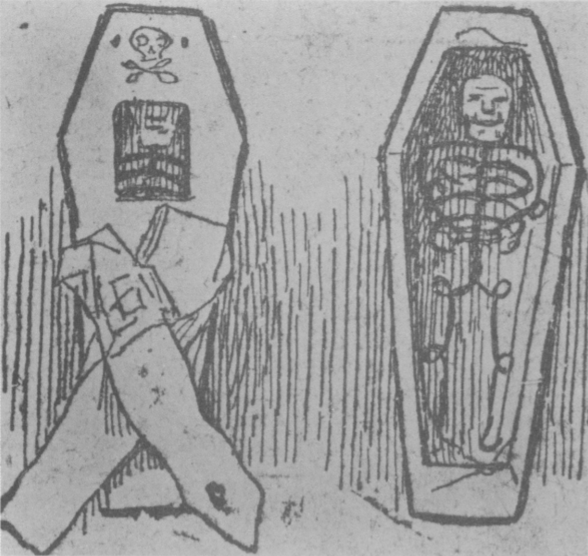
Another oft-used voodoo hex was to place a coffin inscribed with the enemy's death notice upon his doorstep. These emblems of death ranged in size from an eight-inch pasteboard creation to wooden objects over five feet in length. In 1874, Fanny Sweet and all the members of her Basin Street household went into hys- terics when they discovered a miniature coffin in a cigar box on their doorstep. Instead of these symbolic caskets, voodoos some- times put black crosses, salt or strange mixtures of mustard, bones, lizards, snuff, oil and grave dust on their adversary's threshold. The salt, if wet, would eat into the varnished wood, leaving a perma- nent mark. Coins or candles arranged in the proper order could also bring harm to the occupants of the house.
To combat such hexes, or just to ward off evil, a voodoo often scrubbed his own doorstep and sprinkled it with powdered brick or some specially brewed odoriferous preparation. Other gris gris, obtained from the voodoo doctor, wbuld also protect its pos- sessor or provide good luck. One of the most widely used of these charms was a concoction wrapped in red flannel and worn around the neck. There was nothing really mysterious about the gris gris of the voodoos, the harm wrought being due to the power of suggestion or, in the case of some potions, to the use of poison.
Notes
- length. "Voudou Coffin," Daily States, Sept. 9, 1896; "Voudouism," ibid., Aug. 24, 1897; "Voudouing in the City," Sunday States, October 7, 1900, as well as other unidentified newspaper clippings located under voodoo, Louisiana vertical file, Special Collections, Howard-Tilton Memorial Library, Tulane University.
- doorstep. "Death Prefigured-Voudouism as Practiced in the Jardin Mabille," Timies, June 16, 1874.
- house. "A Voudou Case," Times, June 23, 1870; "Voudoued," Daily States, June 24, 1902; Puckett, Folk Beliefs, 225; Hearn, "Superstitions," 843; G. W. Nott, "Marie Laveau," New Orleans Times Picayune, Nov. 19, 1922; Lyle Saxon (ed.) and Robert Tallant (revisor), New Orleans City Guide (Boston, 1952), 61.
- preparation. "Voudouism," Times, June 28, 1870; Saxon and Tallant, New Orleans City Guide, 61.
- neck. "His Superstitions," Daily States, Oct. 15, 1899; Puckett, Folk Beliefs, 221, 239, 273, 287, 293, 564.
- poison. Puckett, Folk Beliefs, 226. The liquid in some vials captured by the police reputedly contained "lizards' tongues and blind worms' stings," "The Voudou Vessels," Picayune, Aug. 1, 1863.
Dealing in such charms became a lucrative business. The famous conjurer Jean Montanet, better known as Doctor John, is reputed to have filled his "prescriptions" with charms and potions priced at fifty dollars. Estimates of this voodoo doctor's wealth ranged from $50,000 to $150,000. After 1886, the Board of Health and even the federal government interfered with the growing numbers of voodoo doctors in efforts to suppress their activities.
|
|
But voodoo in New Orleans has not died out. The curious and continuous tone image gullible read Robert Tallant (now in paperback) instead of wan- dering through the swamps or seeking admittance to a lake-front shack; the truly superstitious still hold their mysterious rites or gather in covens away from the public eye. The distinction be- tween these two facets of voodoo both now and in the nineteenth century should not be obscured. Unfortunately, the popularizers who have written most extensively on voodoo confuse the two and fail to place the topic in historical perspective.
The newspapers which they themselves used as prime sources- when they were not paraphrasing each other-reveal many of their fallacies and overstatements. A critical reading of the New Orleans press reveals that St. John's Eve was a time for merrymaking and money-making. The voodoos described in the popular literature were in reality drunk picnickers and dancers or enterprising blacks turning a fast buck selling gris gris and admission to a spectacle. As black freedmen the New Orleans "voodoos" played a role ex- pected by whites-superstitious primitives possessing great rhythm and colorful dialects-while they simultaneously released pent-up energies and frustrations in drink and dance. In the period of tumultuous Reconstruction politics the conservative white press was quick to exploit any evidence of voodoo to make it appear that blacks were ill prepared to vote and hold public office.
Later in the 1 890s voodoo might be used to buttress white argu- ments of Negro inferiority and the need for legalized segregation. By 1900 voodoo was seldom mentioned in the newspapers, but remnants of commercial voodoo and of the underground varie- ty survived in the guise of a few "hoodoo-men," witchcraft stores and odd charms. These remnants have witnessed a small renais- sance in recent years with the renewed interest of tourists and the advent of hippie culture. hippie culture.
Notes
- $50,000 to $150,000. Cf. Hearn, "The Last of the Voodoos," 726-27, with Tallant, Voodoo in New Orleans, 33-39. Notice how Tallant has built upon the story of Hearn.
- activities. Phillip A. Bruce, The Plantation Negro as a Freeman (New York, 1889), 125 fn.; Puckett, Folk Beliefs, 226. Several efforts of the police and the city coun- cil to curtail voodoo are found in miscellaneous newspaper clippings under voodoo, Louisiana vertical file, Special Collections, Howard-Tilton Memorial Library, Tulane University. In 1914 an old Negro, Francois Pierre, was charged in court with exhuming a body from the Nazarene Society's Cemetery in order to use its head for concocting potions, Daily Picayune, March 17, 1914. For an interesting case involving federal disapproval of a voodoo doctor's use of the mails, see "Voodoo Charm 'Doctor' Makes Court Defense," New Orleans Item, Feb. 6, 1934.
- legalized segregation. "Dance of the Voodoos," Times Democrat, June 24, 1896.
- hippie culture. Puckett, Folk Beliefs, 190; Hearn, "Superstitions," 843; J. B. Hollis Tegarden, "Voodooism," (thesis, University of Chicago, Department of Practical Theology in the Graduate Divinity School, 1924), 9. Lyle Saxon claims in "Voodoo," The New Republic, March 23, 1927, pp. 135-59, to have participated in a secret voo- doo ceremony in the 1920s. See also fns. 39 and 56. More recent evidence of voodoo appears in "Voodoo Takes on New Twists in Iberia, Researcher Finds," Times Picayune, May 9, 1966, and in several clippings under voodoo, Louisiana vertical file, Special Collections, Howard-Tilton Memorial Library, Tulane University.
Text prepared by:
- Laney Robbins
- Chris Ruff
Source
Touchstone, Blake. Louisiana History: The Journal of the Louisiana Historical Association, vol. 13, no. 4, 1972, pp. 371—386. <https://www.jstor.org/stable/4231284;.