
George Washington Cable.
“Posson Jone.”
notes to next group.
- Fix the footnotes
- Fix the images
- Fix the Table of Contents, list of illustrations, and list of maps.
AMERICAN LEADERS
AND HEROES
A PRELIMINARY TEXT-BOOK IN
UNITED STATES HISTORY
BY
WILBUR F. GORDY
PRINCIPAL OF THE NORTH SCHOOL, HARTFORD, CONN.; AUTHOR OF
“A HISTORY OF THE UNITED STATES FOR SCHOOLS”; AND
CO-AUTHOR OF “A PATHFINDER IN AMERICAN HISTORY”
WITH MANY ILLUSTRATIONS AND MAPS
NEW YORK
CHARLES SCRIBNER’S SONS
1907
COPYRIGHT, 1901, BY
CHARLES SCRIBNER’S SONS
PREFACE
In teaching history to boys and girls from ten to twelve years old simple material should be used. Children of that age like action. They crave the dramatic, the picturesque, the concrete, the personal. When they read about Daniel Boone or Abraham Lincoln they do far more than admire their hero. By a mysterious, sympathetic process they so identify themselves with him as to feel that what they see in him is possible for them. Herein is suggested the ethical value of history. But such ethical stimulus, be it noted, can come only in so far as actions are translated into the thoughts and feelings embodied in the actions.
In this process of passing from deeds to the hearts and heads of the doers the image-forming power plays a leading part. Therefore a special effort should be made to train the sensuous imagination by furnishing picturesque and dramatic incidents, and then so skilfully presenting them that the children may get living pictures. This I have endeavored to do in the preparation of this historical reader, by making prominent the personal traits of the heroes and leaders, as they are seen, in boyhood and manhood alike, in the environment of their every-day home and social life.
With the purpose of quickening the imagination, questions “To the Pupil” are introduced at intervals throughout the book, and on almost every page additional questions of the same kind might be supplied to advantage. “What picture do you get in that paragraph?” may well be asked over and over again, as children read the book. If they get clear and definite pictures, they will be likely to see the past as a living present, and thus will experience anew the thoughts and feelings of those who now live only in their words and deeds. The steps in this vital process are imagination, sympathy, and assimilation.
To the same end the excellent maps and illustrations contribute a prominent and valuable feature of the book. If, in the elementary stages of historical reading, the image-forming power is developed, when the later work in the study of organized history is reached the imagination can hold the outward event before the mind for the judgment to determine its inner significance. For historical interpretation is based upon the inner life quite as much as upon the outward expression of that life in action.
Attention is called to the fact that while the biographical element predominates, around the heroes and leaders are clustered typical and significant events in such a way as to give the basal facts of American history. It is hoped, therefore, that this little volume will furnish the young mind some conception of what our history is, and at the same time stimulate an abiding interest in historical and biographical reading.
Perhaps it is needless to say that the “Review Outline” may be used in many ways. It certainly will furnish excellent material for language work, oral or written. In so using it pupils may well be encouraged to enlarge the number of topics.
I wish to acknowledge my obligations to Professor William E. Mead, of Wesleyan University, who has read the manuscript and made invaluable suggestions; also to my wife, whose interest and assistance have done much to give the book whatever of merit it may possess.
Wilbur F. Gordy.
Hartford, Conn., May 1, 1901.
CONTENTS
| CHAPTER | PAGE | |
| II. | Hernando De Soto and the Discovery of the Mississippi, | 22 |
| III. | Sir Walter Raleigh and the First English Attempts to Colonize America, | 31 |
| IV. | John Smith and the Settlement of Jamestown, | 42 |
| V. | Nathaniel Bacon and the Uprising of the People in Virginia in 1676, | 55 |
| VI. | Miles Standish and the Pilgrims, | 64 |
| VII. | Roger Williams and the Puritans, | 81 |
| VIII. | William Penn and the Settlement of Pennsylvania, | 92 |
| IX. | Cavelier De La Salle and the French in the Mississippi Valley, | 103 |
| X. | George Washington, the Boy Surveyor and Young Soldier, | 116 |
| XI. | James Wolfe, the Hero of Quebec, | 136 |
| XII. | Patrick Henry and the Stamp Act, | 146 |
| XIII. | Samuel Adams and the Boston Tea Party, | 156 |
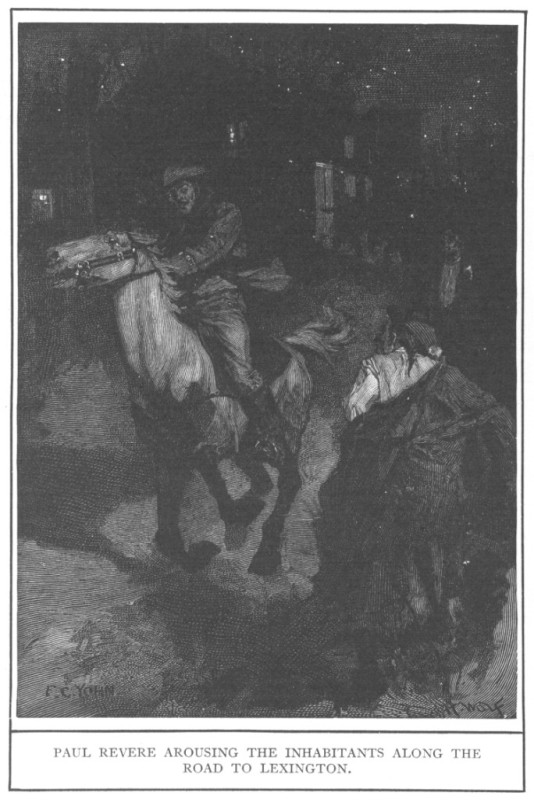
| XIV. | Paul Revere and the Battle of Concord and Lexington, | 165 |
| XV. | Benjamin Franklin and Aid from France, | 175 |
| XVI. | George Washington, the Virginia Planter and the Revolutionary Soldier, | 189 |
| XVII. | Nathaniel Greene, the Hero of the South, and Francis Marion, the "Swamp Fox," | 211 |
| XVIII. | Daniel Boone, the Kentucky Pioneer, | 222 |
| XIX. | Thomas Jefferson and the Louisiana Purchase, | 234 |
| XX. | Robert Fulton and the Steamboat, | 246 |
| XXI. | Andrew Jackson, the Upholder of the Union, | 253 |
| XXII. | Daniel Webster, the Defender and Expounder of the Constitution, | 264 |
| XXIII. | Samuel Finley Breese Morse and the Electric Telegraph, | 273 |
| XXIV. | Abraham Lincoln, the Liberator of the Slaves, | 282 |
| XXV. | Ulysses Simpson Grant and the Civil War, | 302 |
| XXVI. | Some Leaders and Heroes in the War with Spain, | 314 |
LIST OF ILLUSTRATIONS
| PAGE | |
| Christopher Columbus, | 1 |
| The Santa Maria, | 7 |
| The Nina, | 8 |
| The Pinta, | 9 |
| The Triumphal Return of Columbus to Spain, | 13 |
| An Indian Stone Maul, | 20 |
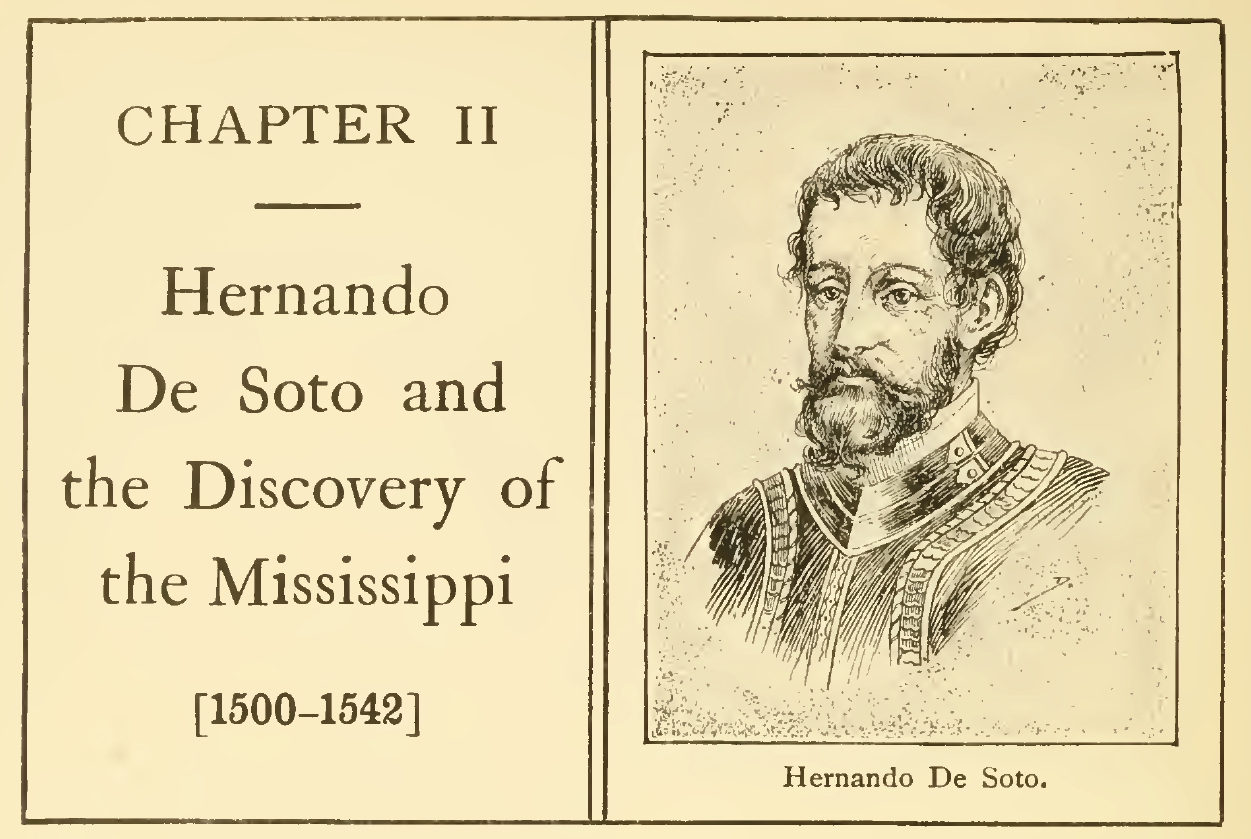
| Hernando De Soto, | 22 |
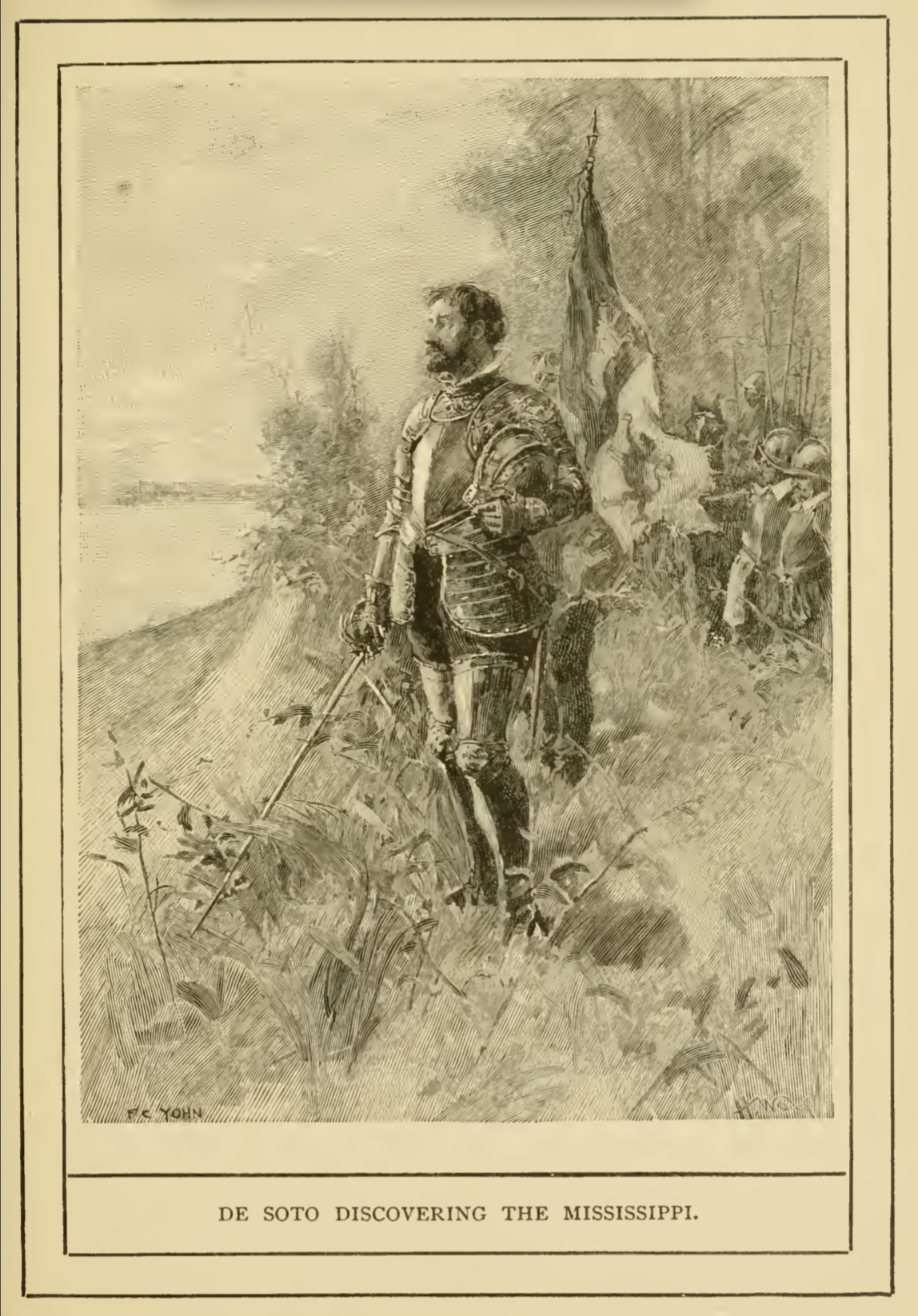
| De Soto Discovering the Mississippi, | 25 |
| Sir Walter Raleigh, | 31 |
| Queen Elizabeth, | 35 |
| Entrance to Raleigh’s Cell in the Tower, | 38 |
| Tower of London, | 39 |
| An Indian Pipe, | 40 |
| John Smith, | 42 |
| John Smith and the Indians, | 45 |
| Indian Weapons, | 46 |
| Ruins of Jamestown, | 47 |
| Apache’s War-club, | 50 |
| Sioux Indian Bow and Arrow with Stone Point, | 50 |
| Navajo Sling, | 51 |
| A Pappoose Case, | 51 |
| Tobacco Plant, | 56 |
| Loading Tobacco, | 57 |
| The Burning of Jamestown, | 61 |
| Miles Standish, | 64 |
| The Mayflower, | 70 |
| A Matchlock Gun, | 74 |
| A Group of Pilgrim Relics, | 75 |
| Pilgrims Returning from Church, | 77 |
| Brewster’s and Standish’s Swords, | 79 |
| Roger Williams on his Way to Visit the Chief of the Narragansett Indians, | 83 |
| A Block House, | 84 |
| Roger Williams’s Meeting-House, | 85 |
| A Puritan Fireplace, | 87 |
| William Penn, | 92 |
| William Penn’s Famous Treaty with the Indians, | 95 |
| Penn’s Slate-roof House, Philadelphia, | 98 |
| A Belt of Wampum Given to Penn by the Indians, | 99 |
| Cavelier De La Salle, | 103 |
| Long House of the Iroquois, | 104 |
| The Murder of La Salle by his Followers, | 113 |
| George Washington, | 116 |
| Washington’s Birthplace, | 117 |
| Washington Crossing the Alleghany River, | 119 |
| The Death of Braddock, | 129 |
| James Wolfe, | 136 |
| General Montcalm, | 139 |
| The Death of Wolfe, | 141 |
| Patrick Henry, | 146 |
| George III., | 149 |
| St. John’s Church, Richmond, | 152 |
| Samuel Adams, | 156 |
| Faneuil Hall, Boston, | 160 |
| The Old South Church, Boston, | 161 |
| The "Boston Tea Party," | 163 |
| Paul Revere, | 165 |
| The Old North Church, | 168 |
| Stone in Front of the Harrington House, Lexington, Marking the Line of the Minute-Men, | 170 |
| The Retreat of the British from Concord, | 172 |
| Benjamin Franklin, | 175 |
| Franklin in the Streets of Philadelphia, | 180 |
| Franklin Experimenting with Electricity, | 184 |
| Lafayette Offering His Services to Franklin, | 186 |
| George Washington, | 189 |
| Washington’s Coach, | 190 |
| A Stage Coach of the Eighteenth Century, | 191 |
| Washington’s Retreat through New Jersey, | 199 |
| Winter at Valley Forge, | 204 |
| Washington’s Home?Mount Vernon, | 208 |
| Nathaniel Greene, | 211 |
| Lord Cornwallis, | 215 |
| General Francis Marion, | 218 |
| Marion and His Men Swooping Down on a British Camp, | 219 |
| Daniel Boone, | 222 |
| Indian Costume (Female), | 224 |
| Indian Costume (Male), | 225 |
| Daniel Boone in his Cabin, | 228 |
| A Hand Corn Mill, | 229 |
| A Wigwam, | 231 |
| Indian Implements, | 232 |
| Thomas Jefferson, | 234 |
| Monticello, | 237 |
| Thomas Jefferson at Work upon the First Draft of the Declaration of Independence, | 238 |
| Robert Fulton, | 246 |
| A Pack Horse, | 247 |
| A Flat Boat, | 248 |
| The Clermont, | 251 |
| Andrew Jackson, | 253 |
| Andrew Jackson’s Cradle, | 254 |
| A Spinning Wheel, | 255 |
| Jackson at the Battle of New Orleans, | 261 |
| Daniel Webster, | 264 |
| Marshfield?Home of Daniel Webster, | 271 |
| S. F. B. Morse, | 273 |
| Telegraph and Railroad, | 280 |
| Abraham Lincoln, | 282 |
| Lincoln’s Birthplace, | 283 |
| Lincoln Studying, | 287 |
| Slaves on a Cotton Plantation, | 299 |
| Ulysses S. Grant, | 302 |
| The Meeting of Generals Grant and Lee at Appomattox, | 310 |
| The McLean House, | 311 |
| General R. E. Lee, | 312 |
| The Wreck of the Maine, | 316 |
| Admiral Dewey, | 318 |
| President MCKinley, | 319 |
| “Escolta,” Manila’s Main Street, | 320 |
LIST OF MAPS
| PAGE | |
| Places of Interest in Connection with Columbus’s Earlier Life, | 3 |
| The First Voyage of Columbus, and Places of Interest in Connection with his Later Voyages, | 11 |
| Routes Traversed by De Soto and De Leon, | 27 |
| Cabot’s Route. Land Discovered by him Darkened, | 33 |
| Section where Raleigh’s various Colonies were Located, | 37 |
| Jamestown and the Surrounding Country, | 48 |
| The Pilgrims in England and Holland, | 67 |
| The Pilgrim Settlement, | 72 |
| The Rhode Island Settlement, | 88 |
| The Pennsylvania Settlement, | 97 |
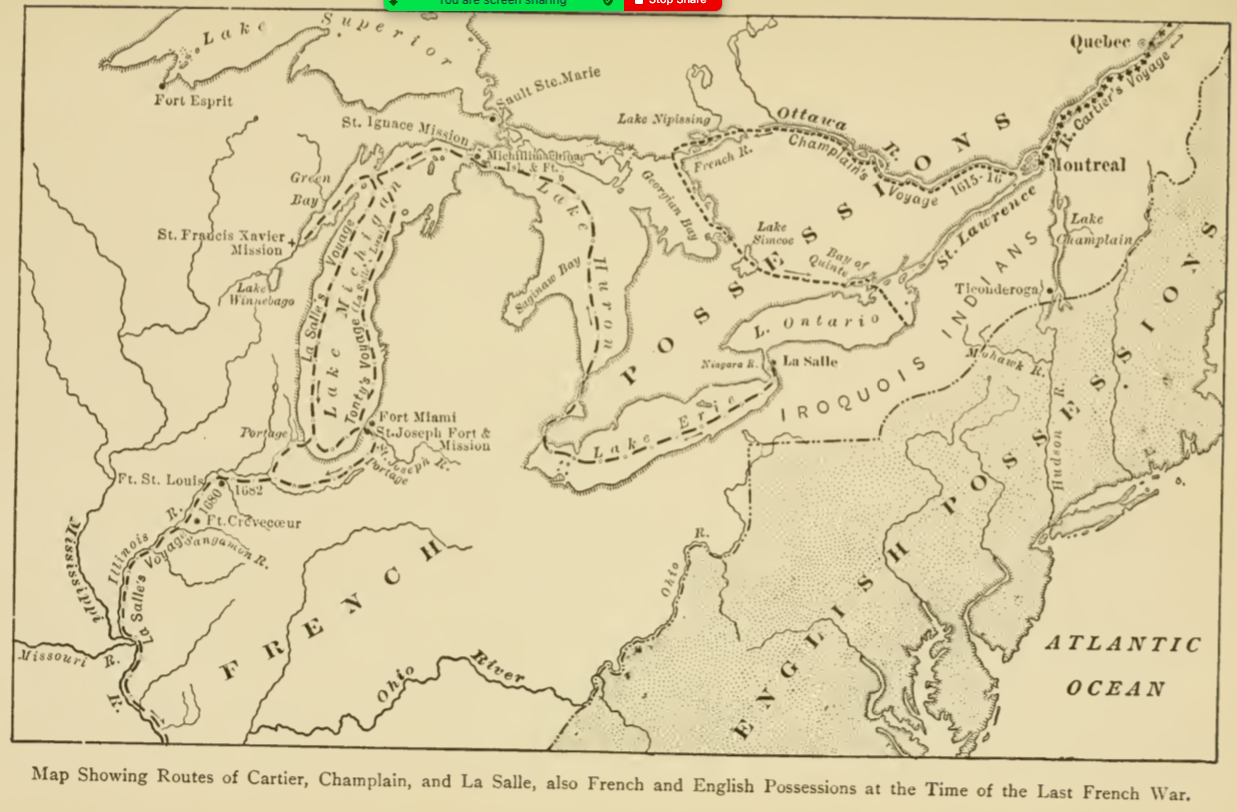
| Map Showing Routes of Cartier, Champlain, and La Salle, also French and English Possessions at the Time of the Last French War, | 107 |
| The English Colonies and the French Claims in 1754, | 121 |
| The French in the Ohio Valley, | 123 |
| Quebec and Surroundings, | 138 |
| Paul Revere’s Ride, | 167 |
| Franklin’s Journey from New York to Philadelphia, | 178 |
| Map Illustrating the Battle of Long Island, | 196 |
| Map Illustrating the Struggle for the Hudson River and the Middle States, | 201 |
| Map Showing the War in the South, | 213 |
| The Kentucky Settlement, | 223 |
| Map of Louisiana Purchase: also United States in 1803, | 242 |
| Map Illustrating Two of Andrew Jackson’s Campaigns, | 258 |
| Map of the United States showing the Southern Confederacy, the Slave States that did not Secede, and the Territories, | 297 |
| Map Illustrating Campaigns in the West in 1862-63, | 307 |
| The United States Coast and the West Indies, | 315 |
CHAPTER II
Hernando
De Soto and
the Discovery of
the Mississippi
[1500-1542]
After the discovery of the New World by Columbus, the Spaniards, who had no other thought than that he had found a new way to India, dreamed eagerly of its marvellous wealth, and were impatient to be off to the land where they believed fortunes awaited them. So zealous were they, in their mad search for gold and adventure, that many were willing to leave home and friends for years.
The most brilliant of these explorers were Cortez, the conqueror of Mexico, and Pizarro, the conqueror of Peru, both of whom carried back to Spain many million dollars’ worth of gold and silver. With Pizarro was a young man named Hernando De Soto, whose adventurous life is full of interest, and whose important discovery of the Mississippi River has given him a prominent place in the history of our country.
He was born about 1500, of a poor but noble family. In his youth he excelled in athletic sports, and possessed unusual skill in horsemanship and in fencing. Taking a leading part in all the dangerous exploits in the New World, he not only won fame, but went back to Spain after many years’ absence a rich man.
While Cortez and Pizarro had been conquering Mexico and Peru, other Spaniards had been seeking their fortune in Florida. Thus far these men had brought back no gold and silver, but their faith in the mines of the interior was so great that De Soto wished to conquer and explore the country. Having already won great influence by his achievements, he secured the favor of the king, who made him governor of the island of Cuba, and appointed him leader of an expedition to conquer and occupy Florida. He was to take men enough with him to build forts and plant a colony, so as to hold the country for Spain.
De Soto had no difficulty in getting followers to join him in this enterprise. Young men from noble families flocked to his standard from all parts of Spain, and as he knew that dangers and hardships awaited them he was careful to select from the large numbers the strongest men.
De Soto’s company included richly dressed nobles and warriors in glittering armor. It was a gala day when they sailed out of port with banners flying and cannon booming, and not a young man of them but felt proud to sail on so grand an expedition. After arriving in Cuba, De Soto spent some time there, and then leaving his wife to govern the island, set out to explore Florida. His expedition was an imposing one, comprising nine vessels, six hundred men, and about two hundred and twenty-five horses. In May, 1539, the whole force landed at Tampa Bay, on the western coast of Florida.
They had not advanced far into the interior when De Soto fell in with a Spaniard named Ortiz, who had accompanied Narvaez in a previous expedition some ten or eleven years before. According to his story, the Indians had captured him, and only forbore to kill him because an Indian girl had begged for his life. Ortiz had lived with the Indians so many years that he had become very much like one himself; but we can imagine his joy at seeing white men once more. The Spaniards were equally rejoiced because they knew how serviceable their countryman would be as a guide and interpreter.
The advantage of this good-fortune was soon counteracted, however, by De Soto’s unfriendliness to the Indians. He was not only indifferent to their pleasure and sufferings, but even seemed to enjoy torturing and killing them. It was his custom upon arriving at an Indian settlement to demand food for his men and horses, and upon his departure to carry off with him the head chief as guide and hostage, not releasing him until the next tribe was reached. Indian men and squaws were forced into service as porters for the Spanish baggage; and thus enslaved, often with chains and with iron collars about their necks, they were compelled to do all sorts of menial work. It is not strange that after such treatment the Indians lost all confidence in De Soto. They not only learned to hate him and the Spaniards but longed to be revenged upon them. In return for the cruelties inflicted they purposely led the Spaniards astray, and left untried no treachery which would serve to destroy the pale-faced strangers.
In May, 1540, an Indian princess, rowed by her followers in a canopied canoe, came across a stream to meet De Soto. When she landed, her followers carried her in a litter, from which she alighted and approached him. She gave him presents of shawls and skins, and a string of pearls which she took from around her neck. In return for these acts of courtesy De Soto made her a prisoner, and kept her going about on foot with him until she escaped.
This is but an instance of the cruelty which made enemies of all the Indians with whom the Spaniards came in contact. No doubt Indian runners were sent hundreds of miles in many directions to tell the various tribes of the inhuman deeds of the white men. No doubt these tribes combined in a desperate effort to destroy De Soto and all his men. How nearly they succeeded in their plan can be told in a few lines.
In the autumn of 1540 the Spaniards came to the tribe of a giant chieftain whose slaves held over him, as he sat upon cushions on a raised platform, a buckskin umbrella stained red and white. He was sullen in the presence of the richly dressed Spaniards on their prancing steeds, but allowed De Soto to carry him a prisoner to the next Indian town, as the other head chiefs had done.
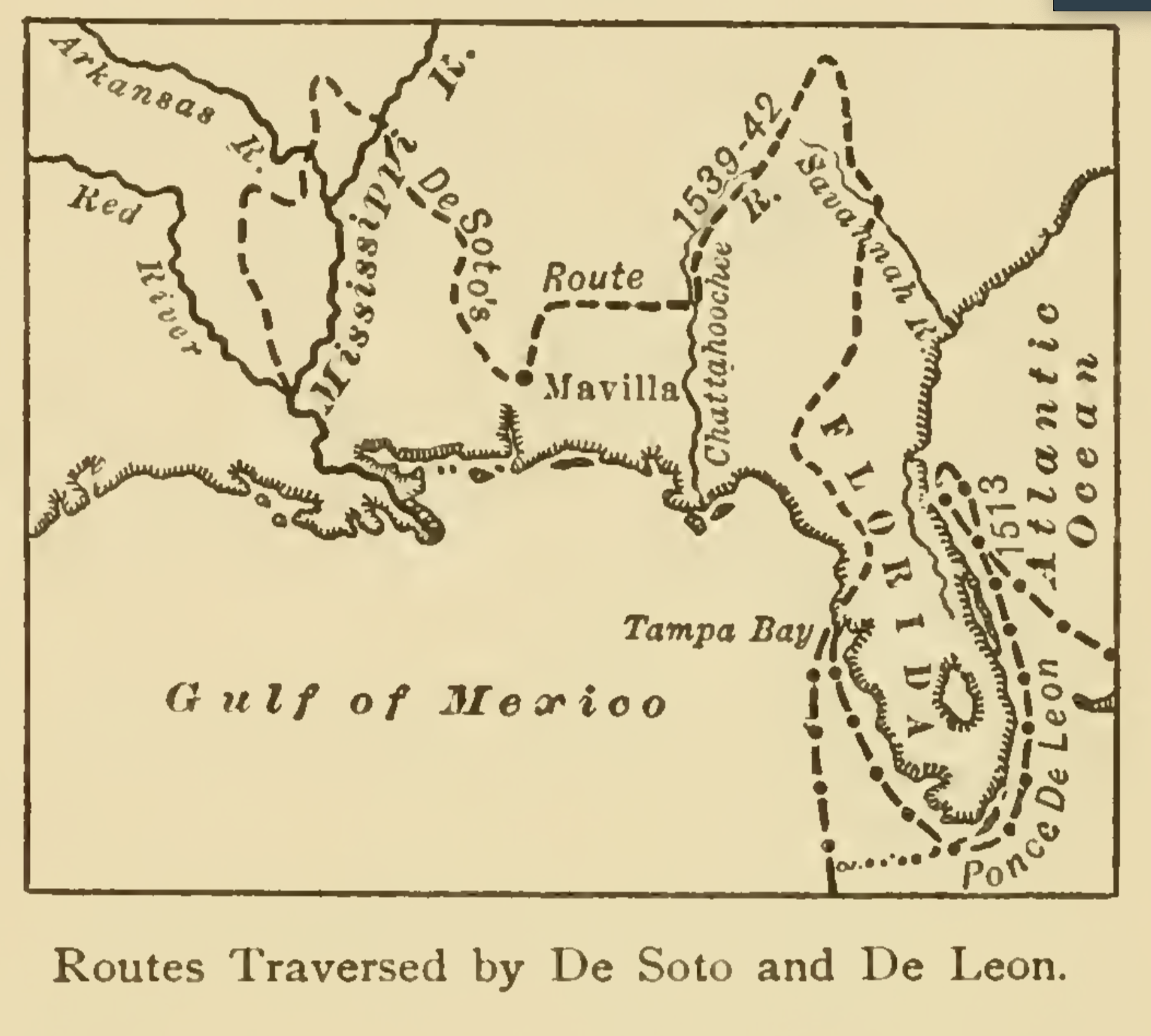
This town was called Mavilla, an Indian word from which we get the name Mobile for the city and river in Alabama. As the Spaniards approached this town Indians came out to meet them, their faces showing signs of displeasure and evil intent. Fearing nothing, however, De Soto, attended by about a dozen of his men, rode boldly inside the town, which was surrounded with a palisade.
The giant chieftain then asked for a release that he might return to his own people, and on being refused went into a house in which many Indian warriors were concealed. When De Soto ordered him to come out he refused. In the excitement that followed, a Spaniard cut down with his sword an Indian warrior standing near by. Then, in wild fury, hundreds of dusky warriors rushed like madmen out of the house to the attack, and soon shot down five of De Soto’s body-guard. Of course he had to flee for his life. But before he could reach the main force outside the town he fell to the ground two or three times, struck by Indian arrows.
It was the beginning of a terrible battle, in which the Spaniards, although outnumbered, had the advantage because of their horses, swords, firearms, and superior training. Finally, from the outside, they closed the gates to the town, and set fire to the Indian buildings. The Indians fought with desperation, but they either fell, cut down by Spanish swords, or rushed in mad fury to perish in the flames. When night came, only three Indian warriors remained alive. Two of these fought until they were killed, and the last unfortunate one hanged himself on a tree with his bow-string. The Spaniards said they killed at least 2,500 Indians, but they lost in killed and wounded about a third of their own number. It was a dearly bought victory.
Nor was Indian craftiness the only source of trouble for the Spaniards. De Soto’s men had to travel through thick forests with no road except the narrow path made by wild animals or the trail made by the Indian hunter. They spent many laborious days in picking their way through dense underbrush and miry swamps, stopping here and there to make rafts to carry them across the numerous streams. Often without food and on the point of starving, they were obliged to feed upon native dogs, and were sometimes reduced to berries, nuts, bear-oil, and wild honey.
In spite of hunger, disease, death, and many other misfortunes, however, De Soto in his mad search for gold threaded his way through the tangled forests until, in the spring of 1541, about two years after landing at Tampa Bay, he reached the bank of the Mississippi River. After spending months in making boats, he at length crossed the mighty stream, and then continued his march in a northerly and westerly direction, going, it would seem, as far as the site of what is now Little Rock, the capital of Arkansas.
Marching southeast, probably to the banks of the Washita, he spent a winter so severe that many of the party, including Ortiz, died.
About the middle of April, 1542, the Spaniards, travel-spent and sick at heart, reached the mouth of the Red River, where De Soto, discouraged and broken in spirit, was taken ill with fever and soon died. At first his followers buried his body near the town where they were staying, but when the Indians began with some suspicion to examine the ground under which he lay, the Spaniards in the darkness of night took up the body, wrapped it in blankets made heavy with sand, and sadly lowered it into the waters of the mighty river which it was De Soto’s chief honor to have discovered. After many more hardships the wretched survivors of this unhappy company, numbering not many more than half of those who landed at Tampa Bay, found their way to a Spanish colony in Mexico. Thus ended in disaster the expedition which sailed with such hope of wealth and renown.
REVIEW OUTLINE
Spanish thirst for gold and adventure.
De Soto’s early love of sports and dangerous
exploits.
De Soto plans to explore and colonize
Florida.
Preparations For the expedition.
De Soto sets out on his voyage.
He falls in with Ortiz.
De Soto’s cruel treatment of the Indians.
The Indian princess.
The plan to destroy De Soto and his men.
The giant chieftain.
De Soto in danger.
A terrible battle.
De Soto discovers the Mississippi.
Difficulties and sufferings.
More troubles for the Spaniards.
De Soto’s death.
TO THE PUPIL
1. Find on the map Mexico, Peru, Porto Rico, Cuba, Florida, Mobile the Mississippi River, and the Washita River.
2. Draw a map in which you will indicate De Soto’s route.
3. Tell in your own words the story of this wretched march through the forests.
4. Make a mental picture of De Soto’s meeting with the Indian princess; of De Soto and his body-guard in Mavilla; of the burial of De Soto’s body by night.
5. What did De Soto accomplish? When?
CHAPTER IX
Cavelier De La
Salle and the
French in
the Mississippi
Valley
[1643-1687]
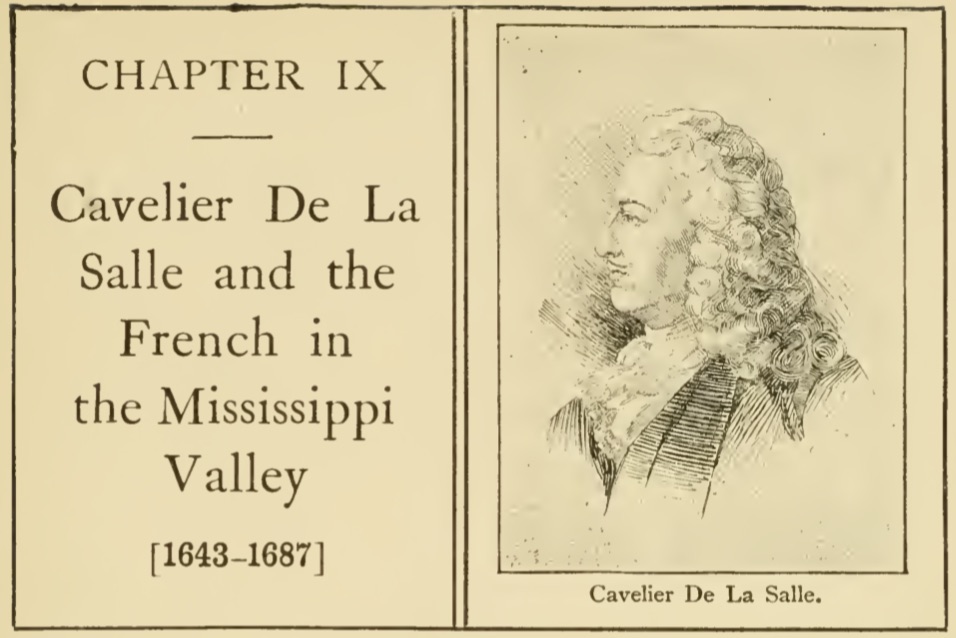
The same year in which William Penn laid out Philadelphia and there made a treaty with the Indians, a noted Frenchman sailed down the Mississippi River, exploring it in the interests of France. This man was Robert Cavelier, Better known as La Salle, who, like many of his countrymen, was trying, just as the Spaniards and Englishmen had tried, to find or do something in America that would not only bring glory to his own name, but also wealth and honor to his fatherland. We have now to consider the work of the French in America.
In 1534 Cartier, a French explorer, discovered the St. Lawrence, and sailed up the river as far as an Indian village on the present site of Montreal. He took possession of Canada in the name of the French King, and his favorable reports led to several unsuccessful attempts to plant settlements there.
More than seventy years after the discovery of the St. Lawrence, another French explorer, Samuel de Champlain, sailed up the noble river. Much impressed with the great beauty of the St. Lawrence Valley and its wealth of forests and furs, he longed to bring all this vast new country under the control of France. In 1608 he planted the first permanent French settlement in Canada, at Quebec, and the following year discovered the lake which bears his name.
Although Champlain loved his country and desired to increase its glory and power, he made an unfortunate blunder, which proved fatal to the best interests of France in the New World. In planting the settlement at Quebec, in 1608, he found that the neighboring tribes of Algonquin Indians were bitter enemies of the Mohawks, one of the Five Nations, or Iroquois, who lived in New York.
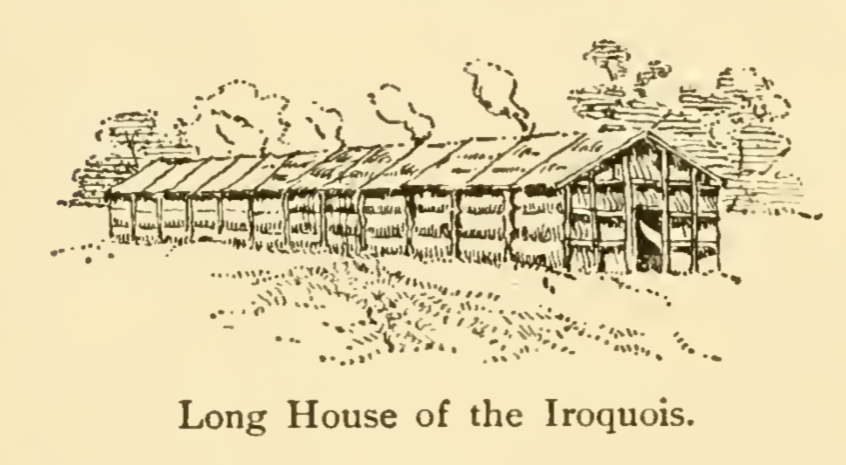
The Algonquins begged him to join them in an attack upon the Mohawks, and he unwisely consented. Having gone up Lake Champlain with a canoe-party of sixty Indians, he landed near the site of Ticonderoga to fight a battle with two hundred hardy Mohawk warriors. Champlain, clad in light armor and gun in hand, advanced at the head of his war-party and, shooting into the ranks of the astonished Mohawks, who stood in battle array, brought to the earth two of their chiefs. The others fled in terror and confusion, while their enemies, Champlain’s dusky allies, yelled with joy, and filled the woods with their terrible warwhoops.
From that day, however, the Iroquois were the bitter enemies of the French, and this enmity seriously interfered with the successful carrying out of French plans. Having control of the St. Lawrence River, France greatly desired to get control of the Mississippi River as well. Once securing possession of these two great streams, she would come into possession of the wealth of the North American Continent.
But the Iroquois Indians were strongly posted in the Mohawk River Valley, and thus held the key to the situation. In this way they blocked the path of the French, who wished to reach the Ohio and the Mississippi through Lake Erie and Lake Ontario. So the French were driven to seek a route farther north, a route which was much longer and more difficult. It would be well for you to trace on your map this roundabout way, which extended up the Ottawa River into Georgian Bay, through Lake Huron and Lake Michigan, across into the Illinois River, and through that into the Mississippi.
In the same year that Champlain made the Iroquois bitter enemies of the French, Henry Hudson won their lasting friendship for the Dutch. About the time the Frenchman was fighting in the battle against the Mohawks at Ticonderoga, Hudson, with a crew of twenty men in the Half Moon, was sailing up the river that now bears his name. Instead of finding the short passage to the Pacific, for which he was searching in the interests of the Dutch, he discovered the great water-way to the interior. Having received just treatment from him, the Iroquois Indians became his friends and the friends of the Dutch settlers and traders that came later.
From that time, in fact, these Iroquois Indians were as ready to sell their furs to the Dutch and to the English, who in 1664 took New York away from the Dutch, as they were to oppose the French and compel them to go many hundred miles out of their way in the tedious explorations in search of the Mississippi.
This toilsome work of exploration was largely accomplished by the Jesuit missionaries. Fearless in their heroic efforts to advance their faith, they suffered all sorts of hardships, many being put to death, in their earnest struggle to bring religious truth to the ignorant red men of the woods. In their journeys through the forests and over the lakes, these Jesuit Fathers made many valuable discoveries and explorations which they carefully recorded in their journals.
It was one of these missionaries, Father Marquette, who succeeded in reaching the waters of the Mississippi. Attended by Joliet and five other Frenchmen, he went, in 1673, as far down the mighty river as the mouth of the Arkansas. This was sixty-five years after Champlain made his settlement at Quebec.
But the most important of all the French explorations were made by the daring and tireless La Salle. He was born in France in 1643, and belonged to an old and rich family. Strong in mind and character, he received a good education, and became an earnest Catholic. With a heart ready to brave any danger in the achievement of glory for himself and for France, this young man at the age of twenty-three sailed for Canada.
His plans, as finally worked out, were twofold: (1) To build forts and trading centres at various points along the St. Lawrence, the Great Lakes, and the Mississippi; and (2) to plant a colony at the mouth of the Mississippi. Wishing to get control of the rich fur trade for France, his forts and his colony would help to protect and further this trade, which could be carried on more easily by way of the Mississippi, than by way of the Great Lakes and the St. Lawrence. For along the latter route lay the hostile Iroquois, who were friendly to the Dutch and the English; and, moreover, the St. Lawrence was ice-bound nearly one-half of the year.
Early in August, 1679, after long and weary efforts spent in preparation, La Salle launched on the Niagara River above the Falls, his little vessel, the Griffin, of forty tons burden, which was to bear him through the lakes on his way to the Mississippi.
Nearly a year before starting, La Salle had sent up the lakes fifteen men to trade for furs. He expected them to have ready, against the time of his arrival, a cargo of furs to be sent back to Canada. For La Salle needed a great deal of money with which to buy provisions, ammunition, and tools, and to pay his men for their services. Besides, he wished to get cables, anchors, and rigging for a new vessel to be built on the Illinois River, for the purpose of making his expedition to the mouth of the Mississippi. The expected cargo of furs, taken back and sold in Canada, would give him the money he needed to carry out his plans.
Having arrived at the head of Lake Huron, therefore, he collected the cargo awaiting him, loaded the Griffin with furs, and on September 18, 1679, despatched it in charge of six men to Niagara. La Salle himself pushed on to the mouth of the St. Joseph River, where he built a fort, and waited long and anxiously for the Griffin’s return. But he waited in vain, for he never heard from his vessel again. It was a great loss and a keen disappointment. After waiting long he continued his way, careworn and weary, with eight canoes and a party of thirty-three men.
They rowed up the St. Joseph in search of the carrying-place leading to the head-waters of the Illinois River. On landing, La Salle started off alone to look for the pathway. In the midst of a blinding snow-storm he lost his bearings in the dense forest, and wandered until about two o’clock in the morning, when he found himself once more at the river, and fired his gun as a signal to the party.
Then his eyes caught the welcome sight of a fire burning in the woods. Believing he was near his friends, he quickened his steps, only to find himself mistaken. Near the fire, under a tree, was a bed of dried grass which was still warm, and showed plainly that a man had but a few minutes before been lying there. Very likely the man was an Indian, who had been frightened off by the sound of the gun. La Salle carefully placed brush for a sort of barricade on each side of the newly found bed, and then lay down by the blazing fire and slept till daybreak. He did not find his friends until four o’clock next afternoon.
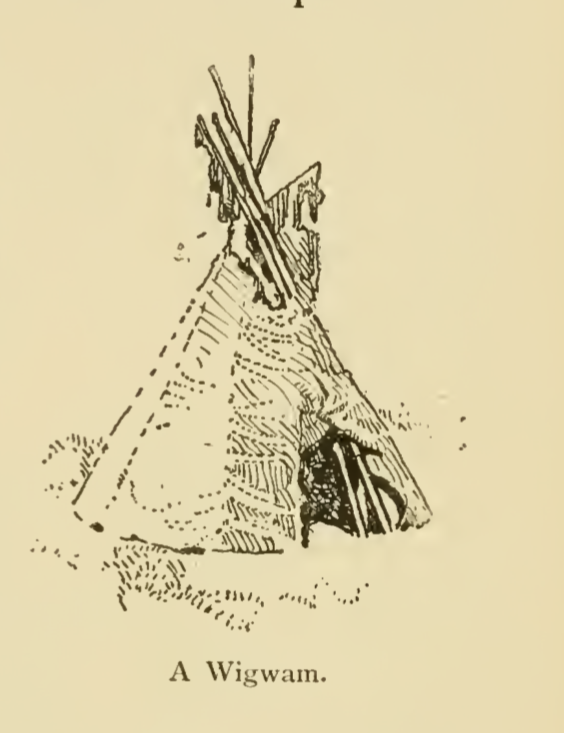
On rejoining his party they made their way down the Illinois River, until their eyes fell upon some Indian wigwams on the forest-covered bank. The Indians, being friendly, received the Frenchmen with generous hospitality. They urged La Salle not to go down the Mississippi. They indeed said so much of the danger of the journey that six of La Salle’s followers deserted, and another tried to poison him. These were sad days for La Salle and, like all his days, were beset with troubles and dangers. To protect himself from attack during the winter, he now planned the building of a fort which he called Cr?vec?ur, the French word for heartbreak, surely a fitting name.
Up to this time the iron-willed La Salle had not given up hope of hearing from the Griffin, but now he decided that his vessel was lost. There was but one thing to do. He must make an overland journey to Canada, 1,500 miles away, to get supplies for his expedition down the Mississippi. It was a dangerous undertaking. But on March 1, 1680, with an Indian hunter and four Frenchmen, the dauntless explorer started in two canoes.
The season was the worst in the year for such a journey. The ground was covered with melting snow, and the rivers in many places were frozen with ice, too thick to be broken by the boats. Much of the time the party had to pull the canoes on rough sleds overland or carry them on their shoulders until, a few days after starting, they hid them in the woods and pushed forward on foot to the head of Lake Michigan.
Reaching that point, it was now necessary for them to thread their toilsome way through the deep forests of Southern Michigan to the head of Lake Erie. For three days the undergrowth was so thick with thorns that it tore their clothing into shreds, and scratched their faces until they were covered with blood. Another three days were spent in wading, sometimes up to their waists, in the mud and water of the flood-covered marshes. At night they would take off their clothing and, covering their bodies with blankets, lie down to sleep on some dry hillock. One frosty night their clothes froze so stiff that in the morning they had to be thawed by the fireside before they could be put on. Amid such exposure some of the men fell sick, and thus delayed the party. But early in May, at the end of sixty-five days, they reached Canada.
As soon as he could arrange his affairs in Canada, La Salle again returned to the Illinois River and reached its mouth. But owing to fresh disappointments, he had to make still another journey through the wilderness to the base of his supplies on the St. Lawrence.
Not until February 6, 1682, two years and a half after he first started out in the Griffin, and after three attempts to build a suitable vessel for the journey, did he float out upon the waters of the Mississippi to explore it; and at last he was obliged to make the journey in canoes. This time his party included fifty-four people?eighteen Indian warriors, ten squaws, three Indian children, and twenty-three Frenchmen. On reaching the mouth of the river he planted a column bearing the arms of France, and then, with imposing ceremonies, took possession of the great Mississippi Valley in the name of the French King, Louis XIV., after whom he named the country Louisiana.
By building forts and trading centres along his route, La Salle had carried out the first part of his plan. He now resolved to go to France and get men for a colony which he wished to plant at the mouth of the Mississippi, and thus carry out the second part.
Having succeeded in France in fitting out this colony, he sailed with four vessels early in July, 1684, in search of the Mississippi River by way of the Gulf of Mexico. With his usual bad fortune, however, he missed its mouth and landed at Matagorda Bay, 400 miles to the west. Then followed many disasters, among which were loss of vessels and supplies, lack of food, sickness and death, and attacks by unfriendly Indians. For two years the wretched little colony struggled for life. La Salle was in sore distress. He knew he had many enemies among his men who would gladly take his life, but he hoped for help from France. No help came. It was plain to La Salle that he could save the suffering colony only by making his way to Canada. He therefore started out on January 12, 1687, with a party of seventeen men and five horses, on another long and dangerous journey through the dense forests?this time from the Gulf of Mexico to Canada.
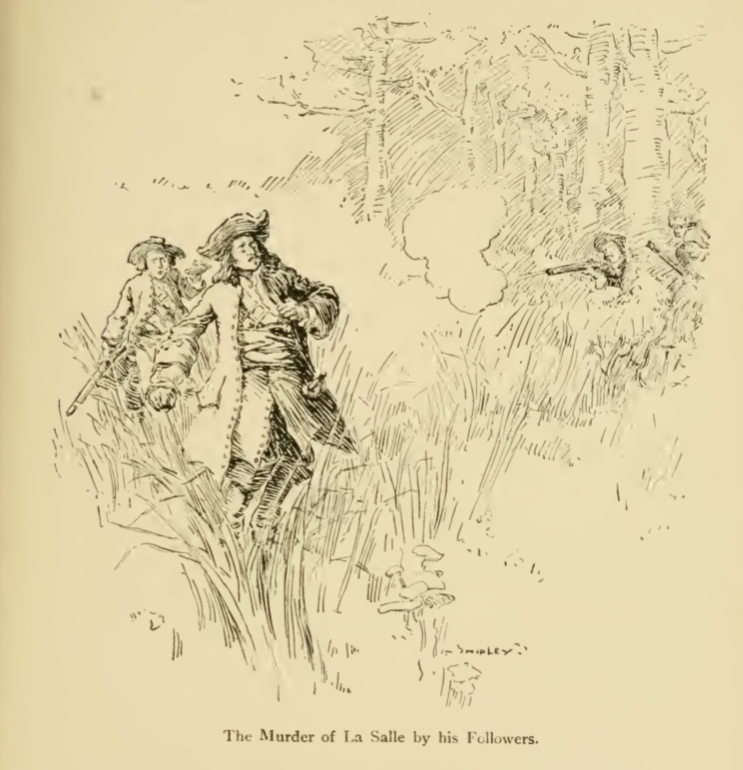
Travelling north, the party crossed the Brazos River and toiled onward to the Trinity River. But La Salle’s men were tired of travelling through the forests, and some of them were thirsting for his blood. They were waiting only for a suitable opportunity to carry out their murderous purpose. On the morning of March 19th they lay in ambush, and shot him dead as he approached, probably not far from the Trinity River.
La Salle’s life was one of storm and peril; but he was as fearless as a lion. Ambitious for himself and for his country, he had room for little else in his life, His repeated failures brought criticism and lack of confidence from men who had loaned him large sums of money, and these criticisms hardened his spirit. Many enemies making him suspicious, he seemed to lose sympathy with his men, and became harsh in his treatment of them. But he did a great work for France, a work which entitles him to be regarded as one of the most remarkable of all the explorers of America.
REVIEW OUTLINE
The coming of the French to America.
Cartier discovers the St. Lawrence.
Champlain explores for France.
Champlain’s fatal gunshot.
The Iroquois become bitter enemies of the
French.
The Iroquois force the French to seek a
roundabout route to the Mississippi River.
Henry Hudson wins for the Dutch the
friendship of the Iroquois.
Valuable work of the Jesuit missionaries.
Father Marquette goes down the Mississippi.
The daring and tireless La Salle.
His twofold plans.
His voyage to Lake Michigan in the Griffin.
The Griffin sails back to Canada with a
cargo of furs.
La Salle lost in the forest.
With friendly indians on the banks of the
Illinois River.
Sad days for La Salle.
He decides to make an overland journey to
Canada.
Travel in the deep forests.
La Salle at last reaches the mouth of the
Mississippi.
He goes to France.
His colony fails.
A long journey begun.
La Salle murdered by his men.
His character and his work.
TO THE PUPIL
1. What did Champlain accomplish? When? Why did the Iroquois become bitter enemies of the French and warm friends of the Dutch?
2. What were La Salle’s twofold plans? Trace his route through the lakes to the mouth of the Mississippi.
3. Picture him lost in the forest, and spending the night alone.
4. Describe his overland journey to Canada.
5. How did his colony suffer? What do you admire in La Salle’s character?
6. What do the following dates mean: 1492, 1541, 1607, 1629, 1676, 1682?
Daniel Boone,
the
Kentucky
Pioneer
You will recall that at the beginning of the Last French War in 1756 the English colonies lived almost entirely between the Alleghany Mountains and the Atlantic Ocean. Such continued to be their narrow boundaries up to the beginning of the Revolutionary War. To understand how, at the end of this war, the western boundary had been extended to the Mississippi, we must turn our attention to those early western pioneers, the backwoodsmen, who rendered very important services to their country.
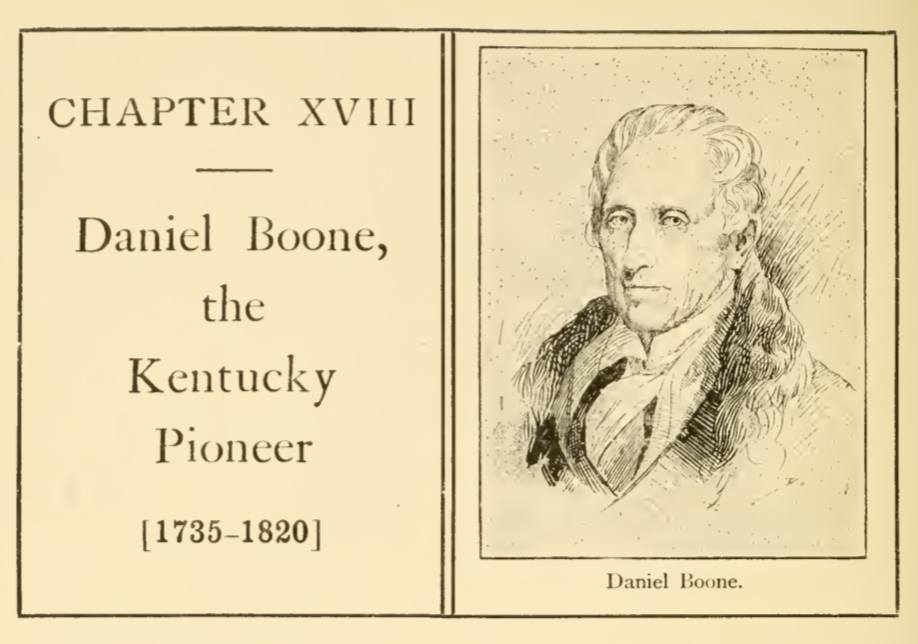
One of the most noted of these pioneers was Daniel Boone. He was born in Bucks County, Pa., in 1735. Caring little for books, he spent most of his time in hunting and fishing. The woods were his special delight, and naturally he became an expert rifleman.
The story is told that when a small boy he wandered one day into the forest some distance from home, and built himself a rough shelter of logs. There he would spend days at a time with only his rifle and game for company. The rifle served to bring down the game, and this he cooked over a fire of logs. A prince might have envied his dreamless slumber as he lay on a bed of leaves with the skin of a wild animal for covering. This free, wild life trained him for his future career as a fearless hunter and woodsman.
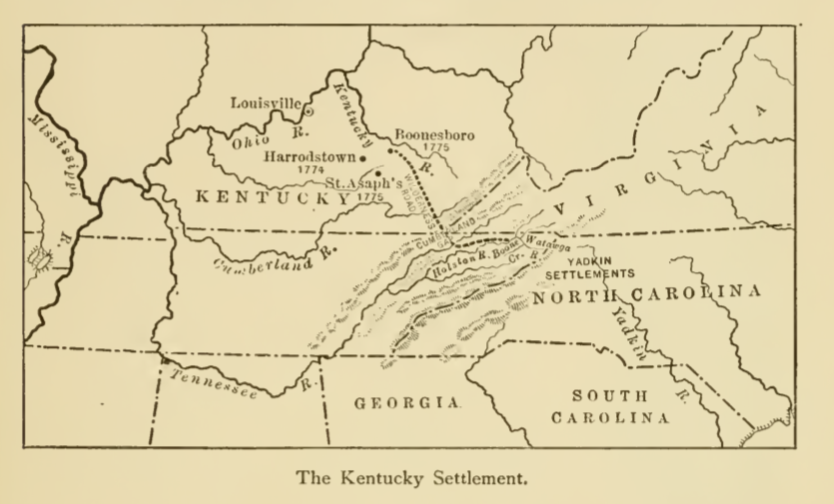
When Daniel was about thirteen years old his father moved to North Carolina and settled on the Yadkin River, where Daniel grew to manhood. After his marriage at the age of twenty, he built him a hut in the solitude of the wilderness, far removed from other settlers’ homes.
But Boone was restless. For years he looked with eager eyes toward the rugged mountains on the west and to the country beyond. Day by day, his desire to visit this wild unknown region increased, until he could no longer restrain it. By the time he was twenty-five he had begun his explorations and had pushed his way as far as Boone’s Creek, which is a branch of the Watauga River in Eastern Tennessee. Near this creek there yet stands a beech-tree with the inscription: “D. Boon cilled a bar on (this) tree in the year 1760.”
Nine years after this date Daniel Boone, in company with five other men, started out on May 1st to cross the Alleghany Mountains. For five weeks the bold travellers picked their way through the pathless woods. But when in June they reached Kentucky, they were rewarded for all the hardships they had endured. For here was a beautiful country with an abundance of game, including deer, bears, and great herds of bison.
They promptly put up a shelter made of logs and open on one side. The floor of this camp, as it was called, was the earth, covered with leaves and hemlock twigs.
Six months after their arrival Boone and a man named Stewart had an unpleasant experience. While off on a hunting expedition, they were captured by an Indian party. For seven days the dusky warriors carefully guarded their prisoners. But on the seventh night, having gorged themselves with the game killed during the day, the Indians fell into a sound sleep. Boone, while pretending to be asleep, had been watching his opportunity. So when the right moment came he quietly arose, awoke Stewart, and the two crept stealthily away until out of hearing of the Indians. Then, leaping to their feet, they bounded away like deer, through the dark woods toward their camp. This they found deserted, and what had become of their friends they never learned.
Some weeks later Boone was pleasantly surprised by the appearance at the camp of his brother, Squire Boone, and a companion. The four men lived together without special incident, until one day Stewart was surprised and shot by some Indians. Stewart’s death so terrified the man who had accompanied Squire Boone, that he gave up the wilderness life and returned to his home.
Boone and his brother remained together in the forest for three months longer, but their ammunition getting low, on May 1st Squire Boone returned to North Carolina for a fresh supply and for horses. Daniel was thus left alone, 500 miles from home. His life was in constant peril from wild beasts and Indians. He dared not sleep in his camp, but resorted at night to a canebrake or some other hiding-place, where he lay concealed, not even kindling a fire lest its light might betray him. During these months of solitary waiting for his brother, Boone endured many privations. He had neither salt, sugar, nor flour, his sole food being game brought down by his rifle. But the return of his brother, in July, with the expected provisions, brought him much good cheer.
After two years of this experience in the wilderness, Daniel Boone returned to his home on the Yadkin to make preparations for removal. By September, 1773, he had sold his farm and was ready to go with his family to settle in Kentucky. His enthusiastic reports of the fertile country he had been exploring found eager listeners, and when his party was ready to start it included, besides his wife and children, five families and forty men, with a sufficient number of horses and cattle. Unhappily they were attacked on their way by Indians, and six men, one of them Boone’s eldest son, were killed. Discouraged by this setback the party returned to the nearest settlement, and for a while longer the migration westward was postponed.
But it was Boone’s unflinching purpose to settle in the beautiful Kentucky region. It had already become historic, for the Indians called it a “dark ground,” a “bloody ground,” and an old Indian Chief had related to Boone how many tribes had hunted and fought on its disputed territory.
None of the Indians held an undisputed claim to the land. Nevertheless a friend of Boone, Richard Henderson, and other white men made treaties with the powerful Cherokees, who allowed them to settle here. As soon as it became certain that the Cherokees would not interfere, Henderson sent Boone in charge of thirty men to open a pathway from the Holston River, over Cumberland Gap to the Kentucky River. This is still known as the Wilderness Road, along which so many thousand settlers afterward made their way.
On reaching the Kentucky River, Boone and his men set to work to build a fort on the left bank of the stream. This fort they called Boonesborough. Its four stout walls consisted in part of the outer sides of log cabins and in part of a stockade, some twelve feet high, made by thrusting into the ground stout pieces of timber pointed at the top. There were loop-holes in all the cabins, and a loop-holed block-house at each corner of the fort.
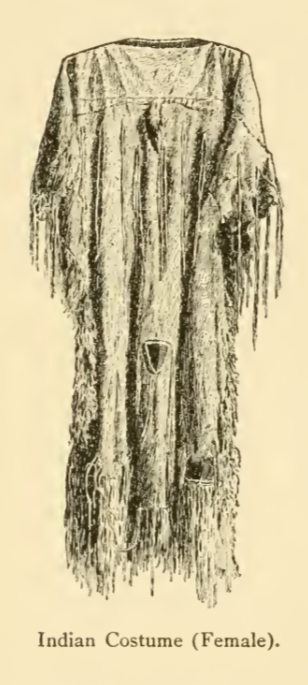
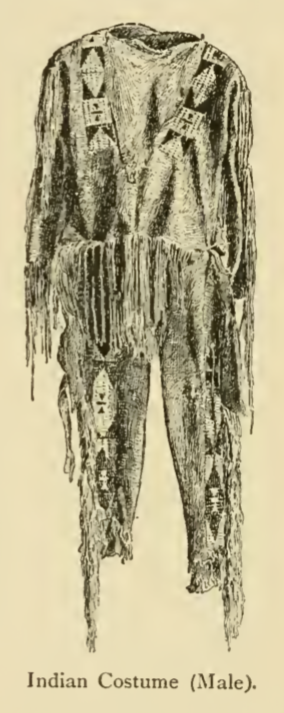
Daniel Boone, the leader of this settlement, was a man of interesting personality. He was a tall, slender backwoodsman, with muscles of iron and a rugged nature that enabled him to endure great hardship. Quiet and serious, he possessed courage that never shrank in the face of danger. Men had confidence in him because he had confidence in himself. Moreover, his kind heart and tender sympathies won lasting friendships. He usually though not always dressed like an Indian. A fur cap, a fringed hunting shirt, and leggings and moccasins, all made of skins of wild animals, made up his ordinary costume.
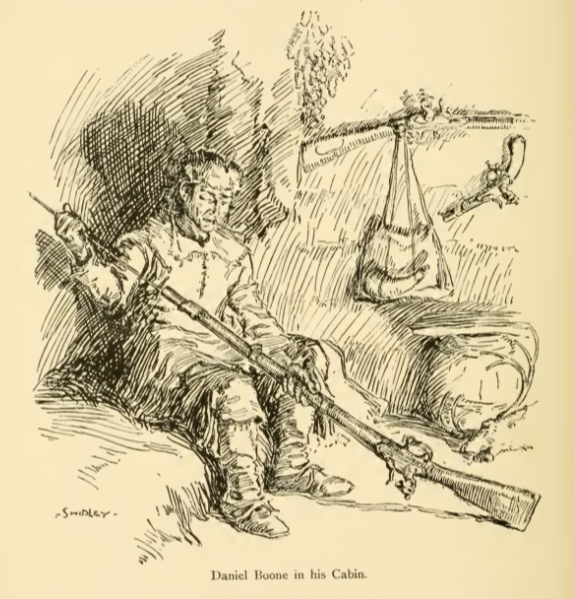
If we should go in imagination into Daniel Boone’s log cabin out in the clearing not far from the fort, we should find it a simple home with rude furnishings. A ladder against the wall was the stairway by which the children reached the loft. Pegs driven into the wall held the scanty family wardrobe, and upon a rough board, supported by four wooden legs, was spread the family meal.
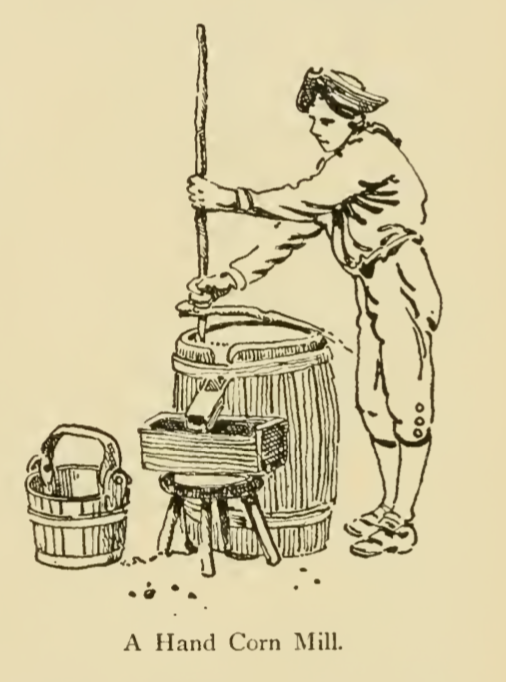
There was an abundance of plain and simple food. Bear’s meat was a substitute for pork, and venison for beef. As salt was scarce, the beef was not salted down or pickled, but was jerked by drying in the sun or smoking over the fire. Corn was also an important article of diet. When away from home to hunt game or to follow the war trail, sometimes the only food which the settler had was the parched corn he carried in his pocket or wallet. Every cabin had its hand-mill for grinding the corn into meal and a mortar for beating it into hominy. The mortar was made by burning a hole into the top of a block of wood.
A pioneer boy found his life a busy and interesting one. While still young he received careful training in imitating the notes and calls of birds and wild animals. He learned how to set traps, and how to shoot a rifle with unerring aim. At twelve years of age he became a fort-soldier, with port-hole assigned to him for use in case of an Indian attack. He received careful training, also, in following an Indian trail and in concealing his own when on the warpath. For expert knowledge of this kind was necessary in the midst of dangers from unseen foes that were likely to creep stealthily upon the settlers at all times whether they were working in the clearings or hunting in the forest.
After building the fort, Boone returned to his home in North Carolina for his family. Some months after the family reached Boonesborough, Boone’s daughter with two girl friends was one day floating in a boat near the river-bank. Suddenly five Indians darted out of the woods and, seizing the three girls, hurried away with them. When in their flight the Indians observed the eldest of the girls breaking twigs and dropping them in their trail, they threatened to tomahawk her unless she stopped it. But watching her chance, she from time to time tore off strips of her dress, and dropped them as guides to the pursuing whites.
As soon as possible after hearing of the capture Boone, with seven other men from the fort, started upon the trail of the Indians and kept up the pursuit until, early on the second morning, they discovered the Indians sitting around a fire cooking breakfast. Suddenly the whites, firing a volley, killed two of the Indians and frightened the others so badly that they beat a hasty retreat, leaving the girls uninjured.
Early in 1778, Boone and twenty nine other men were captured and carried off by a party of Indian warriors. At that time the Indians in that part of the country were fighting on the English side in the Revolution, and as they received a ransom for any Americans they might hand over to the English, they took Boone and the other men of his party to Detroit.
Although the English offered $500 for Boone’s ransom the Indians refused to let him go. They admired him so much that they took him to their home, and with due ceremony adopted him into their tribe. Having plucked out all his hair except a tuft on the top of his head, they dressed this with feathers and ribbons as a scalp-lock. Next they threw him into the river and gave his body a thorough scrubbing in order to wash out all the white blood. Then, daubing his face with paint in true Indian fashion, they looked upon him with huge satisfaction as one of themselves.
Boone remained with them several months, during which he made the best of the life he had to lead. But when he heard that the Indians were planning an attack upon Boonesborough, he determined to escape if possible and give his friends warning. His own words tell the story in a simple way: “On the 16th of June, before sunrise, I departed in the most secret manner, and arrived at Boonesborough on the 20th after a journey of 160 miles, during which I had but one meal.” He could not get any food because he dared not use his gun, nor would he build a fire for fear of discovery by his foes. He reached the fort in safety, where he was of great service in beating off the attacking party.
But this is only one of the many hairbreadth escapes of the fearless backwoodsman. Once while in a shed looking after some tobacco, four Indians with loaded guns appeared at the door. They said: “Now, Boone, we got you. You no get away any more. You no cheat us any more.” In the meantime, Boone had gathered up in his arms a number of dry tobacco leaves, and with the dust of these suddenly filled the Indians’ eyes and nostrils. Then while they were coughing, sneezing, and rubbing their eyes, he made good his escape.
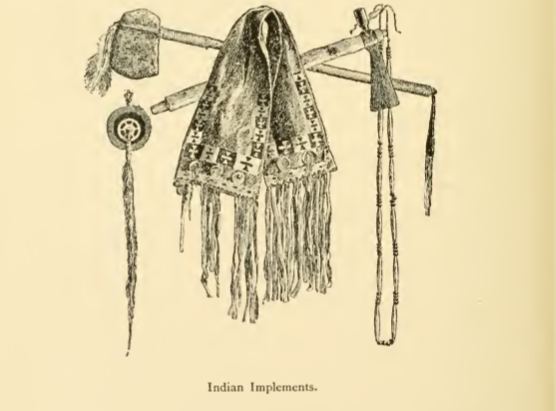
But from all his dangerous adventures Boone came out safely, and for years remained the leader of the settlement at Boonesborough. He was certainly a masterful leader in that early pioneer life in Kentucky. The solitude of the wilderness never lost its charm for him even to the last of his long life. He died in 1820, eighty-five years old. It has been said that but for him the settlement in Kentucky could not have been made for many years.
REVIEW OUTLINE
Western pioneers and patriots.
Boone’s fondness for life in the woods.
He goes to Kentucky.
His solitary life in the forest.
He plants a settlement in Kentucky.
Boonesborough.
Personal appearance and character of Daniel Boone.
His log cabin.
Food of the backwoodsmen.
Life of the pioneer boy.
Boone’s daughter captured by the Indians.
His adoption by an Indian Tribe.
Boone’s important work.
TO THE PUPIL
1. Try to form a picture of Boone alone in the woods in his boyhood, and then tell the story of what he did.
2. Do the same with Boone alone in the Kentucky forest after his brother had left him.
3. What do you admire in Boone’s character? How did he dress? Describe his log cabin. Give some facts about the Kentucky settlers’ diet.
4. Tell something about the life of the pioneer boy.
5. Give an account of Boone’s adoption into an Indian tribe.
6. What was Boone’s great work?
Thomas
Jefferson and
the
Louisiana
Purchase
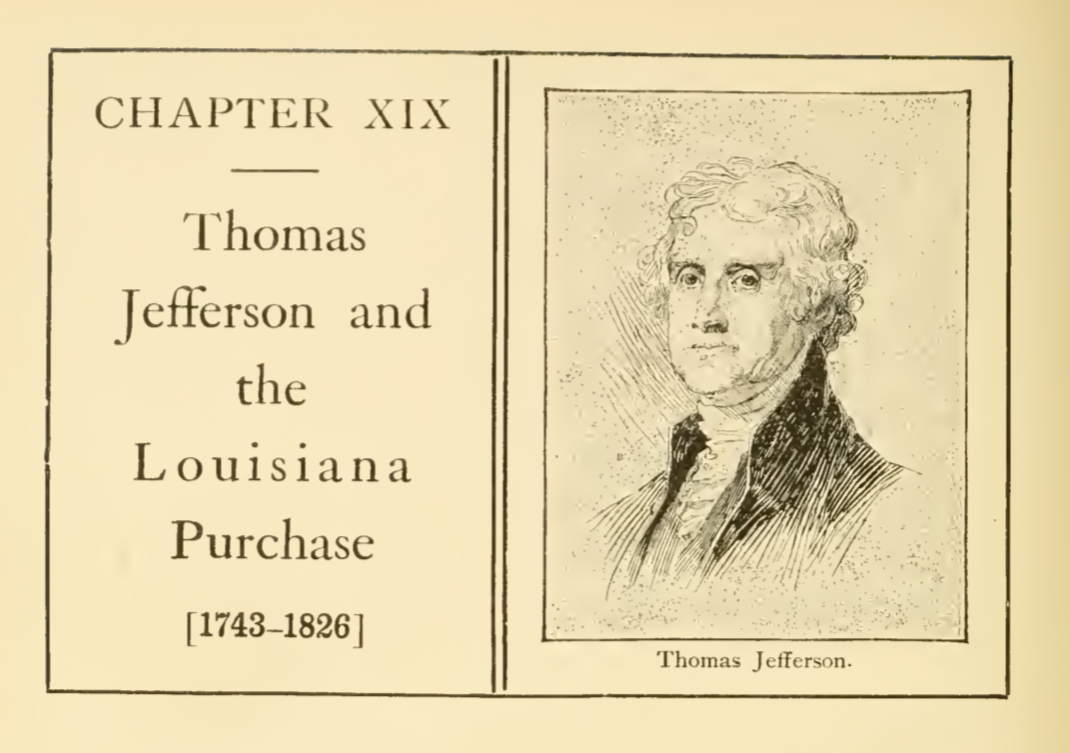
Through the achievements of early pioneers and settlers, of whom Daniel Boone is the type, the region lying between the Alleghany Mountains and the Mississippi River came into the possession of the United States. In a very different way did the territory lying between the Mississippi River and the Rocky Mountains become a part of the national domain. It was acquired not by exploration or settlement, but by purchase, and the man most intimately associated with this purchase was Thomas Jefferson.
He was born in 1743 near Charlottesville, Va., on a plantation of nearly 2,000 acres. From his father, a man of great physical strength and energy, Thomas inherited a hardy constitution. As a boy he lived an out-of-door life, sometimes hunting for deer, wild turkeys, and other game, sometimes swimming or paddling his boat in the river near his home, and sometimes riding one of his father’s horses. A skilful and a daring rider, he remained to the end of his long life fond of a fine horse.
When he was five years of age he entered school, and thus early began his life-long habit of reading and study. Even in his younger boyhood days he was known among his playmates for industry and thoroughness.
At seventeen he entered William and Mary College, at Williamsburg, Va. Although Williamsburg was a village of only 1,000 people, it was the State capital, and represented the most aristocratic and refined social life of the colony. As a young college student Jefferson received the full advantage of this good society, and at the same time studied very hard, sometimes as much as fifteen hours a day. But for his strong body and sound health he must have broken down under such a severe strain.
Being simple, refined, and gentle in manner, with a cheerful disposition and rare intelligence, he easily won and kept warm friends. One of these was the rollicking, fun-loving Patrick Henry, who with his jokes and stories kept everyone about him in good humor. He and Jefferson were, in their youth, the best of friends, and spent many an hour in playing their violins together.
While in college at Williamsburg Jefferson, according to a description left of him as he appeared at that time, was six feet two and one-half inches tall, with a slender frame, a freckled face, sandy hair, hazel-gray eyes, and large feet and hands. He stood erect, straight as an arrow, a perfect picture of health and vigorous young manhood.
It was during the last of his five-year stay at Williamsburg that Jefferson, then twenty-two-years old, stood one day at the door of the court-house earnestly listening to his friend Patrick Henry as he delivered his famous speech. The impassioned words of the great orator, bitterly denouncing the Stamp Act, made a deep impression upon young Jefferson’s fervid nature. They fell as seed in good soil, and a few years later yielded harvest in the cause of liberty.
These two men, devoted friends as they were, had many traits in common. Both were earnest patriots and fought in the same cause. But unlike Patrick Henry Thomas Jefferson was a poor speaker. His power expressed itself rather through his writing, and with such grace and strength that he has rightly been called “The Pen of the Revolution.”
At twenty-nine years of age he married a beautiful young widow of twenty-three. After the wedding festivities, he and his bride started out in a four-horse carriage to drive to his home, Monticello, more than 100 miles away. It was in the month of January, and a heavy snow-storm overtook them, compelling them to abandon the carriage and continue the journey over the rough mountain roads on horseback.
When at last they reached Monticello, tired and hungry, it was so late that the slaves had gone to their quarters for the night. The house was dark and the fires all out, but the bride and groom quickly kindled a fire, hunted up refreshments, and made the empty rooms ring with their songs and merriment. Thus with joyous hearts did they begin a long-continued and happy married life in their beautiful home, Monticello.
Both Jefferson and his wife inherited wealth. When he was married, he owned 5,000 acres of land and fifty-two slaves, and a year later his wife’s father died and left her 40,000 acres of land and 135 slaves.
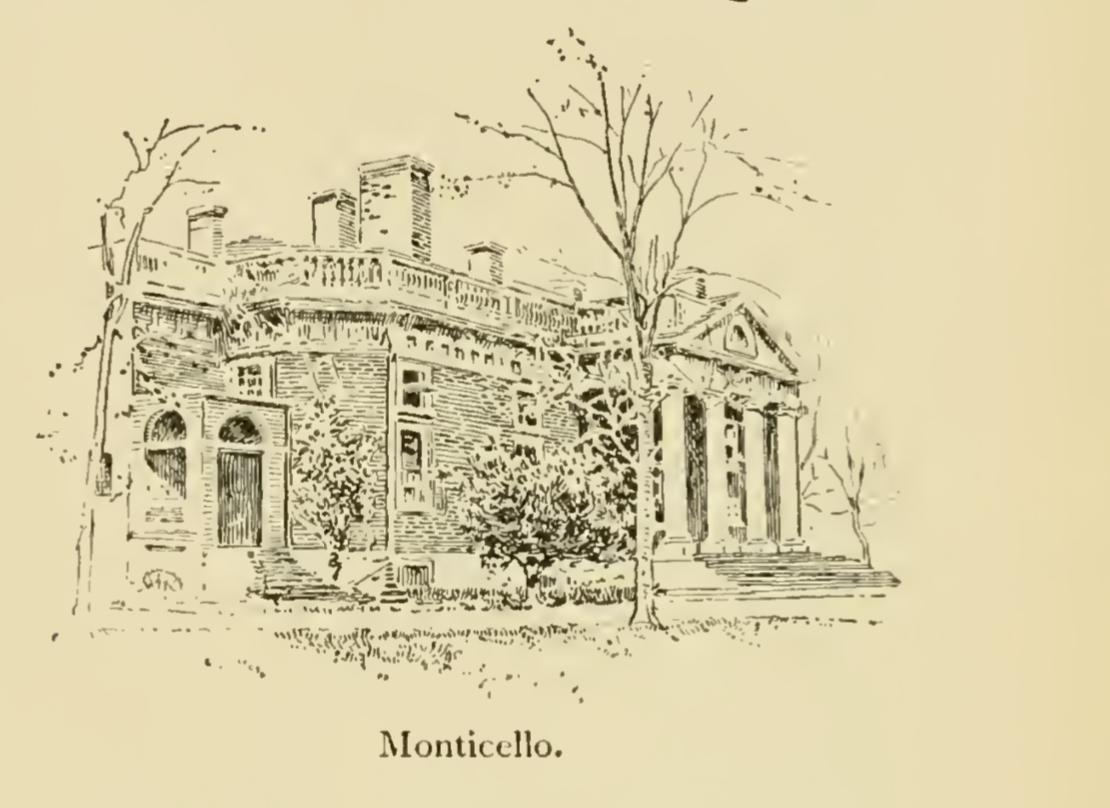
He became strongly attached to his mountain home and his life there as a planter, taking great interest in laying out and cultivating the grounds, and in introducing many new varieties of plants and trees.
But he was too public-spirited to be lost in his private interest. In the year following his marriage, the famous “Boston Tea Party” emptied the chests of taxed tea into Boston Harbor. Then followed such stirring events as the Boston Port Bill, the first meeting of the Continental Congress, and the battles of Lexington and Concord; and finally the crisis, when the brave men of the Continental Congress, having decided that the time had come for the American people to declare themselves free and independent of England, appointed a committee of five to draw up the Declaration of Independence.
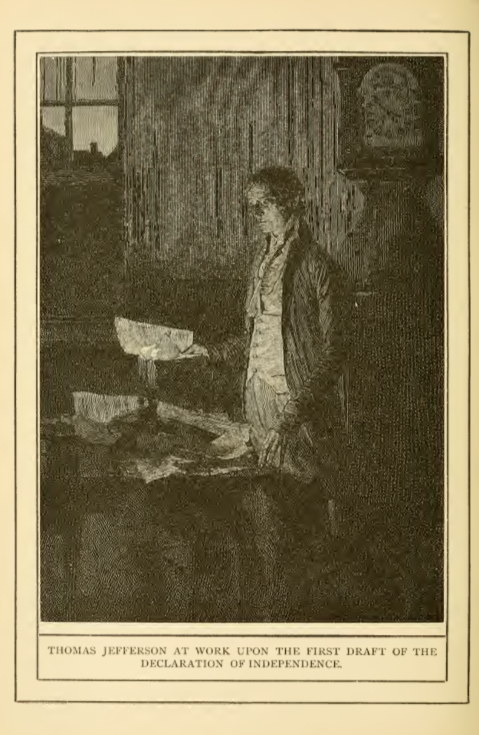
Jefferson was one of this committee and, as he had distinguished himself for literary ability, it fell to him to write the first draft of this great state paper. Congress spent a few days in making some unimportant changes in Jefferson’s draft, but left it practically as he had written it. On July 4, 1776, all the members of the Continental Congress signed the Declaration of Independence in Carpenter’s Hall, Philadelphia, a hall which is yet standing.
One of the striking things that Jefferson wrote in the Declaration of Independence was that “all men are created equal.” He was always democratic in feeling, trying to do what he could for the interest of rich and poor alike. There was a law in Virginia requiring that the owner of land should hand it down to his eldest son. In its place he got a law passed which would permit all the children of a family to share in the land owned by their father. Another law in Virginia required that people should pay taxes for the support of the religious denomination, or church, known as the Established Church. As Jefferson believed this law unfair, he secured the passage of one which provided that nobody should be compelled to pay taxes for the support of any church.
But Jefferson showed his sympathy for the rights of others quite as much in his private as in his public life, and won the personal attachment of his numerous household. His letters to his little daughters were full of loving advice, and their letters to him breathed the spirit of genuine affection. When, after the close of the Revolution, Franklin returned from his mission as minister to France, Jefferson was sent to take his place. On his return to Monticello at the end of five years, his slaves went miles to meet him and give him a hearty welcome home. They wished to take the horses from the carriage, that they might draw it themselves; and when, arriving at the house, Jefferson alighted, they bore him proudly upon their shoulders, while they laughed and cried for joy because “Massa” had come home again.
Jefferson was truly polite, because he had warm sympathy for others, especially for the poor and the needy. Once when he and his grandson were out riding together they met a negro who bowed to them. The young man paid no attention to the negro, but Jefferson politely returned the bow, saying, “Do you permit a negro to be more of a gentleman than yourself?” thus teaching the young man a useful lesson.
After filling many of the highest offices in the country, Thomas Jefferson became the third President of the United States in 1801. He had looked on with serious misgivings at some of the ceremonies and formalities in the executive mansion while Washington was President. He loved Washington, but he did not think that the President of the United States should be coldly formal and hold himself aloof from the people quite as much as Washington did. He believed in “republican simplicity,” which he began to practise on the very day he was inaugurated.
On that occasion he went on foot to the capitol, clothed in his every-day dress, and attended by some of his political friends. It became his custom later when going up to the capitol on official business to ride on a horse, which he tied with his own hands to a fence near by, before entering. He declined to hold weekly levees, as had been the custom, but instead opened his house to all on the fourth of July and the first of January. In these ways he was carrying out his convictions that the President should be simple in dress and manner, or, in other words, should live in “republican simplicity.”
Many acts of Jefferson prove that he was an able statesman; but one of the greatest things he did, while President in the years 1801-1809, was the purchase of Louisiana. Do not think of this territory as the State of Louisiana. It was far more than this, for it included all the country lying between the Mississippi River on the east and the Rocky Mountains on the west, and extending from Canada on the north to Texas on the south.
In 1763, at the close of the Last French War, France gave up all this vast region to Spain. But in 1800, Napoleon forced Spain to give it up to France. When the Americans learned that Louisiana had again become French territory they were alarmed, as the country that held Louisiana could control the mouth of the Mississippi, and stop all American goods passing down through the river. As a consequence, American settlers living west of the Alleghanies would not be able to find a ready outlet to the world for their products. Then, too, France might plant a strong colony in Louisiana and thus give the American people untold trouble.
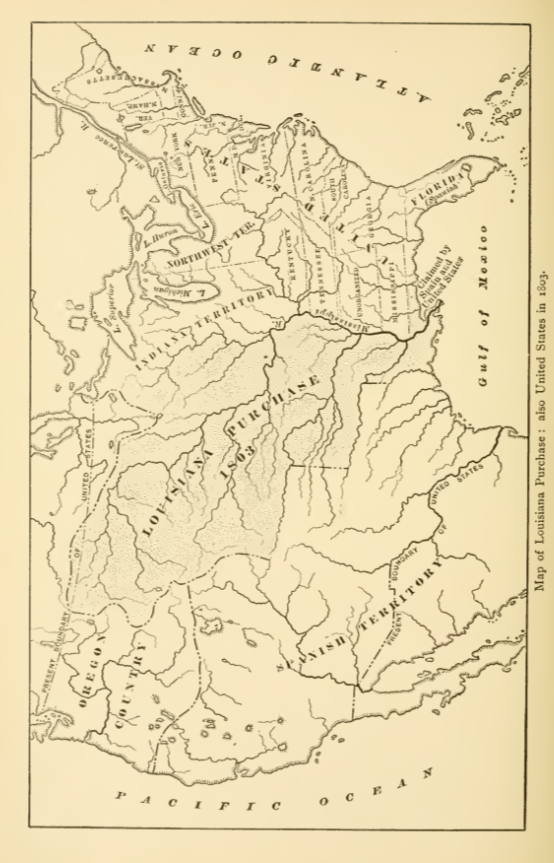
Accordingly, President Jefferson sent Monroe to France to aid in securing New Orleans and a stretch of territory in Louisiana lying on the east bank of the Mississippi. By getting that territory, the Americans would own the entire east bank of the river, and could therefore control their own trade.
The Americans approached Napoleon at a fortunate time; for he was greatly in need of money to aid him in his war with England. Besides, he feared that England might seize Louisiana with her fleet. He therefore gladly sold us for $15,000,000 all the immense territory of Louisiana.
By carefully looking at your map you will get some idea of its vast extent. It was much larger than all the rest of the territory which we held before this purchase was made. Jefferson himself, perhaps, hardly realized how great a thing he was doing for his country when he made the purchase.
At the end of his term of office as President, Jefferson retired to private life in his much-loved home of Monticello. Famous not only for his statesmanship, but for his learning, he was called the “Sage of Monticello,” and was visited by people from far and near. The number of his guests was enormous, his housekeepers sometimes finding it necessary to provide fifty beds for them.
Of course all this entertaining was a great burden, and the expense of it almost ruined him financially. But his life moved happily on. Always busy with some useful work, he took a deep interest in education, and was the founder of the University of Virginia, in which he felt a just pride.
On July 4, 1826, just fifty years after the signing of the Declaration of Independence, this great man breathed his last, at the ripe age of eighty-three. On the tombstone which marks his grave at Monticello is this inscription, written by his own hand: “Here was buried Thomas Jefferson, author of the Declaration of Independence, of the Statutes of Virginia for Religious Freedom, and Father of the University of Virginia.” It was such things as these?things that touched the freedom of all men?that he sought to further, and in so doing found his greatest satisfaction.
REVIEW OUTLINE
The Louisiana territory.
The out-door life of young Thomas Jefferson.
School and college life.
Jefferson’s personal appearance.
“The pen of the Revolution.”
Jefferson’s happy home life.
A wealthy planter at Monticello.
Jefferson writes the Declaration of
Independence.
His “republican simplicity.”
Napoleon sells us Louisiana; its vast extent.
The “Sage of Monticello.”
TO THE PUPIL
1. Tell about Jefferson’s youthful friendship for Patrick Henry.
2. How did Jefferson look when he was in college?
3. Describe Jefferson’s happy home life. How did he show his interest in the people? How did his slaves regard him?
4. What is meant by his “republican simplicity”?
5. When and why did Jefferson purchase Louisiana?
6. Draw a map of Louisiana.
7. What do you admire in Jefferson’s character?
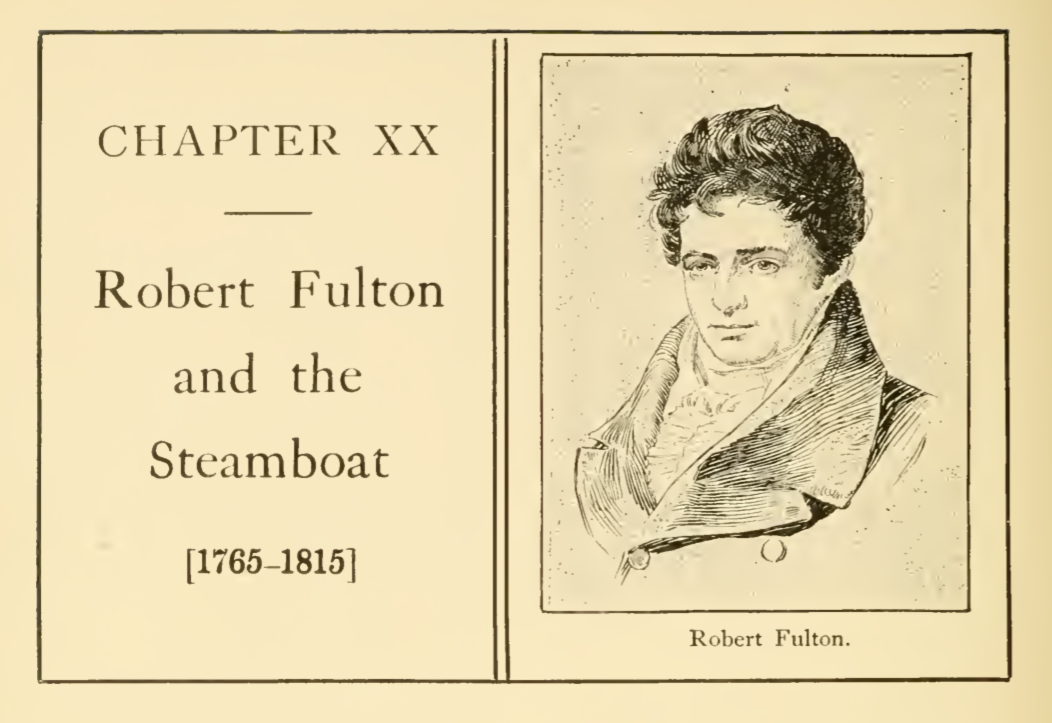
Robert Fulton
and the
Steamboat
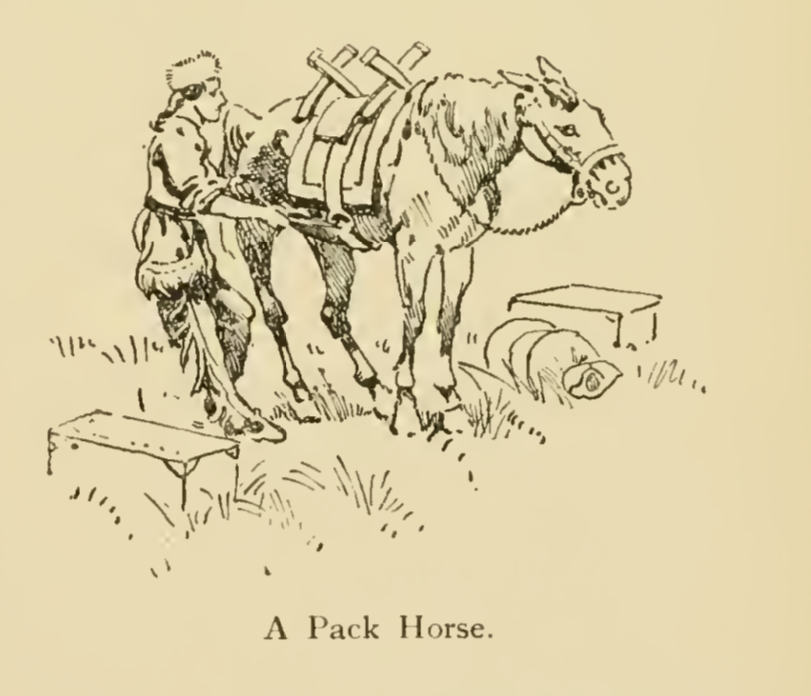
After the purchase of Louisiana thousands of settlers joined the ever-swelling tide of westward migration which had been set in motion by the early pioneers. These frontiersmen had made their way across the mountains either by the forest trail, leading with them their pack-horses or, a little later, by the rough road cut through the forest, their household goods packed in a strong wagon drawn by oxen or horses.
Already this difficult method had given place to the flat boat, which, though safer and more convenient, was still unsatisfactory except when it floated down stream. In the early years of this century, therefore, the increasing demands of migration and traffic turned many inventive minds to the problem of applying steam-power to river navigation, in the hope of accomplishing a speedier means of travel and transportation. The first to achieve success in inventing and bringing into practical use a steam-driven boat was Robert Fulton.
Robert Fulton was born of poor parents in 1765, in Little Britain, Pa. His father having died when the boy was only three years old, his mother took charge of his education. She taught him herself until he was eight and then sent him to school. But he had no liking for books, and made slow progress. Drawing and mechanical devices absorbed his interest, and nothing gave him greater delight than to visit the shops of mechanics and there with his own hands to work out his new ideas.
It is said that Robert came into school late one morning, and upon being reproved by his teacher explained that he had been at a shop beating a piece of lead into a pencil. At the same time he exhibited the pencil and remarked: “It is the best that I have ever used.” Upon examining it the school-master was so well pleased that he praised Robert’s effort, and in a short time nearly all the pupils were using the same sort of pencil.
His ingenious ideas found expression in other ways. For example, it was the custom of his town to celebrate the Fourth of July by an illumination with candles; but one year candles being scarce, the citizens were requested to omit the usual display. Robert was at this time only thirteen years old, and like other boys of his age, full of Fourth of July patriotism which had to be expressed in some extraordinary way. So he set his busy brain to work, and having bought gunpowder and pasteboard, produced some home-made sky-rockets which greatly astonished the community by their mid-air explosions. Such fireworks were at that time entirely new to the people of the town.
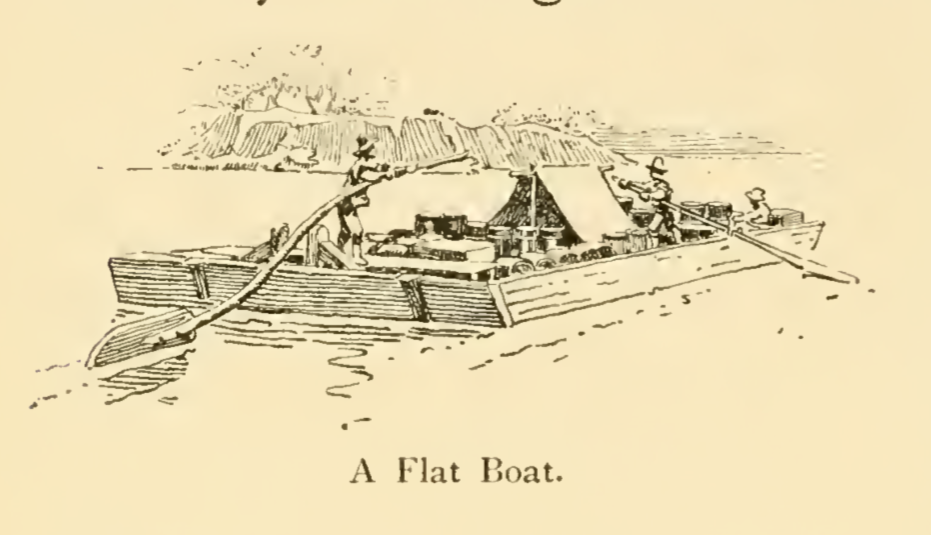
Another illustration of his inventive gift belongs to his boyhood days. He and one of his playmates used to go out fishing in a flat boat which they propelled by the use of long poles. Getting tired of this method of navigation, Robert made two crude paddle-wheels, one for each side of the boat, connecting them by a sort of double crank, which the boys united in turning. They could then easily propel the boat in their fishing trips to various parts of the lake, and keenly enjoyed this novel and easy way of going a-fishing.
While still young Robert won the warm regard of a great painter, Benjamin West, whose father was an intimate friend of Robert’s father. Very likely this friendship turned Robert’s mind strongly toward painting. At all events, the desire to become an artist took so strong a hold upon him that at the age of seventeen he went to Philadelphia and devoted his time to drawing and painting. Here he remained three years and painted with such skill that he not only supported himself, but sent money to his old home, and saved $400, with which he bought a little home for his mother.
In time his interest in art led him to go to London, where he studied under Benjamin West. But very soon he became interested in trying to improve canal navigation and in working out various mechanical appliances.
This love for invention finally diverted his attention very largely from painting, and led him to the work which made him famous. When about thirty years old he went to Paris to experiment with a diving-boat, an invention of his own, intended to carry cases of gunpowder under water. This machine was not successful, but by the spring of 1801, a little more than three years after his first effort, he had constructed another diving-boat, and went with it to Brest where he gave it a successful trial. With three companions he descended twenty-five feet below the surface of the water and remained for one hour. In 1805 he tested it again in England where, with a torpedo of 170 pounds, he blew up a vessel of 200 tons.
For the invention of the torpedo-boat, the world is indebted to Fulton, but for the first successful steamboat it owes him a debt of deeper gratitude. Before leaving Paris, Fulton became acquainted with Robert R. Livingston, who was at that time the American minister to France. Mr. Livingston had long felt an interest in steamboat navigation, and was willing to supply Fulton the necessary money. A steamboat, constructed at Paris, was finished by the spring of 1803, and the day for its trial trip was at hand, when, early one morning the boat broke in two parts and sunk to the bottom of the river. The frame had been too weak to support the weight of the heavy machinery. On receiving the news, Fulton hastened to the scene of his misfortune and began at once the work of raising the boat. For twenty-four hours, without food or rest, and standing up to his waist in the cold water, he labored with his men until he succeeded in raising the machinery and in placing it in another boat. But the exposure to which he submitted himself brought on a lung trouble from which he never fully recovered.
Having discovered the defects of the machinery Fulton returned in 1806 to America, where, with money furnished by his friend Livingston, he began to construct another steamboat which he called the Clermont, after the name of Livingston’s home on the Hudson. This boat was 130 feet long and 18 feet wide, with a mast and a sail, and on each side a wheel 15 feet in diameter, fully exposed to view.
One morning in August, 1807, a throng of expectant people gathered on the banks of the North River at New York, to see the trial of the Clermont. Everybody was looking for failure. People had all along spoken of Fulton as a crack-brained dreamer, and had called the Clermont “Fulton’s Folly.” “Of course the thing would not move.” “That any man with common-sense might know,” they said. So while Fulton was waiting to give the signal to start, these wiseacres were getting ready to jest at his failure.
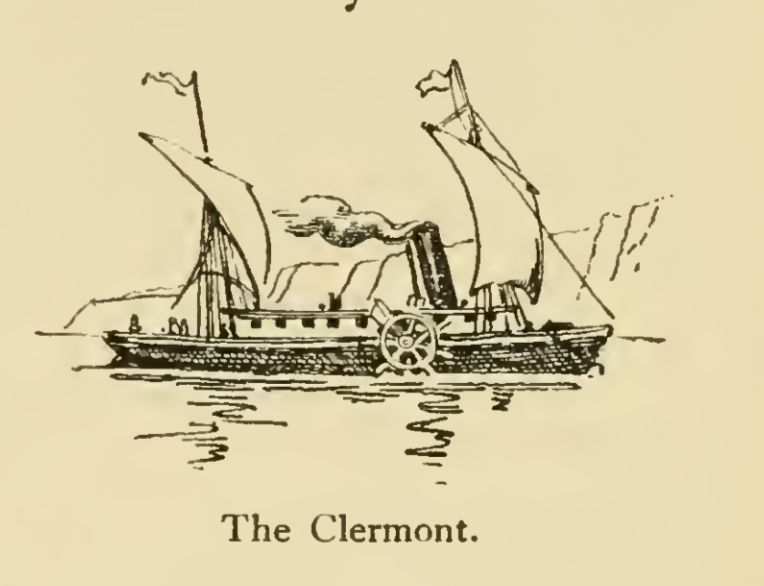
Finally, at the signal, the Clermont moved slowly, and then stood perfectly still. “Just what I have been saying,” said one onlooker with emphasis. “I knew the boat would not go,” said another. “Such a thing is impossible,” said a third. But they spoke too soon, for after a little adjustment of the machinery, the Clermont steamed proudly up the Hudson.
As she continued her journey, all along the river, people who had come from far and near stood watching the strange sight. When the boatmen and sailors on the Hudson, heard the clanking machinery and saw the great sparks of fire and the volumes of dense, black smoke rising out of the funnel, they thought the Clermont was a sea-monster. In their superstitious dread, some of them went ashore, some jumped into the river, and some fell on their knees in fear, believing the day of judgment to be at hand. One old Dutchman told his wife that he had seen the devil coming up the river on a raft.
The trip of 150 miles from New York to Albany was made in thirty-two hours. Success had at last rewarded this man of strong common-sense, quiet modesty, and iron will. The Clermont was the first steamboat of practical use ever invented. From that time men saw the immeasurable advantage to trade of steam navigation on lakes and rivers.
This was Fulton’s last work of great public interest. He died in 1815, having rendered an untold service to the industrial welfare of his country and the world.
REVIEW OUTLINE
The pack-horse, the flat boat, and the new
problem.
Robert Fulton at home and at school.
His Fourth of July sky rockets.
A new method of navigation.
Fulton’s fondness for drawing and painting.
He invents the diving-boat.
Fulton and Livingston.
A serious accident.
“Fulton’s Folly” and her trip up the Hudson.
TO THE PUPIL
1. Give an account of Fulton’s life at school, and his youthful inventions.
2. Tell about his experience with the diving-boat.
3. What serious accident happened to his boat?
4. Imagine yourself on the Clermont at the time of its trial trip, and give an account of the journey from New York to Albany.
5. What do you admire in the character of Robert Fulton?
Andrew
Jackson, the
Upholder
of the Union
Only four years after the Clermont made its successful trip up the Hudson, the first steamboat on the Ohio was launched at Pittsburg. This boat was the forerunner of numerous steam-driven craft which swarmed the extensive network of rivers west of the Alleghany Mountains. A fresh impulse was given to westward migration, for settlers could now easily and cheaply reach the fertile lands of the Mississippi Valley, and, having raised an abundant crop, could successfully send the surplus to the Eastern markets. Under conditions so favorable the West grew in population with marvellous rapidity.
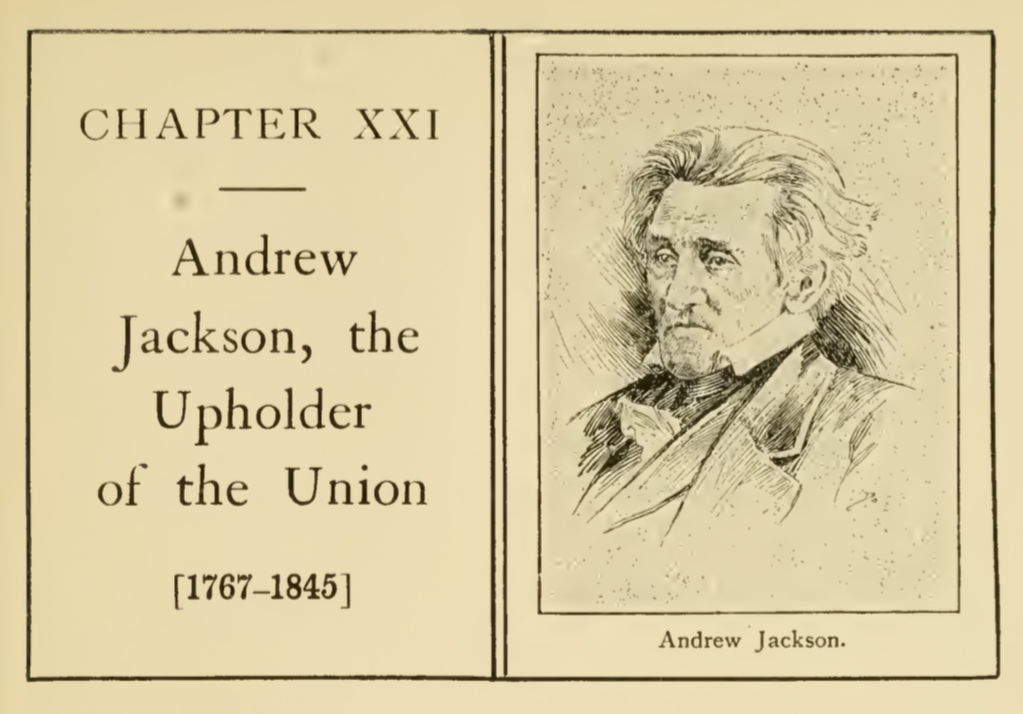
Wealth went hand in hand with the increase of population, and greatly strengthened the influence of the people of the West in the affairs of the country. By 1829, one of their number became the sixth President of the United States. This was Andrew Jackson, of Tennessee.
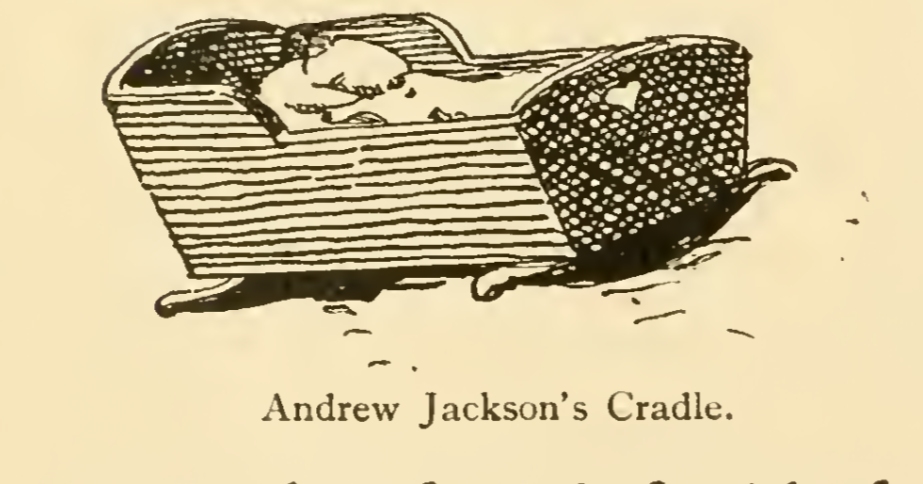
Andrew Jackson was born in Union County, N. C., in 1767, of poor parents, who about two years before had come from Ireland. In a little clearing in the woods, they had built a rude log hut and settled down to hard work.
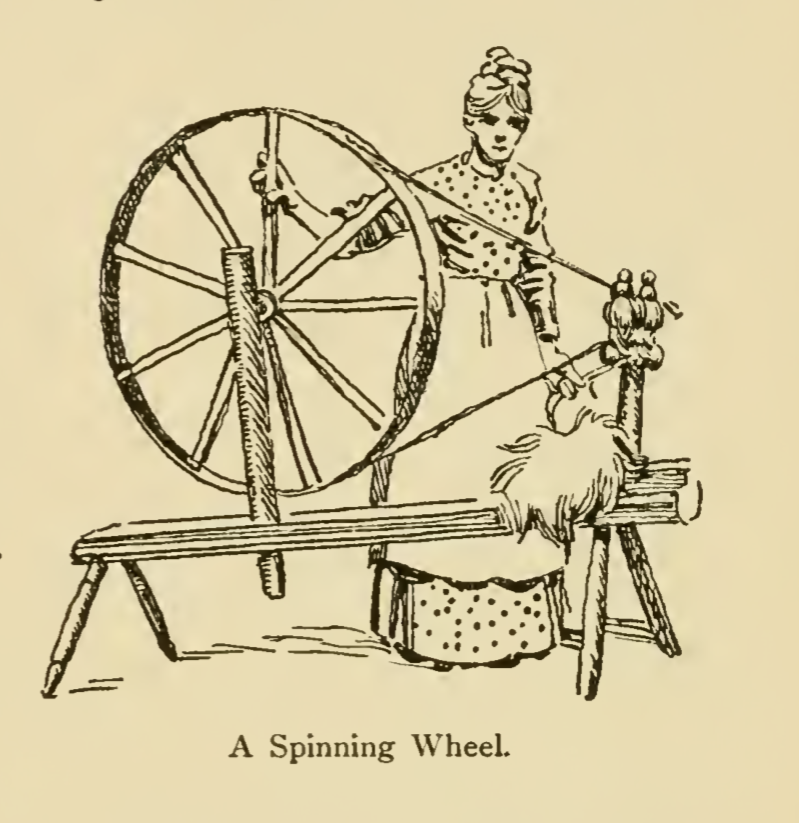
But Andrew’s father soon died, and his mother went with her children to live in her brother’s home, where she spun flax to earn money. She was very fond of little Andrew and hoped some day to make a minister of him. With this in view she sent him to school where he learned reading, writing, and a little ciphering. But he cared so little for study that he made small advancement, and in fact never learned to spell well nor to write the English language with ease or even correctness.
He found great pleasure in hunting and in rough-and-tumble sports, excelling in running, jumping, and wrestling. Although not robust, he was wiry and energetic, and when a stronger boy threw him to the ground, he was so agile that he always managed to regain his feet.
As a school-boy Andrew was a bare-footed, freckle-faced lad, with slender frame, bright blue eyes, and reddish colored hair. Full of life and fun, he became known as “Mischievous Andy.” Andy was brave and ready to champion the weaker and smaller boys, but sometimes he became overbearing and at other times his quick temper got him into trouble. One day his companions, wishing to play a practical joke upon him, secretly overloaded a gun, and dared Andy to shoot it. The fearless little fellow, seizing the gun, shot it off, and was kicked violently upon his back. But quickly jumping up, his eyes blazing with anger, he shouted, “If any of you boys laugh, I’ll kill him.” The boys did not laugh.
While he was yet a lad the Revolution broke out, and there was severe fighting between the Americans and the British near his home. His love of action, which up to that time had expressed itself in out-of-door sports, now took a more serious turn. War became a passion with him, and from this time he could not visit the local blacksmith’s shop without hammering into shape some form of weapon. Once while fiercely cutting weeds with a scythe he was heard repeating these words: “Oh, if I were a man, how I would sweep down the British with my grass blade!”
In the course of a few years young “Andy” had real British soldiers to fight; for he was only thirteen when he was made a prisoner of war. One day soon after his capture, a British officer ordered him to clean his muddy boots. The fiery youth flashed back: “Sir, I am not your slave. I am your prisoner, and as such I refuse to do the work of a slave.” Incensed at this reply, the brutal officer struck the boy a cruel blow with his sword. Andrew saved himself from the brunt of the blow, but received two severe wounds, the scars and the bitter memory of which he carried through life.
These indignities were but a beginning. He was transferred to the prison pen about Camden jail, some forty miles away, where without shelter and almost without food, he suffered from heartless exposure. In a weak and half-starved condition, his wounds yet unhealed, he fell a victim to small-pox. Hearing of his wretched plight, Andrew’s mother secured his release and took him home with her. Andrew struggled for months with a severe illness. Before he had entirely recovered, his mother died leaving him quite alone in the world.
But these hardships passed, and some years later Andrew decided to become a lawyer. After studying law for a while, at twenty-one he crossed the mountains with an emigrant party into the backwoods region of Tennessee. Now grown to manhood, he was six feet and one inch tall, slender, straight, and graceful, with a long slim face and thick hair falling over a forehead beneath which looked out piercing blue eyes.
When he reached Nashville, the destination of his party, his experience was, in a large measure, the same as that of Daniel Boone in the wilds of Kentucky. When the women of the settlement went out to pick berries, and when the men hoed corn in the clearings, some of the settlers, gun in hand, with watchful eyes stood guard against attack from stealthy Indians.
To the dangers belonging to backwoods life, Jackson was greatly exposed. The court-houses in which, as public prosecutor, he had to try cases, were in some instances hundreds of miles apart. In going from one to another he journeyed alone, and sometimes had to remain alone in the woods for twenty nights in succession. In periods of unusual danger, he dared not light a fire or even shoot a deer for fear of Indians.
But in the midst of all these dangers he escaped harm, and by his energy and business ability achieved success as a lawyer. In time he acquired the means to become a large land-owner. After his marriage he built a house which he called The Hermitage, on a plantation of 1,100 acres, about eleven miles from Nashville.
Here Jackson lived with his wife, whom he loved with a deep and abiding affection. They kept open house for visitors, and entertained large numbers of guests at a time, treating rich and poor with like hospitality. His warm heart and generous nature were especially shown in his own household, where he was kind to all, including his slaves. Having no children he adopted two, one of whom was an Indian baby-boy who had lost his mother. Of these children, Jackson was very fond.
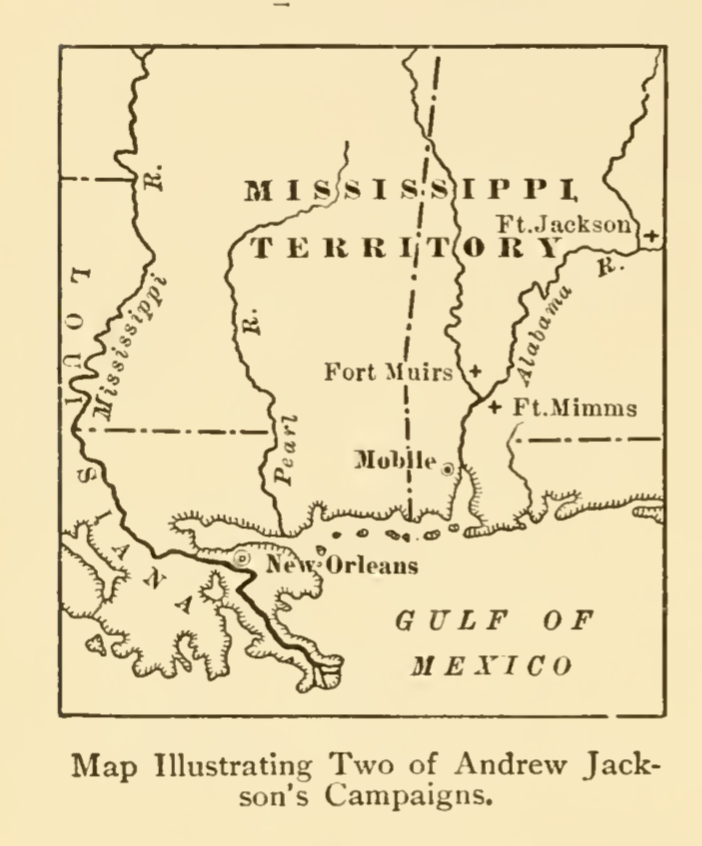
Indeed, childlike simplicity was always one of his striking traits. Not even when he became a noted man did he give up smoking his corn-cob pipe. But we must not think of him as a faultless man, for besides being often rough in manner and speech he had a violent temper which got him into many serious troubles; among them were some foolish duels.
After one of his duels, with a ball in his shoulder and his left arm in a sling, he went to lead an army of 2,500 men in an attack upon the Creek Indians, who had risen against the whites in Alabama. These Indians had captured Fort Mimms, which was in Southern Alabama, about forty miles north of Mobile, and had massacred 500 men, women, and children seeking shelter there. Although Jackson was weak from a long illness, he marched with vigor against the Creeks. In the campaign he endured much hardship, increased by the difficulty of feeding his 2,500 men in a wild country, where they almost starved for lack of food.
Under such conditions Jackson had to exercise much firmness and tact to keep his army from deserting and returning home. The following incident is told to show in what way he won the confidence and love of his men: “A soldier, gaunt and woe-begone, approached the general one morning, while he was sitting under a tree eating, and begged for some food, as he was nearly starving. ‘It has always been a rule with me,’ replied Jackson, ‘never to turn away a hungry man when it was in my power to relieve him, and I will most cheerfully divide with you what I have.’ Putting his hand into his pocket, he drew forth a few acorns, saying: ‘This is the best and only fare that I have.’” But in spite of all his drawbacks, Jackson conquered the Creeks, and thus broke for all time the power of the Indians south of the Ohio River.
Not long afterward he was sent at the head of an army, with the rank of major-general, to defend New Orleans against an attack of the British who hoped to get control of the lower Mississippi and all the southern part of what was then known as the Louisiana Territory. When Jackson went down to New Orleans he was in such extremely poor health that he was hardly able to sit on his horse. Nevertheless he worked night and day with unflagging energy, arming his men and encouraging them to meet the over-confident British foe.
The British army consisted of 12,000 veterans fresh from victories over the great Napoleon. Naturally enough they despised the American backwoodsmen. Their confidence seemed reasonable, for they numbered twice as many as the Americans.
On January 8, 1815, the British made a vigorous assault on the American lines. But they were mowed down with such terrible slaughter that at the end of twenty-five minutes, they were forced to retreat with a loss of 2,600 men in killed and wounded. The Americans lost only twenty-one. The resolute courage and unwearied action of “Old Hickory,” as Jackson was fondly called by his men, had won a signal victory. Through his military reputation Jackson soon became very popular. His honesty and patriotism took a strong hold on the people, and in due time he was elected President of the United States.
A man of passionate feeling, he loved his friends and hated his enemies with equal intensity. Moreover, he did not seem to think that a man could disagree with him, especially in political matters, and still be his friend. So when he became President he at once began to turn out of office those who held government positions, and put into their places men of his own political party who had helped to bring about his election. Thus was introduced into our national civil service the “spoils system.”
We can readily imagine that such a man, so warm-hearted, and yet so intolerant, would make many friends and many enemies. But no one doubted his sincerity, especially in matters pertaining to the welfare of his country. His absolute fairness and his high sense of duty are well illustrated by his dealings with the Nullification Act. By reason of a high tariff, passed for the protection of manufacturers in the North, South Carolina declared that she would not allow any such law to be enforced in that State. This declaration was called the Nullification Act.
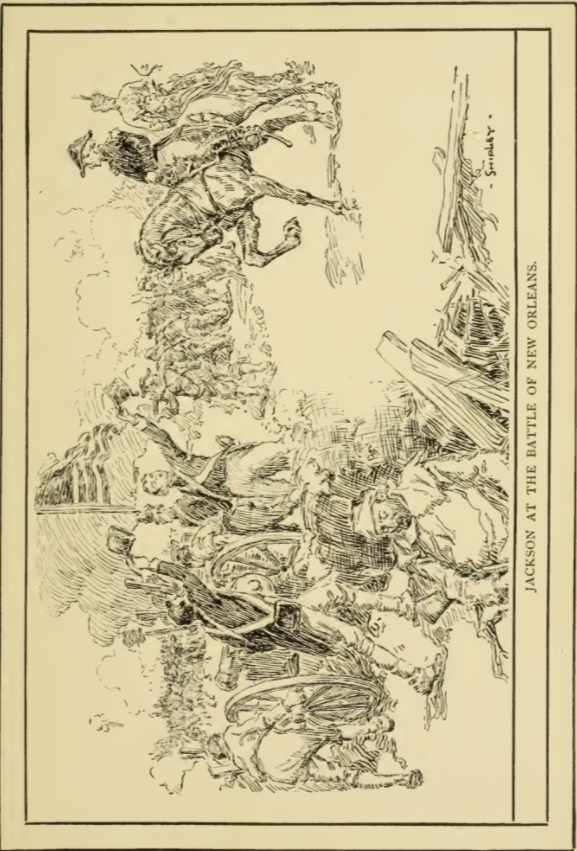
Jackson himself did not favor a high tariff, but he was firm in his purpose that whatever law Congress passed should be enforced in every State in the Union. When, therefore, he heard of the action of South Carolina, he rose to the full height of his executive authority. The news came to him as he was quietly smoking his corn-cob pipe. In a flash of anger he cried aloud, “The Union! It must and shall be preserved! Send for General Scott!” Troops were speedily sent to compel obedience, and South Carolina withdrew her opposition.
In 1837, at the end of his term of office as President of the United States, he went to his old home, The Hermitage, where he once more took up the life of a hospitable planter. He was now nearly seventy years old, and a constant sufferer from disease. With his usual stubborn will, however, he battled for several years longer. He died in 1845, at the age of seventy-eight, one of the most striking figures in American history. His prompt and decisive action in compelling South Carolina to obey the tariff laws did much to strengthen the Union, for it prepared the nation to ward off the greater danger of secession, in which South Carolina took the lead, twenty-eight years later.
REVIEW OUTLINE
Rapid growth and influence of the west.
Andrew Jackson’s early home a rude log hut.
“Mischievous Andy” at school.
“Andy” and the British officer.
Jackson’s personal appearance.
Life at Nashville; backwoods dangers.
Home life at the Hermitage.
Jackson conquers the Creek Indians.
He wins the confidence of his men.
He defeats the British at New Orleans.
Jackson and the union.
TO THE PUPIL
1. Explain the rapid growth of the West.
2. Give an account of Jackson’s experience in the Revolution.
3. What sort of a man was he in his home life?
4. What and where was The Hermitage?
5. What were his most prominent traits of character?
6. Tell about the Battle of New Orleans.
INDEX
Adams, Samuel, 156;
in public life, 157;
opposes tax on tea, 158-162
Bacon, Nathaniel, 55;
marches against the Indians, 59;
his struggle with Berkeley, 60-62
Boone, Daniel, 222;
goes to Kentucky, 224;
at Boonesborough, 227;
captured by Indians, 230
“Boston Tea Party,” 158-163
Braddock, General, 132, 133
Bradford, Governor, 69, 70, 74
Bunker Hill, battle of, 173
Burgoyne, General, 203-205
Cabot, John, 31
Cartier, 103
Carver, Governor, 70, 74-76
Cervera, Admiral, 320-324
Champlain, 104
Civil War, 295, 298
Clermont, the, 250-252
Columbus, Christopher, 1;
at Lisbon, 4;
goes to Spain, 5;
first voyage, 10;
in the New World, 12-15;
other voyages, 17-20
Concord, battle of, 170-173
Continental Congress, 193
Cornwallis, General, 200-203, 206, 207, 214-220
Cortez, 22, 23
Cowpens, battle of, 214, 215
Dale, Sir Thomas, 56
Dawes, William, 167-170
Declaration of Independence, 186, 239
De Leon, 23
De Soto, Hernando, 22;
lands in Florida, 24;
his trials and difficulties, 26-28;
discovers the Mississippi, 29
Dewey, Admiral, 317-319
Dinwiddie, Governor, 128, 131
Douglas, Stephen A., 293, 294
Drake, Sir Francis, 36
Elizabeth, Queen, 33-35
Fairfax, Lord, 124-127
Faneuil Hall, 159, 160
Ferdinand, King, 6
Franklin, Benjamin, 175;
in his brother’s
printing-office, 176;
goes to Philadelphia, 179;
in London, 181;
"Poor Richard’s Almanac," 182;
his great discovery, 184;
"Plan of Union," 185;
in France, 186
French War, Last, 128-133, 136-144
Fulton, Robert, 246;
his boyhood, 247;
invents a torpedo boat, 249;
the Clermont, 250-252
Gage, General, 166, 167
Gates, General, 212
George III., 146-152
Grant, Ulysses S., 302;
his boyhood and youth, 303;
in Civil War, 305-309;
captures Lee’s army, 309-311
Greene, Nathaniel, 211;
a Quaker boy, 212;
joins the army, 213;
in the South, 214-220
Griffin, the, 108-110
Hancock, John, 165-168, 170
Henry, Patrick, 146;
early life, 148;
opposes Stamp Act, 150;
his great speech, 153
Hobson, Lieutenant, 322
Howe, General, 195-197, 203-205
Hudson, Henry, 105
Hutchinson, Governor, 159-162
Indians, 14, 15,
17, 48, 49
Iroquois, 104-106
Isabella, Queen, 6, 8
Jackson, Andrew, 253;
his boyhood, 254;
goes to Nashville, 256;
conquers the Creeks, 258;
at battle of New Orleans, 259;
as President, 260
James I., 65, 66
Jefferson, Thomas, 234;
at college, 235;
as President, 240;
the Louisiana Purchase, 241-243
Jesuit Missionaries, 106
La Salle, 103;
his plans, 108;
his explorations, 109-112;
his colony, 112;
his assassination, 114
Lee, General, his surrender, 296, 309-311
Lincoln, Abraham, 282;
in Kentucky and Indiana, 283-289;
goes to Illinois, 290;
debates with Douglas, 294;
Emancipation Proclamation, 296;
his assassination, 296
Long Island, battle of, 196
Mckinley, President, 317-319
Maine, the, 316
Manila, 317
Marion, Francis, 217-219
Marquette, Father, 106
Massasoit, 75, 76
Merrimac, the, 319-322
Mimms, Fort, massacre at, 258
Montcalm, General, 138-140, 143, 144
Morgan, General, 214-216
Morse, Samuel F. B., 273;
studies painting, 274;
invents the telegraph, 276-280
Narvaez, 24
Navigation Laws, 58
New Orleans, battle of, 259, 260
Nullification, 260
Old North Church, 167, 168
Old South Church, 159, 161
Olympia, the, 316
Ortiz, 24
Penn, William, 92;
turns Quaker, 94;
his settlement in Pennsylvania,
98;
his Indian treaty, 99;
his country home, 100
Pilgrims, 65-79
Pittsburg Landing, battle of, 305
Pizarro, 22, 23
Plymouth, landing at, 72
Pocahontas, 50, 52
Powhatan, 49-52
Puritans, 65, 81-88
Quakers, 92-101
Quebec, capture of, 142-144
Raleigh, Sir Walter, 31;
in France, 33;
his first colony, 35;
second colony, 37-39;
in the Tower of London, 40
Revere, Paul, 165;
on his "midnight ride," 167-170
Sampson, Admiral, 322
Santiago, fighting near, 322-324
Schley, Commodore, 321
Secession, 295
Slavery, 282, 283,
294, 296
Smith, John, 42;
early life, 46;
in Virginia, 47-53;
relations with the Indians, 47-52;
explores New England coast, 53
South Carolina, 261, 262
Stamp Act, 147-151
Standish, Miles, 64;
military leader of the Pilgrims,
68;
explores coast, 69-71;
at Plymouth, 72-79
State Rights, 269
Tariff, 261, 262
Telegraph, the electric, 276-280
Tobacco, 57, 58
Trenton, battle of, 200-202
Valley Forge, suffering at, 205, 206
Vicksburg, capture of, 306
Warren, Dr. Joseph, 167
Washington, George, 116;
at home and school, 117-124;
the young surveyor, 124-127;
his journey to the French forts,
130;
at Great Meadows, 132;
with Braddock, 132;
at Mount Vernon, 189-193;
as General, 193-207;
as President, 208
Washington, Lawrence, 118-121
Webster, Daniel, 264;
his boyhood and youth, 265-268;
his "Reply to Hayne," 269;
his last days, 271
West, Benjamin, 274, 275
Williams, Roger, 81;
goes to Salem, 86;
driven into exile, 88;
his settlement at Providence, 89
Wolfe, James, 136;
his youth, 136;
at Quebec, 138-144
FOOTNOTES
- Florida. De Leon discovered this land in the full bloom of an Easter Sunday (1513). In token of the day and the flowers he named it Pascua Florida.
- Capuchin A Catholic friar.
- Laurynn Phillips

Notes
Text prepared by:
Source
Cable, George Washington. “Posson Jone’” and P�re Rapha�l: With a New Word Setting Forth How and Why the Two Tales Are One. Illus. Stanley M. Arthurs. New York: Charles Scribner’s Sons, 1909. Google Books. Web. 27 Feb. 2012. <http://books. google.com/books?id=bzhLAAAAIAAJ>.