
Long-distance trade was a hallmark of Poverty Point culture.
Stones were moved over long distances, some up to 1,400 miles (2,250 km).
Many kinds of materials were traded, including flint, sandstone, quartzite,
slate, shale, granite and other coarse igneous rocks, limonite, hematite,
magnetite, soapstone, greenstone, crystal quartz, copper, galena, and dozens
of others. They came from many areas of the mid-continent, including the
Ouachita, Ozark, and Appalachian mountains and the Upper Mississippi Valley
and Great Lakes. Even gravels were probably traded, since they were not
always available within easy reach of every Poverty Point site.
The Poverty Point trade network reached throughout the Lower Mississippi
Valley. Sites, like Claiborne near the Gulf coast, participated. So did
sites, like Jaketown, in the northern sections. Many other sites were also
involved, especially those close to the larger sites, where trade seems
to have been more intensive. However, trade was by no means uniform nor
did every site or community in the Lower Mississippi Valley participate.
The trade that took place at the Poverty Point site was the most intensive
of all.
Rocks were the major trade goods. Some were traded in a natural unaltered
condition, but many were circulated as finished or partly finished artifacts.There
is very little evidence that other kinds of materials were traded in large
quantities. Trade in rocks does make good sense, because rocks furnished
the raw material for many tools. Poverty Point people did not make metal
tools, and wood, bone, and other perishable substances used to make tools
were locally available.
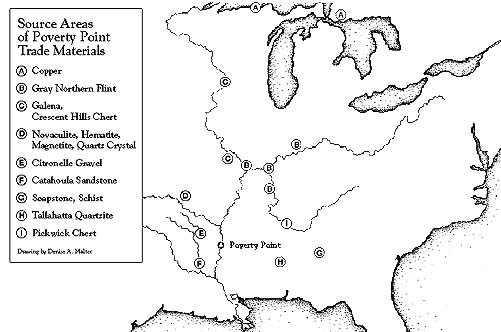
Sources of Poverty Point Trade Materials
Some rocks occur naturally in the heartland of Poverty
Point culture, but they are limited to deposits of chert gravels and outcrops
of crumbly sandstones, quartzites, and ironstones. Although local resources
could have furnished (and did furnish for many time periods) all the raw
materials people needed, most rocks imported by Poverty Point peoples were
of better quality and prettier than local ones. They were obviously highly
desired, and the large quantities that were circulated show that demand
was high and supply and exchange systems efficient.
Most trade rocks came from outside the land of Poverty Point culture, sometimes
from a long way away. It is hard to explain how they got into Poverty Point
country, because we have not identified anything of Poverty Point origin
in the areas where the rocks originated that might have been traded for
them. This lack seems to eliminate simple barter, or at least, barter involving
hard, durable items. Perhaps, if peoples living in the lands of the rocks
had traded rocks for food, hides, feathers, or other organic materials,
then we should expect to find little or no evidence. It is hard to imagine
perishable goods being exchanged in the quantities that would surely have
been necessary to secure the tons of rocks that wound up in the lower reaches
of the Mississippi Valley. Besides, northern groups had their own food,
hides, feathers, and the like.
It is doubtful that they would have wanted the same kinds of goods, just
because they were from the South. It is also doubtful that Louisiana cooking
had the same appeal then as now. With rare exceptions, Poverty Point cooking
balls do not occur in rock country.
Were Poverty Point people trading ideas or an ideology (religion) for rocks?
Ideas would have left no direct trace either, but we should expect some
symbolic artifact, some religious image, perhaps a pot-bellied jasper owl
pendant, to have accompanied idea exchange, and so far, none have shown
up in the land of the rocks.
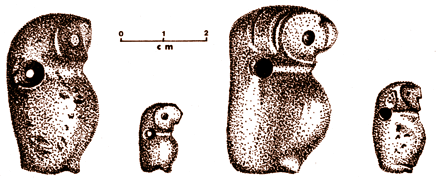 Fat-Bellied Owls
We can rule out down-the-line, or neighbor-to-neighbor,
trade because the number of imported rocks would have decreased as distance
from sources increased, and that is not the case. In fact, there is little
imported material at all along the long stretch of river valley lying between
the rock sources and the Poverty Point heartland. The largest volume of
rocks accumulated at the far end of the line, opposite the sources.
Perhaps, James Ford and Clarence Webb were not too far off base when they
suggested that gathering expeditions were sent out from the big Poverty
Point site itself. Maybe one or two big ventures were all that were needed
to obtain most non-local flints and other materials that outcropped along
the Mississippi, Ohio, and Tennessee rivers and their tributaries. Other
sources could have been visited more often. It is hard to imagine such long-distance
collecting trips being sustained for very long, and maybe, they were not.
People may have lived at the Poverty Point site for only a couple of generations.
Direct gathering could, however, explain why southern trade goods seem to
be lacking in the rock country of the Midwest and why there was such a big
gap between rock sources and Poverty Point territory.
But direct gathering does not explain how materials were circulated once
they reached the Lower Mississippi Valley. Here, we are certainly talking
about some kind of delivery network, some kind of organized trade system.
It is not reasonable to assume that each and every site with nonlocal rocks
got them independently by sending out gathering expeditions to the rock
sources. If every site had gotten its own rocks directly, we would expect
each site to have different kinds of rocks, and that is not the case. Although
each site does not always have the full array of nonlocal materials, those
that are present are always the same kinds that appear everywhere else.
How Poverty Point trade was carried out in the confines of the Lower Mississippi
Valley remains as obscure as how it was conducted on its broadest scale.
In the last 10 years, considerable research has been done, and while we
still do not have definite answers, we have been able to sharpen our views
about some aspects of the topic.
In the area within 25 miles of the Poverty Point site, certain kinds of
tools were consistently made from certain kinds of nonlocal rock, and very
few unworked trade rocks occur. So, the types of tools present at a given
site determine the types of trade rocks at the site. For example, plummets
were made of hematite, and hoes and Motley points were made of gray northern
flint, usually of the Dover variety. So, if a site had a lot of plummets,
it had a lot of hematite; if it had a lot of hoes or Motley points, it had
a lot of gray northern flint.
How long people lived on a place also must have affected amounts and kinds
of trade materials; sites with long occupations probably obtained larger
quantities and a wider variety, too. If these were the only influential
factors, then we could assume that trade was a simple affair with a simple
motive: putting stone resources into the hands of workers and putting the
workers to work.
But this view may be too simplistic. To date, only the most abundant trade
rocks have been studied, and these were all made into common work tools.
We should not be surprised to find them mainly where people worked. Other
trade materials, destined to become ornaments, fetishes, or other symbolic
objects, may have been traded through different channels or through the
same channels in different hands. These materials may be distributed differently
from the trade rock used for tools, but they are so uncommon that we really
cannot tell. Certainly, the large number of ornaments and symbolic artifacts
at the Poverty Point site is in keeping with its great size and cultural
significance, but what about symbolic objects from small outlying sites?
What do they mean? Do they make that site or its head man or shaman more
important than other small sites without such objects? We do not know, and
until we find out, the full nature of Poverty Point trade will remain unclear.
Only one conclusion is certain: The Poverty Point site was the most important
trade center.

Death and burial are solemn and powerful rituals in every
society, ancient and modern, but there is very little information about
Poverty Point burial practices. This may simply be a sampling problem, since
archaeologists have sampled less than one percent of the area of the Poverty
Point site. However, so far, no burials have turned up at the Poverty Point
site, nor have burials been found at other excavated Poverty Point sites.
A suspected cemetery at the Cowpen Slough site near Larto Lake in central
Louisiana proved to be much earlier, after it was finally radiocarbon dated.
Burned bone fragments were found in an ash bed beneath Mound B at the Poverty
Point site. Most were tiny and unidentifiable, but one was the upper end
of a burned human femur (thighbone), proving that at least one person had
been cremated and covered by the earthen mound. Two human milk teeth were
found in another area of the site, called the "Dock," and a cut
out section of jaw and other teeth, drilled for suspension, were discovered
in the muck dredged out of Bayou Maçon, the small stream that lies
at the foot of the bluff beneath the Poverty Point site. The drilled molars
and jaw section were not from burials; they were ornaments, made from the
remains of revered ancestors or brave enemies to serve as amulets, charms,
medals, or religious objects.
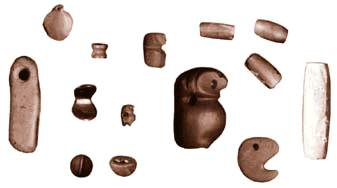
Stone Ornaments: Pendants, Beads, Effigies
How did Poverty Point people dispose of their dead? Through
cremation that left little or no remains? By putting bodies in trees or
on scaffolds for the scavengers? By simply abandoning corpses in the woods
or throwing them in streams? By burying people in individual graves scattered
across villages and camping areas or perhaps away from living areas entirely?
Or by putting corpses in traditional cemeteries, which simply have not been
discovered yet? We just do not know.
This much we can say though. If a lot of people lived and died at the Poverty
Point site, then burial of their physical remains would have required a
sizeable area. It seems that if cemeteries existed, archaeologists would
have discovered them by now, and this makes cremation or some other kind
of non-burial disposal practice likely.
Poverty Point people made many unusual objects, but none were more unusual
than those having symbolic meaning. No other preceding or contemporary culture
in North America had as many ornaments and symbolic objects. Cylindrical,
tubular, and disc-shaped stone beads, made mostly of red jasper, predominated,
but many other special objects were crafted. Ground stone pendants were
made in a variety of geometric and zoomorphic shapes: mainly silhouettes
of birds and bird heads, animal claws or talons, feet or paws, and turtle
shells. There were even small stone replicas of open clam shells. In-the-round
pendants shaped like fat-bellied owls were made and circulated across the
Gulf area from western Louisiana to central Florida. A polished tablet from
Jaketown bore a carved human face. Copper and galena beads and bangles were
worn at Poverty Point and Claiborne sites. Perforated human and animal teeth,
cut out sections of human jaws, bone tubes, and bird bills, dredged from
the bottom muck of the bayou below the Poverty Point site, suggest that
much more ornamentation of perishable materials has disappeared.
It would hardly be appropriate to describe the folks at Poverty Point as
gaudily adorned, but compared with their country neighbors in the small
villages, they must have appeared quite ornate and "fancy." Because
there were so many ornaments at the Poverty Point site, it is conceivable
that personal status and social standing were more formalized there than
anywhere else.
Hundreds of solid stone objects, such as cones, cylinders, spheres, cubes,
trapezoids, buttons, and others, were also made at the Poverty Point site.
Because utilitarian functions for these small objects are hard to imagine,
they too may have had ornamental or symbolic significance.
Religious and other symbolic purposes may have also been served by stone
pipes. Most were shaped like slender ice-cream cones or fat cigars. Other
smoking tubes, made of baked clay, have also been found at Poverty Point
and other places far from Poverty Point. Among historic Indian peoples of
the southeastern United States, smoking was a religious ritual and was not
done for pleasure. Pipes and their elaborately decorated pipe stems were
considered sacred; they were symbols of tribal identity and were used in
intertribal ceremonies: to proclaim war and peace and to honor and salute
visiting dignitaries. Might not the Poverty Point pipes have been used similarly?
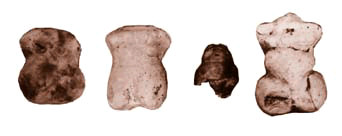
Female Figurines of Baked Clay
Other possible sacred objects may have included the small,
hand-molded, clay figurines depicting seated or kneeling women, many of
whom appear to be pregnant. Heads were nearly always missing, although whether
or not they were snapped off deliberately during ceremonies is unknown.
Smaller decorated versions of Poverty Point objects may have had special
symbolic value as well.
Everyday artifacts may have been turned into sacred ones under special circumstances.
This could explain the deposit of thousands of soapstone vessel fragments
buried in an oval pit a little southwest of the big mound at the Poverty
Point site. These were not from vessels that had been intentionally broken
on the spot and then buried. Only a few pieces from the same vessel were
buried in the pit, and no whole vessels could be pieced back together. Some
pieces from the deposit fit fragments found on the ridges, up to three-quarters
of a mile (1.2 km) away. This deposit might have just as easily been interpreted
as an artisan's cache of recyclable material if it had not been for the
four small fires that had burned in the corners of the pit. The fires suggest
ritual, and the deposit probably represents some kind of offering. Other
deposits of soapstone vessels, both whole and broken, were found at the
Claiborne site on the Gulf coast.
Other ordinary objects that may have been given special religious significance
include plummets and bannerstones bearing engravings of various animals.
The engravings include the so-called "Fox-Man" and "Long-Tail"
designs, as well as duck foot and bird figures. The "Fox-Man"
design is probably a stylized horned owl, rather than a man with fox head
or headdress, and the "Long-Tail" may represent an opossum. The
really interesting thing about these engravings, as well as all the other
zoomorphic objects at Poverty Point, is that the animals they represent
are all important in the myths and lore of historic Southeastern Indians.
They are usually mentioned in connection with death, witchcraft, early warning,
news bringing, and origin stories.
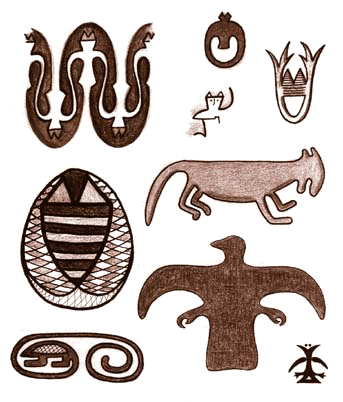
Stone Engravings with Symbolic Significance
The unique abilities possessed by these animals--flight,
night vision, and alertness--were awe-inspiring. It is easy to see how people
living as close to nature as did Native Americans came to respect and revere
them. These similarities do not mean that Poverty Point people and historic
tribes had the same religion, but it does make me wonder if they might have
shared similar world views, world views carried on by oral tradition for
thousands of years.
If these images really are religious symbols, then we ought to think of
Poverty Point religion as animistic. Animism is a belief system that sees
the world as being full of spirits and power. Such a world can be manipulated
by shamans (or medicine men or women) and witches and altered by prayers,
fetishes, amulets, and charms. Although animism lacks the formal organization
of religions historically associated with other monument-building societies,
it was not any less capable of explaining the great mysteries or of providing
direction and meaning for its followers. Its rituals and ceremonies were
just as exciting and fearsome as those of more formalized religions, perhaps
even more so since the spirit world was so constantly close at hand.
There is little doubt that religion was the most powerful and persuasive
force in Poverty Point society. The uncommonly large number of fetishes
and charms at Poverty Point indicates that a great deal of power was concentrated
there, and that power and those who were able to control and direct it were
undoubtedly responsible, in whole or part, for the great constructions and
other remarkable achievements.
NEXT >>