
In the 1950s and 1960s, when archaeologists were starting
to realize just how large and imposing the Poverty Point site really was,
they assumed that a large, permanently settled, and complex society was
responsible for it. Prevailing theory held that large complex societies
were agricultural. So, despite its early age and simple tools, Poverty Point
people were assumed to have been farmers. Because other peoples of the same
age depended on hunting and gathering, Poverty Point society was assumed
to be transitional: one of the first groups in eastern North America to
take up farming, corn farming.
At the time, no plant remains had been found at Poverty Point. Consequently,
it was impossible to tell if Poverty Point people had farmed, or if they
had made a living some other way, such as by intensively gathering native
wild plants or by hunting and gathering along the especially bountiful narrow
environmental seams where uplands joined the Mississippi floodplain.We still
do not have much information about foods eaten by Poverty Point peoples,
but we have enough to be sure about one thing. Poverty Point peoples were
not corn farmers. They were hunter-gatherers. We are only beginning to find
out what they ate. We have more information about meats than plants, because
bones are more resistant to decay through time and are more easily recovered
by standard excavation methods.
From the Claiborne site on the Gulf to inland sites up the valley, like
Poverty Point and Copes, major meat sources included fish, reptiles, small
and large mammals, and birds. Freshwater fish were the main source of meat
everywhere. They included gar, bowfin, catfish, gaspergou, bass, sunfish,
and other species. Brackish water clams were collected at Claiborne and
nearby coastal sites, but inland groups did not utilize river mussels at
all. Oysters were eaten at the Cedarland site, near Claiborne, but apparently
nowhere else. Turtles were caught, especially snapping, mud-musk, red-eared,
and soft-shelled species. Water snakes, rat/king snakes, and racers were
eaten; so were alligators and frogs.
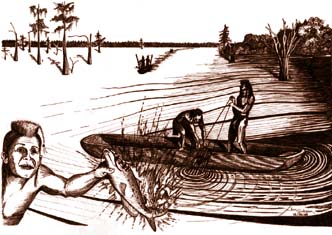
Fish, a staple food for Poverty Point people
Next to fish, venison was the most important meat, but
small mammals, such as cottontail and swamp rabbits, gray and fox squirrels,
raccoons, opossums, and a few others also contributed. Waterfowl and a few
upland birds made up a minor part of the diet; they included ducks and geese,
coots, herons, egrets, pelicans, Sandhill cranes, turkeys, crows, and others.
Plants undoubtedly provided the main part of Poverty Point food, but because
remains are rarely preserved, we have a limited view of their contribution.
Nuts predominate and include hickory nuts, pecans, acorns, and walnuts.
Their relative importance may be inflated because they have hard shells,
which were often burned in campfires. Charred nut shells are more readily
preserved than uncharred plant remains, but even if exaggerated, the importance
of nuts to Poverty Point peoples is undeniable. Other identified plant remains
include persimmons, wild grapes, wild beans, hackberries and seeds from
honey locust, goosefoot, knotweed, and doveweed.
Squash seeds, rinds, and stems have been found in small quantities at the
Copes site, but this plant may have provided containers rather than food.
There is no certainty that this variety was even cultivated, but even if
it was and had been used for food, it was not very important.
These remains do not form a complete list of Poverty Point table fare. Food
remains have only been recovered from a handful of sites. Differences in
archaeological techniques and natural preservation conditions from site
to site complicate direct comparisons and make it difficult to say which
foods were preferred and how much they contributed to diets. One thing is
certain: Poverty Point peoples throughout the Lower Mississippi Valley did
not eat the same kinds of foods in the same proportions.
The most difficult problem with subsistence is figuring out just how the
large Poverty Point site population, which may have numbered in the hundreds
or possibly thousands, existed by simple hunting and gathering. This problem
lessens when one begins to add up the incredible food richness of the land
around Poverty Point. The Poverty Point site was located in an environment
where naturally abundant plants and animals were even more bountiful and
varied.
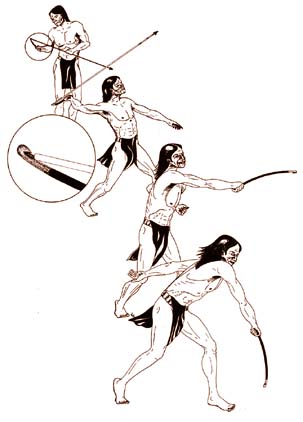
Throwing a javelin with an atlatl; close-up shows atlatl hook on spear
Recently archaeologists have found that the site's inhabitants
were primarily eating acorns, hickory nuts, fish, and turtle, in that order.
The great use of aquatic species and acorns at the Poverty Point site suggests
that most of Poverty Point's foods came from an environment that included
slow-moving or motionless water. Archaeologists have recently found evidence
that a large permanent or seasonal lake lay alongside the Poverty Point
site. No lake is there today, only woods and farmland. Such overflow lakes,
located near the Mississippi River and high ground, are the most productive
natural food sources in the generally productive Mississippi "delta"
environment.
Much more information is needed before we can fully describe Poverty Point
subsistence, locally and regionally, but we can draw a few general conclusions.
We know that Poverty Point groups throughout the Mississippi Valley were
hunter-gatherers, not farmers. No matter how you figure it, the group who
lived at the Poverty Point site not only met its daily food needs but also
supplied enough extra to support an unparalleled building program.
We know that Poverty Point peoples from different sections of the Lower
Mississippi Valley ate different kinds of foods or similar foods in different
combinations. Sometimes people living only a few miles apart did, too. These
differences are probably due to differences in available foods, and that,
in turn, was partly dependent on nature and partly on human factors, such
as food preferences and what season of the year that exploitation took place.
Finally, we know that Poverty Point subsistence generally emphasized aquatic
resources, especially fish, which is logical considering the location of
sites on streams and lakes down in the Mississippi swampland and along the
bluffs bordering the swampland. Without the steady and superabundant supply
of fish, none of the remarkable accomplishments at the Poverty Point site
would have been possible.

Hunters used spears; bows and arrows were unknown. Spears
were tipped with a variety of stone points. Some points, like the ones illustrated
below, were exclusive Poverty Point styles, but many were forms which had
been made for hundreds and even thousands of years before.Spears were thrown
with atlatls, or spear-throwers, which gave added distance and power. Shaped
like oversized crochet needles, atlatls were held in the throwing hand with
the hooked end inserted into a shallow socket in the butt of the spear.
Hurled with a smooth, gliding motion, the spear was cast toward the target
while the atlatl remained in the hand.
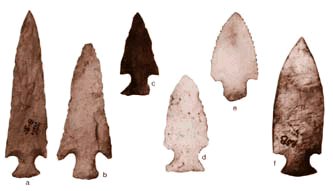
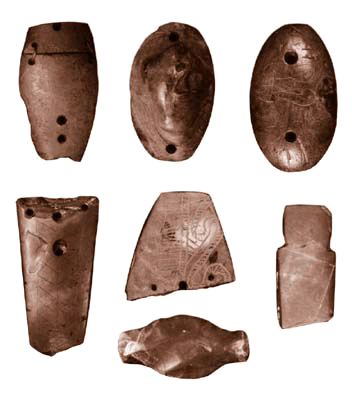
Projectile Points; Motley, Epps, Pontchartrain. Atlatl Weights: Gorgets,
and Tablets
Atlatl hooks were sometimes made of carved antler, and
polished stone weights were attached to the atlatl shaft. The weights helped
to transfer the forces of the throwing motion to the spear in flight. Atlatl
weights were made in a variety of sizes and shapes, including rectangular,
diamond, oval, boat-shaped bars, and a host of unusual forms. Some were
quite elaborate with shiny finishes and engraved decorations. Many broken
weights have repair holes along the edges.
The hunters and fishermen also used plummets. These objects were ground
from heavy lumps of magnetite, hematite, limonite, and occasionally other
stones. Shaped like plumb bobs or big teardrops, plummets often had encircling
grooves or holes drilled in the small end to aid in attachment. Some archaeologists
consider plummets to be bola weights, but they were more likely weights
for cast and gill fishing nets.
Other kinds of hunting devices, such as deadfalls, snares, and traps, were
probably used by Poverty Point hunters, but because they were made of perishable
wood, their use can only be inferred from the presence of bones of nocturnal
animals among food remains. The presence of fishbones, ranging from tiny
minnows to giant gar, suggests that fishermen used some technique, such
as poisoning or muddying, for mass catches.
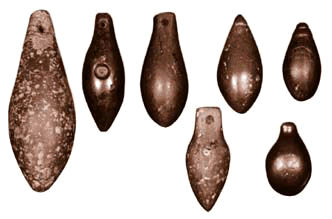
Hematite Plummets
Other kinds of tools undoubtedly were used to obtain food,
but we cannot identify with certainty which of the many other chipped and
ground artifacts may have been used. Gathering plant foods, such as nuts,
acorns, seeds, fruits, berries, greens, and vegetables, probably did not
require any tools. Digging edible roots would have required some sort of
tool, but it need not have been anything other than a convenient pointed
stick. Stone hoes have been found at several Poverty Point villages. Some
of these objects have coatings which look like melted glass or thick shellac.
The coatings are called sickle-sheen and formed when hoes chopped through
sod.
Foods were prepared with a variety of implements. Animals were butchered
with heavy chipped stone bifaces (or cleavers) and sharp flakes or blades
(knives). Battered rocks, pitted stones, and mortars served to pound nuts,
acorns, and seeds into flour and oil.
Food was cooked in open hearths and earth ovens. The earth oven was an ingenious
Poverty Point invention. A hole was dug in the ground, hot "clay balls"
were packed around the food, and the pit was covered. Ovens efficiently
regulated heat and conserved energy. "Clay balls" were hand-molded;
fingers, palms, and sometimes tools were used to fashion dozens of different
styles. Although they are often referred to as "clay balls," they
are not really balls, and they are made of silt, not clay. These objects
are distinguishing hallmarks of Poverty Point culture. They are so common
that archaeologists call them Poverty Point objects.
Some archaeologists have cooked in earth ovens, made like those at Poverty
Point. They found, if they always put the same number of Poverty Point objects
in the oven every time they cooked, that the shapes (cylindrical, biconical,
spheriodial, etc.) controlled how hot the pit got and how long it stayed
hot. Using different shaped objects was apparently the cooks' means of regulating
cooking temperature, just like setting the time and power level in modern
microwave ovens.
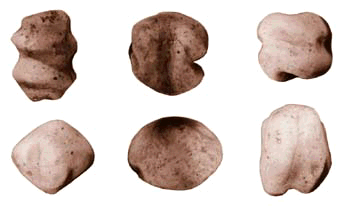
Poverty Point Objects
Poverty Point peoples had a variety of vessels for cooking,
storage, and simple containment. They used pots and bowls made of stone
and baked clay. Stone vessels were chiseled out of soapstone (a dense soft
rock) and sandstone at the rock quarries. Tons of soapstone were imported
to the Poverty Point site from quarries in northern Georgia and Alabama.
Most stone vessels were plain, but a few had decorations and small handles.
One notable soapstone fragment was decorated with a bas-relief of a bird
and another with a panther. Holes drilled along the edges of some fragments
show that cracked vessels were often repaired by lacing them back together.
Broken pieces also were made into beads, pendants, and, sometimes, plummets.
Poverty Point clay vessels mark the first appearance of pottery in the Lower
Mississippi Valley. Archaeologists accord great historical significance
to this event. James Ford argued that Poverty Point pottery making derived
from Indians in South or Central America and was passed on through people
living along the Atlantic and eastern Gulf coasts of North America. Ned
Jenkins suggested that knowledge of pottery came from Alabama as a spin-off
of soapstone trade. Recent excavations at the Poverty Point site suggest
thatPoverty Point people started designing pottery independently of the
other southern centers of early pottery. This conclusion is based on new
archaeological evidence showing that some Poverty Point pottery was made
before soapstone containers and eastern-style pottery arrived at the site.
There are site-to-site differences in Poverty Point pottery. Some pottery
contains plant fibers, like early ceramics in other parts of the South.
Some contains sand and grit, bone particles, concretions, and/or hard lumps
of clay; some contains no additions or impurities. It is just pure clay
or löess (a fine, silty, wind-deposited sediment). Some archaeologists
think sand, bone, and other things were intentionally added to the wet clay
as temper, additives designed to prevent breaking when pots were fired.
Other archaeologists suspect the included particles are natural and just
happened to be in the dirt selected to make the pottery. If the inclusions
were natural, it suggests that potters were merely using the handiest supply
of suitable material, no matter what it contained. Such a practice seems
to be in keeping with the first groping efforts of a new technology. Most
Poverty Point pottery was plain, but decorations sometimes were made by
lightly pressing objects or fingernails into the damp clay, by rocking simple
tools back and forth, and by pinching or incising patterns into the surface.
Many other tools were used in the everyday tasks of building houses, doing
odd jobs, and making other tools. We know Poverty Point peoples used stone
tools for these jobs and probably also used wood, bone and antler ones,
as well. Most of these were very similar to those used by earlier Archaic
people. Hammerstones, whetstones, polishers, and other tools required little
or no preparation, beyond selecting a suitable rock. 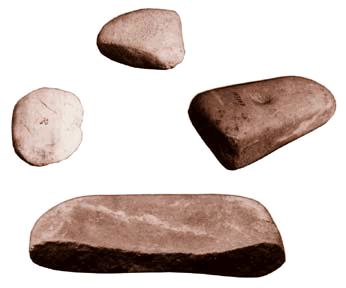 Ground Stone Tools Fabricated tools include gouges,
adzes, axes, and drills. These objects were chipped from large pieces of
gravel or big flakes. The working edges of these tools often bear polish
or tiny scratches, which confirm they were used for chopping, carving, digging,
and drilling. Some of these items, especially celts and adzes (cutting tools
with the blades set at right angles to the handles), have counterparts made
of ground and polished stone. These ground tools were made by chipping,
battering, grinding, and polishing in combination or singly. Another group
of chipped stone artifacts is quite abundant at the Poverty Point and Jaketown
sites and occurs in respectable numbers at other Poverty Point villages.
These curious objects are called microliths (meaning small stones), and
the most common type is a Jaketown perforator. Perforators are made from
flakes and blades (specialized flakes at least twice as long as they are
wide with parallel sides); one end is expanded and the other is pointed.
They look like small car keys. They were first presumed to be drills or
punches, but when modern experiments showed that they could be made by whittling
antler, bone, and even wood, they came to be regarded as worn-out scrapers.
However, archaeologist Sam Brookes found the end of a perforator lodged
in the bottom of an unfinished hole in a stone tablet, suggesting that the
original assumption was correct.
Ground Stone Tools Fabricated tools include gouges,
adzes, axes, and drills. These objects were chipped from large pieces of
gravel or big flakes. The working edges of these tools often bear polish
or tiny scratches, which confirm they were used for chopping, carving, digging,
and drilling. Some of these items, especially celts and adzes (cutting tools
with the blades set at right angles to the handles), have counterparts made
of ground and polished stone. These ground tools were made by chipping,
battering, grinding, and polishing in combination or singly. Another group
of chipped stone artifacts is quite abundant at the Poverty Point and Jaketown
sites and occurs in respectable numbers at other Poverty Point villages.
These curious objects are called microliths (meaning small stones), and
the most common type is a Jaketown perforator. Perforators are made from
flakes and blades (specialized flakes at least twice as long as they are
wide with parallel sides); one end is expanded and the other is pointed.
They look like small car keys. They were first presumed to be drills or
punches, but when modern experiments showed that they could be made by whittling
antler, bone, and even wood, they came to be regarded as worn-out scrapers.
However, archaeologist Sam Brookes found the end of a perforator lodged
in the bottom of an unfinished hole in a stone tablet, suggesting that the
original assumption was correct.
NEXT >>