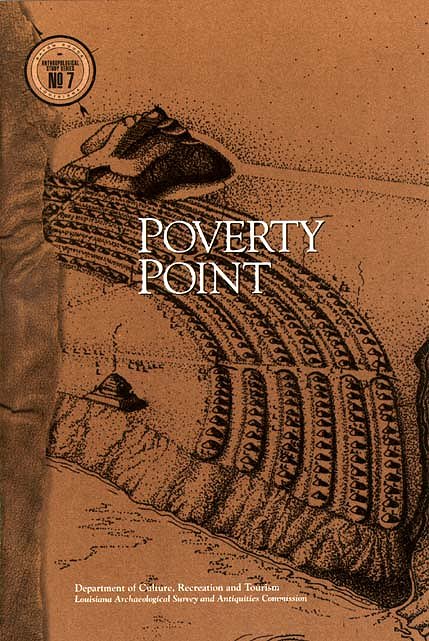
Poverty Point
A Terminal Archaic Culture of the Lower Mississippi Valley
Second Edition May 1996
Jon L. Gibson
University of Southwestern Louisiana
Department of Culture, Recreation and Tourism
Louisiana Archaeological Survey and Antiquities Commission

In the first edition of this study, I acknowledged the help
and stimulation I received from Dr. Clarence Webb and Mitchell Hillman.
I enjoyed three decades of collaboration on Poverty Point and related matters
with Dr. Webb and nearly that long with Mitchell. They are both gone now
but my debt to them remains. Much of my view of Poverty Point grew out of
our mutual searches and musings.
 Poverty Point Ceramic Cooking Ball
Dr. Webb and I planned to co-author the original study,
but when other commitments caused him to withdraw, he charged me with full
responsibility. Having his unwavering confidence and support was a major
source of satisfaction then and still is. Dr. Webb critiqued and copy edited
the final draft of the first edition, and although he would not let me include
him as co-author strictly on that basis, I think the published version says
what we would have said if we had written the piece together, not exactly
in the same words but with the same spirit.
The revised edition of Poverty Point has not benefitted from his
direct scrutiny, but it was written as if he had reviewed it. This is still
very much of a collaborative study.
Yakoke sa kana.

Louisiana's cultural heritage dates back to approximately
10,000 B.C. when people first entered this region. Since that time, many
other Native American groups have settled here. All of these groups, as
well as the more recent Europeans, Africans, and Asians, have left evidence
of their presence in the archaeological record. The Anthropological Study
Series published by the Department of Culture, Recreation and Tourism, Office
of Cultural Development provides a readable account of various activities
of these cultural groups.
Jon L. Gibson, an archaeologist with a long-standing interest in the Poverty
Point culture, is the author of Poverty Point: A Terminal Archaic Culture
of the Lower Mississippi Valley, the seventh in the series. In this
volume, Jon Gibson describes the Poverty Point culture: one of the most
spectacular episodes in Louisiana's past. Few people realize that the Poverty
Point site, at 1500 B.C., was the commercial and governmental center of
its day. In its time, the Poverty Point site had the largest, most elaborate
earthworks anywhere in the western hemisphere. No other Louisiana earthen
constructions approached the size of the Poverty Point site until the nineteenth
century.
This volume tries to reconstruct the life of these bygone people from the
archaeological remains. It discusses where these people lived, what they
ate, and how they made their tools. It also attempts to reconstruct their
social organization and government. New understanding of the Poverty Point
culture is based in part on recently received radiocarbon dates, which are
included in this volume in calibrated, calendar dates.
Thousands of years after Native Americans built the earthworks, a historic
plantation encompassed much of the site. The nineteenth-century owners gave
their property the name Poverty Point. Archaeologists continued using that
name when they recorded the prehistoric site.
Today, the Poverty Point site is owned by the state of Louisiana and is
managed by the Office of State Parks as the Poverty Point State Historic Site. It is open to the public seven days a week, 9:00 a.m. to 5:00 p.m.
A visitor center, museum, and an archaeological research laboratory are
located on the grounds. Readers are encouraged to visit the site to learn
more about Poverty Point.
We, in the Division of Archaeology, are confident that your understanding
of the significance of Poverty Point will be enhanced by this second edition
of Poverty Point: A Terminal Archaic Culture of the Lower Mississippi
Valley.
Thomas Hales Eubanks
State Archaeologist

Poverty Point is a major archaeological mystery. The mystery
centers on the ruins of a large prehistoric Indian settlement, the Poverty
Point site. There on a bluff top overlooking Mississippi River swamplands
in northeastern Louisiana is a group of artificial mounds and embankments.
It is not the earthworks themselves that are so mysterious. Eastern North
America is, after all, the land of the "Mound Builders." These
people once were thought to be a highly advanced, extinct race, but now
are known to be ancestors of Native Americans, such as the Creek, Choctaw,
Shawnee, and Natchez. The real mystery lies in the size and age of the earthworks.
They are among the largest native constructions known in eastern North America,
yet they are old, older than any other earthworks of this size in the western
hemisphere.
Radiocarbon dates indicate that the earthworks were built between fourteen
and eighteen centuries before the birth of Christ. This was an eventful
time throughout the world. In Egypt, Amenhotep IV, his queen, Nefertiti,
and the boy pharaoh, Tutankhamen, were ruling, and the Canaanites were being
enslaved. In Turkey and Syria, the Hittite Empire was expanding. In Iraq,
Babylon and its lawgiver king, Hammurabi, were in power. In Crete and surrounding
Mediterranean islands, Minoan civilization was reaching its peak. In Britain,
Stonehenge was being completed, and in Pakistan, the great planned city
of Moenjo-Daro was succumbing to flooding. In China, the Shang dynasty was
flourishing, and in Mexico, the Olmec chiefdom was ascending.
At that time, almost all Indians living north of Mexico were small bands
of migratory hunter-gatherers. Such societies do not ordinarily build huge
earthworks like those at Poverty Point. Large-scale construction is possible
when large numbers of people settle down in villages and after political
forces grow strong enough to shift some labor from the hunt and harvest
to the civic and ceremonial. In most of the world, these conditions--large,
permanent villages and political power--are found among agricultural societies.
How did the conditions necessary for large-scale construction appear at
Poverty Point while everyone else in America north of Mexico was still following
a simpler way of life? Was Poverty Point one of the first communities to
rise above its contemporaries to start the long journey toward becoming
a truly complex society? If Poverty Point did represent the awakening of
complex society in the United States, how and why did it develop?
Was it created by immigrants bearing maize and a new religion from somewhere
in Mexico? Was it developed by local peoples who had been stimulated by
ideas from Mexico? Did it arise by itself without any foreign influences?
Did it come about without agriculture? Could hunting and gathering have
sustained the society and its impressive works?
These sorts of questions perplexed archaeologists. Limited data and disagreement
over these issues made Poverty Point a real archaeological puzzle. New research
has begun to clarify some of these things. We no longer regard Poverty Point
as a geographic or developmental irregularity, but it remains one of the
most unusual archaeological cultures in eastern North America.
NEXT >>