You are hereHouma History
Houma History
United Houma Nation History
by
T. Mayheart Dardar
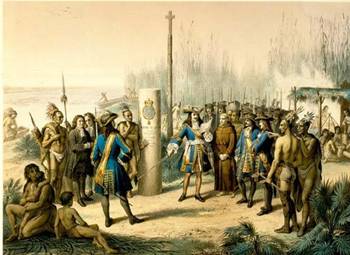
Most researchers universally accept the early history of the Houma (1682-circa 1765). The tribe enters the historical record in the journal of LaSalle in 1682 when the explorer notes that he passed their village but does not visit them. They were visited by Tonti in 1686 and D’Iberville in 1699 beginning a friendship with the French that continues to this day.
In 1706 the Houma left their village, located at the site of the modern-day Angola Penitentiary, and began a southward migration that brought them to the area of the LaFourche Post in the mid-1700’s. Conflict arises when we attempt to connect these historic Houma with the United Houma Nation of today. Indeed the gist of the Bureau of Indian Affairs decision to not Federally Recognize the UHN is tied to this one point. In the opinion of this bureaucracy the tribe can not make this all-important historic tie-in. Presented here in this chapter is a simple presentation of facts that I feel were overlooked. They show a clear link between the United Houma Nation and the historic Houma Tribe.
In 1793, Judice ( 3 June 1793 PPC ) reports a Houma population that remained relatively stable over the preceding ten years;
“All the body of this ( Houma ) Nation forms no more than ninety persons.
15 in a village at Cantrelle’s
17 in a village at Verret’s
58 in a village at Judice’s
( 13 men, 22 women, 23 children )
whose places were all located near the confluence of Bayou LaFourche an the Mississippi River at Donaldsonville.”
Just downriver from the LaFourche at Cabahanoce ( St. James ), situated side by side, were the resident plantations of Judice, Cantrelle and Verret. In the forested backlands of these landholdings were the three Houma villages listed by Judice. These settlements had existed at least since 1783, corresponding with the end of Galvez’s campaigns against the British.
These types of settlements and their relationship to the colonial plantation system are well documented.
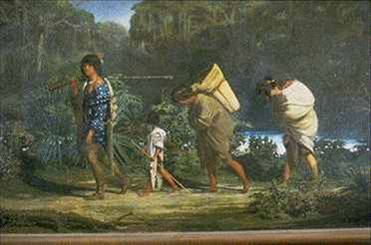
“By the nineteenth century….they moved to isolated areas-swamps and pinewoods-not in demand by the expanding plantation economy of the time. Planters used Indian hunters to augment their meat supplies, to track down runaway slaves and to provide entertainment. Stickball games and even traditional dances were held on the plantations to amuse the planter’s guest….The bands of Choctaw and other Indians were permitted to live in the back-swamps or in hill areas of plantations. Creole planters became patrons of these groups and frequently attempted to protect them from Anglo-American intruders.”( The Historic Indian Tribes of Louisiana, Kniffen, Gregory and Stokes 1987 )
By tracking the Houma references in the PPC and correlating the leaders most associated with the different planters ( Judice, Cantrelle and Verret ) I believe we get a clear picture of which tribal leader lead which band.
The 15 at Cantrelle’s were lead by Mico-Houma or Chac-Chouma, at Judice’s was the remnant of Calabe’s band, numbering 58, now lead by Mingo Oujo, while at Verret’s was the band of 17 lead by Natiabe. It is this band at Verret’s that would become the ancestors of the UHN.
With Nicolas Verret and the PPC reference to a Houma village on his plantation comes a firm historic link. Nicolas Verret had a liaison with a woman named Marianne ( parentage unknown ), a free woman of color. From this union two sons are born, Zenon and Paulin Verret. These two eventually marry into the UHN ancestral community and have extensive documented relationships with known UHN ancestors. It is not, therefore, unreasonable to assume that Marianne, her sons and the UHN ancestors were all part of the Houma settlement at Verret’s in 1793.
The Houma village on Bayou Cane, called Whiskey Point by the local settlers [ a corruption of Ouisky the Houma word for cane ] was initially established as a seasonal settlement, probably while they were still at Verrets.
“From all indications, Indians moved freely from plantation to plantation to hunt and possibly raise crops for themselves and their patrons.” ( Bill Starna 1996 )
It is important to note that Verret had a large land grant on Bayou Terrebonne that encompassed the Bayou Cane area. Bayou Terrebonne and the surrounding area at this time was a vast wilderness virtually uninhabited by any save the Indians.
“….Finally, few Acadians dared to explore, and only seven families actually occupied lands in the densely forested, natural levee along Bayou Terrebonne.” (The Founding of New Acadia, Carl Brassaux, 1987)
The early church records of the UHN ancestral community such as the 1808 marriage of Jacques Billiot and Rosalie Courteau and the 1809 marriage of Michel Dardar and Adelaide Billiot were witnessed by landowners from upper Bayou Terrebonne such as Thibodaux and Malbough. It is the Bayou Cane village and the Indians that lived there that became the namesake of the town founded in 1834.
“Court, in the early days of the Parish, was held in a little building on Bayou Cane. On May 10th, 1834, Richard H. Grange and Hubert M. Belanger donated to the Parish of Terrebonne the property on which the present Courthouse and other public buildings are situated. This land was valued at the time at $ 150. The land on each side of this was laid off into town lots and the town of Houma came into existence, bearing the name of the Indian tribe that lived and loved and worshipped among its groves, the ancient Houmas, which means the sun….” (Directory of the Parish of Terrebonne, E.C.Wurzlow, 1897)
Also of note are the oral histories of the tribe that tell of the Houma Courthouse being built on Rosalie Courteau’s land. The misunderstanding has been that it was not the modern courthouse but rather the original one on Bayou Cane. Sometime after the American takeover in 1803 the Houma tribe filed a claim to twelve sections of land, 7680 acres, on Bayou Black/Boeuf.
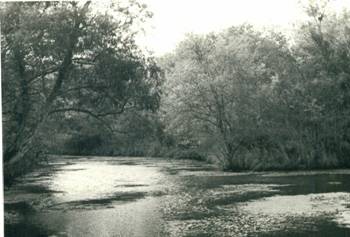
“The Houma tribe of Indians claims a tract of land lying on Bayou Boeuf or Bayou Black, containing twelve sections. We know of no law of the United States by which a tribe of Indians have a right to claim land as a donation.” ( ASP 1834 3:265, 1817 )
This appears to be an attempt by the Houma to secure a land base in the face of a growing White population. Likely, they hoped the American Government would honor the Louisiana Purchase Agreement in which they promised to continue the Louisiana Colonial land policies that respected, for the most part, tribal landclaims.
Unfortunately the claim was rejected but it stands as evidence of a Houma presence in the area during this period. At this time Bayou Black ( called Bayou Boeuf on its western end ) flowed from the swamplands northwest of the town of Houma. The bayou cut through the backlands of the tribes Bayou Cane settlement, hence it would be logical to assume that the tribe at Bayou Cane and the tribe that filed the landclaim where one in the same.
It is the contention of the BIA’s Branch of Acknowledgement and Research that the ancestors of the UHN were not a tribe at the beginning of the nineteenth century but rather a few Indian individuals who married into the surrounding population and eventually produced a separate community.
This theory is clearly contradicted by the following chart (1) of baptisms. The initial perception has been that they took place within a white community but a closer examination of the dates ( Monday July 7th, and Tuesday July 8th, 1817 and Wednesday Dec. 16th, and Thursday Dec. 17th, 1818 ) reveal these to be mid-week services taking place within the UHN community.
The White sponsors of the baptisms were, for the most part, a single extended family that lived near the Houma’s lower bayou settlement.It may have been in there house that the actual service was held, the nature of the service was describe a couple generations later.
“I went to visit all those families who cannot come to church. These visits took me two weeks…to see those who are in the islands neighboring Bayou Terrebonne. The people are not able to come to church. I go from time to time among them for baptisms and communions. These are practically all decent well-disposed Indians. I have already given communion to a good many of them. When I arrive among these people they gather ( from ) all the islands to attend Mass. I stay in the house most suitable. One sees that the sight of a priest makes them happy and it is with sorrow that they see me leave them. The day of departure ( having ) come, they take great pleasure in taking me to the embarkation”. ( Fr. Dene’ce to Monsignor, 10 Dec., 1868 )
With these records we see a single Houma community in the early nineteenth century, with no distinction between Billiot, Courteau or Verdin. As the community continues we see it again in 1836 ( chart 2 ) as the tribe attempts to secure another land base, this time in the wilderness west of Pointe Coupee near the town of Fordoce. Perhaps it was the efforts of the American Government at the time to remove tribes to the Indian Territory that persuaded the Houma to abandon this area but it does serve to show the continuation of a Houma community.
Lastly, we consider the history of Abbe Rouquette and the St. Tammany Choctaw. Father Rouquette was a missionary to the Choctaw community centered around Bayou LaCombe in the mid to late 1800’s. Twice in the text is mention of the Indians of Barataria who are invited to the annual Feast of the Dead and are also invited to the funeral of Abbe Rouquette in 1887. At this time the ancestors of the UHN are known to inhabit the Barataria area.
By tying these scattered documents and references into a single narrative we see a single Houma community from 1783 on into the late nineteenth century. A community that links directly to the modern United Houma Nation.
This clearly contradicts the Branch’s assertion that the Houma of Bayou Terrebonne between 1809 and 1820 “….did not live in a distinct, identifiable Indian community-geographically, socially or politically.”
And it shows that their decision to not recognize the UHN was based on bias and ignorance.
- Printer-friendly version
- Login or register to post comments