
Coastal Environments.
“The Lost River Town History and Archaeology of Bayou Sara.”
notes. basically finished. recheck images.
The Lost River Town
History and Archaeology of Bayou Sara
by Coastal Environments, Inc.
2019
Bayou Sara, once the most important port for steamboats and flatboats between Natchez and New Orleans, is located on the Mississippi River, downhill from St. Francisville, in West Feliciana Parish, Louisiana. Named after the adjacent bayou, Bayou Sara was originally developed in 1800 and survived until the great flood of 1927. The town contained many homes and a wide variety of businesses, all of which were repeatedly rebuilt after many fires and floods.
Archaeological evidence of the founding and rebuilding of this town is preserved beneath the ground. Unfortunately, the bayou is naturally moving east and eroding that ground away. Stabilization of the east bank of the bayou provided a rare opportunity to explore the material culture from the town’s past and bring its written records to life, thus showing what it may have been like to live and work in Bayou Sara over 100 years ago. This brochure shares what was found, and gives future generations an opportunity to learn about their history and culture, the legacy of which is sometimes preserved just beneath their feet.
This brochure details FEMA’s efforts to not only stabilize the east bank of Bayou Sara, but also preserve the history and culture of the area for the education and enlightenment of future generations. This work describes the only archaeological excavations conducted in the former town of Bayou Sara and has produced important information on the history, development, and demise of this river town.
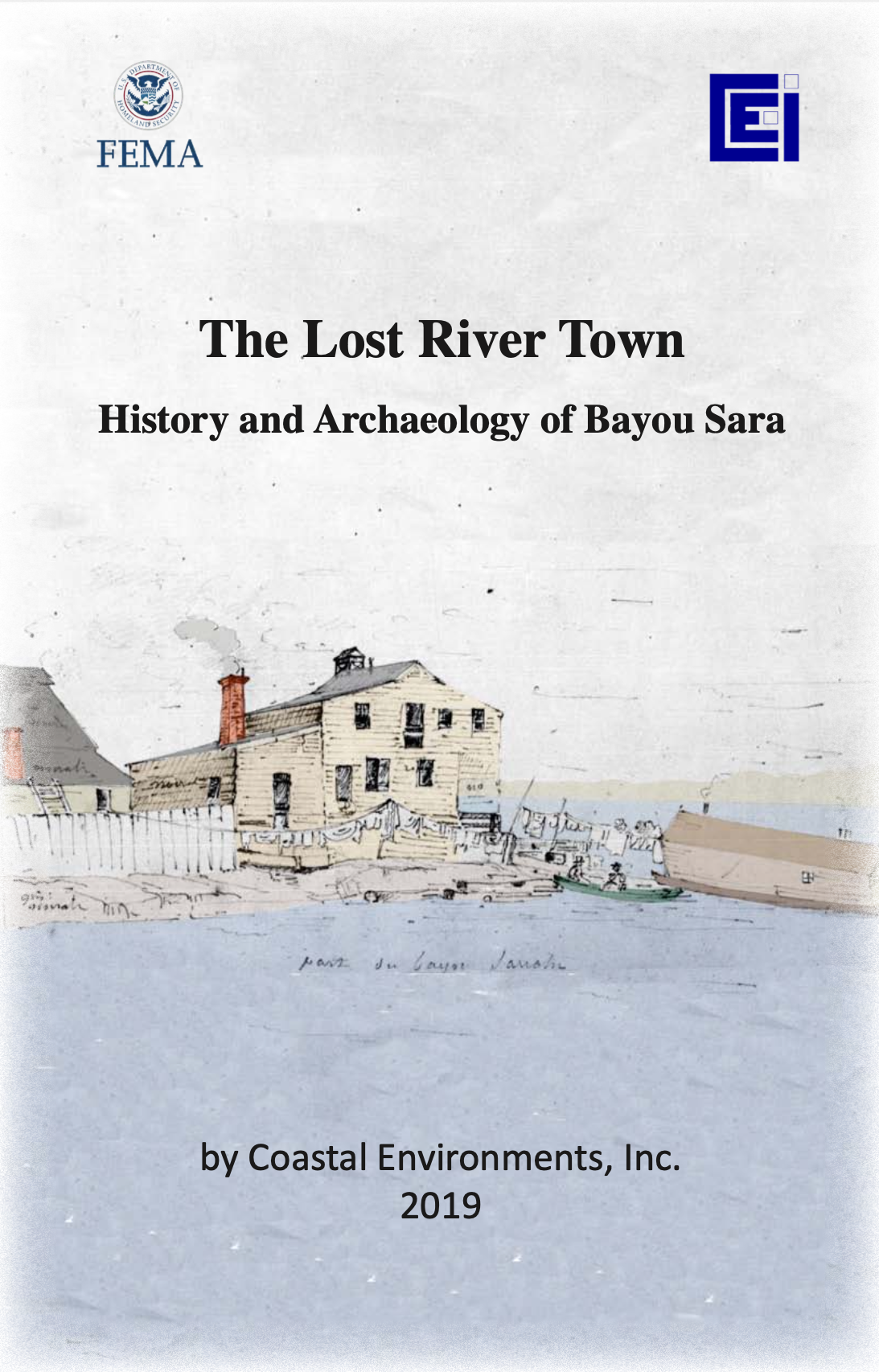
Cover image: Colorized version of Charles Alexandre Lesueur’s May 1829 sketch Part du Bayou Sarah. The sketch likely depicts Reuben Kemper’s house (left) and store (center) on Lots 1 and 2 of Square 1 in the town of Bayou Sara. The bayou is in the foreground and a houseboat on the Mississippi River on the right.
In the Lower Mississippi Valley from 10,000 B.C. until Europeans arrived, Native American bands of hunters and gatherers developed into large agricultural societies. These were decimated by European diseases and intertribal warfare. The Tunica, Houma, Biloxi, Ofogoula, and some Choctaw lived in the Feliciana region when the French arrived. The Houma had a village in West Feliciana or southern Mississippi in 1699. In 1706, the Tunica moved from Mississippi to Portage de la Croix, near the confluence of the Red and Mississippi rivers. They attacked the Houma, who moved south to New Orleans. The Tunica moved to Tunica Bayou in 1731 but fled in 1764. They returned to the Pointe Coupée area before moving to Marksville on Red River around 1790. However, one historic letter indicates that some Native Americans remained in the Alexander Creek area of West Feliciana, where they grew corn, through at least 1807.
The French first mapped the small stream now known as Bayou Sara in the 1730s. They referred to it as the Riviere a la Chaude pissie, or “river of hot urine” perhaps due to its color and flow. Also colloquial for gonorrhea, Chaude pissie became Clap Creek under the British in the 1760s. By 1789, the bayou had acquired the more respectable name of Sara, reportedly after an elderly woman who then lived on its banks.
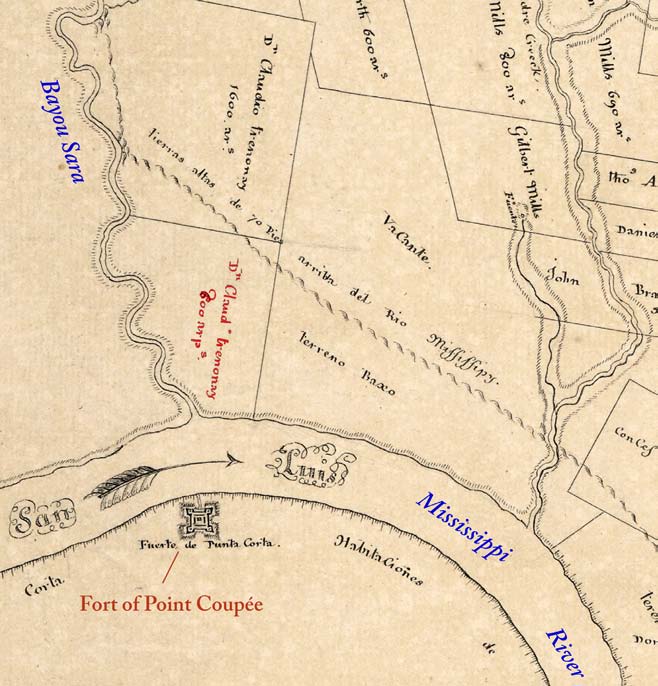
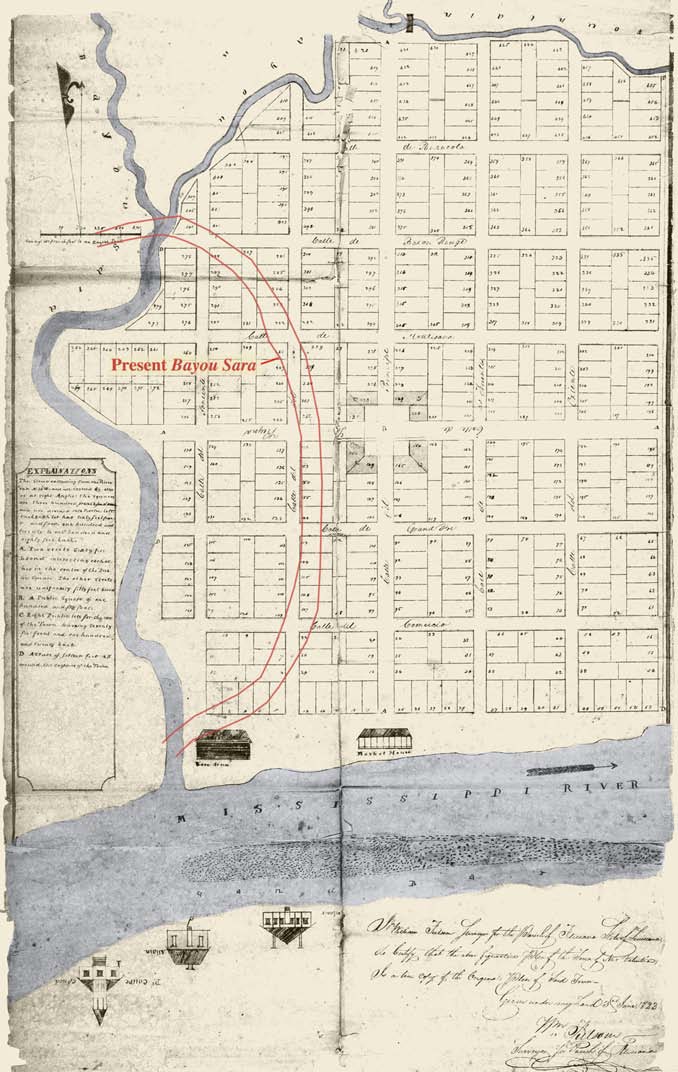
In 1787, the Spanish granted Jean Claude Trénonay de Chanfrey a tract of land at the mouth of Bayou Sara, which later passed to his nephew, Armand Duplantier. In 1799, John Smith and Reuben Kemper, of Cincinnati, Ohio, bought Duplantier’s property where they operated a store. When this partnership failed, Smith became the sole owner of the land where, in 1800, he laid out the town of New Valencia. Spanish Governor Carlos de Grand Pré bought four of the few lots sold in the town before the land passed to Smith’s sons. Once under American control, the town acquired the name of the bayou landing, and most of its street names were translated into English. Located on the batture of the Mississippi River at the mouth of the bayou, the town of Bayou Sara quickly developed into the most important flatboat and steamboat port between Natchez and New Orleans.
As the economic center for St. Francisville, the more genteel community on the adjacent bluff, Bayou Sara was a rough-and-tumble place that attracted gamblers, prostitutes, and raucous riverboat men. Business people of different races, cultures, and creeds flocked there to operate hotels, boarding houses, restaurants, coffee houses, liveries, stables, billiard rooms, taverns, saloons, ice houses, and general merchandise stores. The latter were some of the most extensive and heavily stocked stores in Louisiana, outside of New Orleans. Bankers, physicians, dentists, druggists, tailors, milliners, jewelers, shoe and saddle makers, printers, booksellers, photographers, fruit vendors, confectioners, tinsmiths, and even a tombstone maker called the town home. A Methodist church was established in Bayou Sara in 1844, while Catholics attended mass up the bluff in St. Francisville.
The terminus of the West Feliciana Railroad, finished in 1842, was located in Bayou Sara and boosted its economy. The town rapidly became a major shipping port for cotton from as far away as Mississippi and soon boasted a cotton press and warehouses. Horse dealing was also a prominent business with herds brought in for sale from Kentucky and other states.
Bayou Sara had 530 residents by 1850, including Irishmen, Germans, Russians, Swedes, Spaniards, Cubans, Jews, slaves, and 32 free people of color. Among the latter, Ellen Wooten is the most well known. Likely born a slave in the West Indies, Ellen belonged to a trading partnership that included the Spanish Nolasco brothers, with one of whom she had children. When the brothers died, she gained her freedom and inherited property in Bayou Sara. Ellen owned a tavern, boarding house and hotel, and, by the time of her death in 1853, a plantation on the bayou north of the town and 15 slaves.
Fire was a constant threat in Bayou Sara since almost all the buildings were made of wood. The earliest documented fire was in 1843. Twelve years later, a fire started in a stable destroyed all but one block of the town. Newspaper accounts suggest that not one hotel, coffee house or warehouse was left standing in the town.
After passage of the 1830 federal Indian Removal Act, Native Americans were forcibly removed from their traditional lands in the Southeast, and relocated west of the Mississippi River. Many died from exposure, disease, and starvation while traveling. The Creek and Seminole were funneled through New Orleans and shipped up the Mississippi, past Bayou Sara, to the Arkansas and Ouachita rivers. In 1837, over 300 Creek died in the wreck of the steamer Monmouth near Profit Island, sixteen miles downriver of the town. Doctors from Bayou Sara rushed downriver to treat the wounded.
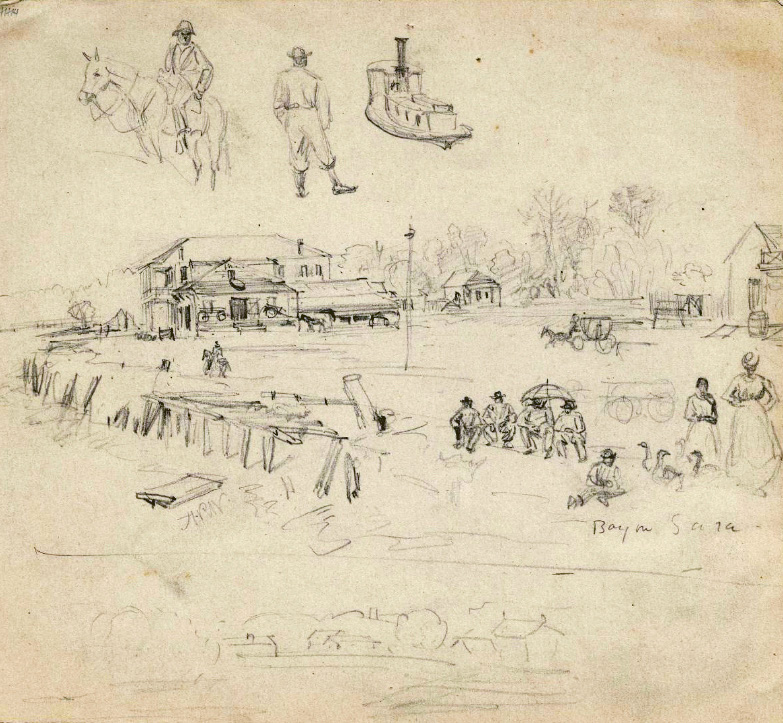
During the Civil War, Bayou Sara saw more conflict than anywhere else in the Felicianas. On August 10, 1862, the U.S. gunboat Essex shelled the town while a small landing party set it ablaze. All buildings within two blocks of the river were destroyed. The Union Navy continued to harass Bayou Sara for two weeks, shelling and burning more of the town. By May 1863, when Federal troops crossed the Mississippi at Bayou Sara on their way to lay siege to Port Hudson, Union gunboats had virtually leveled the town. Union troops likely also destroyed the West Feliciana Railroad Bridge crossing the bayou above town. A former resident from Germany returned to Bayou Sara in 1867 and found it a desolate and disorderly collection of newly built houses and old brick ruins. Nevertheless, the Bethel African Methodist Episcopal (AME) Church was incorporated there in 1869 and had erected its own church building by 1879.
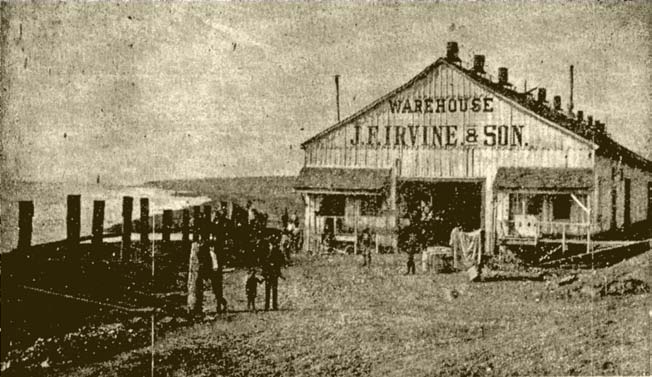
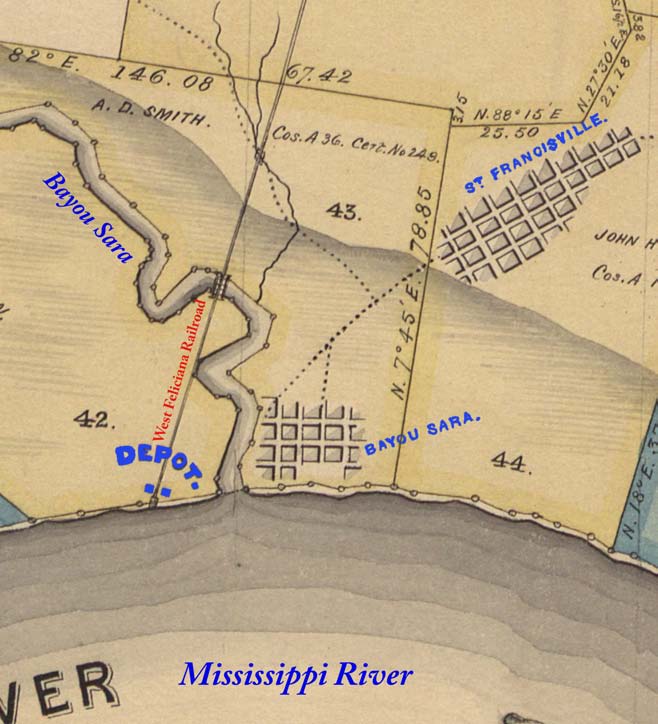
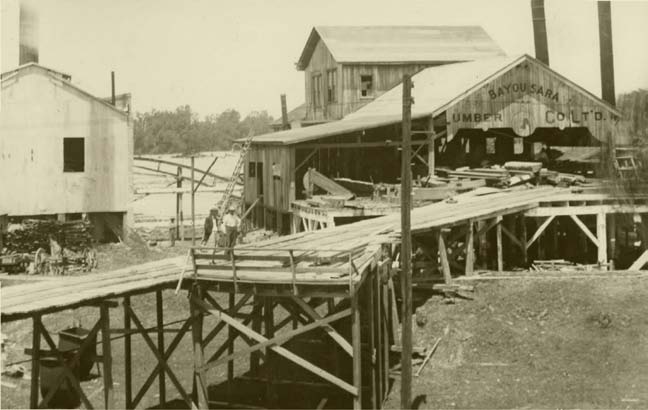
Post-war recovery was slow. When the West Feliciana Railroad finally resumed operations in 1875, the track on the west bank of the bayou was abandoned and the depot moved to the east bank. The railroad brought cotton, and the incorporation of the Bayou Sara Compress Company in 1887 increased exports from the town. The line became part of the Yazoo and Mississippi Valley Railroad in 1892. The resulting market expansion fostered the growth of the lumber and cattle industries, which became the economic mainstays of Bayou Sara, then home to about 750 people. By 1891, the Bayou Sara Lumber Company was milling West Feliciana cypress, tupelo, cottonwood, oak and gum. It shipped lumber to New Orleans and as far away as St. Louis. Newly cleared timber and eroded cotton lands in the region were converted to cattle pasture. By 1917, Texas cattlemen made regular visits to Bayou Sara to acquire stock for their ranges, while thousands of head were driven down to the town for shipment by river or rail. The Louisiana Railway and Navigation Company completed their Shreveport-to-New Orleans rail line through Bayou Sara in 1906. The Bayou Sara Brickyard was soon founded to take advantage of that new artery.
Bayou Sara flooded repeatedly, especially in 1844, 1846, and 1849, despite being surrounded by an earthen ring levee since the late 1820s. In May 1865, the batture area from Tunica Landing to Bayou Sara went under water. In May 1874, most buildings were inundated with from six to 24 inches, while in April 1882, all but two houses were submerged. The floods of 1890 and 1892 surpassed all previous floods in magnitude and scope. Water depths in 1890 ranged from two to seven feet, and not a single dwelling or other structure was spared. In 1892, a break in the bayou levee flooded the town with four to 11 feet of water, which did not drain away for almost a month. Although the town soon constructed new levees, some residents moved to St. Francisville and the safety of the bluffs. The Methodist Church did likewise in 1898.
Bayou Sara was equally acquainted with the sudden and devastating effects of fire. Rebuilt after the Civil War, the town burned repeatedly throughout the remainder of the century. In 1875, the stores of T. A. Mumford, Pickard and Weil, and A. J. Burge were destroyed in a fire attributed to arson. In 1880, a fire near the toe of the bluff destroyed three stores and some of their stock. Months later, another fire, started in Picard and Weil’s stable, damaged nine businesses, but firemen saved several homes and businesses in the same block. Another fire, causing over $118,000 in damages, occurred in 1886. Burning occurred three years in a row beginning in 1894. In that year, almost the entire business district of Bayou Sara was destroyed, while in 1895, several blocks near the river were lost when a fire started in Bockel’s store burned 25 buildings, including stores, warehouses, hotels and residences. Then in 1896, the cotton compress at the Bayou Sara Compress Company burned.
In 1912, the levees near the Bayou Sara Brickyard and the post office failed. Floodwaters moved the post office, Burton Hotel kitchen, and Szabo’s saloon more than a block and twisted homes on their foundations. St. Francisville residents helped the people of Bayou Sara save livestock, poultry, and belongings. The tugboats Laurel and T. & F. carried rescued residents to the Yazoo and Mississippi Valley Railroad tracks at the toe of the bluff. The levee break grew to 100 feet wide and covered Bayou Sara in 10 to 20 feet of water, inundating all stores and sweeping away at least 10 houses.
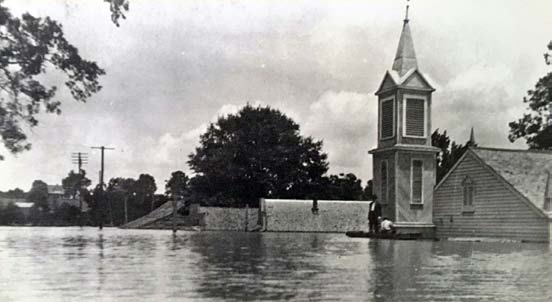
Of Bayou Sara’s 630 residents in 1910, only 234 remained in 1920. The town was unincorporated in 1926. The flood of 1927 effectively destroyed what remained of the community. Yet over 20 families, plus some houses and small businesses, persisted at least until the flood of 1937. These families then retreated to the bluffs when nine feet of water submerged the town. Few of them returned. In 1939, the Bethel AME Church finally moved up the bluff to today’s LA Highway 10.
Once abandoned, the Bayou Sara area gradually returned to backswamp. With no levees, almost annual floods blanketed the town remnants in layers of alluvium. Meanwhile, Bayou Sara, the stream, continued to migrate east cutting into the town plat. All streets and blocks west of Sun Street were gone by the 1940s, and Sun Street itself by the 1990s. Yet land grew on the Mississippi River batture beginning in the 1930s, so that the river now is located almost a quarter mile south of the former town. A ferry crossing the Mississippi River at Bayou Sara operated for as long as there was a town. However due to bankline erosion, the road leading to the ferry was shifted from Sun Street to its present route along Principle (now Ferdinand) Street in the early 1950s. The ferry operated until the opening of the John James Audubon Bridge in 2011. The U.S. Army Corps of Engineers built the St. Francisville Mat Casting Yard at Bayou Sara between 1961 and 1967. This construction buried the eastern half of the former town.
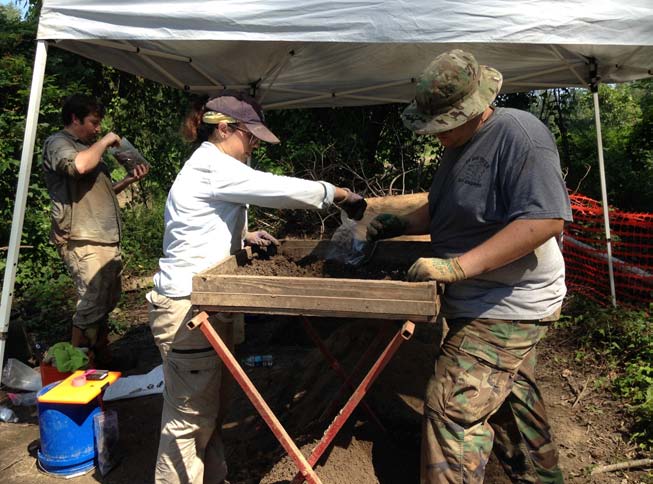
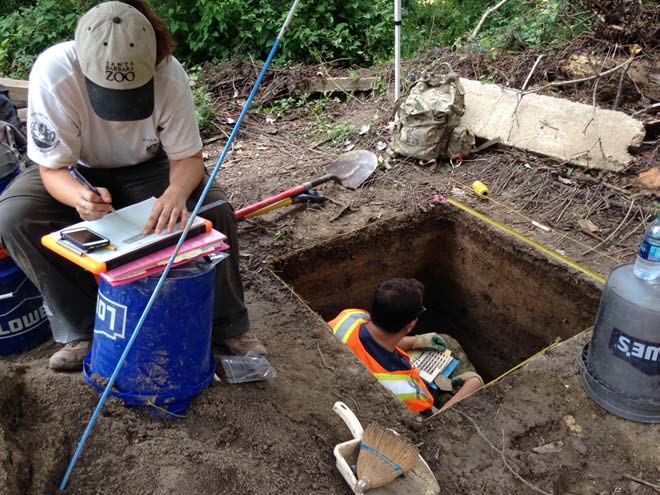
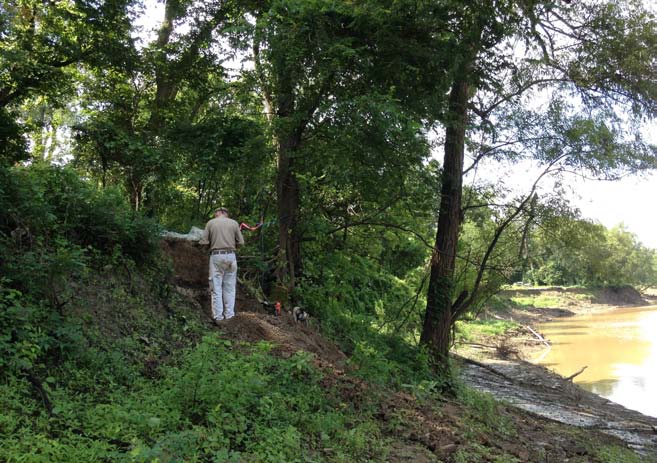
In the early 1980s, archaeologists working for the National Park Service used historic maps to find where the town of Bayou Sara used to be. Yet archaeologists would not examine the actual site for another 30 years. Before construction of rock and concrete facings to stabilize the east bank of the bayou, the Federal Emergency Management Agency (FEMA) hired archaeologists from Coastal Environments, Inc., to survey and dig shovel holes along the bank line in 2016. In 2017, they excavated four 1-by-1-meter test units next to the shovel tests that had contained artifacts or building remains.
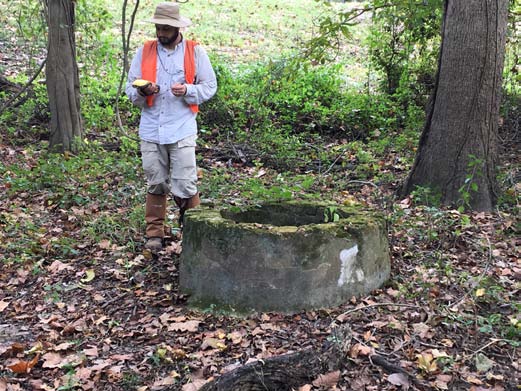
During the survey, archaeologists found many brick features, like cisterns and pier foundations, still visible above ground or eroding out of the bank of the bayou. They also collected artifacts, such as dish, bottle and porcelain doll fragments recently eroded from the bayou bank. In the test units, archaeologists found evidence of occupation and layers of soil associated with some of the fires and floods that affected the town. The four test units were located in four different town lots. By examining historic maps of Bayou Sara, historians, working with the archaeologists, were able to determine what kinds of buildings were located on these lots. By looking at courthouse records, newspapers, and other historic documents, they were also able to learn something about the people who occupied them.
Square 1, Lot 5
(Morris, Tooraen, Fischer,
and Lacoste Families)
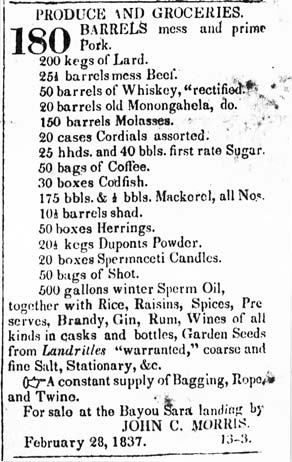
Historic records indicate that Lot 5 in Square 1 was one of the first lots sold in Bayou Sara. Spanish Governor Carlos de Grande-Pré bought it in 1808, and it changed hands several times. By 1820, the lot was worth $1,000 and retained this value in 1829 when it was sold to John C. Morris, an Irish immigrant, local merchant, and associate of Ellen Wooten. The high price of the lot suggests that it contained Morris’ Bayou Sara landing store, in operation by 1825, although Morris did not purchase the lot until 1829. His store catered to flatboat men, small farmers, and planters. Morris owned three slaves in 1830 and ten in 1840. His store burned in 1843, but was rebuilt before his death in 1850. Morris’ sister, Rebecca Harrison, inherited the property, but she and her husband died soon afterwards, leaving three young daughters. Their maternal uncle, Charles E. Tooraen, a Swedish immigrant, purchased the property from the Morris heirs in 1852. Two of the daughters then died, most likely of yellow fever, which ravaged the town in 1853 and 1854. Standing on Lots 4 and 5 at the time of the sale were a store, house, kitchen and warehouse. The store and two associated warehouses were lost in the 1855 fire, but the store was soon rebuilt. It was burned down again in 1861, during the Civil War, while Toorean was killed at the Battle of Shiloh in 1862.
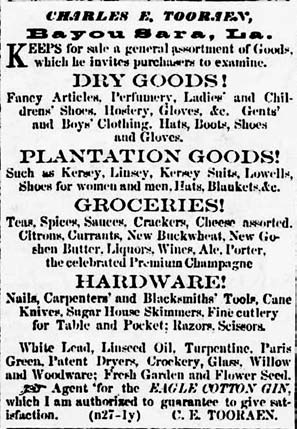
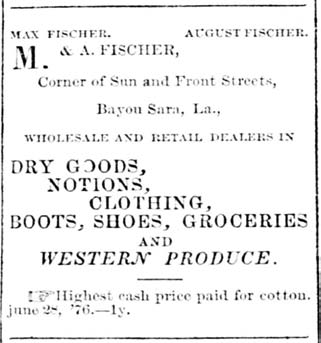
In 1866, Morris’ granddaughter, Martha Harrison Bell, and her husband, leased Lot 5 from Martha Tooraen, Charles’ widow. There they built a house and operated a bar. In 1872, the Bells sold the buildings to Tooraen for $500. When Tooraen’s property was seized in 1876 due to an unpaid mortgage, Lots 4 and 5 were sold to merchants Max and August Fischer for $670.00. The parents of these brothers were German immigrants. The Fischers operated a wholesale and retail business. Fires in 1880 ruined their stock and likely destroyed the store building. By 1885, the lots contained four buildings–a grocery, warehouse, and two other small structures. All were sold in a sheriff’s sale to Pierce Butler in 1886. In 1888, Thomas Butler inherited the property from his late father. The grocery and general merchandise business remained in operation through 1891. The Lot 4 and 5 structures were destroyed in the 1895 fire, and the lot remained vacant until 1898 when all of Square 1 was sold to Albert Ruemmel, the first president of the Bayou Sara Ice Company. John F. Irvine, Jr., one of Bayou Sara’s leading citizens, served as vice president. On Lots 3, 4 and 5 of Square 1, this firm erected an ice factory, which operated until 1912. The facility flooded in that year, and all equipment was sold due to unpaid debt. The Anheuser-Busch Brewing Association bought the plant property for $2,500. Charles A. Lacoste purchased Lots 1 through 6 in Square 1 for $60 in 1937. He was born in Illinois, but had lived in Bayou Sara since at least 1920. By 1941, he had built a store on Lot 5, which operated through 1950. Between 1950 and 1952, his store was either destroyed in a flood or demolished when the ferry road was shifted from Sun to Principle (now Ferdinand) Street. A Lacoste heir built a house on Lot 5 between 1961 and 1963. It became a restaurant and bar in the early 1970s, and then the Oyster Bar in 1997.
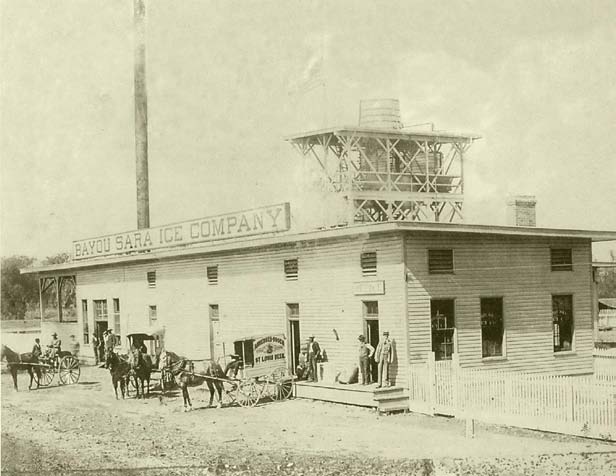
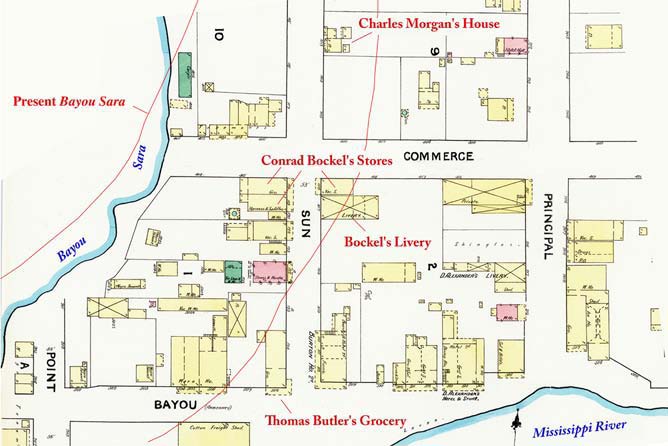
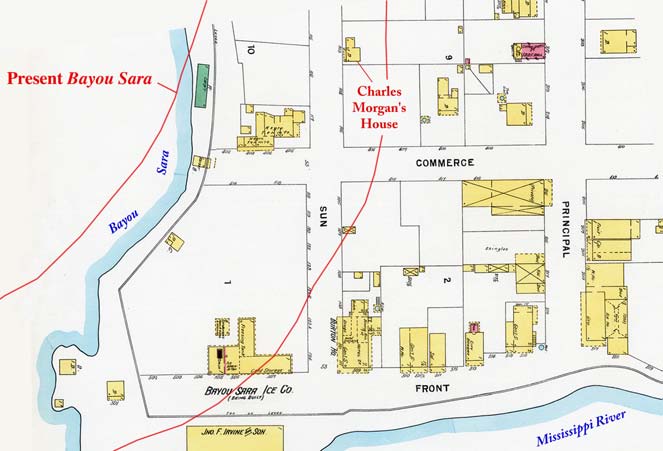
Historic maps of Bayou Sara show that Lot 5 constituted the backyard of a store from at least 1885 through 1891, and then the backyard of an icehouse from 1898 through 1909. A hole dug in this lot during the survey contained a piece of a stoneware jar, three pieces of bottle glass, and some iron, brick and coal. Archaeologists then dug a test unit in the lot to determine exactly where those artifacts came from. This unit revealed many layers of soil deposited from the early 1800s through the late 1900s.
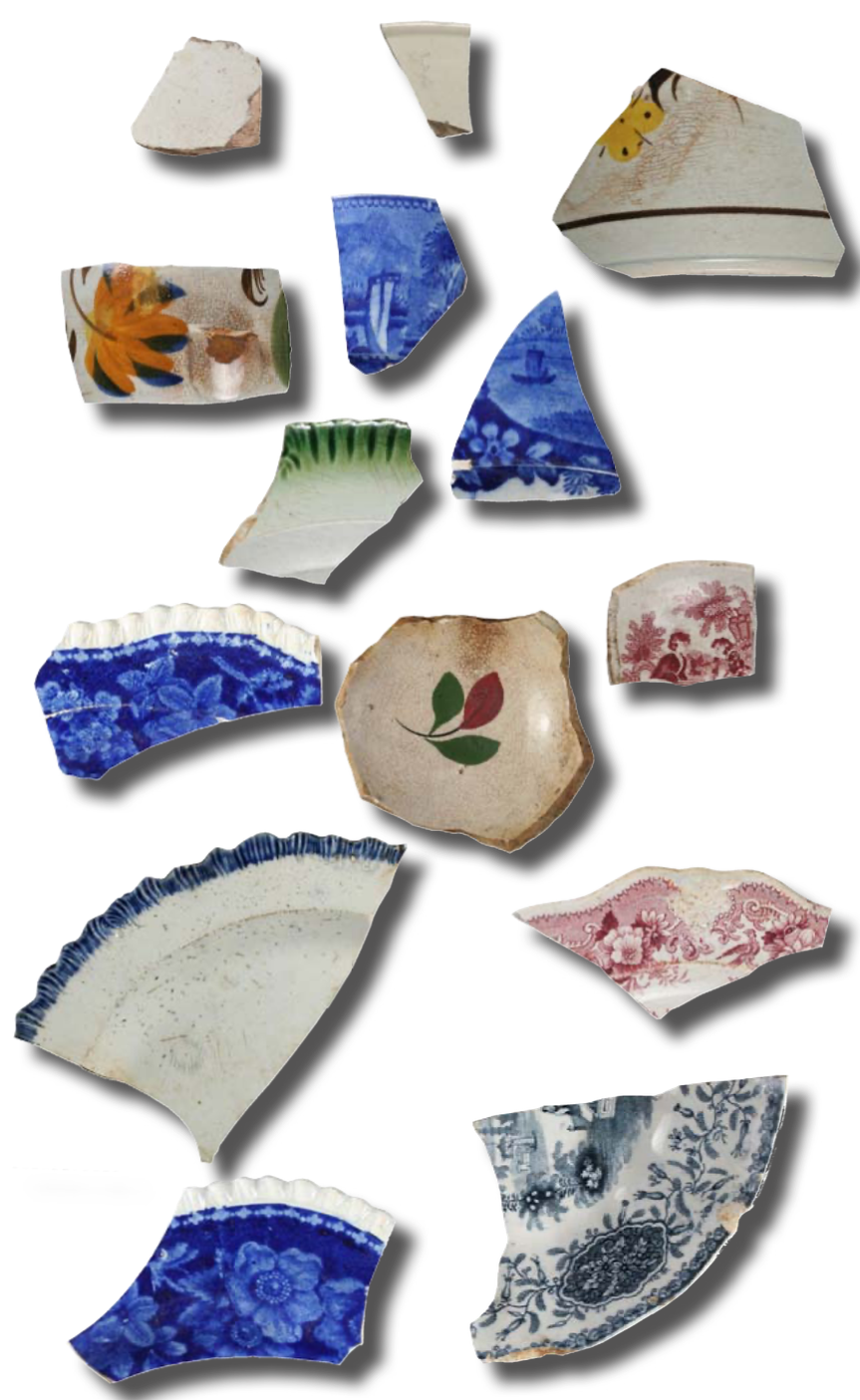
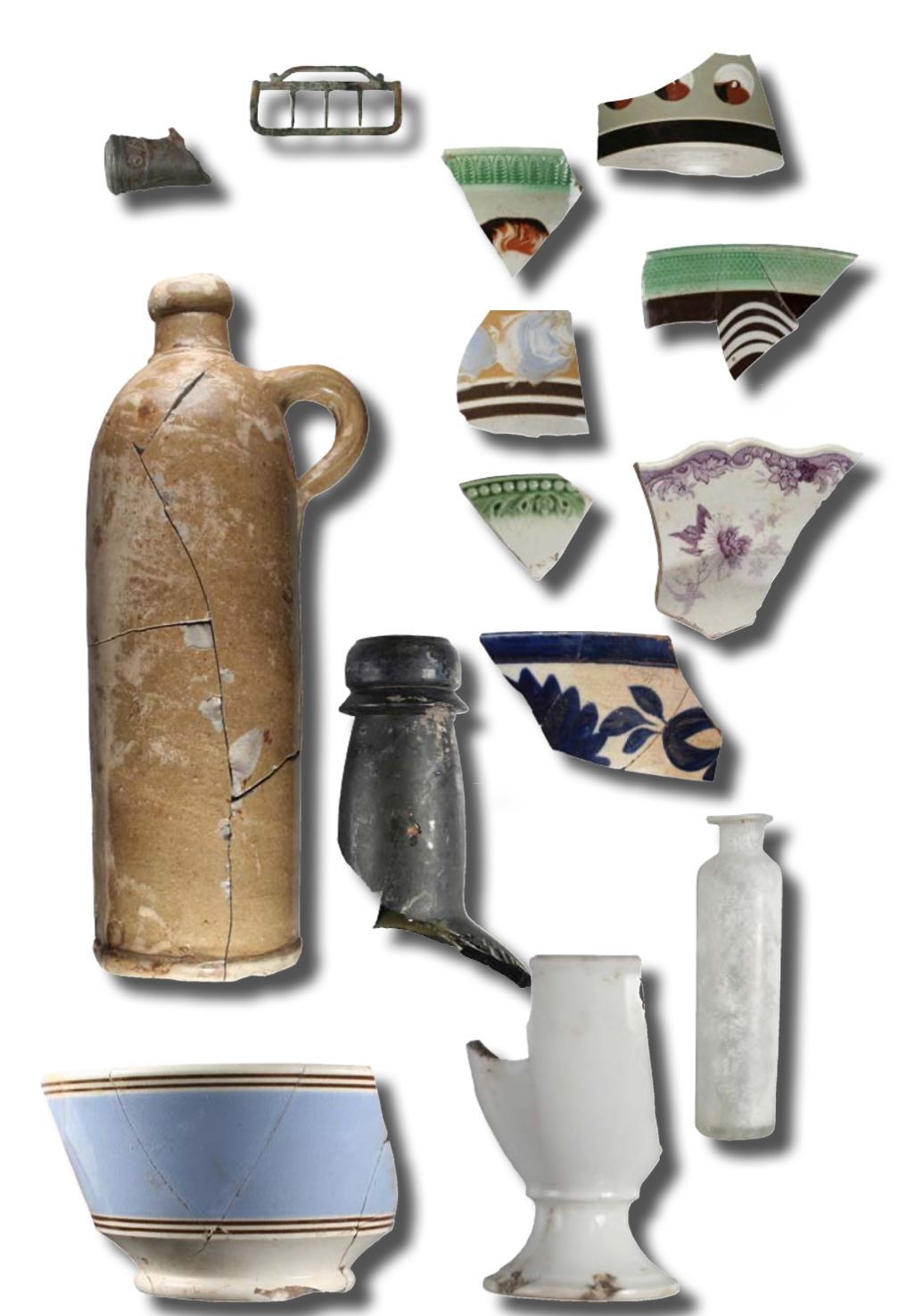
The deepest occupation layer contained dish fragments made from the 1780s through the 1820s. They represent trash likely deposited by John Morris in the town’s earliest years. Above this was another trash deposit, or midden, containing dishes made from the 1820s through the 1890s. These were likely used by the Morris, Tooraen, and Fischer families, or possibly sold in their store. Capping this midden was a thin layer of black silt, probably from the 1895 fire that destroyed the store and other buildings on the lot. In the silt were charcoal and clay mud daubers’ nests, baked hard in the fire. The nests were likely located in the eaves of the Lot 5 buildings before they burned down. A thin midden located above the black silt contained many nails from the burned buildings and ceramic and glass fragments dating from about 1895 to 1912. A large pit, maybe from the root ball of a tree that died in the fire, cut into these layered trash deposits. It was filled with trash, probably when the lot was cleaned up and leveled in the years after the fire. In the pit fill were clay tobacco pipe fragments, a porcelain eggcup, and a copper suspender buckle.
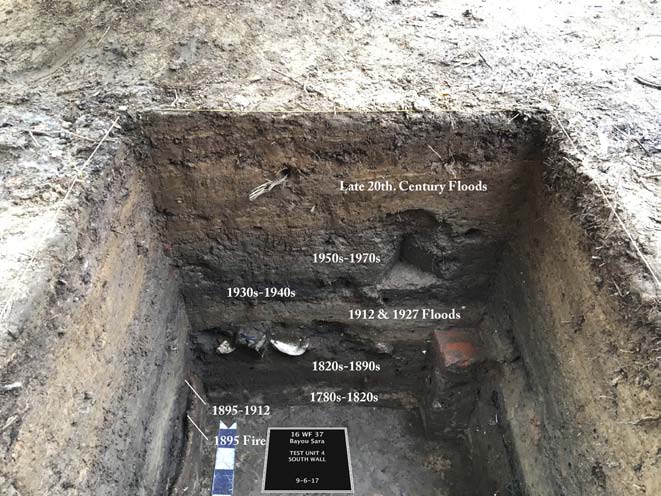
Sealing all these brown, gray and black cultural deposits was a thick band of yellow alluvium, soil likely washed in during the 1912 and 1927 floods that submerged the whole town. These waters carried debris as well as soil, including a heavy fireplace andiron. Above the flood layer was a thin, dark gray midden likely associated with the Lacoste family store in the 1930s and 1940s. Topping this was a thick band of light gray soil that represented the old ground surface from the 1950s through the 1970s when the Lacostes built a home, restaurant, and bar elsewhere on the lot. This deposit contained fragments of concrete, modern machine-made glass, aluminum bottle tops, and electrical wire. The thick, yellow band of alluvium, capping the Lacoste layers, was deposited by the almost annual floods that have drowned Bayou Sara from the 1980s through 2017.
Square 2, Lot 22
(Bogel, Mumford, and Bockel Families)
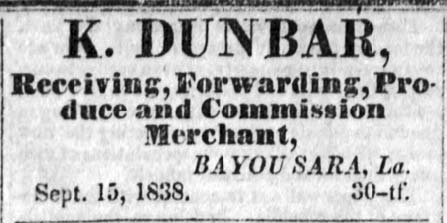
Historic records indicate that Kendall Dunbar, a receiving and commission merchant from Maryland, constructed a house on Lot 22 in Square 2 between 1834 and 1843. Commission merchants acted as cotton brokers for area planters and produce farmers. When Dunbar lost Lot 22 in a lawsuit, it was sold in a sheriff’s sale to John C. Morris for $1,000 in 1843. As Morris lived and worked on Lot 5 in Square 1 (see Lot 5 above), he probably rented out the house on Lot 22. Between 1843 and 1850, Fredric Clauss lived in the house. Frederic was a mechanic, born in Germany around 1820, and had a wife and two children by 1850. The Claus and Fischer families (see Lot 5 above) were related by marriage.
When the Morris estate was auctioned off in 1852, Lemuel P. Day, a 23-year-old teacher from Ohio, bought Lot 22. He likely lived in the house until he sold the lot to Charles Hofman by 1854. Hofman was a 28-year-old merchant from Germany. The Hofman family lived in the house and operated a dry-goods store on the property until both buildings were lost in the fire of 1855. While the store was partially insured, Hofman had no insurance on the house. Union soldiers burned the family home down again during the Civil War. Yet Hofman rebuilt his business and home after both fires and remained in Bayou Sara until around 1866 when he moved to New Orleans. He then sold Lot 22 to Augustus J. Bogel for $1,000.
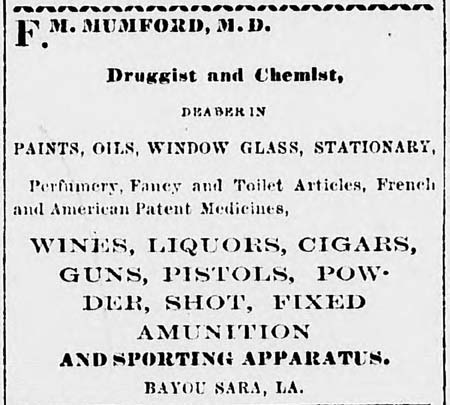
Bogel, another German immigrant, occupied the Lot 22 house and operated a drugstore there for three years before moving to Shreveport around 1870. Bogel rented the store and sold all the contents to Francis M. Mumford who was also a druggist. Although his father was a North Carolinian, Mumford was born in West Feliciana, served in the Confederate cavalry, and was postmaster in Bayou Sara from 1871 through 1893. In May 1875, an arsonist burned down Mumford’s drugstore plus a vacant store next door. Mumford lost the $7,000-building and $10,000 in stock, with insurance covering only $7,500. A few months later, Bogel sold Lot 22 to Lucien Martinez, a Cuban, who passed it to Conrad Bockel in 1876.
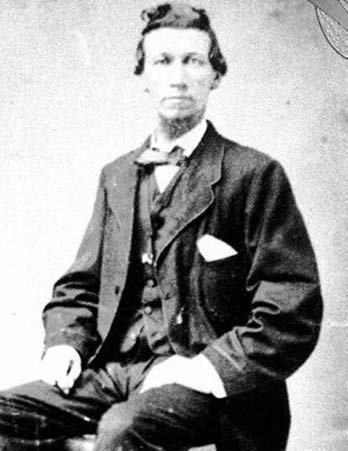
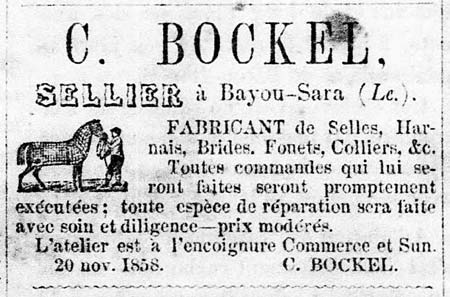
Russian by birth, Bockel moved to Bayou Sara from Texas in 1858 and bought the lot across Sun Street from Lot 22, from the heirs of Ellen Wooten. There he made saddles and harnesses. Between 1875 and 1882, he built a dry goods and grocery store on the corner of Lot 22, but the building was vacant by 1883. Bockel then built a livery, abutting the vacant store, between 1885 and 1891. Livery stables hired out mules, horses, wagons and carriages, stabled horses and mules for town residents, and also sold them. Bockel lost both properties in lawsuits with his creditors in 1885. However, his wife, Bridget, soon bought back both lots. While her father was Irish, Bridget Bockel and her mother were both born in Louisiana.
In 1895, both the store and livery on Lot 22 burned down in a fire that started across the street in the Bockels’ saddlery. Lot 22 then remained vacant and in the Bockel family until 1939 when it passed to a family friend, Charles T. Tooraen, Jr., the grandson of Swedish immigrant Charles E. Tooraen (see Lot 5 above). A chemical engineer in the Brazilian sugar industry, Tooraen sold the land to Paul Lambert in 1968. Bayou Sara began eroding away the northwestern corner of Lot 22 by 1988.
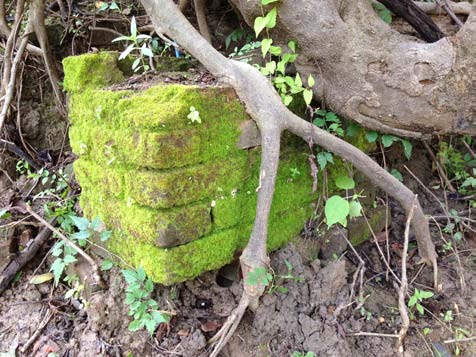
Historic maps of Bayou Sara show that Lot 22 constituted the side yard of a store by at least 1885. By 1891, it housed a livery, which was gone by 1898. During the survey, archaeologists noticed a brick pier and some brick pavement eroding out of the bayou bank in Lot 22. They dug a test unit in the lot to determine why those features were there. This unit revealed many layers of soil deposited from the late 1800s through the late 1900s. None were associated with Lot 22’s antebellum (1834-1861) residents, but deposits from that time could exist in other parts of the lot that have not yet been excavated.
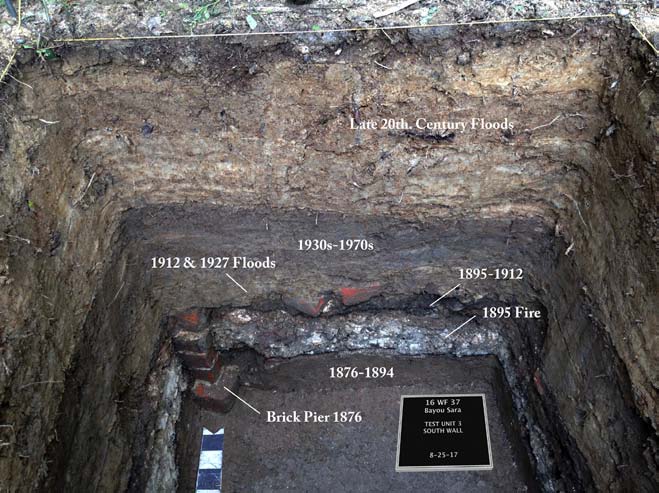
The deepest occupation layer in this test unit contained a brick pier built immediately after the 1875 fire. The pier was constructed and oriented exactly like the one found eroding out of the bank of the bayou, and both belonged to the same building–very probably the store built by Conrad Bockel in about 1876. The trash deposit abutting the toe of the pier contained dishes made from the 1820s through the 1890s, likely used by the Bockel family, or possibly sold in their store. It also contained many window glass fragments, baked clay, and burned nails, which might have come from Francis Mumford’s drugstore, located elsewhere on the lot, which was burned by an arsonist in 1875. Capping the Bockel trash deposit was a thick layer of white and black ash from the 1895 fire, which destroyed this family’s store and livery on Lot 22. This ash deposit also contained a lot of window glass, baked clay, and nails.
Although Lot 22 contained no buildings after 1895, local residents did deposit some trash on the vacant lot between 1895 and 1912, including pieces of a stoneware bottle and a molded glass inkwell. Sealing all these brown, black and white cultural deposits was a band of yellow alluvium likely washed in during the 1912 and 1927 floods, which submerged the whole town. Trash continued to accumulate on Lot 22 from the 1930s through the 1970s, including animal bone, a brass clock cog, and lead shot. Almost annual floods from the 1980s through 2017 buried these and other artifacts with a thick yellow band of alluvium. Among the finds in these upper flood deposits was a whole Coffee-mate jar made after 1961.

Square 9, Lot 105
(Morgan and Canfield Families)
Historic records indicate that William B. Clugston purchased Lot 105 in 1829 for $50. Clugston sold the lot to Theodore Fassett for the same price in 1830. When Fassett, who worked for Dunbar, Holmes and Company, died in 1831, his business associate, Ananias Dunbar, bought Lot 105 at the probate sale for $100. Another partner, John Holmes, paid $200 for the lot in 1836. This higher price suggests that a house may have stood on Lot 105 by this time. In 1838, Holmes sold the property to Robert Lockhart for an unknown amount. Lot 105 changed hands twice a year later, going first to Thomas Codyre, and second to Christopher Glinnen for over $400. Glinnen owned Lot 105 for only a year and a half before his death in 1841. Colonel Charles Morgan then bought the lot for $670 at Glinnen’s probate sale. The higher price suggests that Glinnen had either enlarged the home, or replaced it with a larger house.
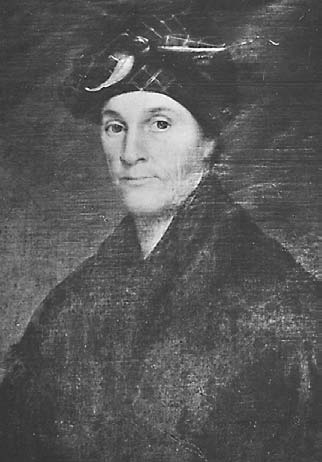
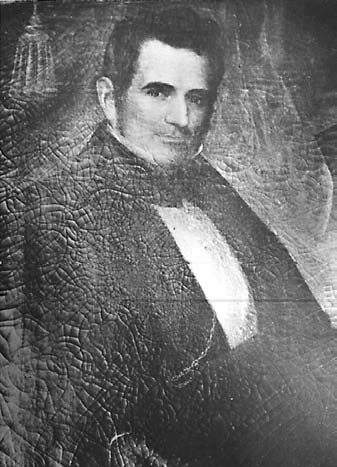
Charles Morgan, a wealthy sugar planter, state senator, and first American sheriff of Pointe Coupée Parish, across the river, likely used the house on Lot 105 as his residence while doing business in Bayou Sara. When Morgan died in 1848, Lot 105 passed to his widow, Hyacinthe Allain Morgan. The Morgans likely had to repair the house frequently, as Bayou Sara flooded in 1844, 1846, and 1849. The home was then completely destroyed in the 1855 fire. The Morgans likely rebuilt, but saw the house burned down again during the Civil War. The Morgan heirs again rebuilt the Lot 105 house, which flooded several times before the fire of 1880. The home either survived that fire or was rebuilt by 1883, when Lot 105 contained a main house with one wing and two smaller outbuildings. The 1892 flood or the 1895 fire likely destroyed the two outbuildings. By 1898, one small outbuilding, probably an outhouse, stood along the lot’s back property line. Charles Morgan’s grandson eventually inherited Lot 105, but in 1901 sold a three-eighths share of it to Eugene S. Muse for $10.66. In 1904, Muse sold this share to Villeneuve F. Allain, who in 1907, purchased the remainder of Lot 105 for $17.66 at the younger Morgan’s estate sale. By 1904, the house was considered old and had no wings. It was demolished by 1907 when Allain sold Lot 105 to his business partner, Abram Villeret, for $50. After Villeret’s death in 1912, John F. Irvine, Jr., purchased Lot 105, at auction, for the sum of $33.33.
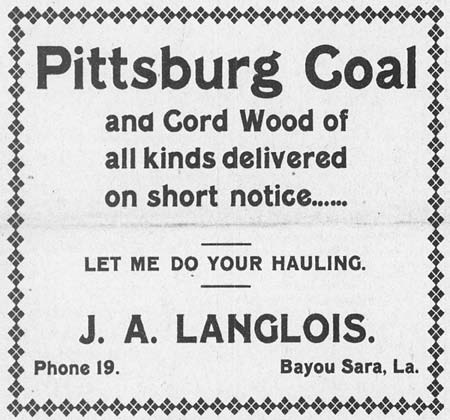
When Irvine declared bankruptcy in 1914, John Aubin Langlois bought Lot 105 at auction for $25. Langlois was a merchant and resident of New Roads, who also sold coal and other goods in Bayou Sara. Like Irvine, Langlois made no improvements to Lot 105 during his twelve years of ownership. In 1926, Lot 105 was seized by the sheriff, for unpaid property taxes, and sold at auction to Eugene S. Muse for $6.49. Muse, who had owned a portion of the lot between 1901 and 1904, likewise made no improvements to Lot 105 over the next 11 years. In 1937, Muse sold the unimproved lot for $20 to Lloyd Lacoste. Lloyd, the son of Charles Lacoste (see Lot 5 above), then sold it to Theophile F. Canfield for $15.00 in 1939. Canfield used it as a side yard for his house, which was erected on two neighboring lots between 1898 and 1904. In 1940, Canfield, who never married or had children, donated Lot 105 and his house to his 14-year-old niece Cleontine Mary Canfield. However, she married and moved to Ohio in about 1944. In 1945, the Canfields sold several lots, including Lot 105, to brothers, Frank, Salvador, Samuel, and Joseph Vinci in 1945. They immediately sold Lots 105, 106, and 107 in Square 9 to James Neal for $350. The Canfield house was gone by 1951 when Columbus Erwin Hare bought those three lots for $100. In 1963, they passed from Hare to Owen E. Barnett and then to Leonard Sagely. In 1970, Sagely sold them to Macon O. Blankenship for $900. James Robert Blankenship inherited them in 1990. Bayou Sara began to erode away Lot 105 in the 1960s. More than half of the lot was gone by 2017.
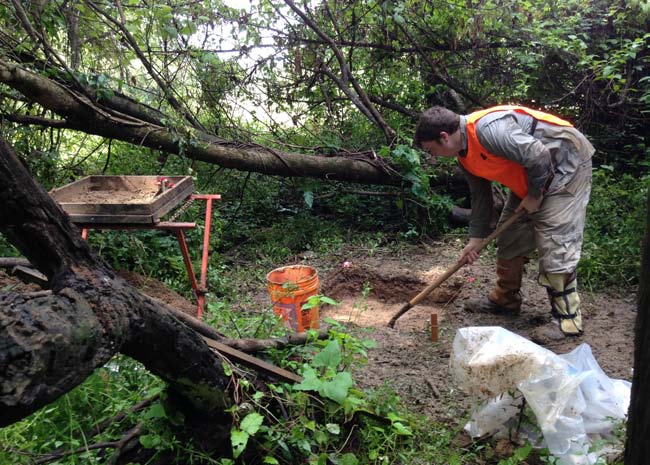
Historic maps of Bayou Sara show that Lot 105 constituted the backyard of a dwelling from at least 1885 through 1904. A hole dug in this lot during the survey contained a piece of bottle glass and some coal. Archaeologists then dug a test unit in the lot to determine exactly where those artifacts came from. This unit revealed many layers of soil deposited through out the 1900s None were associated with Lot 105’s residents in the 1800s, but deposits from that time could exist elsewhere within what remains of the lot.
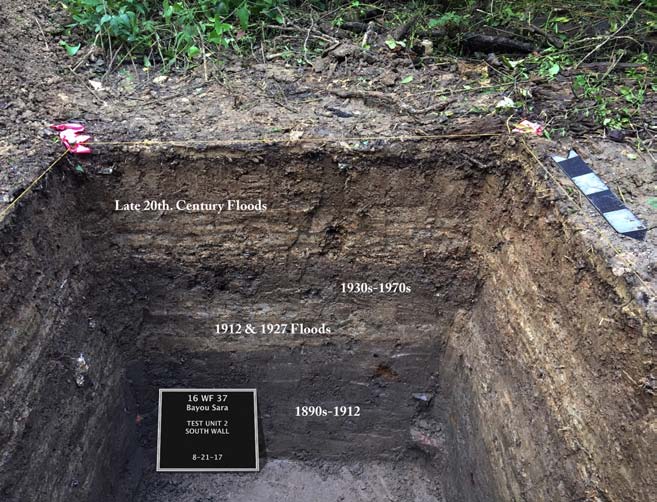
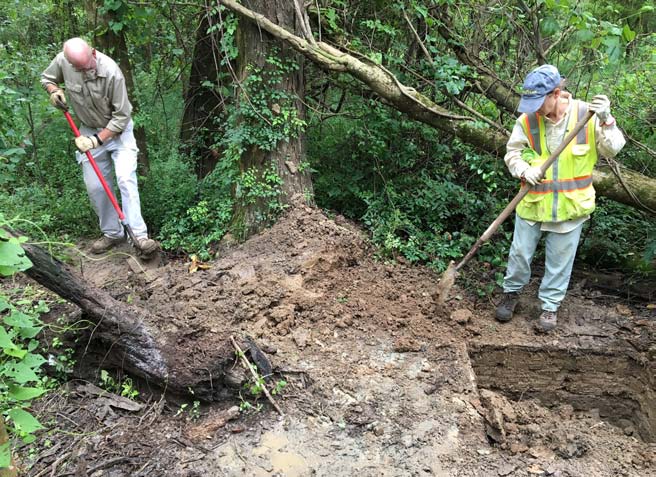
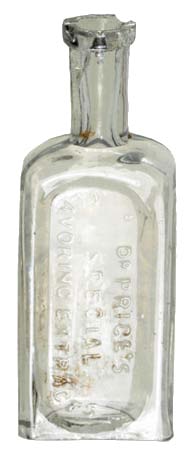
The deepest occupation layer in this test unit dated to the late 1800s and early 1900s. It contained dish and bottle fragments made from the 1830s through the 1920s, including a molded Dr. Price’s Special Flavoring Extracts bottle made between 1874 and 1883. This trash was likely deposited during the Morgan family’s ownership of Lot 105. Above this midden was a thick band of yellow alluvium probably washed in by the 1912 and 1927 floods, which submerged the whole town. Some trash accumulated on Lot 105 from the 1930s through the 1970s. This included brick and coal fragments and modern wire nails, all probably deposited by the Canfield family. Almost annual floods from the 1980s through 2017 then buried these and other artifacts with a thick yellow layer of alluvium.
Square 25, Lot 265
(Kaufman and Neal Families)
Historic records indicated that Hugh B. Maxwell bought Lot 265 for $26 in 1829. Maxwell and his partner, James Hudson, operated a store elsewhere in town and ran two steamboats between Bayou Sara and New Orleans. James H. Coulter bought Lot 265 for $40 at Maxwell’s probate sale in 1833. Coulter lived in St. Francisville and had rental houses erected on Lots 263, 264, and 265. When Coulter lost the lots in a lawsuit in 1844, Solomon H. Wisdom purchased them for $318.92. Yet Coulter bought them back for the same price just two years later. As Antoine Lana paid only $84 for all three lots in 1847, the houses on them must have been destroyed by flood or fire.
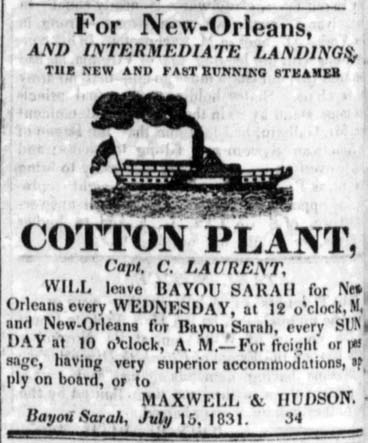
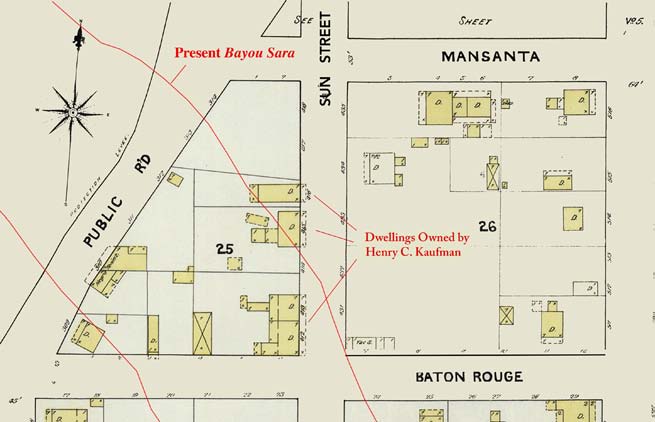
Lana, a Bayou Sara merchant and resident who owned many town lots, built new rental houses on Lots 263, 264, and 265. Savannah Shields traded one 12-year-old slave named Walter for the three lots and their buildings in 1850. The houses probably burned in the 1855 fire but were rebuilt. In 1856, Shields sold all three lots for $200 to German grocer Charles J. Wolflin, who may have used one or more of the homes as a boarding house. Wolflin sold the lots to St. Francisville grocer, Henry C. Kaufman, in the late 1870s for $800. Kaufman rented out the houses, which were likely destroyed in the 1927 flood. The lots remained vacant and in the Kaufman family until 1943 when Leon G. Lazarus purchased them. He sold them to James and Beatrice Neal in 1948 for $200.
The Neals had erected two small buildings on Lots 263 and 265 by 1952. In 1959, they sold the lots to Ovid Leet, Jr. Leet removed the two small buildings and built a large house on Lots 264 and 265. However, he sold the house and lots to Joseph Leo Neal in 1963. Neal rebuilt or replaced the house between 1963 and 1967. It was gone by 1977 and the vacant land retained by the Neal heirs. Over the next forty years, Lots 263, 264, and 265 remained vacant and faced erosion by the bayou. Between 1988 and 2017, Bayou Sara eroded away all but the easternmost portions of Lots 263, 264 and 265.
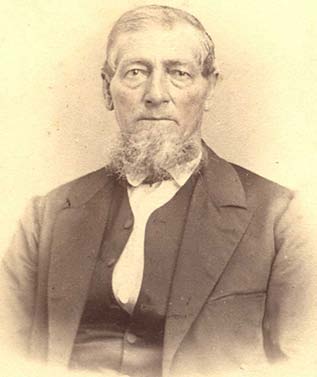
Historic maps of Bayou Sara show that Lot 265 constituted the side yards of two adjacent residences from at least 1891 through 1922. A hole dug in this lot during the survey encountered what looked like a brick pier. Archaeologists then dug a test unit near the shovel test to see if this was true and to determine why it was there. This unit revealed layers of soil deposited throughout the twentieth century. None were associated with Lot 265’s residents in the 1800s, but deposits from that time could exist elsewhere within what remains of the lot. The possible brick pier proved to be brick debris, likely from a collapsed pier foundation.
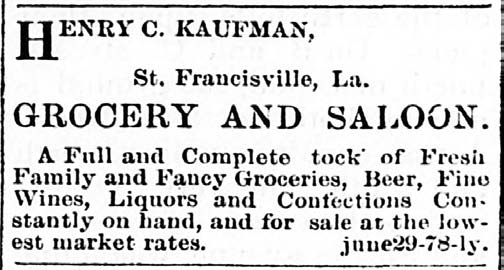
The deepest occupation layer in this test unit dated to the early and middle 1900s. It contained dish and bottle fragments made from the 1830s through the 1970s, including a ball clay marble and a clear machine-made soda bottle. Above this midden was an old ground surface that contained artifacts of a similar age. These included brick, coal, and metal fragments plus a machine-made jar. The items in both these layers were likely discarded by the Kaufman family. Sealing these layers was a thick layer of yellow alluvium deposited by the almost annual floods, which occurred from the 1970s through 2017.
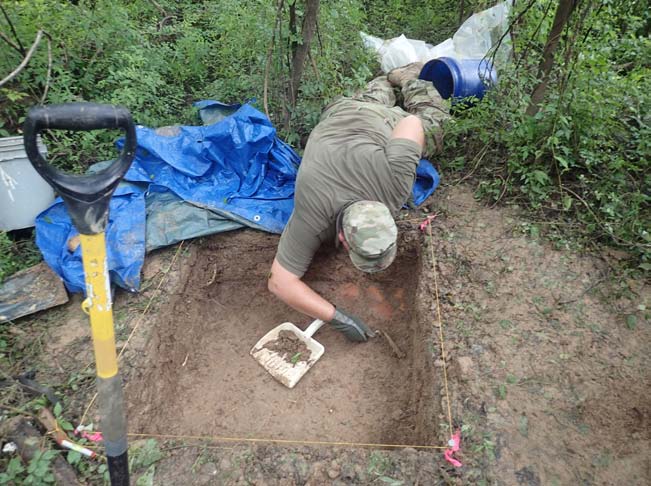
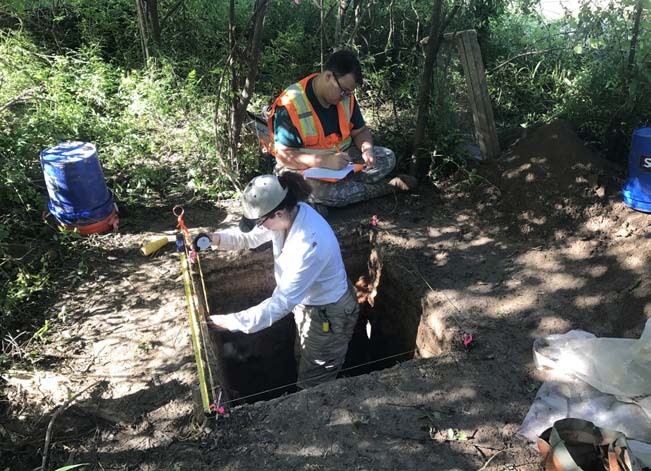
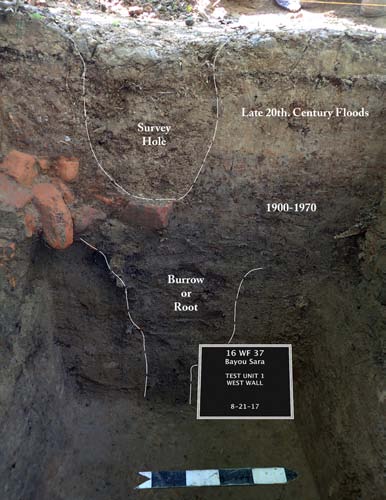
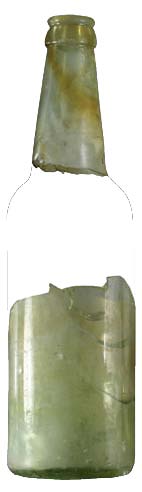
The work conducted at Bayou Sara between 2015 and 2017 constitutes the only archaeological investigation conducted in the former town of Bayou Sara, once the most important flatboat and steamboat port between Natchez and New Orleans. The archaeological excavations showed that remains of the town of Bayou Sara still exist and exactly how deeply they are buried. They also determined how much of the town has been lost to erosion. The excavators found the locations of some lots and specific buildings and collected a sample of the kinds of artifacts used on those lots through time. Careful study of the soil layers even showed how some residents survived and rebuilt after disasters.
By combining information gathered from the excavations with the results of archival research, archaeologists were able to shed light on the lives of some of the early residents of the town. Those residents came from many different backgrounds. Many, like John Morris, Charles Tooraen, Augustus Bogel, and Conrad Bockel, were recent immigrants from other countries, while others, like Francis Mumford and Charles Morgan came from families that had lived in the United States for generations. Most were free, some enslaved, and a few, like Ellen Wooten, free people of color. Most were successful business people, like Wooten, Morris, Toorean, Bogel, Bockel, and Mumford, while others were non-resident landlords, like James H. Coulter and Henry C. Kaufman. All were flooded and suffered other calamities, including death in military service (Charles Tooraen), yellow fever (the Harrison family), property seizure (Martha Tooraen), arson (the Mumfords), and accidental fire (Tooraen, Bockel, the Fischer brothers, and the Hofman family).
Although the original owners of the items recovered at Bayou Sara could not be positively identified, the material helps us understand what it was like to live in Bayou Sara over 100 years ago. Some artifacts, like porcelain dolls and marbles, belonged to the town’s children. Others, like tobacco pipes, clocks, suspenders, buttons, and dining room vessels, represent objects of everyday life touched and used by Bayou Sara’s former residents.
What is Archaeology?
Archaeology is a branch of scientific study that examines how people lived in the past, while a person who uses the methods of archaeology to study past peoples is called an archaeologist. To learn about people from the past, archaeologists search for archaeological sites, which are places where people once lived or worked long ago. Sites may be thousands of years old, such as prehistoric camps where early Native Americans may have once hunted or fished, or more recent sites such as Bayou Sara, which represents the remains of a river town founded over 200 years ago.
To be considered an archaeological site, a location must contain artifacts or features. An artifact is anything small that was made or used by people, such as an arrowhead, a clay pot, or a glass bottle. A feature typically is larger than an artifact and represents the remnants of something built by humans, such as a building or an Indian mound. At Bayou Sara, archaeologists uncovered features such as brick piers, cisterns, and trash deposits. They also recovered artifacts such as fragments of plates, bowls, cups, bottles, and other items used by the people who once lived in the town.
Often, artifacts and features are located beneath the ground surface, and archaeologists have to dig in order to find them. At Bayou Sara, most of the buildings were destroyed by fires and floods in the 1800s and early 1900s. Remnants of those buildings were later buried by many layers of alluvium deposited by floods before and after the town was abandoned. Archaeologists carefully dug down to find and study the remains of those earlier buildings (features) and the items that the people who used them left behind (artifacts).
It takes years of study and training to learn how to do archaeological work the right way. The archaeologists who worked at Bayou Sara all went to college to study archaeology, and also attended a field school. A field school is often an extra class, usually taken during the summer, where college professors teach students how to do archaeology properly by excavating at an archaeological site. Proper training is important, because digging an archaeological site the wrong way can destroy it forever.


STOPPED HERE
ClosingImage Credits
Cover. C. A. Lesueur Collection, Muséum d’Historie Naturelle du Havre, Le Harve, France.
p.2. Vicente Sebastián Pintado 1799 Mapa de las locaciones del Distrito de la Na. Feliciana. Library of Congress, Geography and Map Division.
p. 3. William Fulsum 1823 copy of Plan of the Town of New Valentia. Millaudon v. Smith, Eastern District, Supreme Court of Louisiana, Earl K. Long Library, University of New Orleans.
p. 4. R.W. Boyd 1852 Township 3 South Range 3 West. Greensburg District Louisiana. Louisiana State Land Office, Baton Rouge.
p. 5. The Historic New Orleans Collection, Acc. No. 1977.137.3.7.
p. 6. The Advocate [Baton Rouge, LA] 23 November 1952:65.
p. 7. West Feliciana Historical Society.
p. 8. West Feliciana Historical Society.
p. 11. The Liberty Advocate [Liberty, MS] 14 November 1837:4.
p. 11. The Point Coupee Democrat [False River, LA] 22 January 1858:2.
p. 12. The Feliciana Sentinel [St. Francisville, LA] 22 January 1877:3.
p. 12. West Feliciana Historical Society.
p. 13. Sanborn Map and Publishing Co., Limited 1891 Fire Insurance Map of Bayou Sara and St. Francisville. Library of Congress, Geography and Map Division.
p. 13. Sanborn Map and Publishing Co., Limited 1898 Fire Insurance Map of Bayou Sara and St. Francisville. Library of Congress, Geography and Map Division.
p. 14. West Feliciana Historical Society.
p. 18. The Piney Woods Planter and Amite Union Literary Reflector [Liberty, MS] 15 September 1838:3.
p. 19. The Semi-Weekly Republican [St. Francisville, LA] 20 September 1872:3.
p. 19. Courtesy of Denise Bockel Kembro.
p. 20. The Pointe Coupée Democrat [False River, LA] 17 Septemer 1859.
p. 23. Morgan Family, Mss. 1368, 1936, 2015, Louisiana and Lower Mississippi Valley Collections, LSU Libraries, Baton Rouge, Louisiana.
p. 24. The True Democrat [St. Francisville, LA] 31 October 1914:1.
p. 27. The Southern Planter [Woodville, MS] 26 January 1832:4.
p. 28. Courtesy of Pat Sory.
p. 28. The Feliciana Sentinel [St. Francisville, LA] 9 November 1878:3.
p. 29. Sanborn Map and Publishing Co., Limited 1891 Fire Insurance Map of Bayou Sara and St. Francisville. Library of Congress, Geography and Map Division.
Further Reading
Ryan, Joanne, Michael P. Carpenter, Donald G. Hunter, and David B. Kelley
2018 Phase III Data Recovery at Bayou Sara (16WF37), Hazard Mitigation Project 1603-0436, Bayou Sara Bank Stabilization Project, West Feliciana Parish, Louisiana. Coastal Environments, Inc. Submitted to the Federal Emergency Management Agency (FEMA), U.S. Department of Homeland Security. Louisiana Recovery Office, Baton Rouge, Louisiana.

This work was conducted in partial fulfillment of FEMA obligations under Section 106 of the National Historic Preservation Act, and its implementing regulations as delineated in 36 CFR Part 800 (Protection of Historic Properties). FEMA developed the archaeological statement of work for this project in consultation with the Louisiana State Historic Preservation Officer and participating federally recognized Indian tribes as part of FEMA’s Section 106 responsibilities for this undertaking.
This pamphlet was created by FEMA’s Environmental and Historic Preservation staff at the Louisiana Recovery Office (R6) and Coastal Environments, Inc., in partial fulfillment of Standard Treatment Measure III: Public Interpretation, as set out in Stipulation II.C.6(a) of the 2016 LA Statewide Programmatic Agreement. Consulting parties included the Louisiana Governor’s Office of Homeland Security and Emergency Preparedness, the Louisiana State Historic Preservation Office, participating federally recognized Indian tribes, the West Feliciana Parish Government, and the West Feliciana Historical Society. Creation and distribution of this pamphlet partially mitigates adverse effects to the Bayou Sara archaeological site under the National Historic Preservation Act, Section 106.
Printed by:
Connelly Press & Copy
9864 Professional Blvd./Baton Rouge, LA 70809
Ph. 225-293-2900/Fax 225-293-2020
info@cpcbr.com
Notes
- Capuchin A Catholic friar.
Text prepared by:
- Kendal Clark
- Madison James
- Ryliegh Lemoine
- Hayley Owen
Source
Cable, George Washington. "Posson Jone'" and Père Raphaël: With a New Word Setting Forth How and Why the Two Tales Are One. Illus. Stanley M. Arthurs. New York: Charles Scribner's Sons, 1909. Google Books. Web. 27 Feb. 2012. <http://books. google.com/books?id=bzhLAAAAIAAJ>.