
- W. B. Stickney
-
“No. 33. Bureau Report from Shreveport, Louisiana”
- Edmond Ducre Estillette
-
“No. 34. Ordinance relative to the police of recently emancipated negroes or freedmen within the corporate limits of the town of Opelousas”
- The Police Jury of the Parish of St. Landry
-
“No. 35. Ordinance relative to the police of negroes recently emancipated within the parish of St. Landry”
-
W. T. Palfrey
- “Report of the Citizens' Committee of the Parish of St. Mary”
-
A. S. Tucker
-
“Ordinance relative to the police of negroes or colored persons within the corporate limits of the town of Franklin”
-
Thomas W. Conway
- “Military Telegram Nullifying the Franklin Ordinance”

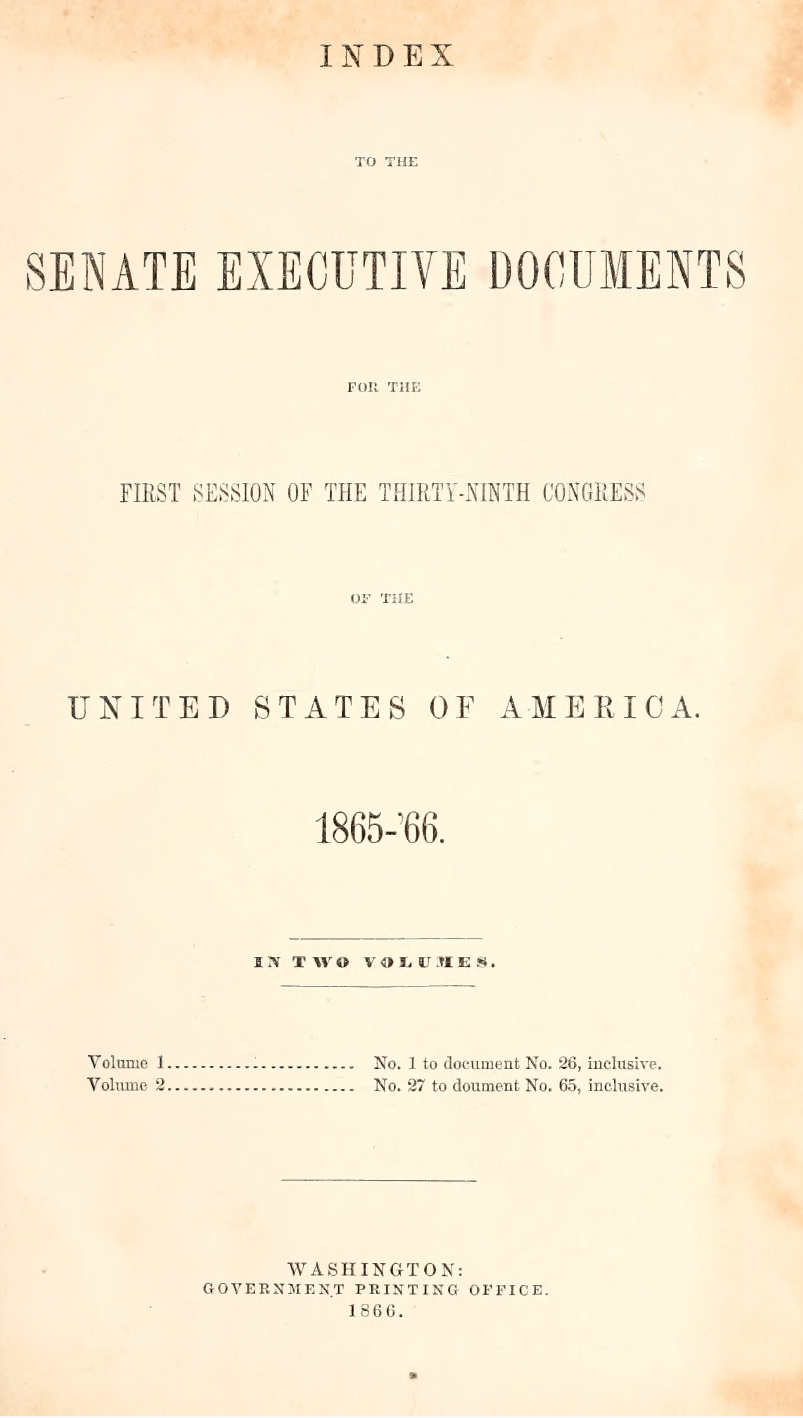
Table of Contents
- W. B. Stickney
- “No. 33. Bureau Report from Shreveport, Louisiana”
- Edmond Ducre Estillette
- “No. 34. Ordinance relative to the police of recently emancipated negroes or freedmen within the corporate limits of the town of Opelousas”
- The Police Jury of the Parish of St. Landry
- “No. 35. Ordinance relative to the police of negroes recently emancipated within the parish of St. Landry”
- W. T. Palfrey
- “Report of the Citizens’ Committee of the Parish of St. Mary”
- A. S. Tucker
- “Ordinance relative to the police of negroes or colored persons within the corporate limits of the town of Franklin”
- Thomas W. Conway
- “Military Telegram Nullifying the Franklin Ordinance”

No. 33. 90
Freedmen’s Bureau,
Shreveport, Louisiana, August 26, 1865.
Sir: I have the honor to report, in accordance with orders, that in the district under my supervision, comprising eight parishes in Louisiana and two counties in Texas, and an area of about 13,764 square miles, 3,105 contracts have been made, and 27,830 laborers enrolled since the first of July. The work of making contracts is now nearly completed, but the returns for the month of August from the officers acting in the different parishes have not as yet been received. From the data already collected it will be safe to estimate the whole number of laborers working under the contract system in the district at not less than 32,000, 25,000 of whom are in Louisiana.

The experience of two months has demonstrated the fact that the negro will work well when he is well paid and kindly treated; and another principle in the nature of the contracting parties has been equally as clearly elucidated, i. e., the planters are disposed to pay the freedmen the least possible sum for their labor, and that for much compensation the freedmen make an offset by making as little as possible. To acknowledge the right of the negro to freedom, and to regard him as a free man entitled to the benefits of his labor and to all the privileges and immunities of citizenship, is to throw aside the dogmas for which the south have been contending for the last thirty years, and seems to be too great a stride for the people to take at once, and too unpalatable a truth for the aristocratic planter to comprehend, without the interposition of the stern logic of the bayonet in the hands of a colored soldier.
Duty to my government compels me to report the following well-authenticated facts: 91
- Nineteen-twentieths of the planters have no disposition to pay the negro well or treat him well.
- In the same proportion the planting aristocracy proffers obedience to the government, and at the same time do all in their power to make trouble.
- The planters evince a disposition to throw all the helpless and infirm freedmen upon the hands of the government possible, in order to embarrass us and compel us to return them to slavery again.
- A majority of the planters desire to prevent the success of the free-labor system, that they may force Congress to revive slavery, or, what is more, a system of peonage.
- The belief is general among the planters that without some means of “controlling” the persons of the laborers they cannot succeed; and for this reason they desire to have the military force removed, and the privilege of enacting such laws as will enable them to retain this power.
- To defraud, oppress, and maltreat the freedmen seems to be the principle governing the action of more than half of those who make contracts with them,
- The lives of the freedmen are frequently threatened, and murders are not of uncommon occurrence.
- The life of a northern man who is true to his country and the spirit and genius of its institutions, and frankly enunciates his principles, is not secure where there is not a military force to protect him.
About the 15th of July Corporal J. M. Wallace, of company B, forty-seventh Indiana veteran volunteer infantry, was on duty with this bureau, and engaged in making contracts upon Red river, in the parish of Caddo. He visited Mr. Daniel’s plantation, and, as it is stated, started for Mr. White’s place, but never reached it. Being absent unaccountably, a sergeant and a detail of four men were sent to look him up, but could find no trace of him. Without doubt he was murdered. He was a young man of unexceptionable habits and character, and was highly esteemed by the officers of his regiment. The circumstances of the case are such as to lead to the belief that the planters in the vicinity connived at his death. Captain Hoke, another agent of the bureau, was stopped by a highwayman within eight miles of Shreveport. One of my assistants reports as follows: “In the northern part of this parish (Caddo) there are men armed and banded to resist the law.” These facts prove that the presence of a military force is needed in every parish. Instead of the present system of districts, I would recommend that the officer for each parish report direct to headquarters at New Orleans for instructions, and that each officer be furnished with at least twenty men, ten of whom should be mounted. I apprehend that at the commencement of the next year the planters will endeavor to load us down with the aged and infirm, and those with large families. To meet this and other difficulties that may arise, I recommend that at least five thousand acres of land be confiscated in every parish, and an opportunity given the freedmen to rent or purchase the land, and that every facility be afforded planters in the lower part of the State to obtain laborers from western Louisiana. Another remedy has been suggested, and as it meets with my approval I quote the recommendations of the officer in his own words: “Let the white troops on duty in this department be mustered out; they are greatly dissatisfied with remaining in the service after the close of the war; let black troops be mustered in their stead. In urging this matter, I suggest that the government has the first right to the services of the freedmen, and he needs the discipline of the army to develop his manhood and self-reliance. Such a course of recruiting black soldiers will act as a powerful restraint upon the abuses practiced by the planters on the freedmen, and will also compel the payment of better wages. If the planter wishes the services of a shrewd, enterprising freedman, he must out-bid the government. Lastly, the country needs the soldiers. Politicians may say what they may; western Louisiana is no more loyal now than when the State adopted the ordinance of secession.”
The statistics given at the commencement prove that we have experienced less difficulty with the freedmen than could have been expected. At times it has been necessary to adopt stringent measures to stem the tide of freedmen that seemed to be setting in toward Shreveport, and many of them have such vague ideas of the moral obligations of a contract that it has been necessary to strengthen them by imprisonment and hard labor; but the great and insuperable difficulty which meets us at every step is, that the planters and the freedmen have no confidence in and respect for each other. The planters inform us that they are the best friends of the negro, but the freedmen fail to see the matter in that light. I am well assured that as a general rule the old planters and overseers can never succeed with the freedmen; that there must be an entire change in either laborers or proprietors before the country will again be prosperous. The plan of renting lands to the freedmen, as proposed by a few planters, I am of the opinion will prove very profitable to both parties. While, as a general rule, there is constant difficulty between the freedmen and their old masters and overseers, my agents and northern men have no trouble with them; and should the planters employ practical farmers from the north as business managers, it seems to be well demonstrated that the free-labor system, as it now is, with but slight modifications, would be a grand success. In this connexion I cannot refrain from noticing the assertion of a southern politician to the effect 92 “that were the freedmen enfranchised, nine out of ten of them would vote for their old masters,” which assertion every freedman will pronounce a wilful and malignant falsehood.
The country is full of arms, and their use upon the freedmen is so frequent, and the general disposition of the people such, that I would strongly recommend, as a measure to secure the safety of life and property, that all classes of arms be taken from the citizens, not to be returned until an entirely different disposition is evinced.
The system to be made binding for the next year should be published as early as the 15th of October, and the matter of contracting be commenced as soon thereafter as the parties desire to do so. I would respectfully suggest the propriety for calling of such statistical matter upon the back of the contract as will enable the officer in charge of the educational interests to determine the whole number of freedmen residing in the different parishes, and also the number of children of school age.
The establishment of schools will be met by the most venomous opposition, and a military force will be required to protect the teacher and scholars from insult and injury unless the tone of public sentiment improves very rapidly.
The civil authorities, so far as my knowledge extends, are not willing to grant the freedmen the rights to which their freedom entitles them. In fact it became necessary, as will be seen by a former report, for the military authorities to interfere to prevent their being virulently oppressed. In consequence of this I have kept an officer constantly on duty adjusting the difficulties arising between the whites and negroes, but important cases have been referred to the military authorities.
Chaplain Thomas Callahan, the officer referred to above, in his last report says:
“To many of the planters the idea of a negro’s testimony being as good as a white man’s is very unpleasant, and occasional attempts are made to bully and browbeat a colored witness upon the stand. The attempt is never made twice. Once I pitted a lawyer against a negro witness, held the parties on the cross-examination, and the lawyer was badly beaten. Some of the freedmen can conduct a case with uncommon shrewdness.”
I cannot urge upon your attention too strongly the importance of keeping an officer in every parish and of providing him with a sufficient guard to command respect and enforce obedience to the laws. The presence of a military force, with judicious and discreet officers to command it, is the only means of securing to the freedmen their rights and of giving proper security to life and property.
With many thanks for that encouragement which has supported and cheered me through every difficulty, I have the honor to be, with much respect, your most obedient servant,
Lieutenant and Assistant Superintendent of Freedmen.
Assistant Commissioner, &c.
No. 34.
ORDINANCE relative to the police of recently emancipated negroes or freedmen within the corporate limits of the town of Opelousas.
Whereas the relations formerly subsisting between master and slave have become changed by the action of the controlling authorities; and whereas it is necessary to provide for the proper police and government of the recently emancipated negroes or freedmen in their new relations to the municipal authorities:
Section 1. Be it therefore ordained by the board of police of the town of Opelousas, That no negro or freedman shall be allowed to come within the limits of the town of Opelousas without special permission from his employers, specifying the object of his visit and the time necessary for the accomplishment of the same. Whoever shall violate this provision shall suffer imprisonment and two days’ work on the public streets, or shall pay a fine of two dollars and fifty cents.
Section 2. Be it further ordained, That every negro freedman who shall be found on the streets of Opelousas after 10 o’clock at night without a written pass or permit from his employer shall be imprisoned and compelled to work five days on the public streets, or pay a fine of five dollars.
Section 3. No negro or freedman shall be permitted to rent or keep a house within the limits of the town under any circumstances, and any one thus offending shall be ejected and compelled to find an employer or leave the town within twenty-four hours. The lessor or furnisher of the house leased or kept as above shall pay a fine of ten dollars for each offence.
Section 4. No negro or freedman shall reside within the limits of the town of Opelousas who is not in the regular service of some white person or former owner, who shall be held responsible for the conduct of said freedman; but said employer or former owner may permit said freedman to hire his time by special permission in writing, which permission shall not extend over twenty-four hours at any one time. Any one violating the provisions of this section shall be imprisoned and forced to work for two days on the public streets.
93 Section 5. No public meetings or congregations of negroes or freedmen shall be allowed within the limits of the town of Opelousas under any circumstances or for any purpose without the permission of the mayor or president of the board. This prohibition is not intended, however, to prevent the freedmen from attending the usual church services conducted by established ministers of religion. Every freedman violating this law shall be imprisoned and made to work five days on the public streets.
Section 6. No negro or freedman shall be permitted to preach, exhort, or otherwise declaim to congregations of colored people without a special permission from the mayor or president of the board of police under the penalty of a fine of ten dollars or twenty days’ work on the public streets.
Section 7. No freedman who is not in the military service shall be allowed to carry firearms, or any kind of weapons, within the limits of the town of Opelousas without the special permission of his employer, in writing, and approved by the mayor or president of the board of police. Any one thus offending shall forfeit his weapons and shall be imprisoned and made to work for five days on the public streets or pay a fine of five dollars in lieu of said work.
Section 8. No freedman shall sell, barter, or exchange any articles of merchandise or traffic within the limits of the town of Opelousas without permission in writing from his employer or the mayor or president of the board, under the penalty of the forfeiture of said articles and imprisonment and one day’s labor, or a fine of one dollar in lieu of said work.
Section 9. Any freedman found drunk within the limits of the town shall be imprisoned and made to labor five days on the public streets, or pay five dollars in lieu of said labor.
Section 10. Any freedman not residing in Opelousas who shall be found within the corporate limits after the hour of 3 p. m. on Sunday without a special permission from his employer or the mayor shall be arrested and imprisoned and made to work two days on the public streets, or pay two dollars in lieu of said work.
Section 11. All the foregoing provisions apply to freedmen and freedwomen, or both sexes.
Section 12. It shall be the special duty of the mayor or president of the board to see that all the provisions of this ordinance are faithfully executed.
Section 13. Be it further ordained, That this ordinance to take effect from and after its first publication.
Ordained the 3d day of July, 1865.
President of the Board of Police.
JOS. D. RICHARDS, Clerk.
Captain and Assistant Adjutant General.
No. 35.
AN ORDINANCE relative to the police of negroes recently emancipated within the parish
of St. Landry.
Whereas it was formerly made the duty of the police jury to make suitable regulations for the police of slaves within the limits of the parish; and whereas slaves have become emancipated by the action of the ruling powers; and whereas it is necessary for public order, as well as for the comfort and correct deportment of said freedmen, that suitable regulations should be established for their government in their changed condition, the following ordinances are adopted, with the approval of the United States military authorities commanding in said parish, viz:
Section 1. Be it ordained by the police jury of the parish of St. Landry, That no negro shall be allowed to pass within the limits of said parish without a special permit in writing from his employer. Whoever shall violate this provision shall pay a fine of two dollars and fifty cents, or in default thereof shall be forced to work four days on the public road, or suffer corporeal punishment as provided hereinafter.
Section 2. Be it further ordained, That every negro who shall be found absent from the residence of his employer after 10 o'clock at night, without a written permit from his employer, shall pay a fine of five dollars, or in default thereof, shall be compelled to work five days on the public road, or suffer corporeal punishments as hereinafter provided.
Section 3. Be it further ordained, That no negro shall be permitted to rent or keep a house within said parish. Any negro violating this provision shall be immediately ejected and compelled to find an employer; and any person who shall rent, or give the use of any house to any negro, in violation of this section, shall pay a fine of five dollars for each offence.
Section 4. Be it further ordained, That every negro is required to be in the regular service of some white person, or former owner, who shall be held responsible for the conduct of said negro. But said employer or former owner may permit said negro to hire his own 94 time by special permission in writing, which permission shall not extend over seven days at any one time. Any negro violating the provisions of this section shall be fined five dollars for each offence, or in default of the payment thereof shall be forced to work five days on the public road, or suffer corporeal punishment as hereinafter provided.
Section 5. Be it further ordained, That no public meetings or congregations of negroes shall be allowed within said parish after sunset; but such public meetings and congregations may be held between the hours of sunrise and sunset, by the special permission in writing of the captain of patrol, within whose beat such meetings shall take place. This prohibition, however, is not intended to prevent negroes from attending the usual church services, conducted by white ministers and priests. Every negro violating the provisions of this section shall pay a fine of five dollars, or in default thereof shall be compelled to work five days on the public road, or suffer corporeal punishment as hereinafter provided.
Section 6. Be it further ordained, That no negro shall be permitted to preach, exhort, or otherwise declaim to congregations of colored people, without a special permission in writing from the president of the police jury. Any negro violating the provisions of this section shall pay a fine of ten dollars, or in default thereof shall be forced to work ten days on the public road, or suffer corporeal punishment as hereinafter provided.
Section 7. Be it further ordained, That no negro who is not in the military service shall be allowed to carry fire-arms, or any kind of weapons, within the parish, without the special written permission of his employers, approved and indorsed by the nearest or most convenient chief of patrol. Any one violating the provisions of this section shall forfeit his weapons and pay a fine of five dollars, or in default of the payment of said fine, shall be forced to work five days on the public road, or suffer corporeal punishment as hereinafter provided.
Section 8. Be it further ordained, That no negro shall sell, barter, or exchange any articles of merchandise or traffic within said parish without the special written permission of his employer, specifying the articles of sale, barter or traffic. Any one thus offending shall pay a fine of one dollar for each offence, and suffer the forfeiture of said articles, or in default of the payment of said fine shall work one day on the public road, or suffer corporeal punishment as hereinafter provided.
Section 9. Be it further ordained, That any negro found drunk within the said parish shall pay a fine of five dollars, or in default thereof shall work five days on the public road, or suffer corporeal punishment as hereinafter provided.
Section 10. Be it further ordained, That all the foregoing provisions shall apply to negroes of both sexes.
Section 11. Be it further ordained, That it shall be the duty of every citizen to act as a police officer for the detection of offences and the apprehension of offenders, who shall be immediately handed over to the proper captain or chief of patrol.
Section 12. Be it further ordained, That the aforesaid penalties shall be summarily enforced, and that it shall be the duty of the captains and chiefs of patrol to see that the aforesaid ordinances are promptly executed.
Section 13. Be it further ordained, That all sums collected from the aforesaid fines shall be immediately handed over to the parish treasurer.
Section 14. Be it further ordained, That the corporeal punishment provided for in the foregoing sections shall consist in confining the body of the offender within a barrel placed over his or her shoulders, in the manner practiced in the army, such confinement not to continue longer than twelve hours, and for such time within the aforesaid limit as shall be fixed by the captain or chief of patrol who inflicts the penalty.
Section 15. Be it further ordained, That these ordinances shall not interfere with any municipal or military regulations inconsistent with them within the limits of said parish.
Section 16. Be it further ordained, That these ordinances shall take effect five days after their publication in the Opelousas Courier.
Official copy:
Captain and Assistant Adjutant General.
“Report of the Citizens’ Committee of the Parish of St. Mary”
At a meeting of the citizens of the parish of St. Mary, held at the court-house in the town of Franklin, on Saturday, the 15th instant, P. C. Bethel, esq., was called to the chair, when a committee was appointed to report upon certain matters submitted to the consideration of the meeting, which committee reported by their chairman the following, which was unanimously adopted:
REPORT OF THE COMMITTEE.
The committee appointed for the purpose of embodying the views and objects of the meeting of the citizens of the parish of St. Mary, assembled at the court-house of said parish on the 15th day of July, A. D. 1865, to deliberate concerning the discipline of colored persons or freedmen, respectfully report that they recommend to the town council of the town of Franklin the adoption of the ordinance of the board of police of the town of Opelousas, passed on the third day of the present month, with such alterations and modifications as may suit 95 the wants and necessities of this locality; also the ordinance of the same board of police, passed on the same day, relative to the town of Opelousas; which ordinances are herewith presented for reference. And they furthermore recommend to the police jury of the parish of St. Mary, whenever convened, to make such regulations with regard to the discipline and management of the freedmen or colored population for the entire parish as may be most conducive to the quiet, tranquillity, and productiveness of said parish generally. The committee further recommend to all well-disposed citizens to co-operate with the authorities and with each other in producing a return to civil rule and good order within the shortest delay possible, that the State of Louisiana may be restored to her proper condition as regards internal political stability and tranquillity, as well as the representation she is entitled to in the councils of the nation, which representation is more important to her now than at any previous period of her history.
W. T. PALFREY, Chairman.
Proceedings of the Mayor and Council of the town of Franklin.
Friday, July 28, 1865.
Pursuant to call of the major commanding, the mayor and council met this day. Present: A. S. Tucker, mayor; Wilson McKerall, Alfred Gates, John C. Gordy, and J. A. Peterman, members of the council.
The following was unanimously adopted, viz:
ORDINANCE relative to the police of negroes or colored persons within the corporate limits of the town of Franklin.
Sec. 1. Be it ordained by the mayor and council of the town of Franklin, That no negro or colored person shall be allowed to come within the limits of said town without special permission from his employer, specifying the object of his visit and the time necessary for the accomplishment of the same. Whoever shall violate this provision shall suffer imprisonment and two days’ work on the public streets, or shall pay a fine of two dollars and a half.
Sec. 2. Be it further ordained, &c., That every negro or colored person who shall be found on the streets of Franklin after ten o’clock at night without a written pass or permit from his or her employer, shall be imprisoned and compelled to work five days on the public streets or pay a fine of five dollars.
Sec. 3. No negro or colored person shall be permitted to rent or keep a house within the limits of the town under any circumstances; and any one thus offending shall be ejected and compelled to find an employer, or leave the town within twenty-four hours. The lessor or furnisher of the house kept as above shall pay a fine of ten dollars for each offence: Provided, That the provisions of this section shall not apply to any free negro or colored person who was residing in the town of Franklin prior to the 1st January (1865) last.
Sec. 4. No negro or colored person shall reside within the limits of the town of Franklin who is not in the regular service of some white person or former owner, who shall be held responsible for the conduct of said negro or colored person; but said employer or former owner may permit said negro or colored person to hire his or their time by special permission in writing, which permission shall not extend to over twenty-five hours at any one time. Any negro or colored person violating the provisions of this section shall be imprisoned and forced to work for two days on the public streets: Provided, That the provisions of this section shall not apply to negroes or colored persons heretofore free.
Sec. 5. No public meetings or congregations of negroes or colored persons shall be allowed within the limits of the town of Franklin, under any circumstances or for any purpose, without the permission of the mayor. This prohibition is not intended, however, to prevent negroes or colored persons from attending the usual church service, conducted by established ministers of religion. Every negro or colored person violating this law shall be imprisoned and put to work five days on the public streets.
Sec. 6. No negro or colored person shall be permitted to preach, exhort, or otherwise declaim to congregations of colored people without a special permission from the mayor, under the penalty of a fine of ten dollars or twenty days’ work on the public streets.
Sec. 7. No negro or colored person who is not in the military service shall be allowed to carry fire-arms or any kind of weapons within the limits of the town of Franklin without the special permission of his employer in writing, and approved by the mayor. Any one thus offending shall forfeit his weapons and shall be imprisoned and made to work five days on the public streets, or pay a fine of five dollars in lieu of said work.
Sec. 8. No negro or colored person shall sell, barter, or exchange any articles of merchandise or traffic within the limits of Franklin, without permission in writing from his employer or the mayor, under the penalty of forfeiture of the said articles and imprisonment and one day’s labor, or a fine of one dollar in lieu of said work.
96 Sec. 9. Any negro or colored person found drunk within the limits of the town shall be imprisoned and made to labor five days on the public streets, or pay five dollars in lieu of said labor.
Sec. 10. Any negro or colored person not residing in Franklin who shall be found within its corporate limits after the hour of three o’clock p. m. on Sunday without a special written permission from his employer or the mayor, shall be arrested and imprisoned and made to work two days on the public streets, or pay two dollars in lieu of said work.
Sec. 11. All the foregoing provisions apply to negroes or colored persons of both sexes.
Sec. 12. It shall be the special duty of the town constable, under direction of the mayor, to see that all the provisions of this ordinance are faithfully executed.
Sec. 13. Whoever in Franklin shall sell or give to any negro or colored person any intoxicating liquors, or shall exchange or barter for the same with any such negro or colored person, without special permission from the mayor or employer of said negro or colored person, shall, on conviction thereof before the mayor or justice of the peace in and for the seventh ward of the parish of St. Mary, pay a fine of twenty-five dollars and costs of prosecution, and in default of the payment of said fine and costs the person thus offending shall suffer imprisonment in the parish jail for ten days.
Approved:
Major Third Rhode Island Cavalry, Commanding Post.
New Orleans, August 10, 1865.
The ordinance relative to the “Police of negroes or colored persons within the corporate limits of the town of Franklin,” dated Friday, July 28, 1865, and signed by A. L. Tucker, mayor, being in violation of the emancipation proclamation, the orders of the War Department, and the orders of these headquarters, you will prevent their enforcement and arrest any person attempting to carry them out. The negroes are as free as other people. This ordinance, if enforced, would be slavery in substance, which can never be. Attend to this matter with all the vigor at your command. I have consulted General Canby, who concurs with me in the matter.
Ass. Comm. Bureau of Refugees, Freedmen, &c., State of Louisiana.
Provost Marshal, Parish of St. Mary, Brashear City, or Franklin, La.
Official copy:
First Lieutenant and A. A. A. General.
Text prepared by:
- Bruce R. Magee
Source
United States, Congress, Senate. Executive Documents for the First Session of the Thirty-Ninth Congress of the United States of America, 1865-1866. Vol 2. Government Printing Office, 1866. Internet Archive, uploaded 5 May 2010, archive.org/ details/ senate executive d00unit/. Accessed 6 June 2026. 90-96.